1. Introduction
Recent decades have seen a surge in the number of legislators who leave office for a job in the private sector (Lazarus et al., Reference Lazarus, McKay and Herbel2016). This has fueled widespread public attention and a growing research interest in the so-called revolving door between business and politics (Adolph, Reference Adolph2013; LaPira and Thomas, Reference LaPira and Thomas2017; McCrain, Reference McCrain2018).
A common assumption in this research is that lucrative private sector employment motivates legislators to walk through the revolving door. If outside career options, indeed, can lure elected officials out of public service, it would establish private actors as rivals to the electorate in the demand for the labor of politicians—even while those legislators are in the public's service. If the lure of the private sector is stronger for specific types of legislators, the revolving door would change the type of politician that holds office, thereby shaping the representation citizens receive.
In this paper, I show that career prospects in the private sector, indeed, do affect the decision of Members of Congress (MCs) to leave public service, and that this has consequences for the representation voters receive. Any inference about such a claim is complicated by the fact that career prospects are unobserved: in the best of cases, it would only be possible to observe the offer of revolving door employment that a legislator accepts upon her retirement. Any offer that she has rejected along the way will remain unobserved. However, if it were possible to establish how expectations about post-elective career prospects are formed, this would allow us to measure how those expectations affected career choices.
My identification strategy builds on a novel theory about how legislators are confronted with information about their career prospects. I argue that we can gage how well an MC would do, if she were to walk through the revolving door, by observing the success enjoyed by her former colleagues, who currently work in the private sector. I argue that to gage the career prospects of any particular MC, we first need to identify a comparable set of former legislators that now work as lobbyists. The post-elective experiences of this particular group can then be used to capture the career prospects of similar MCs that currently serve. Specifically, I propose that it is possible to gage a legislator's career prospects by observing legislators-turned-lobbyists, who worked in similar jobs before Congress, or served in a comparable mix of committees during their tenure. Importantly, because the demand for legislators-turned-lobbyists is shaped outside the reach of their former colleagues, this provides me with a proxy for career prospects which is plausibly exogenous.
To test this claim, I proceed in two steps. First, I collect data on the career trajectories of legislators serving between the 102nd and the 113th Senate. Second, after obtaining all results from the Senate, I provide a complete out-of-sample replication in the House of Representatives. I group MCs together based on (a) precongressional career trajectories and (b) the committees they have served in. I use the expected size of the lobbying contracts within these groups to measure the demand for specific types of legislator labor.
My results show that when legislators-turned-lobbyists work on more valuable lobby contracts, the probability that an MC walks through the revolving door increases significantly. I test the mechanism in a variety of ways. Crucially, I show that legislators do not react to outside career prospects when they are about to experience an improvement in their pension scheme. This strongly suggests that legislators react to the opportunity costs associated with being in office
Finally, I show that the lure of the private sector differs strongly between legislators. In the Senate, legislative specialists are attracted most strongly, leaving strategists with a broad legislative focus. In the House, I present preliminary evidence that the career choices of the least wealthy are affected most strongly. Thereby, outside career options can potentially shape representation and policies by attracting expertise from the Senate and those who are least well-off from the House.
1.1 Contribution to the literature
The extant literature on political selection has focused heavily on how monetary incentives structure the selection of specific types of politicians into office (Messner and Polborn, Reference Messner and Polborn2004; Ferraz and Finan, Reference Ferraz and Finan2009; Hall, Reference Hall2019). Far less attention, however, has been devoted to how the same structures can motivate the selection out of office.
The exception is the literature on voluntary retirement from Congress. This has established that financial remuneration from congressional service shapes voluntary retirement (Hibbing, Reference Hibbing1982a, Reference Hibbing1982b, Groseclose and Krehbiel, Reference Groseclose and Krehbiel1994; Hall and Van Houweling, Reference Hall and Van Houweling1995; Theriault, Reference Theriault1998; Diermeier et al., Reference Diermeier, Keane and Merlo2005; Wolak, Reference Wolak2007; Stone et al., Reference Stone, Fulton, Maestas and Maisel2010). Most recently, this literature has been complemented by Weschle (Reference Weschle2019) who shows that when returns to office are reduced by limits on campaign contributions, the revolving door becomes more attractive for state legislators. I add to this literature by investigating the pull of private sector career prospects, and through an explicit focus on how it shapes political representation.
The growing literature on revolving door politics has found that the average legislator stands to gain almost extravagantly from leaving office for a private sector job (Eggers and Hainmueller, Reference Eggers and Hainmueller2009; Palmer and Schneer, Reference Palmer and Schneer2016). Importantly, it is not only the legislators who profit. Political connections shape the value of lobbyists and—ultimately—the firms that employ them (Blanes i Vidal et al., Reference Blanes i Vidal, Draca and Fons-Rosen2012; McCrain, Reference McCrain2018; Strickland, Reference Strickland2020). These insights have fueled research investigating how the potential for lucrative employment may shape decisions before an official leaves public service (Adolph, Reference Adolph2013; Shepherd and You, Reference Shepherd and You2020). I provide two missing pieces by showing that legislators are motivated by the potential for lucrative private sector employment, and that certain types are attracted the most. Through this selection effect, the revolving door is shapes the skillset of legislators and the representation voters receive.
2. Information about career prospects
The main argument in this paper is that legislators will leave office when it is most lucrative to do so. Additionally, we can use the labor market experiences of former legislators to estimate the price of hiring certain types of politicians on the post-elective labor market. As the rewards that legislators give up by remaining in office grow larger, they will be more likely to retire from public service. I will unfold the argument in two steps. First, I discuss how we could expect information about opportunity costs to be communicated to current legislators. Second, I argue that pre-Congressional employment histories and committee service provide valuable information about the legislator's characteristics.
There are two ways information about career prospects can be communicated to incumbents. First, legislators might glean their career prospects by observing how well their former colleagues do in the private sector, which makes them update their expectations about how lucrative it would be for themselves to walk through the revolving door. Second, legislators are likely to be contacted directly by actors on the post-elective labor market. The executive recruitment industry is key in this respect: On K Street, headhunting is big business and provides a whole class of professionals whose only job is to persuade the most valuable legislators to walk through the revolving door.Footnote 1 The headhunting industry is likely to make MCs extraordinarily well-informed about their outside career prospects.
2.1 Finding comparable colleagues
Despite being a relatively homogeneous group, MCs vary to a significant degree in their abilities. Different types are in high demand on the post-elective labor market at particular points in time. To gage the price of hiring certain types of legislators, I argue that we can compare MC with similar individual characteristics. Specifically, we can leverage the per contract price of hiring a former MC to form expectations as to how well a similar current legislator would do, if she were to walk through the revolving door. I propose two factors that can be used to construct groups of similar legislators—what I call “reference groups”: (1) the careers, they followed before running for office, and (2) committee assignments during their congressional tenure.
Carnes (Reference Carnes2013) has shown that the careers legislators followed before being elected to Congress affect their behavior throughout their time in office. Not only do pre-Congressional career trajectories impact voting, they also predict the content of the bills MCs propose, how hard they work to see them enacted, and their views of the world (see also Francis and Bramlett, Reference Francis and Bramlett2017).
Similarly, the portfolio of committees that legislators have been assigned to during their political careers carry information about their political interests, preferences and post-elective labor market outcomes. Committee membership affords MCs the opportunity to have a political impact, service constituent preferences and attract pork (Shepsle, Reference Shepsle1978; Schiller, Reference Schiller1995; Berry and Fowler, Reference Berry and Fowler2016). Personal interests that predate the political career also play a role in which committees legislators seek to be assigned to (Fenno, Reference Fenno1973). Special interests are generally highly interested in targeting committees in their influence-seeking (Bertrand et al., Reference Bertrand, Bombardini and Trebbi2014; Fouirnaies and Hall, Reference Fouirnaies and Hall2018). This makes connections to committees a valuable asset for revolvers.
In a nutshell, precongressional careers and committee assignments in Congress carry broad information about the politician's type. Legislators with comparable precongressional careers and portfolios of committee memberships are likely to behave similarly during their tenure. This makes it natural to use these factors to construct reference groups.
3. Empirical strategy
The empirical strategy is illustrated in Table 1. I obtain the main results on data from the Senate—everything is then replicated in the House. Each senator is placed in two distinct reference groups with similar pre-Senate career paths and in-Senate committee assignments, respectively. I then compute the expected dollar size of the lobbying contracts in each of these groups. This serves as my two measures of career prospects. I now elaborate these steps.
Empirical strategy and expected results

Identifying reference groups. I started by computing the proportion of each senator's total career that had been spent working in the following careers: lawyer, independent business owner, politician, academia, management of major company, military, public sector employee, and private sector employee. I gathered these data from the Congressional Biographical Database. Similarly, for each senator, I calculated the proportion of her career that had been spent in each of the standing committees in the Senate. I used data on committee assignment in the Senate from 103rd to the 113th Congress collected from Stewart and Woon (Reference Stewart and Woon2017).
I then used Ward (Reference Ward1963) hierarchical clustering to group senators into one of five groups based on their pre-Senate careers, and one of six based on their mix of committee assignments. In online Appendix G, I show diagnostics on the cluster analyses. In online Appendix A, I describe in more detail the data on careers and committee assignments. To get an idea about what the reference groups capture I describe the types of careers that are located in each cluster in online Appendixes A2 and A3. In online Appendix C1, I show that the groups contain senators of very different legislative styles. Let two groups serve as illustrative examples. First, the group of former lawyers tends to be moderates and legislatively effective politicians. For instance, Senator Sheldon Whitehouse (D-RI) spent most of his pre-political career practicing law. Afterward, he was first appointed the US Attorney and later Attorney General—both of Rhode Island. In the Senate, he was very broadly effective, figuring close to the third quantile of the legislative effectiveness scores (LES). On the other hand, the group of former businesspeople with a background in political work tends to be more extremist and less legislatively effective. Senator Pat Toomey's (R-PA) profile captures this group well. In his pre-political career, he worked as a banker and financial consultant and co-owned a local restaurant with his brothers. Before running for Congress, he served in local government. During his tenure in the Senate, he pushed relatively few bills through the legislative process, and was far to the right on the DW-NOMINATE scale, above the 90th percentile.
Measuring career prospects as equilibrium price. To measure career prospects, I need an estimate of the exogenous part of the price legislators can get for their labor. On the market for lobbying services, the good that is traded is the lobbying contract. This makes it the natural unit through which to measure the price of senator labor. To estimate this, I rely on the average value of lobbying contracts. The logic is that the success experienced by senators-turned-lobbyists will be mirrored by the price of their contracts. Insofar as the most lucrative contracts represent the most prestigious, interesting and challenging work assignments, and the most highly paid lobbyists are assigned to work on them, this measure of career prospects will capture a mix of salaries and what we can call ego rents more broadly.
Because contract sizes capture a conjunction of salaries and more intrinsic perks, I also follow Ban et al. (Reference Ban, Palmer and Schneer2019) and construct a measure of Lobbyist Value Added (LVA). This should more closely reflect the earnings attributable to each individual lobbyist. I do this by first using ridge regression to estimate lobbyist fixed effects, which can be thought of as a measure of each lobbyist's earning history (i.e., LVA). I then weight the value of each contract-lobbyist observation by the ratio of each lobbyist's LVA to the combined LVAs of the other lobbyists on the contract. The intuition is that when a lobbyist with a history of working on high-value contracts work with other lobbyists with histories of lower earnings, the former will be attributed a larger share of the contract value. In online Appendix B3, I compare the unweighted and weighted measures and provide more detail on the estimation.
The simple average captures the equilibrium price of the type of contract a legislator typically works on. The weighted average is the price of hiring a senator to work on a contract—i.e., the per unit price of their labor.
I use data on lobbying contracts registered under the Lobbying Disclosure Act (LDA), and made available by the Center for Responsive Politics (CRP). Since expenditure by paying clients and in-house lobbyists include different items, I exclude in-house lobbyists (see Blanes i Vidal et al., Reference Blanes i Vidal, Draca and Fons-Rosen2012). Following Ban et al. (Reference Ban, Palmer and Schneer2019) I also exclude pro-bono work. I match the names of all former senators who have served in the period 1992–2015 to the names reported on the lobbying contracts.Footnote 2
Finally, I predict the average Contract Size in each career and committee group, respectively, for each Congress in the period under investigation. I use linear regressions with an interaction between group and year dummies. This prediction is my final explanatory variable, which I will call Contract Size in the remainder of the text.
In online Appendixes C1–C3, I undertake a number of validation exercises. First, I show that the predicted contract size is highly correlated with the actual value of lobbying contracts revolvers come to work on. Second, the prediction obtained from predicting contract size using the senator's actual reference group outperforms the prediction from using any other reference group the senator could have been placed in. Third, I show that the average contract size correlates strongly with external measures of demand for members of the reference group—most importantly, when senators from a reference group gain more campaign donations, the average contract size of lobbyists from the same group increases. Fourth, in online Appendixes C3.1 and C3.2, I show that the price of a lobbying contract is shaped by shifts in the political environment which drives the demand for different types of lobbyists. This helps the substantive interpretation of Contract Size: the price of hiring a revolver increases, when the political environment increases demand for their skill set.
3.1 Dependent variable: walking through the door
The dependent variable is a binary indicator, which takes the value 1 in the last Congress before a senator voluntarily chooses to leave office for a job with some kind of special interest. I count jobs in companies (whether they are lobbying firms or ordinary companies) as well as civil society groups (think tanks, NGOs, universities) as employment with special interest groups.
The measure is relatively broad, and includes other post-elective careers than contract lobbyist. This is to avoid selection problems from shadow lobbying. If there is a component of interest representation in, e.g., board service, then the information about demand for senator-lobbyist is likely to be informative about the demand for senator-directors as well. The choice is based on previous research which has found that former legislators employed with these kinds of special interests work with lobbying and interest representation (Lazarus and McKay, Reference Lazarus and McKay2012; Egerod, Reference Egerod2019). Thus, the career prospects of senators, who wish to work as lobbyists for NGOs might be proxied by Contract Sizes among contract lobbyists. In online Appendix E3, I investigate how informative the demand for senator-lobbyists is for other types of revolvers.
For contract lobbyists, the information for this variable was mainly collected from the CRP, which collects its information from the Senate Office of Public Records. However, for private sector employment that does not require registration as a lobbyist, the CRP registry is incomplete. I use a number of sources to make up for the blind spots in the CRP data among non-lobbyists. First, many companies put out press releases, when they hire former MCs. Second, Bloomberg tracks the career trajectories of a range of high-profile CEOs and government officials. When it came to memberships on boards of directors, the SECs EDGAR database proved invaluable. When none of these sources gave a picture of post-elective careers, I read their biographies on Encyclopedia Britannica and Wikipedia.
In total, 205 senators serving in the 105th to the 113th Congress—of whom 56 leave for a revolving door job in the period of investigation—are included in my models.
3.2 Controls
To measure, whether a senator's political preference is in the party's mainstream or on the fringes, I use the absolute difference between the senator's own roll call score and her party median. I estimate roll call ideal points using the Martin and Quinn (Reference Martin and Quinn2002) Dynamic Item Response Theory (D-IRT) model. I include the first and second order polynomials. I use the Caughey and Warshaw (Reference Caughey and Warshaw2015) measure of state policy liberalism to capture the ideological leanings of the senator's home state. I also use the logged number of years the senator has served in the Senate at time $t$ . Finally, I also include a dummy for whether the senator is up for reelection during the current Congress.
Variable definitions, descriptive statistics and data sources can be found in online Appendix B.
3.3 Identification
The allocation of lobbyists to work on specific contracts happens internally in the lobbying companies and is shaped without reference to currently serving senators. Therefore, the dollar size of lobbying contracts is unlikely to be related to time-varying characteristics of currently serving senators. In online Appendix D1, I show that Contract Size does not correlate with a number of observable individual characteristics of senators. This makes it an ideal measure to use in a differences-in-differences model with variation in treatment timing, which I estimate by the inclusion of senator and time fixed effects. This differences-in-differences estimate will be causally identified if trends in senators’ probabilities of walking through the revolving door would have evolved in parallel had the change in Contract Size not occurred. Because Contract Size evolves outside of the reach of currently serving senators, they cannot select into changes. This makes the assumption plausible.
The most important threat to the parallel trends assumption shocks to the political system, which influence both strategic retirement from office and the general size of lobbying contracts heterogeneously across reference groups. To alleviate this concern, I adopt a series of highly flexible models, allowing for some forms of differential shocks and trends.
4. Senate results
Table 2 presents the results from a number of linear probability models. The indicator for voluntarily leaving office for a revolving door job is regressed on the senator's predicted Contract Size alongside fixed effects for senator and time. The first four columns use pre-Senate careers to measure Contract Size. Panel A presents results for unweighted Contract Size, which will include both broad intrinsic benefits from working on large projects and the monetary value of them. Panel B uses the LVA-weighted Contract Size, which more narrowly reflects monetary earnings of senators-turned-lobbyists. Column 1 presents the bivariate results. I estimate that when the cost of hiring a the contracts senator-revolvers work on increases by $91,000 (which corresponds approximately to a standard deviation), the probability that the average senator walks through the revolving door increases by 3.7 percentage points. The null can be rejected at a high level of confidence. The corresponding coefficient on weighted Contract Size is smaller, and I cannot reject the null. This is intuitive: the unweighted measure captures career prospects more broadly than the weighted one, which is intended to be an estimate of monetary earnings alone. To the extent that senators—who generally are very wealthy—do not only react to potential salaries, but also want interesting jobs, this difference in estimates makes sense.
Pay-off from lobbying and timing of resignation

Note: Dependent variable is SIG Career. Driscoll–Kraay robust standard errors in parentheses. Estimates are OLS coefficients with independent variables standardized. *, **, and *** indicate statistical significance at the 10, 5, and 1% levels, respectively.
To alleviate concerns that the parallel trends assumption might be violated, in column 2 I allow each reference group to follow its own time trend. The results maintain.
A major remaining threat to identification is if shocks have heterogeneous effects across reference groups in a manner not captured by the differential linear trends. It would be plausible that changes in majority status or reforms could have different effects across groups. To deal with this, I first allow the parties to follow their own non-parametric trend (column 3), and then include an interaction between all controls and the time dummies (column 4). This is a highly flexible specification—again, the results do not change dramatically.
In the next four columns, I present the results from similar specifications, but use in-Senate committee assignment to estimate Contract Size. Coefficients are of similar sizes—but somewhat smaller—than in the first four specifications. Importantly, in these specifications, weighted Contract Size is statistically significant.
Lobbying is thoroughly partisan, and a main reason why former political operatives are valuable is that they retain connections to members of their party (Furnas et al., Reference Furnas, Heaney and LaPira2019). In the previous specifications, I deal with potential endogeneity concerns arising from this by allowing for differential trends depending on party. However, in columns 8–11, I include party in the measurement of career prospects. In column 8, I use party to group senators instead of the career and committee-based reference groups. This increases the coefficient. In columns 10 and 11, I include party alongside the reference groups when predicting career prospects. Since this requires a three way interaction on a relatively small sample, there are power issues in this specification which will add noise to the prediction. This might explain why the coefficients decrease slightly from the baseline.
The effect of Contract Size on taking revolving door employment is substantial. One way of gauging this is by comparing it to the average probability of walking through the revolving door which is approximately 4.7 percent. Additionally, the probability is between 7 and 8 percentage points higher during election years. Thus, the effect of changing Contract Size by one standard deviation corresponds to between one-third and half of the impact of finishing a term.
4.1 Robustness checks
In online Appendix D2 I run an extensive set of robustness checks. First, I show that the results are robust to using different numbers of career clusters. Second, I test the robustness to different ways of estimating the typical contract size (mean, median, and total). Importantly, the results do not hold when using the total contract size. To investigate why this is, in online Appendix C3.4, I find that the predicted total value correlates weakly with my external measures of demand or not at all. This indicates that senators base their retirement decisions on the price of hiring revolvers of their type—not what former senators are earning. Although this will obviously be related, there are important exceptions. For instance, a high total can be driven by many small contracts, or few extremely large ones combined with many of low value. Crucially, a high expected value per contract will entail a combination of high earnings, intrinsic value, and job security, which a large sum will not necessarily do—i.e., a strong demand for high-priced contracts.
I run a set of placebo tests, where I show that senators, who leave the labor market entirely after retiring from Congress are unaffected by career prospects in the private sector. The latter is a very strong test, indicating that it really is career prospects and no other factors, which are behind the results.
In online Appendix D3, I test for pre-treatment trends. The results show no trends prior to changes in Contract Size. One potentially salient concern is that the results could be driven by measurement error induced by reforms, which have led many to avoid registration after walking through the revolving door (LaPira, Reference LaPira2014). In online Appendix D4, I show that congress-by-congress estimates are relatively stable in the periods before and after the 2007 reform. This indicates that any bias caused by this is soaked up by the time fixed effects.
In online Appendix D5, I conduct a series of additional robustness checks. First, and most importantly, because lobbying contracts vary idiosyncratically, and there is error associated with the cluster analysis, my measure of career prospects contains error. To test the sensitivity of my results to this, I follow two strategies. First, I implement the method of composition (Treier and Jackman, Reference Treier and Jackman2008; Caughey and Warshaw, Reference Caughey and Warshaw2017). Second, in online Appendix D6, I bootstrap the full procedure to bias-correct the uncertainty estimates. I implement a non-parametric bootstrap, where I resample the input for the cluster analysis and let the additional uncertainty propagate through the remaining steps of the model. Additionally, I use a sequential bootstrap where I first resample the cluster analysis, and then—within each draw from the cluster model—bootstrap the estimates of career prospects. The results maintain.
Finally, I include random effects at the level of the reference group, cluster the standard errors at the senator-level, and use the non-parametric bootstrap with resampling at the senator-level. The results from the career specifications are highly robust, while the uncertainty estimates of the committee-based models vary slightly more. Overall, the baseline results are supported.
5. The mechanism: opportunity costs to holding office
The turning point in the argument presented here is that elected politicians discount gains from staying in office against potential private sector options (cf. Weschle, Reference Weschle2019). If this is correct, the senators, who have the most to gain from staying in office, should not be affected by private sector career prospects.
5.1 Senators are lured when costs to holding office are high
First, I exploit the fact that the retirement scheme for MCs becomes significantly more lucrative at specific points in their tenure. After serving five years in Congress, members are eligible to receive full pension, when they reach 62 years of age. When they have served for 20 years, full pension is available at the age of 50, while members serving for more than 25 years can receive a full pension at any age. I compute the number of years until a senator's pension scheme improves, and use the Hainmueller et al. (Reference Hainmueller, Mummolo and Xu2019) binning estimator and estimate effects within bins. I separate (a) those who will never see another improvement, from those who will see one (b) within this election cycle and (c) those who will have to run for reelection at least once. The results are presented in Figure 1. Panel A presents results for pre-Senate career based measure of Contract Size, while Panel B shows the ones for the committee assignment based measure.
Effects for senators with differing opportunity costs.
Note: Panels A and B show results based on pre-Senate Careers and in-Senate committees. In the first two specifications, effects are estimated within bins using the Hainmueller et al. (Reference Hainmueller, Mummolo and Xu2019) binning estimator. In the final one, effects are estimated at each level of the binary variables. Senator and time fixed effects are included in all models. Robust confidence intervals are 95 percent (thin lines) and 90 percent (thick lines).

The results show that the effect of Contract Size is driven by the senators, who are not about to receive a hike in the lucrativeness of their pension scheme. Both for the pre-Senate career and committee assignment specifications, there is no discernible effect of Contract Size, when the senator's pension scheme will become more lucrative before next election. Among senators, who will never see another improvement, the effect is considerably larger than the average effect. For those with ten years until their pension scheme improvement, the impact of Contract Size is about the average effect. The patterns are comparable between specifications, but there is more noise in the models relying on committee assignments.
Uncertainty about a senator's political future is likely to exacerbate opportunity costs to holding office. In the second specification, I use the margin with which the senator won her seat in the previous election. If it is unlikely that she will be reelected and can continue her political career, gains from holding office go toward zero, and the prospect of lucrative employment in the private sector should be more alluring. There is no clear pattern when using pre-Senate careers. The results for the committee specifications, however, show that for senators, who were elected by a margin below 6 percentage points, the impact of Contract Size is twice the average effect.
Revolvers make two different decisions: (1) to retire and (2) to go into some form of lobbying. However, senators have different reasons to leave office other than simply deciding to walk through the revolving door. Some are defeated for reelection, others remain in office until they are so old that they leave the labor market after their political career. Importantly, we can leverage these ideas to delve further into the incentives structuring revolving door retirements.
First, since senators who choose to retire are in the best possible position to plan their future career trajectories, they are most likely to assess the opportunity costs to remaining in office. Senators, who leave Congress, because they lose an election, on the other hand, are in no such position. This would lead us to expect a larger effect for resigning senators.
The figure shows the effect of Contract Size for the subset of senators, who, respectively, did and did not resign of their own volition. The point estimate for senators, who chose to resign, is largest. In the specification using committee assignments, however, it is noisy, and statistically insignificant. Importantly, this difference should be driven by election losers not needing the information on career prospects at this time. They should, however, react to it when it is clear that they will have to leave the Senate. In online Appendix E1, I show that this is so: election losers react as strongly to career prospects in lobbying at the time when they leave office. Second, regarding complete retirement, I have already discussed how there is no effect of Contract Size on retirement for leaving the labor market. In addition, in online Appendix E2, I show that there is a strong nonlinear age-gradient in this—effects of career prospects on becoming a revolver is concentrated among senators between the late 50s and the late 70s.
6. The revolving door shapes political selection
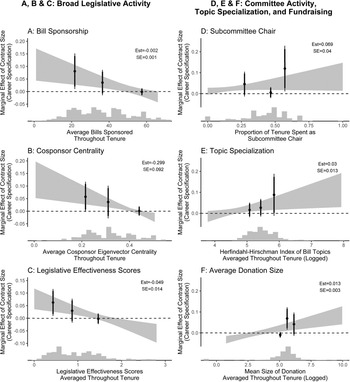
Although serving in Congress, legislators face many competing demands on what little time they have. Legislators with certain “styles” prioritize their time differently (Bernhard and Sulkin, Reference Bernhard and Sulkin2018). Although legislative strategists choose to sponsor bills on a broad array of topics, policy specialists focus on a few areas on which they build expertise. Additionally, all legislators have to raise campaign funds—but some pursue them more vehemently than others (Hall, Reference Hall2019). Crucially, specialists are likely to be in high demand, and fundraisers can have developed ties to future employers. If this results in the revolving door attracting senators differently depending on legislative styles, it can have important selection effects.
I draw on six separate measures to capture legislative styles—three to measure broad legislative engagement, two to capture legislative specialization, and one to measure fundraising. First, I use the average number of bills a senator has sponsored throughout her career. Second, I calculate each senator's eigenvector centrality in the cosponsorship network. To do this, I collect data on each bill's cosponsors (data on sponsorship and cosponsorship are from GovTrack (2017)). I then follow Fowler (Reference Fowler2006) and construct directed networks capturing the number of times each other senator has signed on as a cosponsor supporting the sponsor's bill. Extracting eigenvector centrality captures not only how central each senator is, but also weights this by the centrality of her cosponsors. This captures two important features: how hard the senator has worked to drum up support among well-connected cosponsors, and how well connected she is in the Senate. Third, I use LES (Volden and Wiseman, Reference Volden and Wiseman2018), which capture not only how many bills a senator has sponsored, but also a weighted combination of 15 indicators capturing how far the senator has managed to move those bills through the legislative process.
I use two different measures of specialization. As a first simple one, I calculate the time a senator has spent chairing subcommittees, using data from Volden and Wiseman (Reference Volden and Wiseman2018). Second, I construct a measure of how narrow a set of topics a senator has sponsored bills on. I use data from Adler and Wilkerson (Reference Adler and Wilkerson2018) who have categorized bills into Political Agendas Project (PAP) topics. I use the minor topic codes. I then calculate each senator's Herfindahl–Hirschman index (HHI), measuring their how concentrated their bill sponsoring activity was across topics—higher scores indicate more concentration. To measure fundraising intensity, I calculate each senator's average contribution size from Bonica and Sulkin (Reference Bonica and Sulkin2016).
I average all measures over the senator's tenure in office.
6.1 Selection effects
I examine this in Figure 2. Panels A, B, and C show how effects vary depending on the senators broad legislative activity. Panels D and E show results for policy specialization, while panel F presents results on fundraising intensity. Each panel presents estimates from a linear interaction model along with Hainmueller et al. (Reference Hainmueller, Mummolo and Xu2019) binning estimator for non-linear effects. The results presented in the main text are for career-based reference groups. Online Appendix F1 presents the results using committee assignments which show the same pattern.
Selection effects of career prospects.
Note: Senator and time fixed effects are included in all models. Shaded areas are 95 percent robust confidence intervals. Thick and thin lines are 90 and 95 percent confidence intervals of the binning estimator. Results using committee assignments can be found in online Appendix F1.

Looking first at broad legislative engagement, it is clear that the senators, who on average have sponsored the least bills per Congress, are affected the most. The average probability of selecting out for a senator, who has introduced only 20 bills in her average Congress, increases by almost 7 percentage points, when career prospects improve by one standard deviation. For senators, who have sponsored 40 bills in their average Congress (one standard deviation more), the effect is 4 percentage points lower. After this point, the effect approaches zero and becomes statistically insignificant. The same pattern exists for both cosponsor centrality and LES: the effect is by far strongest for senators with low values on these two moderators.
The results for specialization show the opposite pattern. Although less precise, they indicate that the effect of Contract Size are considerably larger for senators who have specialized in a narrower set of topics. The same is the case for fundraising.
This suggests that legislative specialists and fundraisers are attracted away from public service to a much higher degree than broad legislative strategists.
7. Career prospects and retirement in the house
In this section, I present the results of a full out-of-sample replication in the House of Representatives. The theory presented in this paper is broad: career prospects should matter in the House as well. Replicating the main results is, therefore, both theoretically and normatively important.
7.1 Data
In order to replicate the results, I have gathered data from a wide range of sources. To construct career-based reference groups in the House, I rely on the Carnes (Reference Carnes2016) CLASS dataset, which tracks pre-political employment histories of MCs between the 106th and 110th Congress. Once again, I rely on the Stewart and Woon (Reference Stewart and Woon2017) data on committee membership. The replication is as exact as possible, and I use the same specifications as I did in the Senate. Therefore, I extract five and six clusters, respectively. Again, I rely on CRP data to measure contract sizes, and identify MCs that register as lobbyists in their post-elective lives. The dependent variable is slightly more narrow in this situation, as I—due to data constraints—only record MCs that register as lobbyists.
To investigate selection effects, I use data from Volden and Wiseman (Reference Volden and Wiseman2014) to measure LES, bill sponsorship, chairing subcommittees, and time remaining until an MC's next improvement in her Congressional pension. I use data from Adler and Wilkerson (Reference Adler and Wilkerson2018) to compute HHI of how concentrated the MC's bill sponsorship is within PAP-topic codes. Finally, I use GovTrack (2017) to construct cosponsorship networks for the House, and calculate the centrality of MCs. This provides data on the House of Representatives covering a shorter time period than available for the Senate, but for more unique MCs. In total, I have data on 657 members.
7.2 The lure in the house of representatives
Table 3 presents the results from the replication. Since the coefficients imply percentage point changes, they will have different implications because the two chambers differ in size. I facilitate comparison with the Senate results in two ways. First, I normalize Contract Size in the House by the Senate standard deviation—$91,000. Additionally, I present the number of MCs we would expect to select out of the House following such a change along with the coefficient and its standard error.
Career prospects and revolving out of the house

Note: Dependent variable is an indicator for the final Congress before leaving for a job as registered lobbyist. Driscoll–Kraay robust standard errors in parentheses. Contract Size is normalized by $90,000. Coefficients are from OLS regressions. *, **, and *** indicate statistical significance at the 10, 5, and 1% levels, respectively.
The results suggest that an improvement of $91,000 in outside career prospects increases the average probability of selecting out in the House by 1 and 3.5 percentage point, respectively, depending on how we estimate Contract Size. This corresponds to, respectively, four and fifteen additional revolvers. Thus, although the former estimate is approximately the same as in the Senate, the latter is significantly larger. The results are robust to the inclusion of time by party interacted fixed effects, allowing for differential trends between the two parties.
In online Appendix F2, I also replicate the retirement effects that I uncovered in Figure 1. Although the results suggest that the same mechanism is at play in the House, they are also more noisy than in the Senate.
Finally, in online Appendix F3, I investigate the differential effects across the same variables as I used in the Senate. Interestingly, we observe no strong patterns of moderation, indicating that the revolving door will impact representation differently in the House.
To investigate why, in F4, I draw on data from Carnes (Reference Carnes2016) to show the distributions of net wealth in the two chambers. Although the median Senator controls upward of $1.8 million in personal wealth, the median Representative only owns approximately $630,000. In Figure 3, I show that wealth strongly moderates the effect of outside career prospects in the House. The effect is concentrated among the least wealthy and drops off quickly as wealth increases. In the Senate, however, the trend is reversed and the moderation is not statistically significant. The results should be taken with the caveats that the Carnes data only covers the 108th to the 110th Congress, and the results are less clear for the committee-based models in online Appendix F4. Still, these results provide a strong—if preliminary—indication that differences in personal wealth is key to understand the different selection effects between the two chambers.
Net worth moderates the effect of outside career options.
Note: Effects estimated within tertiles of log net worth using Hainmueller et al. (Reference Hainmueller, Mummolo and Xu2019). Lines are 95 percent robust confidence intervals.

8. Conclusion
Motivating good candidates to run for office is a precondition for high quality government, but so is persuading them to stay. My results show that MC are attracted by the potential for private sector employment opportunities and leave office to pursue them when prospects are good.
The results were originally produced on Senate data and then replicated in the House of Representatives. The results indicate that when the price of hiring a legislator to work on a lobbying contract increased by $91,000 (one standard deviation), the probability that the average legislator left Congress for a lobbying job rose markedly. It caused between two and three additional senators and between four and fifteen Representatives to become revolvers.
I provided evidence that it, indeed, is opportunity costs associated with holding elected office, that drives the effect. Specifically, there was no effect of career prospects immediately before and after MCs experience improved pension schemes. Instead the effect was localized among legislators, who would never see another improvement, or who had to run for reelection before one. Similarly, legislators, who only narrowly won their seat in the previous election were affected at an above-average rate.
These results have at least two important implications. First, they show that monetary gains do not only structure the selection into public service. Their effect persists even after candidates have entered elective office, shaping the timing of resignation. Legislators take stock of the opportunity costs associated with being in politics by gaging the career prospects available to them outside of public service. When the rewards they relinquish by holding elected office are lucrative enough, the average legislator will leave public service to take private sector employment.
Second, the results clearly show that the outside career options exert a different pull depending on the type of legislator. Thereby, the revolving door shapes the type of legislator that remains in office. The patterns of selection, however, differ by chamber. In the Senate, the revolving door attracts legislative specialists, leaving strategists with a broader focus. In the House, there were no strong patterns across different legislative styles. Instead, there was preliminary evidence that least wealthy MCs reacted most strongly to the lure of the private sector. Both selection effects are likely to shape the quality of representation voters receive. Private career prospects attract legislators with specific policy capabilities out of the Senate which might contribute to a deficit of policymaking expertise. The moderating effect of personal wealth in the House suggests that the revolving door could play a part in skewing representation toward wealthy interests.
Supplementary material
The supplementary material for this article can be found at https://doi.org/10.1017/psrm.2021.10.
Acknowledgments
I am very grateful for the comments and suggestions I have received from Sandy Gordon, Alex Fouirnaies, Jim Curry, Anne Binderkrantz, Adam Bonica, Justin Grimmer, Anne Rasmussen, David Dreyer Lassen, Jacob Hariri, Steven Finkel, Martin Vinæs, Wiebke Junk, and Lasse Aaskoven. Nick Carnes has generously shared data and adviced on how to use it. Remaining errors are my own.