Introduction
The University of Michigan's archival collection on the Philippines contains the photograph album of an American couple who lived in Manila sometime between 1910 and 1915. While the handwritten captions indicate that the man's name was Arthur, the woman remains anonymous. The choreography and subject matter of their photographs share marked similarities with those produced by colonial elites in the neighbouring colonies of Southeast Asia and northern Australia. Like their British, Dutch, and Anglo-Australian counterparts, Arthur and his wife depicted themselves lounging in the lush tropical garden of their colonial home accompanied by Asian male servants. Figure 1—a photograph of the couple's Filipino cook, Felix, and their ‘houseboy’, Aniceto—provides just one example of the hundreds of photographs of Filipino, Chinese, Malay, and Javanese male domestics that were produced by employers of servants in this region. The forms that these images take are diverse. While some are studio portraits taken by professional photographers, others are, like the image of Felix and Aniceto, amateur snaps produced within the home.
‘Felix—cook. Doesn't he hold his hands gracefully. Veranda upstairs. Aniceto Sico—Houseboy. He says he looks like a chinaman’. Philippines, circa 1910–15, Philippines, Japan, and China Travel Album, Special Collections Library, University of Michigan, PHLH126.Footnote 2

Producing or commissioning photographs of seemingly devoted ‘native’ servants was one means by which ‘white’ employers of servants expressed their sense of power and status in the colony.Footnote 1 In the hand-written description on the back of Figure 1, the unnamed American mistress noted Aniceto's discomfort about the way he was represented in the photograph. Aniceto complained that the uniform or perhaps the pose ‘made him look like a Chinaman’, yet he was powerless to challenge the depiction of himself in this way. Or so it seems. In fact, the photograph that the couple took of their servants was not the only image in the album that featured Felix and Aniceto.
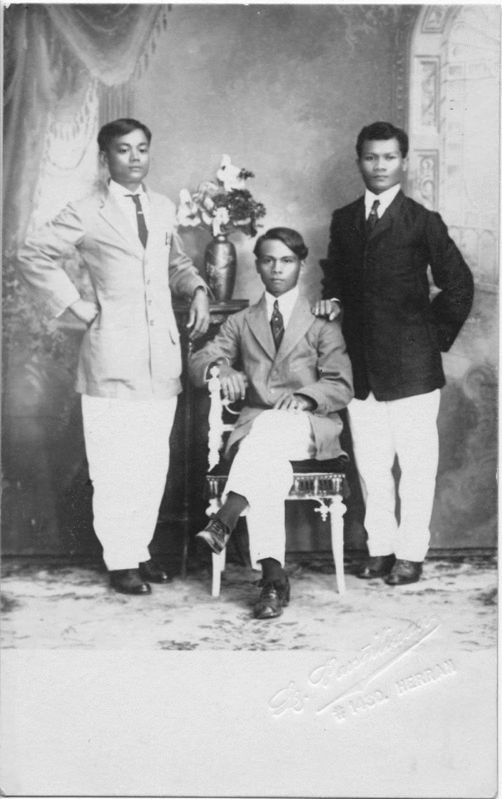
Figure 2 is a studio portrait that the men and another servant employed in the home, Pedro, paid to have taken and then presented to their mistress. The photograph that Aniceto, Pedro, and Felix used their earnings to fund is in stark contrast with the image favoured by their employer. Dressed in Western-style suits with ties, the men are depicted as well-to-do colonial gentleman rather than devoted ‘oriental’ servants. The pose of domestic leisure and dignified respectability that they adopted in the image was one associated with masters rather than servants.
‘Aniceto + Felix placed this on the table in kitchen for my notice. They were tickled to death. Felix, my cook, at right. Aniceto, my house boy, on left. Pedro, in middle. He used to be Mrs. McDonald's house boy + was the one who told me that one day that I could go home. Funny. Keep this for me.’ Philippines, circa 1910, Philippines, Japan, and China Travel Album, Special Collections Library, University of Michigan, PHLH129.

The central argument of this article is that photographs of Asian ‘houseboys’ tending to their white colonial employers or poised ready to serve an unseen master constituted a ‘visual culture’ of empire. The term ‘visual culture’ draws on the ideas of Deborah Poole and is used in this article to describe the shared language, knowledge, and messages cultivated within these photographs, which at once contributed to, inhibited and challenged European colonialisms in Southeast Asia.Footnote 3 I explore how, through the use of the careful choreography, props, and captioning, this visual culture sought to reinforce colonial hierarchies by emphasizing unquestioned white mastery and devoted ‘native’ servitude. At the time, the self-conscious arrangement of these images spoke to anxieties about the viability of colonial projects and highlighted the potential of the domestic service relationship to destabilize colonial hierarchies.
If the photographs taken by employers constituted a visual culture of empire, those commissioned by domestic servants illustrate how that culture was occasionally challenged by the attempts of household workers to represent themselves on their own terms. In the archives of colonial Singapore, Hong Kong, the Philippines, the Netherlands Indies, and the Northern Territory of Australia, it is the photographs of employers of domestic servants that predominate. More than 1,000 photographs were surveyed for this article, with 56 selected and analysed in detail. These included 16 photographs from the Netherlands Indies, 11 from the Northern Territory, ten from Singapore, nine from the Philippines, six from Hong Kong, and three from French Indochina. Figure 2 was the only one commissioned by servants that was located. Yet there is some evidence to suggest that self-commissioned servant photographs may have been more common than the archive suggests. The final part of the article will explore this possibility, drawing on histories of photography in Southeast Asia and the oral history account of Lim Ming Joon, a Hainanese man who worked as a servant and a photographer in colonial Singapore.
By highlighting the rare examples of photographs that servants commissioned themselves and by considering the active role that these workers played as subjects in their employer's photographs, this article aims to explore how both masters and servants used the photographic medium to assert their power in the home and the colony. The tools of photographic theory are used to analyse servant photographs at the level of representation, as cultural artefacts, and as sources of empirical evidence.Footnote 4 Rather than a ‘mirror to the age’ or a reflection of one intended message, photographs are considered here to be products of (unequal) negotiation between the photographer, the subject of the image, and the viewer. Thus, a degree of subject agency, ranging from pose, choice of expression, or attire, can be discerned in even the most choreographed photograph.Footnote 5 In this article, I look at photographic representations of male servants, with the aim of accessing the multiple perspectives and messages contained within them.Footnote 6 In a context in which photographic, written, and oral records left by Asian male servants are scarce, this article to seeks to ‘reinterpret’ colonial photographs in order to destabilize the master narrative of domestic service and, where possible, to bring ‘into focus’ the stories of the servants.Footnote 7
My assertion that photography was a medium through which colonial contests between masters and servants played out draws on the foundational work of scholars of the Netherlands Indies. As Ann Laura Stoler observed in her classic work on domesticity and colonialism in the Netherlands Indies, photographs were the ‘visual counterpart’ of the discursive strategies used by employers to assert power over ‘native’ servants and colonized populations more generally.Footnote 8 Following on from that observation, historians such as Jean Gelman-Taylor, Pamela Pattynama, Susie Protschky, and Karen Strassler have explored how the notions of race, class, gender, and modernity on which the colonial project rested were constructed through photographs of colonial elites at home. A key strength of this work is the way in which it explores the connections between photography and imperialism in Indo-European, ethnic Chinese, and Javanese homes, as well as in Dutch homes.Footnote 9
The focus of this article on photographs of servants produced by ‘white’ colonists, including Anglo-Americans, Dutch, British, and Anglo-Australians, reflects the predominance of photographs from these groups within the archives of Southeast Asia and northern Australia. Yet, like the white colonizing classes, the interracial elites of this region, both migrant and local-born, employed numerous domestic servants in their homes, including ‘houseboys’ and other male servants.Footnote 10 The existence of small numbers of photographs of domestic servants employed in migrant and Indigenous households suggests that Asian elites, like their white counterparts, used servant photography to express their wealth and power in colonial societies.Footnote 11
This article adopts a ‘transcolonial’ frame of reference, studying ‘discourses reiterated’ and ‘fantasies shared’ within photographs of ‘houseboys’ produced across the colonies of the Southeast Asia region, including the Northern Territory of Australia.Footnote 12 While this article does not deal with French Indochina, a preliminary survey of the photographic collections of that colony indicates that photographs of male domestic staff were also popular there.Footnote 13 The process of looking at British, Dutch, American, and Australian colonial situations side by side brings ‘into focus’ the specificities of these colonial projects while at the same time highlighting the ‘webs’ of imperial connection between them.Footnote 14 The following discussion explores how photographs of Asian ‘houseboys’ can be used to shed light upon shared traditions of tropical domesticity, common assertions and anxieties of colonial power, and the daily realities of servants’ lives.
Photography and the ‘houseboy’ in Southeast Asia
As was common across the tropical colonial world, male servants formed an important component of the servant workforce in Southeast Asia. Female servants were also employed in significant numbers as nursemaids to children, cooks, laundresses, and, in the Netherlands Indies and British North Borneo, as nyai (housekeepers/concubines). Yet, in most colonies, Asian male labour migrants and local men predominated in service until the late 1920s, after which domestic service as an occupation became gradually feminized.Footnote 15 In Singapore, men accounted for 95 per cent of the domestic workforce in 1883 and 64 per cent in 1921.Footnote 16 In Hong Kong, approximately 88 per cent of domestic servants employed within British households were men in 1891, while male servants constituted 57 per cent of servants employed in all households in 1921.Footnote 17 In the Philippines, male servants made up 75 per cent of the domestic workforce in 1903 and, in the Northern Territory, male servants comprised 61 per cent of the servant workforce in 1911.Footnote 18 The exception to the broad pattern of male predominance service was the Netherlands Indies, where women outnumbered men in service. Even in this colony, however, male servants made up a significant 40 per cent of the servant workforce in 1930.Footnote 19
Male servants worked as cooks, gardeners, washermen, coachmen, and chauffeurs. The most iconic position, however, was that of the ‘houseboy’. As Ethel Legge, an Australian tourist who visited Hong Kong and Manila, put it in 1932: ‘to me the call of the East is the call of the Boy.’Footnote 20 The culture of male servitude in the tropics was in distinct contrast to the colonial metropoles of England, the Netherlands, the United States of America, and south-eastern Australia, where women formed the bulk of the servant class from the early nineteenth century onwards.Footnote 21
At the most basic level, the photographs of servants provide tangible and physical evidence of the colonial cultures of domestic service in this region. The volume of images of Indigenous and Asian female servants caring for young children illustrates the important role of the ayah, amah, or babu in colonial households.Footnote 22 An equally pervasive presence in the photographic record (and the focus of attention here) is that of the ‘houseboy’.Footnote 23 Where the original captions have survived, as is in Figures 1, 2, and 3, photographs also shed light on colonial parlance common to the tropics with British, Dutch, American, and Australian colonists, referring to these servants as ‘houseboy’ and ‘boy’ or, in the Netherlands Indies, ‘jongos’ and ‘sepen’.Footnote 24 These terms were at once a job description and means of exercising hegemony over servants who were generally, as the photographs illustrate, adult men.Footnote 25 The demeaning nature of these terms is made all the more stark by the use of gender-neutral and inoffensive terms like ‘servant’ (‘bediende’) and ‘house staff’ in photographs that have been labelled by archivists, such as Figures 5, 7, and 10.
‘301—Chinese Boy on duty’, Lambert and Co, circa 1900, University of Leiden, Royal Netherlands Institute of Southeast Asian and Caribbean Studies (hereafter KITLV), 50196.

In addition to providing evidence of a culture of male servitude in Southeast Asia, images of liveried Chinese male servants arranged in opulent colonial homes and hotels, such as in Figures 3 and 4, attest to the special status of these servants in particular. Employers maintained that Chinese servants were ‘the best servants in the world’, as the former Governor of Hong Kong, Sir Laurence Guillemard, put it in 1937.Footnote 26 Racialized perceptions of Chinese ‘houseboys’ as loyal and efficient domestic servants, as well as the ready availability of Chinese male labourers, ensured they came to be the favoured servants in many parts of Southeast Asia, as well as in Hawaii, California, and British Columbia during the nineteenth and early twentieth centuries.Footnote 27
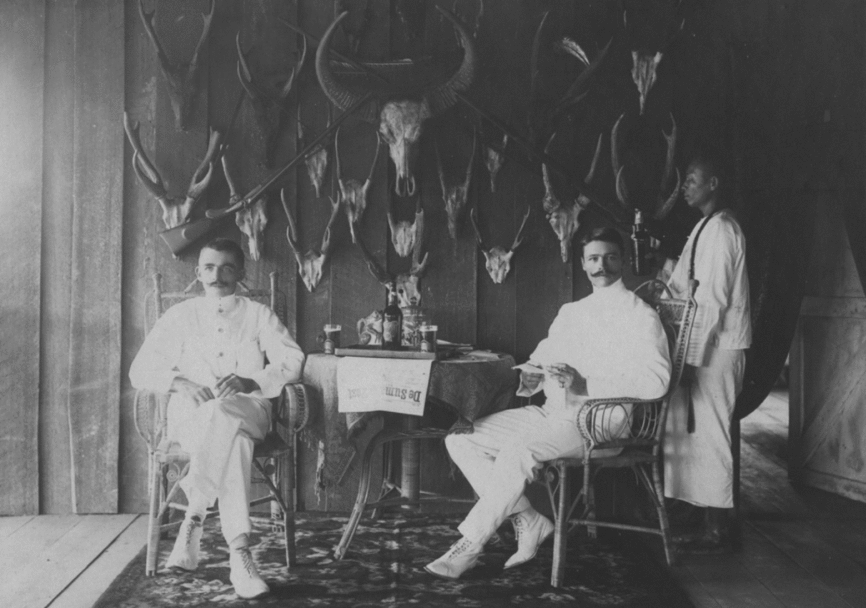
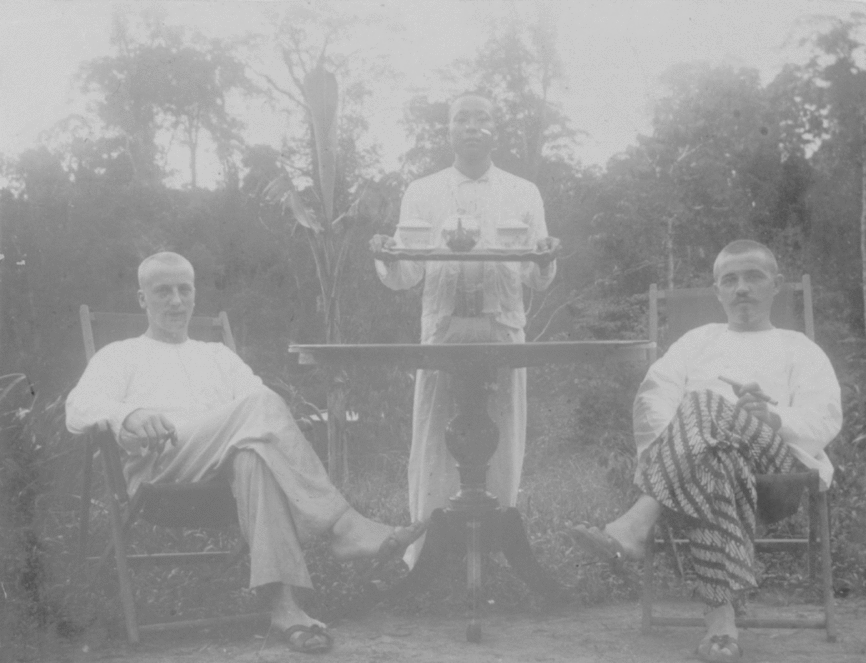
Two European men drinking beer, with the Sumatra Post on the table in front of them, Deli, Netherlands Indies, circa 1890, photographer: Kleingrothe, KITLV, 155291.

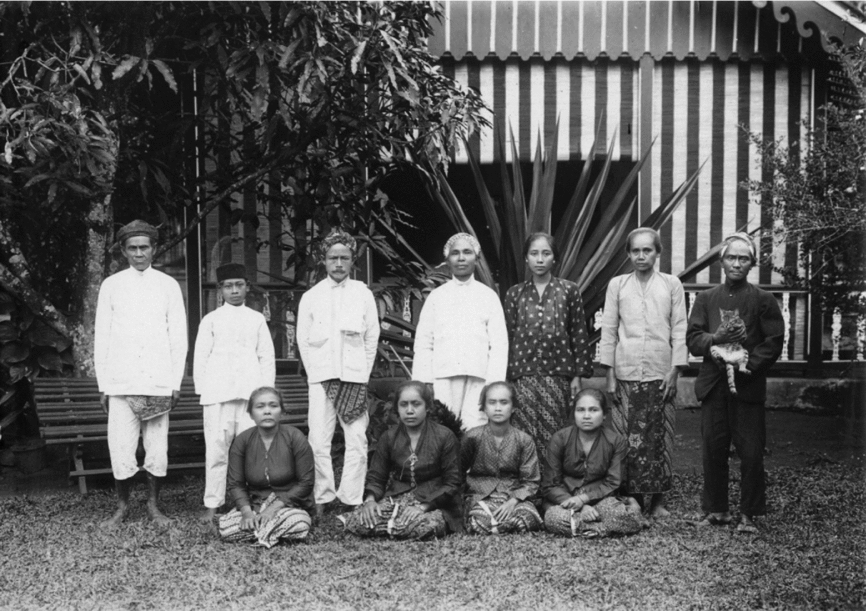
While the presence of male servants was the norm in European households throughout Southeast Asia, there were local differences to which the photographic archive attests. In the Netherlands Indies, Javanese rather than Chinese men tended to be employed as ‘houseboys’. Indeed, Chinese men made up only 1.5 per cent of the servant workforce of the Netherlands Indies in 1930.Footnote 28 Not surprisingly then, only four photographs of the approximately 850 images of servants held by the Royal Netherlands Institute of Southeast Asian and Caribbean Studies (KITLV) feature Chinese male servants.Footnote 29 The prevalence of female servants in photographs from the Netherlands Indies, such as in Figure 5, also indicates the higher proportion of women in service compared to the other colonies.Footnote 30
Native house staff employed by H. W. Dalfsen in Bandung, circa 1915, Netherlands Indies, KITLV, 32825.

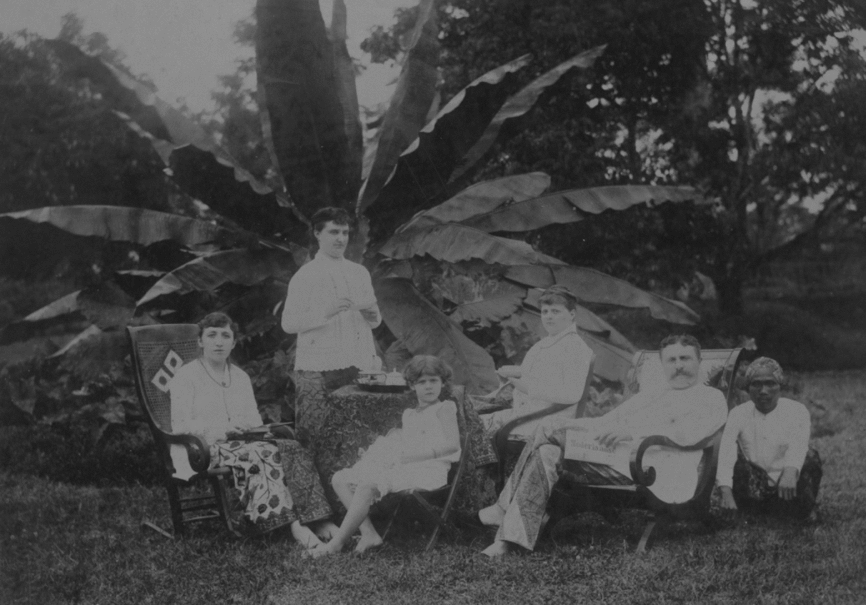
Another peculiarity of the photographs of servants from the Netherlands Indies is that, where Javanese servants were pictured with their Dutch employers, they were positioned squatting humbly on the ground, as illustrated in Figure 6. The images of Javanese servants with their employers are in stark contrast to those of Chinese ‘houseboys’ taken in the Netherlands Indies and elsewhere. Rather than crouching at the feet of their masters, Chinese servants tended to be posed standing above their seated masters, sometimes even staring down the lens of the camera, as in Figure 9.Footnote 31 The decision to picture Javanese male servants in a squatted position illustrates how Javanese conventions of demonstrating social hierarchy were adopted in Dutch colonial homes.Footnote 32 The different positioning of Chinese versus Javanese servants in photographs from the Netherlands Indies may also be a product of ideas of racial hierarchy. In the Philippines, Singapore, and the Northern Territory, for example, Chinese male servants were considered to be more ‘civilized’ than Filipino, Malay, Indian, and Aboriginal servants. They received higher wages and more favourable treatment in some part due to this perception.Footnote 33
Europeans drink tea in the garden of a house in the Netherlands Indies, circa 1890, KITLV, 151433.

Photographs of servants thus provide a good deal of insight into the shared features and peculiarities of the tradition of the ‘houseboy’ in Southeast Asia. The self-conscious ways in which photographs of male servants were staged and choreographed also open up the images to an analysis of the colonial ideologies and anxieties contained within them.
Visions of power and questions of legitimacy
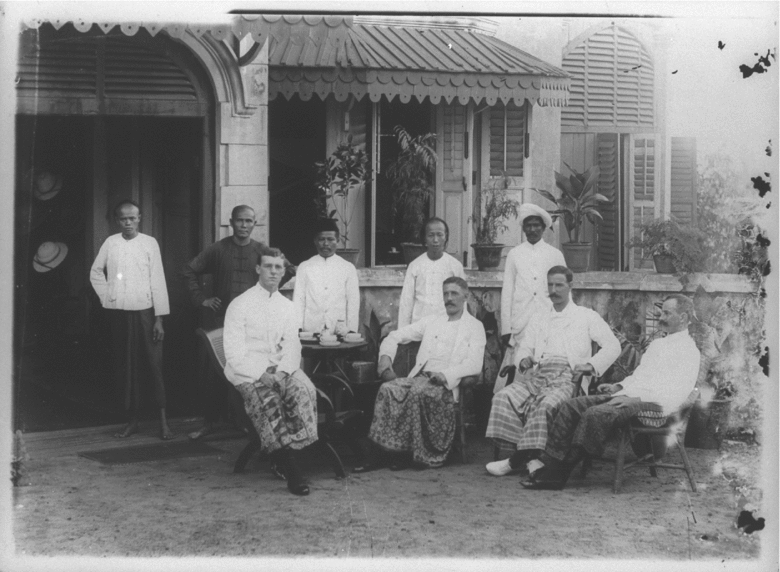
One of the most striking aspects of the photographs of male servants produced in the Netherlands Indies, the Northern Territory, Singapore, Hong Kong, and the Philippines is the similarity between them. Photographs such as Figure 7, featuring white men lounging in lush tropical gardens or relaxing within their bungalow homes tended to by Chinese, Malay, Filipino, and Javanese servants, were common.Footnote 34 Where Chinese ‘houseboys’ were pictured, as in Figures 3 and 4, they were usually choreographed in the act of serving refreshing beverages to revitalize climate-weary white colonials.Footnote 35 Photographs of servants also featured common props such as the solar topee or pith helmet.Footnote 36 As popular writers of the period observed, the solar topee was considered ‘more a badge of authority than a hat’ and essential to maintaining ‘proper pride’ in the tropical colonial world.Footnote 37 Thus, while the British men in Figure 7 are wearing sarongs, signalling their potential abandonment of traditional values of masculinity, the solar topees on the hat rack in the background attest to the maintenance of white male power in the colony.
Englishmen and servants, circa 1900, Boden-Kloss Collection, National Archives of Singapore (hereafter NAS), ACC 606.

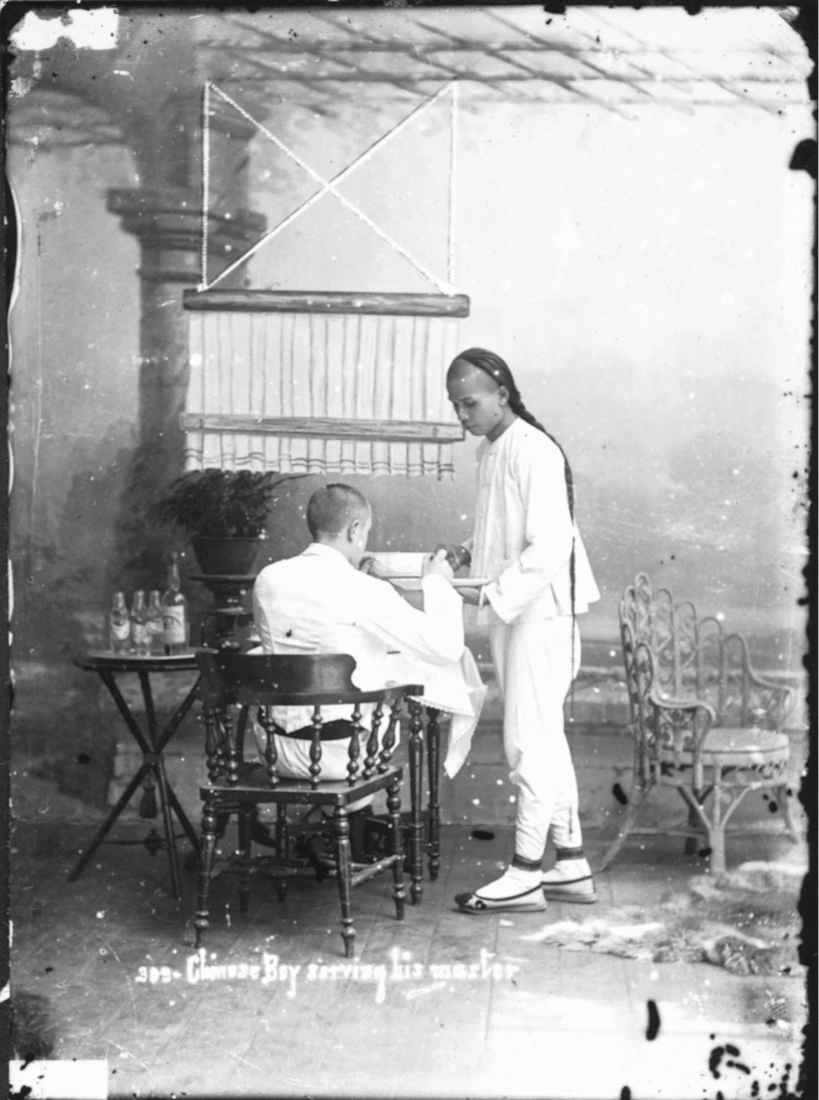
For white colonists, mastery over ‘native’ servants was considered to be a symbol and an expression of colonizer status.Footnote 38 Photographs of seemingly devoted male and female servants provided a means through which the power of the colonizers could be immortalized and presented as objective scientific ‘fact’.Footnote 39 Thus, in Figure 8, a highly choreographed studio image from Singapore, the Chinese servant is focused intently on his master, his queue (long plait) uncoiled as a sign of respect. Similarly, in Figure 9 from the Netherlands Indies, the Chinese ‘boy’ is poised, ready to serve the relaxed white men tea. The visual culture of servant photography was a strategy of rule that stretched beyond the tropical colonial world, as the paintings and photographs of faithful black and Indigenous servants that produced temperate settler colonies such as the United States and south-eastern Australia illustrate.Footnote 40 The production of photographs, sketches, and paintings of domestic servants in Britain and Europe indicate that this tactic of colonial rule had its roots in class-based forms of oppression.Footnote 41
‘303—Chinese boy serving his master’, Singapore, circa 1890, Courtesy of the National Museum of Singapore (hereafter NMS), National Heritage Board, ACC-XXXX-12898.

Drill Master De Vries and Mr Van Gastel of the Mueara Knini Petroleum Company with servant, at Babat, near Sekajoe, Netherlands Indies, 1900, KITLV, 150764.Footnote 42

While photographs of servants may well have been intended to depict European superiority as objective truth, they also contained unintended and potentially subversive messages. A common (though not uncontested) belief of European scientists and doctors during the nineteenth century and early twentieth century was that white colonizers were at risk of degenerating as a result of exposure to the climate and cultures of the tropical colonial world.Footnote 43 As John Thomson, a prolific photographer for Britain's Royal Geographic Society, put it in relation to Singapore, the ‘constant attendance’ of Chinese ‘houseboys’ had a ‘debasing effect’ on white men, causing them to succumb to the indolence and passivity that he associated with life in the tropics.Footnote 44 Seen in this light, Figures 8 and 9 are as much about luxury and power as they are about the frailty and vulnerability of the ‘white race’.
In Figure 8, the British man with his back to the camera is almost child-like. He requires the Chinese man for the most basic of necessities, including being fed. Indeed, he is dependent on the Chinese man for his very life. This image of white dependency emerged in a context in which accounts of Chinese ‘houseboys’ in Southeast Asia exploiting, stealing from, and even violently assaulting their employers were relatively common.Footnote 45 As such, we might view these photographs as disavowals of servant misbehaviour as much as they are statements of domestic and colonial mastery. The relaxed atmosphere of Figure 9 from Sumatra, particularly the batik trousers of the man on the right, could also speak to the risk of going native and losing vigour in the tropics. A similar interpretation could be made of Figure 6, with the Dutch man dressed in batik trousers and the women in kain kebaya (batik skirt and long-sleeved blouse). While these costumes were standard attire for Dutch men and women at home in the Indies, they indicate a slippage between European and ‘native’ ways of life.Footnote 46 Nor was this hybrid style of dress peculiar to the Netherlands Indies, as Figure 7 from Singapore illustrates.
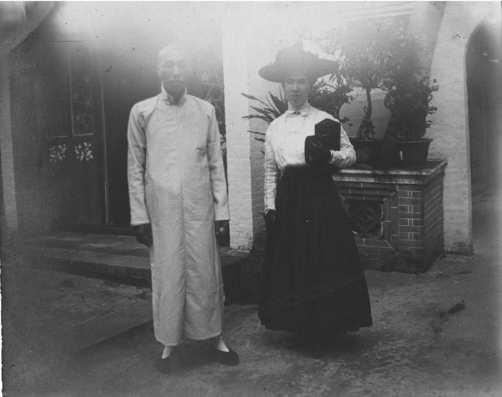
As well as being a medium through which white superiority could be affirmed or scrutinized, photographs of servants expressed employers’ sexual fears about and desires for their servants. While white men were constantly photographed with their ‘houseboys’, white women were almost never depicted with male servants unless flanked by their husbands.Footnote 47 This was the case even after increasing numbers of white women began living in the tropics from the turn of the twentieth century.Footnote 48 Figure 10—a picture of an American woman with a Chinese male servant—is a rare exception. The rarity of photographs of mistresses with male servants reflects the intense angst about the possibility of sexual contact between mistresses and ‘houseboys’ that marked public debate in tropical colonies in the early twentieth century.Footnote 49 Thus, even in instances where white women were photographed alone with male servants, as in Figure 10, considerable physical distance was maintained. Compare this image with the intense intimacy of Figure 8, where the hands of master and servant seem to connect as the servant administers the broth.
American woman and a servant outside house, circa 1910–15, Philippines, Japan, and China Travel Album, University of Michigan, Special Collections Library, PHLH074.

In a context in which the sexual ‘contagion’ of white women by ‘native’ male servants represented a symbolic and practical threat to white imperial patriarchy, the visual maintenance of appropriate distance was essential.Footnote 50 Yet, just as the absence of photographs of white mistresses with male servants hints at the sexualization of these servants by their employers, so too does the abundance of images of male servants providing devoted and intimate care to white masters, such as Figures 4, 7, 8, and 9. As Robert Aldrich has argued, the possibility of sexual encounters between white masters and ‘houseboys’ inspired fear and fascination and had the potential to destabilize colonial power.Footnote 51 In British colonies, the threat of prosecution for sodomy and the stigma associated with homosexuality have ensured that direct accounts of sexual relationships between masters and their male servants simply do not exist. Documented evidence is also hard to come by in colonies where no law prohibiting homosexuality existed, as in the American Philippines, or where the laws governing homosexuality were not enforced, as in the Netherlands Indies until the late 1930s.Footnote 52
Despite the paucity of hard evidence, cases where Chinese, Malay, Indian, and, very occasionally, European men were convicted of so-called ‘unnatural acts’ in the Southeast Asian region illustrates that homosexuality was part of life.Footnote 53 While there is no direct evidence of sexual relationships between masters and their male servants, homoerotic depictions of Malay and Javanese ‘houseboys’ can be found in white men's fictional accounts and letters.Footnote 54 In addition, Chinese ‘houseboys’ were often condemned by European colonists for allegedly engaging in sodomy.Footnote 55 This reputation may have had some basis in reality considering that homosexuality was relatively acceptable in Chinese society prior to the Chinese Revolution (1911–12), with Hainanese men, the group that represented the bulk of Chinese servants in Singapore, particularly accepting of sexual relationships between men.Footnote 56
If assertions of and anxieties about gender, sexuality, race, and power are an overriding theme in the photographs of male servants, these photographs also provide hints about the different ideologies that informed colonialism in different contexts. In photographs from Hong Kong, the Netherlands Indies, and Singapore, domestic servants were almost always described in terms of the job they performed, if they were described at all.Footnote 57 Like many employers of servants in Europe and Britain, British and Dutch employers in the colonies only considered their servants noteworthy in terms of the role they played in serving their masters.Footnote 58 Thus, in Figure 11, eight individual Chinese men are described simply as ‘chair coolies’ and ‘house servants’. The lack of given names in these images ensures that, at the same time as being subject to ‘compulsory visibility’, these servants were also rendered anonymous, invisible, and silent.Footnote 59
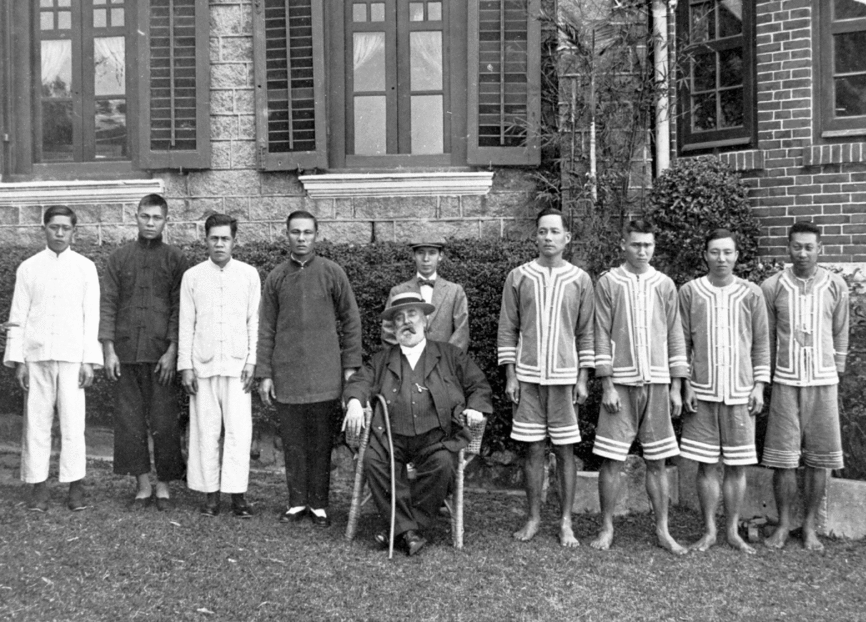
‘The stone house (mount Kellet, next to the Peak), H. P. Smith with house servants and chair coolies, 1924’, Hong Kong, Hong Kong Public Records Office (hereafter HKPRO), Government Records Service, PH003517.

The names of domestic servants were recorded in captions and written descriptions much more frequently in photographs from the Philippines and the Northern Territory of Australia.Footnote 60 This subtle difference may well have been a reflection of a desire on the part of the colonists of the ‘new world’ to imagine themselves as more egalitarian and progressive than the colonists of the old world. From the early twentieth century, the United States government justified their violent colonization of the Philippines by arguing that Americans were ‘exceptional imperialists’ who were paving the path to democracy. As masters and mistresses of Filipino servants, the Americans residing in the Philippines were presented as being engaged in a process of ‘tutelage’, ‘uplifting’ their Filipino servants and instructing them in the dignity of labour.Footnote 61
Australian federation in 1901 marked the formal end of the British colonial period. The White Australia Policy was introduced almost immediately following the unification of the colonies into the Commonwealth of Australia. By the 1910s, the numbers of Chinese male servants in the Northern Territory had gone into dramatic decline in large part as a result of the policies of immigration restriction brought in to transform the multi-ethnic north into a bastion of white settlement.Footnote 62 The Northern Territory's powerful white Australian trade union movement celebrated this development, arguing that the colonial practice of employing Chinese ‘houseboys’ was anathema to the values of democracy and egalitarianism that, they maintained, were at the heart of white Australian nationalism.Footnote 63 They lobbied the Commonwealth government to replace the Chinese domestic staff in government employ with white labour. Where that was not possible, they argued that Chinese cooks and ‘houseboys’ should be paid the same wages as that of a white male servant.Footnote 64
Perhaps the inclusion of names in the photographs of Filipino and Chinese servants from the Philippines and Northern Australia can be interpreted in light of this rhetoric of democracy and working men's rights. Yet, neither the Australians nor the Americans were alone in imagining themselves as more progressive and enlightened than other Western nations. The colonial administrators of Britain, France, and the Netherlands also depicted themselves as engaged in ‘ethical imperialism’ in Southeast Asia, and imagined themselves to be an exception to other less enlightened imperial regimes.Footnote 65 Furthermore, as Vicente L. Rafael has pointed out in the context of the Philippines, American approaches to colonization and the treatment of domestic servants were ‘far from an exception to, and in some ways continuous with, the European colonialisms of the early twentieth century’.Footnote 66
The argument against American exceptionalism is supported by Figure 12—an image of Filipino and Chinese domestic servants employed by American military men. While the domestic servants are named, they are also described in relation to their employers in a way that suggests ownership, with this ‘boy’ belonging to Colonial Brainard and so on. Describing the men in this way reflects the influence of older colonial traditions of indenture and even slavery. Likewise, while half of the photographs from the Northern Territory and the Philippines analysed in this study included the names of domestic servants, in others, the servants are portrayed in the fashion favoured by British and Dutch colonists. They remain an anonymous and exotic collection of ‘native attendants’.Footnote 67
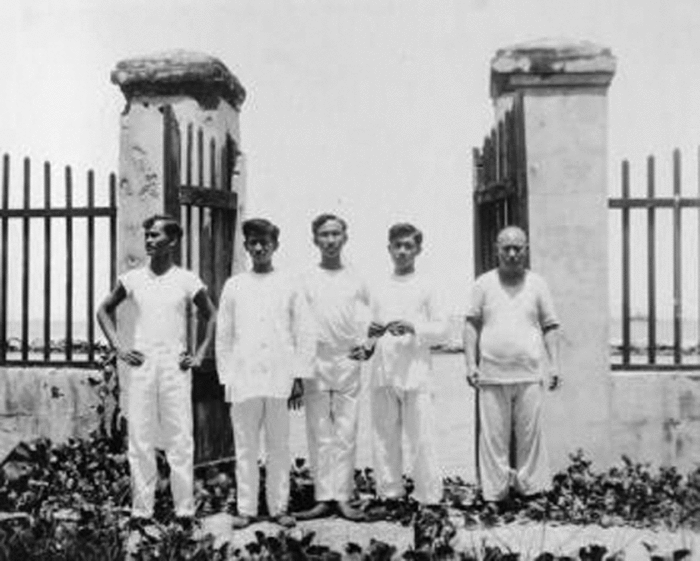
‘“Boys” at 127 Caffe Marina, Ermita, Manila, P.I. From right to left: Choy (cook), Andres, Col Brainard's boy, Juan, Col. Bellinger's boy, Bruno, Maj. Rassiter's boy, Felix, Col Richard's boy’, 1910, D. L. Brainard's Family Albums, 1884–1910, National Archives at College Park (hereafter NACP), College Park MD, RG 200S-BR, vol. 3C, 179.

If the focus of attention is transferred from the employers of servants and towards domestic workers themselves, the decision to name servants (or not) has significance for another reason. Historians of colonial domestic service, such as Swapna Banerjee, have long lamented the ‘dearth of primary sources left by the servant themselves’.Footnote 68 Yet, as Clare Anderson has shown, in the context of the increasing digitization of archival records, the fleeting traces that subaltern people left on the historical record can be used to illuminate their individual lives and central role that they played in histories of colonialism.Footnote 69 Photographs in which the names of domestic servants are recorded provide opportunities for historians to trace their life histories. The process of doing so places usually silent servants rather than their verbose masters at the centre of the story.
‘What a picture can do’: decentring the master narrative
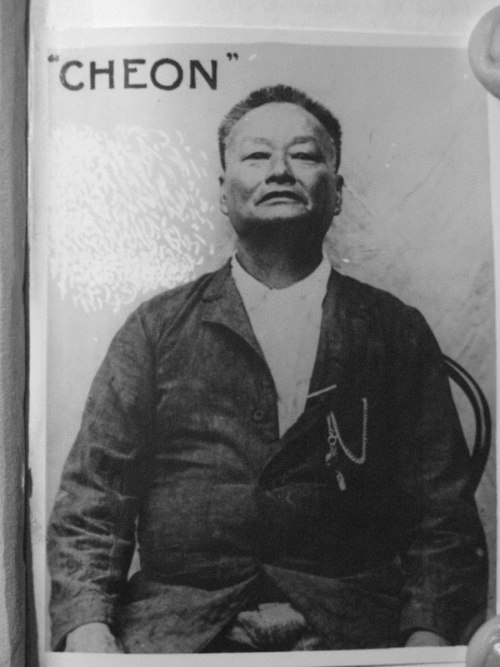
In cases where servants have been photographed multiple times over a number of years, the photographs themselves can provide some sense of servants’ lives within and outside of the colonial home. Three photographs of Hong Pak Cheon, a Chinese cook who worked in the Northern Territory of Australia in the early twentieth century, illustrate this point. Figure 13 shows Cheon at the prime of his life. His possession of a pocket watch speaks to his modernity, personal success, and ambition.Footnote 70 In another image, apparently taken on the same day, Cheon is carrying an umbrella and, significantly, is wearing a solar topee, which, as I have outlined, was considered to be a symbol of male colonizer status.Footnote 71 As with the Filipeno servants in Figure 2, Cheon appears not as a servant, but as a master.
‘Ah Cheon’, Northern Territory of Australia, circa 1908, Northern Territory Library (hereafter NTL), PH0147/0071.

The photographs were taken at Elsey Station, where Cheon worked as a cook, and were probably commissioned by his employers, Aeneas and Jeanie Gunn. It may be that the pocket watch and solar topee did not belong to Cheon, but were props included by the photographer. Nonetheless, the image of Cheon as a powerful actor in the household is one that is echoed in Jeanie Gunn's memoir of her time on Elsey Station. As Gunn put it, Cheon constantly patronized her and refused to ‘be instructed’, acting as ‘a born ruler’ and ‘master’.Footnote 72
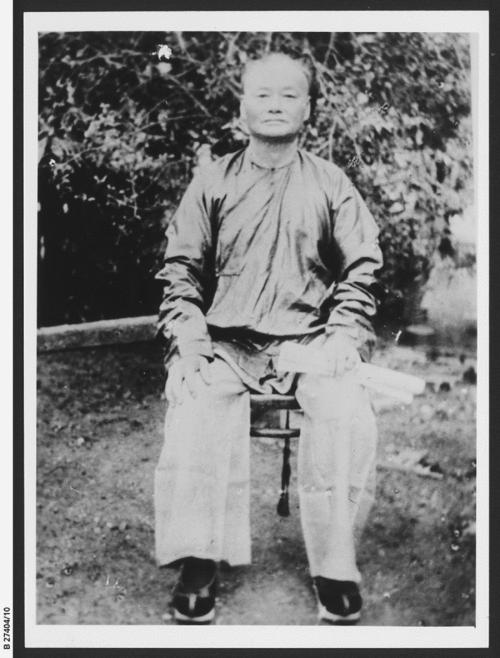
In the third photograph of Cheon, Figure 14, he appears in Chinese attire, possibly in preparation for his return to China, which took place around this time according to Gunn.Footnote 73 Taken at least 14 years after the previous two, the photograph illustrates how Cheon aged, grew frail, and lost weight. Such details may seem inconsequential. Ageing is a human condition after all. Yet the predominance of the ‘discourse of their employers’ in primary sources means that, where domestic workers are discussed in histories of domestic service, the focus is often on how employers treated them in the home.Footnote 74 As they detail the physical and material condition of domestic workers’ lives, photographs provide opportunities for considering these workers ‘on their own terms’.Footnote 75 In combination with employers’ memoirs, immigration records, and newspaper articles, photographs can also enable historians to trace the life histories of domestic servants—a task that Kevin Wong Hoy has recently pursued in relation to Cheon.Footnote 76
‘Ah Cheon’, Northern Territory of Australia, circa 1922, General Collection, State Library of South Australia, B 27404/10.

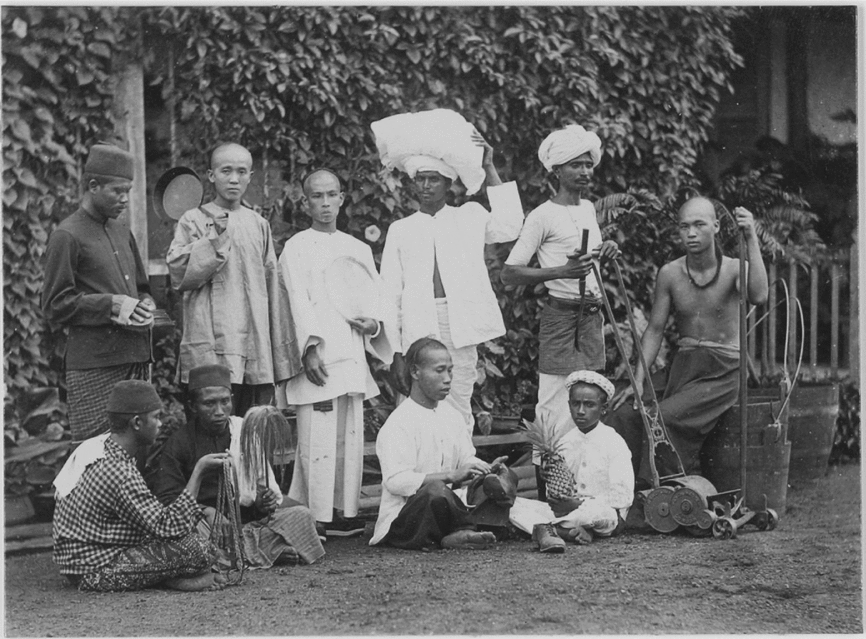
Regardless of the purpose for which they were intended, photographs of servants can be mined for details on the daily reality and material culture of servants’ lives. The dirty work involved in colonial housekeeping, such as cooking in the kitchen, washing the sheets, and emptying the bed pans, was very rarely the subject of photography.Footnote 77 Nonetheless, photographs of servants attest to the diversity of households in which servants worked, ranging from the basic conditions and attire of the Chinese dobie (laundry worker) in the Frontier town of Darwin to the opulence and formal livery of ‘houseboys’ employed in wealthy households in urban centres like Batavia.Footnote 78 Figure 15—an elaborately staged image from Singapore—provides an accurate reflection of the ethnic division of labour in the wealthy British households of Singapore.Footnote 79 Included within the ten domestic workers in the image are a Chinese cook and ‘houseboy’, a Malay groom, and an Indian dobie. The photograph also provides information about the tools of the trade and thus the nature of the work—the grass cutter held by the gardener suggesting hard physical labour, for example.
Ten domestic workers of various ethnic origins, each with an object related to their job, Singapore, circa 1900, KITLV, 29190.

Figure 15 is a quintessential example of the ways in which European colonizers used photography in an ethnographic and condescending way to display ‘racial types’.Footnote 80 It also draws on British and European traditions of photographing servants with their tools—a photographic tradition that was also replicated in the Netherlands Indies.Footnote 81 The story of this photograph is more complex than objectification and victimhood. It is likely that these men and the young boy were paid by the photographer to take part in the image. As Jane Lydon has documented in relation to anthropological photographs of Aboriginal people in colonial Victoria (Australia), the subjects of such images sometimes bargained hard with photographers to achieve remuneration for being objectified in this way.Footnote 82 Certainly, Chinese male servants in Singapore were well known for asserting their rights in the workplace and in colonial society more broadly.Footnote 83
Even photographs that were clearly taken in the ethnographic style, such as Figure 16, can be used to illuminate relationships between servants. It is possible that racial hierarchy and strategies of segregation and divide and rule that governed colonial life in British and Dutch colonies in particular resulted in marked separation between servants of different ethnicities working in the same home.Footnote 84 Figure 16 suggests that hierarchy may have been a feature of the relationship. Note the Aboriginal servant girl's lack of shoes and positioning off to the side of the group in contrast to the elaborate livery and self-assured stance of the other servants. On the other hand, these servants may have bonded over a common experience of colonial and domestic exploitation. Photographs of servants do not provide answers about the relationships between servants. However, they prompt historians to at least consider these relationships and to seek out fragmentary written records that illuminate the diversity of servant–servant encounters, ranging from conflict to romantic attachments.Footnote 85
Mixed group of six domestic staff pose outside Government House, Darwin, Northern Territory of Australia, circa 1911–18, Jean A. Austin Collection, NTL, PH0412-0020.

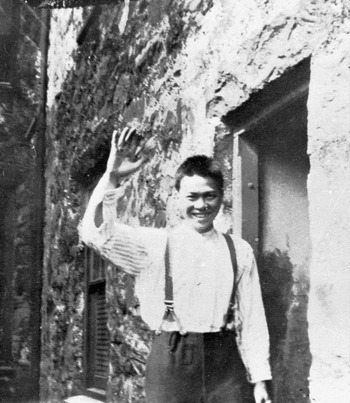
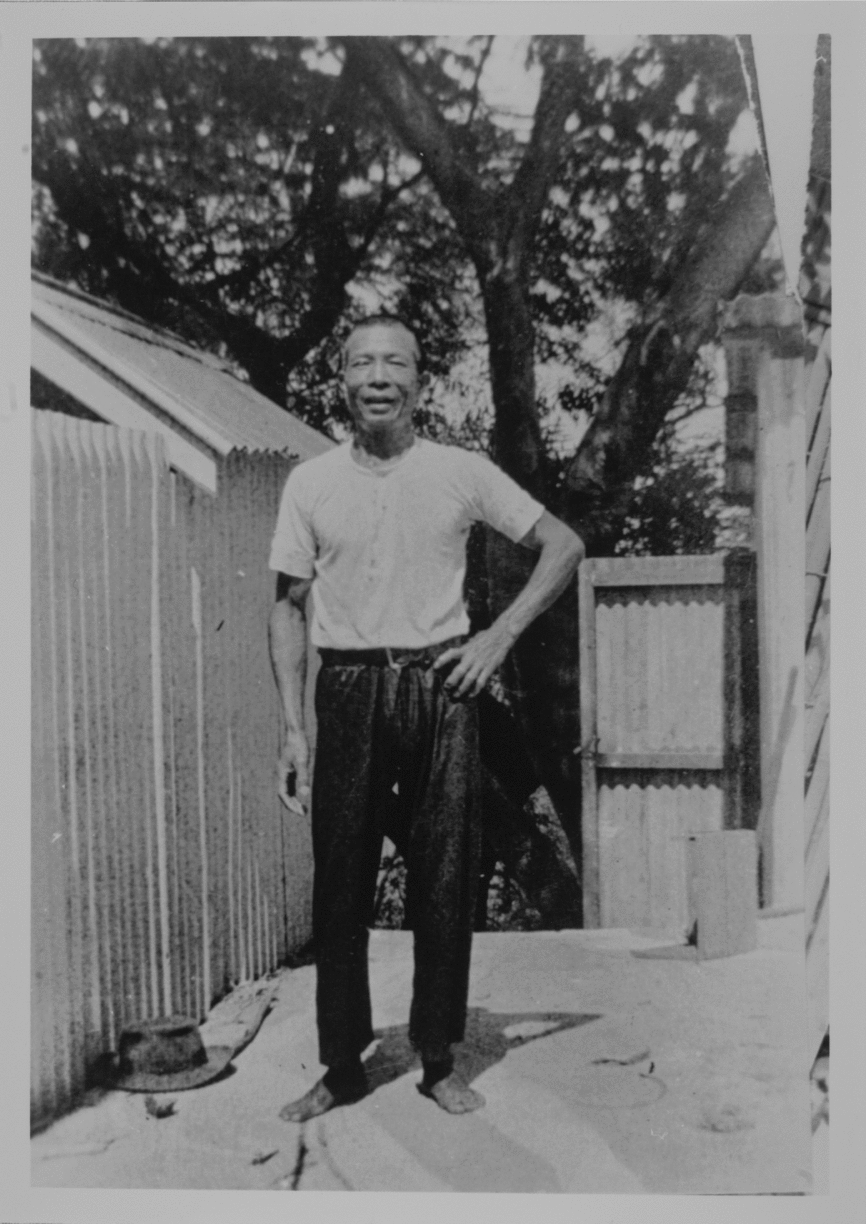
While most photographs of domestic servants are highly staged, the photographic archive includes some candid amateur images of servants taken by their employers within the family home. They feature domestic servants smiling at the camera and variously engaged in work or at leisure, as we see in Figures 17 and 18 from Hong Kong and Darwin.Footnote 86 Amateur snaps reflect the growing availability of cameras from the early twentieth century and technological developments that allowed more spontaneity in photographs.Footnote 87 These less structured images of servants do not at first glance seem to be engaged in asserting colonial power. They capture a moment in which the domestic worker (rather than their employers) decided on their stance, facial expression, and position in the photograph. As such, they perhaps even provide a glimpse of the individual personality of the domestic servant.
One of Percy Smith's Chinese servants, Hong Kong, 1924, HKPRO, PH003518.

Chinese servant in Government House grounds, Darwin, Northern Territory of Australia, circa 1911–18, Jean A. Austin Collection, NTL, PH0412-0009.

Even in these candid shots, however, the employers of servants still held the power in terms of the decision to take the picture and the setting in which it was taken.Footnote 88 Despite their appearance of spontaneity, these photographs promote a prescribed image of the past—telling a story of domestic harmony and kindly masters. As a former Aboriginal domestic servant, Nancy Wood, put it when presented with a photograph of herself smiling in a household where she had a painful and unhappy working-life: ‘What a picture can do.’Footnote 89
When viewed alongside the memoirs and oral histories of former domestic workers, photographs of servants can be seen in a new light, as Nancy Wood's comment illustrates. In their interviews with former servants of the Dutch, Ann Laura Stoler and Karen Strassler noted the tendency of their informants to contradict the sentimental representation of the colonial home so often evoked in the photographs and memoirs of employers of servants. Instead, they recalled the home in pragmatic terms as a site of monotonous work, ridged routine, and tactile encounters with their employers’ bodies and bodily fluids.Footnote 90 First-hand accounts of the men who worked as servants in Southeast Asia and northern Australia are extremely rare. Apart from the three interviews with former Javanese male servants from Stoler and Strassler's study, I know of only three oral histories from Asian male servants, all of which come from Singapore.Footnote 91 One of these is an interview with Lim Ming Joon, a Hainanese man in Singapore who worked as a servant for British and Armenian employers in the 1920s before becoming a photographer. Lim's account adds further weight to the observations of Stoler and Strassler. He described his job in matter-of-fact terms as involving cooking, sweeping, polishing shoes, and cleaning ‘the container used for shitting’.Footnote 92
The photographs that hold the greatest potential for accessing the perspectives and attitudes of domestic servants are the studio portraits that they commissioned themselves, such as Figure 2. While the photograph of Pedro, Aniceto, and Felix is the only image of its kind that I managed to locate, it is possible that self-commissioned servants’ photographs were more common than the formal archive of colonial Southeast Asia indicates. In Singapore, Hong Kong, the Netherlands Indies, and the Northern Territory of Australia, photographic studios owned by British, Dutch, American, and white Australian photographers primarily serviced the white colonial elite. In contrast, the clientele of Chinese, Indonesian, and Filipino photographers included middle-class professionals and, as photographs became less expensive in the early twentieth century, labourers from non-European backgrounds.Footnote 93 In addition, the growing affordability of cameras from the early twentieth century resulted in people being able to purchase their own cameras.Footnote 94 Lim Ming Joon, for example, recalled how his Armenian employer gave him one of the two cameras that he owned, inspiring him to leave domestic service and open up a photography studio. Lim's studio serviced mainly Chinese workers, who commissioned photographs of themselves to be sent home to their families in China. As Lim put it, Chinese workers ‘liked taking photos’.Footnote 95
This contextual evidence suggests that more studio portraits and amateur snaps may have been produced or commissioned by servants. That such images are not included within the collections of formal archives indicates that self-commissioned photographs of workers were rare. At the same time, however, it may also be a consequence of the failure of many archives and museums to collect private images from non-European communities. In terms of colonial Indonesia and Australia, this gap in the photographic archive is only just beginning to be addressed.Footnote 96 The task of locating self-fashioned servant images is made more difficult by the fact that few of the photographs produced by Chinese photographers, particularly those serving middle- and working-class communities, have survived.Footnote 97
Despite the challenges of the archival record, a small number of self-commissioned servant photographs have been located outside of formal archives. In his history of Singapore, Kenneth Gaw includes a studio image of two ‘black and white’ amahs (Chinese female servants) from the 1920s. Gaw provides some context for the photograph, which he located an antique shop in Singapore, explaining that amahs commissioned such images to be sent home to China.Footnote 98 Michael Aird's study of Aboriginal women and photography in colonial Queensland includes a studio image commissioned by Katie Williams, an Aboriginal woman who worked as domestic servant in the 1920s. Williams was Aird's great-great aunt and the photograph is part of his extended family's private collection.Footnote 99 In addition to the photograph from 1924, two other studio images of Williams from the 1920s were reproduced in her daughter's autobiography.Footnote 100
While the photographs produced by the employers of servants depicted them as faithful, servile, and exotic, those that domestic servants paid photographers to produce tell a different story. Like Katie Williams in Queensland, Aniceto, Pedro, and Felix in Manila dressed in their finest clothes (or perhaps hired them from the studio) in order to cultivate an image of success and respectability. In contrast, the Chinese amahs from Singapore dressed in the characteristic uniform of the ‘black and white amahs’—a white shirt and black trousers. Yet, in this case too, the domestic workers emphasized their prosperity and modernity by having watches, rings, and earrings painted onto the portrait.Footnote 101 According to Lim Ming Joon, workers in Singapore often requested that jewellery be painted onto the photograph in cases where they did not possess any.Footnote 102
That the image of the amahs from Singapore was intended to be sent home to China and the photograph of Williams from Queensland was preserved in a family album indicates that a desire to illustrate economic and social advancement for the benefit of family members was one factor that motivated domestic servants to have themselves photographed. Yet such images may have had broader political purposes. As Aird puts it in the Australian context, the process of dressing up and paying for a studio image was for Aboriginal domestic workers a ‘tactic of survival’ amidst colonial oppression.Footnote 103 For Aniceto, Pedro, and Felix, the production of their portrait and, in particular, the act of presenting it to their mistress seem to have been intended to challenge the domestic and colonial hierarchy.
For those employers who thought of their servants as possessions, providing them with neat attire or even elaborate livery was a means of maintaining social status.Footnote 104 When servants adopted the clothing and pose of their masters, however, the implications were rather different and had the potential to disrupt the colonial hierarchy. The American mistress found the studio photograph of Aniceto, Pedro, and Felix, and the circumstances under which it was produced, ‘funny’ rather than threatening. Occasional photographs of servants pictured ‘passing as their masters’ produced by their employers in the Netherlands Indies suggest that other white employers were also relatively comfortable with servants transgressing racial and domestic boundaries.Footnote 105 Yet, in some homes, where domestic servants donned Western dress, they were punished or ridiculed.Footnote 106
As Gelman-Taylor has argued in relation to the Netherlands Indies, Western dress was seen to signify civilization and modernity. Chinese and Javanese people who embraced Western clothing elicited a medium of respect from the Dutch colonizers. The Western suit, in particular, embodied ‘power and the ability to enforce power’.Footnote 107 By dressing in this way and having their photograph taken, Pedro, Aniceto, and Felix seem to have been asserting their sense of authority. In presenting the photograph to their American mistress, the servants seem to have been well aware that they were turning the power dynamic of the master–servant relationship on its head. Indeed, they were ‘tickled to death’ to do so. As with the other Filipino people in this period, Pedro, Felix, and Aniceto used their clothing and the photographic medium to ‘assert themselves as civilized citizens capable of self-government’.Footnote 108 The American woman's admission in the caption that Pedro had given her permission to ‘go home’ someday further illustrates the desire of these men to assert control not only over their mistress, but also over the entire colonial project.
Conclusion
This article has explored how photography was used by masters and servants as a tool for asserting and contesting power in the home and the colony. Photographs of Asian ‘houseboys’ produced or commissioned by employers of servants in colonial Southeast Asia constituted a visual culture of empire. The common language, messages, and knowledge embedded within this culture affirmed white colonial power, yet also expressed deep-seated anxiety and ambivalence about colonial rule in this region. As well as illuminating the common culture of the Asian ‘houseboy’, photographs of servants highlighted the particularities of the domestic service relationship and the different ways in which the colonial project was conceived of in different colonial contexts. Those rare studio images that domestic servants commissioned themselves hint at the existence of a visual counter-culture at work in colonial Southeast Asia. At the very least, the photograph of Pedro, Aniceto, and Felix illuminates the way in which these men saw themselves or wanted to be seen—as powerful actors rather than devoted servants.
When it comes to photography in colonial Southeast Asia, domestic servants’ ability to represent themselves on their own terms was highly constrained. Domestic workers who commissioned their own studio images seem to have been the exception rather than the rule. Servants who ceased to be the subjects of photographs and became photographers in their own right, such as Lim Ming Joon, were rarer still. What this article has aimed to illustrate, however, is that there are opportunities for considering servant perspectives and experiences in all types of photographs. There is no denying the choreographed nature of the photographs of servants taken or commissioned by their employers. Nonetheless, casting a critical eye on these photographs brings to light a sense of the daily lives of domestic servants and the ways in which they contested the power of their employers.