


ORIGINS IN HUNGARY
When I was a child, my favorite book was Wonderful Journey by Selma Lagerlof in Hungarian translation. The story is about a boy who is turned into a Tom Thumb for bad behavior. He joins a flock of wild geese and travels with them on the back of a goose on a series of adventures through towns and forests, even under the sea to an “Atlantis.” He speaks the language of the animals and learns good behavior. As a reward, after a year, he is transformed back into a regular boy and goes home. He looks up wonderingly at the flock of geese going on another adventure but can no longer understand the language of animals. He is sad. At this point, I always cried. (I did not know that the story, written in 1907, took place in Sweden and was a geography lesson of Sweden, specifically. It is available now in English as the Wonderful Adventures of Nils. Selma Lagerlof received the Nobel Prize.)
I was born in Budapest, Hungary, in June 1943, during the middle of the Second World War. I was the older daughter of Laszlo Miskolczy and Klara Konya. My father was an architect interested in modern, i.e., Bauhaus, architecture who was very successful in the 1930s. He designed villas, apartment houses, factories, and an internationally known resort hotel. During communism (1947–1956), he was the head of the Hungarian City Planning Bureau, rebuilding old cities and planning new ones. He admired people who “did” things, like doctors and engineers. He was disappointed in me for being a scholar and professor and referred to me as “my daughter, the schoolteacher.”
My mother, 16 years his junior, was a beautiful model and beginning actress. She gave up acting after marriage and the birth of two daughters. She wanted me to be a movie star and/or the socialite wife of a prominent man. She was always telling me not to spend so much time in the library.
She came from a small town in Transylvania (then in Rumania) and my father came from a small town in southern Hungary. It was a wartime courtship. They met on the first train that went from Budapest to Transylvania in 1941, when Hitler returned Transylvania to Hungary in payment for Hungary siding with him in the war. The return lasted only a short time but, unfortunately, Hungary would do anything to get Transylvania back and was punished in the peace negotiations by losing it again. Those were tumultuous times.
Hungary was still in relative peace when I was born in 1943, but by 1944 the Germans occupied it and the Soviet forces laid siege to Budapest. The inhabitants of Budapest moved to the cellars. As a one-year-old, of course I don't remember anything other than what I was later told. Bombs, sirens, corpses in the streets, eating horsemeat, and Russian atrocities against everyone, especially women, were matters of everyday conversation.
After the siege, I don't know how, my father was asked by a villa owner to finish an unfinished building in exchange for living there for free. It was a spectacular apartment overlooking the Buda hills. A few years later, the communists moved multiple families into such large apartments to ease the housing shortage. So, to prevent this, my father divided it up and voluntarily gave some of it up to the state. It was still a gorgeous apartment in one of the most exclusive streets of Budapest. My father was not a member of the Communist Party, although he was always pressured to join. There were not enough communist professionals and intellectuals to run the country, so people like my father were needed by the system for their practical expertise. Later in life, he regretted even this much cooperation.
I grew up pampered with maids in the kitchen and learning French from a native-speaking nanny, while hearing stories of communist torture and the disappearance of people like one of my uncles. Everyone was terrified if the doorbell rang in the evening, the favorite time of the Secret Police (AVO) for taking people away. No one was immune. In school I learned to lie and pretend. Darwin did not discover evolution, Lysenko did. We were taught that everything worth inventing was invented by a Russian. The Russians “liberated” Hungary. We all pretended to learn all this but did not believe it. So much for the supposed powers of brainwashing.
My family were all, one way or the other, involved with the visual arts. My mother was interested in Paris fashion as well as folk dress and designed our clothes, even under communism. My father searched out the primitive beauties of peasant architecture and published photographs of them in a book. My uncle, his brother, was an artist, especially of watercolors, though only of repute in Baja, the town of their birth. (There is now a house museum of his works.) He and my father were concerned about the decline of folk crafts in the 1930s and founded a weaving workshop near Baja. They designed rugs combining the current Art Deco style with folk motifs. I now have two of these rare and special rugs in my living room.
One of the high points of my childhood was a trip to the opera. I particularly remember seeing The Magic Flute and Don Giovanni, which inspired me to design similar costumes—the Queen of the Night in black and silver, Don Giovanni all in white for the Champagne Aria. I started out wanting to be a costume and set designer for opera. Later, in the United States, my father told me to take an art history course to learn the various styles, as well as architectural drawing to create the sets.
THE REVOLUTION OF 1956
After 1945, the Soviets took over eastern Europe, put in puppet governments, and treated them as colonies to be exploited. An “Iron Curtain” stopped anyone from leaving the country. Hungarians listened eagerly for any signs and information from the “West,” especially the radio program The Voice of America, which urged the East to resist and rebel and promised “help.” In 1953, Stalin died and Soviet rule eased a little. There was restlessness in eastern Europe, but Hungary was the first to rebel. On October 23, 1956, there was a spontaneous uprising in Budapest against the Soviets and communism. It was primarily a nationalistic rebellion against the occupying Russians and secondarily a rebellion against the enforced communist economic system that was bankrupting the country. Almost everybody, including workers, joined the students who started it in an exhilarating experience of national pride and unity.
It all lasted only 11 days. At first, the Russians were taken by surprise and were not sure what to do. For a few days the Hungarians thought that they had actually won. Despite many pleas, the West did not help. They were preoccupied by the more immediate crisis of the Suez Canal. By November 4, the Russians stopped hesitating and shelled the city, putting down the revolution by force and exterminating everyone who seemed to have been in it. The general consensus now is that the United States did not interfere for fear of starting a Third World War.
We were not involved in the rebellion itself, beyond listening to the radio and watching the tanks out of the window. Like most naïve Hungarians, we were elated when we thought we had won. The “Iron Curtain” was dismantled by the revolutionaries right away and some people began streaming across the borders immediately. My father decided that all was lost and we should also leave the country. We set out around November 15–20 and crossed the border to Austria on the 24th. So as not to know the truth in case we were captured, we children were told that we were going “visiting” and none of us took anything with us and expected to come back in a few days. We escaped at night, in the last stretch climbing over ploughed fields and dodging the searchlights of Russian tanks to the sound of machine gun fire. We were among 200,000 Hungarians who left the country in a short time.
The United States expanded its quota for Hungarian refugees, and my father's sister-in-law, who lived on Cape Cod, convinced my father to come to the United States. (He was also thinking of Rio de Janeiro and Bruxelles.) After various camps in Austria, we were flown to the United States, to an army base in New Jersey, and my aunt's son drove us to Cape Cod. We were there sometime before Christmas. My aunt arranged that my father should look for a job in New York and placed my sister and me in different boarding schools so we would assimilate more quickly. A few weeks later, by the middle of January 1957, I was in a boarding school (The Cambridge School of Weston, Massachusetts, near Boston), not speaking a word of English. I was 13 years old. I remember feeling numb.
PRIMITIVE ART
After I learned English and became familiar with American customs, I had a wonderful time at The Cambridge School. I starred as Miranda in The Tempest, the Chinese Princess Kukachin in Eugene O'Neal's Marco Millions, Nebuchadnazzer in modern dance, spent many hours in the art studio, and I learned to write. Hungarian education put a heavy emphasis on memorization. At the Cambridge School, everything was written. Writing was a pleasure. A scholarship enabled me to attend Vassar College, where I took the architectural drawing and art history courses my father had recommended. I was astonished by art history, which revealed all the hidden meanings a work of art could have that were not obvious by looking at it. It was cultural history through an artistic lens. The intellectual aspects of art history appealed to me and I abandoned the idea of its practical application in stage and costume design.
I transferred to Barnard College when I married Blaise Pasztory in 1963 and moved to New York. Like me, Blaise came to the United States from Hungary as a child and studied at Exeter, Harvard, and Harvard Law. Our similar backgrounds and a location in New York where there was a large Hungarian exile community was homey and comforting after years of American “assimilation.”
Barnard College had many more requirements than Vassar and, although I got interested in other subjects, such as geology, I only had the necessary credits to major in art history. I studied everything from ancient to modern art and covered Islamic, Hindu, Chinese, and Japanese art, as well. My favorite projects were the Medieval notebooks of Villard de Honnecourt, the Baroque architecture of Borromini, and especially Guarini. I was tempted to go into Asian art, but the immediate necessity of buckling down to language study in those areas made me hesitate.
Primitive art as a subject emerged in a required anthropology course. The instructor assigned us to go to a gallery or museum and write about a work of “primitive art.” Cultures then considered “primitive” included Africa, Australia, Melanesia, Polynesia, Siberia, North and South America including the Aztec, Maya, and Inka, and sometimes some of southeast Asia and Indonesia. Primitive art included most of the world! There was plenty to choose from.
There was an African art gallery near my neighborhood run by a Hungarian called Segy and that seemed to me to be the easiest of access for this paper and, of course, the fact that he was Hungarian made it less intimidating. I looked around among the some roughly, some smoothly, shaped pieces of wood in his gallery and nothing caught my eye. Then, in a back room there were little stick figures of metal (brass?) that seemed curious. I asked Segy what they were. He said that they were gold weights from the Ashanti of Ghana. He told me that they were made precisely to weight and weighed gold dust. He showed me the picture of an Ashanti scale to weigh gold dust in a book. Each gold weight was also a proverb.
I was enchanted. Gold weights and gold dust south of the Sahara in Africa! I knew nothing about this. There were also the European silks unraveled and rewoven in African designs in Kente cloth worn by the Ashanti kings—fascinating! What else was there in the world that was wonderful and about which I knew nothing? When I went to graduate school at Columbia University, I decided to follow up this mysterious world-wide primitive art that seemed to be neglected by art historians. Some of my professors told me that I would never get a job teaching it and should stay with the Renaissance. Luckily, I was married, my husband supported my interests, and I could afford to be adventurous. Coming to the United States made the whole world available to me the way it could not have been in Hungary. I may have lost my homeland, but I gained that world.
The first Museum of Primitive Art was founded in the 1950s. It was located one block from the Museum of Modern Art in New York and housed the collection of Nelson Rockefeller. Because it was the modern artists like Picasso who “discovered” primitive art around 1900, there was always a connection between primitive and modern art. While many people learned grudgingly to appreciate modern art, only a small number of those went on to value primitive art. The study of primitive art was the interest of a small minority who prided themselves on being at the cutting edge of art history.
ANCIENT AMERICA
My initial grand idea for the study of African art for my Master's degree at Columbia University was to concentrate on group composition. It was obvious that most African art consisted of masks and single figures and that group composition was less common. I had divided it into three themes—figures flanked by attendants, and two others I can no longer remember. Professor Wingert talked me into focusing just on flanking in west African art. A comparison of several cultures, Ashanti, Benin, Yoruba, Ijo, and Bamum among them, showed that male attendants were usually contextualized by political hierarchy, while female attendants were contextualized by fertility and agriculture. The relationship of representation in relation to sociopolitical structure was my first subject and has remained so. This was in contrast to the studies of style that were then popular.
Columbia University was one of the few places where one could get a degree in Primitive Art. The older Paul Wingert and the younger Douglas Fraser were among the handful of pioneers both of whom wrote a book entitled Primitive Art. Although Wingert was an Africanist and Fraser an Oceanist, and later an Africanist, as well, they both taught everything, including American Indian and Ancient American (then called Pre-Columbian) art. In addition, we had visiting professors such as the African and Inuit (Eskimo) scholar Hans Himmelheber, famous for fieldwork, Gordon Ekholm, the Ancient American connoisseur from the Museum of Natural History, and Alan Sawyer, then preparing for a Peruvian show at the Guggenheim. Also, the Anthropology department had the Peruvianist Ed Lanning, who did not believe in the importance of art. Still teaching were the retired Margaret Mead and Ruth Benedict. It was a stellar beginning.
As fieldwork was necessary for a Primitive Art dissertation and traditional arts and societies were still flourishing in many parts of the world, as a budding Africanist I was expected to go to Africa for an extended period of time. Given my family situation, that was impossible and, thinking it all over, something in Mexico seemed more practical. I thought of a topic like “Female Figures in Aztec Art” when we went on a tourist trip to Mexico visiting all the major museums and sites. I still remember the moment I set foot on the avenue at Teotihuacan and saw the enormous site with the two pyramids spread out before me—I had never seen anything like that, and I had the same feeling of awe every subsequent time I went there, however often.
That was the site I wanted to study. I discovered very quickly that there were many fragmentary murals and that very little was known about them. I wanted to study them rather than the better-known Aztecs. With so much material, it seemed best to concentrate on the murals of one of the best preserved and published apartment compounds, which was that of Tepantitla. Studying Tepantitla at Teotihuacan counted as fieldwork and I became an Americanist. At my oral exams, I majored in Pre-Columbian Art, which consisted of Mesoamerica and the Andes, and minored in Primitive Art, which consisted of Africa, Pacific, and American Indian Art. My second minor was Ancient China, Shang to Han periods. It was a background of amazing breadth.
At my oral exams in the spring of 1968, the Columbia campus was in turmoil. Most buildings were occupied by protesters and my professors and I wandered around looking for an available room to in which to hold the exams. The larger issue was the Vietnam war, but the local issue was Columbia's plan to build a gymnasium in Morningside Park, which was in Harlem. The protesters objected to taking land away from the black community. Douglas Fraser joined the protesters and soon after had a nervous breakdown and had to be hospitalized. I was asked to substitute for him and began my long teaching career at Columbia. In the early years, I taught Primitive Art, Pre-Columbian Art, and Art Humanities – Parthenon to Picasso-European Art.
NON-WESTERN ART
One result of the 1968 protests was that the gymnasium in Morningside Park was not built. Liberal members of the Art History department felt strongly about civil rights and asked me to prepare a teaching unit on African Art for the Art Humanities course. It was to be next to the unit on Picasso. That required the choice of a mask-using rural culture and, because of their variety and abstraction of their masks, I chose the Bamana (Bambara) of Mali. I did not want to leave students with the impression that all African art was village art, however, so secondarily I also prepared an Ife-Benin unit on naturalistic bronzes and court art from Nigeria. The two were to work together.
Although all members of the teaching faculty were expected to teach the African units, in fact no one did except for me. They all pleaded that the material was too alien to them and they could not do it. After a few years, the unit disappeared from the Art Humanities curriculum. I was frustrated in that it was a lot of wasted time. About a decade later, I was asked by the department to prepare a unit on Maya art. I did not want to do it, since I expected the same result. Still, it was argued that this time all faculty would teach it for certain. For the core building, I chose the Palenque Temple of Inscriptions and tomb. Presumably, portraiture, naturalism, and hieroglyphic writing would be attractive to students and faculty alike. It would fit somewhere near the Parthenon and Amiens Cathedral in the sequence. For a while, a few people taught it but, basically, history repeated itself and it was dropped. Once this, too, was removed, I made my unhappiness known to the faculty member in charge. I asked him at least to change the title of the course, which was Masterpieces in the Fine Arts, to Masterpieces in Western Art, and that is where we left it.
The irony is that the students liked the non-Western units just fine: to them it was all the same, something to be studied for the exam. They had no more idea where Amiens was than where Palenque was. African art was no stranger to them than Picasso. They made imaginative parallels and differences between ancient Greek, gothic Amiens, and Maya Palenque, coming up with things I never thought of—the Tree of Jesse genealogy at Amiens and the Sarcophagus at Palenque ancestors as parallels, for example.
As far as the faculty were concerned, non-Western art was fine in its own marginalized context, but was not to be mixed up with the central focus of art history and the art theory derived from it, which was Western art. Western Art had nothing to learn from non-Western art, it already knew everything.
TEOTIHUACAN – THE FIRST TIME
My dissertation on Tepantitla was not a very significant contribution and was more in the nature of a learning experience. Teotihuacan was once thought to be Aztec or sort of like the Aztecs. In the 1960s, great advances were made under the direction of René Millon. He directed a mapping project that determined that Teotihuacan was a great urban city with approximately 2,000 apartment compounds, housing 100,000–150,000 people. New dates put the beginning of the city ca. 100 b.c. and the end by a.d. 600. The great pyramids were built relatively early in the sequence, the apartment compounds relatively late, but there were mysteries galore—no one quite knew what language the Teotihuacanos spoke or the ethnic group to which they belonged.
The murals in which I was interested were mostly in the apartment compounds, the construction of which was believed to have been ordered by a great pharaonic ruler. Teotihuacan was the greatest city in ancient America and was influential on all its neighbors in Mesoamerica. Clara Millon, René’s wife, had written the first dissertation on the chronology of the murals and had a complete list of them. I met various members of the Mapping Project, including George Cowgill (computer analysis), Michael Spence (obsidian), Evelyn Rattray (ceramics), and Warren Barbour (figurines), as well as others who helped me understand what was and was not known. The Mexican scholars archaeologists Ruben Cabrera Castro and Linda Manzanilla and art historian Beatriz de la Fuente subsequently added a great deal.
The mural of Tepantitla was perhaps, not so oddly, a large figure flanked by profile figures like the African sculptures I studied. The large frontal figure was surrounded by water symbols and plants. There were also mysterious scenes of little figures, all within elaborate borders. It had been interpreted as the Aztec rain god Tlaloc and the little figures were in his afterworld “paradise.” Rows of richly but uniformly dressed “elites” were in flanking rooms as secondary processional figures. I saw female traits in the frontal figure and thought it was either a female or bisexual deity, but not the Aztec rain god. The little figures might have been performing rituals in this world and not necessarily in the next. It was not a very satisfactory interpretation, although various symbols and imagery were taken apart and usefully analyzed.
I received my Ph.D. in 1971 and that same year I gave birth to my son, Adam. I was teaching, but I was still very much learning. I spent considerable time traveling through Mexico and Guatemala looking at everything, especially in the Maya area, such as Tikal, Palenque, and Seibal. The Maya sites and images were extremely different from those of Teotihuacan. I rented a plane and pilot to find the then-roadless sites of Yaxchilan and Bonampak in the tropical forest. It was my homage to that great painted mural; homage because, due to a white coat of silica, the Bonampak murals were almost invisible. Near Lake Atitlan and Chichicastenango, I collected beautiful modern Maya embroidered blouses (huipiles), to which I added on subsequent trips: I suppose I was continuing my parent's interest in peasant art. Eventually, I came to the inevitable conclusion that, as everyone was using Aztec information to interpret Teotihuacan and my Aztec knowledge was limited, I better turn to a thorough study of Aztec art if I wanted to understand Teotihuacan.
AZTEC ART
There is no contemporary written information about Teotihuacan: it is all archaeology. The Aztec empire and culture existed only for a few hundred years prior to the Conquest. It came into being about five hundred years after Teotihuacan had collapsed and had no clear historical knowledge of it. There were myths, but they were as confusing as they were helpful. Because the Spanish conquered the Aztecs in the sixteenth century, there are reams of data written by conquistadors and missionaries, either in Spanish or in Nahuatl adapted to the European alphabet. Histories, religious rituals, everyday life, craft activities, even speeches and poems were recorded. Actually, for the Aztecs there were more documents available than archaeology.
Although Aztec monuments, such as the famous Calendar Stone, were well-published, for research, most Aztec works were hidden in separate books and articles. There was no one book that illustrated them all. As I was doing research on all of Aztec art anyway, it occurred to me to publish a book of most Aztec sculpture, which was the best-known art. The publisher I turned to, who at first understood “Aztec” to mean all of Mesoamerica, wanted me to cover all the media. As a result, the book has architecture, sculpture, lapidary art, gold, turquoise mosaic, featherwork, codices, ceramics, and figurines, much to its benefit. Meant to be a survey, the book was greatly improved by information from historical study of the major monuments completed by my student, Emily Umberger.
What I learned from the project was twofold. For one, all the texts I had been reading did not help explain the monuments a great deal. Second, I discovered there was no one Aztec art: the dramatically carved mythological and historical monuments with terrifying death imagery were mostly made for the major elite temples of the Aztecs. They were meant to awe not just their peoples but visiting dignitaries who might have been allies or adversaries. The smaller or local temples had simpler fertility deities in stone, such as wind, rain, water, or corn deities, of standardized form and benign aspect. The corn goddess was by far the most numerous sculpture. Rural areas had clay figurines, mostly of women with or without babies, who had no resemblance to any of the stone images and were perhaps personal fertility images. The codices had some of the nature deities, but also many other deities necessary for the calendar that may not have had a cult at all. In other words, Aztec images depended on social class as well as function and were not uniform. There were many anthropomorphic beings.
Aztec Art was a very useful and popular book. The College Art Association said it was worthy of a prize, but they no longer give prizes to survey books, only to in-depth detailed studies since, in most areas, survey books were written a long time ago. The Pre-Columbian field was backward. So, I received a “citation.” On the other hand, the book got me tenure.
After his recovery from a nervous breakdown in 1968, Douglas Fraser returned to teaching as a professor at Columbia. I was an assistant professor hired for eight years who could move up the ladder if there was a “line” available. If no line was available, I would have to leave Columbia. As Fraser was in his fifties, my chances were slim and I hung on with fellowships and visiting professorships. Quite unexpectedly, Fraser caught legionnaire's disease at a conference and died shortly after. Ghoulish as it was, I inherited his line in 1982. The tenure committee particularly liked Aztec Art, then in galleys, and I received the professorship. Tenure also allowed me to support myself and get a divorce. Besides personal issues, eventually I found living in the New York Hungarian community restricting and wanted to get to know and assimilate into “America” as I then understood it. After all, I was living in America. Although I only moved from the East Side to the West Side of Manhattan into a Columbia apartment, this step was a major rupture and undertaking in my life. It allowed me to take myself more seriously as a scholar.
TEOTIHUACAN – THE SECOND TIME
In 1976, the San Francisco architect Harald Wagner died and left the de Young Museum about 200, some very small, Teotihuacan mural fragments. In the early 1980s a large number of them were returned to Mexico in a controversial repatriation. I was called in to examine them as an “expert” on Teotihuacan art. The murals were extremely important and mostly in good condition. Polychrome paintings of feathered serpent and flowering trees with glyphs related to the nature theme of the Tepantitla murals and murals in shades of red of apparent dignitaries with emblems or glyphs related to the elite figures. The museum decided to publish the murals and Clara Millon and I divided the murals on which we wanted to write. René Million located the place where the murals were looted from and named it Techinantitla. It had been an unusually large compound. The de Young editor, Kathleen Berrin, asked me to write an introduction on Teotihuacan for the volume, published in 1988.
After my study of Aztec art, I knew that the Aztecs and Teotihuacan were very different. They shared a calendar, mythic beliefs about the universe, heart sacrifice, the importance of the rain god, now called the storm god at Teotihuacan, and many other details common in Mesoamerica. But the differences were glaring: Teotihuacan lacked large-scale sculptures of mythic-historic subjects representing gods and rulers. While there were references to war and sacrifice in imagery, the emphasis seemed to be on nature, fertility, and water.
Most unusual was the fact that there were no clear divisions between social classes. Insofar as we can tell, there were no elaborately decorated palaces, or mostly they did not survive. The murals came from more or less upper-middle class houses and were widespread. Even more striking were the figurines and incense burners, which were more or less the same throughout the site. As Aztec art differed by class and function, Teotihuacan art was more or less one. While there was variety in quality, the types of things were the same. It was also striking that there were no images of royalty and the elaborately dressed elite figures were usually identical in rows as groups rather than individuals: even the rare Techinantila ones with glyphs were uniform figures. Unlike Aztec style, which tended towards naturalism, Teotihuacano style was flat and abstract, further downplaying the human element.
Aztec art made it possible for me to see the special features of Teotihuacan art. In those days, I was particularly interested in reading poststructuralist analyses as general theory. I was not unique, it was then the vogue. I was particularly interested in Roland Barthes, who wrote extensively about the significance of forms, not just in art but in everyday things such as cars and children's toys. What I gleaned from this reading was that the nature of objects expressed the nature of social ideologies and was a form of evidence and source of information in itself. (Art history had said the same thing, but was too involved in issues of “beauty” and “genius,” which, for my work, was irrelevant.) Most archaeologists believed that art was an epiphenomenon— i.e., it described social and political realities after those had happened but had no creative impact on them. I was convinced that art existed because it had a functioning role in society. So, somewhere between Aztec art and Barthian analysis, I concluded that Teotihuacan must have had some kind of a collective “ideology,” if not an actual “collective” form of government and society. I wasn't sure what word was right, “communal,” “collective,” or whatever.
As I was still a beginner in Teotihuacan studies, I showed the draft of my chapter to René Millon, the great archaeologist in the field, for his opinion. We had been working together for years, especially at Techinantitla. He was vehement and adamant that I was wrong and that Teotihuacan must have had a very powerful absolutist ruler like a pharaoh. He was probably thinking of then-current anthropological theory in which societies go through stages of social complexity such as bands, tribes, chiefdoms, and states. The early state was defined as absolutist power from the top down. As he put it, and others quoted him saying it, “Teotihuacan was not built by committee.” As a result, I toned down my chapter. Subsequently, however, he actually began to use the word “collective” to describe Teotihuacan. Most upsetting to me was that he did not give me credit for the idea. I even wrote him a letter about this and stopped consulting him.
While working on the Wagner murals, the San Francisco de Young Museum decided to do the first major Teotihuacan exhibit with Kathleen Berrin and myself as co-curators. Called Teotihuacan: City of the Gods (1993), we were hoping to stress some of the conventional wisdom about the site which most people did not know. This was my chance to put my ideas about Teotihuacan in visible form. My theme was to be abstraction as the formal language of a collective ideology. The Instituto Nacional de Antropología was not enthusiastic about an exhibit generated outside Mexico, which, in retrospect is understandable. Eventual cooperation with Mexico led to necessary compromises in the objects and catalogue essays. The museum's preconceived notions of pre-Columbian art and how it should be exhibited exaggerated more the similarities to other arts, like the Maya or Aztec, rather than differences in which I was interested. Clever lighting brought out dimensions not visible in ordinary light. My “theme” was not really visible, although the exhibition was wonderful and a great success in itself. An art connoisseur quipped to me at the time that we “managed to make Teotihuacan things look like art with this exhibit.” What he meant coincided with my opinion that Teotihuacan things are by nature not arty, and that's what had to be explained.
I embarked on a book, Teotihuacan: An Experiment in Living (1997) because I was unable to get my ideas across in the previous two projects. This was the first non-technical book on Teotihuacan and received an award from Oklahoma University Press as their best book of 1997. In brief, my argument went as follows. The population of Teotihuacan lived in good masonry apartment compounds and appeared to have a higher quality of life than any other Mesoamerican culture. Although these habitations were late in the city's history, they likely reflected earlier living patterns, suggesting that people had “rights” and or “powers” commensurate with their living quarters. Second, at any rate, there was no royalty commemorated in images and/or inscriptions, as in the Maya and Aztec area, and/or royalty kept a low profile. Teotihuacan objects we might consider “art” were few, modest, mass-produced, and non-aristocratic, i.e., not glitzy or elaborately aesthetic and naturalistic. In general, Teotihuacan did not rule or even think very much in images. I attributed all this to a “collective” ideology that emphasized the community rather than individuals.
I assumed that, during the about 600 years that Teotihuacan lasted, its government might have undergone changes, that perhaps at the time of the building of the pyramids there were more powerful rulers than at later times. I thought of the collective outlook as a general tendency that was stronger and weaker at various times, but was always a characteristic. I had no practical suggestion as to the governmental form or popular participation in the Teotihuacan state beyond a sense of its essential nature. I knew this view would be controversial, but I hoped to encourage debate.
One immediate effect of the book was a strong desire among my archaeological colleagues to prove me wrong on the “collective” issue. Following their agendas and perhaps my challenge, the subsequent decades saw the in-depth excavation of the major pyramids, hoping to find the burials of one or more powerful rulers that were predicted. Although these excavations proved to be very important, no royal burial was found. The concept of the “collective” is in some ways now accepted, but it is not credited to me, as if my work had not called it forth at all. In any case, I went off to do another project of great importance to me and let Teotihuacan drop for the moment.
THINKING WITH THINGS
Since the 1970s, I was particularly interested in neoevolutionist writings in American anthropology and archaeology. There had been many attempts to sort out and classify various early societies in the past, but the schemas of my own time seemed especially cogent to me. Although many scholars were involved in this project, I particularly picked up on the books of Elman Service. Dividing societies into bands, tribes, chiefdoms, and states seemed to me to create sensible order in a lot of seemingly disparate heterogeneities. It was easy to see how they could have developed from one another in an evolutionary scheme.
I saw at once that these categories would match up perfectly with the types and forms of art I was studying, especially in “Primitive Art.” Moreover, I also saw that they would solve the apparently silly developmental schemes in art history, which went from “abstraction to naturalism” or vice versa. That schema went back to the eighteenth-century writings of Joachim Winckelmann, who posited a gradual development from stylized Egyptian to naturalistic Greek art. Opposite schemas of naturalism to abstraction came from students of the decorative arts. The development of naturalism was supposed to be slow and to require an advanced philosophical vision.
If one looked at the art of “bands, tribes, chiefdoms, and states” anthropologically, it was obvious that each of these social types needed different types of visual objects and preferred different styles. “Tribal” societies might prefer masks, not necessarily of refined but dramatic forms, while chiefdoms might prefer exotic materials, intricate craftsmanship, and shiny surfaces. There are naturalistic moments here or there, but there is no question of a unilineal “abstraction to naturalism” development overall. As societies change, types of art and styles change with them. These changes are not random, however, but follow certain structural paradigms.
I felt that, with my background in art history and anthropology, I could make sense of this and tried to write a book on it after I completed the Teotihuacan study. I knew that it would be unpopular. While popular for a while, the neoevolutionist schema became unpopular even among anthropologists for being too rigid and simpleminded, although it often seemed to be in the back of their minds even when they avoided it. Art history was in the thrall of poststructuralism, that held that such “totalizing” theories were wrong to undertake at all and one should study a particular form or time in detail and let some generalizations emerge from that. Nevertheless, I believed in my insight and wrote it up in a suitably apologetic tone. Little stories or anecdotes began each chapter and I drifted around to the major points, quite verbosely focusing also on the exceptions where my theory did not seem to work. I entitled it Towards a Natural History of Art. As my art history friends considered it “wrongheaded” and no publisher was interested in it, I put it in the drawer.
There were major changes in my life at that time. The Berlin wall came down in 1989 and the Russians withdrew from Hungary. Elections were being held for a new democratic regime. Many Hungarian exiles decided to go back, if not completely, at least to see what was happening. My former husband opened a law office and bought a house in Budapest besides continuing his American life. I, too, wanted to get involved in the new Hungary. I looked up the anthropology section of Eötvös Loránd University. They were eager to be international. We exchanged information about our work, there was some talk of translating Aztec Art into Hungarian, I helped my Hungarian colleagues get grants in the United States, and they suggested that I come and teach for a semester. The way to do this, they explained, was to apply for a Fulbright teaching grant and they would take care of it at the Hungarian end.
I was very excited about the prospect of teaching in my homeland. My Hungarian language skills were very good for everyday life, but I would have to bone up on intellectual talk and technical expressions, and it might not be easy. It was a challenge. I took a semester off the following year, and I applied to the Fulbright. Rentals being scarce but prices very cheap, I bought a studio apartment, luckily fully furnished in Budapest. I prepared for this project by readying Toward a Natural History of Art for classes. I hoped that Hungarians would find it more interesting.
In short, I got the Fulbright, called Budapest, and was told that they had changed their minds and no longer wanted me to come and teach there. No reasons were given and none I could find out. Besides my own profound disappointment, I was also embarrassed to say at Columbia that, at the last minute, teaching in my homeland was called off. So, I decided to go, see Hungary for myself as an adult, and enjoy a free semester in my new apartment. In some ways, it was a relief that I didn't have to teach in Hungarian after all and, in fact, that I didn't have to teach. I decided that, just as I had planned, I would work on Natural History.
Thinking that my old manuscript was hopeless, I decided to write a whole new version from scratch, cutting out the defensive tone and the unnecessary bits of information, focusing only on the major arguments in a brief and concise manner. The text became very short and to the point. I discussed it with Hungarian friends who were, in fact, interested in it and received excellent responses and advice, especially from Zsolt Farkas, a literary critic and writer at another university who was very knowledgeable about poststructuralist thought, and Janos Gyarmati, an Andean archaeologist specializing in the Inka working at the Ethnographic Museum. Both suggested that my book needed an introduction on “what is art.” I was mulling that over.
While I was in Hungary with freedom on my hands, I decided also to start into a novel. I had long wanted to write a novel on a pre-Columbian theme, so on the long evenings I started the adventures of Marigold from Teotihuacan, which I entitled Daughter of the Pyramids. I had written various fiction pieces before, but never anything ambitious like a novel. It was just a start.
My Hungarian sabbatical allowed me to recover the Hungary I remembered from my childhood, to learn how people lived and thought there, and what might have become of me had my father not taken us to the United States. Although I enjoyed myself, I ended up feeling very “American” and looked forward to going home to New York. An experience on my return to New York inspired the missing “what is art” section of the book. After a long sabbatical in Hungary, I found my New York apartment all wrong and no longer “me.” It bothered me so much, that I got up after a night's sleep and before breakfast and dressing, I rearranged the furniture, the pictures, and all the things in it. I didn't have an idea behind it, I just did it. When I finished, I looked to see what I had done. In my apartment, which was perfectly nice, things had been arranged in sets of similar things, separate from each other. That morning I had transformed it by putting different things next to one another and finding more subtle similarities between them. I had integrated my belongings in a completely different way. I gathered that this integration had something to do with myself after my Hungarian sojourn. Consciously, I did not know this, but I was literally “thinking it through with things.” I then realized that I was “thinking with things” all the time.
Rather than emphasizing “beauty” and the “aesthetic” experience, as in European art history, it seemed evident to me that the purpose of “art” was cognitive—to think with. Moreover, “art” was anything that was designated as worthy of such thought, and could be anything, human-made or not. There was no intrinsic quality of art-ness in any object, so I called them “things.” Things useful for thought were particularly important until writing and texts took their place in history. That either spelled the end of art in the denial of iconoclasm or deflected it into the overvaluation of aestheticism.
It thus became possible for me to integrate non-Western and European things in one theoretical framework: I found this very satisfying. To the anthropological bands, tribes, chiefdoms, and states, I added two more categories —a textual era and a media era bringing the evolution to the present. From the time of the cave paintings, some thing or images, including what we call art, were not a sideline in culture but necessary to communicate ideas about society, religion, and identity, as well as a host of general and specific issues. Text and media have changed that forever. So, the title of the book became, Thinking with Things (2005). The footnotes alone were a colossal task. The book became so short that it needed to be amplified by a handful of articles for publication. The book has been of particular interest in Europe, Mexico, and even the Middle East (an Arab translation came to naught because of the expense of illustration permits).
THE YEAR 2000
Three noteworthy things happened in my life in 2000: I remarried, I was diagnosed with cancer, and I organized and held a conference entitled “West by Nonwest.”
In July, I married the artist Richard Eaton on Deer Isle Maine. His family had lived there for generations and he was a genuinely rooted American. I stopped going to Hungary for my summer vacations and moved to Maine. I felt that I was finally assimilating into some corner of America, learning how people thought and behaved. I thought I might belong. Although I continued to teach at Columbia and live in New York, the interesting part of life was now in Maine. Deer Isle turned out to be an interesting place. Amazingly enough, the noteworthy outsider inhabitants included William Haviland, a Maya archaeologist, and Hank Millon, brother of René Millon and head the Center for Advanced Study in the Visual Arts, an art historical institute in Washington, DC. A former summer inhabitant of the island was the pioneer pre-Columbianist art historian, George Kubler. I joined the local writer's group and I learned to eat lobster. I also got to know the “native” community who had been living, fishing, intermarrying, and gossiping there in their own world since the eighteenth century, some once off the Mayflower.
In the fall, I was diagnosed with breast cancer and spent most of 2001 with lumpectomy, chemotherapy, radiation, and medical therapy. Once released from all of that, in the summer at Deer Isle I was, as anyone would be, full of thoughts of mortality and unfinished business. The project I was most anxious to complete was the “novelette” I had begun in Budapest. Even though it was several years later, I decided to finish it, as is, and not to redo it from the beginning. Energized by the desire to complete, I transformed the early somewhat aimless dithering into a fantasy of time travel. I turned my pre-Columbian heroine, Marigold, into a modern writer who becomes trapped in her own book and has Marigold's adventures herself. Although it has some humor, the book is an awkward learning experience and I published it myself.
I wasn't done with fiction writing by Daughter of the Pyramids. I continued to write fantasy and ghost stories out of my Hungarian, American, and pre-Columbian experience. I stayed funny, sometimes with a bit of black humor, but found little readership. One story judged “the best” is “My Jo,” the comic story of a Hungarian Freedom Fighter of 1956 living in the United States, who is trying to write a book about an American girl in order to understand what America is like. It is in Conversations with Quetzalcoatl and Other Stories (2013). One of the things that interested me as a writer was how to combine fiction and nonfiction styles. Every one of my stories is a different attempt at creating such a juxtaposition. This works particularly well with memoirs, which I have tackled in different ways, this being one of them.
The third event of 2000 was a conference at the Metropolitan Museum in November that I had organized to celebrate 50 years of pre-Columbian art history. Entitled “West by Nonwest,” neither the speakers nor the audience knew quite what to make of it. I suppose I did not explain it very well. What I meant was that, no matter how much we try to define or understand the non-West, we are dealing with the preoccupations and unconscious desires of the West, i.e., ourselves. Everything comes back to ourselves and we need to know ourselves better. The reigning paradigm in the field, however, held that we could know the non-West with no difficulty. The aim was to describe how different the non-West was from the West, that the non-West can be defined, and it is the task of the scholar to define it. No one wanted to admit that the non-West is a Western construct. Forgery, which is not recognized as such for half a century or more, lent itself to this theme. Cancer prevented me from turning this into a book, so the essays were published in the journal RES.
After 2000, I had no major scholarly projects, like Aztec Art, or Teotihuacan, or Thinking with Things. The shorter projects I undertook dealt one way or another with the sometimes obvious, sometimes obscure, Western component of research about ancient America: Jean Frederic Waldeck's discovery and misunderstanding of Maya art in the early nineteenth century in the context of European exoticism; Aztec human sacrifice in Western thought; Western forgeries of great pre-Columbian art in the nineteenth and twentieth centuries; popular Western theories of extraterrestrials; or, formerly, the Indians as the Lost Tribes of Israel.
THE END OF PRIMITIVE ART
The field of study entitled “Primitive Art” began disintegrating by the 1980s. There was a general feeling that the term “Primitive” was too pejorative and had to be abandoned. No alternative was found. The Museum of Primitive Art closed its doors and the Nelson Rockefeller collection was given to the Metropolitan Museum in the 1980s. This move institutionalized primitive art in some ways and redefined it as marginal in in other ways. The gallery was named the Africa, Oceania, and Americas Gallery. Although the areas were still yoked together, especially is museums, they were now defined by geography. As scholarship grew exponentially, there was no way that any one person could know all this material and they were no longer taught together in universities. Rarely did Africanists, Oceanists, and Americanists talk together or write for each other: specialization set in.
At the same time, by the 1990s, due to globalization and modernization, traditional “primitive” culture also disappeared. The most remote Amazon tribes had camcorders to help applying for grants for their own survival. Masks were still made and masquerades held in many parts of the world but for tourists, not insiders, or for both at best. Isolated unique human groups pretty much disappeared. The “traditional” arts we searched for and studied in the 1960s were all in local or international museums. People referred to them as “classical,” which would have been an oxymoron, or even “extinct.”
At Columbia, this phenomenon was evident in applications: students stopped applying to study the traditional arts, they wanted to study “Contemporary Nonwestern Art” which was in no one's curriculum. Another facet of globalization was that many natives picked up the vocabulary of modern art, either on their own or with the help of Western teachers, in order to sell to Westerners and tourists. They combined native themes with the freedom of modern art and created fantastic images in all media–Australian Aboriginal painting, Inuit soapstone carving, African photography. Museums did not know what to do with these exciting things at first—besides bemoaning the end of traditional art—put them in modern art, in regional art? We did not teach it and there was no literature on the subject.
As this subject interested me since the 1980s, I taught seminars on it and was eventually joined by half a dozen colleagues at Columbia whose areas of research included these developments. Since none of us were specialists, we joined forces in a team-taught course we entitled Multiple Modernities. The Africanist Susan Vogel and I were the major organizers. Our aim was to understand this new art and phenomenon, what it had in common, and how it fit into the Western reality of things. As in the old days, these courses were global and comparative and a lot of fun to learn and teach. A book of essays was planned by Susan Vogel, but did not materialize. I put my introductory essay, “Multiple Modernities,” on the web. Events moved faster than the course: many non-Western artists learned to use the mechanics of the Western Art world in no time at all, exhibited in places like the Venice Biennale, and were even featured in popular magazines like Vogue. Rapidly, they became a part of the international modern art world. We played a tiny part in this process.
INKA CUBISM
From the beginning of my teaching career, I alternated courses on Mesoamerican and Andean art. I found the similarities and differences fascinating. Students often preferred things like unworked stones set up as monuments by the Inka, strange textile and metallurgy techniques suggesting “essences,” intentional deformations of shapes, and, of course, the famous Nazca lines, visible mostly from the air. Until I was commissioned by an art series to write a book on pre-Columbian art, I hadn't had the chance to publish anything on South America. This little book gave me the chance to compare Mesoamerican and Andean arts in their sociopolitical contexts.
I, as well as others, have come not to like the term “pre-Columbian” and I was beginning to use the term “Ancient American.” Most people have no idea what “pre-Columbian” means and the reference to “Columbus” does not help. The editors, however, insisted on titling this book Pre-Columbian Art and also chose the cover photo without my input. (Later they complained that they could not do translations into other languages because the term “Pre-Columbian” did not mean anything in many other countries.) “Ancient America” is becoming the present label.
Although I was getting close to retirement, I thought I would do a little book based on my insights of teaching Andean art over the years. I kept up with most of the literature, but I was not a specialist in any one culture. However, I had something to say here and there and I thought that might be valuable. Because Andean art is mostly abstract, though complex in its own way, I entitled it Inka Cubism: Reflections on Andean Art. Although several publishers liked it, all the Peruvianist readers hated it. It's not so much that I was wrong or I didn't know what I was talking about, but that I was a “well-known Mesoamericanist.” None of them seemed to think that an outsider's point of view might be interesting; they were protecting their turf from me. I had hoped that the word “Reflections” would indicate the nature of my enterprise as accessory to the work of Peruvianists, but it didn't. Perhaps continued publishing attempts would have eventually found me two sympathetic Andean readers, but what with illustrations, permissions and revisions, and the passage of time, it was turning into too big of a project. I was retiring shortly and decided to give up the book project and, typescript as it was, I put it on the web. To my satisfaction, a few Andeanists I admire, such as Gary Urton, have liked my comments so far.
TEOTIHUACAN – THE THIRD TIME
I retired in 2013. I was 70 years old. There was the customary symposium in my honor, published as “Visual Culture of the Ancient Americas” (2017). I did not think that I would do any more serious work on Ancient American topics. I donated my extensive library to the Indian Museum at Bar Harbor Maine, my papers to the Newberry Library in Chicago, and my modern Maya textile collection to the Brooklyn Museum. We moved to Deer Isle Maine, which proved too isolated, and then to a retirement community in Kennebunk, southern Maine.
In the writer's groups there I tried to learn how to write fiction and memoir/nonfiction for the nonacademic general reader. I wrote a sequel to Daughter of the Pyramids in which the heroine, left in Tikal, comes back to the United States and discovers a looted Maya vase, which she then returns to ancient Tikal. It is a who-done-it, ghost story, romance lark. Entitled The Maya Vase, reader-friends judged it a great improvement on Daughter of the Pyramids. I found in the writer's groups that people liked short pieces. So, I wrote a series of humorous vignettes about famous and non-famous people I met, interesting places I had been to, and curious and sometimes poignant things that happened in my life of assimilation to American culture I eventually called Multiple Horizons. Neither of these was quite long enough for a book in itself.
In the fall of 2016, I was contacted by the British Broadcasting Company (BBC), who were making a television series entitled Civilizations with the emphasis on the “s.” They liked Thinking with Things very much, and wanted to interview me for the film on the remarkably naturalistic Olmec heads and the issue of realism that I had written about. They were interested in forgery.
On my way home from the interview, I was annoyed with myself for not mentioning that the Olmec heads were carved with stone tools. Those of us in the field of Ancient American art take the stone tools for granted and rarely mention them. Other features of Ancient America came to mind that I wished I had mentioned to the BBC. Shortly, I had a whole list of aspects of the Americas that the BBC or anything like might wish to know – not a history, but a series of features. I began to write them down and explained them by comparison with conditions in the Old World. It brought out, even to me, how favorable the ancient civilizations had been. Entitled “Stone Age Civilization of the New World,” the essay turned out to involve Teotihuacan in great detail. Short, personal, and idiosyncratic as it turned out to be, it was not publishable in the usual university presses. I decided to go with the idiosyncratic and join it with the other pieces I had been writing, in that they all had the same voice. I decided to publish it with “The Maya Vase” and “Multiple Horizons” in a hybrid volume with the title of Exile Space: Encountering Ancient and Modern America. Memoir, Essay and Story (2018).
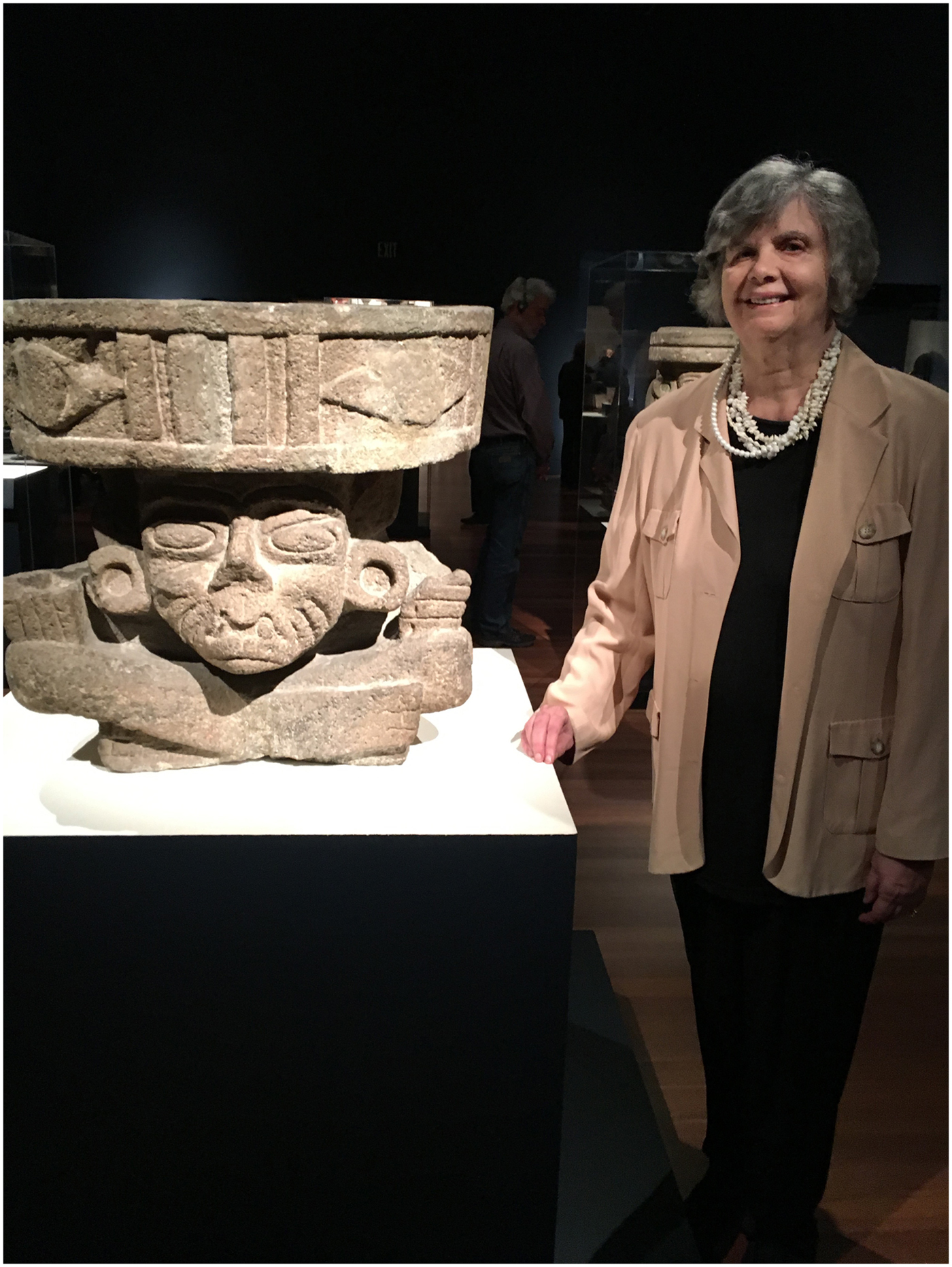
September 30, we moved to San Francisco, to be near my grandchildren. Coincidentally, on arrival, the San Francisco de Young Museum happened to have a major Teotihuacan exhibit. The exhibition features the objects and information from the excavations of the last decades that I followed only from a distance, right here at my doorstep. This brought forth other dimensions and interpretations of Teotihuacan added to my old ones. The major discovery of the excavations into the major pyramids and other important structures was what wasn't there: there was no evidence of a royal tomb, or clear evidence of a royal palace complex at Teotihuacan. (Various structures could have functioned as palaces and/or administrative centers, but were not obviously so as could be determined from material features.) Given my interpretation that Teotihuacan had either a “collective” ideology or a “collective” governmental structure, I felt vindicated. The catalogue did refer to “collective” features without mentioning my earlier work or name, but I suppose I had to make do with the fact that the “idea” made it, even if my connection with it did not.
In the essay for the imaginary BBC, I took on the issue of the well-worn critique that Ancient America was backward in lacking metal tools, the wheel, horses, and cattle by asking why the Old World had them in the first place. I suggested that the Stone, Bronze, and Iron ages there developed in quick succession due to the extremely competitive and combative situation. Better tools and weapons were a necessity in the many competing civilizations of the Old World, who did not just threaten each other to the point of annihilation but were subject to deadly invasions from afar like the horse nomads of the Huns, Tartars Mongols, and others. New techniques and ideas were the silver lining of these violent far-flung interactions. Such a situation may go back far in the history of Old World, at least as far as the conflicts between Homo sapiens and Neanderthals.
By comparison, Ancient America had it easy. The land the Asian migrants came into was unspoiled, unoccupied, and rich in domesticable vegetarian foods. Only two civilizations emerged in Mesoamerica and the Andes, only minimally in contact with one another but, most importantly, not a threat to each other. Patience and care worked well in agriculture and stones were similarly adequate in technical purposes. While there was plenty of small-scale local warfare and eventually empire-building, there were no invading hordes or seagoing vandals to worry about. Ancient Americans had no large-scale slavery, police force, or standing armies. To build or accomplish anything major, they had to convince, inspire, and, to some extent, recompense their own people. To be sure, religion has always been a good inspiration but, in the Americas, people seem to have been convinced to cooperate by actually belonging (socially, politically, or ideologically) to the society that wanted their work.
There is relatively little data to support this, except the labor service system of the Andes and the structure of Teotihuacan in Mesoamerica. The lack of a pharaonic ruler at Teotihuacan and the well-made apartment compounds of the inhabitants has suggested a “republic type of government.” Added to that fact is the lack of a rich state and aristocratic tradition of things proving their legitimacy and the humble figurines, vessels, and incense burners found in all levels of the social pyramid. The recently found large greenstone figures are possibly state and “aristocratic” things, but they are remarkably inarticulate about the nature of power. The rows of richly dressed elite in paintings suggest collective power. Some elements of collective organization have been noted in other parts of Mesoamerica.
How can one explain it? One explanation is that, in a culture with a stone technology, it is practical to develop the kind of social engineering that works more on the basis of cooperation rather than competition. Another explanation may be that Ancient American customs derive from early man hunting Pleistocene fauna communally when the Americas were populated. We know little of this because the sixteenth century observers were probably blind to it. But it is there, in the magnificent cities and monuments that were built that rival the Bronze Age works of the Old World. Yet, they are not the same. The pyramids of Egypt and Teotihuacan may look the similar on the outside, but their contexts are very different. The Teotihuacan context is that of a more or less egalitarian “tribal” or simply ranked “chiefdom” culture writ large, rather than an ancient Old World state.
Ancient Americans had, for a time, great good fortune: they had time, patience, isolation, and cooperation to create works that were way beyond their apparent level of development. In other words, they could create a civilization practically from nothing. The scale of layout of Teotihuacan is the equivalent of the American ambition to put a man on the moon. But, of course, Ancient Americans could not compete with a predatory Old World.
ENTRANCES
George Kubler, the Ancient American scholar, argued that artists are often “great” because of their “entrance.” By entrance, he meant the point at which their work appears in the development of a particular tradition, such as early or late. Certain things are possible only at certain times. George Kubler's entrance was in the very beginning, and he sketched out the whole field without going into detail. My generation followed his lead and had the good fortune to study most cultures in detail for the first time. Now, younger scholars complain that there is nothing left for them to study. The field is now more mature and needs new and different approaches. It has been my good fortune to have had a wonderful “entrance.”


