Introduction
Natural disasters are associated with negative consequences on mental health, including depression, anxiety, somatic symptoms (e.g. headaches), post-traumatic stress, and substance misuse (Beaglehole et al., Reference Beaglehole, Mulder, Frampton, Boden, Newton-Howes and Bell2018; Goldmann & Galea, Reference Goldmann and Galea2014). Disasters also create physical and organizational barriers to the delivery of mental health care (Bonanno, Brewin, Kaniasty, & Greca, Reference Bonanno, Brewin, Kaniasty and Greca2010). Hence, there is an interest for accessible interventions that can foster psychological resilience in disaster-stricken populations. However, interventions in the immediate aftermath of a disaster, when the distress peaks, have often been found to be useless or harmful (Bonanno et al., Reference Bonanno, Brewin, Kaniasty and Greca2010; Rose, Bisson, & Wessely, Reference Rose, Bisson and Wessely2003). Efforts during the recovery period (1 month to 1 year post-disaster) could be more effective (Bonanno et al., Reference Bonanno, Brewin, Kaniasty and Greca2010).
Women who are pregnant at the time of the disaster or who conceive during the recovery period could particularly benefit from such interventions. Female gender and younger age are associated with a greater risk of developing post-disaster psychopathology (Goldmann & Galea, Reference Goldmann and Galea2014). In perinatal women, hardship from the disaster superimposes on the uncertainties of pregnancy (Brock et al., Reference Brock, O'Hara, Hart, McCabe, Williamson, Laplante and King2014; Serverson et al., Reference Severson, Olson, Hyde, Brémault-Phillips, King, Bick and Olsonsubmitted for publication).
Expressive writing (Pennebaker & Beall, Reference Pennebaker and Beall1986) is a simple intervention that could be remotely delivered during the post-disaster recovery period in the hopes of improving psychological outcomes in perinatal women. It consists in expressing one's ‘deepest thoughts and feelings’ about difficult experiences, during daily writing sessions of 15 min, for 3–4 consecutive days. This technique, which does not require clinician feedback, has generated interest across disciplines. Studies suggest it could relieve distress in veterans (Sayer et al., Reference Sayer, Noorbaloochi, Frazier, Pennebaker, Orazem, Schnurr and Litz2015), reduce healthcare utilization costs in healthy post-partum women (Ayers et al., Reference Ayers, Crawley, Button, Thornton, Field, Flood and Smith2018), and improve immunological parameters in medical patients (Frattaroli, Reference Frattaroli2006).
Despite this enthusiasm, past research has provided mixed evidence to establish the psychological benefits of expressive writing (Frattaroli, Reference Frattaroli2006; Qian et al., Reference Qian, Zhou, Sun, Wu, Sun and Yu2020; Reinhold, Bürkner, & Holling, Reference Reinhold, Bürkner and Holling2018). As a systematic review has shown, most studies to date have been underpowered to detect small effects on post-traumatic stress symptoms (Pavlacic, Buchanan, Maxwell, Hopke, & Schulenberg, Reference Pavlacic, Buchanan, Maxwell, Hopke and Schulenberg2019). The intervention may be more effective if it features more than three sessions of expressive writing (Frattaroli, Reference Frattaroli2006; Qian et al., Reference Qian, Zhou, Sun, Wu, Sun and Yu2020; Reinhold et al., Reference Reinhold, Bürkner and Holling2018), if it is conducted at home, if the writing sessions are 15 min or longer (Frattaroli, Reference Frattaroli2006), and if specific instructions about writing topics are provided (Frattaroli, Reference Frattaroli2006; Reinhold et al., Reference Reinhold, Bürkner and Holling2018). Certain populations may benefit more from the intervention, such as participants with pessimistic traits (Frattaroli, Reference Frattaroli2006), but it is not clear if expressive writing is more effective in those with or without clinical post-traumatic stress disorder (Pavlacic et al., Reference Pavlacic, Buchanan, Maxwell, Hopke and Schulenberg2019).
Current study
Hurricane Harvey made landfall in the State of Texas, USA on August 25, 2017, flooding one-third of the city of Houston (Amadeo, Reference Amadeo2019). Tens of thousands of families were displaced out of their homes, while others were left without power or clean water for weeks. In response to this single disaster, we conducted the largest randomized controlled trial of expressive writing to date, harnessing population and intervention characteristics previously linked to greater efficacy for psychological outcomes.
The primary aim of our study was to (1) examine whether expressive writing, compared to two controls (neutral writing and no writing), could improve post-traumatic stress symptoms in Houston women who were pregnant during or shortly after the flooding. In order to examine the intervention's efficacy across levels of distress, women with any level of post-traumatic stress were included. Our secondary aims were to: (2) determine the efficacy of expressive writing for improving depressive and anxious symptoms, (3) test a number of putative moderators of the intervention, and (4) assess the participants' feelings during the intervention and the mediating effects of these feelings on the primary outcome.
Methods
Design and participants
This randomized controlled trial had three parallel arms: expressive writing, neutral writing, and no writing. The recruitment, consent, interventions, and assessments were conducted online. Participants were assessed at baseline (i.e. at recruitment before randomization) and 2 months post-intervention. All study procedures were approved by the University of Houston Institutional Review Board.
In a priori power analyses, a sample of 1000 participants was found necessary to detect a small effect size of d = 0.20, with a two-sided alpha level = 0.05, and anticipating an attrition of 20%. Eligible individuals were English-speaking women aged 18–45 residing in the greater Houston area, and who were pregnant at the time of, or who conceived within 6 months of, Hurricane Harvey's landfall (August 25, 2017). Women who had a multiple pregnancy were excluded.
Recruitment
Women were recruited between February 12 and October 9, 2018. The study was publicized locally on social media, in the newspaper, on the radio, and through the distribution of flyers in community centers serving pregnant women. Women were invited to visit www.vantageppc.com/harvey-study, where they could learn about the study, check their eligibility, and enroll. Eligible women received a standardized email. Participants were offered $20 gift cards for each phase of the study completed (total of 80 USD). All participants provided their informed consent via electronic signature.
Randomization
The group allocation table was created by an independent data analyst and was implemented with an internet-based platform (REDCap™), which allowed for allocation concealment. Participants were randomized to either expressive writing, neutral writing, or no writing. The assignment was conducted using unstratified, block randomization (block size = 6), and a 1:1:1 ratio (Broglio, Reference Broglio2018). The allocation sequence was established using a computer random number generator. To avoid influencing participants' expectations, the nature of the intervention (i.e. expressive writing), was not disclosed, and participants were blinded to the hypotheses. The assignment was presented as ‘Writing Exercise A’, ‘Writing Exercise B’, or ‘No Writing Exercise’. Outcome measures were completed by participants using online self-report questionnaires. After participants completed baseline measures, they were randomized. After randomization, entries were examined individually to remove those with discrepant or duplicate demographic data.
Interventions
Group-specific standardized written instructions were emailed daily to participants (Supplementary Material). Participants in the expressive and neutral writing groups were instructed to write continuously for 15 min a day, 4 days in a row. For each day, they were provided specific instructions about what topics to write about.
Expressive writing
Participants in the expressive writing group were instructed to write about their worst fears related to the flood (day 1), about whether the flood had caused any change in their personal relationships (day 2), about the most traumatic experience of their lifetime (day 3), and about their lifetime or current worst conflicts or problems (day 4). Participants were asked to write about what had helped them deal with each situation or stressor. In line with Pennebaker and Beall (Reference Pennebaker and Beall1986) and subsequent studies of expressive writing (Frattaroli, Reference Frattaroli2006; Reinhold et al., Reference Reinhold, Bürkner and Holling2018), these instructions focus on extreme, difficult personal experiences. Written disclosure of personal upheavals is thought to facilitate cognitive processing and extinction of the stress response (Reinhold et al., Reference Reinhold, Bürkner and Holling2018; Sloan, Marx, Lee, & Resick, Reference Sloan, Marx, Lee and Resick2018), and some authors believe it benefits interpersonal relationships and problem-solving (Hoyt, Austenfeld, & Stanton, Reference Hoyt, Austenfeld and Stanton2016; Lepore & Greenberg, Reference Lepore and Greenberg2002).
Neutral and no writing
Participants in the neutral writing group were instructed to write about their exercising habits and goals (day 1), their eating habits (day 2), their general health and health history (day 3), and their work (day 4). Participants in the non-writing group were informed they were not assigned any writing exercise, and that they would be re-contacted later for follow-up questionnaires.
Primary outcome measure
At baseline and 2 months post-intervention, post-traumatic stress symptoms were measured as a continuous variable using the Impact of Event Scale-Revised (IES-R) (Weiss & Marmar, Reference Weiss, Marmar, Wilson and Keane1997). This 22-item scale assesses Diagnostic and Statistical Manual of Mental Disorders, fourth edition (DSM-IV) and International Classification of Diseases, eleventh revision (ICD-11) symptoms of intrusion, avoidance, and hyperarousal in the past 7 days, and was tailored to the stress from the flooding that followed Hurricane Harvey. Each item is rated on a 5-point scale (0 = not at all, to 4 = extremely). It has high internal consistency and strong predictive validity for post-traumatic stress disorder (Creamer, Bell, & Failla, Reference Creamer, Bell and Failla2003), and has been repeatedly used by our group with pregnant women affected by disasters (Dancause et al., Reference Dancause, Laplante, Hart, O'Hara, Elgbeili, Brunet and King2015; Laplante et al., Reference Laplante, Barr, Brunet, Du Fort, Meaney, Saucier and King2004; Simcock et al., Reference Simcock, Kildea, Elgbeili, Laplante, Stapleton, Cobham and King2016). Creamer et al. (Reference Creamer, Bell and Failla2003) proposed a clinical cut-off score of 33.
Secondary outcome measures
Affective symptoms
At baseline and 2 months post-intervention, participants completed a modified version of the Inventory of Depression and Anxiety Scales (IDAS) (Watson et al., Reference Watson, O'Hara, Simms, Kotov, Chmielewski, McDade-Montez and Stuart2007). In the IDAS, agreement to items is rated on a 5-point scale (1 = not at all, to 5 = extremely). From the original 68-item IDAS comprising 10 subscales, the following 5 subscales were extracted: depression, dysphoria, panic, ill-temper and well-being (total 40 items). All five subscales have strong internal consistency and predictive validity in normative samples (Watson et al., Reference Watson, O'Hara, Simms, Kotov, Chmielewski, McDade-Montez and Stuart2007).
Writing experiences
Feelings immediately after the writing tasks were measured using a daily post-writing questionnaire (Supplementary Material). This questionnaire comprises eight items assessing somatic symptoms of anxiety (e.g. headaches) and eight items related to mood (e.g. nervousness). Agreement with each item is rated on a 4-point scale (1 = not at all, to 4 = a great deal). After day 4, additional items on a 7-point scale addressed the overall writing experience: how difficult the assignment had been, how sad participants felt over the 4 days, and how valuable they found the writing tasks to be.
Other measures
Objective hardship
Participants' objective hardship from the hurricane was measured at baseline with the Harvey Objective Stress Scale (HOSS). The HOSS is adapted from previous scales developed by our group for other disaster studies of pregnancy (Dancause et al., Reference Dancause, Laplante, Hart, O'Hara, Elgbeili, Brunet and King2015; Laplante et al., Reference Laplante, Barr, Brunet, Du Fort, Meaney, Saucier and King2004; Simcock et al., Reference Simcock, Kildea, Elgbeili, Laplante, Stapleton, Cobham and King2016). It comprises 40 items assessing factual aspects of disaster experience (e.g. ‘Was your vehicle damaged because of the flooding?’). Total scores can range between 0 and 200, where a higher score indicates more severe hardship.
Peritraumatic distress
Distress reactions during or immediately after the flood were measured at baseline using the 13-item Peritraumatic Distress Inventory (PDI) (Brunet et al., Reference Brunet, Weiss, Metzler, Best, Neylan, Rogers and Marmar2001). Responders are instructed to think back to the time of the event and rate the extent to which they had experienced reactions, such as ‘I felt helpless to do more’ or ‘I thought I might die’, from 0 = not at all to 4 = extremely. This scale has high internal consistency, as well as strong predictive validity for post-traumatic stress symptoms (Brunet et al., Reference Brunet, Weiss, Metzler, Best, Neylan, Rogers and Marmar2001).
Time since the hurricane
To adjust for heterogeneous timings of assessments and interventions relative to the hurricane, time was calculated in days elapsed between the hurricane's landfall and the 2-month post-intervention assessment.
Cognitive appraisal
The cognitive appraisal was measured at baseline with the following single item: ‘Overall, what were the consequences of the hurricane on you and your family?’. Answer choices were ‘Very negative’, ‘Negative’, ‘Neutral’, ‘Positive’, or ‘Very positive’. This item has been used by our group in several disaster studies of pregnancy (van den Bergh et al., Reference van den Bergh, van den Heuvel, Lahti, Braeken, de Rooij, Entringer and Schwab2017), and was found to be a factor of resilience in mothers (Paquin, Elgbeili, Laplante, Kildea, & King, Reference Paquin, Elgbeili, Laplante, Kildea and King2021). As done in these studies, because of positive skew, answers were dichotomized between negative and neutral/positive appraisal.
Others
Resilience was also measured with the following item: ‘When things go wrong in my life it generally takes me a long time to get back to normal’ (rated on a scale of 1 = don't agree at all to 5 = agree a lot). Timing in pregnancy was defined as days since conception at the time of the hurricane's landfall (negative value if pre-conception). Sociodemographic characteristics were self-reported at baseline. Prior journal keeping at baseline was defined as journaling or blogging since the hurricane.
Statistical analyses
All analyses were performed in R version 3.6.1. Baseline characteristics were compared between the three groups using Kruskal–Wallis one-way analysis of variance for continuous variables and chi-square test for categorical variables. Analyses were by intention to treat. Multiple imputations were performed using chained equations (van Buuren & Groothuis-Oudshoorn, Reference van Buuren and Groothuis-Oudshoorn2011); 20 datasets were generated.
To compare outcomes between groups, analyses of covariance (ANCOVA) with type III sum of squares were performed. In primary models, the only covariate was the baseline score of the model's outcome (i.e. either post-traumatic stress, depression, etc.). All outcome scores except for well-being were log-transformed to reduce heteroscedasticity and non-normality of residuals. In fully adjusted models, the following covariates were added: objective hardship, peritraumatic distress, and time since the hurricane. Interactions between the intervention group and the following putative moderators were tested separately: baseline score of the model's outcome, objective hardship, peritraumatic distress, time since the hurricane, cognitive appraisal, resilience, timing in pregnancy, educational attainment, prior journal keeping, household income, employment, race, and ethnicity.
To assess the effect of expressive v. neutral writing on daily writing experiences, linear mixed models with random intercepts were employed. Analyses were by intention to treat and were performed on the original (non-imputed) dataset since mixed models are robust to missingness-at-random. Baseline levels of post-traumatic stress were controlled for. Models were fitted using restricted maximum likelihood, and p values were derived from Satterthwaite approximations. All items except ‘happy’, ‘content’ and ‘fatigued’ were log-transformed. To assess the effect of expressive v. neutral writing on the overall writing experiences, ANCOVA were performed as functions of the intervention group and baseline post-traumatic stress symptoms. Mediations by overall writing experiences of intervention group on post-traumatic stress symptoms were computed using the mediation package (Tingley, Yamamoto, Hirose, Keele, & Imai, Reference Tingley, Yamamoto, Hirose, Keele and Imai2014).
For all tests, p values were considered significant below 0.05 (two-tailed tests). Adjusted means and standardized effect sizes for between-group differences were computed using the emmeans package (Lenth, Reference Lenth2020). To correct for multiple comparisons between groups, Tukey's method was applied to effect sizes. Effect sizes were interpreted as Cohen's d (d = 0.2, 0.5 and 0.8 correspond to small, medium and large effects, respectively). Population standard deviations were estimated with the residual standard deviations (in ANCOVA) or by combining random-effect variances (in linear mixed models). Sensitivity analyses consisted in (1) subgroup analyses of participants with clinical levels of post-traumatic stress at baseline (IES-R ⩾ 33) and (2) per-protocol models, wherein participants in the writing groups who did not complete all writing tasks, as well as those with missing data, were excluded.
Results
Descriptive statistics
Of 1388 individuals assessed for eligibility, 1090 were randomized to expressive (n = 363), neutral (n = 363), and no writing (n = 364) (Fig. 1). After removing participants who had provided unreliable dates of birth or were duplicate entries, 351, 357 and 350 participants in each group were retained for analyses, respectively. Across groups, participants did not significantly differ on demographics, disaster-related variables, or outcomes at baseline (Table 1). Compared to the general population of Houston, our sample reported higher educational attainment and household income, and underrepresented Hispanic/Latinx and racial minorities of Houston (online Supplementary Table S1). At baseline, 285 women were pregnant, and 773 had given birth (on average, women were 3.5 months post-partum; range: first trimester to 11 months post-partum). In each group, 24.2% (expressive), 19.1% (neutral), and 20.6% (no writing) of participants reported clinical levels of post-traumatic stress symptoms (IES-R ⩾ 33).
Flow chart of participants.

Sample characteristics at baseline for each intervention groupa

IDAS: Inventory of Depression and Anxiety Scales.
a No significant differences between intervention groups on any variable.
In the expressive writing group, 248 participants (70.7%) completed all four daily writing tasks. In the neutral writing group, 250 participants completed all writing tasks (70.0%). The two groups did not differ on the number of completed days writing (Kruskal–Wallis χ2 = 0.26, p = 0.61). Older age, lower baseline post-traumatic stress levels, higher education, and neutral/positive cognitive appraisal were associated with the completion of the writing tasks (online Supplementary Table S2). As for the 2-month follow-up, completion was similar [χ2(1) = 0.02, p = 0.89] across the expressive (n = 258; 73.5%), neutral (n = 269; 75.4%), and non-writing (n = 291; 83.1%) groups. Compared to participants lost to follow-up, completers of the 2-month assessment generally had higher educational attainment, higher household income, lower baseline levels of post-traumatic stress, less objective hardship from the hurricane, and lower levels of panic and ill-temper. Completers were more likely to be White or Asian, and to have been recruited sooner after the hurricane. They did not differ in other baseline characteristics (online Supplementary Table S2). Among follow-up completers, 83.3 and 84.5% of expressive and neutral writing participants, respectively, had completed the 4 days of writing.
Primary outcome
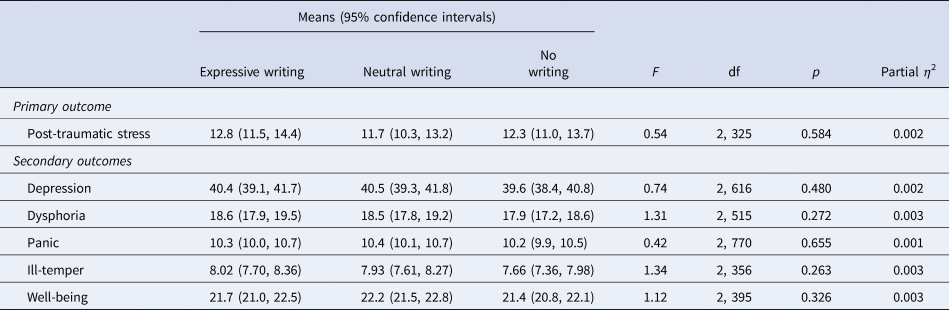
The intervention did not have a significant effect on levels of post-traumatic stress symptoms at 2 months post-intervention, after controlling for baseline symptom levels (Table 2). The result was similar after adding objective hardship, peritraumatic distress, and time since the hurricane as covariates: F(2, 367) = 0.79, p = 0.46, partial η2 = 0.002 (online Supplementary Table S3). In the primary model, expressive writing was associated with non-significantly higher post-traumatic stress levels at 2 months compared to neutral writing [d = 0.10 (95% confidence interval (CI): −0.07, 0.27)] and compared to no writing [d = 0.05 (95% CI: −0.11, 0.21)]. Neutral writing was associated with non-significantly lower post-traumatic stress levels at 2 months compared to no writing [d = −0.05 (95% CI: −0.21, 0.11)]. Per-protocol and subgroup analyses yielded similar results (online Supplementary Tables S4–S5). Two-way interactions between intervention and putative moderators were not significant (online Supplementary Table S6).
Means and ANCOVA of outcomes at 2 months post-intervention, by intention to treat

Intention-to-treat analyses pooled over 20 multiply imputed datasets. All outcomes except well-being were log-transformed in the models. Means are adjusted for baseline score and are back-transformed to the original scales.
Secondary outcomes
After controlling for baseline scores, the intervention did not have a significant effect on depression, dysphoria, panic, ill-temper, or well-being after 2 months (Table 2). Results were similar after adding objective hardship, peritraumatic distress, and time since the hurricane as covariates (online Supplementary Table S3). Effect sizes were marginal and non-significant (online Supplementary Table S7). Models of panic and ill-temper violated the assumptions of homoscedasticity and normality despite transformations (online Supplementary Figs S1–S2). Hence, we also tested these outcomes with robust, one-way comparisons of multiple trimmed group means (Mair & Wilcox, Reference Mair and Wilcox2020), and found no significant between-group differences (data not shown).
Two-way interactions between intervention group and putative moderators were not significant, with two exceptions (online Supplementary Table S6). First, cognitive appraisal moderated the intervention effect on depression: F(2, 1375) = 3.77, p = 0.023, partial η 2 = 0.008 (online Supplementary Fig. S3). Post-hoc contrasts revealed that when cognitive appraisal of the hurricane's consequences was neutral/positive, neutral writing was associated with slightly greater depressive symptoms compared to no writing [d = 0.37 (95% CI: 0.11, 0.63)], while expressive writing yielded no significant difference compared to neutral writing [d = −0.22 (95% CI: −0.49, 0.04)] or no writing [d = 0.14 (95% CI: −0.12, 0.40)]. When cognitive appraisal was negative, there were no significant between-group differences. Second, cognitive appraisal similarly moderated the effect of intervention group on dysphoria (online Supplementary Fig. S4).
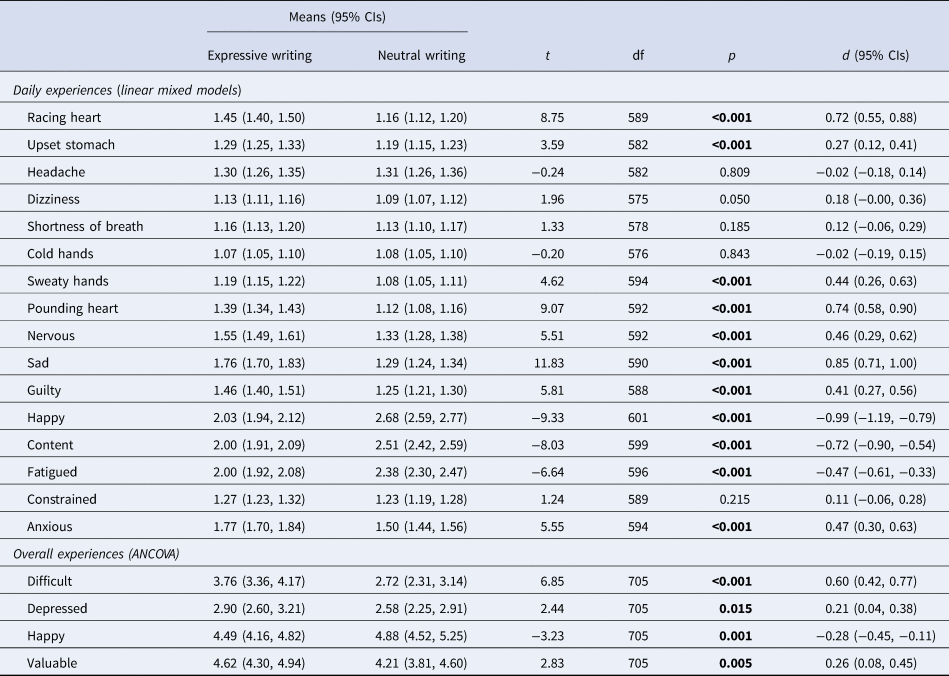
Most daily writing experiences differed between expressive and neutral writing groups (Table 3). In linear mixed models, participants undergoing expressive writing reported significantly more intense racing heart, upset stomach, sweaty hands, pounding heart, nervousness, sadness, guilt, and anxiety, as well as lower levels of happiness, content, and fatigue. Effect sizes for these items were small to large, with the largest effects being on higher sadness and lower happiness: d = 0.85 (95% CI: 0.71, 1.00) and d = −0.99 (95% CI: −1.19, −0.79). The two writing groups did not differ in severity of headache, dizziness, shortness of breath, cold hands, or constraint.
Daily and overall writing experiences in the expressive and neutral writing groups

Intention-to-treat comparisons using linear mixed models (on the original dataset) and ANCOVA (pooled over 20 multiply imputed datasets), all adjusted for baseline post-traumatic stress. Except happy, content, and fatigued, all daily experience variables were log-transformed and their adjusted means were back-transformed. CI: confidence interval. Significant p values are given in bold.
Post hoc, we examined time trends of sadness and anxiety (we chose sadness because of its large effect size, and anxiety because of its overlap with several other items on the questionnaire). Intervention group interacted with time (i.e. days 1 to 4) for sadness [standardized coefficient (β) = −0.144, s.e. = 0.042, t(1668) = −3.445, p < 0.001], and anxiety [β = −0.130, s.e. = 0.040, t(1658) = −3.271, p = 0.001]. In the expressive writing group, sadness increased over time [β = 0.063, s.e. = 0.023, t(1670) = 2.780, p = 0.006], whereas it decreased over time in the neutral writing group [β = −0.047, s.e. = 0.023, t(1670) = −2.092, p = 0.037]. In the expressive writing group, there was no time trend in anxiety [β = −0.014, s.e. = 0.021, t(1659) = −0.639, p = 0.523], whereas anxiety decreased over time in the neutral writing group [β = −0.114, s.e. = 0.021, t(1659) = −5.268, p < 0.001]. Kruskal–Wallis one-way analysis of variance revealed no significant difference in levels of sadness at days 1, 2, and 3 between completers and non-completers.
Finally, ANCOVA of the overall writing experiences revealed that expressive writing was perceived as more difficult (medium effect) and more valuable (small effect) compared to neutral writing (Table 3). Participants in the expressive writing group reported being more depressed and less happy over the 4 days of writing (small effects). Across the two writing groups, higher ratings for ‘difficult’, ‘depressed’ and ‘valuable’, and lower ratings for ‘happy’, predicted higher post-traumatic stress scores 2 months later (online Supplementary Table S8). These feelings significantly mediated the greater post-traumatic stress symptoms at 2 months among expressive writing participants compared to neutral writing participants (online Supplementary Table S8). The average causal mediated effects on log-transformed post-traumatic stress scores were: 0.106 (95% CI: 0.059, 0.160) for ‘difficult’, 0.041 (95% CI: 0.012, 0.080) for ‘depressed’, 0.028 (95% CI: 0.008, 0.050) for ‘happy’, and 0.030 (95% CI: 0.009, 0.060) for ‘valuable’.
Discussion
Contrary to our primary hypothesis, intention to treat with expressive writing did not lead to greater improvements in levels of post-traumatic stress symptoms, compared to neutral writing or no writing; rather, post-traumatic stress scores at 2 months were non-significantly higher among expressive writing participants. As for the secondary hypotheses, the efficacy of expressive writing for improving affective symptoms was no better than for post-traumatic stress, with no significant differences between the intervention groups.
Our negative findings add substantial weight against the previously mixed evidence that expressive writing can alleviate the psychological effects of stressors. Two meta-analyses found that expressive writing and related interventions did not significantly reduce symptoms of post-traumatic stress [r = −0.02 (95% CI unknown), p = 0.072] (Frattaroli, Reference Frattaroli2006) or depression [g = −0.03 (95% CI: −0.09, 0.03)] (Reinhold et al., Reference Reinhold, Bürkner and Holling2018). While the meta-analysis by Pavlacic et al. (Reference Pavlacic, Buchanan, Maxwell, Hopke and Schulenberg2019) found significant within-individual effects of expressive writing on post-traumatic stress symptoms, they did not examine between-group differences (i.e. with control groups). In a meta-analysis of eight studies related to pregnancy or infertility (Qian et al., Reference Qian, Zhou, Sun, Wu, Sun and Yu2020), expressive writing produced greater improvements in women's symptoms of post-traumatic stress compared to neutral or no writing [d = −0.39 (95% CI: −0.57, −0.22)]. However, when compared to neutral writing only, there was no significant difference [d = −0.01 (95% CI: −0.37, 0.36)]. The intervention was not effective for improving depression or anxiety (Qian et al., Reference Qian, Zhou, Sun, Wu, Sun and Yu2020). Substantial risks of bias were noted among the eight studies included in the meta-analysis.
Considering that the intervention's efficacy may depend on individual factors, we tested several putative moderators, but none of these variables significantly moderated the efficacy of expressive writing for any of the outcomes. Unexpectedly, we found that when the cognitive appraisal was neutral/positive, levels of depression and dysphoria at 2 months post-intervention were greater in the neutral writing than in the non-writing group. Underlying these effects, perhaps the neutral writing topics elicited more preoccupations (e.g. related to work or health) in those participants that were least concerned about the hurricane.
Finally, not surprisingly given the writing themes, we found that expressive writing was associated with negative post-writing reactions. Indeed, a qualitative analysis of participants' texts revealed that many women disclosed past traumatic memories that continued to impact them (Severson et al., Reference Severson, Olson, Hyde, Brémault-Phillips, King, Bick and Olsonsubmitted for publication). We then found that, in the expressive writing group, sadness increased over the 4 days, suggesting a dose-response relationship. Although attrition could bias this association, we showed that sadness at days 1, 2, or 3 did not differ between completers and non-completers. The overall experiences reported after day 4 of writing mediated the association between assignment to expressive writing and higher levels of post-traumatic stress after 2 months. The clinical significance of this indirect effect is unclear since the post-traumatic stress scores had to be log-transformed to meet assumptions of linear regression. Nonetheless, it suggests that expressive writing might have led to greater symptoms of post-traumatic stress in some participants.
Although the clinical significance of these adverse effects may be minimal, they bring to mind the landmark review by Rose, Bisson, Churchill, and Wessely (Reference Rose, Bisson, Churchill and Wessely2002). They found that single-session psychological debriefing, typically conducted within days following a traumatic incident, is ineffective, and may even increase the risk of post-traumatic stress disorder. Our intervention was delivered much later after the disaster but, like psychological debriefing, it prompts emotional and cognitive ‘reprocessing’ of the incident. Both paradigms focus on extreme personal experiences, and do not take into account whether participants are psychologically ready and prepared for such endeavor. It was suggested that psychological debriefing's one-time, potentially triggering approach, in absence of individualized care and follow-up, could underlie its lack of efficacy and adverse effects (Bonanno et al., Reference Bonanno, Brewin, Kaniasty and Greca2010; Rose et al., Reference Rose, Bisson and Wessely2003). As such, self-help therapies for post-traumatic stress disorder appear to be more effective when combined with external support (Mavranezouli et al., Reference Mavranezouli, Megnin-Viggars, Daly, Dias, Welton, Stockton and Pilling2020). Adaptations of expressive writing featuring clinician feedback, along with a greater number of sessions, have shown good results (e.g. Sloan et al., Reference Sloan, Marx, Lee and Resick2018), and can provide more flexibility for participants who feel less ready to tackle intense traumatic memories.
Limitations
Our convenience sample underrepresented the Hispanic/Latinx, racial minorities, and socioeconomically disadvantaged populations of Houston. These groups could have responded differently to expressive writing. However, in line with the meta-analysis by Frattaroli (Reference Frattaroli2006), we did not find that sociodemographic characteristics moderated the intervention's effects. Our inclusion of women with any level of post-traumatic stress could also be a limitation, but we showed that baseline symptom severity did not modify the intervention's effects. Restricting the analysis to participants with clinically significant IES-R scores yielded similar results. Another limitation stems from the loss to follow-up. We believe the potential for attrition bias is minimal, due to the similar attrition across the three intervention arms, and our use of intention-to-treat analysis with multiple imputations.
Most expressive writing trials similarly instructed participants to write about traumatic lifetime experiences, but not all provided different instructions for each day as we did. Writing about the same topic every day could better promote the extinction of the stress response. However, one can wonder if extinction is significantly mobilized after four unassisted sessions of writing, compared to the more intensive protocol that is typical of exposure therapies for post-traumatic stress disorder (e.g. Foa, Hembree, Rothbaum, & Rauch, Reference Foa, Hembree, Rothbaum and Rauch2019).
To conclude, expressive writing was not found to be effective in improving post-traumatic stress and affective symptoms in perinatal women. Instead, the intervention led to transient negative experiences which mediated its effect on greater post-traumatic stress symptoms compared to neutral writing. Our findings prompt caution in using brief, exposure-based approaches to foster resilience in disaster-stricken populations, especially if delivered in absence of external support.
Supplementary material
The supplementary material for this article can be found at https://doi.org/10.1017/S003329172100074X.
Acknowledgements
All authors critically reviewed the manuscript and approved the final draft for submission. We sincerely thank the Harvey families who participated in this research, Griselda Barcenas and Rosa McPherson at the University of Houston for their help with recruitment and study administration, Shana Rimmer at the University of Alberta for her help with setting up and monitoring the REDCap platform, Michael W. O'Hara for his help in adapting the IDAS, and James W. Pennebaker for his generous assistance in setting up the intervention and interpreting the data.
Financial support
The Canadian Institutes of Health Research (CIHR) permitted to use funds from grant PJT-148903, awarded to S. King and colleagues, to support this research. Funding was also provided from a grant awarded to D. Olson and colleagues (CIHR No. 151029). In-kind contribution, in the form of management of REDCap surveys and data, was provided by the Women and Children's Health Research Institute, University of Alberta.
Conflict of interest
None.
Ethical standards
All participants gave their informed consent via electronic signature. The study protocol was approved by the Institutional Review Board of the University of Houston (ref: STUDY00000657). The trial is registered at www.isrctn.com (trial number: ISRCTN52932563).