


Introduction
Several international reviews have examined the prevalence of mental health (MH) difficulties in footballers (Pillay et al., Reference Pillay, van Rensburg and Ramkilawon2024; Bilgoe et al., Reference Bilgoe, Janse van Rensburg and Goedhart2024; Woods et al., Reference Woods, McCabe and Mistry2022; Gouttebarge et al., Reference Gouttebarge, Aoki, Verhagen and Kerkhoffs2017b). A study of Australian male (n=149) and female (n=132) professional footballers (Kilic et al., Reference Kilic, Carmody, Upmeijer, Kerkhoffs and Purcell2021) found sport-related psychological distress was common, with prevalences of 52% in men and 63% in women. MH symptoms ranged from 24% for gambling in male players (2% in females) to 51% for alcohol misuse in males (44% in females). The high levels of distress may reflect the fact that specific MH conditions (e.g. misuse of alcohol, poor sleep) often result in heightened stress.
A later study was conducted on behalf of the union of Football Players Worldwide (FIFPRO, 2024) in which 101 male players were recruited via their national football unions (Pillay et al., Reference Pillay, van Rensburg and Ramkilawon2024). The results showed there was a greater prevalence of MH symptoms in professional male footballers than in other sports, as well as the general population. Results showed that 53% were experiencing distress, with 48% reporting alcohol misuse and 6% drug misuse. The incidence of distress and sleep disturbances across a 12-month period were 29% and 11%, respectively. It was also noted that after severe injury/surgery the risk of developing mental distress increased markedly. Based on their findings Pillay et al. (Reference Pillay, van Rensburg and Ramkilawon2024) concluded that football clubs should be aware of the relatively high MH difficulties of footballers and particularly the potential distress of their injured players. FIFPRO (2024) estimates that in a squad of 25 male players, at least nine are likely to experience MH symptoms during a season. Similarly, a longitudinal survey of 74 female professional players found over 50% experienced sports-related distress and 15–20% reported disordered eating over 12 months, with issues often linked to injuries, particularly those requiring surgery (Bilgoe et al., Reference Bilgoe, Janse van Rensburg and Goedhart2024).
To explore the topic of help-seeking systematically for the MH conditions outlined above, we employ the WH framework. It questions the topic, using the following calibration questions: Why, What, Who, When? The responses provide a useful way to structure the discussion. To illustrate the value of the WH framework, let us show how it helps to illuminate the decision-making features of ‘seeking help’ for the management of a physical health injury. For example, consider the sequence of WH questions (and responses) for a player who has experienced a severe fracture to the ankle:
Why is help needed? Because without help the footballer would be unable to play due to pain and ankle instability.
What help is available? Immobilisation, use of cast and physical rehabilitation.
Who should provide the help? Surgeon, medical team, physiotherapist, etc.
When should help be obtained? Treatment should commence immediately.
The care pathway for physical injuries is clear, with minimal stigma or avoidance. Within a professional club, there will be several rehabilitation specialists employed to deal with such injuries (physiotherapists, strength and conditioning coaches, nutritionists), whose work is coordinated by a Performance Lead and medical team (Rhoden, Reference Rhoden2024).
In contrast, responses to these questions for MH issues like depression or anxiety are less clear, and the pathway is more complex, making help-seeking decisions harder to navigate (see below):
-
Why is help needed? Untreated mental distress will impact performance and activities on-and-off the field; it may lead to the development of unhelpful coping strategies (alcohol misuse). Untreated MH conditions increase the risk of physical injury (Rogers et al., Reference Rogers, Tanka and Cosgarea2023). However, the player’s lack of awareness of their mental illness, may prevent them recognising help is needed.
-
What help is available? Evidence suggests that players are often unaware of available resources (Prinz et al., Reference Prinz, Dvorak and Junge2016). Or they may lack the language to describe their struggles.
-
Who should provide the help? The player may worry about seeking assistance from people from within the club, leading them to use inappropriate therapists, using unsanctioned remedies (Castaldelli-Maia et al., Reference Castaldelli-Maia, de Mello e Gallinaro, Falcão, Gouttebarge and Hitchcock2019).
-
When should help be obtained? Players may delay seeking treatment due to fear of losing their team position or finding themselves too busy. The players may resort to unhelpful coping strategies (alcohol, sedatives, over-training, etc.) to enable them to deal with their problems; this may exacerbate the difficulties. Furthermore, the dysfunctional coping strategies themselves may become engrained if the treatment is delayed, leading to alcohol misuse and excessive gambling (Gouttebarge and Kerkhoffs, Reference Gouttebarge, Kerkoffs and Musahl2018).
In summary, mental health decision-making is more complex and ambiguous than for physical injuries. The current article investigates the resulting decision-making processes, paying particular attention to why a mentally distressed athlete may choose not to speak up.
Conceptualising the decision-making process
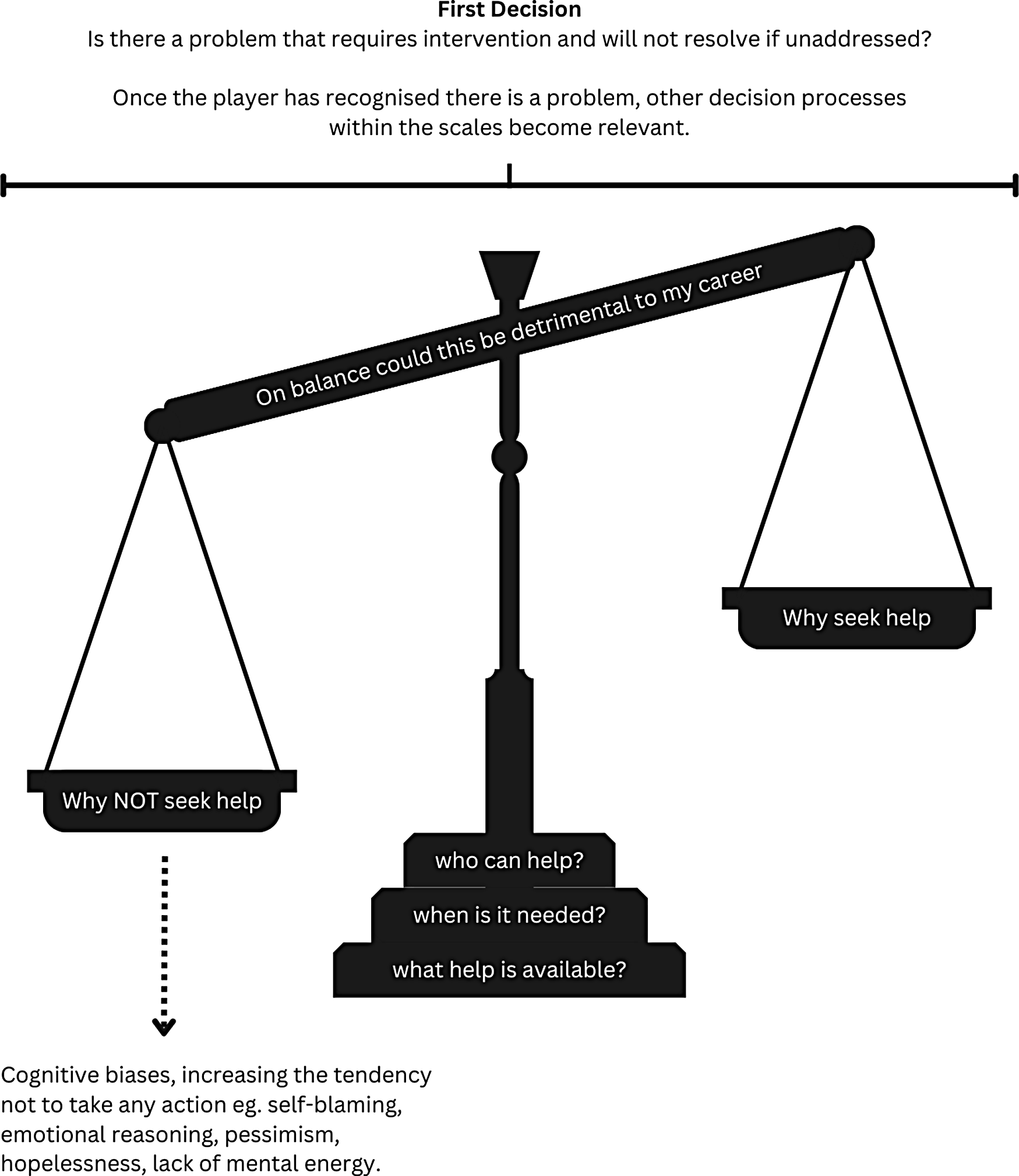
Figure 1 represents the footballers’ decision-making processes using the WH framework as a set of scales. The decision to seek help is primarily influenced by the ‘Why’ question, represented by the weights on the scales (reasons for versus against seeking help). The horizontal bar of the scales indicates that making the wrong decision in either direction could potentially threaten the player’s career. For example, there is the fear that seeking help could lead to stigmatisation and the possibility of de-selection (McGraw et al., Reference McGraw, Deubert, Fernandez-Lynch and Nozzolillo2018). In contrast, not seeking appropriate help could lead to a decline into major illness, career loss, or, in extremity, loss of life either while playing or post-retirement (Russell et al., Reference Russell, McCabe, Mackay, Stewart, MacLean, Pell and Stewart2020). The What, When, and Who questions only become relevant once a player decides to seek help; the decision to do so is often hindered by depression and anxiety. This is because low mood and cognitive biases are interlinked with each other. Pessimistic thoughts, a sense of worthlessness and catastrophising the impact of disclosure can magnify stigmatisation, and vice versa (Stanley et al., Reference Stanley, Hom and Joiner2018). Therefore, the interplay of such biases maintains the status quo, discouraging help-seeking. The WH questions are further examined below to clarify the decision-making process.
The decision scales.

WH question 1 – Why is help needed?
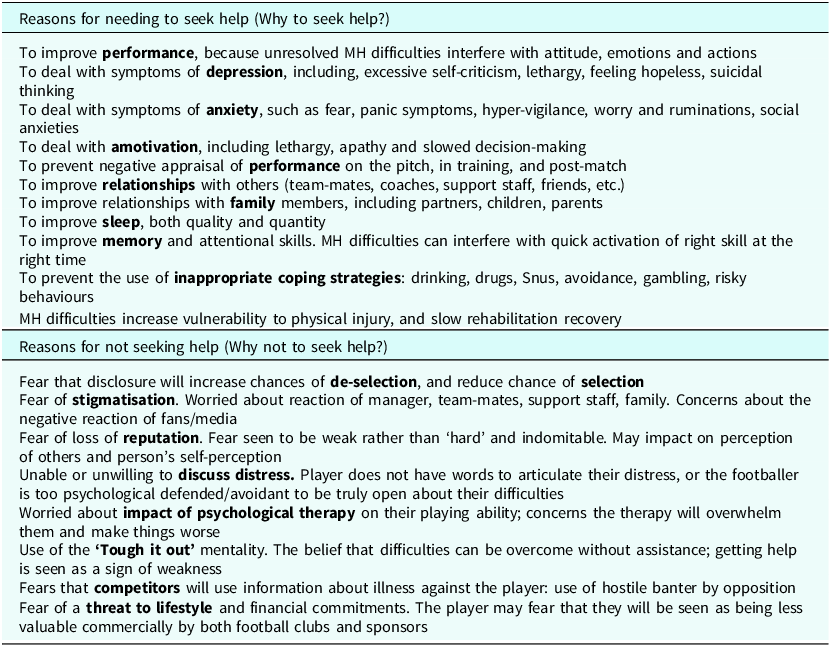
Table 1 outlines reasons for why ‘help’ is needed and why ‘seeking help’ is problematic from the perspective of the player, based on themes from Woods et al. (Reference Woods, McCabe and Mistry2022), Gouttebarge and Kerkhoffs (Reference Gouttebarge, Kerkoffs and Krutsch2020), and the authors’ therapeutic work with professional footballers.
Players’ reasons for both ‘seeking’ and ‘not seeking’ help for mental distress/illness

Seeking help involves two key steps: disclosing a mental health issue and actively pursuing support. In the top half of Table 1, once a player has identified a problem, there are numerous reasons for getting help, including managing symptoms of anxiety and/or depression. There is also a recognised need to manage the experiential features of the illness (mood, thoughts, physiology), which will impact performance. Ford and colleagues concluded that untreated sport-related anxiety can ‘continue to have spiralling effects on an athlete’s performance. In short, sport-related anxiety can (1) have a negative impact on sports performance during practice and competitions, (2) lead to increased risk of injury occurrence, (3) delay and obstruct injury rehabilitation and the return to sport process, and (4) increase subsequent re-injury risk during post-rehabilitation practice and competitions’ (p. 210, Ford et al., Reference Ford, Ildefonso, Jones and Arvinen-Barrow2017).
Injury is a particularly significant issue. This is because a vicious cycle often emerges, with injured players developing MH symptoms, and those with MH symptoms becoming more prone to injuries (Bilgoe et al., Reference Bilgoe, Janse van Rensburg and Goedhart2024; Rogers et al., Reference Rogers, Tanka and Cosgarea2023). Beyond performance, distress affects other areas of life, causing fear, avoidance, hopelessness and self-criticism (James et al., Reference James, Medea, Harding, Glover and Carraca2022a). Footballers may also seek help upon realising their current coping strategies (drinking, over-use of medications/drugs, over-training) are exacerbating their distress.
In contrast, reasons not to seek help, shown in the bottom half of Table 1, include lack of faith in treatment, fear the treatment process might destabilise them further, and a culture of ‘toughing it out’. Players may worry about appearing weak, particularly if they fear there will be disapproval from managers, agents, team mates and family. The player may think the manager will be less likely to select them, worrying they are being seen as less competitive in high-stakes matches, and opening themselves up to ridicule from opponents, or fans on social media (Wood et al., Reference Wood, Harrison and Kucharska2017). While stigma exists in the general population, elite athletes face heightened pressures due to the competitive environment, micro-monitoring of performance, fears of de-selection, and concepts of hypermasculinity in the male game (Castaldelli-Maia et al., Reference Castaldelli-Maia, de Mello e Gallinaro, Falcão, Gouttebarge and Hitchcock2019).
Another factor is ‘learned behaviour’ from being members of footballing academies, (i.e. the stoical legacy of being part of an academy). Sothern and O’Gorman’s (Reference Sothern and O’Gorman2021) qualitative study examined the views of ‘category one’ academy players. They found young players were highly likely to hide both mental and physical difficulties in order to foster positive perceptions of themselves, and to avoid criticism and sanctions from coaches or parents. The young players were keen to maintain a positive identity of being a ‘resilient’ footballer.
WH question 2 – What types of help are available?
The NICE guidelines for depression recommend psychotherapies as the first-line treatment for mild to moderate depression, and the combined use of psychotherapy and anti-depressants for severe depression (NICE, 2022). Similar guidance applies to the various forms of anxiety disorders. It is relevant to note that care must be taken when administering psychiatric drugs to players owing to the numerous problematic side-effects as well as the need for a ‘treatment use exemption’ (TUE) assessment, under anti-doping regulations. TUEs enable players with a legitimate medical condition to use a prohibited medication or substance. These complexities highlight the importance of club staff understanding the evidence-based psychotherapies available to players.
Cognitive behaviour therapy (CBT), particularly Beck’s cognitive therapy (CT; Beck, Reference Beck1976), is the most widely used form of psychotherapy in the UK and considered the gold standard psychological treatment (David et al., Reference David, Cristea and Hofmann2018). In relation to football and UK sports in general, the dominant form of CBT is rational emotive behaviour therapy (REBT) rather than CT. This is partly due to some key academic practitioners championing the role of REBT, believing that working with the concept of ‘irrational beliefs’ bridges ‘performance and MH’ effectively (Jordana et al., Reference Jordana, Turner, Ramis and Torregrossa2020; Turner, Reference Turner2022; Turner and Bennett, Reference Turner and Bennett2018). This group of practitioners, mainly sports psychologists, have produced an impressive body of work in support of their views (Turner et al., Reference Turner, Jones and Wood2023). A comparative review of the differences and similarities between REBT and Beckian CT from the perspectives of these academic practitioners has been published recently in this journal (Young and Turner, Reference Young and Turner2023). Other CBT approaches available to athletes (schema therapy, acceptance and commitment therapy, etc.) have been described in a book edited by Turner et al. (Reference Turner, Jones and Wood2023). In relation to football specifically, Nesti, who has worked with a number of English Premier League teams, recommends the use of existential psychotherapy (Nesti, Reference Nesti2014; Nesti and Ronkainen, Reference Nesti, Ronkainen, Tod and Eubank2020). An adapted version of the Power Threat Meaning Framework has also been described for players (James et al., Reference James, Morris, Johnston and Glover2022b). Like REBT, the latter is a trans-diagnostic approach, avoiding the need for diagnostic labelling.
One of few studies on CT in footballers showed it was neither popular nor known about, with only 8% of players aware of CT and just 4% able to describe it (Wilkins et al., Reference Wilkins, Sweeney and Zaborski2020). However, when informed about such therapies, players expressed that such support should be available to all footballers, with a preference for one-to-one, face-to-face sessions over group or online formats (Wilkins et al., Reference Wilkins, Sweeney and Zaborski2020). The lack of awareness is partly due to limited effort in distributing material to them, but also reflects the shortage of published studies on psychotherapy in football (Ekelund et al., Reference Ekelund, Holmström and Stenling2022). Other studies have shown that even when players request psychological support, access remains a challenge. For example, a study by Junge and Prinz (Reference Junge and Prinz2019) found only a third of female professional players seeking psychotherapeutic support received it.
Beyond formal therapies, less structured options are support groups and counselling approaches, as well as self-directed support such as bibliotherapies, therapeutic animations, online courses and case studies. FIFPRO (2024) have produced a website providing MH resources for professional footballers. The English FA addresses MH issues within its Equality, Diversity and Inclusion program (‘A Game for All’) and in its ‘Kick it out’ campaign; the latter tackling racial discrimination for players, coaches, and fans. A Game for All outlines three key strategic EDI commitments under the headings – Lead the Change, Be the Change, and Inspire the Change. Within these titles the FA supports wellbeing initiatives that: promote EDI training sessions; tackle online abuse; identify and sanction discriminatory practices, etc. The over-arching aim is to deliver initiatives that enable individuals from across gender, ethnicity, disability, faith, and LGBTQ+ communities to fully participate in football at all levels.
WH question 3 – Who can provide the help/treatment?
Footballers seek help from a range of non-clinical and clinical sources – partners, family members, friends, managers, coaches, team doctors, sports psychologists, player care staff, safeguarding officers and other support staff (James et al., Reference James, Turner and Reicheltunder review). Weber et al. (Reference Weber, Bos and Clancy2021) interviewed 22 club doctors in Australian Rules Football about their roles in managing MH issues. The doctors felt they needed to have an executive role in the treatment of players, having specific roles with respect to: screening, prevention, assessment and treatment, duty of care, case coordination, communication, and confidentiality.
In UK football clubs, in addition to the medical doctors, the club’s sports psychologists have a clinical/coordination role as well as their performance-related work. Indeed, sports psychologists have the competencies to undertake MH screening and low-level treatments (within their professional competencies). Nesti believes that sports psychologists should have a more important role in managing the MH of players, but notes their training is heavily biased towards ‘performance’ rather than therapy (Nesti and Ronkainen, Reference Nesti, Ronkainen, Tod and Eubank2020). A review paper by Feddersen et al. (Reference Feddersen, Champ and Littlewood2025) examined the perceptions and knowledge of coaches and sport scientists (physiotherapists, strength and conditioning workers) regarding the work of sports psychologists within football academies, including their MH input. The researchers found there was a lack of knowledge and appreciation of the benefits of having psychologists as part of multi-disciplinary teams (MDTs). This was in part due to the fact that psychologists had only recently been employed full-time within teams; thus there was scepticism about their added value (McGinty-Minster et al., Reference McGinty-Minster, Champ, Eubank, Littlewood and Whitehead2023). There were also historical and cultural features that disadvantaged many of the psychologists’ contributions, owing to the fact most had not previously played football at a professional or semi-professional level. Indeed, playing football to a high level was greatly valued amongst coaches in the elite clubs, with many of the senior coaches coming from footballing backgrounds (Hanin, Reference Hanin2007). It was noteworthy that the sports science staff were not similarly disadvantaged because many had played football, but more importantly they were seen as providing technical skills and inputs. In contrast, it was viewed that the psychologists were working with concepts (confidence, mental toughness, fear of re-injury) which were very familiar to the ‘footballing’ coaches from an experiential standpoint; thus the coaches often regarded themselves as ‘experts by experience’ in such areas.
The other staff offering support for wellbeing issues within clubs are the members of the player care team. This team have responsibility for many of the non-sporting aspects of a player’s time at a club, such as welfare and personal developmental aspects. In addition, members of the player care team get involved in many of the operational and practical features (assisting with housing, transport issues), enabling footballers to perform with minimal distractions. In addition to providing support from within the club, external help can also be accessed from general practitioners (GPs), counsellors, clinical psychologists and psychiatrists. There are also a number of specific organisations, such as Sporting Chance, who offer bespoke packages of therapy (www.sportingchanceclinic.com). In extreme cases the player may be required to attend a residential clinic for a period of time.
While professional assistance is vital, elite athletes often turn to family, friends, and coaches for support (Gulliver et al., Reference Gulliver, Griffiths, Christensen and Brewer2012). While there are clearly benefits obtained from speaking to non-specialists, it may also be inappropriate. For example, Mazzer and Rickwood (Reference Mazzer and Rickwood2014) found there were concerns amongst coaches that their input could potentially undermine their athlete’s MH. A helpful review of the area concerning the role of sports coaches in promoting athlete MH was undertaken by Bissett et al. (Reference Bissett, Kroshus and Hebard2020). A product of their review was a list of 26 activities athletic coaches could undertake to promote good MH. The three key themes identified were: to promote a culture that supports MH; to help identify and connect ‘at-risk’ athletes to appropriate services; and to support those in treatment. However, the research also recognised that in order for coaches to undertake such roles, they required supervision. Such supervision could potentially be provided by sports psychologists, although an article by Kelly and colleagues noted sports psychologists felt that they would require extra training both to provide psychological support to coaches and to enable the coaches to support others (Kelly et al., Reference Kelly, Thelwell, Barker and Harwood2018).
Selecting the appropriate ‘helper’ is evidently difficult for players. Owing to stigma, trust and confidentiality issues some footballers may obtain help outside of the club, often without the club’s knowledge. The employment of unvetted and potentially unqualified ‘therapists’ is highly problematic and could potentially lead to worsening MH (Curran et al., Reference Curran, Parry, Hardy, Darling, Mason and Chambers2019). It is relevant to note that in elite (Category 1) academies there are safeguarding features that prevent the employment of unqualified professionals. Indeed, the FA stipulate that starting the season 2025–26 all Category 1 departments must employ a full-time (or equivalent) HCPC registered psychologist (Barraclough et al., Reference Barraclough, Grecic and Harper2024). Of note, such standards are not required for men’s or women’s ‘first-teams’ in either the Premier, EFL or women’s leagues.
A further issue regarding the selection of MH providers from an EDI perspective (Equality, Diversity and Inclusion) is the inability of many MH and wellbeing professionals to speak multiple languages. While English may be regarded as the lingua franca of footballers in Europe, personal experience has shown that many foreign players struggle to express their MH needs effectively and confidently using a second language. An additional query regarding ‘who provides the help’ is the matter of the gender of the MH provider. In the general literature it has been shown that female college students often feel more comfortable self-disclosing to female therapists (Landes et al., Reference Landes, Burton, King and Sullivan2013). The broad consensus of this body of research is that organisations (such as football clubs) should ideally enquire about a client’s preferences about the gender of the therapist prior to therapy and, if possible, cater to the client’s preference.
WH question 4 – When is the best time to get assistance?
Many mental illnesses get worse if not treated early in the onset of the disorder; there are a number of reasons for this. Firstly, the person’s thinking will become more negative, exacerbated by reduced concentration, motivation and poor quality sleep, leading to self-criticism and withdrawal (James et al., Reference James, Medea, Harding, Glover and Carraca2022a). Secondly, the player may develop ‘bad’ habits such as avoidance, hyper-vigilance, and overthinking – known as safety-seeking behaviours – that make future treatment more difficult (Thwaites and Freeston, Reference Thwaites and Freeston2005). Unfortunately, accessing help in a timely manner may be difficult if (i) their club has not set up a pathway for the management of their difficulties (Purcell et al., Reference Purcell, Gwyther and Rice2019; Purcell et al., Reference Purcell, Pilkington, Carberry, Reid and Gwyther2022), or (ii) there is an overly demanding schedule of football fixtures and travel pressures. Players may also fear that treatment will destabilise them when they are ‘barely coping already’ and delay seeking help until the season ends – a costly decision psychologically (Pillay et al., Reference Pillay, van Rensburg and Ramkilawon2024).
Obtaining the appropriate help
Having reviewed players’ decision-making using the WH questions, we can answer the question ‘how can clubs improve their MH provision to meet the needs of their players?’. To help structure this section we provide an overview of the ‘Elite athlete mental health and wellbeing framework’ of Purcell et al. (Reference Purcell, Gwyther and Rice2019). It is composed of four ascending steps: a base layer of prevention (MH screening, building MH literacy, skills acquisition); an at-risk prevention layer (early detection and identification); an early intervention layer (managing emerging and existing problems); and a top layer of specialist MH care for more severe conditions. Purcell highlights the importance of having an over-arching comprehensive structure with societal and contextual influences, together with features bespoke to the sport. The clarity of the structure allows athletes to move in and out of the pathway in a step-wise manner, depending on their needs.
Purcell’s framework outlines the types of support a football club should offer its players, paying particular attention to preventative work. A proactive club would educate players and staff on identifying MH difficulties, and help players to articulate their problems by teaching them meaningful ways to describe their distress (i.e. develop a MH literacy specific to footballers; Bu et al., Reference Bu, Chung, Zhang, Liu and Wang2020). A Dutch study of professional footballers (Confectioner et al., Reference Confectioner, Currie, Gabana, van Gerven, Kerhoffs and Gouttebarge2021) assessed the impact of a 6-minute animation, containing information on ‘definition, recognition of problems, causes, and support’. The findings showed increases in help-seeking attitude, intention, and confidence in talking about MH difficulties. This aligns with a systematic review showing that increased literacy boosts help-seeking behaviours and reduces stigma (Bu et al., Reference Bu, Chung, Zhang, Liu and Wang2020).
Screening tools can further support prevention. The Sports Interference Checklist (Donohue et al., Reference Donohue, Silver, Dickens, Covassin and Lancer2007) offers practical questions that identify concerns and educate players about the language of MH (e.g. Do you have difficulties thinking positively once negative thoughts have occurred?; Are you too impulsive?). The IOC Sport Mental Health Assessment Tools (SMHAT 1 and 2) are also useful, investigating anxiety, disordered eating, depression, distress, sleep disturbance, alcohol misuse and drug misuse (Gouttebarge et al., Reference Gouttebarge, Bindra and Blauwet2021).
While screening is useful, the judgements of professionals working with the players on a daily basis are crucial in the early identification of problems. Clubs such as Leeds United and Burnley FC hold regular multi-disciplinary MH and Wellbeing (MDT) meetings to discuss players’ welfare. Both clubs have ‘in-house’ protocols regarding the pathway and tools for assessing and managing MH difficulties. The MDT within the Burnley Academy is run on a weekly basis, and is attended by the doctor, sports psychologist and player care staff. Typically a stepped-care approach is used whereby those with ‘minor’ problems can be sign-posted to age-appropriate leaflets or Apps, whereas more complex and severe difficulties will be seen by a qualified MH professional, who acts as a consultant to the club (see James et al., Reference James, Turner and Reicheltunder review). It is also important to keep the parents of academy players informed of these resources, making them stakeholders in the health and wellbeing of the young players (Young Minds, 2020). As a means of providing support regarding MH provision at Burnley FC, the MH professional runs a 10-week MH training course attended by members of the player care team and the sports psychologists; additional case supervision sessions are provided and support is given for individual cases.
MDT also functions to answer the WH question ‘Who to go to?’. In responding to this query, and as part of his consultative work within the MDT, the first author devised Fig. 2. The figure is a flow diagram of the MH and Wellbeing pathway for players at Burnley FC, and may be regarded as a stepped-care pathway. The pathway identifies the main referral sources and the purpose of the MDT. The role of the MDT is to discuss the MH concerns, and to use the decision-making graph to determine whether qualified MH support is required. The decision-making graph is based on the two continua of severity and complexity. It essentially states that when there are high levels of severity and/or complexity, a qualified MH professional needs to have some level of input in a player’s treatment. The Action section of the figure gives guidance on the types of support that can be offered to players. In Action 1 there is ‘No action’ required. The MH difficulty is neither complex nor severe and thus players in this area simply need to be monitored by coaches. The majority of MH and Wellbeing concerns will fall into the light grey area (Action 2), and will usually be dealt with by members of the player care team who are able to provide unqualified support to address issues of illbeing. A very small number of players will be in the Action 3/dark grey section (high severity and high complexity). The players here will require bespoke assessments and treatment plans (formulations and care plans). They will require input from a qualified MH professional. Note that the player may be treated by any member of the MDT (e.g. player care), but will always receive monitoring from a MH professional. In order for such a system to work well, and to overcome problems with confidentiality and conflicts of interest relating to ‘fitness to play’, good collaborative working with the medical team is essential. The use of confidential record systems, monitored access, and regular MDT meetings are seen as key features. For example, within the Academy at Burnley FC, the Safeguarding department acts as a gatekeeper to the record systems, and only permits access to the details of a player’s current difficulties when a formal request has been approved. It is relevant to note that neither coaches nor agents are permitted access to player’s MH records, although information is regularly provided once the details have been seen and screened by the players (and/or parents). Footballers’ agents are frequently sensitive about the possibility of their player’s MH concerns being conveyed to future clubs, and so agents are keen to ensure ‘within-club’ confidentiality. However, ‘in-house’ confidentiality is generally well maintained unless players choose to discuss their MH difficulties openly with the public or media. At present the exchanging of information between clubs regarding MH difficulties is relatively uncommon, and this will probably continue to be so until such times that MH screening becomes a regular feature of the transfer process.
Multi-disciplinary team decision-making pathway.

Based on this graph, it suggested that players occupying Area 3 require a clinical formulation. A formulation is a summary of the key factors causing and maintaining a person’s distress. Gouttebarge and Kerkoffs (Reference Gouttebarge, Kerkoffs and Krutsch2020) recommend the use of a biopsychosocial formulation, containing information about the physical, psychological and social elements of a footballer’s life. Formulations clarify the developmental and maintaining features of a player’s difficulties, and guide intervention strategies. Because they are bespoke, the proposed management strategies are uniquely adapted to the player’s cultural, religious, intellectual, and language preferences (Nesti and Ronkainen, Reference Nesti, Ronkainen, Tod and Eubank2020; Turner, Reference Turner2014). In relation to the effective use of formulation-led interventions, in most cases one would be operating at Purcell’s (2022) ‘top layer’ of support, which requires specialist MH clinicians. At Burnley FC a CT therapist (clinical psychologist) provides weekly assistance, including assessment, formulation and treatment of players in the Academy, men’s and women’s teams. A paper examining the pros and cons of ‘in-house’ MH provision is currently under evaluation (James et al., Reference James, Turner and Reicheltunder review). As noted previously, the use of CT is not well documented in football literature in relation to MH. However, when one considers the common mental health conditions experienced by footballers (depression, anxiety, disordered eating, sleep problems, addictions), over time its use may begin to rival the usage of REBT, particularly as more specialist MH clinicians become integrated into the sport, in line with Purcell’s framework. It is relevant to note that CBT therapies, such as ACT and compassion focused therapies, have been shown to be effective in the management of performance related issues in football (perfectionism, self-criticism; James et al, Reference James, Medea, Harding, Glover and Carraca2022a; Watson, Reference Watson2024), but this is regarded as a separate literature to MH. This discrepancy again highlights the lack of published work employing CT for MH conditions.
In relation to ‘When to deliver therapy?’ it is important for club staff to anticipate difficulties, and therefore provide support at those times when players are most vulnerable, such as during transition periods (injury involving surgery, post-injury, following de-selection, nearing retirement; Rice et al., Reference Rice, Purcell, De Silva, Mawren, McGorry and Parker2016). Indeed, Blakelock’s work demonstrated increases in levels of clinical depression and anxiety following contract termination (Blakelock et al., Reference Blakelock, Chen and Prescott2015). MH difficulties are also common during and after periods of injury (Ford et al., Reference Ford, Ildefonso, Jones and Arvinen-Barrow2017). Gouttebarge et al. (Reference Gouttebarge, Aoki and Kerkhoffs2017a) observed that professional footballers who had sustained two or more significant injuries during their career (injuries taking more than 4 weeks to recover) were 2.5 to 3.5 times more likely to report distress, anxiety depression, sleep disturbance or misuse of alcohol. It is argued that the clubs should proactively develop support programs during these transitional phases. A therapeutic model that has been utilised at Burnley FC for such difficult phases is the Power Threat Meaning Framework. The use of this approach with footballers has been discussed in a previous paper by the authors (James, et al., Reference James, Morris, Johnston and Glover2022b). It helps players see their current difficulties within the context of career and personal pressures. This helicopter perspective allows them to make better informed decisions in line with their values and identity, both as a footballer and a ‘person.’
Purcell and colleagues (2022) advocate for support of MH difficulties at an organisational level, by fostering cultures that support athletes’ mental health (Purcell et al., Reference Purcell, Gwyther and Rice2019). An issue that has grown in importance recently is the notion of ‘inclusiveness’ in relation to MH and wellbeing. In specific terms this is concerned with the strategies clubs are employing to meet the needs of women, black and minority players, people with neurodiversity, and faith-based needs, etc. In addition to the FA’s own initiatives mentioned earlier (‘A Game for All’), the UK Government has suggested appointing a football regulator as part of their ‘Football Governance Bill’. Such an appointee would be committed to improving EDI within the game. Once the proposed Bill is enacted the clubs in the English leagues would be required to publish the actions they are taking on EDI in relation to a new Football Club governance code.
Confectioner et al. (Reference Confectioner, Currie, Gabana, van Gerven, Kerhoffs and Gouttebarge2021) emphasise the need for ‘All stakeholders…’ (p. 5) – players, unions, clubs, coaches, administrations, owners and fans – to create psychologically safe environments that encourage help-seeking. A whole system approach within football would require major investment, involving training and scaffolding to support staff and coaches. A potential guide for such support has been provided by Quartiroli et al. (Reference Quartiroli, Schinke, Giffin, Vosloo and Fisher2023) who addressed the concept of cultural competence via a series of interviews with sport psychologists. Cultural competence in sports encompasses a wide range of factors that influence players’ care: from ethnic and racial differences to religious practices, gender issues, and language barriers. These features determine how athletes experience sports environments and also how they seek assistance within them. Quartiroli and colleagues outlined the implications for individuals and professional bodies in relation to CPD (continued professional development), training, and effective practice.
This paper represents the first of a series of articles on integrating MH clinicians within professional football clubs. The second paper currently under review (James et al., Reference James, Turner and Reicheltunder review) examines the dynamics between the various staff within the clubs who are providing psychological support. The paper discusses the advantages and problems associated with employing an ‘in-house’ MH specialist. Future papers intend to examine the viability of providing placements for MH trainees within sports settings, and will explore how to integrate evidence-based clinical and performance frameworks to enable the trainees to obtain relevant therapeutic and sports experiences.
Conclusion
The ‘WH calibration’ questions have been used to describe the decision-making processes of footballers in relation to their MH. This article provided responses to these questions and gave recommendations about how the needs of players can be met. It was noted that REBT is the dominant form of CBT in use by sports psychologists, but CT may become more popular if MH specialists establish themselves within football clubs. The staff currently providing MH and wellbeing support were identified (medical staff, psychologists, and player care), along with the nature of the assistance they provided.
The support provided by coaches was outlined, but their lack of confidence in dealing with MH issues was noted. The relevance of the ‘timing’ of help was discussed. It was highlighted that while footballers had busy schedules, it was important to prioritise the seeking of help because emergent MH problems could become engrained if left untreated. In the second part of the article a number of the ‘WH’ questions were addressed again, but from a more practical perspective. Examples of initiatives and protocols currently in use by football clubs were discussed, with a particular emphasis on developing solutions at systemic and organisational levels. Finally, extrapolating FIFPRO’s prevalence data across all the teams within a professional club (including Women and Academy squads), it is evident that MH support is required. Hence, the authors believe it is essential to take MH difficulties seriously, and provide a coordinated approach in relation to players’ health and wellbeing (Pillay et al., Reference Pillay, van Rensburg and Ramkilawon2024).
Key practice points
-
(1) Footballers demonstrate MH prevalence rates similar to the general public, with some studies suggesting higher rates.
-
(2) Footballers’ help-seeking behaviours are described well using the ‘WH’ calibration questions.
-
(3) REBT is the preferred CBT approach used in the UK by sports psychologists. There are a lack of studies using CT for the management of MH conditions.
-
(4) There is a potential role for MH specialists to work directly in professional football clubs as members of multi-disciplinary health teams.
Data availability statement
None.
Acknowledgements
None.
Author contributions
Ian Andrew James: Conceptualization (lead), Investigation (lead), Project administration (supporting), Resources (equal), Supervision (equal), Writing - original draft (lead); Martin Turner: Conceptualization (supporting), Investigation (supporting), Supervision (supporting), Writing - original draft (supporting), Writing - review & editing (supporting); Cerys Anna James: Conceptualization (supporting), Project administration (lead), Resources (supporting), Writing - original draft (supporting).
Financial support
The work received no specific grant from any funding agency, commercial or not-for-profit sectors.
Competing interests
The authors report there are no competing interests to declare.
Ethical standards
The authors have abided by the Ethical Principles of Psychologists and Code of Conduct as set out by BABCP and BPS.




Comments
No Comments have been published for this article.