Implication
The review covers purebred populations of North European short-tailed sheep, and a companion paper (Thomas, Reference Thomas2009) will deal with the use of these breeds in crossbreeding, mainly for increasing prolificacy, primarily in North America. Although the Northern short-tails are normally regarded as primitive breeds of sheep, they are of substantial academic and practical value in many countries, especially in the northern hemisphere. In a world facing great changes in the availability of energy (peak oil) and in weather patterns (climate change), the grassland-based genetically diverse and generally robust Northern short-tails can contribute in many ways to sustainable development, particularly under marginal conditions, and are thus likely to have both economic and social impacts in the future. While normally regarded as meat production breeds, they also supply byproducts such as wool, skins and milk of high quality. In a welfare-conscious world, the absence of a long tail, thus not requiring docking, will be increasingly appreciated. This paper highlights that many of these breeds are endangered.
Introduction
This review paper is based on the results of a postal/e-mail questionnaire survey (see Appendix), information obtained through personal communications (see Acknowledgements) and on several references to North European short-tailed breeds of sheep in books, journals, databases and webpages, including both FAO and EAAP databases (www.fao.org/DAD-IS; www.efabis.tzv.fal.de; www.tiho-hannover.de/einricht/zucht/eaap). Emphasis was placed on geographic location, distribution and present purebred population size. The economic value and importance, as well as products and role under a range of conditions, are covered but only brief references are made to crossbreeding, which will be dealt with specifically in the companion paper (Thomas, Reference Thomas2009). Although information was obtained on 34 short-tailed breeds originating in Northern Europe, it should be kept in mind that several of them are now rare and endangered and continued efforts are needed to conserve their great genetic diversity (Tapio, Reference Tapio2006). Breeds with North European short-tail ancestry such as the Estonian Ruhnu, the Estonian Saaremaa, the Lithuanian Native Coarsewooled and the Norwegian Grey Troender sheep (Tapio et al., Reference Tapio, Tapio, Grislis, Holm, Jeppsson, Kantanen, Miceikiene, Olsaker, Viinalass and Eythórsdóttir2005a and Reference Tapio, Tapio, Grislis, Holm, Jeppsson, Kantanen, Miceikiene, Olsaker, Viinalass and Eythórsdóttir2005b; Zapasnikiene and Nainiene, Reference Zapasnikiene and Nainiene2008), and possibly the Herdwick sheep in the United Kingdom (Ryder, Reference Ryder1983), are not classified as short-tails, presumably due to their longer tails as a results of crossing with long-tailed breeds. Thus, they could not be included in the survey.
Breed characteristics
The short-tailed sheep, native of an area from Russia to Iceland, are generally considered a primitive type spread by Norse Vikings to several countries in this area from the late eighth century to the middle of the eleventh century ad (Ryder, Reference Ryder1983). The Soay, the most primitive breed of sheep belonging to the Northern short-tailed group of breeds, certainly resembles the wild Mouflon sheep (Ryder, Reference Ryder1983). As in their ancient predecessors, their fluke-shaped and tapered short tail is a common feature, however, varying somewhat in length. Normally, there are 8 to 10 vertebrae in the tail of short-tailed sheep (Hlídar, Reference Hlídar1937) compared to 16 to 18 vertebrae in long-tailed sheep (Frandson, Reference Frandson1975). Comprehensive studies on microsatellite variation and genetic diversity in North European sheep breeds have been reported on in recent years (Tapio et al., Reference Tapio, Tapio, Grislis, Holm, Jeppsson, Kantanen, Miceikiene, Olsaker, Viinalass and Eythórsdóttir2005a and Reference Tapio, Tapio, Grislis, Holm, Jeppsson, Kantanen, Miceikiene, Olsaker, Viinalass and Eythórsdóttir2005b; Tapio, Reference Tapio2006; Eythórsdóttir, Reference Eythórsdóttir2007). These and other studies have shown clearly several common characteristics of the North European short-tailed breeds, in addition to the short tail, such as a wide range of colour patterns, dual-coated wool, robustness and prolificacy (Adalsteinsson, Reference Adalsteinsson1970; Jakubec Reference Jakubec1977; Maijala and Österberg, Reference Maijala and Österberg1977; Ricordeau et al., Reference Ricordeau, Tchamitchian, Thimonier, Flamant and Theriez1978; Finnsheep, 1988; Fahmy, Reference Fahmy1989; Kantanen, Reference Kantanen2003; Niclasen, Reference Niclasen2007). Both polled and horned sheep are found in these breeds – in some cases, sex linked, and even fourhornedness, is still known in a few of them (National Sheep Association, 1998; Dýrmundsson, Reference Dýrmundsson2005). Furthermore, they vary a great deal in size and productive performance, and although often found in isolated marginal areas, thriving under harsh environmental conditions, some of the short-tailed breeds perform well in milder climates (Ryder, Reference Ryder1983; Villsauen, 1997; National Sheep Association, 1998; www.nordgen.org; www.sheep-isle.dk).
The best-known breeds of this group outside Northern Europe are the Finnsheep and the Romanov, which have been exported to several countries in the world where their genetic merits, especially prolificacy, have been utilized through crossbreeding with local sheep (Jakubec, Reference Jakubec1977; Maijala and Österberg, Reference Maijala and Österberg1977; Ricordeau et al., Reference Ricordeau, Tchamitchian, Thimonier, Flamant and Theriez1978; Finnsheep, 1988; Fahmy, Reference Fahmy1989; Thomas, Reference Thomas2009). Thus, they have played an important role in the production of some new synthetic/composite breeds in several countries through hybridization.
Results
Distribution and size of purebred populations
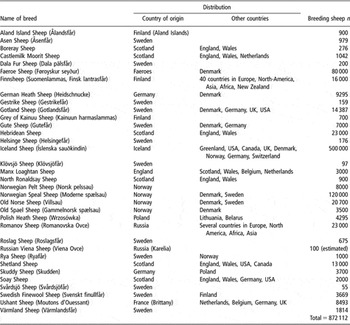
Generally speaking, most of the purebred North European short-tails have developed in and are confined to certain areas or countries in Northern Europe. Thus, they tend to be local breeds with some exceptions, however. Several of them have become transboundary, especially in Scandinavia and the United Kingdom (Ryder, Reference Ryder1983; Tapio, Reference Tapio2006) and, for example, sheep of the Iceland breed constitute the Greenland sheep population due to exports from Iceland in the early twentieth century (Sigurðsson, Reference Sigurðsson1938; Dýrmundsson, Reference Dýrmundsson1990), with minor influence from other breeds. In some cases, certain subgroups or strains are officially recorded within breeds, for example, in the German Heath Sheep (www.genres.de). On the contrary, several small, local, populations of landrace sheep are classified and recorded as separate, heritage breeds, for example, in Sweden (Svenska allmogefår, 2005).
Table 1 lists the 34 breeds on which information was obtained, named alphabetically in English followed by the local name in brackets, if different. It should be noted that although the country of origin of each breed is stated with reasonable accuracy, the list of countries to which the breed has been distributed may be incomplete. The population sizes, based on the most up-to-date information on the number of breeding sheep (ewes + rams) in each case, should be regarded as minimum values. For some of the breeds, there are indications that a certain number, even whole flocks, are unregistered, and in a few cases feral flocks could not be included, such as of the Boreray Sheep on the island of Boreray in the St Kilda archipelago and Soay Sheep on the islands of Hirta and Soay in Scotland.
The status of North European short-tailed breeds of sheep: distribution and purebred population size

In general, most of the distribution of the North European short-tails has been confined to countries bordering on or close to the countries of origin. However, since the 1960s, some of the breeds have gained considerable distribution, especially the Finnsheep and the Romanov, and in recent decades breeds such as the Iceland, Gotland and Shetland, especially in North American, as indicated in Table 1 (see also Thomas, Reference Thomas2009). In summary (Table 1), 872 112 breeding sheep were kept in purebred populations in several countries, mainly in Northern Europe and North America. The population size is less than 1000 head in 12 of the breeds, that is, they are endangered, 13 breeds are in the range of 1000 to 10 000 sheep, 7 are in the range of 10 000 to 100 000 and only 2 are more numerous than 100 000. Comments made by several of those replying to the questionnaire indicate that many of these short-tail populations have been declining in numbers in their countries of orgin, some over a long period of time. However, in some cases, this negative trend has been reversed by conservation efforts and some of the breeds have even been introduced to new countries with some success during recent decades. The purebred populations sizes of the internationally best-known North European short-tailed breeds, the Finnsheep and the Romonov, 16 000 and 23 000, respectively, are perhaps smaller than would be expected. The relatively strong position of the Iceland breed is at least partly due to the fact it is the only breed of sheep kept in that geographically isolated country where a strong sheep-keeping tradition exists (Eythórsdóttir et al., Reference Eythórsdóttir, Dýrmundsson and Jónmundsson2008).
Breed utilization, breeding practices and products
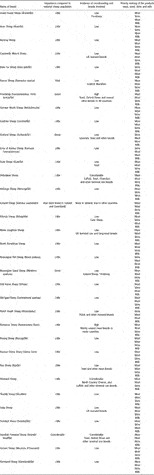
There is a great deal of variation in the national or regional economic importance of the North European short-tailed breeds in the countries where they are kept. This may range from the value of niche production of endangered populations of conservation breeds, such as in Sweden, Finland and the United Kingdom, to substantial production, mainly of lamb, in Iceland, the Faeroes and Norway. In some areas, the browsing ability of such breeds is of great value in landscape management and conservation grazing. Overall, the results of the survey (Table 2) show that comparing the importance of the North European short-tailed breeds to other breeds in their countries of origin on the scale of little, considerable, great and vital show the numerical values 28 (82%), 1 (3%), 3 (9%) and 2 (6%), respectively. This reflects very strongly on the weak position of several of the breeds in economic terms leaving open the question of the value of the genetic, cultural and societal resources involved, which should not be overlooked.
The status of North European short-tailed breeds of sheep: importance, breeding practices and products

The incidence of crossbreeding classified as none, low, considerable and high (Table 2) is low in 28 (82%) of the breeds and in 1 (3%) none at all, at least in the country of origin. In 3 (9%) out of the 34 breeds, crossbreeding is regarded as being considerable, but the incidence is high in only 2 (6%). The breeds crossed with are mainly meat types, that is, lowland and terminal sire breeds of European origin. The priority ranking of the products of the North European short-tailed breeds shows in fact clearly (Table 2) that meat production is most important in 20 (59%) out of the 34 breeds with wool and skins being byproducts. Although market trends have favoured lamb production and the economic returns of wool and skins have declined, especially during the last 20 years, it is interesting to note that still in nine (26%) of the breeds first priority is given to wool and in five (15%), priority is given to skins. Out of the four products – meat, wool, skin and milk, milk ranked lowest overall in all the breeds included in the survey. A few cases are known, however, of such sheep being kept in specialized dairy units.
Discussion
In spite of the fact that purebred populations of the North European short-tailed breeds have been declining over a long period of time (Tapio et al., Reference Tapio, Tapio, Grislis, Holm, Jeppsson, Kantanen, Miceikiene, Olsaker, Viinalass and Eythórsdóttir2005a) and are now endangered in several cases, they should not be looked upon as relics from the past. Although adapted to certain local/regional conditions in the northern hemisphere, at least some of these breeds have much to offer in the international context and a few have already done so, especially in relation to prolificacy and mothering ability (Thomas, Reference Thomas2009). They can improve the efficiency of production of both quality food and fibre, not least in grassland-based, low-energy input and easy-care systems. Dýrmundsson (Reference Dýrmundsson2006) has pointed out that the sheep production systems in Northern Europe fulfil most criteria of sustainability in agriculture. The North European short-tailed breeds certainly fit well into that picture. Even the short tail, eliminating the need for docking, has its value, at least from an animal welfare point of view. Then there are certain genetic traits of less obvious economic value such as the unique ability of North Ronaldsay sheep to feed almost entirely on seaweed (Ryder, Reference Ryder1983) and the leadersheep behaviour, which has evolved in a strain of the Iceland breed (Dýrmundsson, Reference Dýrmundsson2002).
It should be kept in mind that genetic diversity is now recognized internationally as a valuable resource (Fimland, Reference Fimland2003), and this is reflected in the work of the European Association for Animal Production (EAAP) and the Food and Agriculture Organization (FAO) in Europe and elsewhere, in harmony with sustainability criteria. Comprehensive data banks are being established by these bodies, such as the EFAB-IS and DAD-IS, and cryopreservation is widely in progress (Cryo WEB). As far as the North European short-tailed breeds are concerned, there are certainly cases of endangered breeds being saved from extinction, such as the Old Norse Sheep (Villsau) in Norway (Buer, Reference Buer2008), Grey of Kainuu Sheep (Kainuun harmaslammas) in Finland (Sevón-Aimonen et al., Reference Sevón-Aimonen, Strandén and Kantanen2008), Polish Heath Sheep (Wrzosówka) in Poland (Martyniuk et al., Reference Martyniuk, Sikora and Niżnikowski2008) and Castlemilk Moorit Sheep in the United Kingdom (National Sheep Association, 1998). Individual breeders, breeders’ groups and bodies such as the Nordic Gene Bank for Domestic Animals in the Nordic Countries and the Rare Breeds Survival Trust in the United Kingdom, have indeed contributed significantly to the conservation of these and other breeds.
Research bodies have also made valuable contributions to conservation. Unusual qualities have been revealed from the recorded data (National Sheep Association, 1998), single genes enhancing production have been discovered (Eythórsdóttir et al., Reference Eythórsdóttir, Dýrmundsson and Jónmundsson2008), and there are good reasons to believe that a larger number of valuable traits will be identified through further scientific studies, thus making at least some of these multifunctional breeds more attractive and competitive in modern sheep farming. To quote further examples from research, meat quality studies of Skuddy lambs have revealed properties beneficial to consumer health such as low concentrations of fat and cholesterol and a desirable fatty acid profile (Brzostowski and Tański, Reference Brzostowski and Tański2008). Polish Heath Sheep (Wrzosówka) is a well-known example of a conservation breed being monitored and studied in detail under local conditions, by teams of scientists, (Fiszdon et al., Reference Fiszdon, Niżnikowski, Popielarczyk and Cieśliński2008; Niżnikowski et al., Reference Niżnikowski, Strzelec, Popielarczyk, Głowacz and Lityński2008; Sikora and Kawęcka, Reference Sikora and Kawęcka2008). Finally, it is worth noting that North European short-tailed breeds of sheep have low or nil frequency of the most scrapie-resistant ARR/ARR genotype (Hunter et al., Reference Hunter, Goldmann, Foster, Cairns and Smith1997; Thorgeirsdóttir et al., Reference Thorgeirsdóttir, Sigurdarson, Thórisson, Georgsson and Pálsdóttir1999; Alderson et al., Reference Alderson, Titley and Morris2001). However, through selection, the relative frequency of the ARR allele of the PrP gene in the population is being increased, for example, in Romanov Sheep in the Czech Republic (Milerski, Reference Milerski2008) and Polish Heath Sheep in Poland (Lityński et al., Reference Lityński, Niżnikowski, Popielarczyk, Strzelec and Głowacz2008).
Conclusions
The results of the survey presented above may somewhat simplify the status of the North European short-tailed breeds. However, it is a matter of concern how small most of the purebred populations are. Many of these breeds, parhaps all of them, or genetic material derived from them, should have a future role to play in sustainable grassland-based production systems. They possess great genetic diversity, can utilize pastures anywhere from lowlands to steep mountain slopes, are less dependent on the use of fossil fuels in the forms of artificial fertilizers and grain feeding than many other sheep breeds and provide a range of high quality products. Therefore, we conclude by proposing that animal scientists should address particularly, how best the genetic resources of the North European short-tailed breeds can be managed and utilized, both in pure- and crossbreeding programmes, because this is the most effective way of preserving and delivering them to future generations of sheep farmers.
Acknowledgements
The authors thank the following for giving useful sheep breed information from their countries:
Anton Pinschof (France), Birgit Boberg (Sweden), Charles H. Rose (Greenland), GEMO, Ushant Sheep Breeding Society (France), Gert Nieuwhof (United Kingdom), Gunnar Bjarnason (Faeroes), ISBONA, Icelandic Sheep Breeders of North America (Canada and United States of America), Jackis Lannek (Sweden), Jayne Drinkwater (United Kingdom), Jill Tyrer (United Kingdom), Jim Johnson (United Kingdom), Kjeld Malthe–Bruun (Denmark), Kreg Leymaster (United States of America), Lars Erik Wallin (Norway), Lawrence Alderson (United Kingdom), Lindsey Tapp (United Kingdom), Maija Häggblom (Finland), Maria Ericson (Sweden), Marja-Leena Puntila (Finland), Mark Joung (New Zealand), Matthias Gauly (Germany), Patrick Miossec (France), Peter Hardman (United Kingdom), Sergeij Kharitonov (Russia), Ulla Savolainen (Finland), Vicky Mason (United Kingdom) and Zhivko I. Duchev (Germany). This review is based on an invited presentation at the 59th Annual Meeting of the European Association for Animal Production held in Vilnius, Lithuania, in August 2008.
Appendix
A postal/e-mail questionnaire on the status of North European short-tailed breeds of sheep in 2008
A list of all officially documented North European short-tailed breeds, according to database information and other sources, distributed to several institutes, breed societies and individuals in January 2008. Information was requested under the following headings:
1. Name of breed (English and local name).
2. Location/distribution in the country of origin and in other countries.
3. Present purebred population size expressed as the number of breeding sheep.
4. Importance of the breed compared with the total, national sheep population, numerically and/or economically (little, considerable, great and vital).
5. Incidence of crossbreeding (none, low, considerable and high) and the breeds involved.
6. Products and their priority ranking (meat, milk, skins and wool).
7. Comments and additional information.