1. Introduction
Accounts of comparative alternation for English adjectives are explanations as to why people pair adjectives with periphrastic more, e.g. more lazy, instead of suffix -er, e.g. lazier, or vice versa. Of interest here is comparative alternation in English adjectives ending in an orthographic <y> and a /i/ sound called the y-adjectives, e.g. tidy, worthy, and giddy. In the corpus study of Chua (Reference Chua2016, Reference Chua2018), y-adjective comparatives were found predicted by base adjective morphology, and to correlate with counts of comparative constructions of English disyllabic adjectives that are not y-adjectives – known by the mnemonic HANDSOME adjectives, examples of which include handsome, mellow, and common. With hypotheses formulated against a configuration of principles that forward linguistic constructions as an analytical point of departure, core to this paper is the report of an experiment conducted to validate the corpus findings in Chua. The report analyses people’s reading times (RTs) in the context of comparative more and -er constructions, where RTs were captured under various experimental manipulations related to the morphology of y-adjectives and the HANDSOME more and -er constructions to which people were exposed. Experimental findings, though they leave unconfirmed an independent effect of morphology on the y-adjective comparatives, confirm that y-adjective more constructions are predictable from HANDSOME more constructions. HANDSOME more constructions, and also HANDSOME -er ones, seem, moreover, to suppress, respectively, an anticipated bias for -er in morphologically simple (or simple) y-adjectives, and an anticipated bias for more in morphologically complex (or complex) y-adjectives. The value in explaining y-adjective comparatives through the lenses of more and -er patterns abstracted from surfaced constructions is consequently foregrounded, in a contribution to the advancement of a constructional approach for work in linguistics.
2. Background to experimental study
2.1. theoretical background
A constructional approach may be taken as an umbrella term for linguistic theories focused on whole form representations that subsume grammatical relations in place of those focused on constituent functional assignment in part–whole relations. In y-adjectives, fertile ground exists for advancing the validity of a constructional approach to explain comparative alternation. First, if the notion of construction applies equally at the lexical and phrasal–syntactic levels (Booij, Reference Booij2010, p. 1; Jackendoff & Audring, Reference Jackendoff, Audring, Audring and Masini2019, pp. 392–393), then the synthetic–periphrastic alternation in y-adjective comparatives ought to lend itself to explanatory ease by any constructional approach. Periphrastic alternatives to otherwise synthetic realisations are moreover theorised to occupy a cell in morphological paradigms (Brown, Chumakina, Corbett, Popova & Spencer, Reference Brown, Chumakina, Corbett, Popova and Spencer2012, p. 239; Spencer, Reference Spencer, Chumakina and Corbett2013, p. 227), suggesting in-principle support – even from accounts classically defined by synthetic forms – to explain synthetic–periphrastic alternation within a unified framework. Constructional approaches, since they are theorised with this explantory capacity from the start, seem suited then as a means to understand the synthetic–periphrastic fluidity of y-adjective comparatives. Theoretical headway has no doubt been made to couch comparative alternation within a theory known as construction morphology, for example, when the English comparative -er is claimed to be bound to an abstract schema (Booij, Reference Booij2010, pp. 4, 15), represented as say, [[X]ADJ [er]AFF]ADJ, rather than to specific lexical items. Schemas emerge from generalisations across sets of words with shared “patterns of semantic and phonological” correspondences (Bybee, Reference Bybee and Bybee2007, p. 171). In the pattern of symbols just presented, X notates an unspecified item with the class of an adjective (subscript ADJ), and the specified phonological sequence /ə(r)/ ‘er’ corresponds to an affix (subscript AFF) with the meaning of ‘a higher degree’ stored in a schema that retains the class of ADJ. Given the semantic and phonological specification of ‘er’, this schema may be identified as one ‘partially filled’ (Goldberg, Reference Goldberg2009, p. 94) with the affix -er.
Schemas such as the above, which I prefer to call henceforth constructional patterns, originate from attempts to explain complex morphology (including phrases) (Bybee, Reference Bybee and Bybee2007, p. 169; Jackendoff, Reference Jackendoff1975, pp. 665–666) without recourse to word-item lists versus word formation by means of procedures applied on input units for output production (Aronoff, Reference Aronoff1976, p. 18; Jackendoff & Audring, Reference Jackendoff, Audring, Audring and Masini2019, p. 394). Alternative to this recourse, one thinks instead in a constructional approach of words or phrases as units in their entirety (or whole constructions) for the abstraction, and also instantiation, of their patterns. A constructional approach, in other words, takes “a larger form as the basis for abstracting smaller forms” (Blevins, Reference Blevins2006, p. 533), abstracting, as Blevins (2006, p. 533) interprets of Anderson (1992, p. 369), the grammatical relations shared across several surfaced forms, or as Bybee (2007, p. 169) notes, the “associations made among related words in lexical representation”. Regardless of whether grammatical relations/associations are abstracted from across several basic–derived form pairs (‘source-oriented’) or from across several derivatives (‘product-oriented’) (Bybee, Reference Bybee and Bybee2007, p. 171), the abstraction is objectified as a constructional pattern. In this regard, a constructional pattern – an abstraction of surfaced instances – also “licenses or motivates” (Jackendoff & Audring, Reference Jackendoff and Audring2016, p. 471, italics in original) these instances.
The terms ‘constructional approach’ and ‘constructional pattern’ might be deemed unfortunate given Blevins’s (2006, p. 537) use instead of abstractive approaches to reference analyses that abstract grammatical patterns from entire words/phrases, which he then distinguishes from constructional approaches, reserved for analyses that culminate minimal units into (rule-predicated) words/phrases. I argue, however, that, since the term ‘construction’ names at least a couple of the schematic theories, say construction grammar and construction morphology, from which my notion of constructional patterns finds root, I see no harm in naming my theoretical conceptions of interest with the term ‘construction’, as long as the qualifier in reference to Blevins is here noted. For the most part, nonetheless, I refer to a constructional approach because the difference between construction morphology and construction grammar is not to me entirely clear beyond the naming as a schema in the former what is otherwise named as a construction in the latter (Jackendoff & Audring, Reference Jackendoff and Audring2016, p. 471). The choice, moreover, to use either one of the terms ‘construction morphology’ or ‘construction grammar’ may inadvertently leave unacknowledged theoretical associations of the synthetic–periphrastic property of y-adjective comparatives. Construction morphology as named identifies outwardly with the morphological domain, while construction grammar may affiliate at first cut with the syntactic domain, given the conventional implication in grammar of combining words to form phrases, clauses, and sentences. In this context, ‘constructional approach’ as a term seems comparatively neutral insofar as it averts any terminological segregation of morphology, syntax, and, indeed, phonetics/phonology and semantics, into separate domains of study. This neutrality is needed because constructions/schemas are here advanced precisely for the trajectory they project of de-emphasising classical boundaries of linguistic study, the way the alternation between periphrastic more and synthetic -er in comparative y-adjectives does.
To buttress the theoretical landscape above, we may note that English comparative -er words, e.g. lazier, are not semantically differentiated with ease from English agentive -er words, e.g. gardener, by the constituent -er form alone. Any such ease surfaces only through the respective constructional patterns representing these words in (1a) and (1b).
(1) (a) Word: lazier
Constructional pattern:
[[X]ADJm [er]AFF]ADJ ↔ [SEMm in a higher degree]ADJ
(b) Word: gardener
Constructional pattern:
[[X]Vo [er]AFF]N ↔ [one who SEMo habitually, professionally]N
Note: (1b) is partially adapted from Booij’s (2010, p. 4) representation of Aronoff’s (Reference Aronoff1976) word-formation rule for deverbal nouns, where the adaptation reflects instead the abstracted constructional pattern of these nouns.
To the left of arrows above are the constructional patterns. The pattern in (1a) implicates -er within an ADJ frame that also contains an ADJ with meaning subscript ‘m’, whereas (1b) implicates -er in a nominal (subscript N) frame that also contains a verb (subscript V) with meaning subscript ‘o’. Spelt out to the right of the arrows are semantic correspondences to each constructional pattern where SEM stands for ‘semantic’ with the subscript tagged to it referencing a meaning parallel to that tagged to X on the arrows’ left. That there exists a constructional pattern difference – even if minute – between (1a) and (1b) on the arrow’s left is the key point here because it demonstrates that the semantic differentiation between English comparative and agentive -er words is fully transparent only through a scrutiny of their correspondent constructional patterns. That is, the scrutiny has to move beyond the -er form alone, or that to which it affixes, to the pattern in its entirety.
As represented in (2a) and (2b), that constructional patterns convey with relatively fuller transparency a semantic differentiation implicated in otherwise overlapping forms holds as well for English comparative more phrases, e.g. more lazy, as matched against English quantitative more phrases, e.g. more cats.
(2) (a) Phrase: more lazy
Constructional pattern:
[[more]ADV [X]ADJq]ADJ ↔ [SEMq in a higher degree]ADJ
(b) Phrase: more cats
Constructional pattern:
[[more]ADV [X]Nr]N ↔ [SEMr in a larger quantity]N
In (2), semantic counterparts to the right of the arrows show no alteration in their grammatical class from that of their correspondent X to the left of the arrows. That is, ADJ in (2a), even with its defining property ‘q’ in a higher degree, remains ADJ. Likewise, N in (2b), even with its defining property ‘r’ in a larger quantity, remains N. Worthy of note, however, is that without the relevant constructional patterns fleshed out for scrutiny on the arrows’ left, neither more alone nor that with which it concatenates is sufficient to show that the more phrases in (2a) and (2b) are semantically differentiated by the retention of a class difference that starts at notation X, which then gets carried over to the constructional pattern containing both more and X.
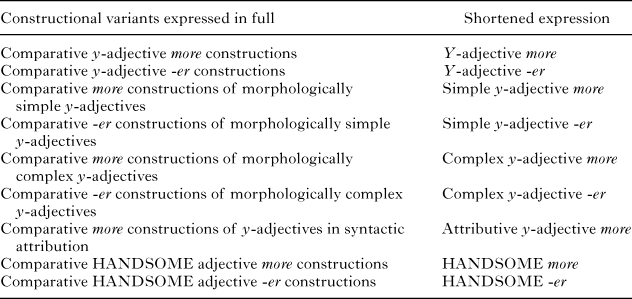
While the English agentive is not of core interest in this paper, it is hoped that its juxtaposition against the English comparative in (1) and (2) demonstrates the richness of constructional patterns and, by extension, the constructional approach on which they rest, for an analysis of English comparatives. It is these constructional patterns taken as a whole, more than their constituent elements, that show in one fell swoop, so to speak, the full extent of the specifications surrounding more and -er used in the comparative sense – both the specifications that support this use and those that arise and/or are retained from it. In the face of y-adjectives, therefore, where features typifying these adjectives alone, such as their length and stress placement, remain insufficient predictors of their comparative forms (Chua, Reference Chua2018, pp. 463–464), the shift towards a study of the more and -er comparative patterns themselves for potential compensation of this insufficiency seems apt. To facilitate expressive ease henceforth, I will refer to constructional patterns not at the level of abstraction presented in (1) and (2), but in relatively more concrete terms, for example, as y-adjective more construction (y-adjective more for short) and y-adjective -er construction (y-adjective -er for short). For these constructional variants and others subsequently referenced, relevant shortened expressions henceforth used interchangeably with their full expressions are summarised in Table 1.
Shortened expressions of constructional variants of interest

notes: HANDSOME adjectives refer to disyllabic adjectives that are not y-adjectives, e.g. handsome and mellow.
The potential explanatory power of a constructional approach to comparative alternation in y-adjectives finds an equally compelling case in the observation that the unreliable prediction of this alternation by adjectival features alone is symptomatic of that known as the partial productivity of grammatical constructions (Goldberg, Reference Goldberg2016, p. 369). That is, where a non-violation of phonological, syntactic, and semantic constraints of a construction’s use is no guarantee of this use in place of an alternative. With the y-adjectives, it is unsurprising to find, say, its trisyllabic members, e.g. untidy, in the comparative -er construction, i.e. untidier, even as a count of three or more syllables in an adjective points towards the uptake of the comparative more option (Bauer, Lieber, & Plag, Reference Bauer, Lieber and Plag2013,p. 186). Likewise, where y-adjectives are presumably constrained to the comparative -er because of their weak-stressed -y ending (Kruisinga, Reference Kruisinga1932, p. 63) and their final unstressed vowel (Quirk, Greenbaum, Leech, & Svartvik, Reference Quirk, Greenbaum, Leech and Svartvik1985, p. 462), we continue to find these adjectives in the comparative more construction, and in a non-exceptional way. Y-adjectives are found to comprise “more than a third of the 247 adjectives alternating between more and -er identified … for study in Hilpert 2008” (Chua, Reference Chua2018, p. 463).
For now, it may help to add that partial productivity (Goldberg, Reference Goldberg2016), to which comparative formation in y-adjectives seems to cohere, is rooted in such principles as exemplar theory (Bybee, Reference Bybee2006), grammatical form generalisation by type frequency (Bybee, Reference Bybee and Bybee2007; Bybee & Newman, Reference Bybee and Newman1995; Goldberg, Reference Goldberg2016; Marchman & Bates, Reference Marchman and Bates1994), and constructional persistence in cognition (Bock, Reference Bock1986; Szmrecsanyi, Reference Szmrecsanyi2005). Exemplar theory (Bybee, Reference Bybee2006, pp. 716–717, citing Pierrehumbert, Reference Pierrehumbert, Bybee and Hopper2001, p. 140) is concerned with the frequent, repeated encounters of a specific token (which may be a word or phrase) with its configuration of linguistic (and sociolinguistic) information, such as its specific phonetic and phonological realisation, its specific morphological affix, and/or its specific social context and pragmatics of use. A token’s frequent occurrence consequently creates a mental representation or exemplar of it bearing its said information so that tokens bearing an identical information configuration strengthens the exemplar, while tokens with an overlapping but non-identical information configuration evoke their own exemplars that nevertheless cluster around the original exemplar. Grammatical form generalisation by type frequency, on the other hand, takes the view that the larger the range of different lexical items employing a grammatical constructional pattern, which entails the pattern’s low lexical arbitrariness and high type frequency, the more likely is the pattern’s use over an alternative in prospective input. The relevant constructional pattern is greater in its application strength, so to speak, than an alternative (Bybee, Reference Bybee and Bybee2007, p. 171). Finally, constructional persistence in cognition claims that, of two constructional options, we are likely to find the same rather than the alternating option between discourse sites of close proximity. One measure of this proximity for Szmrecsanyi (2005, pp. 139–140) is identicalness of verb lemmas, and for Bock (1986, p. 355), it is the sequential distance between a prime and the associated task that follows. Given the above, partial productivity essentially arose between two tendencies: that of finding a linguistic input in a construction via overlaps in the input’s exemplar with other exemplars in that construction; and that of having the input pulled towards an alternate construction ‘systematically witnessed’ across a variety of instances to the point of serving as a ‘statistical pre[-]emption’ of the initial construction (Goldberg, Reference Goldberg2016, p. 386). It is in partial productivity, in other words, that we have a middle path between exemplar theory and grammatical form generalisation by type frequency, with the latter expected to hold out insofar as a sufficiently high type frequency of a construction facilitates its persistence in cognition, while producing a decomposing effect on partially activated competing constructions (Goldberg, Reference Goldberg2016, p. 384). If a partially activated construction is one speakers anticipate (Goldberg, Reference Goldberg2016, p. 384), both more and -er constructions are partially activated for y-adjectives because y-adjectives, as noted above, do not strictly conform to syllable count- and stress-based predictions of comparative forms. Where y-adjective more and -er are deemed partially activated, they may then also be deemed decomposable, cognitively speaking.
2.2. empirical background
The theoretical circumstances laid out above permit, in short, the abstraction of synthetic and periphrastic constructional patterns (Booij, Reference Booij2010, p. 1) across surfaced instances (Anderson, Reference Anderson1992, p. 369; Blevins, Reference Blevins2006, p. 533; Bybee, Reference Bybee and Bybee2007, pp. 169, 171; Jackendoff & Audring, Reference Jackendoff and Audring2016, p. 471), motivated by the relevant constructional pattern’s persistence (Bock, Reference Bock1986, p. 381; Szmrecsanyi, Reference Szmrecsanyi2005, p. 141) through its high lexical type frequency (Bybee, Reference Bybee and Bybee2007, p. 171; Bybee & Newman, Reference Bybee and Newman1995, p. 651; Goldberg, Reference Goldberg2016, p. 373; Marchman & Bates, Reference Marchman and Bates1994, p. 360). With resepct to y-adjectives, this proposes the potential for y-adjectival bias towards more given user exposure to multiple instances of more comparatives, and likewise, y-adjectival bias towards -er given user exposure to multiple instances of -er comparatives. Another way of forwarding this, in the light of decompositional effects predicted by partial productivity (Goldberg, Reference Goldberg2016, p. 384), is that a sufficiently high occurrence of more constructions from across other adjective types might pre-empt y-adjective -er constructions, just as a sufficiently high occurrence of -er constructions from across other adjective types might pre-empt y-adjective more constructions. The proposals here raised certainly align with the claim of potential facilitation and inhibition in “the processing of any given form … by other related forms” (Blevins, Reference Blevins2006, p. 535).
A question remains as to whether the intervening multiple more and -er constructions that might create/pre-empt a bias in y-adjectives for a comparative alternative are to come from a relatively more closely overlapping adjectival category, say, disyllabic adjectives, rather than other categories of adjectives. Observations before of constructional persistence in cognition have, after all, shown this persistence supported in the context of categorical overlaps, for example, via shared verb lemmas (Szmrecsanyi, Reference Szmrecsanyi2005, pp. 139–140). Another question of interest is that of whether any bias created/pre-empted in y-adjectives for a comparative alternative by intervening multiple more and -er constructions occurs only in subgroups of y-adjectives. A contributing principle of partial productivity, if we recall, is that a constructional alternative’s uptake is not strictly governed by formal and semantic constraints. Presumably, as such, it ought to be unsurprising to find, given multiple intervening more and -er constructions, relatively less regard for a priori associations of a constructional option with, say, morphological, syntactic, and phonological subcategories of y-adjectives. Findings from a previous study of y-adjectives in historical corpora (Chua, Reference Chua2016, Reference Chua2018) answer seemingly in the affirmative the questions here raised. In the relevant corpus findings, where y-adjectival bias for a comparative alternative is shown to exist in relation to the comparative constructions of other adjectives, specific and not all categories of these other adjectives are implicated. A specific category implicated is the disyllabic adjectives that are not y-adjectives, but which overlap with most y-adjectives in comprising two syllables. This category is also what I refer to in the ‘Introduction’ as the HANDSOME adjectives. We may note further that where the seeming pre-emption of y-adjectival bias for a comparative alternative is shown to exist in relation to the comparative constructions of other adjectives, this pre-emption is indeed found for particular morphological and syntactic groups of y-adjectives, respectively, morphologically simple y-adjectives, and y-adjectives in syntactic attribution. Where the corpus findings here recounted are symptomatic then of constructional persistence and partial productivity, principles that in turn rest on constructions, the corpus findings are a foretaste of the value of a constructional approach to understanding y-adjective comparatives.
Such a value cannot, however, be justified by corpus findings alone. This is in part because a constructional approach often implicates a cognitive dimension, typically associated with the individual language user, and which corpus data, since it draws together en masse the linguistic output of several individuals, may be less than effective in capturing. Given that it is a compilation of linguistic output generated for purposes other than that of a corpus, corpus data also has the downside of being relatively less controlled for, say, the number of intervening more and -er constructions of other adjectives that could possibly relate to the more and -er constructions found of y-adjectives. There is a risk, therefore, that these relationships, if found or otherwise from corpus data, may be statistical artefacts more than they are observations worth further theorisation. To avert this and ensure that data in support of a constructional approach to y-adjective comparatives is authentic to the cognitive dimension of this approach, controlled experimentation seems an appropriate means to validate, if not compensate for any shortfalls of, corpus findings. After all, if constructional patterns are claimed to associate with language processing (Jackendoff & Audring, Reference Jackendoff and Audring2016, p. 487; 2019, pp. 395–396), and if language processing theories often find their empirical avenue in experimental work, a controlled experiment would be an ideal space to detect the workings (or otherwise) of constructions, and their associated constructional patterns, in shaping y-adjective comparative alternation. Section 3 presents the hypotheses for experiment-based testing following a brief recount of the corpus findings that contextualise (potential) effects for experimental validation.
3. The experimental study
3.1. effects for experimental validation
The corpus findings that motivated the experimental study central to this paper were derived from a compilation of British English stage comedies spanning the seventeenth to the twentieth centuries (Chua, Reference Chua2016, Reference Chua2018). Structural factors that included a y-adjective’s syntactic positioning, its morphology, its word-final element, and the [+voiced] feature of its penultimate segment were examined as potential predictors of y-adjective comparative forms. Morphology was found as the only independent predictor in this regard, with complex y-adjectives biased towards more and simple y-adjectives towards -er – a finding coherent with previous corpus-based claims of a bias towards more with morphological complexity (Hilpert, Reference Hilpert2008, p. 407; Mondorf, Reference Mondorf, Rohdenburg and Mondorf2003, p. 283). An example of a complex y-adjective is lucky, comprising luck+y; an example of a simple y-adjective is merry, which cannot be further broken down into meaningful parts. Any follow-up experiment to the corpus findings to confirm various effects on the comparatives of y-adjectives may not therefore preclude in the first instance a test of the effect of morphology.
Juxtaposed against the investigated structural predictors, equally worthy of note from the corpus data are the significant correlations found of (structural subsets of) y-adjective more and -er with the comparative more constructions of HANDSOME adjectives. Table 2 indicates a significant positive relationship between HANDSOME more and y-adjective more, suggesting that multiple HANDSOME more biases y-adjectives towards more.
Some significant correlations from the corpus data of Chua (2016, 2018)

notes: HANDSOME adjectives refer to disyllabic adjectives that are not y-adjectives, e.g. handsome and mellow.
We are, however, unable to tell from correlations alone whether, first, that it is not the y-adjective more instead that impact a pairing of HANDSOME adjectives with more, and second, that in keeping with the cognitive dimension of a constructional approach, multiple HANDSOME more indeed promote ease in processing y-adjective more. Likewise, the significant negative relationship in Table 2 between HANDSOME more and simple y-adjective -er, while suggesting that multiple HANDSOME more reduce an expected morphological bias of simple y-adjectives for -er, does not confirm a cognitive dimension to this reduced bias, namely, that the reduced bias reflects a reduced ease in processing simple y-adjective -er given multiple HANDSOME more.
Confirmation that the relationships between HANDSOME more and the comparative constructions of y-adjectives are of a cognitive nature have to stem from further testing in an experiment. Where experimental design feasibility restrains the number of testable variables, however, validation of morphological effects has to be prioritised over syntactic positioning effects, since it is morphology that is found in the corpus study to have an independent effect on the comparative forms of y-adjectives (Chua, Reference Chua2016, p. 117; 2018, p. 488). The correlation implicating attributive y-adjective more in Table 2 will not therefore be pursued in an experiment beyond controlling for it as necessary.
If correlations found from the corpus data require further testing, the same holds for correlations unfound, but which cohere with a constructional approach to comparative alternation in y-adjectives. Therefore, although HANDSOME -er are not implicated in Table 2, it is premature to say that these would not, following the principle of a construction’s cognitive persistence, ease processing of y-adjective -er the way HANDSOME more might ease processing of y-adjective more. Likewise, it might be that HANDSOME -er will reduce ease in processing complex y-adjective more the way HANDSOME more are suspected to reduce ease in processing simple y-adjective -er. This possibility is supported by the pre-emption of expected biases associated with formal constraints in the partial productivity component of a constructional approach. The current theoretical circumstances, where a construction’s use is enabled by its cognitive persistence in similar exemplars and, in contrast, pre-empted by the cognitive persistence of an alternative construction, say little about what should happen if formally derived constructional biases, such as morphologically derived ones, are in tune with rather than pit against constructions that happen to be cognitively persistent. Hypothetically speaking, the formally derived biases might be either enhanced by the constructions, or neutralised, where the dampening of formal constraints characteristic of partial productivity overrides any effect of the construction’s cognitive persistence. This means that, given an anticipated bias towards -er with morphological simplicity, and towards more with morphological complexity, it is reasonable to test whether HANDSOME -er and more constructions ease processing, respectively, of simple y-adjective -er and complex y-adjective more.
3.2. hypotheses for experimental study
The effects for experimental validation generate a number of hypotheses where processing ease of comparative y-adjective constructions, given an intervention of comparative HANDSOME constructions, may be sought from people’s silent reading times (RTs). RTs, as visual measures, are justified as measures of processing ease of constructions implicating comparatives because visual measures have before been used to assess ambiguity resolution between alternate comparative forms (Boyd, Reference Boyd2007). In the experiment here reported, of interest are RTs related to comparative more and -er constructions. Increased/reduced ease in processing comparative y-adjective constructions is tantamount to increased/reduced facilitation in reading them, where facilitation is reflected in a shortening of relevant RTs.
To test the effects of morphology on its own in easing the processing of y-adjective comparatives, Hypotheses 1 and 2 below are formulated.
Hypothesis 1: For comparatives formed with -er, there will be greater facilitation in reading where base y-adjectives are simple compared to where they are complex.
Hypothesis 2: For comparatives formed with more, there will be greater facilitation in reading where base y-adjectives are complex compared to where they are simple.
Following the expectation of cognitive persistence in a constructional approach, Hypotheses 3 and 4 below test whether processing ease of comparative y-adjective constructions may be encouraged by HANDSOME constructions in the same comparative form.
Hypothesis 3: For y-adjective more, greater facilitation in reading will occur for participants exposed to an experimental treatment of multiple instances of HANDSOME more than for those exposed to a control condition.
Hypothesis 4: For y-adjective -er, greater facilitation in reading will occur for participants exposed to an experimental treatment of multiple instances of HANDSOME -er than for those exposed to a control condition.
An expected dampening of formally governed biases in a constructional approach, in accordance with partial productivity, derive Hypotheses 5 and 6 below, which test whether processing ease of morphological subsets of y-adjective comparatives may be reduced by HANDSOME constructions in the alternative comparative form. Hypotheses 7 and 8, on the other hand, test whether this ease may be enhanced by HANDSOME constructions in the same comparative form, in the hope of determining whether formally derived constructional biases may be tolerated where these biases happen to overlap with constructions that have cognitive persistence.
Hypothesis 5: Any facilitation in the reading of more comparatives resulting from an exposure to multiple instances of HANDSOME -er will be weaker for complex y-adjectives than for simple ones. In contrast, any facilitation in this reading resulting from an exposure to a control condition will be no different between complex and simple y-adjectives.
Hypothesis 6: Any facilitation in the reading of -er comparatives resulting from an exposure to multiple instances of HANDSOME more will be weaker for simple y-adjectives than for complex ones. In contrast, any facilitation in this reading resulting from an exposure to a control condition will be no different between complex and simple y-adjectives.
Hypothesis 7: Any facilitation in the reading of more comparatives resulting from an exposure to multiple instances of HANDSOME more will be greater for complex y-adjectives than for simple ones. In contrast, any facilitation in this reading resulting from an exposure to a control condition will be no different between complex and simple y-adjectives.
Hypothesis 8: Any facilitation in the reading of -er comparatives resulting from an exposure to multiple instances of HANDSOME -er will be greater for simple y-adjectives than for complex ones. In contrast, any facilitation in this reading resulting from an exposure to a control condition will be no different between complex and simple y-adjectives.
4. The experiment
The experiment to test the hypotheses above was approved by the Human Ethics Committee of Victoria University of Wellington (Ethics Approval: 20737).
4.1. experimental procedures
RTs used for the confirmation or otherwise of the hypotheses were those of the second word following the comparative y-adjective constructions, where these RTs were taken as proxies for the time taken to read the constructions of interest. In the sentence the cake was mintier than we expected, for example, the second word following mintier is we, and the time taken to read we serves as a proxy for the time taken to read mintier. Two reasons underscore the use of proxies. First, the comparative y-adjective construction is sometimes one word, e.g. mintier, and sometimes two, e.g. more minty, so that a direct comparison of RTs obtained from them would be confounded by differences in the number of words. Second, any processing ease experienced in one word/region during reading typically surfaces only when the following words/regions are read – see, for example, Gibson, Pearlmutter, Canseco-Gonzalez, and Hickok (Reference Gibson, Pearlmutter, Canseco-Gonzalez and Hickok1996, p. 30), and Vine and Warren (Reference Vine, Warren, Hoffman, Rayson and Leech2012, p. 244).
Experiment participants were 96 native speakers of New Zealand English who, at the time of study, were from twenty to thirty years of age (mean age = 21.75, sd = 2.15), had no language disability, had normal/corrected vision, and normal hearing. Thirty-one participants were males and 65, females; 88 were right-handed and 8, left-handed. The experiment comprised a pre- and post-treatment stage, with a treatment in between. Pre-treatment was a self-paced reading task, where a story embedding 20 comparative y-adjectives was silently read. Each participant read one of four stories; and each story was read by 24 participants. Of these 24, eight were assigned to one treatment group following pre-treatment, eight to a second treatment group, and eight to a third. With four stories, and eight participants who read each story assigned to one of three treatments, each treatment group comprised 32 participants. At post-treatment, participants read the same story as at pre-treatment.
In two of the four stories used, embedded y-adjectives were morphologically complex: minty, pushy, nerdy, toothy, scratchy, swampy, smoggy, stinky, grotty, nosey, yummy, cheery, groggy, freaky, breathy, yucky, pasty, teary, crappy, sludgy. In another two stories, embedded y-adjectives were morphologically simple: puny, tardy, snazzy, scrawny, tidy, empty, nasty, shoddy, dingy, petty, dainty, happy, giddy, eerie, flimsy, ugly, queasy, heavy, silly, dizzy. Complex y-adjectives were paired with -er in one story and paired with more in another, and likewise for simple y-adjectives. All storylines were similar, if not identical. Immediate post-comparative clauses were matched closely for each simple–complex pair of y-adjectives, to ensure comparability of processing ease at around the same points between different stories. All comparative y-adjective constructions were written in syntactic predication, to prevent any confounding effect syntactic attribution might have on reading facilitation – see Section 3.1 on the difficulty of testing for this effect within the confines of one experiment. With the support of a response box, the reading tasks of the experiment – masked in the moving window condition (Just, Carpenter, & Woolley, Reference Just, Carpenter and Woolley1982, p. 230) – were run in E-prime (version 2.0) (Psychology Software Tools, 2012), with RTs captured in the software. Each reading task (or story) comprised 16 trials (or 16 sets of six sentences). yes/no comprehension questions pertaining to each trial were interleaved in between trials to ensure attentive reading. While a pre- and post-treatment story was the same for a participant, the interleaving questions differed, to encourage attentive reading of the stories at both stages.
For the treatment stage between readings, participants listened to one of two dialogues or to a piece of music. The music – an excerpt of an instrumental piece, Okuribito – was the control condition (Treatment 0 or T0). The dialogues were experimental conditions, and were the same in content except for the comparative forms found. One dialogue (Treatment 1 or T1) embedded eight HANDSOME adjectives (clever, mellow, pleasant, handsome, quiet, common, nimble, and stupid) with comparative -er. The other dialogue (Treatment 2 or T2) embedded the same eight adjectives with comparative more. HANDSOME adjectives used all alternate between more and -er in the British National Corpus (BYU-BNC) (Davies, Reference Davies2004–). Eight HANDSOME comparatives in each of T1 and T2 were assumed sufficient to surface any hypothesised effects. This was because the type count of each of HANDSOME more and -er comparatives per thousand words in each treatment dialogue was several times higher than at each corpus datapoint correlated to derive the relationships in Table 2 (Section 3.1).
4.2. statistical procedure
A series of mixed effects models (MEMs) were fitted on the relevant RT data using the lme4 library (version 1.1-9) (Bates et al., Reference Bates, Maechler, Bolker, Walker, Christensen, Singmann, Dai, Scheipl, Grothendieck, Green and Fox2018) in R (version 3.1.3) (R Core Team, 2014). 2.45 per cent of the data comprising unusually long and short RTs, that is, those above 2500 milliseconds (ms) and below 125 ms, were removed. Cut-offs for data removal were based on the overall shape of the data, which showed RTs to begin to scatter from around 2500ms, and some abnormality in data shape where observations fell below 125ms. RTs remaining after data removal were inverse square root-transformed to approximate a normal distribution. To reduce potential collinearity between the non-experimental and experimental factors, transformed RTs were analysed with a two-stage modelling process. The first stage regressed out a set of non-experimental factors, and the second examined “the primary experimental manipulation” (Hofmeister, Reference Hofmeister2011, p. 384).
4.2.1. Stage 1 modelling
Factors regressed out in Stage 1 were referred to as item and participant factors. Although irrelevant to my hypotheses, these have been reported to predict RTs (Baayen & Milin, Reference Baayen and Milin2010, pp. 13, 19; Fernández & Cairns, Reference Fernández and Cairns2011, p. 190; Hofmeister, Reference Hofmeister2011, p. 383; Moers, Meyer, & Janse, Reference Moers, Meyer and Janse2017, p. 291). Item factors were: the length and frequency of items in a reading task, with frequency log-transformed; the position of an item within a sentence in a reading task (or item position), which was restricted cubic spline (rcs)-transformed with five knots; and the position within each story of a sentence where an item was found (or sentence position), which was rcs-transformed with seven knots. Item position and sentence position served, respectively, as a local and global measure of any learning and/or fatigue effects. Rcs transformations are to address non-linearities that take the form of many knots instead of a smooth line (Baayen, Reference Baayen2008, pp. 176–179; Hofmeister, Reference Hofmeister2011, p. 383) – the case for item position and sentence position. Participant factors regressed out at Stage 1 were: the age of participants; their biological sex; and their handedness (right/left). Since participants were speakers of New Zealand English, raw item frequencies were aggregated from relevant counts in the spoken and written components of the Wellington Corpora (Bauer, 1986–1992; Holmes, Vine, & Johnson, 1988–Reference Holmes, Vine and Johnson1994), and the written component of the International Corpus of English–New Zealand (ICE–NZ) (School of Linguistics and Applied Language Studies, 1989–1994). Actual item frequencies log-transformed and consequently included in data modelling had a value of 1 consistently added to their correspondent raw item frequencies. This was done because some raw item frequencies had a value of 0, which, if left as was, disallowed data transformation. Random intercepts for the variables item and participant were included in the modelling, to accommodate data fluctuation attributable to differences between lexical forms and between individual participants.
4.2.2. Stage 2 modelling
Data that remained unaccounted for after Stage 1, known as the residuals of transformed RTs (or residuals), were investigated in Stage 2. Residuals tagged to the second word following the comparative y-adjective constructions were the dependent variable (DV) (see Section 4.1). For ease of expression henceforth, the term ‘residuals of transformed RTs’ is used interchangeably with the term ‘RTs’. Independent variables (IVs) in Stage 2 – all categorical – were: the comparative form of y-adjectives (more, -er) in the reading task, or comparative for short; the morphology of these adjectives (simple or complex), or morphology for short; the treatment to which participants were subjected (T0, T1, or T2), or treatment for short; and whether the reading task was performed prior to or after treatment (pre or post), or PrePost for short. MEMs fitted in Stage 2 included two or more of these IVs depending on the hypothesis tested. IVs were centred due to collinearities found in preliminary modelling (Jaeger, Reference Jaeger2009). Random intercepts were included for the variables item, participant, and item-y, the last accommodating data fluctuation arising from lexical form differences of y-adjectives to which residual RT data were proxies. In Stage 2 modelling, data were partitioned into five subsets for five MEMs that tested different (pairs of) hypotheses. Data associated with incorrect reading comprehension answers were excluded from all MEMs fitted in Stage 2, since attentive reading cannot be assured in these cases.
5. Findings
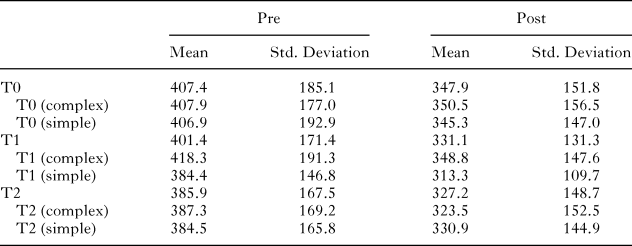
Table 3 shows the mean raw RTs at post-treatment to be shorter than at pre-treatment in all conditions. This confirms the appropriateness of referring, in the hypotheses, to facilitation in reading arising from treatment.
Mean with standard (std.) deviation of raw RTs in pre- and post-treatment self-paced reading tasks, by treatment and morphology, in milliseconds

notes: T0: control treatment of music; T1: exposure to multiple instances of HANDSOME -er; T2: exposure to multiple instances of HANDSOME more.
5.1. effect of morphology on the comparatives of y-adjectives
The effect of morphology alone in easing processing of comparative y-adjective constructions (Hypotheses 1 and 2) was tested on pre-treatment data. A significant interaction between morphology and comparative in predicting RTs was not found, however. This leaves unconfirmed as such Hypotheses 1 and 2, and their respective implications that processing of simple y-adjective -er is eased relative to complex y-adjective -er, and that of complex y-adjective more eased relative to simple y-adjective more.
5.2. effect of HANDSOME more on y-adjective more
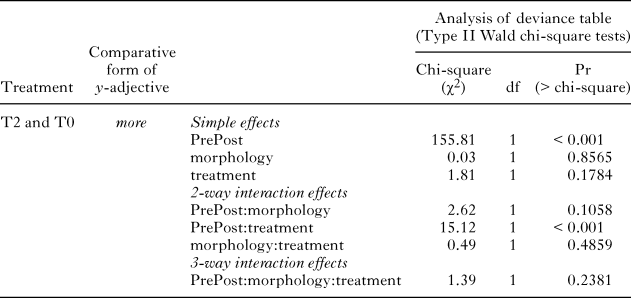
The effect of HANDSOME more on processing more constructions of y-adjectives (Hypothesis 3) and their morphological subsets (Hypothesis 7) was tested on data where more was read with y-adjectives, and where treatment was either HANDSOME more (T2) or control (T0). With multiple significant effects produced in the MEM to test these hypotheses, as well as in other MEMs reported in subsequent sections below, the significance of the different factors and of their interactions were tested with the Anova function in the phia library (version 0.2-1) (De Rosario-Martinez, Fox, & R Core Team, Reference De Rosario-Martinez and Fox2015) in R (version 3.1.3) (R Core Team, 2014). The output in Table 4 found a significant interaction between PrePost and treatment (χ2 (1, N = 1207) = 15.12, p < .001) in predicting RTs, indicating a differential effect between T2 and T0 on RTs in the context of y-adjective more, in preliminary support of Hypothesis 3.
Mixed effects model accepted to test effect of HANDSOME more (T2) on y-adjective more (Hypotheses 3 and 7)

notes: a. T0: control treatment of music; T2: exposure to multiple instances of HANDSOME more. b. Colons in the table signal an interaction term between the relevant variables.
The non-significant interaction between PrePost, morphology, and treatment (χ2 (1, N = 1207) = 1.39, p = .238) meant, however, that RTs between contexts of complex and simple y-adjective more were undifferentiated by T2. This suspends a pursuit of Hypothesis 7 and leaves unanswered the question of whether multiple instances of HANDSOME more (T2) ease processing of complex y-adjective more relative to simple y-adjective more. The significant simple effect of PrePost (χ2 (1, N = 1207) = 155.81, p < .001) in Table 4, and in subsequent models, was left unanalysed because PrePost often surfaced as a main effect within a higher-order non-null interaction, and “main effects of factors with non-null interactions should not be interpreted”, with “the same warning apply[ing] to interactions that are themselves contained in interactions of higher order” (De Rosario-Martinez, Reference De Rosario-Martinez2015, p. 6).
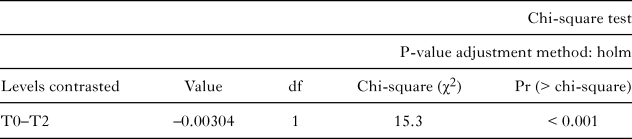
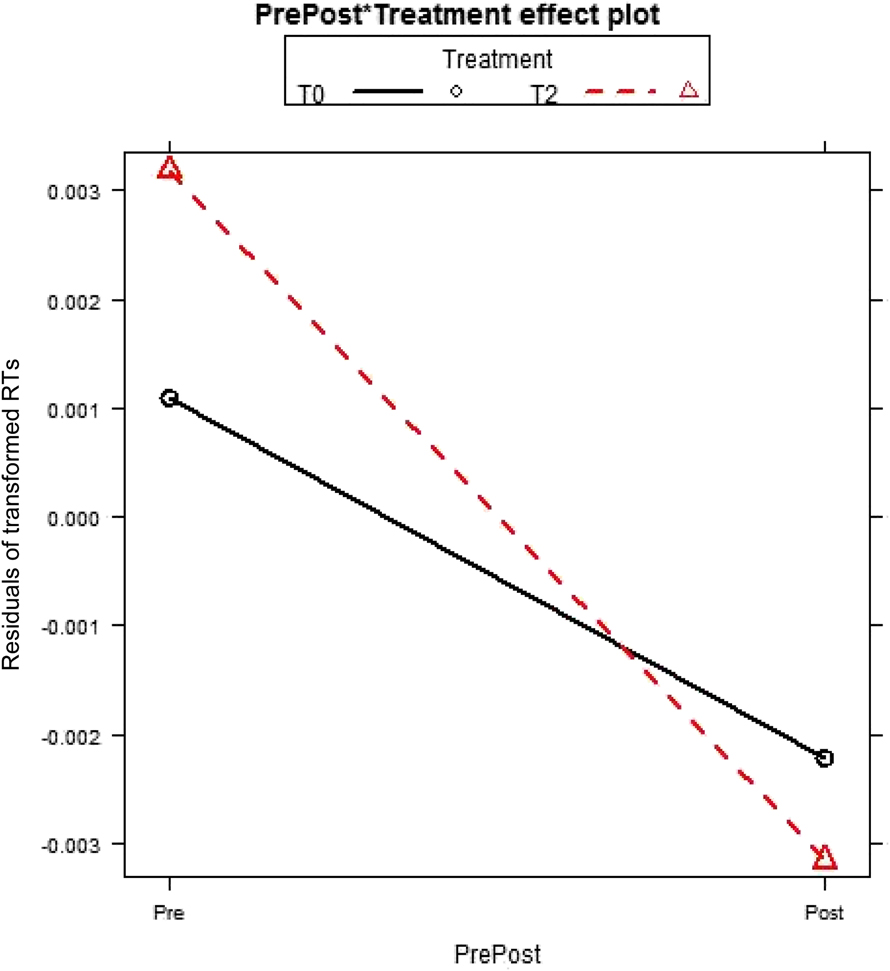
A post-hoc analysis of the significant interaction between PrePost and treatment from Table 4 showed the HANDSOME more treatment to facilitate reading in the context of y-adjective more, confirming Hypothesis 3. The post-hoc – performed with the testInteractions function in the phia library (version 0.2-1) in R (version 3.1.3) – tested the relative size of pre- and post-treatment RT differences when treatment levels were contrasted by subtracting the differences of T2 from those of T0. The negative value of -0.00304 obtained in Table 5 (with its graphical representation in Figure 1) showed pre-to-post decreases in RTs in the context of y-adjective more to be greater with T2 (exposure to HANDSOME more) than with T0 (control). Multiple instances of HANDSOME more (T2) eases processing of y-adjective more, in other words.
Contrast between T2 and T0 for pre-to-post-treatment changes in reading times in the context of y-adjective more

notes: a. T0: control treatment of music; T2: exposure to multiple instances of HANDSOME more. b. The output in Table 5 was obtained from the uncentred equivalent of the model presented in Table 4 because centring changes all categorical independent variables into numeric predictors; and the testInteractions function cannot work with numeric predictors.
Mean values showing pre-to-post-treatment facilitation effect for T2 and T0 for reading times (RTs) in the context of y-adjective more.
notes: a. T0: control treatment of music; T2: exposure to multiple instances of HANDSOME more. b. Figure 1 was plotted from an equivalent of the model presented in Table 4, but with independent variables kept uncentred. Residuals of transformed RTs provided the dependent variable in the model. c. The mean raw RTs in milliseconds (ms) for the conditions shown in Figure 1 were: 387.6 (Pre) and 334.9 (Post) for T0 (change of 52.7ms); and 390.8 (Pre) and 330.1 (Post) for T2 (change of 60.7ms).

5.3. effect of HANDSOME -er on y-adjective more
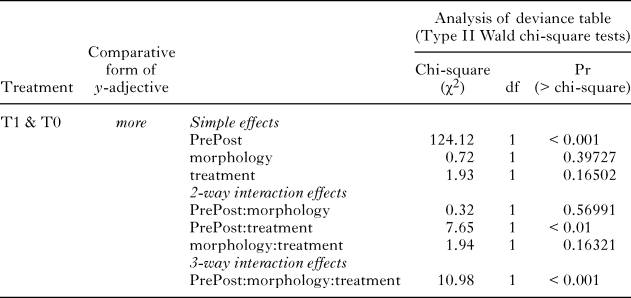
The effect of HANDSOME -er on processing more constructions of morphological subsets of y-adjectives (Hypothesis 5) was tested on data where more was read with y-adjectives, and where treatment was either HANDSOME -er (T1) or control (T0). The relevant MEM output in Table 6 shows a significant interaction between PrePost, treatment, and morphology in predicting RTs (χ2 (1, N = 1195) = 10.98, p < .001), indicating, in preliminary support of Hypothesis 5, that relative to T0, T1 differentiated RTs between the contexts of complex and simple y-adjective more.
Mixed effects model accepted to test effect of HANDSOME -er on y-adjective more (Hypothesis 5)

notes: a. T0: control treatment of music; T1: exposure to multiple instances of HANDSOME -er. b. Colons in the table signal an interaction term between the relevant variables.
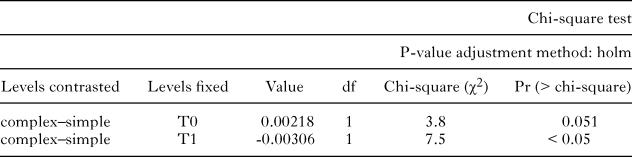
A post-hoc analysis of the significant interaction between PrePost, morphology, and treatment from Table 6 showed the HANDSOME -er treatment to facilitate reading less in the context of complex than in the context of simple y-adjective more, confirming Hypothesis 5. The post-hoc results in Table 7 tested the relative size of pre- and post-treatment RT differences by subtracting the differences of simple morphology from those of complex morphology, while treatment levels were kept fixed.
Contrast between complex and simple conditions for pre-to-post-treatment changes in reading times in the context of y-adjective more

notes: a. T0: control treatment of music; T1: exposure to multiple instances of HANDSOME -er. b. The output in Table 7 was obtained from the uncentred equivalent of the model presented in Table 6 because centring changes all categorical independent variables into numeric predictors; and the testInteractions function cannot work with numeric predictors.
With T1 (exposure to HANDSOME -er) in Table 7, there was a significant difference between complex and simple contexts in pre-post-treatment changes in RTs (χ2 (1, N = 600) = 7.5, p < .05). Granted, with T0 (control), the difference came close as well to conventional significance (χ2 (1, N = 595) = 3.8, p = .051). Contrasted with the negative value for T1 (–0.00306), however, the positive value for T0 (0.00218) meant that, whatever the trend found of T1, the trend of T0 was the reverse. Therefore, where for T1, pre-to-post decreases in RTs were relatively smaller in the context of complex y-adjective more, for T0, the decreases were instead relatively smaller in the context of simple y-adjective more. Corroboration remains as such from a control condition that multiple instances of HANDSOME -er (T1) reduce processing ease of complex y-adjective more.
5.4. effect of HANDSOME -er on y-adjective -er
The effect of HANDSOME -er on processing -er constructions of y-adjectives (Hypothesis 4) and their morphological subsets (Hypothesis 8) was tested on data where y-adjectives were read with -er, and where treatment was either HANDSOME -er (T1) or control (T0). However, output from the relevant MEM found neither a significant interaction between PrePost and treatment (χ2 (1, N = 1198) = 2.85, p = .092) nor between PrePost, morphology, and treatment (χ2 (1, N = 1198) = 2.16, p = .141) in predicting RTs. Pursuit of Hypotheses 4 and 8, which respectively rest on the significance of these interactions, has to be suspended therefore, leaving unanswered as to whether multiple instances of HANDSOME -er (T1) eases processing of y-adjective -er, and simple y-adjective -er relative to complex y-adjective -er.
5.5. effect of HANDSOME more on y-adjective -er
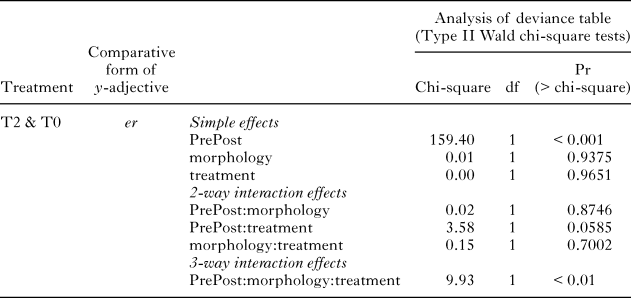
The effect of HANDSOME more on processing -er constructions of morphological subsets of y-adjectives (Hypothesis 6) was tested on data where y-adjectives were read with -er, and where treatment was either HANDSOME more (T2) or control (T0). The relevant MEM output in Table 8 showed a significant interaction between PrePost, treatment, and morphology (χ2 (1, N = 1194) = 9.93, p < .01) in predicting RTs, indicating preliminary support of Hypothesis 6, that relative to T0, T2 differentiated RTs between the contexts of complex and simple y-adjective -er.
Mixed effects model accepted to test effect of HANDSOME more on y-adjective -er (Hypothesis 6)

notes: a. T0: control treatment of music; T2: exposure to multiple instances of HANDSOME more. b. Colons in the table signal an interaction term between the relevant variables.
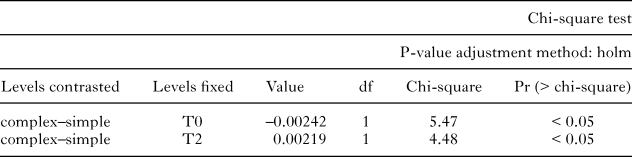
A post-hoc analysis of the significant interaction between PrePost, morphology, and treatment from Table 8 showed the HANDSOME more treatment to facilitate reading less in the context of simple y-adjective -er than in the context of complex y-adjective -er, confirming Hypothesis 6. The post-hoc results in Table 9 tested the relative size of the differences between pre- and post-treatment RTs by subtracting the differences for simple morphology from those for complex morphology. Treatment levels were kept fixed.
Contrast between complex and simple conditions for pre-to-post-treatment changes in reading times in the context of y-adjective -er

notes: a. T0: control treatment of music; T2: exposure to multiple instances of HANDSOME more. b. The output in Table 9 was obtained from the uncentred equivalent of the model presented in Table 8 because centring changes all categorical independent variables into numeric predictors; and the testInteractions function cannot work with numeric predictors.
With T2 (HANDSOME more) in Table 9, there was a significant difference between complex and simple contexts in pre-post-treatment changes in RTs (χ2 (1, N = 597) = 4.48, p < .05). Although with T0 (control), the difference was also significant (χ2 (1, N = 597) = 5.47, p < .05), the pattern of difference was the reverse of that with T2, justified by the negative value of T0 (–0.00242) in contrast to the positive value of T2 (0.00219). Therefore, where for T2 pre-to-post decreases in RTs were relatively smaller in the context of simple y-adjective -er, for T0 the decreases were relatively smaller instead in the context of complex y-adjective -er. Corroboration exists, therefore, from a control condition that multiple instances of HANDSOME more (T2) reduce processing ease of simple y-adjective -er.
5.6. summary of key experimental findings
In sum, the key experimental findings are as follows. First, independent of HANDSOME more and -er treatments, y-adjective morphology is not found to have an effect on the processing ease of comparative y-adjective constructions (Section 5.1). Second, while processing of y-adjective more may be eased by HANDSOME more (Section 5.2), the same may not be said about y-adjective -er given HANDSOME -er (Section 5.4). Third, any anticipated ease from morphological complexity in processing y-adjective more and from morphological simplicity in processing y-adjective -er are open to suppression, respectively, by HANDSOME -er (Section 5.3) and HANDSOME more (Section 5.5); conversely, these anticipated ease are, respectively, found neither enhanced by HANDSOME more (Section 5.2) nor by HANDSOME -er (Section 5.4).
6. Discussion
The experimental findings raise several implications. An obvious one is the need to factor into a comparative alternation account of y-adjectives the comparatives of the HANDSOME adjectives. In concert with the corpus findings in Chua (Reference Chua2016, Reference Chua2018) that prompted the direction of the experimental hypotheses, the experimental findings add empirical weight to the place of comparative HANDSOME constructions in understanding y-adjective comparatives. That processing of y-adjective more eases following a treatment of multiple HANDSOME more (Section 5.2) coheres with the corpus finding of a significant positive correlation between y-adjective more and HANDSOME more (Table 2). The reduced ease in simple y-adjective -er (Section 5.5) and complex y-adjective more (Section 5.3) processing following the treatments, respectively, of multiple HANDSOME more and -er, corresponds with the corpus finding of a significant negative correlation between simple y-adjective -er and HANDSOME more (Table 2), and in fact furthers it by surfacing a parallel association between complex y-adjective more and HANDSOME -er. Where for a long time the scholarship has focused on base adjective-associated features (Hilpert, Reference Hilpert2008, p. 407) as predictors of comparatives, my findings suggest then that, for y-adjectives, HANDSOME comparative constructions are equally crucial predictors. That is, insofar as anticipated y-adjective biases for more with morphological complexity, and for -er with morphological simplicity, are suppressible by HANDSOME constructions in a comparative pattern alternative to those the biases anticipate. That a correspondent observation exists of a non-enhancement of the anticipated morphological biases by HANDSOME comparatives (Sections 5.2 and 5.4) strengthens the claim that features referencing the base adjective alone are relatively limited for an account of y-adjective comparative alternation. A suppression of expected morphological biases in y-adjective comparatives by HANDSOME comparatives seems a case further where HANDSOME more and -er, in their multiple occurrences, decompose (Goldberg, Reference Goldberg2016, p. 384), respectively, that otherwise expected to be a partially activated bias for -er in simple y-adjectives and more in complex y-adjectives. Typifying partial productivity, we have here, in other words, the relegation of formal constraints in linguistic alternation preferences. Where partial productivity associates with grammatical constructions, the role the experimental findings accord to a constructional approach in explaining y-adjective comparatives is apparent.
Any theoretical and empirical implication of a claimed suppression of morphological biases in y-adjective comparatives may be disputed, given that the relevant biases are not found in the first instance at pre-treatment (Section 5.1). The fact remains, however, that the biases are found in the corpus data precedent to the experimental study, with similar biases noted from other corpus studies (Section 3.1). It may be, therefore, that the said morphological biases are not so much non-existent as they are more observable from corpus than from processing data, so that any effect of a cognitive clustering (Bybee, Reference Bybee2006, pp. 716–717) of comparative HANDSOME constructions on those biases might surface less easily in a corpus context. Coherent with this is the observation that multiple HANDSOME -er appear to downplay a more bias in complex y-adjectives only in the experimental but not in the corpus data. If effects of comparative HANDSOME constructions are indeed most clearly sighted in processing data, we may explain the non-confirmation of anticipated morphological biases for more and -er in y-adjectives in the experimental pre-treatment. That is, participants could have entered the experiment with prior cognitive accumulations of comparative HANDSOME constructions high enough to bear upon the expected morphological effects. This does not deny the existence of the morphological biases. It suggests, rather, that the biases are already suppressed at pre-treatment, but without the suppression having reached an experimental ceiling, so that effects of comparative HANDSOME constructions in enabling the suppression remain observable.
The light a constructional approach sheds on y-adjective comparatives is gleaned also when we return the experimental findings to the theory of constructional pattern (or schema) abstraction across surfaced instances (Anderson, Reference Anderson1992, p. 369; Blevins, Reference Blevins2006, p. 533; Booij, Reference Booij2010, pp. 4, 15; Bybee, Reference Bybee and Bybee2007, pp. 169, 171; Jackendoff & Audring, Reference Jackendoff and Audring2016, p. 471). An ease in y-adjective more processing predicted by the treatment of multiple more constructions across several different HANDSOME adjectives supports an abstraction of the more pattern precisely because y-adjectives are in common set apart from HANDSOME adjectives by an orthographic <y> and a /i/ sound. Y-adjectives in the experiment may as such be presumed to evoke exemplars (Bybee, Reference Bybee2006, pp. 716–717) separate from those that HANDSOME adjectives evoke. This entails an intermediary step of comparative pattern abstraction, where a more pattern has first to be abstracted from the HANDSOME adjectives, without which the overlap between this more pattern and y-adjective more may not then sufficiently surface for the former to ease the processing of the latter. If we further this analysis to claim the workings as well of a more pattern abstraction in the significant positive correlation between y-adjective more and HANDSOME more (Table 2) from the diachronic corpora of Chua (Reference Chua2016, Reference Chua2018), a simultaneously important and exciting implication would have found its way into the current discussion. That is, the interpretive ease constructional pattern abstraction lends to both psycholinguistic–experimental and diachronic–corpus findings suggests it may well be via a constructional approach that we have a means of using classically differentiated modes of empiricism within the field to model a unified linguistic phenomenon.
Where a more pattern abstraction conveys the benefit of a constructional approach to explaining y-adjective more, the issue remains as to whether this approach lends as easily to explaining y-adjective -er. HANDSOME -er are not after all observed to ease y-adjective -er processing (Section 5.4). A ready explanation exists, however, for this non-observation in what is called the prime surprisal effect, which claims “less frequent structures … to prime [relatively] more strongly” (Jaeger & Snider, Reference Jaeger and Snider2013, p. 60) because they are less expected. Where y-adjective -er processing is not eased by HANDSOME -er therefore, it may be that the -er pattern is relatively more frequent, so that it is the more pattern that primes more strongly onto y-adjectives. While not experimentally set up as such, it is entirely reasonable for comparative -er to exceed comparative more constructions in cognition because -er-biased adjectives, since they are primarily monosyllabic (Hilpert, Reference Hilpert2008, p. 395; Quirk et al., Reference Quirk, Greenbaum, Leech and Svartvik1985, p. 461), would, in accordance with Zipf’s Law (Mondorf, Reference Mondorf2009, p. 40; Zipf, Reference Zipf1929, p. 30), be of higher frequency in the first instance. Of importance is that a prime surprisal effect does not dispute the workings of a contructional approach. If the -er pattern is expected to a degree that multiple HANDSOME -er motivate no observable priming of -er on y-adjectives, this simply means that surprisal of the -er pattern is low – possibly (close to) 0 (Jaegar & Snider, Reference Jaeger and Snider2013, p. 61). It does not deny that, given a higher surprisal of the -er pattern, HANDSOME -er could have an observable effect on y-adjective -er. The numerical condition of ‘surprisal’ to observe this effect is a separate issue. Granted, since prime surprisal is in Jaeger and Snider studied in a syntactic context, doubts may arise as to whether it has explanatory power in English comparative alternation, where the -er alternative is classically morphological even as the more alternative may be deemed syntactic. My take is that, insofar as there is no evidence from the literature that prime surprisal is relevant only to syntactic alternatives, an openness to its relevance to syntactic–morphological alternatives may be reasonably kept. After all, if meaning complexity characterises all syntactic structures, then this is a feature necessarily shared in English comparative -er constructions, since -er is a bound morpheme, which, by definition, entails complexity of the morphological structure it constitutes.
If the workings of pattern abstraction and partial productivity implied in the experimental findings support a constructional take on y-adjective comparatives, the same may be said about the implied workings of type frequency-informed grammatical form generalisation (Bybee, Reference Bybee and Bybee2007, p. 171; Bybee & Newman, Reference Bybee and Newman1995, p. 651; Goldberg, Reference Goldberg2016, p. 373; Marchman & Bates, Reference Marchman and Bates1994, p. 360), constructional persistence (Bock, Reference Bock1986, p. 381; Szmrecsanyi, Reference Szmrecsanyi2005, p. 141), and schema-bound (rather than lexically-bound) morphemes (Booij, Reference Booij2010, pp. 4, 15). Type counts of HANDSOME more (and also -er) were experimentally scripted to be several times higher per thousand words than at the datapoints of the corpora that originally surfaced significant correlations between HANDSOME and y-adjective comparatives (Section 4.1). It is reasonable therefore to interpret a y-adjective more processing ease following multiple HANDSOME more as evidence of grammatical form generalisation predicated on type frequency. It is reasonable as well to interpret in this processing ease the workings of constructional persistence, at least of the comparative more pattern, since a pattern presented in high frequency logically entails a persistence of its cognitive presence to which the pattern is presented. A potential caveat is the degree of certainty that it is the more pattern of the HANDSOME adjectives rather than the ongoing presence of y-adjective more itself in the reading trials that eases the processing of y-adjective more. While I see the point in the caveat, I would emphasise that the HANDSOME more treatment is strong enough to suppress an anticipated processing ease of y-adjective -er stemming from morphological simplicity. Presumably, this suppression would not have occurred had effects on y-adjective comparatives from the HANDSOME more treatment been negligible.
The finding of a more bias in y-adjectives attributable to a repeated more pattern in HANDSOME adjectives benefits moreover our understanding of constructional persistence. At the same time that this bias shows a constructional pattern’s persistence to indeed favour it over an alternative (Bock, Reference Bock1986; Szmrecsanyi, Reference Szmrecsanyi2005), the bias also relaxes conditions previously held for constructional persistence to thrive. HANDSOME more and -er were not in the experimental design placed in comparably close proximity to every instance of y-adjective more and -er. Notwithstanding this, and after having accounted for the positioning of the y-adjective comparatives (see item position and sentence position in Section 4.2.1), significant effects remain of the HANDSOME comparatives. Where constructional persistence has before been conditioned on close proximity between constructions bearing the same/similar patterns (Bock, Reference Bock1986, p. 355; Szmrecsanyi, Reference Szmrecsanyi2005, p. 139), my findings then seem to downplay this, suggesting instead that a pattern repetitively presented in high frequency suffices to surface its persistence – in this case, both to reinforce the pattern itself and to downplay an alternative. Likewise, where persistence has before been conditioned on a shared lemma (Szmrecsanyi, Reference Szmrecsanyi2005, p. 140), my findings point otherwise. Y-adjectives and HANDSOME adjectives do not typically share a lemma, and if, despite this, evidence remains of a more pattern persistence in y-adjective comparative processing that stems from an experimental onslaught of HANDSOME more, a case exists for constructional persistence in the absence of shared lemmas. The more pattern’s persistence across lemmas further supports a fundamental in construction morphology that sets it apart from process-based word formation, namely, that morphemes are bound to an abstract schema rather than to individual lexical items (Booij, Reference Booij2010, pp. 4, 15). A more pattern reinforced across lexical items of different adjectival groups in my experiment suggests that comparative more periphrasis is less likely to have emerged from a concatenation of more with specific adjectives than from the import of a whole schema, or constructional pattern, partially filled with more (see 2a, Section 2.1). A constructional take to understanding y-adjective comparatives is again supported as such.
7. Conclusion
In affirming the benefits an account of y-adjective comparatives may derive from HANDSOME comparative constructions, my experimental findings validate rather nicely those of a precedent diachronic corpus study. An understanding of y-adjective comparatives here reached through an uptake of comparative constructions in their entirety advances the increasingly laid pavement, aptly noted in Christiansen and Chater (Reference Christiansen and Chater2017, p. 2), for studies driven by constructions and the numerically informed patterns they evoke. The implication drawn from the way the comparative more pattern persists in user cognition throws up moreover a pleasant surprise. Where a de-emphasis of shared lemmas for this persistence supports the notion of morphemes tagged to schemas instead of words, the experimental findings here that evidence this de-emphasis take our understanding of y-adjective comparatives right to the heart of a constructional perspective!