


Introduction
Conducted electrical weapons (CEWs) are low lethality incapacitating devices which aim to provide police forces with an alternative to firearms, allowing a careful and progressive use of force in situations of special complexity, such as interventions with people aggressive or agitated,Reference Bailey, Smock, Melendez and El-Mallakh1–Reference Gerold, Gibbons, Fisette and Alves4 reducing the injuries in the subject to incapacitateReference Smith, Kaminski, Rojek, Alpert and Mathis5 and increase safety in the environment, because there is no less harmful and more effective alternative.Reference Mesloh, Henych and Wolf6
In a studyReference Gerold, Gibbons, Fisette and Alves4 that included 1,201 people subjected to the use of CEWs, 99.75% did not present significant injuries, attributing a 1.4% mortality compared to 50.0% for firearms.Reference Ordog, Wasserberger, Schlater and Balasubramanium7
This weapon should be used when the police have no chance of dialogue, negotiation, or mediation with the person who is a threat to himself and others. The use of a CEW by the police must be served by the principles of proportionality, consistency, timeliness, training, and adequate and specific training of the person who uses it.
Prehospital Emergency Medical Services (EMS) in Spain are based on two types of ambulances: Basic Life Support with two emergency medical technicians (EMTs), and Advanced Life Support with a physician, a nurse, and two EMTs.
In addition, various Spanish EMS have tactical emergency medical support (TEMS) teams to work with the police special operations teams. They are called Tactical Environment Medical Support Teams (in Spanish, Equipos Médicos de Apoyo a Entorno Táctico – EMAET), which act jointly with the special operations teams of the National Police. This is specified in the Victoria I Consensus,Reference Martín-Ibáñez, Pérez-Martínez and Zamora-Mínguez8 a document that defines the different areas of action in an intentional mass-casualty incident and the tasks for each of them. In Spain, there are three tactical medical civil teams: Madrid City Council, Community of Catalonia, and Zaragoza City Council.Reference Roca, Martin, Borraz, Serrano and Linam9
The EMAET of the Zaragoza Fire Department (EBAZ) was created in 2020 and is integrated to physicians and nurses of the services. Its components have previously passed the Tactical Emergency Casualty Care (TECC) course and are equipped with ballistic protection elements.
Due to the constant and progressive acquisition and implementation of this type of electronic control devices in law enforcement around the world, as well as the generalization of their use, it is necessary that not only the EMAET should know these weapons, but all EMS professionals should.
Therefore, this work should be useful in order to learn the basic concepts of the operation of the CEWs, risks derived from their use, more frequent clinical effects associated with the application of the electric shock, and the protocol of the Zaragoza Fire Department (Spain) is offered to guide and show how to proceed.
Method
For the elaboration of the protocol, a bibliographic search was carried out in PubMed (National Center for Biotechnology Information, National Institutes of Health; Bethesda, Maryland USA) using the keywords “Taser” and “Conducted Electrical Weapon.” The search showed 373 articles with “Taser” and 207 with “Conducted Electrical Weapon.” After reading the abstracts, 55 articles were selected, which are those that form part of the bibliography of this article. These articles were selected because they are the most current or because they present important information for the understanding of the operation, risks, injuries, or actions in front of a patient tasered.
Description and Classification of the CEW
In Spanish legislation, CEWs are included in the Arms Regulations, where although they are not defined, it is made explicit that their acquisition, possession, and use is reserved to officials specially authorized to do so. This regulation specifies that the license to use firearms does not allow the use of CEWs.
Now these devices are already established in more than 100 countries, and have been used for years in Germany, the United Kingdom, Norway, Canada, and the United States.Reference Strote and Hutson10
In Spain, the Departmental Police of the Basque Country and Catalonia (2017-2018), as well as the Local Police of Valencia and numerous towns, were pioneers in the use of CEWs. At the present time, its implementation in the National Police and the Local Police of Madrid, as well as other cities and towns in Spain, is close.
All CEWs are classified according to their mechanism of action by direct or remote contact:Reference Aguilar Pallarès, Morante Barragán, Novelle Rodríguez and Subirana Domènech11
-
Drive Stun Mode: To produce their effect on the person, must come into direct contact with him. Different brands and models can be found on the market: stun guns, stun batons, or stun belts.
-
Probe Mode: Produce electric shock from a distance. In these devices, when removing the cartridges in which the wires that end in the harpoon-shaped electrodes are included, two electrodes remain that allow it to work in drive stun mode.Reference Zipes12,Reference Zipes13
The probe mode device best known and most used is the Taser (Axon; Scottsdale, Arizona USA)Reference Aguilar Pallarès, Morante Barragán, Novelle Rodríguez and Subirana Domènech11,Reference Zipes13 and its different models, the most current being the 7, X2, and X26P. Although this work is about CEWs, and more specifically about probe mode devices, this article analyzes exclusively the Tasers.
The main difference between the Taser devices and the rest of the CEWs is that it affects the muscular nervous system and immobilizes the person, while the others affect only the sensory nervous system and produce intense pain in the contact area. Consequently, the control mechanism of the person through the Taser is not pain but muscle contraction.Reference Aguilar Pallarès, Morante Barragán, Novelle Rodríguez and Subirana Domènech11 This is likely the main reason why its use has become widespread.
Basic Operating Concepts of Taser Reference Aguilar Pallarès, Morante Barragán, Novelle Rodríguez and Subirana Domènech11,Reference LeClair and Meriano14
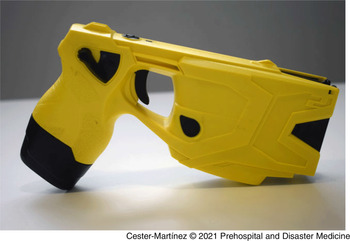
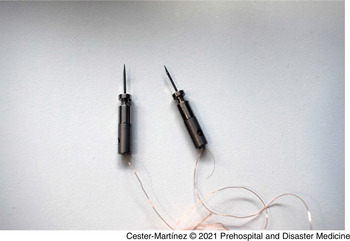
The Taser is made of a plastic material support in the shape of a gun (Figure 1), in which a high-performance lithium battery with a capacity of up to 500 shocks is integrated. Two cartridges can be placed in the front of the Taser. Each of them contains a nitrogen tank, which when shooting drives two darts placed at the end of some fine insulated wires that keep the electrodes in contact with the battery (Figure 2).
Side View of a Taser.

Harpoon-Shaped Electrodes Placed in the Cartridges on the Front of a Taser.

One electrode will be projected in a straight line and the other will make a downward angle to impact different sites. The optimal distance for this type of weapon is between two and three meters, with a maximum range of 7.6 meters. There is the possibility that only one electrode gets nailed; in that case, the circuit would not be closed and discharge would not occur.
The preferred areas for the least damaging impact are, in this order: the upper back for rear shots and the abdomen for front shots, since this increases the distance to the heart and reduces cardiac risks.
Once the electrodes impact the target, the energy released by the battery will be transmitted through them, which in each shot will be 1400 volts with an average intensity of 2.01mA to 3.6mA. This energy will have alternating voltage, although the energy stored in the battery is continuous (the device modifies it).Reference Aguilar Pallarès, Morante Barragán, Novelle Rodríguez and Subirana Domènech11
When talking about the pass of electric current through the human body, the amperage is more important in terms of lethality than voltage, since values between 75mA to 100mA can cause death.Reference Palomo Rando, Ramos Medina and Santos Amaya15
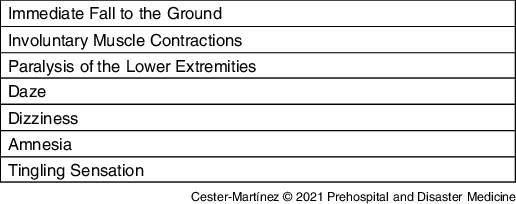
The shock will last as long as the agent holds the trigger, typically between one and five seconds. The discharges caused by the Taser produce some common effects, which are described in Table 1.
Clinical Effects of a Discharge with Taser

The Taser has a double laser to mark the points of impact, as well as the ability to warn before shooting by activating a 50,000 electric arc of blue light and an unpleasant sound that can have a deterrent effect itself.
The use of the Taser has control mechanisms such as the recording of events in an internal memory, which includes the weapon’s serial number (identification) and data on each discharge (exact date and time, duration of the discharge, ambient temperature, percentage of battery at the time of discharge, and total number of discharges made throughout the life of the weapon). The transfer of these data to a computer can only be done using encrypted files, which prevents them from being modified. The internal memory capacity is 1500 discharges and it cannot be deleted or modified.
In addition, each time the Taser is shot, 20-30 small confetti of bright colors are released, called anti-felon identification (AFID), which are printed with the serial number of the cartridge used so that it is possible to know who has activated the device.
It’s important to know that the energy released can cause the ignition of flammable or explosive liquids or vapors, such as gasoline, gases emanating from sewers or confined spaces, or those used in laboratories of manufacture of methamphetamines. It can also be dangerous to use it in poorly ventilated spaces where a defense spray has previously been used, which may contain alcohol. In addition, the effectiveness in individuals wearing ballistic vests or thick coats may be impaired when the maximum thickness of the clothing exceeds 2.5cm.
Risks Derived from the Use of the Taser
According to the Impact Zone of the Electrodes—
-
Chest: There is an increased risk of ventricular tachycardia or ventricular fibrillation in shocks that are located in this area.Reference Aguilar Pallarès, Morante Barragán, Novelle Rodríguez and Subirana Domènech11,Reference Zipes12,Reference Lakkireddy, Wallick and Verma16
-
Skull: A case of generalized tonic-clonic seizure is described after the impact of one of the electrodes in the occipital region.Reference Bui, Sourkes and Wennberg17 The bibliography also includes other areas of location of the electrodes, such as the frontal region, without any clinical signs except for the impact itself.Reference Lewis and Lewis18
-
Eyes: Partial or total loss of vision can occur due to the impact of an electrode in that area or its proximity.Reference Han, Chopra and Carr19–Reference Kroll, Ritter and Kennedy22
-
Others: The impact on soft parts of the face,Reference Campbell and Clark23 neck, pubis,Reference Theisen, Slater and Hale24 or areas with known pre-existing injuries may be associated with more serious injuries such as large vessel injuries or subsequent sequelae.
Risk Groups—Its use is not recommended in the elderly, children, and pregnant women, being described in the literature an abortion after a discharge to the abdomen and one leg in a three-month pregnant woman.Reference Mehl25
Carriers of Implanted Heart Devices—The carriers of these devices could also be considered a risk group, and they can also be susceptible to cardiac pathology when receiving the impact of the electrodes on the chest. However, the dysfunction of the discharge in the implanted device makes these people a specific group to be analyzed.
Carriers of Implantable Cardiac Defibrillators (ICD)—In the scientific literature, there isn’t a wide casuistry that allows to establish decisive conclusions. According to Haegel, et alReference Haegeli, Sterns, Adam and Leather26 who analyzed what happened in a case in which a carrier of an ICD received a discharge using a Taser weapon, causing an episode of ventricular fibrillation during the shock but did not activate as it did not have enough time to reconfirm. What was found is that in the ICD, there was a sustained decrease in the defibrillator activation threshold from 2.4V and 0.5ms to 0.5V and 0.5ms of unknown cause.
In another case, Paninski, et alReference Paninski, Marshall and Link27 recorded the same decrease in the activation threshold in the ICD when receiving the discharge, although on this occasion, ventricular tachycardia did occur. The same confirms Cao, et alReference Cao, Shinbane, Gillberg and Saxon28 in a case studied, but without a decrease in the ICD activation threshold.
All these findings raise the question of what would happen if these people had received a second or successive shocks.
Pacemaker Carriers—In the scientific literature, no cases of Taser discharge in a person with a pacemaker have been found, only experimental cases in pigs without alterations occurring.Reference Khaja, Govindarajan, McDaniel and Flaker29
Pacemakers according to international regulations are designed to endure the electric shocks generated by the automatic external defibrillator (AED), which are in a range of 150-400J, with 30-40amp.Reference Khaja, Govindarajan, McDaniel and Flaker29–Reference Kunz and Adamec31 The energy produced by a Taser is 0.36J and 0.0021amp, so it can be concluded that being lower than that generated by the AED, it should not produce any alteration in the pacemaker.Reference Kunz, Calkins, Adamec and Kroll30,Reference Emergències32
Most Frequent Clinical Effects Associated with the Application of the Electric Shock of a Taser Reference Aguilar Pallarès, Morante Barragán, Novelle Rodríguez and Subirana Domènech11,Reference LeClair and Meriano14,Reference Payne-James and Sheridan33–Reference Stevenson and Drummond-Smith36
Its appearance or its aggravation will be directly related to the duration of the discharges and the number of them:
-
Skin Lesions: Generally appear two lesions, rounded, 2.0-5.0mm, erythematous, as consequence of the impact of the electrodes.Reference Aguilar Pallarès, Morante Barragán, Novelle Rodríguez and Subirana Domènech11
-
Epidermal Burns: Due to the pass of electrical current through the skin.Reference Bozeman, Hauda, Heck, Graham, Martin and Winslow37,Reference Kroll, Ritter and Williams38
-
Musculoskeletal Injury:Reference Kunz, Calkins, Adamec and Kroll30 Ligaments, muscles, dislocations, or damage related to orthopedic or other elementsReference Emergències32 caused by intense muscle contractions.
-
Bone Injuries: Head trauma, which are the ones that produce the highest morbidity and mortality in this group.Reference Kroll, Luceri, Lakireddy and Calkins39 Fractures of all types and locations have also been described, highlighting the vertebral ones that, due to displacement, have produced neurological and spinal involvement.Reference Tyagi, Gill and Felton40 All this is due to the loss of control of the musculature, which can cause falls.
-
Rhabdomyolysis:Reference Strote and Hutson10,Reference Gleason and Ahmad41 Acute kidney failure can be triggered by muscle damage from the electric shock.
-
Cardiac Arrest (CA): The bibliography consulted does not establish a significant correlation between the application of a shock with a Taser and the CAs that occurred in these interventionsReference Zipes12,Reference Reed42 because the energy transferred in this situation has a very low probability of causing fibrillation or ventricular tachycardia.Reference Peel35,Reference Panescu, Kroll and Brave43–Reference Ideker and Dosdall47
However, it has been described the case of an adolescent who did not have a pacemaker or ICD and who had to be treated for ventricular fibrillation after a shock.Reference White, Hankins and Bugliosi48
There are described cases of ventricular tachycardia or fibrillationReference Cao, Shinbane, Gillberg and Saxon28,Reference Kim and Franklin49 when there are other underlying causes such as the impacts of the electrodes on the chest already indicated previously, stimulant drug use,Reference Payne-James and Sheridan33 and the application of multiple discharges or long-term discharges.Reference Aguilar Pallarès, Morante Barragán, Novelle Rodríguez and Subirana Domènech11
This group should also include those who suffer from the excited delirium syndrome (ExDS),Reference Ordog, Wasserberger, Schlater and Balasubramanium7,Reference Strote and Hutson10,Reference Aguilar Pallarès, Morante Barragán, Novelle Rodríguez and Subirana Domènech11 which presents with altered level of consciousness, psychotic symptoms, hyperthermia, state of agitation or extreme aggressiveness towards oneself or towards others, and a decrease in sensitivity to pain.
These patients frequently had an intense confrontation with the police, probably with restraint in the prone position, usually associated with the consumption of cocaine, alcohol, or other stimulants or psychotropic drugs (90% of cases).Reference Gonin, Beysard, Yersin and Carron50
In most autopsies performed on patients suffering from this syndrome, a clear cause of death has not been found, although it could be a consequence of suffering from tako-tsubo cardiomyopathy type secondary to catecholaminergic involvement of the myocardium.Reference Ho, Dawes and Nelson51
The relationship between the use of the Taser and the increase in mortality in patients suffering from ExDS is possibly due to the fact that continuous discharges produce an increase in catecholaminergic activity that reveals an etiological and aggravating factor of this pathology and could increase the mortality of the person who suffers it.Reference Kroll, Hail, Kroll, Wetli and Criscione21
Zaragoza Fire Department Protocol (España) Reference Payne-James and Sheridan33,Reference Starr52,53
The health care of the tasered person has two phases: the one before and the one after the discharge.
Before Shot and Discharge—In Spain, the Electronic Medical Record of patients is computerized and only authorized medical personnel can access it. All EBAZ physicians have access codes to it from any device in order to verify antecedents and risk factors.53
It is important to try to know the reason that caused the discharge with the Taser and if it is related to drug use, medical disorder, or psychiatric disorder with special attention to patients with ExDS criteria.
The police officer who uses the Taser must notify the rest of the personnel of its use, since while the device is in use, it is necessary to remain out of reach so as not to be affected by the electric arc.Reference Emergències32
After Shot and Discharge—The health care providers will not access the scene until the environment is secured by the law enforcement officers and always in coordination and at the orders of them.53,Reference El Sayed, El Tawil, Tamim, Mailhac and Mann54
The patient should not be touched until the police have ensured that the taser cartridge has been removed and that, therefore, a new electric discharge cannot be generated.Reference Emergències32,53
Once the cartridge has been removed, it must be done sequentially:Reference Peel35,53
-
Initial Evaluation: Airway, Breathing, Circulation, Disability, and Exposure (ABCDE), unless there is massive hemorrhage, in which case the sequence will change to C-ABCDE.
-
Vital Signs: Temperature (important to discard ExDS), blood pressure, heart rate, respiratory rate, oxygen saturation, capillary blood glucose, pupillary examination, and Glasgow Coma Scale.
-
Electrocardiogram: Only in patients with a history of heart disease and chest impacts,Reference Vilke, Chan, Bozeman and Childers34,Reference Ho, Dawes and Kunz55 especially watching the QT interval since its prolongation is associated with an increased risk of ventricular arrhythmias.Reference Peel35
-
Secondary Assessment: With special attention to post-discharge trauma, falls at the same or different height.
-
Assessment of the need for sedation in patients at risk of self-injury or injury to others, or who require mechanical restraint. Patients with ExDS should be included in this group (excitement, drugs abuse, extreme exhaustion due to a physical struggle) to try to reduce their morbidity and mortality.Reference Vilke, Debard and Chan56
-
All Basic and Advanced Life Support techniques that are indicated based on the patient’s clinical status.
The removal of the electrodesReference Peel35 will be carried out by the health care providers, as indicated above, making sure previously that the Taser cartridge has been removed.
If the point of impact of one or both electrodes is any of the sensitive areas, it will be carefully stabilized and the patient transferred to a hospital.53
For its extraction, first the wires will be cut with scissors as close as possible to the electrode. The provider will then stabilize the area where the electrode is nailed with one hand, and with the other hand, will extract the electrode firmly, maintaining a 90º angle. Rotational movements should be avoided, proceeding in the same way when removing the second electrode.
Once extracted, it will be verified that the electrodes are intact and that no fragments have remained inside the insertion point. If they are not intact, the patient should be carried to a hospital.
Finally, the electrodes must be treated as hazardous biological material, depositing them in an empty sharps container, leaving it in the custody of the police.Reference Peel35 Electrodes should not penetrate more than 0.66cm,Reference Bolliger, Gort, Kaelin, Barrera, Thali and Martinez57 causing small wounds on the skin that simply have to be disinfected, and it will be annotated in the health care report from which area the electrodes have been removed.
The bibliography consulted shows that there is no risk of infection due to the insertion of the electrodes, or that antibiotic prophylaxis be necessary. This is because the electrodes are not sterilized during their manufacture, but the electrical currents generated during discharge are sufficient to sterilize them by electroporation.Reference Kroll, Ritter, Guilbault and Panescu58
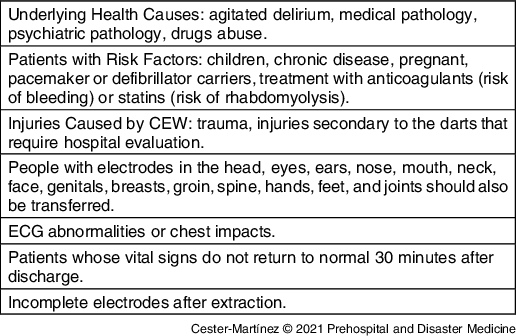
Once the health care intervention is finished, if the patient has the transfer criteria (Table 2), he will be transported to the hospital with police escort. Otherwise, the suspect will be the responsibility of the police. In both cases, the police will apply the appropriate restraint measures to the arrested.
Hospital Referral CriteriaReference Peel35

Abbreviations: CEW, conducted electrical weapon; ECG, electrocardiogram.
It should be emphasized that the medical presence must not prevent the necessary training of police officers in Basic Life Support and that they have an AED in their interventions.Reference Aguilar Pallarès, Morante Barragán, Novelle Rodríguez and Subirana Domènech11,Reference Emergències32,Reference White, Hankins and Bugliosi48
Discussion
Tasers are incapacitating weapons with a very low lethality that provide law enforcement with an alternative to firearms. They are used to reduce aggressive or agitated people, when the dialogue, negotiation, or mediation with them has been exhausted, being essential the training of those who employ them.
The constant and progressive acquisition and implantation of this type of devices in the police around the world makes it essential for the members of the EMS to know its operation, clinical effects, risks, the most frequent injuries that they produce, and possible complications.
Based on this knowledge, health care must be protocoled, prioritizing the safety of the providers and the EMS team at the orders of the police.
This protocol establishes that, once in place and in contact with the tasered, all the necessary therapeutic techniques will be carried out to stabilize the victim, and he will be transferred to a hospital, if necessary, always under police custody of the victim.
Limitations
The literature on this subject is limited in medical journals. In addition, some of the references are from non-medical literature. Therefore, more research is needed, as there is little information available on how to act appropriately as health care personnel in police interventions involving the use of CEWs.
Another limitation is the lack of data on shootings in which there has been no medical problem, and therefore have not been recorded.
And a third limitation is that some articles are based on data obtained in animal experiments, not being appropriate for human experimentation.
Conclusion
Although the CEW-Tasers have low lethality, there are potential risk factors that may be unknown to the police at the time of use and that can cause death as well as serious injury. For this reason, it will be necessary that this police intervention with Taser is always supported by medical providers and a necessary training in Basic Life Support of the police.
Acknowledgment
Acknowledgement to the Local Police of La Almunia de Doña Godina (Zaragoza - Spain).
Conflicts of interest/funding
The authors report no conflict of interest or funding.