





1. Introduction
Intermediate-mass black holes (IMBHs) occupy the
 $10^2-10^5{{\rm M_{\odot}}}$
range, potentially bridging stellar-mass and supermassive black holes (SMBHs) (see w.g. a review by Askar et al. Reference Askar, Baldassare, Mezcua and Arca Sedda2024). Observational evidence is scarce: a few candidates with
 $\sim (5\times10^4-10^6){{\rm M_{\odot}}}$
have been found in low-mass AGN and dwarf galaxies (e.g. Chilingarian et al. Reference Chilingarian, Katkov, Zolotukhin, Grishin, Beletsky, Boutsia and Osip2018); a dozen putative IMBHs of
 $10^3-10^4{{\rm M_{\odot}}}$
have been suggested in Galactic and extragalactic GCs, though most remain inconclusive (see e.g. K z ltan et al. 2017; Tiengo et al. Reference Tiengo2022); and
 $\sim 10$
objects of
 $(100-200){{\rm M_{\odot}}}$
were reported by LIGO-Virgo-Kagra (LVK) from BBH mergers, including possibly the first IMBH–IMBH binary (The LIGO Scientific Collaboration et al. 2025).
Several, non-mutually exclusive, formation channels have been proposed, particularly in dense clusters: (i) repeated stellar collisions (e.g. Portegies Zwart & McMillan Reference Portegies Zwart and McMillan2002; Arca Sedda et al. Reference Arca Sedda, Kamlah, Spurzem, Rizzuto, Naab, Giersz and Berczik2023b; Rantala et al. Reference Rantala, Naab and Lahén2024), (ii) tidal disruption and accretion of stars onto stellar BHs (Giersz et al. Reference Giersz, Leigh, Hypki, Lützgendorf and Askar2015; Arca Sedda et al. Reference Arca Sedda, Kamlah, Spurzem, Rizzuto, Naab, Giersz and Berczik2023b), and (iii) hierarchical BH mergers (Miller & Hamilton Reference Miller and Hamilton2002; Rodriguez et al. Reference Rodriguez, Zevin, Amaro-Seoane, Chatterjee, Kremer, Rasio and Ye2019; Mestichelli et al. Reference Mestichelli, Mapelli, Torniamenti, Arca Sedda, Branchesi, Costa, Iorio and Santoliquido2024; Rantala et al. Reference Rantala, Naab and Lahén2024). The efficiency of the formation channel depends on several uncertain cluster properties, which also shape the BBH merger population. Thus, any viable IMBH model must reproduce GW-inferred BBH merger statistics.
A self-consistent way to investigate this topic would be through direct N-body simulations, but these remain computationally expensive and are limited to a few million particles. Nonetheless, the Dragon-II suite (Arca Sedda et al. Reference Arca Sedda2024a; Arca Sedda et al. Reference Arca Sedda, Kamlah, Spurzem, Rizzuto, Naab, Giersz and Berczik2023b; Arca Sedda et al. Reference Arca Sedda, Kamlah, Spurzem, Rizzuto, Giersz, Naab and Berczik2024b) demonstrates that IMBHs can form through all three main channels.
Semi-analytic codes provide an alternative, capturing key dynamical processes while enabling large BBH catalogues at low cost (Antonini & Gieles Reference Antonini and Gieles2020; Mapelli et al. Reference Mapelli, Santoliquido, Bouffanais, Arca Sedda, Artale and Ballone2021; Arca Sedda et al. Reference Arca Sedda, Mapelli, Benacquista and Spera2023a; Kritos et al. Reference Kritos, Strokov, Baibhav and Berti2024; Torniamenti et al. Reference Torniamenti, Mapelli, Périgois, Arca Sedda, Artale, Dall’Amico and Vaccaro2024). Here we adopt the B-pop (Binary merger POPulations, see Arca Sedda & Benacquista Reference Arca Sedda and Benacquista2019; Arca Sedda et al. Reference Arca Sedda, Mapelli, Spera, Benacquista and Giacobbo2020; Arca Sedda et al. Reference Arca Sedda, Mapelli, Benacquista and Spera2023a, (Arca Sedda et al., in preparation,)) to model cosmic BBH mergers from isolated binaries (IBs) and from dynamical channels (young, globular, and nuclear clusters; YCs, GCs, and NCs).
2. B-pop
The B-pop code is a semi-analytic software to model BBH mergers forming from isolated stellar binaries (IBs) and dynamical interactions in YCs, GCs, and NCs. It includes prescriptions for cosmic star formation and metallicity evolution, star cluster initial masses and sizes, and their long-term evolution. The code also models the formation of stellar black holes, their natal spins and kicks, the properties of dynamically formed binaries, and the masses of black holes assembled through stellar collisions and interactions. It also handles multiple generation mergers in star clusters using numerical relativity fitting formulae to calculate the merger remnant mass and spin (Jiménez-Forteza et al. Reference Jiménez-Forteza, Keitel, Husa, Hannam, Khan and Pürrer2017) and gravitational recoil (Campanelli et al. Reference Campanelli, Lousto, Zlochower and Merritt2007; Lousto et al. Reference Lousto, Zlochower, Dotti and Volonteri2012). We refer the interested reader to Arca Sedda et al. (Reference Arca Sedda, Mapelli, Spera, Benacquista and Giacobbo2020); Arca Sedda et al. (Reference Arca Sedda, Mapelli, Benacquista and Spera2023a), and (Arca Sedda et al., in preparation,) for further details about the code workflow and features.
3. BBH merger rate
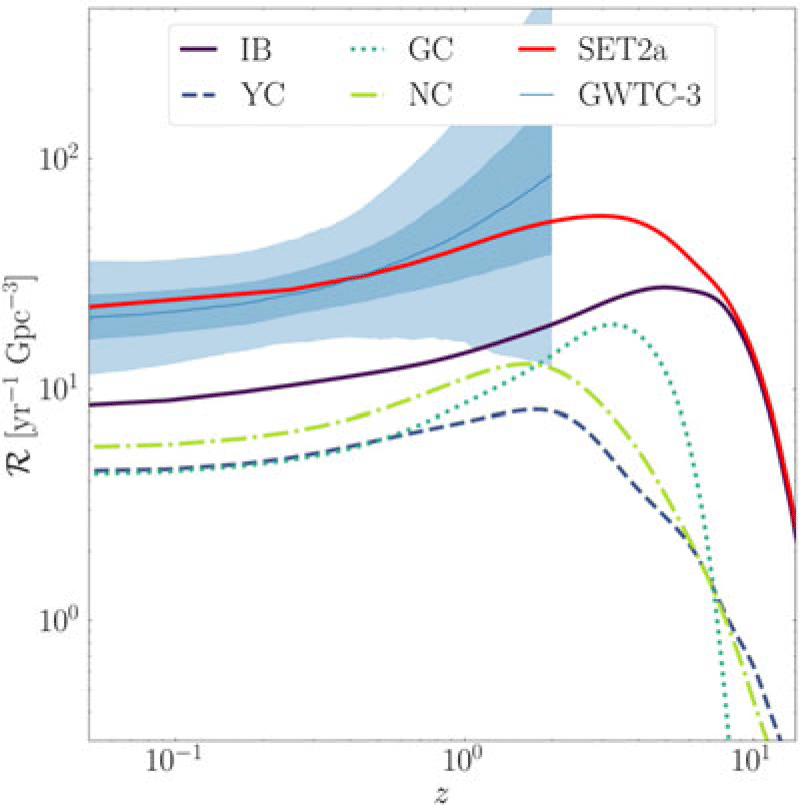
Figure 1 compares the observed and simulated merger rates for our fiducial model with binary fraction at birth
 $f_{\rm mix}=0.5$
. In what we refer to as the EB19+MF17 model, we adopt the star formation histories from El-Badry et al. (Reference El-Badry, Quataert, Weisz, Choksi and Boylan-Kolchin2019) for GCs and from Madau & Fragos (Reference Madau and Fragos2017) for GCs/NCs. The figure shows both the total merger rate and the contribution of each channel. The former is broadly consistent with observation limits. At the fiducial redshift of
 $z=0.2$
, we find a local merger rate
 $\mathscr{R}_{\rm sim} \simeq 27.1~{\rm yr}^{-1}~{\rm Gpc}^{-3}$
, in the ballpark of values inferred from GWTC-3 observations. According to our model, around
 $\sim 30-60\%$
of the cosmic population of BBH mergers have a dynamical origin. For the “a” models (i.e. those adopting the EB19+MF17 star formation history; see (Arca Sedda et al., in preparation,) for details), most dynamical mergers form in GCs (
 $46-51\%$
) and NCs (
 $30-40\%$
). The relatively small contribution from BBH formed in YCs is mostly due to their short lifetime, tipically
 $\lesssim 0.1-1$
Gyr.
Merger rates as a function of redshift for the fiducial model with
 $f_{\rm mix} = 0.5$
,
 $f_{\rm YC}=0.005$
, and
 $f_{\rm IB}=1$
. Different colors and line styles correspond to different formation channels: isolated binaries (IB, straight purple line), young clusters (YC, dashed blue line), globular clusters (GC, dotted green line), and nuclear clusters (NC, dot-dashed light green line). The thick red line represents the total merger rate, while the light blue line and shaded region represent the BBH merger rate inferred from the GWTC-3.

4. IMBH sub-population
We now focus on binaries involving an IMBH (
 $m\gt10^2{{\rm M_{\odot}}}$
), formed either through stellar collisions, repeated BH mergers, or both. These systems, also referred to as intermediate-mass ratio inspirals (IMRIs), provide key insights into IMBH demographics.
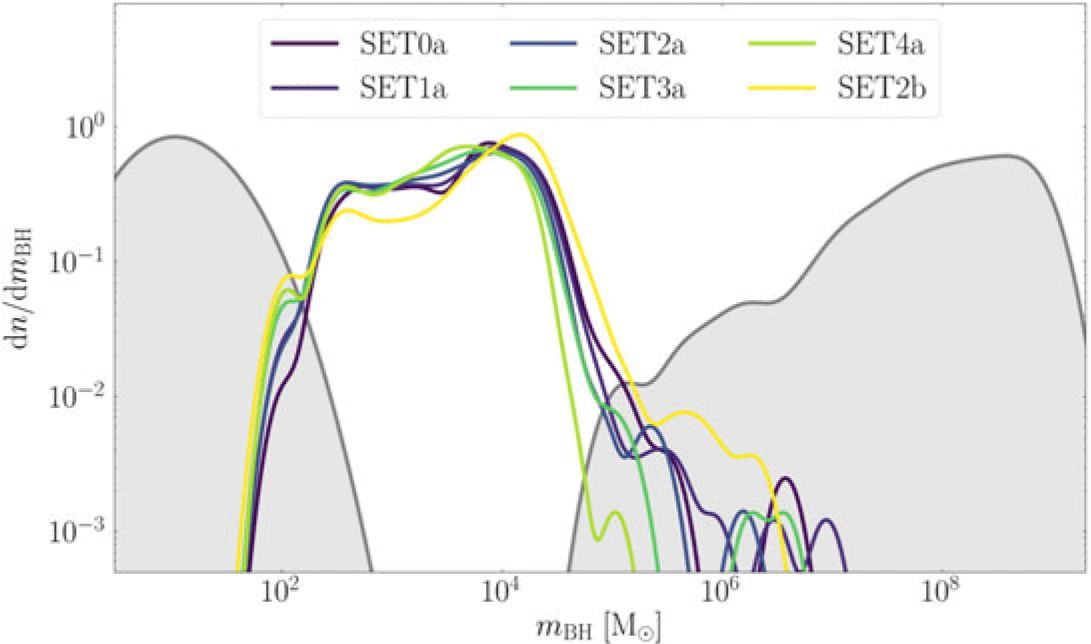
The simulated IMBH population spans
 $m_{\rm IMBH} \sim (2.5\times10^2-4\times10^4){{\rm M_{\odot}}}$
, with
 $\sim5\%$
of objects growing to
 $10^6-10^7{{\rm M_{\odot}}}$
, thus bridging stellar BHs and SMBHs (Figure 2). A fraction
 $f_{\rm IMBH}\simeq 0.018-0.028$
of all BBH mergers involve an IMBH, with the occurrence increasing for larger
 $f_{\rm mix}$
but only weakly sensitive to the assumed cluster star formation history (see (Arca Sedda et al., in preparation,) for further details). The high-mass tail is also enhanced at larger
 $f_{\rm mix}$
. The environment strongly affects IMBH growth. Seeds of
 $\gtrsim500{{\rm M_{\odot}}}$
formed via stellar collisions in clusters with
 $M\gt10^5{{\rm M_{\odot}}}$
and
 $\rho\gt3\times10^5{{\rm M_{\odot}}}$
pc
 $^{-3}$
typically double their mass. More massive NCs (
 $M\gt10^7{{\rm M_{\odot}}}$
,
 $\rho\gt10^6{{\rm M_{\odot}}}$
pc
 $^{-3}$
) favour IMBH growth via successive BH mergers. Overall, most IMBHs originate from massive stellar collision products (
 $\gtrsim 97\%$
), while the fraction seeded by stellar BHs rises modestly with
 $f_{\rm mix}$
(from
 $\lt1\%$
at
 $f_{\rm mix}=0$
to
 $\sim3\%$
for SET2b). Furthermore, metallicity plays a key role. In low-metallicity clusters (
 $Z\lt0.001$
), IMRIs constitute
 $\sim10\%$
of mergers, whereas in metal-rich environments–where PISNe suppress massive stellar seeds–this fraction drops to
 $\lesssim1\%$
.
IMBH mass distribution for all models. The number in the model name indicates the binary fraction at birth, with 0, 1, 2, 3, and 4 corresponding to
 $f_{\rm mix} = 0, 0.25, 0.5, 0.75,$
and 1, respectively. The letter (a or b) indicates the different GCs/NCs star formation histories (see (Arca Sedda et al., in preparation) for details). The stellar BH distribution is obtained from our catalogs, while the SMBH distribution is based on low-z observations (Shankar et al. Reference Shankar, Weinberg and Miralda-Escudé2009). Areas are normalized to unity for comparison.

Finally, increasing
 $f_{\rm mix}$
reduces the maximum IMBH mass (by
 $\sim30\%$
from
 $f_{\rm mix}=0$
to 1) while raising the overall IMBH merger fraction, especially in NCs. This reflects enhanced retention of low-mass BHs with small natal kicks, which preferentially form unequal-mass binaries producing remnants more easily retained in clusters.
5. Summary and conclusions
We combined direct N-body simulations from Dragon-II with semi-analytic studies performed with B-pop to investigate the assembly of IMBHs in dense stellar systems. This hybrid framework exploits the precision of N-body models and the statistical power of semi-analytic approaches.
Our fiducial models reproduce local BBH merger rates consistent with GWTC-3, with
 $\sim30-$
60% of mergers of dynamical origin. A fraction
 $f_{\rm IMBH}\simeq0.02-$
0.03 of all mergers involve an IMBH, producing IMRIs. The simulated IMBH mass spectrum continuously bridges stellar and supermassive BHs, peaking at
 $2.5\times10^2-4\times10^4{{\rm M_{\odot}}}$
with a small high-mass tail reaching
 $\gt10^6{{\rm M_{\odot}}}$
. We find that IMBH demographics depend strongly on cluster environment and metallicity. Larger binary fraction values enhance the IMBH merger fraction but lower the maximum IMBH mass, while low-metallicity clusters sustain IMRI fractions of
 $\sim10\%$
, compared to
 $\lesssim1\%$
in metal-rich systems. Overall, our results support IMBHs as a distinct population shaped by cluster dynamics, binary fraction, and metallicity. The combined use of Dragon-II and B-pop provides a flexible framework to interpret GW observations of IMRIs and to constrain IMBH demographics across cosmic history.
The author acknowledges Manuel Arca Sedda for useful discussion and comments.
 fmix=0.5
 fYC=0.005
 fIB=1
 fmix=0,0.25,0.5,0.75,

 Open access

