One of the fascinating abilities of multilingual speakers is their ability to flexibly shift between the languages they speak. In many situations, bilinguals communicate in a single language in one context (e.g., talk on the phone with a relative in their native language), and minutes later shift to communicate in a different language (e.g., talk to a coworker in the second language). Proficient multilinguals appear to make these language shifts very often, yet the consequences of such changes in language use are not entirely clear. In particular, relatively few studies have empirically examined how brief exposure to one language influences subsequent performance in another (Branzi, Della Rosa, Canini, Costa, & Abutalebi, Reference Branzi, Della Rosa, Canini, Costa and Abutalebi2016; Branzi, Martin, Abutalebi, & Costa, Reference Branzi, Martin, Abutalebi and Costa2014; Declerck & Grainger, Reference Declerck and Grainger2017; Declerck & Philipp, Reference Declerck and Philipp2017; Elston-Güttler, Gunter, & Kotz, Reference Elston-Güttler, Gunter and Kotz2005; Guo, Liu, Misra, & Kroll, Reference Guo, Liu, Misra and Kroll2011; Kreiner & Degani, Reference Kreiner and Degani2015; Misra, Guo, Bobb, & Kroll, Reference Misra, Guo, Bobb and Kroll2012; Van Assche, Duyck, & Gollan, Reference Van Assche, Duyck and Gollan2013). The goal of the present study is therefore to examine how performance is influenced by changing languages between two different communicative settings or tasks. Specifically, we examine whether production performance in the native language (L1) is hindered following brief exposure of a few minutes to the second language (L2), and to what extent modulation in performance following such exposure is dependent on item-specific versus whole-language control mechanisms.
Time frame of change in language context
Changing languages influences the linguistic context in which performance takes place, and the role of language context has been theoretically highlighted before (see, e.g., Grosjean Reference Grosjean and Nicol2001; Kroll, Bobb, & Wodniecka, Reference Kroll, Bobb and Wodniecka2006; Wu & Thierry, Reference Wu and Thierry2010). Whereas bilinguals typically experience changes in language context across different time frames, studies that have investigated the effect of language context typically focus on the extreme ends of this continuum. At one extreme, immersion studies examine the effect of an environmental language context on the order of weeks or months (e.g., Baus, Costa, & Carreiras, Reference Baus, Costa and Carreiras2013; Dussias & Sagarra, Reference Dussias and Sagarra2007; Linck, Kroll, & Sunderman, Reference Linck, Kroll and Sunderman2009; Morales, Paolieri, Cubelli, & Bajo, Reference Morales, Paolieri, Cubelli and Bajo2014). Linck et al. (Reference Linck, Kroll and Sunderman2009), for instance, showed that Spanish learners, who were native English speakers immersed in a Spanish-speaking environment in Spain, experienced reduced access to their L1, while outperforming their classroom-learning counterparts in L2 production, demonstrating that language context may modulate bilingual production.
At the other extreme, language-switching studies manipulate language context on the order of seconds, such that bilinguals are asked to change languages on a trial-by-trial basis (e.g., Costa & Santesteban, Reference Costa and Santesteban2004; Hernandez, Dapretto, Mazziotta, & Bookheimer, Reference Hernandez, Dapretto, Mazziotta and Bookheimer2001; Kaufmann, Mittelberg, Koch, & Philipp, Reference Kaufmann, Mittelberg, Koch and Philipp2018; Meuter & Allport, Reference Meuter and Allport1999; Prior & Gollan, Reference Prior and Gollan2011; for review see Bobb & Wodniecka, Reference Bobb and Wodniecka2013). These studies have demonstrated that switching languages hinders performance on switch relative to no-switch (stay) trials. In the classic study by Meuter and Allport (Reference Meuter and Allport1999), for instance, bilinguals took longer to name digits on switch trials in which the target language changed compared to no-switch trials in which no language change occurred. The findings show that although it seems effortless, involuntary language switch has a cost (for review see Bobb & Wodniecka, Reference Bobb and Wodniecka2013). Of note, in such switching studies, unlike the immersion studies, the within-task language context makes both languages relevant for task performance, deeming dual-language activation an inherent component of task performance in such paradigms.
Recently, research began to tap the middle range of the time scale, with paradigms that utilize blocked-language-order manipulation such that language context is changed on the order of minutes. In contrast to the switching studies, blocked-language-order studies keep the single-language context within-task, defining one language as the relevant target language and the other as an irrelevant nontarget language (for production see Branzi et al., Reference Branzi, Martin, Abutalebi and Costa2014, Reference Branzi, Della Rosa, Canini, Costa and Abutalebi2016; Declerck & Philipp, Reference Declerck and Philipp2017; Guo et al., Reference Guo, Liu, Misra and Kroll2011; Kreiner & Degani, Reference Kreiner and Degani2015; Misra et al., Reference Misra, Guo, Bobb and Kroll2012; Van Assche et al., Reference Van Assche, Duyck and Gollan2013; for comprehension see Canseco-Gonzalez et al., Reference Canseco-Gonzalez, Brehm, Brick, Brown-Schmidt, Fischer and Wagner2010; Declerck & Grainger, Reference Declerck and Grainger2017; Elston-Güttler et al., Reference Elston-Güttler, Gunter and Kotz2005; Mercier, Pivneva, & Titone, Reference Mercier, Pivneva and Titone2016; Paulmann, Elston-Güttler, Gunter, & Kotz, Reference Paulmann, Elston-Güttler, Gunter and Kotz2006). These studies show that shifting from one language block to the other influences subsequent performance. For instance, Misra et al. (Reference Misra, Guo, Bobb and Kroll2012) tested Chinese–English bilinguals in a picture-naming task in which the order of blocked languages was manipulated. Because the same set of pictures was repeated across blocks, facilitation was expected for repeated presentations. However, whereas such a facilitation was observed when naming pictures in the L2 after having named them in the L1, the results showed no facilitation when picture naming in L1 followed picture naming in L2 (see Branzi et al., Reference Branzi, Martin, Abutalebi and Costa2014). Thus, brief production in the L2 hindered subsequent production in the L1, but not vice versa.
These observed effects of blocked-language-order in bilingual performance can be interpreted within the dual-language activation view, according to which both languages of bilingual speakers are active at all times, even when a single language is required for task performance (e.g., Degani, Prior, & Hajajra, Reference Degani, Prior and Hajajra2018; Dijkstra, Reference Dijkstra, Kroll and De Groot2005; Hermans, Bongaertz, De Bot, & Schreuder, Reference Hermans, Bongaerts, De Bot and Schreuder1998; Hoshino & Kroll, Reference Hoshino and Kroll2008; Marian & Spivey, Reference Marian and Spivey2003). One implication of the dual-language activation view is that the availability of both the target language and the nontarget language during task performance is likely to influence performance in the target language. Because the selection of an element for production is assumed to be language nonspecific, nontarget language elements compete for selection (e.g., Hermans et al., Reference Hermans, Bongaerts, De Bot and Schreuder1998) and may interfere with target language production (cf. Kroll et al., Reference Kroll, Bobb and Wodniecka2006, but see Costa, Miozzo, & Caramazza, Reference Costa, Miozzo and Caramazza1999). Thus, the activation balance of the two languages is important even in single-language tasks such as the ones employed in the blocked-language-order studies. The activation balance of the two languages is further modulated both by long-term factors, such as frequency of use and switching habits, and by short-term contextual factors (Kreiner & Degani, Reference Kreiner and Degani2015).
The change in activation balance of the two languages may be explained in two ways (see, e.g., Van Assche et al., Reference Van Assche, Duyck and Gollan2013). First, exposure to the nontarget language may enhance the activation of its elements, and make them more effective competitors to the target language elements required for the post-exposure task. Such an overactivation mechanism is assumed to affect the less-dominant language more strongly (Branzi et al., Reference Branzi, Martin, Abutalebi and Costa2014). Second, exposure may increase cross-language interference through inhibition of the target language. Specifically, the inhibitory control model (Green, Reference Green1998) postulates that in order to produce words in one language, the bilingual speaker has to engage in control mechanisms that suppress, or inhibit, the nontarget language if that language is sufficiently active (dominant language). If prior exposure to the nontarget language leads to inhibition of the target language, subsequent target language production is hindered because it requires recovery from inhibition (Green, Reference Green1998).
Prior studies have attempted to dissociate these two mechanisms. For instance, in the Misra et al. (Reference Misra, Guo, Bobb and Kroll2012) study described above, event-related potentials (ERPs) were recorded during the blocked-language-order picture-naming paradigm. The behavioral decrement during an L1 block preceded by an L2 block was accompanied by more negative N2 ERP component interpreted to suggest inhibition of the L1 during L2 production. A functional magnetic resonance imaging (fMRI) study with a similar population of Chinese–English bilinguals provided converging evidence showing that control areas (dorsal left frontal gyrus and parietal cortex) were recruited when shifting between blocks of L2 picture naming to L1 picture naming, but not the reverse (Guo et al., Reference Guo, Liu, Misra and Kroll2011). A different conclusion was reached, however, by Branzi et al. (Reference Branzi, Martin, Abutalebi and Costa2014), who used a similar blocked-language-order picture-naming paradigm with highly proficient Spanish–Catalan bilinguals. Their behavioral results showed a similar pattern indicating that naming pictures in L1 after having named pictures in L2 hindered performance. However, their ERP record revealed P2 modulations, in contrast to the N2 modulations observed by Misra et al. (Reference Misra, Guo, Bobb and Kroll2012). Branzi et al. (Reference Branzi, Martin, Abutalebi and Costa2014) interpreted these P2 modulations as an index of difficulty in lexical access, and suggested that for highly proficient bilinguals, language control mechanisms do not necessitate inhibition.
Critically, both the activation and inhibition accounts predict that brief exposure to the nontarget language would influence subsequent performance in the target language. Hence, for the purpose of the current study, we do not aim to distinguish between the two mechanisms but rather focus on modulations in activation balance in general, aiming to examine how it is modulated by four factors. First, we test the scope of the effect, namely, to what extent the brief exposure effect reflects item-based mechanisms or whole-language changes in activation balance. Second, the current study examines interactions across time scale. Specifically, we test whether short-term changes in language activation that result from blocked-language-order manipulation interact with long-term accumulated language use. Third, we test the task specificity of the effect. In particular, whereas previous studies typically kept the same task across language blocks (e.g., picture naming in Branzi et al., Reference Branzi, Martin, Abutalebi and Costa2014; Misra et al., Reference Misra, Guo, Bobb and Kroll2012; semantic classification in Declerck & Grainger, Reference Declerck and Grainger2017), the current study examines whether brief exposure to the nontarget language in one type of task influences production performance in a different task (see Kreiner & Degani, Reference Kreiner and Degani2015, described below). Fourth, the current study contributes to the literature in understanding how bilingual characteristics modulate the effects of brief language exposure. We address each of these goals below.
Item-based versus whole-language processes
Evidence for the influence of brief exposure to another language on performance in the target language typically relies on item-based manipulations, in which specific items are being repeated across languages. Thus, the production of a particular item is examined after having produced or comprehended its translation equivalent in the other language. For instance, in a Tip of the Tongue (TOT) study, Gollan, Ferreira, Cera, and Flett (Reference Gollan, Ferreira, Cera and Flett2014) observed that TOT rates increased on items primed by their translation equivalents. Thus, production performance in the target language (English) was hindered by previous exposure to the translation equivalent in the nontarget language (Spanish), clearly demonstrating item-based effects. A similar approach of item repetition was utilized in the blocked-language-order studies described above (e.g., Guo et al., Reference Guo, Liu, Misra and Kroll2011; Misra et al., Reference Misra, Guo, Bobb and Kroll2012).
Nevertheless, theoretical models of dual-language activation suggest that such cross-language effects may not be restricted to item-specific processes, and may operate at a more general whole-language level. In discussing Greens’ (Reference Green1998) inhibitory control model, De Groot and Christoffels (Reference De Groot and Christoffels2006) suggest that both item-specific inhibition mechanisms and more global whole-language inhibition processes operate in the bilingual lexical system. Declerck and Philipp (Reference Declerck and Philipp2017) similarly discuss two stages of bilingual language control. One operates globally, over the entire language system, by controlling language schemas, which achieve task-specific goals (e.g., Schwieter & Sunderman, Reference Schwieter and Sunderman2008), or language tags, which provide language membership information (e.g., Declerck, Koch, & Philipp, Reference Declerck, Koch and Philipp2015). The second operates over lemmas (e.g., Declerck et al., Reference Declerck, Koch and Philipp2015; Green, Reference Green1998; Schwieter & Sunderman, Reference Schwieter and Sunderman2008) in an item-specific manner.
To test the global nature of bilingual language control, Branzi et al. (Reference Branzi, Martin, Abutalebi and Costa2014; see also Branzi et al., Reference Branzi, Della Rosa, Canini, Costa and Abutalebi2016) reasoned that if language control operates via item-specific mechanisms, then only items that are repeated across languages will be affected. If, however, performance in one language leads to changes in the activation balance of the two languages at the whole-language level, then all items will be affected by prior performance in another language. To test this question, they manipulated item repetition in their blocked-language-order picture-naming study with highly proficient Spanish–Catalan bilinguals. They observed that both repeated items and nonrepeated items were negatively influenced in the L1 by a preceding L2 block, as reflected by a lack of repetition facilitation for repeated pictures, and by slower naming times for nonrepeated pictures. Further, P2 modulations were observed for both repeated and nonrepeated pictures in the second L1 block, leading the authors to suggest control mechanisms were applied globally in this population of highly proficient bilinguals. Note, however, that direct comparisons were not reported between naming latencies of repeated and nonrepeated items, such that the extent to which item-based mechanisms contribute above and beyond global mechanisms is unclear.
The contribution of item-based mechanisms was more directly tested by Declerck and Philipp (Reference Declerck and Philipp2017), who introduced a pure language block before a language-switching task, and manipulated whether the same item sequence was repeated between the pure and mixed blocks. They reasoned that nonrepeated item sequences should be influenced by global language control, whereas repeated item sequences should be influenced in addition by item-based mechanisms. Their findings show that switching cost in the mixed block for German–English bilinguals was modulated by prior language practice and by item-specific practice. In other words, practice with the same item sequence resulted in stronger effects than practice just with the language, suggesting that item-based (lemma-based) mechanisms contribute above and beyond global (whole-language schema/tag) control.
Using a different task, Van Assche et al. (Reference Van Assche, Duyck and Gollan2013) further investigated the global nature of bilingual language control. They examined how phoneme fluency in one language is affected by prior production of the same versus different phoneme categories in another language. They reasoned that item-specific effects will be manifested in performance on the same-phoneme category, and that more global effects will be indexed by performance on different-phoneme categories. This is because presumably candidates from both languages that begin with a given phoneme are activated once the phoneme category is presented, leading to item-based competition for those activated items. Their findings show that in the same-phoneme condition, fluency was reduced for both Dutch–English and Chinese–English bilinguals. However, in the different-phoneme condition, assumed to reflect global and non-item-specific processes, fluency was reduced only for Chinese–English bilinguals. The authors interpreted these findings as suggesting that global inhibition is weaker than item-based inhibition and may be revealed only for bilinguals with dissimilar languages. Presumably, this is because in more similar languages, which also contain many cognate words, whole-language inhibition of the nontarget language is less beneficial. However, this interpretation is not in line with the findings of Branzi et al. (Reference Branzi, Martin, Abutalebi and Costa2014), who observed global effects for bilinguals of highly similar languages (Spanish–Catalan) despite the fact that half of the items in their study were cognates.
Therefore, although previous studies reveal a consistent effect of brief exposure to the nontarget language on subsequent production in the target language (Branzi et al., Reference Branzi, Martin, Abutalebi and Costa2014, Reference Branzi, Della Rosa, Canini, Costa and Abutalebi2016; Declerck & Philipp, Reference Declerck and Philipp2017; Guo et al., Reference Guo, Liu, Misra and Kroll2011; Kreiner & Degani, Reference Kreiner and Degani2015; Misra et al., Reference Misra, Guo, Bobb and Kroll2012; Van Assche et al., Reference Van Assche, Duyck and Gollan2013), the scope of the effect is less clear. Some studies conclude that global effects are always present and that item-based effects operate in addition (Declerck & Philipp, Reference Declerck and Philipp2017), whereas others suggest that item-based effects are always present, and that global control is weaker and operates for some bilinguals but not others (Van Assche et al., Reference Van Assche, Duyck and Gollan2013). The present study is therefore designed to explore to what extent the brief exposure effect reflects item-based mechanisms and whole-language changes in activation balance, by manipulating item repetition. Further, we test whether these short-term changes in activation balance, of both specific items and whole-language elements, interact with long-term accumulated language use, as detailed below.
Interactions across time-scale: superseded words
An additional goal of the present study was to examine to what extent short-term modulations in activation balance, induced by the brief language-exposure manipulation, interact with long-term accumulated language use. Such interactions were examined in a recent study by Kreiner and Degani (Reference Kreiner and Degani2015), in which Russian–Hebrew bilinguals’ TOT rates in a picture-naming task in Hebrew (L2) were compared before and after watching a brief (10 min) Russian movie (L1). Critically, both early and late Russian–Hebrew bilinguals were tested, and both exhibited increased TOT rates in Hebrew following the Russian movie. This aspect of the finding reflects short-term changes of activation balance, in that a 10-min exposure phase modulated performance. Moreover, the effect was global in nature, in that items were not repeated across languages. At the same time, that study further revealed the effects of long-term bilingual experience, as reflected in overall group differences between early and late bilinguals. Of interest, there was no evidence for interactions between short-term and long-term effects, in that the brief language-exposure effect was of similar magnitude for both early and late bilinguals.
Other research suggests that the brief language exposure effect may be modulated by long-term accumulated use. In particular, these interactions may be revealed by L1–L2 asymmetries. Specifically, although bidirectional influences often characterize bilingual performance, with transfer effects observed in both directions (e.g., Degani, Prior, & Tokowicz, Reference Degani, Prior and Tokowicz2011), the influence of L1 on L2 may differ from that of L2 on L1. Many studies that focused on the effects of L1 on L2 assumed that when bilinguals are less proficient in their L2, their performance in that language might be more susceptible to cross-language interference from the dominant L1 language (e.g., Kreiner & Degani, Reference Kreiner and Degani2015). Nevertheless, both language-switching studies (Meuter & Allport, Reference Meuter and Allport1999), and studies utilizing blocked-language-order manipulation (Branzi et al., Reference Branzi, Martin, Abutalebi and Costa2014; Guo et al., Reference Guo, Liu, Misra and Kroll2011; Misra et al., Reference Misra, Guo, Bobb and Kroll2012; Van Assche et al., Reference Van Assche, Duyck and Gollan2013) suggest stronger modulations of L1 production as a result of prior L2 production than vice versa. Asymmetric influences in this direction are predicted by inhibition accounts (Green, Reference Green1998), in that the L1 is more strongly inhibited during brief exposure to the L2 requiring recovery from inhibition. Similarly, based on overactivation mechanisms, the increased activation associated with a brief exposure should especially influence the low level of activation of L2 representations, turning them into effective competitors post-exposure.
Of relevance, the fact that blocked-language-order manipulation has been shown to affect L1 production more than L2 production (Branzi et al., Reference Branzi, Martin, Abutalebi and Costa2014; Guo et al., Reference Guo, Liu, Misra and Kroll2011; Misra et al., Reference Misra, Guo, Bobb and Kroll2012; Van Assche et al., Reference Van Assche, Duyck and Gollan2013) may be viewed within this framework as reflecting interactions between short-term and long-term effects. Changes across blocks (short-term effect) are modulated by baseline language proficiency in each language (long-term effect).
In the current study, we focus on the short-term mechanism, testing the effect of brief exposure in only one language direction, by testing bilinguals’ production in the L1 before and after a brief exposure to the L2. We test moderately proficient Arabic–Hebrew bilinguals, and examine whether despite reduced proficiency in Hebrew (the L2), brief exposure to that language influences subsequent performance in Arabic (the L1). However, as discussed below, we also test for interactions with long-term effects by manipulating item frequency.
In particular, rather than tapping long-term effects utilizing group comparisons (early vs. late bilinguals, as in Kreiner & Degani, Reference Kreiner and Degani2015), or language direction comparisons (L1 vs. L2, as in, e.g., Branzi et al., Reference Branzi, Martin, Abutalebi and Costa2014), here, we tap long-term processes in a different way, by focusing on long-term accumulated use of items, rather than participants. We test whether short-term processes, induced by the brief exposure effect, are modulated by the long-term accumulated use of the items.
The approach we take is unique, in that we contrast typical control words, of medium frequency of use in the L1, with superseded L1 (Arabic) words that are typically replaced by borrowed L2 (Hebrew) labels. Previous studies have shown that bilinguals tend to use more borrowed words when producing in their first (and less recent) language than when producing in their less proficient L2 (Marian & Kaushanskaya, Reference Marian and Kaushanskaya2007). This is consistent with the characteristics of Arabic–Hebrew bilinguals tested here, who tend to use many borrowed words from Hebrew when speaking Arabic (Amara, Reference Amara1999; El-Rahman & Rozental, Reference El-Rahman and Rozental2013). For instance, although the word for “air-conditioning” in Arabic is /mukajif/, Arabic–Hebrew bilinguals typically use the Hebrew label (/mazgan/) in daily interactions. In the current study, we focus on the superseded target language labels, those that are typically replaced by borrowed words. On such items, the label in the nontarget L2 language (Hebrew) is of higher frequency of use in the L1 target language (Arabic), than the original L1 label.
Superseded words are revealing in two ways. First, they provide a window into the interplay between target and nontarget language representations. When nontarget language activation prevails over target language activation, these items are likely to lead to cross-language errors. These cross-language errors can be viewed as a direct indication of cross-language influences (see Gross & Kaushanskaya, Reference Gross and Kaushanskaya2018; Sandoval, Gollan, Ferreira, & Salmon, Reference Sandoval, Gollan, Ferreira and Salmon2010), and the enhanced availability of the nontarget language during the production task. Thus, performance on superseded words, which are expected to lead to higher error rates and specifically more cross-language errors, will elucidate the level of activation of the nontarget language during the production test carried out exclusively in the target language.
Second, because these superseded Arabic labels are less frequent words, they may be more susceptible to effects of brief language exposure than higher frequency items. This is because such items are assumed to have low levels of activation and thus may be more sensitive to changes in the activation balance of the relevant language. Evidence for this possibility comes from priming manipulations. For instance, Van Assche, Duyck, and Gollan (Reference Van Assche, Duyck and Gollan2016) demonstrated more pronounced facilitation due to repetition for low-frequency words than for high-frequency words, in both lexical decision and picture naming, in both the L1 and the L2 (see also Lowder, Choi, & Gordon, Reference Lowder, Choi and Gordon2013). Thus, by testing whether superseded words and control words are similarly affected by the brief language-exposure manipulation, the current study reveals the extent to which short-term changes in activation balance interact with long-term accumulated language use.
Task specificity
The current study further tests whether these effects extend across tasks when the brief exposure phase imposes different stimuli and task demands relative to the subsequent production task. Specifically, most studies described thus far examined whether production performance in a given task was modulated by brief exposure to the other language. Although different tasks were used across studies (picture naming in Branzi et al., Reference Branzi, Martin, Abutalebi and Costa2014, Reference Branzi, Della Rosa, Canini, Costa and Abutalebi2016; Guo et al., Reference Guo, Liu, Misra and Kroll2011; Misra et al., Reference Misra, Guo, Bobb and Kroll2012; phoneme fluency in Van Assche et al., Reference Van Assche, Duyck and Gollan2013), within each study the same task was used across language blocks, even if new items were introduced (Branzi et al., Reference Branzi, Martin, Abutalebi and Costa2014). However, to the extent that brief exposure to one language changes the activation balance of the two languages, it is possible that performance in other tasks will be affected as well. In the study of Kreiner and Degani (Reference Kreiner and Degani2015) described above, Russian–Hebrew bilinguals’ TOT rates in a Hebrew picture-naming task were affected by brief Russian L1 exposure utilizing a completely different task (i.e., watching a movie). These findings show that exposure to the nontarget language in one type of task (watching a movie) affected subsequent performance in a different type of task (picture naming). Accordingly, in the current study participants perform a picture-naming task in their L1 before and after a different production task (read-aloud task) in their L2.
In addition to revealing the generality of the effect across tasks, such changes in task demands between languages entail an additional advantage in that different stimuli can be used. In the current study, for instance, pictures are presented for production in one language, whereas written words are presented during the exposure phase in the other language. Such changes in stimulus type preclude the possibility of repetition priming that is based on low-level physical properties, and allow testing of effects across different representations within the bilingual lexicon. Further, rather than relying on the absence of facilitation priming for repeated items (as in Branzi et al., Reference Branzi, Martin, Abutalebi and Costa2014, for repeated items only; and Misra et al., Reference Misra, Guo, Bobb and Kroll2012), direct modulations of performance may be observed for both repeated and nonrepeated items. This further allows a more straightforward comparison between the two types of items. Repeated items in the current study are not identical repetitions of the same physical stimuli (e.g., a picture), but rather reflect associated representations within the bilingual lexicon (a picture to be named in L1 and an L2 translation equivalent presented as a written word). We refer to these as translation equivalents and to nonrepeated items as new items.
Bilingiual characteristics: language similarity and patterns of use
Finally, the present study aims to extend the generalizability of previously observed global processes. Specifically, Van Assche et al. (Reference Van Assche, Duyck and Gollan2013) observed whole-language, global, brief exposure effect only for Chinese–English, but not for Dutch–English bilinguals. The authors attributed the effect to the dissimilar languages of Chinese–English bilinguals, but as noted by the authors themselves, these bilinguals were also early bilinguals, immersed in their L2, whereas the Dutch–English bilinguals were late bilinguals immersed in their L1 environment. Thus, both language similarity and bilinguals’ patterns of language use may modulate the global nature of the effect.
With respect to language similarity, Kreiner and Degani (Reference Kreiner and Degani2015) observed global effects of brief language exposure for bilinguals of dissimilar languages (Russian and Hebrew), as did Van Assche et al. (Reference Van Assche, Duyck and Gollan2013). However, other studies were able to demonstrate global, non-item-specific effects for bilinguals of similar languages (Branzi et al., Reference Branzi, Martin, Abutalebi and Costa2014, with Spanish–Catalan bilinguals; and Declerck & Philipp, Reference Declerck and Philipp2017, with German–English bilinguals). This suggests that language similarity in and of itself might not be sufficient to explain why the Dutch–English bilinguals in the study of Van Assche et al. (Reference Van Assche, Duyck and Gollan2013) exhibited only item-based effects.
With respect to bilinguals’ patterns of language use, both the Chinse–English bilinguals (Van Assche et al., Reference Van Assche, Duyck and Gollan2013) and the Spanish–Catalan bilinguals (Branzi et al., Reference Branzi, Martin, Abutalebi and Costa2014) who have demonstrated global effects were highly proficient early bilinguals. However, the German–English bilinguals tested by Declerck and Philipp (Reference Declerck and Philipp2017) were only moderately proficient in their L2. The generalizability and consistency of global brief language exposure effects require additional empirical support.
To this end, in the current study, we test Arabic–Hebrew bilinguals who are partially immersed in an L2 environment, and tend to use both languages regularly. Thus, they resemble the Chinese–English bilinguals tested in Van Assche et al. (Reference Van Assche, Duyck and Gollan2013) in being immersed in the L2, albeit to a lesser extent. However, unlike the Chinese–English bilinguals, the bilinguals tested here are proficient in two similar Semitic languages that rely on comparable nonlinear morphological principles (Shimron, Reference Shimron2003). In particular, both languages have a non-concatenated morphological system, in which tri-consonantal root morphemes, conveying the core meaning of the word, are superimposed upon phonological word–pattern morphemes, which convey word class information (Norman, Degani, & Peleg, Reference Norman, Degani and Peleg2016). Further, although the two languages are not mutually intelligible (Eviatar, Taha, Cohen, & Schwartz, Reference Eviatar, Taha, Cohen and Schwartz2018), they share many cognate words (e.g., Amara, Reference Amara1999; Degani et al., Reference Degani, Prior and Hajajra2018; El-Rahman & Rozental, Reference El-Rahman and Rozental2013). In addition, in both languages all nouns are inflected for gender and number, and verbs are inflected for tense, person, gender, and number. The two languages (Arabic and Hebrew) differ in their script (for discussion see, e.g., Degani et al., Reference Degani, Prior and Hajajra2018), but this dimension of dissimilarity is unlikely to affect picture-naming production performance (Hoshino & Kroll, Reference Hoshino and Kroll2008).
Further, like the German–English bilinguals tested in the study of Declerck and Phillip (Reference Declerck and Philipp2017), and in contrast to the Chinese–English bilinguals tested in Van Assche et al. (Reference Van Assche, Duyck and Gollan2013), the Arabic–Hebrew bilinguals tested here are only moderately proficient in their L2, and have acquired it in a formal setting starting in elementary school. However, unlike the German–English bilinguals, the Arabic–Hebrew bilinguals tested here are partially immersed in their L2. Global, whole-language, modulations observed in this Arabic–Hebrew population will provide evidence to the generalizability of the findings across a wider range of language pairings and a wider range of bilingual populations.
The current study
The current study examines how brief exposure to the nontarget language (L2) affects performance in the target language (L1), with four main goals. First, we test the contribution of global and item-specific processes, by comparing two sets of items in the post-exposure picture-naming task. One set of pictures depicts concepts that were presented in the exposure task via written words in the nontarget language. These translation equivalents are compared to novel items that were not presented during the exposure in any form (new items). Of note, because we do not repeat the same physical stimuli (in contrast to previous studies, e.g., Branzi et al., Reference Branzi, Martin, Abutalebi and Costa2014), translation equivalents should show a decrement (rather than facilitation) in production post-exposure compared to pre-exposure performance, either due to interactions between associated items or due to a global, whole-language change in activation balance. However, if new items are susceptible to the effect of brief exposure to the nontarget language, this could only be due to global (non-item-specific) processes.
Second, we examine interactions across time scales, by testing whether short-term language exposure effects interact with long-term accumulated frequency of use. To this end, we manipulate the type of items comparing superseded versus control words. Based on frequency differences, we expect more errors in naming superseded words compared to control words in the L1, and a high proportion of cross-language errors, such that the Hebrew (borrowed) word would be produced instead of the corresponding superseded Arabic word. Such effects will serve as a direct reflection of the level of activation of the nontarget language. Critically, if short-term effects of brief language exposure interact with longer term, accumulated activation, we predict that the brief exposure effect would be stronger for superseded as opposed to control words.
Third, the study examines the specificity of the task. We test whether the brief language-exposure effect experienced through one type of task (read aloud of written words) influences performance in a different production task in the other language (picture naming). In this way, we avoid repetition of the same stimuli, and test whether item-based effects are mediated via shared representations in the bilingual lexicon rather than by visual repetition of the same picture.
Fourth, by testing Arabic–Hebrew bilinguals, the current study extends the literature in terms of the characteristics of the bilingual population. We test bilinguals of similar languages, Arabic and Hebrew, who are moderately proficient in their L2, but because they are partially immersed in their L2, use both languages regularly. Together, the study provides converging evidence regarding the engagement of item-specific and global, whole-language control mechanisms when bilinguals negotiate the activation of their two languages.
Method
Participants
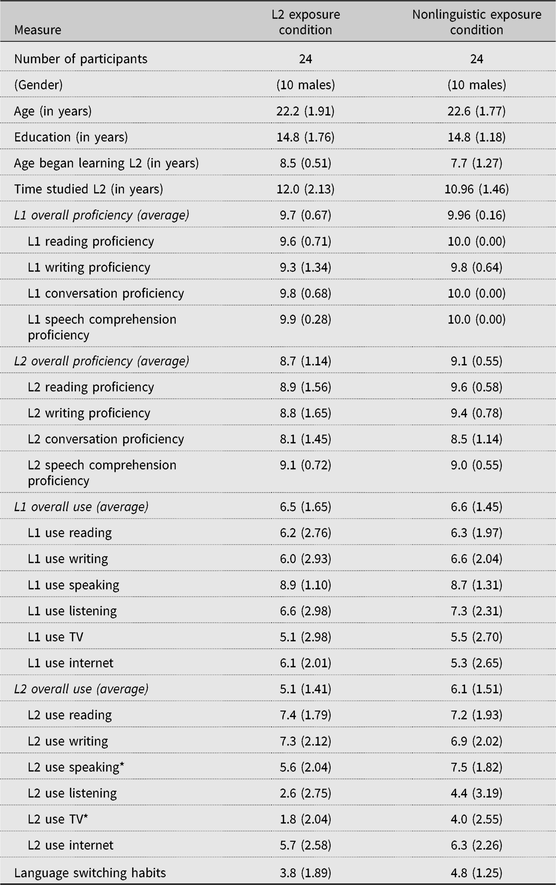
Forty-nine adult Arabic–Hebrew bilinguals (20 males), with normal hearing and vision and with no reported learning disabilities, participated in this experiment. All were native speakers of Arabic living in Israel. They began learning Hebrew during elementary school. All participants were students at a Hebrew-speaking university at the time of testing, but were tested at home where most communication is conducted in Arabic. Participants had learned English as a third language, but estimated using it less than 10% of the time. Of the participants, 25 bilinguals were assigned to the L2 exposure condition and 24 to the nonlinguistic exposure condition. Data from 1 participant in the L2 exposure condition group were lost due to technical problems. Table 1 presents language background information for the final set of 48 participants.
Participants’ characteristics as a function of exposure condition

Note: Standard deviations appear in parentheses. *Marks a significant difference between the condition groups at the p < .05 level. L1 and L2 proficiency, use, and switching habits are self-ratings on a scale of 0 to 10, with 0 indicating the lowest level and 10 indicating the highest level. Participants’ characteristics were collected via a modified version of the Language Experience and Proficiency Questionnaire (Marian et al., Reference Marian, Blumenfeld and Kaushanskaya2007).
Materials
We created a set of colored pictures presenting objects that were classified as either control items or as superseded items. The classification of items as control versus superseded items was based on a norming pretest administered to 13 Arabic–Hebrew bilinguals who did not participate in the main experiment. In this norming pretest, participants were given a list of 169 Arabic words along with their typical Hebrew translation, and were asked to indicate how often they use the word in Arabic, rather than Hebrew, on a scale of 1 to 5, where 1 indicates high frequency of use in Arabic and 5 indicates very low frequency of use in Arabic (this scale was reversed prior to analysis). In addition, they marked (yes/no) whether they tend to use the Hebrew word instead of the Arabic word. Nine items were subsequently excluded because they were exceptionally long or phonetically similar across languages, or because they shared a Hebrew translation.
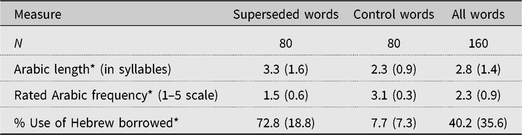
The remaining 160 items were classified into 80 control words, typically named in Arabic, and 80 superseded words, typically named using borrowed Hebrew labels. None of the items were cognates across Hebrew and Arabic as determined by two Arabic–Hebrew bilinguals (authors H.A. and F.K.). Table 2 presents item characteristics, and Appendix A presents the full set of items. Note that superseded words were not only less frequent but also longer.
Mean item characteristics (SD) as a function of word type

Note: *Denotes a significant difference between superseded and control words at the p < .05 level. Arabic frequency ratings are presented after reversal of the scale, such that lower values indicate lower Arabic frequency.
The entire set of 160 items was then divided into two lists to be administered pre- and post-exposure, each including 40 superseded items and 40 control items. The two counterbalanced lists were matched on Arabic frequency of use based on the pretest, number of items with a two-word name in Arabic, and Arabic length in syllables, all t < 1.
Each list was then divided into two sets to allow manipulation of relatedness in the Hebrew exposure block. Specifically, half of the control and half the superseded items within each list were included as written Hebrew words in the Hebrew exposure task (i.e., translation equivalents). Comparisons across translation equivalents and new items within each list and within each word type revealed no significant differences in Arabic frequency of use, ts < 1, number of two-word names, and Arabic length in syllables, ps > .15.
For these 160 items, pictures were selected mostly from the Moreno-Martínez and Montoro’s (Reference Moreno-Martínez and Montoro2012) stimulus database, with some pictures added from Google images. A pilot study with three Arabic–Hebrew bilinguals who did not participate in the main experiment verified that selected pictures were easy to identify and name.
Procedure
The experiment was conducted in a quiet room, in an Arabic-speaking environment. The experimenters were Arabic–Hebrew bilinguals, and all communication with the participant was conducted in Arabic. Participants were given a general explanation of the study, and then signed a consent form (in Arabic). Each participant performed two picture-naming tests in Arabic, interleaved by an exposure task.
Arabic picture-naming task
In this task, participants were instructed to name in Arabic each picture as quickly and accurately as possible. During each of the two blocks, 80 pictures were presented, one by one on the computer screen, each on a different PowerPoint slide for a maximum of 3.5 s. Participants could advance to the following picture prior to the time limit once they had named the picture. Responses were recorded for later coding of accuracy. The order of items was initially randomized and then kept constant across participants. In each block, half of the pictures (20 control and 20 superseded words) were included as Hebrew words during the L2 exposure phase (i.e., translation equivalents), as detailed below.
Exposure task
Participants in the L2 exposure condition were visually presented with 80 words written in Hebrew, presented one by one on the computer screen using PowerPoint. Written Hebrew instructions indicated to participants that they should read each word out loud. Presentation rate was self-paced, and responses were audio recorded for later coding of accuracy. The order of words was initially randomized and then kept constant across participants. This exposure task lasted about 2.5 min (SD = 0.5). Critically, the exposure task included 40 Hebrew translation equivalents of words named in Arabic in the pre-exposure block and 40 translation equivalents of words to be named in Arabic in the post-exposure block.
In contrast, participants in the nonlinguistic exposure condition performed a nonlinguistic paper-and-pencil task. Specifically, they were asked to color a Mandala line drawing on a piece of paper, and were not exposed to Hebrew during the entire experiment. This nonlinguistic exposure task lasted about 2.5 min (SD = 0.5).
Finally, all participants completed a detailed language history questionnaire providing information regarding their language proficiency and use (adapted from the Language Experience and Proficiency Questionnaire; Marian, Blumenfeld, & Kaushanskaya, Reference Marian, Blumenfeld and Kaushanskaya2007).
Results
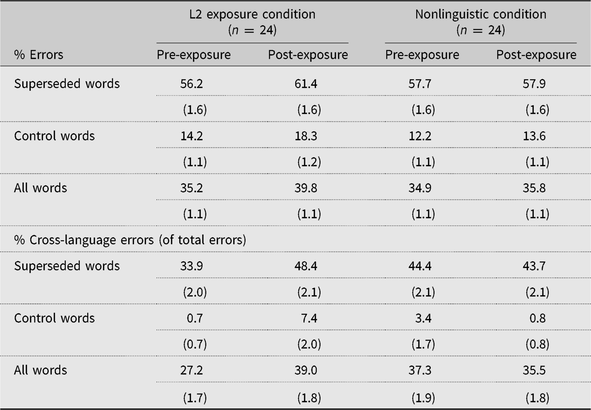
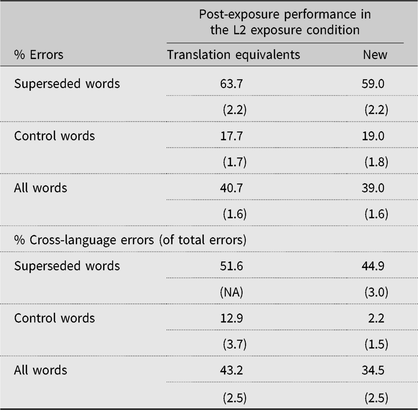
Because two different pictures elicited the same Arabic name from participants, both were excluded from analyses, leaving 158 pictures. This exclusion did not influence the matching of items across conditions. Participants’ responses were coded by two proficient Arabic–Hebrew bilinguals, and were considered correct when the intended Arabic word was produced. All other responses were treated as errors, and were classified as cross-language errors when the Hebrew name of the picture was produced (about 13% of the data); as an English intrusion when the English name of the picture was produced (about 2% of the data); as an omit when no response was provided or when the participant indicated not knowing the name (about 5% of the data); as a meaning error when an unrelated name was produced (about 4% of the data); as an inaccurate production when hesitations or description of the picture were provided (about 7%); or as an alternative when an alternative reasonable name of the picture was provided, but was not the intended Arabic name over which lexical characteristics were computed (about 5% of the data). Mean percentage of naming errors and percentage of cross-language (Hebrew) errors, along with standard errors, are presented in Table 3 as a function of condition, word type, and time, and in Table 4, as a function of item relatedness. Naming errors were analyzed using logistic generalized linear mixed models, as implemented in the lme4 library (Baayen, Davidson, & Bates, Reference Baayen, Davidson and Bates2008) in R (version 3.3.1, R Development Core Team, 2016). This analysis approach allows one to simultaneously account for variance due to participants and to items. Moreover, with this approach, it is possible to perform the analyses directly on the participants’ actual responses rather than on aggregated proportions per condition, which is more suitable for the error rate data (see Dixon, Reference Dixon2008). In the tables, estimations of β, SE, Z, and p values are based on the summary() function, whereas F values are based on the corresponding anova() function of the same models.
Mean (and SE) percentage of errors (top), cross-language errors (bottom) in the different conditions (n = 48)

Mean (and SE) percentage of errors (top) and cross-language errors (bottom) for translation equivalents and new items following exposure to L2 (n = 24)

Initial models included as fixed effects exposure condition (nonlinguistic vs. L2 exposure) with the nonlinguistic condition set as the reference, time (pre-exposure vs. post-exposure), with pre-exposure set as the reference, and word type (control vs. superseded) with control set as the reference. Interactive models, including the two-way interaction between condition and time and a model including in addition the three-way interaction among condition, time, and word type, were compared against the base additive model using log-likelihood model comparisons. Because superseded and control words differed in length, syllable length was included as a control fixed effect in all models. Random factors included by-participant and by-item intercepts, as more complex random structures were not supported by the data (Barr, Levy, Scheepers, & Tily, Reference Barr, Levy, Scheepers and Tily2013). All analyses were first performed on the overall error data as the dependent variable, and then focusing on error trials only, contrasting cross-language errors with all other error types. This resulted in estimations of percentage of cross-language errors, controlling for baseline differences in overall error rates.
Time effects
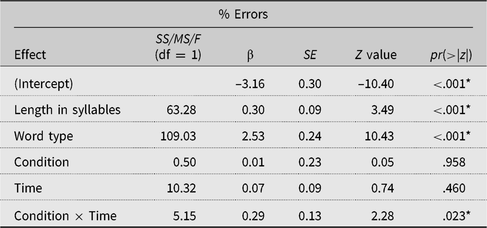
In the overall error rate analyses, model comparisons revealed that the model including the two-way interaction between condition and time was superior to the additive model, χ 2 (df = 1) = 5.04, p = .025, Akaike information criterion (AIC) = 6607.8. Further, the model including the three-way interaction among condition, time, and word type did not converge.Footnote 1 The best fit two-way model, presented in Table 5, reveals that superseded words elicited more errors than control words. Importantly, a significant interaction emerged between the effects of time and condition (see Figure 1).
Model estimates for the effects of word type, condition, time, and the interaction between condition and time on % errors

Note: *Denotes a significant effect with p < .05. Model estimates are based on the anova() and summary() functions.
Overall error rates as a function of time and condition. Observed means with SE as error bars.

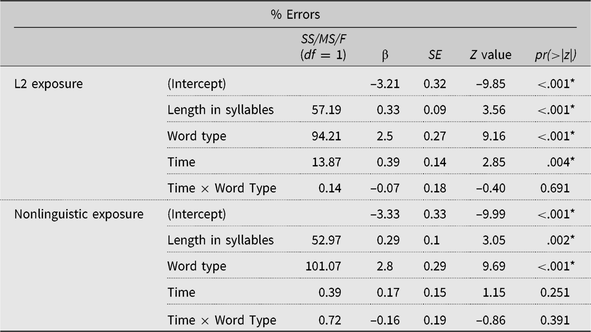
To further examine this significant two-way interaction, we tested for the effect of time within each condition group. Further, due to our theoretical interest in the interactions between short-term effects (time) and long-term effects (word type), and because the model including the three-way interaction failed to converge, we further examined the two-way interaction between these factors separately within each condition. As can be seen in Table 6, in the L2 exposure condition the effect of time was significant, with higher error rates observed post-exposure. The word type effect was significant, but did not modulate the time effect. In contrast, in the nonlinguistic exposure condition, the effect of time was not significant, with similar error rates pre- and post-exposure. Again, superseded words yielded higher error rates than control words, but the interaction between time and word type was not significant.
Model estimates for the effects of time and word type as a function of condition on % errors

Note: *Denotes a significant effect with p < .05. Model estimates are based on the anova() and summary() functions.
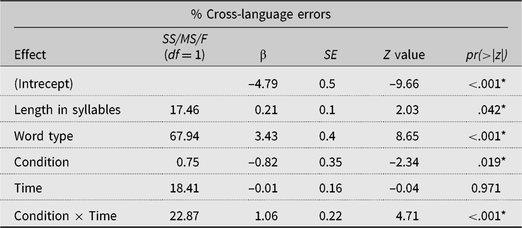
We further examined whether time, condition, and word type affected the percentage of cross-language errors out of the total number of errors. Adhering to the same analysis structure, log-likelihood model comparisons revealed that the model including a two-way interaction between condition and time (see Table 7) was superior to the additive model, χ 2 (df = 1) = 22.29, p < .001, AIC = 2411.2. The model including the three-way interaction among time, condition, and word type failed to converge.Footnote 2
Model estimates for the effects of word type, condition, time, and the interaction between time and exposure on cross-language errors

Note: *Denotes a significant effect with p < .05. Model estimates are based on the anova() and summary() functions.
The best fit model presented in Table 7 reveals that superseded words elicited a significantly higher percentage of cross-language errors than control words. Further, condition differences were significant, but were qualified by a two-way interaction with time (see Figure 2). To further examine this significant two-way interaction, we tested for the effect of time within each condition group. Again, due to our theoretical interest in the interactions between short-term effects (time) and long-term effects (word type), and because the model including the three-way interaction failed to converge, we further examined the two-way interaction between these factors within each condition, separately. As can be seen in Table 8, in the L2 exposure condition group, the effect of time was significant, with a higher percentage of cross-language Hebrew errors post-exposure. In contrast, in the nonlinguistic exposure condition group, the effect of time was not significant. In both conditions, superseded words were associated with more cross-language errors, but the interaction between word type and time was not significant.
Percentage of cross-language errors of the total errors, as a function of time and condition. Observed means with SE as error bars.

Model estimates for the effects of time and word type as a function of condition on cross-language errors

Note: *Denotes a significant effect with p < .05. ±Denotes a marginally significant effect with p < .1.
Relatedness effects
Additional analyses, aimed to examine the contribution of item-specific effects, contrasted the performance on translation equivalents and new items (set as the reference) in the L2 exposure condition group post-exposure (see Table 4 for means and standard errors). In the overall error rate analysis, model comparisons revealed that including the two-way interaction between relatedness and word type did not improve the fit over the model including main effects of relatedness and word type, χ2 (df = 1) = 2.62, p = .11, AIC = 1822.3. Examination of this best fit additive model revealed a main effect of word type, β = 2.47, SE = 0.29, z = 8.46, p < .001, F = 74.27, with superseded items resulting in more errors than control items, but critically no significant effect of relatedness, β = 0.12, SE = 0.12, z = 0.95, p = .34, F = 0.79.
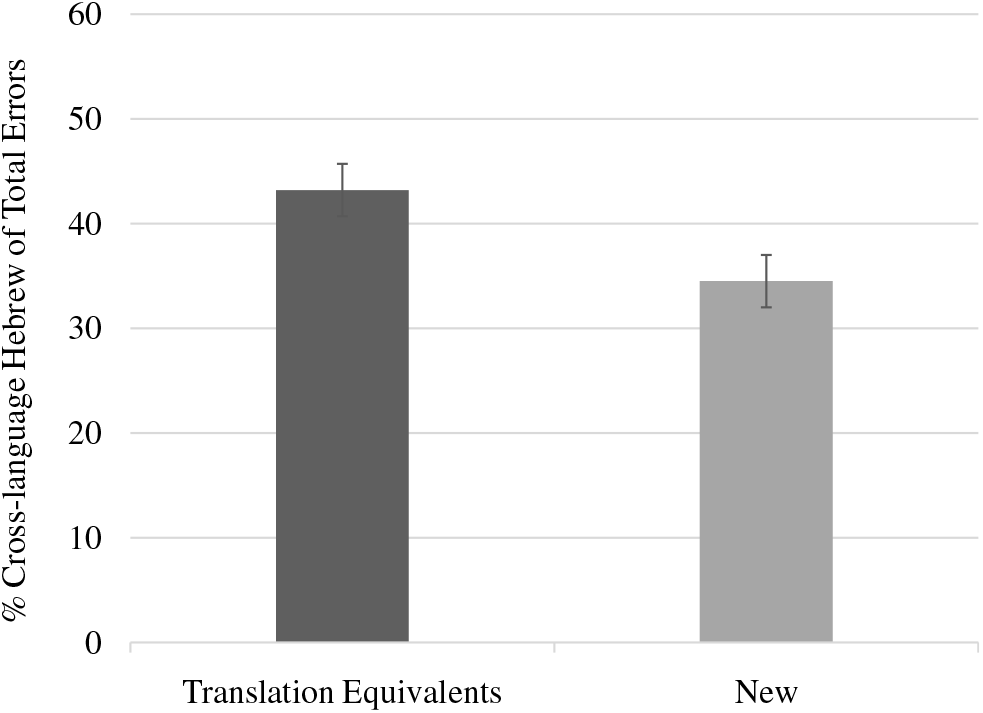
The analysis using the percentage of Hebrew cross-language errors, of the total number of errors made, revealed some modulations by item relatedness. In particular, the model including the two-way interaction between relatedness and word type marginally improved the fit over the additive model, χ2 (df = 1)= 2.82, p = .09, AIC = 722.39. Examination of this best fit model revealed a significant effect of relatedness, β = 1.95, SE = 0.89, z = 2.20, p = .028, F = 3.07, such that translation equivalents were associated with more cross-language errors than new items. Further, superseded items were associated with significantly more cross-language errors than control items, β = 4.39, SE = 0.87, z = 5.05, p < .001, F = 36.96, but the interaction between word type and relatedness did not reach significance, β = –1.44, SE = 0.92, z = –1.57, p = .118, F = 1.73. Together, these analyses reveal that although translation equivalents and new items were associated with similar overall error rates, translation equivalents were associated with more cross-language errors than new items (see Figure 3).
Percentage of cross-language errors of the total errors in the post-exposure phase of the L2 Exposure group, as a function of relatedness. Observed means with SE as error bars.

Discussion
The present study aimed to explore the consequences of brief language exposure on bilingual language production. We examined whether brief exposure of a few minutes to a less proficient L2 influenced subsequent performance in the L1. The results show that Arabic–Hebrew bilinguals exhibited higher error rates in a picture-naming task in their L1 after reading a list of Hebrew words aloud compared to their baseline performance before the exposure. By contrast, error rates did not increase following a nonlinguistic (coloring) intervening task. Analysis of cross-language error rates echoes this pattern, revealing higher rates of cross-language errors post- compared to pre-exposure among bilinguals who were briefly exposed to their L2, but not among those who performed the nonlinguistic task.
Thus, the present findings show that brief exposure, in a time scale on the order of minutes, is sufficient to influence bilingual performance. This effect joins the recent accumulation of evidence demonstrating the importance of language context to bilingual performance (see, e.g., Grosjean Reference Grosjean and Nicol2001; Kroll et al., Reference Kroll, Bobb and Wodniecka2006; Wu & Thierry, Reference Wu and Thierry2010) and the effects of changing the order of language blocks on bilingual production (Branzi et al., Reference Branzi, Martin, Abutalebi and Costa2014, Reference Branzi, Della Rosa, Canini, Costa and Abutalebi2016; Declerck & Philipp, Reference Declerck and Philipp2017; Guo et al., Reference Guo, Liu, Misra and Kroll2011; Kreiner & Degani, Reference Kreiner and Degani2015; Misra et al., Reference Misra, Guo, Bobb and Kroll2012; Van Assche et al., Reference Van Assche, Duyck and Gollan2013). The effects we observe, whereby L1 production is modulated by prior L2 exposure, are compatible with both inhibition- and activation-based accounts. Specifically, according to inhibition accounts (Green, Reference Green1998), L2 exposure requires strong inhibition of the L1, and thus post-exposure performance reveals the effects of recovery from inhibition. According to activation-based accounts, the low level of activation of the L2 increases significantly during the brief exposure task, such that L2 representations become effective competitors post-exposure (e.g., Branzi et al., Reference Branzi, Martin, Abutalebi and Costa2014).
Although the findings cannot clearly dissociate the activation- and inhibition-based accounts (see Kreiner & Degani, Reference Kreiner and Degani2015; Van Assche et al., Reference Van Assche, Duyck and Gollan2013), the current study provides two sources of evidence for the change in the activation balance of the two languages. First, the increased overall error rate post-exposure naturally reflects the change in availability of elements from the target language. Second, the increased rate of cross-language errors suggests an increased availability of elements from the nontarget language. Cross-language errors are viewed as a marker of cross-language activation (Gross & Kaushanskaya, Reference Gross and Kaushanskaya2018; Sandoval et al., Reference Sandoval, Gollan, Ferreira and Salmon2010). Together, the two measures reflect the change in the balance of activation of target and nontarget language elements, respectively, due to the brief exposure manipulation.
The current study further aimed to examine to what extent such brief exposure effects depend on item-specific versus global whole-language control mechanisms. Our results show comparable overall increased error rates following brief L2 exposure for new items and translation equivalents. These results suggest that the brief language-exposure manipulation changes the activation balance of the two languages in a global way, affecting all target language representations. This is because if only item-based (lemma-based) control mechanisms were at play, then only the translation equivalents of previously presented L2 items should be affected. The fact that we observed increased error rates for both translation equivalents and new items underscores the global, whole-language, nature of the effect. This finding extends previous studies in which only repeated items were tested (e.g., Guo et al., Reference Guo, Liu, Misra and Kroll2011; Misra et al., Reference Misra, Guo, Bobb and Kroll2012) and is in line with more recent work showing that new nonrepeated items were affected as well (Branzi et al., Reference Branzi, Martin, Abutalebi and Costa2014; Declerck & Philipp, Reference Declerck and Philipp2017; Kreiner & Degani, Reference Kreiner and Degani2015; Van Assche et al., Reference Van Assche, Duyck and Gollan2013).
Nonetheless, percentage of cross-language errors was modulated by item relatedness, such that items for which Hebrew written translation equivalents were presented during the exposure task tended to result in more cross-language errors than new items. This finding implies that although global control mechanisms are clearly at play, item-based modulations contribute as well. This finding is consistent with the results of Declerck and Philipp (Reference Declerck and Philipp2017), who similarly observed stronger effects when both language (global) and lemma (item-based) representations were repeated. The current findings extend previous studies that observed only global effects (Branzi et al., Reference Branzi, Martin, Abutalebi and Costa2014) or only item-based effects (Van Assche et al., Reference Van Assche, Duyck and Gollan2013 for Dutch-English bilinguals) by demonstrating a global effect alongside an item-based effect. Further, as discussed below, the effects observed here go beyond repeated task and stimuli (extending Branzi et al. Reference Branzi, Martin, Abutalebi and Costa2014 and Declerck & Philipp, Reference Declerck and Philipp2017) and help uncover what bilingual characteristics are important in determining the scope of the brief language-exposure effects.
In the current study, we further tested whether all items are similarly affected by the brief language-exposure effect, or whether this short-term manipulation interacts with item characteristics. To this end, we included superseded L1 words that are typically replaced by L2 borrowed labels, as well as control words. These superseded words provided a window into the activation level of the nontarget language, in that these superseded items were not only associated with more errors but borrowed Hebrew words were often produced in lieu of the superseded, target-language appropriate word. We found that the brief language-exposure effect similarly affected low-frequency superseded words and medium-frequency control words, suggesting that item frequency did not modulate susceptibility to brief language exposure. This implies that long-term and short-term effects were independent. Kreiner and Degani (Reference Kreiner and Degani2015) observed similar independence, where short-term modulations, resulting from watching a nontarget language movie, were similarly observed for early and late bilinguals, who differ in their long-term accumulated frequency of use. Nonetheless, the fact that previous studies demonstrated language asymmetries, with L1 production being influenced by prior L2 exposure but not the reverse (Branzi et al., Reference Branzi, Martin, Abutalebi and Costa2014; Misra et al., Reference Misra, Guo, Bobb and Kroll2012; Van Assche et al., Reference Van Assche, Duyck and Gollan2013), suggests that the interactions of short-term and long-term effects may nonetheless surface under certain conditions.
An additional goal of the current study was to examine whether the effect of brief language exposure can be extended across tasks. Specifically, whereas in most previous research the same task was used across languages in the blocked-language-order manipulation (e.g., picture naming in Branzi et al., Reference Branzi, Martin, Abutalebi and Costa2014; Misra et al., Reference Misra, Guo, Bobb and Kroll2012; semantic classification in Declerck & Grainger, Reference Declerck and Grainger2017), we utilized a change across languages in the type of task from reading aloud to picture naming, and in the type of stimuli over which performance is measured, from written words to pictures. Nonetheless, we observed significant modulations in L1 production following brief L2 exposure. This pattern suggests that the brief language-exposure manipulation changes the activation balance of the mental representations within the bilingual lexicon. As a result, any task that taps these mental representations is likely to be affected by the activation-balance change. Extending the findings of Kreiner and Degani (Reference Kreiner and Degani2015), where comprehension influenced production, the current study directly compares the contribution of item-based and global effects and shows that both are at play. In addition, the current study demonstrates both item-based and non-task-specific global effects in the reversed direction of influence (L2 on L1 here in contrast to L2 on L1 in Kreiner & Degani, Reference Kreiner and Degani2015).
Finally, our study aimed to examine how bilingual characteristics, specifically language similarity and patterns of use, modulate the global nature of the effect. Based on the difference observed between Dutch–English and Chinese–English bilinguals in the phoneme fluency study of Van Assche et al. (Reference Van Assche, Duyck and Gollan2013), the authors suggested that whole-language effects are not expected for bilinguals of highly similar languages (such as Dutch and English). This is because such languages share many cognate words, deeming it inefficient to inhibit the entire nontarget language when using the other language. In the current study, whole-language brief language-exposure effects were nonetheless observed for bilinguals of similar languages, Arabic and Hebrew, which share many cognate words (Degani et al., Reference Degani, Prior and Hajajra2018; Norman et al., Reference Norman, Degani and Peleg2016). Our findings thus suggest that language similarity is unlikely to explain the differential pattern of results and engagement of control mechanisms in the Van Assche et al. (Reference Van Assche, Duyck and Gollan2013) study. This assertion is in line with the results of Branzi et al. (Reference Branzi, Martin, Abutalebi and Costa2014) and Declerck and Philipp (Reference Declerck and Philipp2017), observing global effects for bilinguals of similar languages (Spanish–Catalan and German–English, respectively). Further, this conclusion is consistent with evidence from other bilingual studies implying that language similarity does not necessarily impact the underlying structure of the bilingual lexicon (e.g., Degani et al., Reference Degani, Prior and Hajajra2018; Hoshino & Kroll, Reference Hoshino and Kroll2008; Prior, Degani, Awawdy, Yassin, & Korem, Reference Prior, Degani, Awawdy, Yassin and Korem2017).
In light of the current study, a more plausible explanation for the difference observed in Van Assch et al. (Reference Van Assche, Duyck and Gollan2013), between Chinese–English and Dutch–English bilinguals, is their patterns of language use. Specifically, in the adaptive control hypothesis, Green and Abutalebi (Reference Green and Abutalebi2013) outline how bilingual language-use patterns influence the engagement of control mechanisms (see also Prior & Gollan, Reference Prior and Gollan2011; Verreyt, Woumans, Vandelapontte, Szmalec, & Duyck, Reference Verreyt, Woumans, Vandelanotte, Szmalec and Duyck2016). Like the Chinese–English but not the Dutch–English bilinguals in the Van Assche et al. (Reference Van Assche, Duyck and Gollan2013) study, the Arabic–Hebrew bilinguals in the current study are at least partially immersed in the L2 environment, and critically shift between languages on a day-to-day basis (Prior & Gollan, Reference Prior and Gollan2011). The current findings suggest that this intense use of their two languages invites modulations of the two languages at a whole-language level. The highly proficient Spanish–Catalan bilinguals tested by Branzi et al. (Reference Branzi, Martin, Abutalebi and Costa2014), who exhibited global effects, indicated using both languages regularly from preschool into adulthood. It is thus possible that this intense day-to-day use of both languages is critical for the engagement of global control. This implies that patterns of use, rather than cross-language similarity, may modulate language control mechanisms. In particular, bilinguals with relatively low frequency of language shifting in their daily lives (as the Dutch–English bilinguals tested in Van Assche et al., Reference Van Assche, Duyck and Gollan2013) may be less prone to whole-language control than bilinguals with intense shifting and switching habits. More generally, future research should further examine the generalizability of the brief exposure effect to additional bilingual populations that differ on other dimensions (Luk & Bialystok, Reference Luk and Bialystok2013).
One limitation of the current study was that the word type manipulation resulted in a situation where half of the items were superseded Arabic words, typically replaced by borrowed Hebrew labels. The results reveal a relatively high error rate, even before L2 exposure (see Table 3). This is not only due to the stringent coding scheme we adopted but also because the superseded words are especially difficult to name in the L1. Further, the large proportion of cross-language errors on these superseded items implies that during L1 task performance, bilinguals produced about 13% of the words in the nontarget L2. This aspect may have created a task context that is not purely a single language context task, which may have affected the recruitment of control mechanisms to a certain extent (Ma, Li, & Guo, Reference Ma, Li and Guo2016). Future studies excluding superseded words may shed more light on this issue.
To conclude, the current study demonstrates that L1 bilingual production performance is modulated by brief exposure to the L2. Brief exposure of a few minutes to the nontarget language resulted in increased error rates and specifically higher percentage of cross-language errors post-exposure. Moreover, overall accuracy in naming translation equivalents and new items were similarly hindered by the brief exposure effect, but translation equivalents tended to lead to more cross-language errors post-L2 exposure. These findings implicate both whole-language and item-based control processes in bilingual performance. These processes were demonstrated across different tasks, such that they cannot be reduced to low-level priming effects, and appear to rely on changes in activation balance of representations within the bilingual system. Thus, a very brief production task carried out in one language, such as talking to a friend on the phone, is likely to influence bilinguals’ production performance in the other language, and these effects go beyond the specific items/topic covered, or the task–demand processes involved in the previous task. The findings underscore the influence of language context and the dynamic nature of bilingual performance.
Acknowledgments
The authors would like to thank Anat Prior and Natasha Tokowicz for insightful comments on an earlier version of this manuscript. This project was funded by an ISF 1341/14 (to T.D. and H.K).
Appendix A
Experimental Materials