Introduction
Flies, mosquitoes, ticks, fleas, bed bugs, kissing bugs, and mites are important ectoparasites within the one health concept because their parasitism can result in the transmission of pathogens, allergic reactions, the release of toxins, morbidity, and even death of the host (Elston, Reference Elston2004). Hosts are impaired due to depletion of nutrients and energy reserves due to feeding on blood and skin by the ectoparasites, which impacts the physiology of the host, reflected in the immune defenses, the corporal condition, as well as the hematological and biochemical parameters (Potti et al., Reference Potti, Moreno, Merino, Frías and Rodríguez1999; Schoeler and Wikel, Reference Schoeler and Wikel2001; Szabó et al., Reference Szabó, Szalmás, Liker and Barta2002; Wagner et al., Reference Wagner, Fast and Johnson2008; Pitala et al., Reference Pitala, Siitari, Gustafsson and Broomer2009; Webster et al., Reference Webster, Hill, Burnett and Deane2014).
Blood is a liquid tissue composed of blood cells and plasma. It has different functions such as the transport of oxygen, nutrients, and metabolic waste, due to this, the study of a small portion can present information about the health status of the animals (Guyton and Hall, Reference Guyton and Hall2006; Stoot et al., Reference Stoot, Cairns, Cull, Taylor, Jeffrey, Morin, Mandelman, Clarck and Cooke2014). The complete blood cell count (CBC) is a routine, inexpensive, and easily requested laboratory test that allows evaluation of abnormalities in blood cells, their kinetic in the inflammatory process, and identification of hematologic disorders (Tefferi et al., Reference Tefferi, Hanson and Inwards2005; Stockham and Scott, Reference Stockham and Scott2011). Hematologic changes associated with hematophagous ectoparasites, such as mites (Szabó et al., Reference Szabó, Szalmás, Liker and Barta2002; Moonarmart et al., Reference Moonarmart, Tansakul, Kiewsiri, Watanaboonchai, Somrith, Yinharnmingmongkol and Tunhikorn2018), flies (O'Brien et al., Reference O'Brien, Morrison and Johnson2001), ticks (Pfäffle et al., Reference Pfäffle, Petney, Elgas, Skuballa and Taraschewski2009; Reck et al., Reference Reck, Berger, Terra, Marks, Vaz, Guimarães and Termignoni2009), mosquitoes (Jones and Lloyd, Reference Jones and Lloyd1987), fleas (Araujo et al., Reference Araujo, Silva, Lopes, Ribeiro, Pires, Carvalho, Balbuena, Villas and Ramos1998), bed bugs, and kissing bugs (Pritchard and Hwang, Reference Pritchard and Hwang2009), have been reported for animals and people.
Some aspects of ectoparasites-host relationships remain unclear. Moreover, due to growing populations, urban areas can offer suitable conditions for the proliferation of vectors that can transmit zoonotic pathogens (Szabó et al., Reference Szabó, Szalmás, Liker and Barta2002; de Oliveira et al., Reference de Oliveira, Reckziegel, Ramos, Giannelli, Alves, Carvalho and Ramos2020). Thus, this review aimed to analyze the evidence that ectoparasites influence the hematological parameters of their hosts and the methodologic bias to present evidence and analyze the advances and limitations of these studies.
Methods
Focus question
This systematic review was based on the following focus question: Is there evidence that basic hematologic parameters can be used to understand the ectoparasite and host relationship? If so, which hematologic parameters are the best for evaluating this?
Bibliographic search
The Preferred Reporting Items for Systematic Reviews and Meta-Analysis (PRISMA) guidelines (Moher et al., Reference Moher, Liberati, Tetzlaff and Altman2009) were used as a basis for the development of this systematic review. The bibliographic search was performed on 30 July 2020, for the selection of studies, in Portuguese or English in three databases (PubMed/Medline, Scopus, and Web of Science), using descriptors structured with filters built for three domains: (i) Hematological parameters, (ii) Ectoparasites, and (iii) Animals. These filters were prepared on the PubMed/Medline platform using MeSH Terms (Medical Subject Headings) and the algorithm Title/Abstract, being adapted from the Scopus and Web of Science databases (Table S1).
Selection and management of relevant studies
Two reviewers (BCFN and ESS) grouped the studies in a spreadsheet, and titles and abstracts were read for the initial selection of articles that corresponded to the focus question. In these selections, brief reports, literature reviews, comments, notes, book chapters, and nonindexed studies were excluded. Only studies that met the following eligibility criteria were included for reading the full articles: Studies that evaluated changes in hematological tests in animals with ectoparasite infestation and in non-infested animals. Studies that evaluated other associations that could interfere with hematological assessment were excluded; for example, studies with ectoparasites acting as vectors of pathogens and animals with other parasitic infestations or pathologies.
These reviewers analyzed the reference lists of the selected studies to add relevant studies that were not included in the database search. The level of agreement between these reviewers was assessed using the test Kappa (kappa = 0.81). Independent researchers (AMOO, LAF, and AKC) were consulted when reviewers found doubts in the selection of articles and the selection and collection of data.
Data extraction
The study data were collected and organized in spreadsheets according to the characteristics of the study (country, ethics committee authorization, and statistical analysis), study execution environment (temperature, humidity, and time of year), animals (species, group, sex, age, weight, allocation, food, water supply, antiparasitic treatment before the experiment, parasitological tests to detect the influence of other parasites on the results, and the number of individuals), ectoparasitic infestation (species, group, experimental or natural infestation, and estimation of the number of ectoparasites per animal) and other important analyses. The results of the data extraction were compared between the two reviewers and the conflict information was corrected.
Bias analysis
The bias analysis was based on Animal Research: Reporting of In Vivo Experiments (ARRIVE) guideline (Kilkenny et al., Reference Kilkenny, Browne, Cuthill, Emerson and Altman2010). This guide has been adapted according to the nature of the studies analyzed in this systematic review and verified the information present in the studies corresponding to the following points: (1) title features with a concise description of the article content; (2) abstract presents the important information contained in the article; (3) introduction presents sufficient scientific background; (4) objectives were clearly described; (5) ethics; (6) study design: (a) the number of experimental, control groups and experimental unit; (b) blinded evaluators; (7) how, when, where, and why the study was conducted; (8) animal characteristics; (9) allocation conditions; (10) replications and choice of the sample n; (11) random distribution of animals in groups; (12) statistical analysis; (13) presented results for each analysis; (14) discussed the results clearly and objectively.
Results
Characteristics of the studies
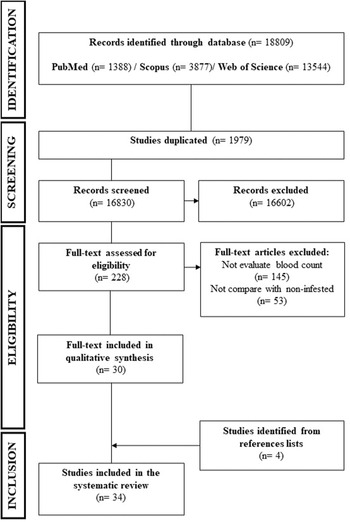
The initial search of the three databases totaled 18,809 studies, of which 1979 were excluded because they were duplicated and 16,602 were excluded after reading the titles and the abstract indicating inconsistency with the eligibility criteria. The remaining 228 studies were read to find 30 studies fully met the criteria, after reading the references, 4 more studies fit the inclusion criteria, totaling 34 studies included in this systematic review (Fig. 1).
PRISMA diagram. Different phases of the selection of studies for conducting qualitative and quantitative analyses. Flow diagram of the systematic review literature search results.

Most studies have been developed in the United States of America (20.60%, n = 7), Australia (14.71%, n = 5), Brazil (14.71%, n = 5), Switzerland (5.88%, n = 2), while 1 study each (2.94%) was developed in Sudan, Turkey, United Kingdom, Belgium, Canada, Chile, Israel, Finland, France, India, Ireland, Iraq, Netherlands, Mexico, and Czech Republic. Approval for the use of animals in experimental procedures by the Animal Use and Care Committee was mentioned only in 23.54% (n = 8) of the studies, while the statistical analyses performed were specified in 97.06% (n = 33) of the studies (Table S2).
Characteristics of the animals
The animals used as hosts for ectoparasites were mammals (55.88%, n = 19), birds (23.54%, n = 8), and fish (20.60%, n = 7) (Table 1). Most studies neglected the age (55.88%, n = 19) and weight (70.58%, n = 24) of the animals, while only 41.17% (n = 14) of the studies neglected the sex of animals, 17.64% (n = 6) of the studies using animals of both sexes, 20.60% (n = 7) of the studies using females and 14.64% (n = 6) of the studies using males. Some studies presented characteristics related to the environment in which the animals were kept, with the temperature shown in 23.54% (n = 8) of the studies, the relative humidity presented only in 5.88% (n = 2) of the studies, and the time of year when the study was developed was neglected in 76.47% (n = 26) of the studies. In most studies (58.82%, n = 20) the animals were allocated to specific locations, while in 23.64% (n = 8) of the studies the animals appeared to be fully exposed to environmental conditions, and the other 17.64% (n = 6) of the studies neglected this information. Food and water supplies were mentioned in 61.76% (n = 21) and 35.29% (n = 12) of the studies, respectively. For animals kept in aquatic conditions in 17.64% (n = 6) of the studies, the characteristics of humidity and water supply were considered as not applicable (Table S2).
Significant changes in hematological parameters were observed in animals infested and not infested by ectoparasites

↑, significant increase; ↓, significant reduction; ?, unclear; ns, no statistically significant difference; dpi, days after infestation; h, hours; r, resistant; RBC, Red blood cells; Hb, Hemoglobin; HCT, Hematocrit; MCV, Mean corpuscular volume; MCH, Mean corpuscular hemoglobin, ESR, Erythrocyte sedimentation rate; MCHC, Mean corpuscular hemoglobin concentration; WBC, White blood cells; NEU, Neutrophils; HET, Heterophils; LYM, Lymphocytes; MON, Monocytes; EOS, Eosinophils, BAS, Basophils; PLT, Platelets.
Characteristics of ectoparasite infestation
The ectoparasites used in the studies correspond to ticks (26.47%, n = 9), mites (23.54%, n = 8), crustaceans (20.60%, n = 7), flies (14.71%, n = 5), fleas (11.76%, n = 4) and lice (2.94%, n = 1) (Table 1). Most studies used experimental infestation of ectoparasites (73.52%, n = 25) compared to natural infestation (23.54%, n = 8); however, one study (2.94%) used both forms of infestation as investigators placed ectoparasites on hosts. The time of year when the studies were conducted was reported in only eight studies (23.54%). Most of the studies (67.64%, n = 23) presented clear information on the performance of procedures that would allow the estimation of the number of ectoparasites infesting the hosts. In addition, only nine (26.47%) studies mentioned treatment with antiparasitic drugs to ensure that the animals were free from infestations before the start of the experiment (Table S2).
Analysis and changes in hematologic parameters
Although blood collection was performed in studies in general, not all of them presented the information clearly. The veins used as access for blood collection varied according to the host, being that in mammals the jugular vein was the most used (26.47%, n = 9), in fish, it was the caudal vein (17.64%, n = 6), and in birds the brachial vein (8.82%, n = 3). Ethylene-Diamine-Tetra-Acetic acid (dipotassium salt) (EDTA) was used as an anticoagulant in 38.23% (n = 13) studies while heparin was used only in six studies (17.64%) (Table S3).
The hematologic parameters most addressed in the studies were hematocrit (HCT) (82.35%, n = 28), white blood cells (WBC) (61.76%, n = 21), hemoglobin (Hb) (44.11%, n = 15) and red blood cells (RBC) (41.17%, n = 14). In the differential leukocyte counts were lymphocytes (LYM) (47.05%, n = 16), eosinophils (EOS) (44.11%, n = 15), neutrophils (NEU) (35.29%, n = 12), basophils (BAS) (32.35%, n = 11) and monocytes (MON) (32.35%, n = 11) (Table S3). Despite this, the behavior of the hematologic parameters was not always similar in the face of infestation by ectoparasites, so that the more frequent significant changes were the decrease in HCT (23.54%, n = 8), Hb (14.70%, n = 5), LYM (11.76%, n = 5) and RBC (8.82%, n = 4) values, the increase in WBC (14.71%, n = 5) and the differential leukocyte count showed an increase in EOS (20.60%, n = 7), NEU (14.71%, n = 5) and BAS (11.76%, n = 4) values; other studies did not observe changes (17.64%, n = 6) (Table 1).
Other analyses
The studies covered in this systematic review reinforce the evidence that ectoparasite infestations result in changes in the host hematologic parameters. However, other analyses carried out in some studies have proved relevant to further understand the relationship between these organisms. Serum biochemical analyses were addressed in 10 (29.41%) studies, with albumin (ALB), total protein (TP), and globulin (GLOB) being analyzed more frequently. The hosts' cortisol levels were analyzed in four (11.76%) studies, with cortisol levels significantly higher in infested animals in three (8.82%) of these studies. Histological analyses of the hosts' skin were performed in five (14.71%) studies. The oxidative changes resulting from ectoparasite infestations were analyzed in three (8.82%) studies, in one of them (2.94%) a significant increase was observed in the levels of erythrocytic lipid peroxide (LPO) and malonaldehyde (MDA) during infestation, glutathione (GSH) and catalase (CAT) after treatment with antiparasitic and no significant change in the antioxidant enzyme superoxide dismutase (SOD). In the remaining study (2.94%, n = 1), a decrease in radical oxygen production in control fish and an increase in infested fish was observed, and in another study (2.94%, n = 1), blood resistance to oxidative stress was evaluated; however, this variable remained stable between groups. In addition, three (8.82%) studies observed that the amount of ectoparasites had a significant effect on hematologic parameters.
Bias analysis
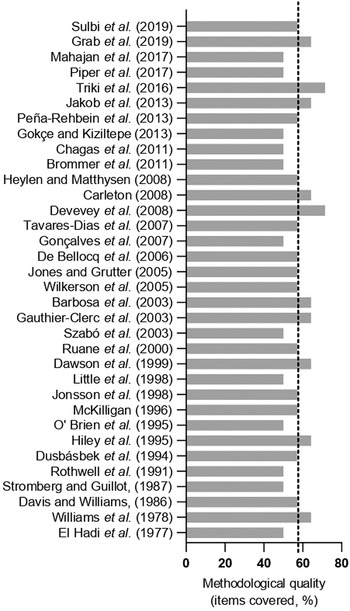
The results of the ARRIVE analysis show that the most recent studies have better met the methodological quality criteria (Table S4 and Fig. 2). None of the studies fulfilled all methodological criteria, and the mean quality score of all studies reviewed was 56.92 ± 0.42. No study reported complete information about the study design, especially regarding the blinding of the evaluators, definition of the sample n, and replications. Few studies have presented information that can be considered relevant for research on ectoparasites, such as the complete characteristics of the host animals (2.94%, n = 1), the allocation conditions (20.6%, n = 7), and the time of year when the study was developed (23.54%, n = 8), which is an important feature mainly for field studies. The approval of ethics boards for the use of animals was more frequently present in more recent studies (23.54%, n = 8). Interestingly, the random distribution of animals among the groups was present in 41.17% (n = 14) of the studies.
Analysis of methodological bias (reporting quality) for each study included in the review. Based on Animal Research: Reporting of In Vivo Experiments (ARRIVE) guidelines (http://www.nc3rs.org.uk/arrive-guidelines). The dotted line indicated the mean quality score (%). Detailed bias analysis stratified by domains and items evaluated is presented in Table S3.

Discussion
General characteristics of studies and methodological biases
In this systematic review, the effects ectoparasite infestations have on host hematological parameters were investigated. In addition, the methodological quality of these studies based on their bias was analyzed. Thirty-four studies that met all the eligibility criteria defined in this review were found. Most of these studies performed hematologic analyses common in the routine of clinical laboratories, requiring no expensive technology, which may justify the variety of countries with different economic statuses in which the studies were developed. Most of the studies found did not present authorization information for the use of the animals in the experiments, this data was provided more frequently in the most recent studies. This is probably due to the growing concern to ensure the welfare of animals used in research and to avoid carrying out unnecessary experiments on animals, because, when the authorization process for the use of animals in scientific experiments is rigorously carried out by the evaluators, it contributes to reducing the unnecessary use of animals in inconclusive and skewed research (e.g. research that fails to randomization, blinding, or sample size calculation) and increase the scientific validation of the discoveries resulting from animal experiments. However, in some cases, the evaluators seemed to prioritize implicit confidence rather than explicit evidence of scientific rigor (Vogt et al., Reference Vogt, Reichlin, Nathues and Wurbel2016). In addition, when the author presents the approval of the ethics board, the reader can be more confident about the fulfillment of techniques that promote the welfare of these animals that contribute so much to the science and understanding of diseases (Festing and Wilkinson, Reference Festing and Wilkinson2007). It is worth mentioning that the presentation of statistical analyses, frequently mentioned in the studies analyzed in this systematic review, in addition to detailed information on the methodological procedures and characteristics of the animals used, were important to reproduce and interpret the experiment, in addition to avoiding the use of a large number of animals (Festing and Wilkinson, Reference Festing and Wilkinson2007).
Most of the studies used mammals as hosts for ectoparasites, most of which were conventionally used as production animals, such as cattle, sheep, pigs, and buffalo. This may have occurred because arthropods are the group of ectoparasites of greatest economic importance for farm animals due to the direct effect on the food production chain (Hurtado and Giraldo-Ríos, Reference Hurtado, Giraldo-Ríos, Abubakar and Perera2019; Pérez de León et al., Reference Pérez de León, Mitchell and Watson2020). In addition, the interest of researchers and producers in understanding the relationship of ectoparasites and their hosts is growing because they need to improve control strategies, as major infestations by ectoparasites can bring losses such as reduced milk production, damage to leather, weight loss, and illnesses, which result in economic losses (Grisi et al., Reference Grisi, Leite, Martins, Barros, Andreotti, Cançado, Léon, Pereira and Villela2014; Mays et al., Reference Mays, Brown, von Tunglen and Rosenkrans2014; Hurtado and Giraldo-Ríos, Reference Hurtado, Giraldo-Ríos, Abubakar and Perera2019; Rashid et al., Reference Rashid, Rashid, Akbar, Ahmad, Hassan, Ashraf, Saeed and Gharbi2019).
The use of production animals may be easier than wild animals, as they are present in several experimental units, with no need for collection and capture, being easily maintained in controlled conditions compared to animals monitored in their natural habitat (e.g. birds in their nests). Despite these productive issues and obtaining animals, most studies with birds used wild animals as hosts, while studies with fish mostly used wild animals that were caught and, in some cases, kept in production tanks. However, it is important to highlight that both production animals kept in pastures and wild animals kept in their natural habitats were subject to environmental conditions that can influence ectoparasite infestation, because ectoparasites show seasonal behavior as they are affected by climatic variations, such as temperature and humidity (Ajith et al., Reference Ajith, Dimri, Madhesh, Gopalakrishnan, Verma, Samad, Reena, Chaudhary, Devi and Bosco2020).
Most studies found in this review did not provide sufficient information on methodology development. For example, the characteristics of the animals were neglected, but sex, age, and weight are important when considering studies involving the immune response. The animal sex influences both adaptive and innate immune responses, which influence the production of cytokines and chemokines, in addition to the amounts of B cells and immunoglobulins (Klein and Flanagan, Reference Klein and Flanagan2016). In addition, the behavioral variation resulting from sexual and gestational hormones, which in some cases can negatively affect the immunological aspect, seems to influence ectoparasite infestations and the duration of blood meals (Pollock et al., Reference Pollock, Vredevoe and Taylor2012), because antibodies, leukocytes and glucocorticoids also change due to the age of the hosts through infestation by ectoparasites (de Coster et al., Reference De Coster, De Neve, Martín-Gálvez, Therry and Lens2010; Veitch et al., Reference Veitch, Bowman, Mastromonaco and Schulte-Hostedde2021). Weight is important to mention because it is now well known that obesity is considered a state of chronic inflammation in which adipose tissue cells can synthesize a variety of pro-inflammatory molecules that can affect arteries as well as various organs (Bray et al., Reference Bray, Kim and Wilding2017). The nutritional status of the hosts, which is related to their weight, the food provided, and hydration, can also be a determining factor for infestation by ectoparasites; for example, the protein content of the food contributes to the acquisition of resistance and weight gain and prevents the incidence of anemia (Rechav and Hay, Reference Rechav and Hay1992). To avoid bias, other points must be considered by the researchers, such as (1) the animals must present a standard state of parasitic infection or even be free of other possible parasites; (2) when carrying out the main analyses of the experiment, new verification of the presence of parasites in general and unwanted diseases that may interfere with the analyses must be made; (3) changes resulting from the comparison of animals that have already had contact with ectoparasites and animals that have not yet been sensitized. However, despite the importance of these procedures, few studies have been found in this review that presented this information. Given this information, the results of the relationship between ectoparasites and their hosts cannot be extrapolated exactly to animals with different characteristics and life histories (Veitch et al., Reference Veitch, Bowman, Mastromonaco and Schulte-Hostedde2021).
When considering the types of ectoparasite infestation practiced in the studies of this review, some advantages of experimental infestation can justify its use in a greater number of studies, because in experimental infestation it is possible to have control of the number of ectoparasites and their species, in addition to which changes are due to infestation than in natural conditions in which the host is exposed to other ectoparasites. In addition, under experimental conditions, it is possible to be sure that the ectoparasites are free of pathogens when they come from laboratory colonies, thus researchers do not need to carry out new analyses to verify the occurrence of this bias. Conversely, despite the potential bias, more reliable data that are closer to natural conditions are acquired when using natural infestation. Despite these considerations, the choice of animals, type of infestation, and allocation can often be seen as a challenge by researchers, because some animals are difficult to maintain in extremely controlled conditions and free from other infestations, whether due to their size, behavior, or even need to be kept in natural habitats, just as not every researcher gets access to laboratory-grown ectoparasites, but these difficulties do not reduce the value of such studies.
Analysis of hematologic parameters
Hematologic parameters are considered biomarkers of health status, which make it possible to observe clinical changes and can indicate the occurrence of pathologies (Kelada et al., Reference Kelada, Aylor, Peck, Ryan, Tavarez, Buus, Miller, Chesler, Threadgill, Churchill, Vilhena and Collins2012). Blood collection for the analysis of hematologic parameters can be performed in different ways, often depending on the anatomies of animal species; however, in some cases, anesthesia is needed or it is important to choose the appropriate anticoagulants for the subsequent analysis, such as EDTA, heparin or sodium citrate. In domestic mammals, EDTA tubes are usually preferred for routine hematologic examinations because they better preserve cellular morphological characteristics in smears after staining (Stockham and Scott, Reference Stockham and Scott2011; Thrall, Reference Thrall2015). When the volume of the sample collected is smaller (e.g. from small mammals), the blood can be collected in tubes with heparin (Thrall, Reference Thrall2015), which allows the use of the material for both hematologic examination and plasma for biochemical tests. In a large number of birds, EDTA is the anticoagulant of choice, but heparin can be used; however, heparin can induce aggregation of leukocytes and thrombocytes as well as a bluish color, making the morphological assessment of cells difficult (Thrall, Reference Thrall2015). In the case of fish, the samples can be collected in tubes with heparin or EDTA, presenting the same, previously mentioned, advantages and limitations. Among the studies evaluated, McKilligan (Reference McKilligan1996) described the use of heparinized microcapillaries with subsequent smear preparations to evaluate polychromatophilic cells. Normally, the cytoplasm of polychromatophilic red blood cells is slightly more basophilic and the nucleus is more purple. Considering that heparin can induce changes in the color of cells, a question arises concerning the effect of heparin on the results described in the study. Heylen and Matthysen (Reference Heylen and Matthysen2008) also used heparinized capillaries; however, they did not perform a morphological evaluation of the cells, focusing on a measurement of the HCT, global count, and leukocyte concentration, with no observations of leukocyte aggregates.
The use of anesthetic drugs can influence laboratory tests, so their effect cannot be neglected. Studies carried out in dogs (Ruiz et al., Reference Ruiz, Gómez, Cadavid and Baéz2010), cats (Dhumeaux et al., Reference Dhumeaux, Snead, Epp, Taylor, Carr, Dickinson and Leis2012) and nonhuman primates (Rovirosa-Hernández et al., Reference Rovirosa-Hernández, García-Orduña, Canales-Espinosa, Hermida-Lagunes and Torres-Pelayo2011) indicated that anesthetics can produce changes such as decreased RBC, Hb, or HCT, in approximately 20 to 40 min. Therefore, when anesthetics are necessary to collect blood, these samples must be collected as quickly as possible.
Analyses of hematologic parameters can be done in a fully automated way, normally using impedance for erythrocytes and flow cytometry for leukocyte differentials. Veterinary hematological analyzers, in general, have ample precision and accuracy (Rishniw and Pion, Reference Rishniw and Pion2016; Thongsahuan et al., Reference Thongsahuan, Fonghoi, Kaewfai and Srinoun2020). However, these devices can have some difficulties. For example, relatively rare cells in dogs, such as BAS, are difficult to detect (Rishniw and Pion, Reference Rishniw and Pion2016). Additionally, RBCs from sheep and goats are relatively small when compared to other domestic species, which means these cells can be mistaken for platelets in automated counters, thus decreasing the precision and accuracy of the equipment for these host species (Johns and Heller, Reference Johns and Heller2021). Furthermore, it is not possible to carry out a morphological evaluation of the cells with only an automated hematological analyzer. The presence of poikilocytosis, hemoparasites, nucleated RBC in the red series, and toxic granulations and left shift in the white series can only be detected through direct visualization of the smear (Johns and Heller, Reference Johns and Heller2021). Therefore, although there are advanced machines in the processing of blood samples, the evaluation of the blood smears still provides important data and must be performed by a trained veterinary clinical pathologist (Santoro, Reference Santoro2018).
Synthesis of the mechanistic theory of studies
The importance of hematologic parameters in the clinical analysis of animals is already known. However, this systematic review was the first to investigate the main changes in hematologic parameters due to ectoparasite infestations. The data reviewed showed that the presence of ectoparasites, in general, tends to negatively influence the red series and positively influence the white series of the blood count components, probably because of the hematophagous habit of most of the analyzed ectoparasites and the defense response of the host body. This probably happens because the host immune system responds to infestation with ectoparasites, while ectoparasite saliva may contain molecules that act as anti-inflammatory, immunosuppressive, anti-hemostatic, anti-angiogenic, and vasodilators (Jones, Reference Jones1998; Cavalcante et al., Reference Cavalcante, Pereira and Gontijo2003; Batista et al., Reference Batista, Ramos, Ventura, Junquiera-de-Azevedo, Ho and Chudzinski-Tavassi2010; Rizzo et al., Reference Rizzo, Ronca, Fiorentino, Verra, Mangano, Poinsignon, Sirima, Nebie, Lombardo, Remoue, Coluzzi, Petrarca and Arca2011; Carvalho-Costa et al., Reference Carvalho-Costa, Mendes, Silva, Costa, Tiburcio, Anhê, Rodrigues and Oliveira2015; Esteves et al., Reference Esteves, Maruyama, Kawahara, Fujita, Martins, Righi, Costa, Palmisano, Labruna, Sá-Nunes, Ribeiro and Fogaça2017; Moreira et al., Reference Moreira, Barcelos, Vidigal, Klein, Montadon, Maciel, Carrizo, Lima, Soares, Martins and Magra2017; Sá Junior et al., Reference Sá Junior, Câmara, Sciani, Porcacchia, Fonseca, Mendonça, Elifio-Esposito and Simons2019).
The reviewed studies showed a decrease in HCT, RBC, and Hb in animals infested with ectoparasites. This could be explained by blood loss due to the ectoparasite blood meal and insufficient replacement of RBCs via erythropoiesis (O'Kelly and Seifert, Reference O'Kelly and Seifert1970; Simon et al., Reference Simon, Thomas, Blondel, Perret and Lambrechts2004; Pryor and Casto, Reference Pryor and Casto2015, Reference Pryor and Casto2017). The hematophagous effect of ectoparasites is similar to chronic blood loss (Thrall, Reference Thrall2015). Initially, these are regenerative anemias, but due to the continuous and severe loss of essential nutrients, such as iron, these anemias can progress until they are non-regenerative (Weiss and Wardrop, Reference Weiss and Wardrop2010). Anemia can be defined as the decrease in RBC, Hb, and/or HCT below the reference values for the species, and its main impact on health is the decrease in the blood's ability to transport oxygen to the body's tissues (Stockham and Scott, Reference Stockham and Scott2011). The decrease in RBC, Hb, and HCT is usually proportional to the reduction in erythroid mass because they reflect the RBC content of the blood. Otherwise, there may be changes in MCV and MCHC (Weiss and Wardrop, Reference Weiss and Wardrop2010; Stockham and Scott, Reference Stockham and Scott2011).
In addition, changes in HCT values may be part of the ectoparasite feeding strategies. According to Daniel and Kingsolver (Reference Daniel and Kingsolver1983), the speed of blood-feeding can have a reverse effect on the concentration of red blood cells. The HCT is considered the primary determining parameter for blood viscosity and flow (Piagnerelli et al., Reference Piagnerelli, Boudjeltia, Vanhaeverbeek and Vincent2003; Harder and Boshkov, Reference Harder and Boshkov2010). Because of ectoparasite hematophagy, there is an inherent loss of the blood's formed elements. Considering the rheological characteristics of this fluid, the loss of cells translates into a decrease in its viscosity, which allows us to infer that this condition could speed up blood intake by ectoparasites, as reported for mosquitoes (Shieh and Rossignol, Reference Shieh and Rossignol1992).
The WBC, including EOS, BAS, and NEU, showed an increase in the reviewed data, probably due to the role of these cells in the defense of the host (Ravikumar, Reference Ravikumar2015). The bites of ectoparasitic arthropods produce skin lesions due to direct tissue damage, hypersensitivity reactions, or infectious agents (Fuller, Reference Fuller, Morrone, Hay and Naafs2020). The saliva injected at the time of the blood meal produces a type I hypersensitivity response due to the release of IgE by plasmocytes, which leads to mast cell degranulation. Eicosanoids and cytokines released by mast cells produced a chemotactic and activating effect on eosinophils and basophils at the affected site (Carlson, Reference Carlson, Freeman and Tracy2017). Even today, the functions of eosinophils and basophils are not well known. Eosinophils have granules that contain highly cytotoxic proteins that damage parasite membranes, participate in the modulation of allergic reactions, and have phagocytic and anti-tumor activity (Weiss and Wardrop, Reference Weiss and Wardrop2010; Thrall, Reference Thrall2015). Basophils also participate in type I hypersensitivity processes; however, they are believed to have a deleterious effect. These cells have low phagocytic activity and are necessary for their chemotactic action on eosinophils and neutrophils. Basophils also secrete heparin, a molecule with anticoagulant properties (Weiss and Wardrop, Reference Weiss and Wardrop2010). Szabó et al. (Reference Szabó, Aoki, Sanches, Aquino, Garcia, Machado and Bechara2003) described a significant basophilia in two infestations (mainly in the second) that they performed on guinea pigs, a species shown to have strong resistance to parasitism by Rhipicephalus sanguineus ticks. According to Carlson (Reference Carlson, Freeman and Tracy2017), hypersensitivity events can trigger local or systemic effects, although there is no certainty as to why a group of arthropods can produce more exacerbated systemic reactions than others. In some studies that performed histopathologic analyses of the skin, findings compatible with type I hypersensitivity, such as eosinophilia and basophilia, could be attributed to the systemic effects associated with ectoparasite saliva.
Neutrophilia in conjunction with lymphopenia are findings commonly related to physiological stress. In this condition and because of systemic inflammatory states, metabolic disorders, and pain, the pituitary gland releases adrenocorticotropic hormone with the consequent release of cortisol by the adrenal glands. Lymphopenia due to cortisol happens through two mechanisms: a lympholytic effect, by inducing lymphocyte apoptosis, and temporary sequestration in lymphoid tissues (Weiss and Wardrop, Reference Weiss and Wardrop2010; Thrall, Reference Thrall2015). Cortisol-induced neutrophilia is caused by the release of neutrophils, from the maturation compartment and spinal cord storage to blood (Weiss and Wardrop, Reference Weiss and Wardrop2010).
In addition, it is important to perform an analysis of hematologic parameters because some of these inflammatory cells are used by researchers as an indication of resistance, mainly in studies that evaluated sustained infestations. Rechav et al. (Reference Rechav, Dauth and Els1990), when comparing different breeds of cattle, observed that the mentor quantity of ticks collected was correlated with the quantity of EOS in the blood.
Other analyses
It is curious that approximately only a third of the studies carried out biochemical analyses because such analyses can provide more data about the health of animals infested with ectoparasites, and even help in differential diagnosis, and these are tests that are relatively easy to access. Gokçe and Kiziltepe (Reference Gokçe and Kiziltepe2013) described a significant decrease in ALB concentrations and an increase in TP and GLOB, Dawson et al. (Reference Dawson, Pike, Houlihan and McVicar1999) and O'Brien et al. (Reference O'Brien, Robinson, Gray and O'Reilly1995) also found a decrease in serum ALB, while Tavares-Dias et al. (Reference Tavares-Dias, de Moraes, Onaka and Rezende2007) and Williams et al. (Reference Williams, Hair and McNew1978) reported increases in TP values. In these animals, hypoalbuminemia can be attributed to states of hyporexia/ anorexia due to the stress of ectoparasites infestation or states of chronic inflammation produced by the eating habits of the parasites because ALB is a negative acute-phase protein and its concentrations may decrease in inflammatory states due to an increase in the synthesis of GLOB and other acute-phase proteins (Cray, Reference Cray2012).
The data regarding the acute phase response that ectoparasites produce in animals are scarce, but the evaluation of some parameters such as serum iron or the measurement of transferrin, another negative acute-phase protein involved in the transport of Iron (Cray, Reference Cray2012) can provide information regarding this response. For example, just one of the selected studies evaluated iron concentrations, which can be affected in cases of parasitism, as reported by Webster et al. (Reference Webster, Hill, Burnett and Deane2014) who detected significant changes in serum iron parameters related to the presence of hematophagous ectoparasites in Trichosurus vulpecula, an Australian marsupial.
Analyses of oxidative stress are being addressed more frequently in the field of veterinary parasitology, especially when studies aim to understand aspects of ectoparasites, such as the damage caused to ectoparasites by blood-feeding (Galay et al., Reference Galay, Umemiya-Shirafuji, Bacolod, Maeda, Kusakisako, Koyama, Tsuji, Mochizuki, Fujisaki and Tanaka2014; Hernandez et al., Reference Hernandez, Kusakisako, Talactac, Galay, Hatta, Matsuo, Fujisaki, Tsuji and Tanaka2018), the transmission of pathogens (Hernandez et al., Reference Hernandez, Talactac, Fujisaki and Tanaka2019), and circulating oxidative stress caused to hosts (Saleh et al., Reference Saleh, Mahran and Al-Salahy2011; Shang et al., Reference Shang, Wang, Miao, Wang, Li, Yang and Pan2014). This probably occurs because in these situations there is an imbalance of Reactive Oxygen Species (ROS) that are produced as a result of cellular metabolism and antioxidant enzymes, which results in ROS changing the cells, damaging lipids, proteins, and cellular DNA (Guo and DiPietro, Reference Guo and DiPietro2010; Birben et al., Reference Birben, Sahiner, Sackesen, Erzurum and Kalayci2012). In this systematic review, studies presented different methodologies for the analysis of oxidative changes due to ectoparasite infestations, and these analyses are fundamental to understanding the relationship between ectoparasites and hosts as well as hematological changes due to oxidative stress in the blood.
Piper et al. (Reference Piper, Jonsson, Gondro, Vance, Lew-Tabor and Jackson2017) observed a linear adjustment in which the increased infestation of Rhipicephalus microplus decreased the RBC count in susceptible cattle and increased VCM and platelets in the resistant cattle. Triki et al. (Reference Triki, Grutter, Bshary and Ros2016) observed that the HCT values were decreased when fish had a greater amount of Gnathia aureamaculosa. Peña-Rehbein et al. (Reference Peña-Rehbein, Ruiz, Ortloff, Pizarro and Navarrete2013) observed that the NEU, EOS, and HCT values were increased in fish with a greater amount of Caligus rogercresseyi while MCHC and LYM were reduced.
In the histopathological findings, the manifestation of the host response at the site of the ectoparasite bite also considers the increase in these cells as indicative of resistance. Schleger et al. (Reference Schleger, Lincoln, McKenna, Kemp and Roberts1976) observed that the degree of rupture of mast cells, and the concentration and degranulation of eosinophils, were significantly higher at the site of tick attachment among highly resistant cattle. Latif et al. (Reference Latif, Punyua, Capstick, Nokoe, Walker and Fletcher1991), observed that the predominant cells infiltrating the attachment sites of ticks in highly resistant cattle were EOS and NEU. In a study carried out by Szabó and Bechara (Reference Szabó and Bechara1999), greater numbers of BAS and EOS were found in guinea pig tissues when compared to dogs, which had a predominance of NEU at the feeding site of R. sanguineus, which could be related to the resistance of guinea pigs to this tick species. The occurrence of inflammation is harmful to ticks, Kotál et al. (Reference Kotál, Langhansová, Lieskovská, Andersen, Francischetti, Chavakis, Kopecký, Pedra, Kotsyfakis and Chmelar2015) highlighted that inflammation impaired blood supply and consequently the viability of female ticks (Louly et al., Reference Louly, Soares, Silveira, Neto, Silva and Borges2009; Owen et al., Reference Owen, Delany, Cardona, Bickford and Mullens2009), which helps to explain the smaller amount of attached ticks and the failure in oviposition. Further studies are needed to further explore other existing host and ectoparasite relationships.
Limitations
Systematic reviews are studies with high levels of scientific evidence, as they allow blind searches and evaluations with specific methods to avoid biased results and provide clear insight (Galvão and Pereira, Reference Galvão and Pereira2014). Therefore, systematic reviews are reliable sources of information for decision-making in animal health (O'Connor and Sargeant, Reference O'Connor and Sargeant2014; Vriezen et al., Reference Vriezen, Sargeant, Vriezen, Reist, Winder and O'Connor2019). However, some limitations can be found during the analysis of research studies for systematic reviews. In this review, the main limitations were the lack of homogeneity between the studies and omissions of important information about the methodology, which are important for the accuracy of the results of this review. In addition, the different hematological parameters observed in the studies, as well as the use and methodologic variabilities, even among animals of the same group, made it difficult to compare the studies included in this review. When observed as a timeline, the studies showed similar methodological quality, although some flaws diminished the reproducibility of the studies, as the analysis of biases showed neglect in the design of the studies and in blinding of the evaluators, showing the need to improve experimental designs to obtain more reliable results. Thus, this review is useful as a guide to improve future research reports on hematological changes due to ectoparasite infestation, in addition to contributing to research on ectoparasite control, variations in resistance between hosts, and transmission of pathogens.
Conclusion
The relationships between ectoparasites and hosts have been extensively investigated, and such interactions are a fundamental research area in veterinary parasitology due to the damage caused by ectoparasites, the health and well-being of their hosts, and the cumulative costs to animal production systems worldwide. Therefore, the development of efficient, sustainable ectoparasite control strategies is essential. In this review, the reviewed data showed that the presence of ectoparasites influenced both the red series and the white series of hematologic parameters. Among the main parameters analyzed, the HCT, RBC, Hb, and LYM showed a reduction probably due to ectoparasite blood-feeding, while EOS, NEU and BAS values increased in infested animals, possibly due to action of the host immune response. However, research methodologies must be improved to better the reproducibility of these studies and reduce the risk of bias and limitations, through a well-planned design, provision of complete group and methodological information, use of methodologies and homogeneous analyses across groups, in addition blinding evaluators to avoid biased results and to obtain results that are more aligned with the ectoparasite-host relationship. Finally, we reiterate the importance of further studies that address these complex relationships, exploring the effects on hematological parameters resulting from ectoparasitism with infection by pathogens and considering particular characteristics of the ectoparasites groups, such as the life cycle, mouthparts and type of feeding.
Supplementary material
The supplementary material for this article can be found at https://doi.org/10.1017/S1466252323000051.
Acknowledgements
The authors would like to thank Marcos Antônio Bezerra Santos for his suggestions and support on the development of this study. The authors are also grateful to the support provided by Fundação do Amparo à Pesquisa do Estado de Minas Gerais (FAPEMIG), Conselho Nacional de Desenvolvimento Científico e Tecnológico (CNPq) and Coordenação de Aperfeiçoamento de Pessoal de Nível Superior – Brazil (CAPES).
Competing interest
The authors declare that there are no conflicts of interest.