Implications
Agroecology offers a scientific and operational framework for moving animal production systems toward sustainability while meeting the forecasted increasing demand for livestock products. Another big challenge will be to propose sound strategies to scale up agroecology at larger scales than that of the farm. In this paper, we identify key research issues to increase knowledge on the technical and organizational innovations that are needed to redesign industrial farming systems and increase small-farm production based on the stimulation of natural processes.
Introduction
Many animal production systems (APS), and especially the most intensive ones, need to be redesigned. Although industrial systems have delivered productivity gains in the last 50 years (Thornton, Reference Thornton2010), they have also had indisputable negative impacts on the environment (Food and Agriculture Organization (FAO), 2006; Rockström et al., Reference Rockström, Steffen, Noone, Persson, Stuart Chapin, Lambin, Lenton, Scheffer, Folke, Schellnhuber, Nykvist, de Wit, Hughes, van der Leeuw, Rodhe, Sörlin, Snyder, Costanza, Svedin, Falkenmark, Karlberg, Corell, Fabry, Hansen, Walker, Liverman, Richardson, Crutzen and Foley2009; Bos et al., Reference Bos, Smit and Schroder2013). Feeding animals on forages and cereals specifically cultivated for this purpose puts animal production in direct competition with the human food supply. High animal densities create rangeland overgrazing and manure management issues in industrial farming systems that run counter to the current consensus effort to reduce greenhouse gas (GHG) emissions and preserve biodiversity, water and soil fertility. Furthermore, chemical drugs have limited animal diseases and production losses; however, the dumping of pharmaceutical residues and metabolites into the environment and the spread of antibiotic resistance threaten public health and the environment (Gilchrist et al., Reference Gilchrist, Greko, Wallinga, Beran, Riley and Thorne2007). These issues will have to be managed within the context of climate change, increases in human population and poverty, shifts in dietary preferences for animal products in the developing world and increased use of arable land for biofuels (FAO, 2009; Thornton, Reference Thornton2010; Tscharntke et al., Reference Tscharntke, Clough, Wanger, Jackson, Motzke, Perfecto, Vandermeer and Whitbread2012). Thus, meeting the aims of sustainable APS requires more than just controlling environmental footprint.
Although industrial agriculture has been the dominant model in Europe, North America, Australia and New Zealand, small multi-purpose farmers who grow crops and rear animals produce the majority of the food supply and promote economic development in Africa, Latin America and South Asia (Altieri et al., Reference Altieri, Koohafkan and Nicholls2014). Five hundred million of these small producers feed more than two billion people worldwide. As three-quarters of the world’s poor live in rural areas and make a living from agriculture, improving small-farm production would benefit poor populations (Wegner and Zwart, Reference Wegner and Zwart2011). Future challenges for APS thus hinge on redesigning industrial farming systems and increasing small-farm production via an alternative set of practices to industrial agriculture. Agroecology offers a holistic framework to tackle these issues and their interconnections at different scales.
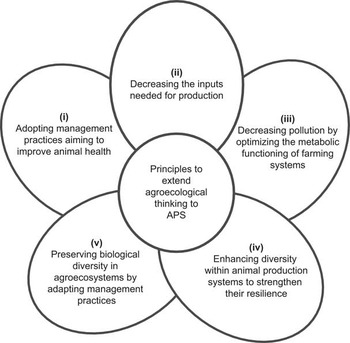
In a previous review (Dumont et al., Reference Dumont, Fortun-Lamothe, Jouven, Thomas and Tichit2013), we proposed five ecological principles to extend agroecological thinking to APS (Figure 1). The objective of this position paper is to identify key research issues to increase knowledge on the technical and organizational innovations that are needed to develop agroecology based on these principles. A multi-disciplinary team of seven scientists working on different APS was set up. They were asked to canvas their professional networks, consult widely among their colleagues over more than a year and to submit a list of priority research issues for which increased knowledge will put the animal sector in a better position to cope with the coming challenges. This effort enabled to propose the research design required to answer these issues. Some of the issues lead into possibilities for scientific breakthrough, whereas for others, of paramount importance that have already been partly studied, we have identified innovations that have not yet been investigated from an ecological principles perspective. Because APSs are closely inter-linked and inter-related with plant production systems (e.g. the role of exported soybean in the deforestation of Brazilian Amazon) and have global impacts (e.g. GHG emissions), we considered all biogeographical areas, despite their highly diverse environmental, socio-economic and policy contexts. APSs developed in the industrial ecology framework, as tackled in the review by Dumont et al. (Reference Dumont, Fortun-Lamothe, Jouven, Thomas and Tichit2013), are out of the scope of this paper and would require developing specific issues relative to recycling loops in food waste management, precision livestock farming and territorial metabolism. The final list of 40 issues was revised by six scientists with different backgrounds who carefully reviewed the paper, before it was presented to and debated in an inter-disciplinary panel of 50 INRA scientists specialized in animal physiology, genetics, animal health, farming system management, plant ecology and economics. The issues identified have been collapsed into four main themes defining the structure of this paper: (i) animal adaptive capacities, (ii) feed resources and forage systems, (iii) design and evaluation of new APS and (iv) rules for scaling-up agroecological APS.
Five ecological principles for the redesign of animal production systems (Dumont et al., Reference Dumont, Fortun-Lamothe, Jouven, Thomas and Tichit2013).

Exploiting animal adaptive capacities
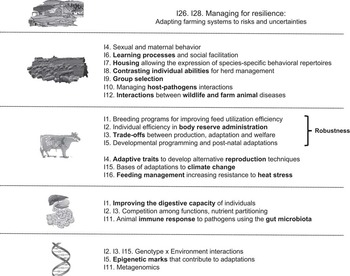
In the past 50 years, animal breeding programs have based selection on the improvement of target criteria (e.g. milk yield and average daily gain) in controlled environments. Despite improving productivity, this strategy has often proved detrimental to fitness traits such as reproduction, disease resistance (mastitis in dairy cows) and skeletal integrity (pigs and broiler chickens). Recent research calls for the restoration of fitness traits and the need to breed for robustness, that is, animal ability to survive, reproduce and maintain production in a wide variety of environmental conditions (Knap, Reference Knap2005). The main challenges of breeding for robustness are: (i) to identify sets of phenotypic criteria that are highly correlated with robustness and (ii) to consider genotype×environment interactions (G×E) in the prediction of breeding values. The aim is to promote individual adaptive capacities while considering more diverse target criteria. Figure 2 summarizes our proposal of core research issues to enhance and valorize the adaptive capacities of animals at different organizational levels.
Research issues to enhance and valorize adaptive capacities of animals at nested organizational levels from genome to organ, animal, herd and farm. Bold characters refer to key levels of investigation for each research issue.

Selecting individuals adapted to fluctuating feed availability and quality (in relation to principles i, ii and iv of Figure 1)
Agroecological APS aims to handle disturbance instead of merely enduring it, which means an important challenge is to adapt animals to fluctuating feed quantity and quality. It is predicted that climate change will decrease forage yield and, in some cases forage quality, in response to elevated CO2, warming or precipitation change (Milchunas et al., Reference Milchunas, Mosier, Morgan, LeCain, King and Nelson2005; Thornton et al., Reference Thornton, van de Steeg, Notenbaert and Herrero2009). Only very limited knowledge is available on the determinism of intra-specific variability in fiber digestibility in ruminants and pigs. A pioneer study has shown that the capacity of growing chicks to digest low-quality wheat is partially heritable and could be improved by selection (Mignon-Grasteau et al., Reference Mignon-Grasteau, Muley, Bastianelly, Gomez, Peron, Sellier, Milet, Besnard, Hallouis and Carré2004). Thus, a research priority is the development of breeding program for improving the digestive capacity of individuals (Issue 1: I1). Focus should be given to (i) rough feed that is not in competition with human food supply, (ii) anti-nutritional factors that affect N and energy digestion of legumes in ruminants, and leguminous seeds in all species and (iii) lower methane emission through the selection of associated traits such as residual feed intake (de Haas et al., Reference de Hass, Windig, Calus, Dijkstra, de Haan, Bannink and Veerkamp2011).
Efforts targeting adaptation to fluctuating feed availability should also lead to an analysis of individual efficiency in the body reserve mobilization-accretion process and its implications for breeding programs (I2). Individual efficiency is an indicator of metabolic plasticity (Blanc et al., Reference Blanc, Bocquier, Agabriel, D’hour and Chilliard2006), and its study entails following individual trajectories of quantifiable physiological parameters such as BW, body condition score, and plasma profiles of metabolites and metabolic hormones as potential physiological markers. We propose three research axes: (i) the identification of robust individuals in a range of breeds, herds and production systems, (ii) the analysis of underlying biological mechanisms by monitoring a complete set of biological indicators (and environmental factors) in robust individuals (and randomly chosen controls) throughout their productive life and (iii) the strategic use of these mechanisms in integrated breeding programs, which will require the development of a robustness index. G×E will be integrated to classify these mechanisms as generic or specific. Finally, focus should be given to the inheritance of mechanisms underlying compensatory growth, which remains unknown at this time.
Overall, breeding programs need to continue to look into balancing adaptive and production traits. This strategy has been implemented for dairy cows, with 40% to 45% of selection intensity dedicated to robustness traits such as fertility and udder health. Assessments of the importance of different parameters by experts from breeding organizations, researchers and groups of farmers will make it possible to develop breeding programs that deal with trade-offs between production, adaptation, and welfare at within-breed and between-breed level (I3). At the within-breed level, selection is facilitated when production and adaptive traits are either positively correlated or independent. Genetic correlations vary with performance levels and environment. For instance, the estimated genetic parameters for reproduction traits in organic and low-input dairy cattle herds are different from those estimated for high-input production systems (Yin et al., Reference Yin, Bapst, Borstel, Simianer and König2012). This underlines the need to implement organic breeding programs using estimates that are based on data obtained from cows in organic or low-input herds.
Adapting animals across production stages and generations (principles i, ii, iv)
The success of any APS is tightly linked to reproductive performance, and nutritional management plays a key role in achieving fertility targets. In dairy cows, simply adding more concentrate or reducing stocking rate will not result in improved fertility. Future research needs to identify specific micro- and macro-nutrients that can stimulate reproduction (Butler, Reference Butler2014). In addition, the use of exogenous hormones has meant that adaptive traits such as estrus expression have been neglected in industrial farming systems. These artificialized systems also attached less value to behavioral traits, for example, maternal behavior to ensure female autonomy at parturition (Canario et al., Reference Canario, Billon, Caritez, Bidanel and Laloë2009). A better understanding of the physiological and behavioral bases of reproductive traits is required to develop alternative techniques (I4) adapted to the environmental, economic and social characteristics of local breeding systems. Some of these alternatives are ready for transfer into practice, for example, the use of photoperiodic treatments to stimulate sexual activity, estrus synchronization with male effect, focused feeding at the time of gamete production or the maximization of offspring survival by selecting dams according to their temperament (Martin et al., Reference Martin, Milton, Davidson, Banchero Hunzicker, Lindsay and Blache2004; Delgadillo, Reference Delgadillo2011).
Farming practices in the fetal stage and early life affect behavior, response to stress, immunity and performance of adult animals, and there is some evidence of transmission to the next generation (Stevens et al., Reference Stevens, Begum, Cook, Connor, Rumball, Oliver, Challis, Bloomfield and White2010). In this sense, epigenetic marks reversibly or heritably present in the genome can contribute to animal robustness. A research priority would be to characterize key physiological mechanisms and epigenetic marks that contribute to individual adaptations in the fetal stage (dubbed ‘fetal programming’) and early life (I5). For instance, fetal nutrition plays a role in long-term lipid and glucose metabolism in dairy cows, and may have consequences for milk yield in adult cows (Bach, Reference Bach2012). A research axis will identify critical periods from early gestation to weaning that favor persistent adaptations. Another key step will be to identify these epigenetic marks and quantify their inheritance. Indeed, a pioneer study revealed the inheritance of acquired behavior adaptation to unpredictable food access in chickens that could be because of variations in chromatine structure (Nätt et al., Reference Nätt, Lindqvist, Stranneheim, Lundeberg, Torjesen and Jensen2009).
Throughout their life, animals have to adapt to changing feeding, social and housing conditions, which requires adequate learning capacities. The appropriation and inclusion of learning processes and related empirical skills into management practices (I6) is entirely relevant to an agroecological approach. One focus will be animal ability to self-medicate in rangeland-based systems for which clear-cut evidence is still missing (Villalba and Provenza, Reference Villalba and Provenza2007; Gradé et al., Reference Gradé, Tabuti and Van Damme2009). Inter-specific differences could be analyzed according to the ‘fight and flight’ theory against nematode infections, in which the two strategies regulating gastrointestinal infection (immune response v. behavior) are not mutually exclusive (Hoste et al., Reference Hoste, Sotiraki, Landau, Jackson and Beveridge2010). At the herd level, shepherds have developed management practices, allowing young animals to acquire plasticity in feeding choices and limiting stressful interactions with social peers or the farmer (Krätli, Reference Krätli2008). The next step is to quantify consequences on animal robustness and herd performance in non-equilibrium systems.
Animal adaptation may also be facilitated by redesigning housing and equipment to allow the expression of species-specific behavioral repertoires (I7), such as rooting or nest-building in pigs, and scratching or dustbathing in poultries. A recent study showed that hen dustbathing in natural dust materials (particularly kaolin) can suppress ectoparasites (Martin and Mullens, Reference Martin and Mullens2012) that offers opportunities for reducing the use of medication. Trained conspecifics are also important for facilitating the consumption of new feed pellets (Oostindjer et al., Reference Oostindjer, Bolhuis, Mendl, Held, van den Branda and Kempa2011) or the learning of self-feeding devices (Noble et al., Reference Noble, Flood and Tabata2012), but further studies are required to quantify the consequences on production efficiency.
New paradigms using individual variability for herd management (principles i, iv)
Inter-individual variability of responses is a key factor that affects herd sensitivity to fluctuating feed availability or changing environments. The concept of generalist and specialist is grounded in inter-individual or inter-breed variability of responses to environmental conditions, and different trade-offs between traits (Strandberg, Reference Strandberg2009). A generalist species, breed or individual can thrive in a wide variety of environmental conditions and make use of an extended range of resources. A specialist has high productivity but only in specific favorable environments. For instance, local breeds under extensive management are generalists as they can adapt to various environmental conditions, whereas highly productive breeds are specialists needing a controlled environment to express their genetic potential and be economically viable (Hoffmann, Reference Hoffmann2010). This concept is derived from niche theory in ecology, and is relevant to analyzing the consequences of contrasting individual abilities on herd or farm productivity responses to fluctuating environments (I8). It can also be used within-breed to account for phenotypic plasticity (Strandberg, Reference Strandberg2009). The varying proportion of generalists and specialists in a given herd can indeed be viewed as an insurance strategy against uncertainty.
In APS, much of the struggle for existence occurs among individuals of the same species. The genotype that gives the highest individual performance is not necessarily the one that gives the highest group performance because there might be a cost of competition within the group. The best-performing individuals may use resources to compete with others, and there are several examples of the deleterious consequences of such agonistic behaviors, for example, bites and feeding competition in pigs, and feather pecking in chicken. A change in paradigm will lead to consider the advantages of group selection to optimize group performance (I9). Pioneer work on a line of White Leghorn chickens reared in multiple hen cages and selected for rate of lay and longevity using a kin selection method resulted in lower cannibalism and flightiness without affecting productivity (Muir and Craig, Reference Muir and Craig1998). In ruminants, selection programs that account for animal temperament are likely to increase social tolerance and group performance.
Integrated management of animal health (principles i, iv)
Integrated approaches to animal health have been developed to prevent production diseases. The rationale is that diseases are closely linked to the way livestock are managed, particularly to parameters related to the quality of housing, nutrition, hygiene and to animal production level (Ducrot et al., Reference Ducrot, Bed’Hom, Beringue, Coulon, Fourichon, Guerin, Krebs, Rainard, Schwartz-Cornil, Torny, Vayssier-Taussat, Zientara, Zundel and Pineau2011). Agroecology opens perspectives for cautious management of animal health by increasing disease prevention and exploring alternative treatments (Dumont et al., Reference Dumont, Fortun-Lamothe, Jouven, Thomas and Tichit2013). First, it endorses applying the principles of evolutionary ecology and population genetics to the study of the relationships between farm animals and their pathogens (I10). This opens new fields of research into antibiotic and anthelmintic-resistance mechanisms, pathogen ecology, and the equilibrium between the microbiota and its host. Various aspects of farm management can be discussed in light of these principles: (i) the size and genetic structure of animal groups (e.g. for poultry, pigs and rabbits), and the way they are housed (e.g. systems allowing sick animals to isolate from their group), coupled with tools for the early detection of diseases that will limit the use of chemical drugs; (ii) better use (therapeutic indications, treatment duration, dose and route of administration) of antibiotics or anthelmintics to limit possibilities for pathogens to adapt and become resistant; and (iii) increased knowledge and experiences on co-farming several species on the same farm, and rotations to limit contact between each species and its specific pathogens (e.g. by clearing pastures of parasites with a non-susceptible species).
Developing an integrated approach to animal immune response to pathogens using the gut microbiota (I11) is another priority. The gut microbiota plays a key role in health by maintaining mucosal immune function, epithelial barrier integrity and motility, nutrient absorption and diversification of antibody repertoire. Disruption of this relationship (i.e. dysbiosis) increases susceptibility to disease. We propose (i) analysis of how gut microbiota diversity could affect animal health, and how cellular and molecular mechanisms of the gut microbiota can be mobilized to naturally stimulate host defenses and (ii) exploration of microbiota engineering to innovate new preventive approaches, especially in young animals. This hinges on identifying the dynamics of microbial community establishment, the time windows of permissiveness for microbiota plasticity, and its management through rearing practices (e.g. feeding, weaning and probiotics) and/or selection. Metagenomics, which is the description of the combined genomes of the microorganisms present in the gut (or other ecosystem), will be a powerful tool for these studies (Morgavi et al., Reference Morgavi, Kelly, Janssen and Attwood2013).
Farm animals have been studied as if they were bred independently from environmental conditions, including wildlife present in the environment. There is evidence of disease transmission (direct, indirect or vector-borne) from wildlife to farm animals, and vice versa, including bovine tuberculosis, swine fever, avian influenza, bluetongue and West Nile Virus (WNV). New research should analyze the consequences of wildlife-farm animal interactions from the standpoint of ecology and epidemiology (I12). A major challenge concerns vector-borne diseases, which require inter-disciplinary entomology, veterinary sciences and farming systems research. The lower incidence of human WNV in eastern US areas that have greater avian (viral host) diversity supports the growing view that protecting biodiversity should be considered in public health and safety plans (Swaddle and Calos, Reference Swaddle and Calos2008). In areas where vector-borne diseases are widespread, there is a need to reduce contact with livestock. The use of repellents and attractors to control diseases transmitted by ticks, mosquitoes or flies is a promising option (Hassanali et al., Reference Hassanali, Herren, Khan, Pickett and Woodcock2008).
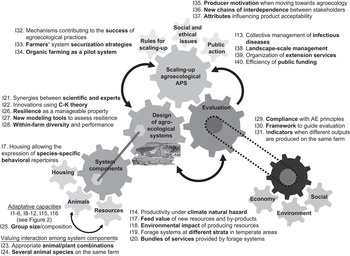
Sustainable farming hinges on controlling major infectious diseases that can spread farm to farm and through the farm industry sector. Public authorities (for regulated diseases) and farmer organizations have vast knowledge and experience of the epidemiology of major infectious diseases in their collective management. However, research needs to be conducted in the field of economics and sociology to find governance principles that would help find a better fit between individual v. collective farmers’ interests and short- v. long-term interests in the control of infectious diseases (I13; Figure 3).
Organization of inter-disciplinary research for the redesign of animal production systems.

Adaptation to climate change (principles i, ii)
Pastoral, grassland-based and rain-fed farming systems are being heavily exposed to climate change impacts, with an increase of inter-annual and seasonal variation in forage availability and risks on forage autonomy (Thornton et al., Reference Thornton, van de Steeg, Notenbaert and Herrero2009; Havet et al., Reference Havet, Coquil, Fiorelli, Gibon, Martel, Roche, Ryschawy, Schaller and Dedieu2014), changes in forage quality (e.g. water-soluble carbohydrates and N content in response to elevated CO2) and shifts in community structure that could impact forage digestibility in grazed pastures (Milchunas et al., Reference Milchunas, Mosier, Morgan, LeCain, King and Nelson2005). To tackle climate change, the priority is thus to minimize the variability of forage and crop productivity under climate natural hazard (I14). To support the choice of adequate cropping systems and management (e.g. genetic diversity, sowing date, stocking rate), numerical methods can be used to better define the boundaries of uncertainty, by coupling climate, crop and grassland models (Wheeler and Reynolds, Reference Wheeler and Reynolds2013).
Hot environments are also detrimental to production levels, animal health and reproductive performance (Nardone et al., Reference Nardone, Ronchi, Lacetera, Ranieri and Bernabucci2010). It is thus important to understand the physiological, genetic and epigenetic bases of animal adaptation to climate change (I15) to reduce its impact on production by choosing appropriate genotypes or acclimatizing animals to heat at a young age. First, a meta-analysis would be helpful to aggregate current knowledge and test the susceptibility of prominent livestock species and breeds to heat stress, as already done for pigs by Renaudeau et al. (Reference Renaudeau, Gourdine and St-Pierre2011). The individual variability of susceptibility will need to be quantified to evaluate potential selection response. Second, we need to measure the genetic correlations between adaptive traits (body size, body reserves and metabolic plasticity) and production traits across a range of performance levels to use them in breeding programs. Third, although we need to pursue the search for candidate genes potentially involved in climate change adaptations, genetic regulatory networks and epigenetic effects may also be particularly relevant. There is much to learn about the genetic architecture of adaptation to climate change (Franks and Hoffmann, Reference Franks and Hoffmann2012).
Advances have recently been made in management and feeding strategies to alleviate heat stress in pigs, poultry and cattle in tropical conditions (Renaudeau et al., Reference Renaudeau, Collin, Yahav, de Basilio, Gourdine and Collie2012). For instance, it was suggested that increasing nutrient density of the diet could maintain normal rumen function in dairy cows during heatwaves, when dietary protein degradability may become critical (West, Reference West2003). In this context, a challenge is to propose feeding management practices that increase animal resistance to heat stress without competing with human food (I16).
Feed resources and forage systems (principles ii, iv, v)
APS based on agroecological principles will integrate functions other than, exclusively, production. Indeed, the grasslands, grass-legume mixtures and rangelands used to feed animals can provide habitat and feed resources for auxiliary, pollinator or protected species, contribute to soil detoxification, produce (or contain) fertilizers, energy and medicinal compounds. We believe that current knowledge on the nutritional requirements of the main domestic animal species is probably sufficient, and hence we propose four complementary research issues.
Forages that are adapted to drought (e.g. lucerne, sainfoin, chicory and sorghum) or have stronger autumn or winter growth (e.g. summer-dormant grasses) should be evaluated for their agronomic management and feed value. Exploring alternative feed resources (e.g. algae, microorganisms and insects) and valorizing by-products associated with the production of biofuels or biomaterials (maize and wheat distiller grains with soluble shives or flax cake) are further options for input reduction. It is essential to estimate the nutritive value and intake of new feed resources and by-products, and to analyze their potential conditions of use and conservation as feed (I17) for different animal species.
There is also a need to press ahead with research to evaluate and compare environmental impacts tied to the production and use of conventional and new feed resources (I18). This is where life cycle assessment (LCA) is a valuable tool. The spectrum of feed types should be enlarged, and data should be geo-referenced to account for production area variability in cultural techniques and yields. The number of environmental criteria in the overall feed evaluation should also be increased to include, for instance, forage system impact on biodiversity. These two research issues will result in databases based on new frameworks, for example, multi-criteria evaluation, going further than traditional feed value tables, as already initiated by Feedipedia (http://www.feedipedia.org), a project to inventory world feed resources.
There are examples of small-scale diversified farming systems in tropical smallholder agriculture that are highly productive and even do better than those relying on agrochemicals (Tscharntke et al., Reference Tscharntke, Clough, Wanger, Jackson, Motzke, Perfecto, Vandermeer and Whitbread2012). For instance, high milk yields are achieved without chemical fertilizers in intensive silvopastoral systems (ISS) that combine legume fodder shrubs (e.g. Leucaena leucocephala) planted at high densities, improved pastures, and trees and palms that provide timber, fruit, green forage for livestock, and root and bark for medicinal uses (Murgueitio et al., Reference Murgueitio, Calle, Uribe, Calle and Solorio2011). ISS facilitate connectivity between tropical forest fragments and thus benefit biodiversity. Several observations in Central America have emphasized that enhancing plant diversity and complexity in farming systems could also reduce their vulnerability to extreme climatic events (Murgueitio et al., Reference Murgueitio, Calle, Uribe, Calle and Solorio2011; Altieri et al., Reference Altieri, Koohafkan and Nicholls2014). An important challenge will be the development of innovative forage systems that intercrop plant species at different strata in temperate areas (I19).
Mixing several plant species in innovative forage systems thus provides a diversity of not only food and feed resources but also regulating, supporting and cultural ecosystem services (Hassanali et al., Reference Hassanali, Herren, Khan, Pickett and Woodcock2008; Murgueitio et al., Reference Murgueitio, Calle, Uribe, Calle and Solorio2011). Studies on the management of forage-based systems have started to quantify these non-provisioning services, but usually one service at a time rather than in bundles of services. It is now needed to analyze the relationships among multiple ecosystem services provided by forage systems (I20). An integrated framework proposed by van Oudenhoven et al. (Reference van Oudehoven, Petz, Alkemade, Hein and de Groote2012) was able to assess the effect of agricultural practices and land management on ecosystem services in a dairy production area, which can improve our ability to manage forage systems and farmlands in a sustainable way.
Design and evaluation of APS
Principles for system design
Agroecological APS design must meet specific criteria (Figure 3). Its focus is on overall performance rather than unit performance, and the system is observed and assessed in a long-term perspective. Soil and climate conditions significantly affect yields because animals are tied to their physical environment. Agroecological APS acknowledge and value diversity, instead of merely enduring it, and use diversity in a programmed way to strengthen adaptive capacity and resilience (Altieri et al., Reference Altieri, Funes-Monzote and Petersen2012). They combine vertical and horizontal complexities. Vertical complexity derives from the dependency between nested levels of organization (e.g. animal and herd, plot, farm and landscape). Horizontal complexity is derived at a level where a network of interactions generates emergent properties at a higher level.
Dealing with these complexities requires a shift from a prescriptive and normative approach toward participatory approach to agroecological APS design. Managers’ experiences and knowledge are taken into account to capitalize on locally adapted know-how. An important approach is to promote synergies between scientific and expert knowledge to develop agroecological innovations (I21). Linkages between real-life scenarios and experimental testing are needed to foster the innovation process. Combining scientific evidence with incentives for rural know-how capitalization is expected to facilitate the integration of agroecological practices into the system (Murgueitio et al., Reference Murgueitio, Calle, Uribe, Calle and Solorio2011; González-García et al., Reference González-García, Gourdine, Alexandre, Archimède and Vaarst2012).
Antagonistic objectives can bring severe constraints to the design process as, in the context of available knowledge, there may be no solution to increase productivity without detriment to the system’s natural resource base. New design approaches borrowed from engineering disciplines, known as concept-knowledge (C-K) theory, can be used to tackle these situations (I22). C-K theory enables a design process that starts from a concept, that is, an unknown proposition (Hatchuel and Weil, Reference Hatchuel and Weil2009), as a starting point for a collective design process involving a wide range of stakeholders including farmers, consumers, citizens and scientists. C-K theory is finding its way into agroecological research to develop innovative ways of reconciling production and environmental objectives (Berthet et al., Reference Berthet, Bretagnolle and Segrestin2012).
Valuing interactions among system components (principles i, ii, iii, iv, v)
The term ‘diversified farming system’ designates farming systems in which practices support the development of agrobiodiversity and stimulate interactions and synergies among its plant and animal components (Kremen et al., Reference Kremen, Iles and Bacon2012). Biotechnical system composition, notably its level of diversification, determines the scale and direction of interactions, whereas particular site conditions (e.g. edapho-climatic context) influence system component complementarities, linkages and interdependencies. A research priority will be to evaluate the effects of plant and animal diversity and propose context-appropriate combinations of plant and animal productions (I23). A key challenge remains the management of manure collection, treatment, transport and/or storage to increase nutrient recycling while reducing pollution. The priority will be to reduce sanitary risks, as analyzed in the World Health Organization (2006) guideline for fish farming.
Combining several species on the same farm enables optimal use of feed and forage resources, decreases the parasite burden of each species and benefits biodiversity. The principle of these systems is the use of multiple spatial niches and, in aquaculture, asynchronicity of biological rhythms between species (Trabelsi et al., Reference Trabelsi, Gardeur, Teletchea and Fontaine2011) to minimize competition. This opens a wide range of possibilities that need to be explored, either experimentally or by modeling, to determine the species combinations, ratios and management strategies offering the greatest farm-scale production, health and environmental benefits (I24). However, mixing different species on the same farm can induce health hazards that also need to be evaluated; some infectious agents such as influenza viruses can adapt to different species and increase their virulence after recombination (Kuiken et al., Reference Kuiken, Holmes, McCauley, Rimmelzwaan, Williams and Grenfell2006).
Furthermore, there is a need for more research on the impact of group size and composition on production, health and welfare issues (I25) across species and across a wide range of farm intensification levels. Increasing herd size in grassland-based systems calls for a better understanding of which breeds might be better suited to large groups, which raises issues relative to social tolerance, ease of calving and maternal behavior. In large flocks of sheep in Australia, increasing group size impaired overall production as individual variability led to inefficiency (Lee et al., Reference Lee, Atkins and Sladek2009). Costs and benefits related to group size suggest a non-linear relationship that warrants more investigation. In aquaculture, variability in growth rates leads to agonistic behaviors, including cannibalism. Analyzing the interactions between fish strain behavior and environmental characteristics could help better control growth heterogeneity (Harrison et al., Reference Harrison, Bradley and Harris2005).
Managing for resilience: adapting APS to risk and uncertainties (principle iv)
Resilience is the capacity of a system to absorb disturbance and reorganize while undergoing change so as to retain the same function, structure, identity and feedback (Walker et al., Reference Walker, Holling, Carpenter and Kinzig2004). Resilient systems are sustainable in the face of major climate, sanitary and economic driving forces. There are several unresolved challenges involved in understanding whether resilience is a manageable property of APS (I26): (i) to assess the relative weights of biological and decisional processes involved in resilience; (ii) to identify diagnosis indicators and indicators for adaptive management, including the potential to share information and technology for more precise decision making (Robertson et al., Reference Robertson, Sawford, Daniel, Nelson and Stephen2010); (iii) to explore the operational character of early-warning indicators for anticipating critical thresholds (so-called tipping points; Scheffer et al., Reference Scheffer, Bascompte, Brock, Brovkin, Carpenter, Dakos, Held, van Nes, Rietkerk and Sugihara2009; Veraart et al., Reference Veraart, Faassen, Dakos, van Nes, Lurling and Scheffer2012); and (iv) to understand how farmers respond (i.e. which management strategies do they use) to overcome climatic events and biotic or abiotic stresses (Vanwindekens et al., Reference Vanwindekens, Stilmant and Baret2013).
In this framework, a methodological priority is the development of new modeling approaches and tools to assess resilience in APS (I27) and emerge robust management decisions avoiding irreversibility. Models based on viability and control theory, which have so far found few applications in agroecosystems (Tichit et al., Reference Tichit, Hubert, Doyen and Genin2004), can be tailored to explore adaptive management and its role in fostering system resilience (Deffuant and Gilbert, Reference Deffuant and Gilbert2011).
The resilience of agroecosystems is intimately linked to their level of diversification in terms of management practices and plant and animal species (Altieri et al., Reference Altieri, Koohafkan and Nicholls2014). Managing different species or breeds with contrasting adaptive capacities within the same herd offers an efficient lever to buffer the effects of extreme climate events on herd productivity and farm income (Tichit et al., Reference Tichit, Hubert, Doyen and Genin2004 and Reference Tichit, Puillet, Sabatier and Teillard2011). This so-called portfolio effect has also been reported in plant assemblages and at forage system level (Andrieu et al., Reference Andrieu, Poix, Josien and Duru2007). However, these studies were so far restricted to either animal or resource components; the next step is to combine the two to identify which level of within-farm diversity could be deployed to benefit several farm performance criteria (I28). Furthermore, the desirable diversity level needs to be balanced with farm constraints (e.g. labor, feeding resources, housing), production chain (e.g. a standard carcass for slaughtering animals) and market constraints. A deeper understanding of the benefits of within-farm diversity will require farm-scale experimentation over several years and farm-observatory networks.
Evaluation of agroecological APS
The five principles proposed by Dumont et al. (Reference Dumont, Fortun-Lamothe, Jouven, Thomas and Tichit2013) for the design of agroecological APS can be used to set up a multi-criteria evaluation that qualifies level of system compliance with agroecological principles (I29). This approach focuses on the joint evaluation of environmental impacts and production outputs. It requires subdividing each principle into a limited set of criteria that need to be crossed with key parameters in the system to identify practice-based indicators. It goes beyond the farm scale, by considering flows toward the atmosphere and surface water. This work is in progress for dairy mountain systems (Botreau et al., Reference Botreau, Farruggia, Martin, Pomiès and Dumont2014), but could extend to all types of APS.
Beyond multi-criteria evaluation, there is a need for a framework to guide the evaluation process (I30), which should be geared to different systems, scales and stakeholders. Some work based on LCA has already been initiated for analyzing the multi-criteria optimization of feeding practices, for example, in beef and dairy systems, while considering several types of products in the same system (Nguyen et al., Reference Nguyen, Van der Werf, Eugene, Veysset, Devun, Chesneau and Doreau2012 and Reference Nguyen, Doreau, Corson, Eugene, Delaby, Chesneau, Gallard and van der Werf2013). General principles and specific methods are currently being developed to include a biodiversity impact through land-use changes in LCAs (Curran et al., Reference Curran, de Baan, De Schryver, van Zelm, Hellweg, Koellner, Sonnemann and Huijbregts2011). Accounting for the subsidies rewarding environmental-friendly practices is another recent development of LCA (Nguyen et al., Reference Nguyen, Van der Werf, Eugene, Veysset, Devun, Chesneau and Doreau2012; Ripoll-Bosch et al., Reference Ripoll-Bosch, de Boer, Bernues and Vellinga2013). Although LCA looks to be emerging into the major holistic framework for assessing APS sustainability, alternative methods have been developed (Lopez-Ridaura et al., Reference Lopez-Ridaura, van Keulen, van Ittersum and Leffelaar2005; Reig-Martinez et al., Reference Reig-Martinez, Gomez-Limon and Picazo-Tadeo2011). However, all these methods carry limitations, notably in transition phases and when sustainability depends on the spatial and organizational arrangement of neighboring farms. Landscape observatories can be combined with modeling to test hypotheses and explore scenarios. Recent work calls for a model co-construction process called companion modeling, where models are developed in partnership with stakeholders (Souchère et al., Reference Souchère, Millair, Echeverria, Bousquet, Le Page and Etienne2010). The process empowers stakeholder awareness of multi-scale issues and practice interdependency, and thus their ability to develop adaptive management strategies.
Regardless of the evaluation method, it requires defining a set of qualitative or quantitative indicators. The ultimate goal is to arrive at a desirable range of values for this set of indicators that define the limits within which the system should be maintained in the long term to perform its multiple functions. A key research topic is the selection of indicators and their expression unit when different outputs are produced on the same farm (I31). Indicators should reflect this diversity. The numerator could cover general figures and refer to human needs, such as protein or energy rather than animal performance criterion; the denominator could refer to the most limiting resource, for example, farmland, labor or water, rather than animal number.
Scaling-up agroecological APS
Important rules for scale up
For the design of agroecological APS, it is essential to account for the ecology of contexts (Bland and Bell, Reference Bland and Bell2007), that is, the dynamic interplay of economic, social and agroecological constraints defining any agroecosystem. By providing an epistemological device for analyzing agroecosystems, it invites researchers and stakeholders to keep in mind that agroecological principles matter more than elementary practices; the principles are needed to extract knowledge from elementary practices. A key research issue is thus to analyze mechanisms contributing to the success or failure of agroecological practices or systems (I32). For instance, the analysis of underlying mechanisms involved in grazing management (i.e. relationships between stocking rate and sward heterogeneity, animal selectivity) can explain the success or failure of grazing practices aiming to combine production and biodiversity conservation (Scohier et al., Reference Scohier, Ouin, Farruggia and Dumont2013). In addition, the ecological rationale of traditional small-scale systems needs to be analyzed to understand the mechanisms contributing to their success. This makes it essential to conduct farm-scale trials or observations over wide gradients of environmental conditions and socio-economic contexts.
Another key issue is tied to risk-spreading strategy. In agroecological APS, the higher dependency of production on climatic hazard and farmer skills will replace the market-based risks (external input dependency) governing conventional systems. As uncertainties will become part of the operational agroecology context, there is a strong need to better understand farmers’ system securization strategies (I33). As agroecological APSs have different security options to conventional systems, it is vital to measure the extent and impact of a switch from external inputs to ecosystem services (Bommarco et al., Reference Bommarco, Kleijn and Potts2013) in a large range of APS.
Several authors consider that conversion to organic farming offers a mirror to the larger transitions in agriculture (Lamine and Bellon, Reference Lamine and Bellon2009). It offers a valuable platform for simulating what could happen in a context of increasing input costs. Organic farming can be considered as a pilot system to identify what could be done to catalyze the transition to agroecological APS (I34). To meet a market demand larger than that of organic production, the transition toward agroecological APS will also demand transformations in farmers’ marketing strategies, in their representations, values and links to various social networks.
Dealing with social and ethical issues
Industrial APS are vigorously criticized as being unsustainable in terms of resource and antibiotic use as well as in terms of animal welfare and ethics. Agroecology practices offer a potential to deal with some of these issues. Their dissemination will be facilitated if innovations have been co-designed by all stakeholders (land-owners, legislators, producers, consumers and NGOs involved in nature conservation) from the start of the process. A first priority is to analyze producer motivation when moving toward agroecological APS (I35), for example, to gain decisional autonomy and break input dependency. This also requires a deeper understanding of the resistance to change by farmers in a variety of contexts. For instance, breeding programs in the tropics benefited from farmers being involved at every stage of the process, and from the integration of their traditional practices and values (Kosgey et al., Reference Kosgey, Baker, Udo and Van Arendonk2006).
Agroecological systems are knowledge-intensive, making appropriation a challenging issue in qualitative terms (nature of labor, skills and expertise). Their development may therefore favor new chains of interdependence among stakeholders that need to be better understood (I36). For instance, the dissemination in Kenya of the push-pull technology operates through farmer-teachers working as village extension staff. Women’s groups establish legume monocultures for seed production, which improves gender equality and family cohesiveness (Hassanali et al., Reference Hassanali, Herren, Khan, Pickett and Woodcock2008). At the other end of the product chain, APS could benefit from short and specific channels, with strong links between food production and local communities (Rosset and Martínez-Torres, Reference Rosset and Martínez-Torres2012), such as direct sales in farmers’ markets, regular basket schemes, ecological meal initiatives in canteens and community gardens. In these networks, economic relations are more than just market relations. They include considerations such as partnerships among producers, social justice or solidarity between producers and consumers, and consumer trust of food.
Finally, there is a need to identify which attributes of agroecological products and APS will influence their dissemination (I37): price, origin, environmental impacts, organoleptic and nutritional quality, traceability and animal welfare in contrasting socio-economic contexts. It will be useful to investigate consumer willingness to purchase meat, milk and eggs produced with practices improving animal welfare and to pay more for these products. Certifications and market-based incentives could be an important lever for the expansion of agroecological APS. They would add value to the products by acknowledging the value of biodiversity-friendly practices (Cavrois, Reference Cavrois2009). However, some eco-labels are vague, unverified and unverifiable (Treves and Jones, Reference Treves and Jones2010), and may mistakenly claim that a product, good or service offers an environmental benefit (Kremen et al., Reference Kremen, Iles and Bacon2012). We will thus need to determine the circumstances under which eco-labels constitute an efficient lever for developing agroecological APS.
Public action levers
Important aspects for the large-scale development of agroecological alternatives for APS need to be analyzed at the landscape scale. Land-use diversity could benefit farm income and ecosystem services, as highlighted in a recent empirical study showing that landscapes with a high level of diversity can ensure resilient agricultural returns in the face of uncertain market and climatic conditions (Abson et al., Reference Abson, Fraser and Benton2013). Studies that emphasize the positive influence of landscape heterogeneity for biodiversity suggest that this action lever requires rethinking the scale of application of agricultural policies and favors collective management based on coordination among farmers (Sabatier et al., Reference Sabatier, Doyen and Tichit2014). The application of landscape-scale management demands organizational innovation and facilitation mechanisms that have to be invented (I38). We need to know what type of ownership or combination of ownership types (e.g. cooperatives, companies, communal institutions and absentee businesses) may be the most supportive of these systems. The patterns may be country dependent.
Agroecology requires a high degree of collective actions, notably in its larger definition that extends the room for reflection up to the food system (Francis et al., Reference Francis, Lieblein, Gliessman, Breland, Creamer, Harwood, Salomonsson, Helenius, Rickerl, Salvador, Wiedenhoeft, Simmons, Allen, Altieri, Flora and Poincelot2003). This collective dimension questions the way extension services are currently organized and whether this organization effectively helps scale up agroecological practices and systems (I39). As reported by Rosset et al. (Reference Rosset, Machín Sosa, Roque Jaime and Ávila Lozano2011), conventional top-down agricultural research and extension services have shown a negligible ability to develop and achieve broad adoption of agroecological practices, whereas rural social movements had significant success. We must also acknowledge the role of education (including schools) in the promotion of agroecological APS, and the role of media that can rapidly spread knowledge about environmental-friendly practices and give a positive image of the farmers that adopt them.
Although there is considerable potential for private markets in payment for ecosystem services, experience shows that public funding remains essential for public and quasi-public goods such as biodiversity and ecosystem services, particularly at national and global scales. We need to determine the circumstances under which public funding is efficient for scaling-up agroecological APS (I40). For instance, success in the adoption of ISS systems in Colombia is partly the result of a new rural capitalization incentive to promote the planting of fodder trees and select local species for their contribution to biodiversity into connectivity corridors (Murgueitio et al., Reference Murgueitio, Calle, Uribe, Calle and Solorio2011). The incentive is not farm size or capital dependent but available to all farmers. The promotion of agroecological APS will also demand significant investments in research and development, extension services, infrastructure and low-risk credits (Farley et al., Reference Farley, Schmitt, Alvez and Ribeiro de Freitas2012). Their scale up will only occur if these systems are supported by mainstream trade and sound agricultural policies.
Conclusion
The redesign of APS using agroecology principles will demand a whole set of innovations targeting the different components of the farm and the food chain, from farmers to consumers. The agroecological transition will involve deep changes and more dynamic and integrative perceptions of each system component and their interactions. We showed that a vast research agenda is opened for the animal science community, with three crucial challenges. First, it will demand a paradigm shift for scientific disciplines. While previous works has long been developed within the control paradigm where system management aims to avoid disturbances the coming challenges will lead to the design of APS with the robustness and resilience needed to readily handle disturbances. Second, it should be developed by increasing inter-disciplinary research among animal scientists, ecologists, economists and sociologists. Third, it calls for a new approach for the whole research development innovation chain to bridge the gap between science and practice. We foresee the need to create initiatives at local, regional, national and/or international levels to accelerate the uptake of innovation, and the scale up of agroecology. These initiatives should enroll farmers, scientists, advisers, NGOs and/or enterprises in participatory effort to reach common objectives. The recently launched European Innovation Partnerships on Agricultural Sustainability and Productivity and the FAO’s Global Agenda of Action (http://www.livestockdialogue.org/) are current examples.
Acknowledgments
We are grateful to S. Bellon, M. Bonnet, P. Chemineau, B. Dedieu, M. Jouven, D. Magda and M. Tixier-Boichard for helpful comments on the manuscript.