I. INTRODUCTION
Magnesium alloys that are considered to be the lightest metallic structural materials have attracted increasing interest in automotive and aerospace applications due to their excellent properties, such as low density, high specific strength, high damping capacity, and good recycle ability.Reference Rokhlin1,Reference Mordike and Ebert2 However, poor ductility and limited elevated temperature strength of Mg alloys are retarding their applications. Therefore, it takes great efforts to improve the strength, and grain refinement is one of the important methods.Reference Li, Zhou and Li3 Recently, thermomechanical processing, such as extrusion, rolling, and forging, have been successfully used to refine coarse microstructure and consequently enhance mechanical properties of magnesium alloys.Reference Lin, Chen and Liu4–Reference Homma, Kunito and Kamado6 Thus, wrought magnesium alloys possess higher strength and toughness than those of cast forms. Up to now, most investigations performed on rolling have been conducted on Mg–Al series alloy sheets because of their excellent castability and good balance of room temperature strength, ductility, and corrosion resistance. But the obviously decreased strength at elevated temperatures limits their service temperatures. Generally speaking, the addition of rare earth (RE) elements in Mg alloys can bring about high strength especially at elevated temperatures.Reference Liu and Meng7,Reference Zhang, Leng, Liu, Li, Zhang and Wu8 So, it is worthwhile to investigate the microstructures and mechanical properties of Mg–RE (rare elements) alloy systems. The most successful Mg–RE alloys developed to date have been those based on the Mg–Y–Nd system, such as WE54 (Mg-5.1wt%Y-3.3wt%RE-0.5wt%Zr) and WE43 (Mg-4.0wt%Y-3.3wt%RE-0.5wt%Zr).Reference Nie and Muddle9 Wu et al.Reference Wu and Xia10 and Wang et al.Reference Wang, Xing, Hou, Wu, Sun and Wang11 have investigated the microstructure of the as-cast Mg–Y–Nd-based alloy. A four-stage precipitation sequence of Mg–Y–Nd alloys was proposed by Nie and MuddleReference Nie and Muddle9 and Antion et al.Reference Antion, Donnadieu, Perrard, Deschamps, Tassin and Pisch12: α-Mg supersaturated solid solution → metastable β′′ (DO19) → metastable β′ (cbco) → metastable β1 (fcc) → stable β (fcc). In addition, the fracture behavior of the Mg–Y–Nd-based alloy in different T6 conditions is well understood.Reference Fu, Peng, Jiang, Zhang and Zhai13 Besides, Mohri et al.Reference Mohri, Mabuchi, Satio and Nakamura14 have reported that the extruded Mg–Y–Nd alloy exhibited superior mechanical properties under peak-aged condition. However, there is little work that has dealt with the rolled Mg–Y–Nd system. In the present work, the Mg–4Y–2.5Nd–0.6Zr alloy was prepared and hot-rolled. The microstructures and mechanical properties of the as-cast, as-rolled, and rolled-T5 samples were investigated.
II. EXPERIMENTAL
An alloy of nominal chemical composition Mg–4Y–2.5Nd–0.6Zr (wt%) was prepared from high purity Mg (>99.95%), the Mg–30Y (wt%), Mg–30Nd (wt%), and Mg–25Zr (wt%) master alloys in an electric resistance furnace under a mixed atmosphere of CO2 and SF6 with the ratio of 100:1 and then cast into a steel mold, which had been preheated to 200 °C. The size of the ingot was 20 mm thickness, 100 mm width, and 200 mm length. The chemical composition of the studied alloy was determined by inductively coupled plasma atomic emission spectroscopy and the results were listed in Table I. The as-cast sample was homogenized at 515 °C for 4 h followed by hot water quenching and then rolled at 450 °C to the thickness of 6 mm. The total thickness reduction was about 70%, and the reduction per pass was <10%. The sheets were heat-treated at 450 °C between passes to stabilize the rolling temperature. Some rolled sheets were directly aged at 250 °C to investigate the age-hardening behaviors. The hardness of the aged sample was measured by a Vickers microhardness tester (HVS-1000, Shanghai MicroCre Light-Machine Tech CO., Ltd., Shanghai, China) with a loading force of 4.9 N and a holding time of 15 s.
Chemical composition (wt%) of the Mg–4Y–2.5Nd–0.6Zr alloy.

Tensile specimens were punched from the sheets along the rolling direction with dimensions of 4 mm width, 2 mm thickness, and 20 mm gauge length by an electric-sparking wire-cutting machine. Room temperature tensile testing was carried out on a CSS-41000 machine with a rate of 2.0 mm/min. Elevated temperature tensile tests were performed on an INSTRON-8032 tensile machine with a rate of 1.0 mm/min. Test temperatures were selected at 100, 200, and 300 °C, respectively. The specimens required 0.5 h to equilibrate at the testing temperature before tensile tests at elevated temperatures. At least three tensile tests were performed to ensure repeatability and accuracy of the data. The microstructures of all samples were observed by an optical microscope (LEICA MEF4M, Leica Microsystems GmbH, Wetzlar, Germany), a scanning electron microscope (SEM, FEI SIRION 200, FEI Company, Eindhoven, Netherlands) with energy dispersive x-ray spectroscopy (EDS; Gensis60, FEI Company, Eindhoven, Netherlands) using a standard-less approach, and a transmission electron microscopy (TEM, TecnaiG220, FEI Company, Eindhoven, Netherlands). The specimens were polished mechanically and chemically etched in a solution of 3 mL acetic acid + 10 mL water + 10 mL ethanol for 10–20 s. Phase analyses were performed with a D/MAS-ⅢA x-ray diffractometer (XRD; Rigaku Corporation, Tokyo, Japan).
III. RESULTS AND DISCUSSION
A. Microstructure
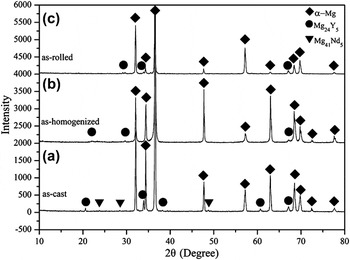
Figure 1 shows x-ray diffraction patterns of as-cast, as-homogenized, and as-rolled samples. It is noted that the as-cast sample is mainly composed of α-Mg, Mg41Nd5, and Mg24Y5 phases [Fig. 1(a)]. After homogenization treatment at 515 °C for 4 h, the diffraction peaks for the Mg41Nd5 phase are disappeared [Fig. 1(b)]. It is clearly confirmed that the Mg41Nd5 phase completely dissolves into the matrix, while the diffraction peaks of the Mg24Y5 phase still exist in the as-homogenized sample. Phase compositions of the as-rolled sample are identical to those of the as-homogenized one [Fig. 1(c)]. The Mg24Y5 phase can be detected in the as-rolled sample due to its good thermal stability.Reference Wu and Xia10
X-ray diffraction patterns of the Mg–4Y–2.5Nd–0.6Zr alloy: (a) as-cast, (b) as-homogenized, and (c) as-rolled.

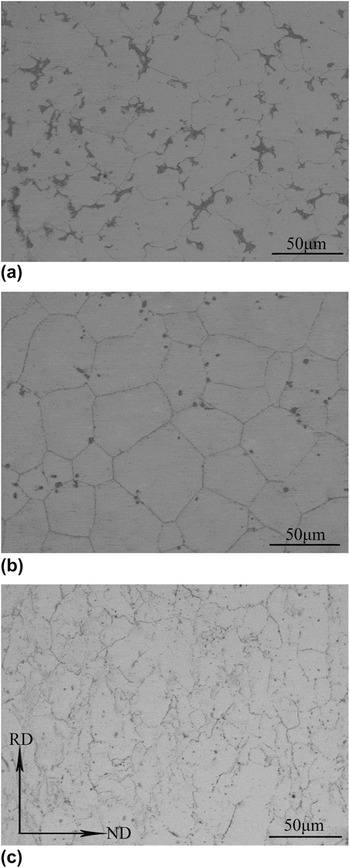
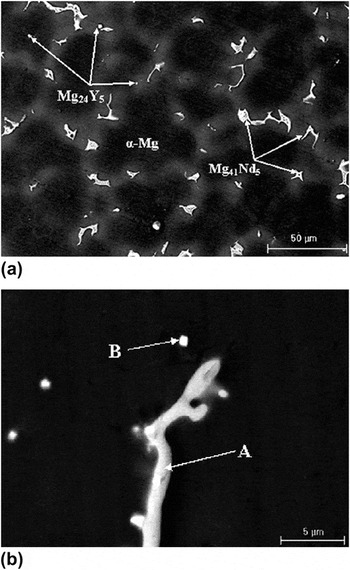
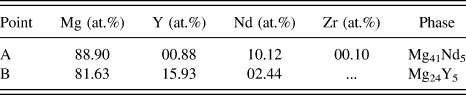
Optical micrograph of the as-cast sample is presented in Fig. 2(a). As can be seen, it has the equiaxed structure and the average grain size is about 40 μm. In addition, it is mainly composed of the α-Mg matrix, network-like phase, and cuboid-shaped particle [Fig. 2(a)]. These phases can be also observed in the SEM image shown in Fig. 3(b) in which A and B are labeled for the network-like phase and cuboid-shaped particles, respectively. Quantitative EDS analysis indicates that the atomic ratio of Mg–Nd at the position of A is approximately 41:5 (88.90/10.12), suggesting a stoichiometry of Mg41Nd5 and that of Mg–Y at the position of B is approximately 24:5 (81.63/15.93), suggesting a stoichiometry of Mg24Y5, respectively (as shown in Table II). Combining this analysis with the XRD results [Fig. 1(a)], it demonstrates that the network-like phase is the Mg41Nd5 phase and the cuboid-shaped particles are the Mg24Y5 phase. Similar result was also reported in the previous work.Reference Wu and Xia10 Although Wang et al.Reference Wang, Xing, Hou, Wu, Sun and Wang11 reported that the phase constitution of the as-cast Mg–Y–Nd alloy contains the β-phase. The β-phase does not appear in the present work, which might be attributed to the different solidification rates caused by different casting molds.
Optical microstructures of the Mg–4Y–2.5Nd–0.6Zr alloy: (a) as-cast, (b) as-homogenized, and (c) as-rolled.

SEM image and EDS spectra of the as-cast Mg–4Y–2.5Nd–0.6Zr alloy: (a) SEM image in low magnified case and (b) SEM image in high magnified case.

EDS results of the as-cast Mg–4Y–2.5Nd–0.6Zr alloy.
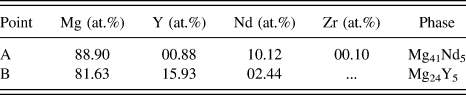
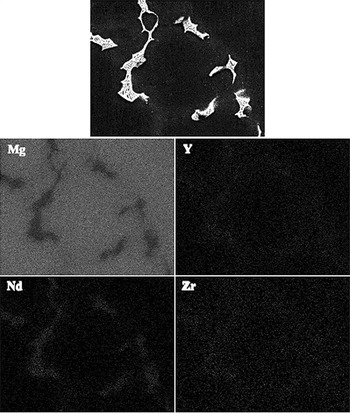
Figure 4 demonstrates the map scanning trace for the elements of Mg, Y, Nd, and Zr in the as-cast Mg–4Y–2.5Nd–0.6Zr sample. It can be seen that element Y evenly distributes in the as-cast sample, but element Nd mainly segregates in the eutectic compound. Due to nonequilibrium solidification, yttrium with a larger solubility (the maximum solubility of Y in Mg is 12.6 wt%)Reference Rokhlin1 has a small amount of precipitate phases, which forms the cuboid-shaped compounds Mg24Y5, whereas most of neodymium forms eutectic Mg41Nd5 because of a relatively low solubility (the maximum solubility of Nd in Mg is 3.6 wt%).Reference Rokhlin1
Elemental distribution of as-cast Mg–4Y–2.5Nd–0.6Zr alloy.

Figure 2(b) demonstrates the optical micrograph of the as-homogenized sample. After homogenization treatment at 515 °C for 4 h, on the one hand, there is little variation for the average grain size. The addition of Zr results in a significant grain refinement of the as-cast Mg alloy. However, it cannot restrict the grain growth during homogenization treatment.Reference Fang, Yi, Nie, Zhang, Wang and Xiao15 Therefore, It is suggested that the addition of RE elements plays an important role in preventing the grain growth during solution treatment. On the other hand, it can be seen that grain boundaries are clear, and only a few black cuboid-shaped particles remained. Based on the XRD result [Fig. 1(b)], the cuboid-shaped particles could be identified as the Mg24Y5 phase. These thermally stable phases with about 1–2 μm are formed during solidification and hardly dissolved into matrix during solution and aging treatment.Reference Xin, Li, Zeng, Song and Liu16
The optical micrograph of the as-rolled sample is showed in Fig. 2(c). A fine equiaxed microstructure with an average grain size of about 15 μm has been formed. Compared with those of the as-cast specimen, the grain size refines greatly. It is clearly that dynamic recrystallization (DRX) and static recrystallization (SRX) took place during the rolling processing. In addition, the secondary phase particles Mg24Y5 locate at both grain boundaries and matrix. The thermally stable intermetallic compounds with high melting point can pin the grain boundaries and prevent the growth of the recrystallized grains during hot rolling. Similar conclusions were achieved during hot deformation, such as 14 H long-period ordered structure for Mg–Gd–Zn alloys,Reference Yamasaki, Anan, Yoshimoto and Kawamura17 Al11RE3 for Mg–Al–RE alloys,Reference Wang, Dong, Wang, Wu and Wang18 and Mg12ZnY for Mg–Zn–Y alloys.Reference Itoi, Seimiya, Kawamura and Hirohashi19
B. Age-hardening behavior
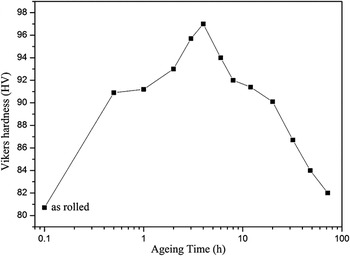
Figure 5 shows the age-hardening behavior of the as-rolled sample at 250 °C. It is observed that the hardness increases rapidly at the beginning of ageing and it reaches 91 HV after 0.5 h, 10 HV higher than that of the sample in the as-rolled condition. Then it rises gradually to the peak hardness of 97 HV, which is obtained at 4 h. Further ageing leads to a slow decrease in the hardness.
Age-hardening curve of the as-rolled Mg–4Y–2.5Nd–0.6Zr alloy at 250 °C.

It is suggested that the nucleation and the growth of precipitates are associated with the dislocations, which are introduced by hot deformation.Reference Anyanwu, Kamado and Kojima20 But the strain hardening has a little contribution at the stage of peak ageing, whereas the hardening effects are mainly ascribed to the precipitates, which form from the supersaturated matrix during the ageing process, especially under the peak-aged condition.Reference Liu, Zhang, Sun, Qiu, Lu, Tang, Rokhlin, Elkin and Meng21
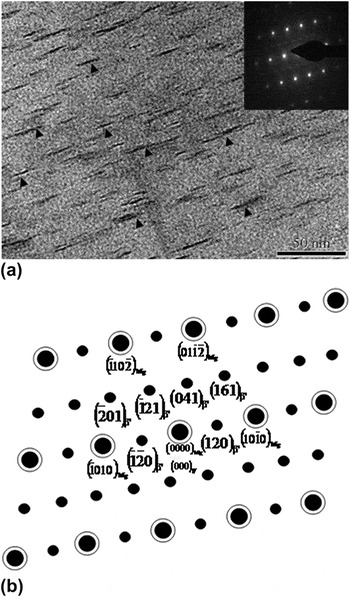
Figure 6 shows the TEM bright field image and the corresponding selected area electron diffraction (SAED) pattern of the peak-aged sample. A great number of plate-shaped precipitates are observed, which are distributed densely and uniformly throughout the matrix, as shown in Fig. 6(a). Based on the previous resultsReference Nie and Muddle9,Reference Antion, Donnadieu, Perrard, Deschamps, Tassin and Pisch12 and the extra spots marked “•” observed in the SAED pattern [Fig. 6(b)], these precipitates are identified to be the β′-phase. The metastable phase has been determined to have a composition of Mg12NdY and a base-centered orthorhombic bravais lattice, with lattice parameters a = 0.640 nm, b = 2.223 nm, and c = 0.521 nm.Reference Antion, Donnadieu, Perrard, Deschamps, Tassin and Pisch12Figure 6(b) schematically shows the indexing of the diffraction pattern [the inset of Fig. 6(a)] and it can be derived that the orientation relationship between β′ and matrix is  $(120)_{{\rm{\beta '}}} //(10\bar 10)_{{\rm{Mg}}}$,
 $[2\bar 14]_{{\rm{\beta '}}} //[\bar 24\bar 23]_{{\rm{Mg}}}$.
(a) TEM bright field image and corresponding SAED (B [2423]Mg) pattern of the peak-aged Mg–4Y–2.5Nd–0.6Zr alloy and (b) schematic diagram illustrating the indexing of the SAED pattern.

This phase plays an important role in the age-hardening response of the alloy during ageing at 250 °C. Moreover, the β′ precipitate as the main secondary strengthening phase in Mg–RE (RE standing for Gd, Y, or Nd) alloys is responsible for the peak hardness.Reference Liu, Zhang, Sun, Qiu, Lu, Tang, Rokhlin, Elkin and Meng21,Reference Gao, He, Zeng, Peng, Ding and Nie22 Under the peak-aged condition, the microstructure contains predominantly β′ precipitates. This is different from that of the WE54 alloy that contains predominantly a mixture of β′ and β1-phase.Reference Nie and Muddle9 No evidence was found the presence of the β1-phase in the present alloy. This is due to the fact that the studied alloy contains lower Y and Nd contents compared with the WE54 alloy. In addition, the β′ precipitates formed in the present alloy have a plate shape on  $\{ 10\bar 10\} {\rm{\alpha }}$ habit plane, which is inconsistent with the globular form of
 $\{ 11\bar 20\} {\rm{\alpha }}$ habit plane reported in other WE alloysReference Nie and Muddle9 because of different formation modes of the β′ precipitates.Reference Antion, Donnadieu, Perrard, Deschamps, Tassin and Pisch12
C. Mechanical properties
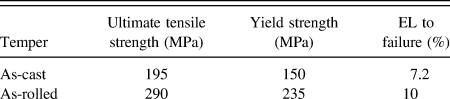
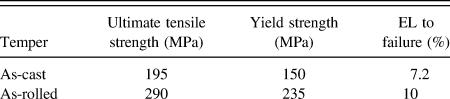
Room temperature tensile properties of the Mg–4Y–2.5Nd–0.6Zr alloy under different conditions are listed in Table III. Compared with those of the as-cast specimen, ultimate tensile strength (UTS) and yield strength (YS) of the as-rolled specimen increase obviously by about 95 and 85 MPa, respectively. Meanwhile, elongation (EL) slightly enhances from 7.2% to 10%. The improvement of mechanical properties can be ascribed to the following two reasons. First, after hot rolling, the grain size is greatly reduced from 40 μm for the as-cast sample to 15 μm for the as-rolled sample. It indicates that the grain size is obviously refined by DRX and SRX. According to the Hall–Petch relationship, the yield stress depends on the grain size and follows the principleReference Mabuchi and Higashi23:
 $$\Delta {\rm{\sigma }}_{{\rm{GS}}} = Kd^{ - {\rm{1/2}}} \quad,$$
where ΔσGS is the increase in yield stress due to grain refinement, K is the constant, and d is the grain size. The constant K in Mg alloys can reach very high value (280–320 MPa μm−1/2).Reference Yang, Li, Guo, Liu, Xia, Zeng and Liang24 Hence, the refined grains lead to a great increment in the mechanical properties. Second, yttrium has a low diffusion rate in Mg matrix and helps to form thermally stable compounds Mg24Y5 with a high melting point. Dislocation movement and grain boundary sliding are effectively prohibited by the thermally stable compounds Mg24Y5, which can strengthen grain boundaries, instead of RE-free intermetallic phases, such as MgZn and Mg17Al12.Reference Wu and Xia10 Therefore, the improvement of mechanical properties is mainly due to the grain refinement and the formation of Mg24Y5 phases.
Tensile properties of as-cast, as-rolled, and rolled-T5 Mg–4Y–2.5Nd–0.6Zr alloys at room temperature.
Note:
rolled-T5, peak-aged at 250 °C.
Under the condition of rolling followed with ageing treatment, the rolled-T5 specimen exhibits excellent mechanical properties with the UTS of 312 MPa, YS of 252 MPa, and EL of 4.5%. This is due to a precipitation of the β′-phase occurred during the ageing process. These metastable phases have been described as forming on the prismatic planes of the matrix in a dense triangular arrangement, and these prismatic precipitate plates have been suggested to play an important role in strengthening by providing effective barriers to gliding dislocations.Reference Nie25 Meanwhile, the size, number density, and volume fraction of precipitates are also recognized as important factors in determining the strength of alloy.Reference He, Zeng, Peng, Gao, Nie and Ding26 Abe et al.Reference Abe, Kawamura, Hayashi and Inoue27 have pointed out that the hot deformation process can produce an accumulation of dislocations (this is confirmed by DRX). Moreover, dislocation provides heterogeneous nucleation sites for transitions and/or precipitates.Reference Nie25 Therefore, such precipitates with a high density and volume fraction can be obtained by hot rolling as shown in Fig. 6(a). In summary, the rolled-T5 specimen containing fine evenly oriented (the planes parallel to the prismatic planes of Mg matrix) and uniformly distributed β′ precipitates with adequate volume fraction can exhibit a very high strength.
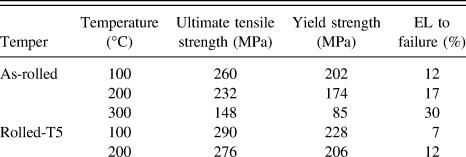
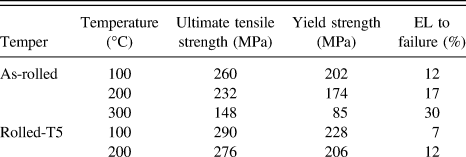
Table IV lists the data of tensile properties of the studied alloys at elevated temperatures. For the two samples, the YS and UTS decrease slowly, and the EL increases gradually from room temperature to 200 °C. Further increasing the temperature up to 300 °C, the tensile strength values decrease rapidly, however, the ELs of these samples have a strong increase. The temperature dependencies of the mechanical properties can be explained as follows. First, as the temperature increases, the critical resolved shear stress for a nonbasal slip system decreases very rapidly, then the nonbasal slip will be activated. It is believed that not only a (basal) dislocation but also c + a (pyramidal) dislocation take part in the deformation of Mg alloys at elevated temperatures. Screw dislocations of pyramidal c + a-type can move to the parallel slip planes by double cross-slip, and then annihilation of dislocations can follow, which may result in softening.Reference Jäger, Lukáč, Gärtnerová, Bohlen and Kainer28 Second, at higher deformation temperatures, DRX will take place and cause softening, improving the ductility. So, DRX has been introduced as the possible mechanism that leads to the softening of magnesium alloys at elevated temperatures.Reference Yi, Zaefferer and Brokmeier29 Third, under the condition at higher temperature, due to the instability of atoms at grain boundaries, it is easy for them to diffuse and move, resulting that the grain boundary function can be considered as sites of weakness. Hence, grain boundary sliding may also play an important role in the softening behavior at high temperatures.Reference Tan and Tan30
Tensile properties of as-rolled and rolled-T5 Mg–4Y–2.5Nd–0.6Zr alloys at elevated temperature.
Note:
rolled-T5, peak-aged at 250 °C.
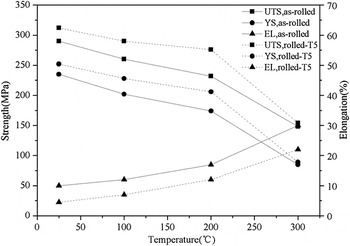
The variations of tensile properties of as-rolled and rolled-T5 specimens with the increase of temperature are shown in Fig. 7. It is of some interest to compare the strength and ductility of the as-rolled specimen with those of rolled-T5 one. As can be seen, the strength of the rolled-T5 specimen is higher than that of as-rolled one from room temperature to 200 °C. At 200 °C, the UTS values of as-rolled and rolled-T5 specimens are 232 and 276 MPa, respectively, and the difference in strength is 276 − 232 = 44 MPa. However, at the temperature of 300 °C, the strengths of both specimens steeply decrease, and the difference in strength becomes smaller (154 − 148 = 6 MPa). In contrast, compared with that of the as-rolled sample, rolled-T5 one shows lower EL at each temperature. The phenomenon can be mainly attributed to the β′ precipitates, whose contribution to mechanical properties depends sensitively on temperature. During ageing treatment, uniformly dispersed β′-phases are formed [Fig. 6(a)], which can effectively prevent the grain deformation and dislocation glide. At the same time, the β′-phase in Mg alloys has a good thermal stability even at 200 °C and could effectively prevent sliding of the basal plane.Reference Li and Li31 So the superior strength with UTS of 276 MPa, YS of 206 MPa, and EL of 12% at higher temperature (200 °C) is obtained from the rolled-T5 sample, and the difference of strength between as-rolled and rolled-T5 specimens is evident. Nevertheless, it is well known that the prismatic β′ precipitates are thought as less effective obstacles to prevent nonbasal slip and cross-slip activated at 250 °C or above. It is because they are not perpendicular to the slip planes now and could easily change the semicoherent crystal lattice, so that the effective area decreases as an obstacle to hinder dislocation slip.Reference He, Zeng, Peng, Gao, Nie and Ding26 In addition, these metastable precipitates can partly transform into equilibrium phases, and the precipitates may be subsequently coarsening above 250 °C. Therefore, at the temperature of 300 °C, the precipitates may not be so effective to strengthen the rolled-T5 sample, the high strength cannot be kept, and the values of the UTS and YS are 154 and 89 MPa, respectively. Meanwhile, the ductility of the rolled-T5 sample is substantially enhanced. As a result, both rolled-T5 containing β′-phase and as-rolled without β′-phase samples have almost the same strength value. However, Liu et al.Reference Liu, Rokhlin, Elkin, Tang and Meng32 suggested that these β′ precipitates in Mg–Y–Gd–Zn alloys are more thermally stable than those in WE alloys. So, the high strength can be kept until 300 °C. Furthermore, the recent experiments revealed that long period stacking ordered (LPSO) phases also exhibited high thermal stability even at temperatures above 400 °C and greatly raised the elevated temperature strengths of Mg alloys.Reference Yamasaki, Anan, Yoshimoto and Kawamura17,Reference Itoi, Seimiya, Kawamura and Hirohashi19
Mechanical properties of as-rolled and rolled-T5 Mg–4Y–2.5Nd–0.6Zr alloys as a function of temperature.

D. Fracture behavior
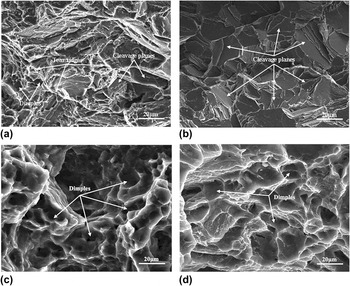
Figure 8 shows fracture surface morphologies of the Mg–4Y–2.5Nd–0.6Zr alloy in various conditions. At room temperature, for the as-rolled sample seen in Fig. 8(a), cleavage planes, a few tear ridges and dimples can be detected. This implies that the as-rolled sample exhibits a quasicleavage fracture mode. It is consistent with fracture pattern usually observed in Mg-based alloys related to its hcp structure at lower temperatures.Reference Wu and Xia10 Followed by aging at 250 °C for 4 h, the fracture surface mainly consists of cleavage planes [Fig. 8(b)], and the fracture mode of the rolled-T5 sample is transgranular cleavage fracture. The variation can be mainly ascribed to the presence of β′ precipitates during ageing treatment. The precipitates are believed to have strong obstruction effects on dislocation motion and can strengthen the grain interior,Reference Gao, He, Zeng, Peng, Ding and Nie22 so the dislocations are very difficult to glide in the interior of grains. As a result, the cracks probably initiate and grow rapidly in the interior of grains, and then travel transgranularly. Lots of cleavage planes are left on the fracture surface [Fig. 8(b)]. The variations of fracture patterns are in accord with the changes in the ELs to failure (10% and 4.5%).
Fracture surface morphologies of the Mg–4Y–2.5Nd–0.6Zr alloy in various conditions: (a) as-rolled sample tested at RT, (b) rolled-T5 sample tested at RT, (c) as-rolled sample tested at 200 °C, and (d) rolled-T5 sample tested at 200 °C.

The fracture morphologies of these two tensile specimens tested at 200 °C are significantly different from that of specimens at room temperature. It can be seen that there are a great number of deep small dimples on the fracture surface of the as-rolled sample [Fig. 8(c)]. Therefore, the fracture pattern of the as-rolled sample at 200 °C is ductile fracture. The fracture surface of the rolled-T5 sample is basically similar to that of the as-rolled sample at 200 °C. But dimples are very shallow and bigger, which can be observed in the rolled-T5 sample [Fig. 8(d)]. It indicates that compared with the rolled-T5 sample, the as-rolled sample has a better ductility. In conclusion, the fracture modes change from cleavage or quasicleavage to ductile fracture with temperatures increasing from room temperature to 200 °C for the two specimens. At higher test temperature, the easier activation of nonbasal slip systems leads to the annihilation of dislocations exhibits intergranular ductile fracture and the increase in EL. A similar observation was recorded in AZ31 alloy deformed at temperatures in the range of 100–300 °C.Reference Jäger, Lukáč, Gärtnerová, Bohlen and Kainer28
IV. CONCLUSION
(1) Mg–4Y–2.5Nd–0.6Zr (wt%) alloy in the as-cast, as-rolled, and rolled-T5 conditions mainly contains α-Mg matrix + Mg41Nd5 network-like phase + Mg24Y5 cuboid-shaped particles, α-Mg matrix + Mg24Y5 cuboid-shaped particles, α-Mg matrix + Mg24Y5 cuboid-shaped particles + β′ plate-shaped precipitates, respectively.
(2) Compared with those of the as-cast specimen, the mechanical properties of as-rolled one increase obviously, which is mainly attributed to the refined grains and the highly thermal stability of the Mg24Y5 phase that effectively prohibit the dislocation movement and grain boundary sliding. Further ageing at 250 °C for 4 h leads to a great many β′ precipitates, the rolled-T5 specimen has highest UTS and YS, 312 and 252 MPa, respectively.
(3) For the as-rolled or rolled-T5 specimen, the strengths decrease gradually from room temperature to 300 °C with a gradual increase of EL. It can be explained by the occurrence of DRX, the high activities of nonbasal slip systems and the occurrence of grain boundary sliding. Moreover, compared with the as-rolled specimen, the rolled-T5 specimen exhibits an enhanced strength from room temperature to 200 °C, which benefits from the fine β′ precipitates.
(4) Mg–4Y–2.5Nd–0.6Zr (wt%) alloy shows different fracture behaviors: tested at room temperature, cleavage planes, a few tear ridges and dimples can be found in the as-rolled condition; after aged at 250 °C for 4 h, due to the presence of β′ precipitates, the alloy exhibits a transgranular cleavage fracture; when tested at 200 °C, the fracture modes change from cleavage or quasicleavage to ductile fracture for the two specimens owing to activation of nonbasal slip systems.
ACKNOWLEDGMENTS
This work was supported partly by the Natural Science Foundation of China (Grant No. 51074186) and the Open-End Fund for the Valuable and Precision Instruments of Central South University. The authors would like to thank Professor Ding Daoyun for providing writing assistance to the article and the anonymous reviewers for supplying the helpful comments.