Introduction
Linear growth in early childhood is one of the most sensitive indicators of child health and well-being. Stunting (defined as a height of >2 s.d. below the World Health Organization growth standards median) 1 , is an anthropometric measure that strongly correlates with social and economic deprivation and is widely used as a proxy measure for inequalities in child health.Reference Pradhan, Sahn and Younger 2 Linear growth faltering commences in the fetal period and continues after birth, with the period between conception and 2 years of life (the ‘first 1000 days’) recognised as a critical period for childhood growth and development.Reference Piwoz, Sundberg and Rooke 3
Stunting is associated with susceptibility to infection, impaired cognitive development and lower educational performance in childhood,Reference Caulfield, de Onis, Blössner and Black 4 , Reference Walker, Wachs and Meeks Gardner 5 reduced adult stature (in the absence of compensatory growth),Reference Liu, Albertsson-Wikland and Karlberg 6 , Reference Victora, Adair and Fall 7 lower productivity and earnings in adulthood,Reference Haas, Murdoch, Rivera and Martorell 8 and increased risk of childhood and adult obesity and cardio-metabolic diseases. There is increasing evidence to support the view that these effects may be transmitted to subsequent generations.Reference Barker, Eriksson, Forsen and Osmond 9 , Reference Prendergast and Humphrey 10
Stunting is considered to have both proximal determinants such as the availability of sufficient quantity, quality and diversity of food, hygiene, water and sanitation, recurrent infections and access to high-quality primary care, and distal determinants such as poverty and low maternal education.Reference Black, Victora and Walker 11 It is acknowledged that the biological (including genetic), psychosocial and environmental determinants of stunting operate in tandem via epigenetic mechanisms and longer-term selection strategies.Reference Wells and Stock 12 It is estimated that ~20% of stunting may be attributed to in utero origins,Reference de Onis and Branca 13 with social, human development and economic factors contributing to the remaining 80%.Reference Frongillo, de Onis and Hanson 14
Although the determinants of stunting are well recognised, the relative contributions of these are influenced by contextual factors such as the distribution and intensity of exposures and the interactions between them.Reference de Onis and Branca 13 , Reference Stewart, Iannotti, Dewey, Michaelsen and Onyango 15 The most common reported differences in stunting prevalence are between wealth quintiles (particularly in countries with high inequality), maternal age and education level, place of residence and, to a lesser extent, child sex. 16 Previous studies examining the association between early life risk exposures and subsequent stunting in this and other low- and middle-income settings have been either cross-sectional in design or considered only a limited number or types of risk, usually at birth and/or postnatally.
The aim of this study was to investigate the effects of selected biological, psychosocial and environmental risk factors affecting the mother (and her child) during pregnancy and the first 2 years of life in an urban South African setting to better understand the determinants of stunting in this context.
Methods
Data and study population
Data for this study were drawn from the Birth to Twenty Plus (Bt20+) study, a longitudinal birth cohort study, initiated in 1990 in the greater Johannesburg metropolitan area, South Africa.Reference Richter, Norris, Pettifor, Yach and Cameron 17 Pregnant women deemed likely to deliver within a specified period were recruited through public health antenatal facilities and all singletons born within a 7-week period (23 April–8 June 1990) were enrolied. The study continues to prospectively follow 3273 children and their families throughout the Gauteng province. The enrolment methods, attrition, and profile of the Bt20+ cohort have been well described elsewhere.Reference Norris, Richter and Fleetwood 18 Black children comprised the major race group in the study sample (78.5%), followed by Coloured/Mixed race (11.7%), White (6.3%) and Indian (3.5%) children.Reference Richter, Norris, Pettifor, Yach and Cameron 17 These groupings refer to the apartheid system of population group classification and continue to be used as a measure for approximating the enduring effects of apartheid and redressing past inequities.
Measures
Individual risk exposures
Maternal demographic and psychosocial risk exposures were recorded using a questionnaire administered verbally to mothers by trained, multilingual interviewers during the third trimester of pregnancy and at 6 months postnatally. This analysis used infant data collected at birth, 6 months, 1 year and 2 years.
In total, 10 maternal and child risk exposures were examined. Pregnancy wantedness (mother’s rating of her desire to be pregnant at the time of the interview), maternal prenatal stress, tobacco use (cigarette smoking, snuff use or chewing tobacco) and alcohol use were measured during pregnancy. Maternal age at the birth of the index child, maternal education, marital status, overcrowding in the home (classified as present if more than three people per room used for sleeping) and household socio-economic status (SES) were measured between birth and 2 years of age. Maternal depression was measured 6 months after the birth of the index child.
Household SES was derived from a listing of household assets (house, radio, television, car, refrigerator, washing machine and landline telephone). The use of household assets as a proxy measure of SES has been validated in low- and middle-income countries and used previously in this cohort.Reference Sheppard, Norris, Pettifor, Cameron and Griffiths 19 For analysis, principal components analysis was used to create a SES index on the basis of household assets. Using this method, study participants were categorised into one of five groups for SES; with quintile one corresponding to the lowest SES group.
Symptoms of maternal depression were assessed 6 months postpartum using the Pitt Depression Inventory (PDI). The PDI primarily assesses a mother’s current feelings and change in mood manifestations.Reference Pitt 20 It comprises 24 items and every item is answered and coded as either no (0), don’t know (1), or yes (2). Total scores range from 0 to 48, with a score of 20 or higher indicating a self-report consistent with postnatal depression. The measure has been used in studies internationally and in South Africa and is highly correlated with measures such as the Edinburgh Postnatal Depression Scale.Reference Verkuijl, Richter and Norris 21
In addition, demographic variables such as the ethnicity and sex of the child were collected.
Control variables
Maternal height, infant birth weight, gestational age and infant breastfeeding (ever breastfed and duration of infant breastfeeding) were identified as possible covariates. Maternal height (in cm) was measured using standardised techniques. 1 Electronic weighing scales were used to weigh the infant at birth. Birth weight z-scores were calculated using the 2006 World Health Organization (WHO) growth standards. 1 Length was not measured at birth. Gestational age was obtained from the medical records and estimated based on the mother’s report of her last menstrual period. Breastfeeding data were measured during the first 2 years of life through maternal/caregiver report.
Outcome measures
Child height was measured at age 2 years using a Harpenden stadiometer and recorded to the nearest 0.1 cm, according to the standard procedures recommended by the WHO. 1 All weight and height measures were converted to z-scores by comparing them with the 2006 WHO growth standards. 1 Stunting was defined as a length/height-for-age z-score (L/HAZ) of less than −2 s.d. of the WHO Child Growth Standards median. 1
Statistical analyses
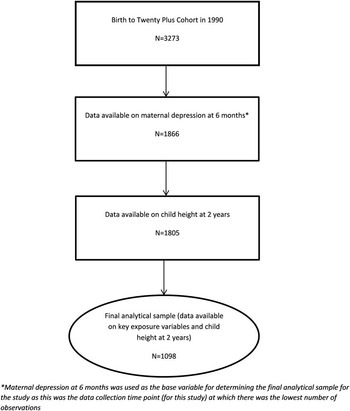
Descriptive statistics were used to summarise the outcome and risk variables by sex of the child. Frequencies and percentages were used for categorical variables, whereas means and standard deviations (s.d.) were used for continuous variables. Pearson’s χ2-test was used to check for differences between the analytical study sample and participants in the Bt20+ cohort who were not included in the analyses (Fig. 1).
Selection of analytical study sample.

Statistical analyses were undertaken to estimate the association between the exposure variables and stunting at age 2 years. Bivariate analyses were conducted to determine the unadjusted association between each exposure and stunting at age 2 years. Thereafter, sex-stratified multiple logistic regression models were used to determine risk factors that were independently associated with stunting at 2 years and the pseudo R 2 for model fit. Possible covariates, selected on the level of significance in bivariate analysis (P<0.1) and theoretical relevance, were adjusted for in the analyses. Variables were included into the regression models using a stepwise approach. A probability value of P<0.05 was considered to be statistically significant and all analyses were conducted using Stata 13.1 (Stata Corporation, College Station, TX, USA).
Results
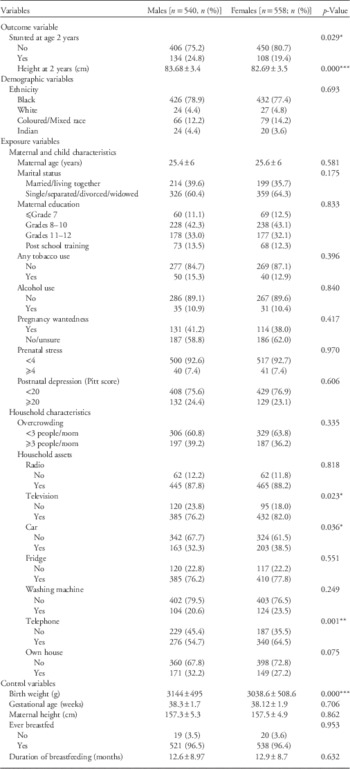
A total of 1866 women completed both the antenatal questionnaire and the PDI 6 months postnatally. Height-for-age measurements were available for 1805 children at age 2 years. The analytical sample for this study included 1098 mother–infant pairs who had exposure and outcome data at all relevant study time points (Fig. 1). A summary of key characteristics of the study sample is shown in Table 1.
Characteristics of study sample (n=1098)

Values are presented as mean±s.d. for continuous variables and number (%) for categorical variables.
*P<0.05; **P<0.01; ***P<0.001
Women included in the analytical sample were more likely to be younger, shorter, Black, live in households with fewer assets, breastfeed their infants and have infants with lower mean length for age z-scores at age 2 years (P⩽0.01 for all) compared with the sample not included in the analysis (data not shown). This inclusion of more vulnerable groups is consistent with previous attrition analyses conducted on the Bt20+ cohort and is likely due to a desire by these groups to receive services.Reference Norris, Richter and Fleetwood 18
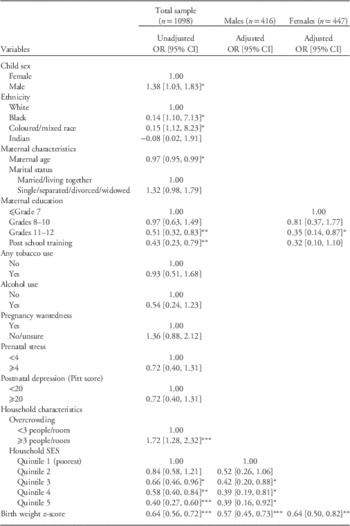
In all, 242 children (22%) were stunted at age 2 years. Although males, on average, were taller than females at age 2 years (P<0.001); significantly more males (24.8%) than females (19.4%) were stunted at age two (Table 1). The odds of being stunted were 38% higher among males [odds ratio (OR)=1.38; 95% confidence interval (CI): 1.03, 1.83] (Table 2).
Factors associated with stunting in children at age 2 years

OR, odds ratio; CI, confidence interval; SES, socio-economic status.
Males: pseudo R 2=0.0936, P=0.000; females: pseudo R 2=0.1342, P=0.000.
Adjusted for gestational age, maternal height, overcrowding, duration of infant breastfeeding, maternal age and marital status.
*P<0.05; **P<0.01; ***P<0.001.
In bivariate analysis (Table 2), being male, Black or Coloured/Mixed race, having a lower SES (quintile 1 or 2), living in overcrowded households, lower maternal education (<Grade 11), maternal age, single motherhood, lower birth weight z-score, shorter gestational age and shorter duration of infant breastfeeding all significantly increased the risk of stunting at age 2 years.
Multivariable logistic regression analysis (Table 2) showed that higher household SES was protective against stunting at age two for males; with males in SES quintiles 4 (adjusted odds ratio (AOR)=0.39; 95% CI: 0.19, 0.81) and 5 (AOR=0.39; 95% CI: 0.16, 0.92) having a 61% decreased likelihood of being stunted as compared with males in quintile 1. Higher maternal education was associated with a lower likelihood of stunting among females, particularly for infants of mothers with a Grade 11–12 education (AOR=0.35; 95% CI: 0.14, 0.87). Birth weight z-scores showed the strongest association with stunting in both sexes; with a 1 s.d. increase in birth weight associated with a 43% and 36% decreased likelihood of being stunted at age 2 years for males (AOR=0.57; 95% CI: 0.45, 0.73) and females (AOR=0.64; 95% CI: 0.50, 0.82), respectively.
Discussion
The study established that more than one in five children was stunted at age 2 years, with males being more susceptible. Higher birth weight was protective against stunting for both sexes. Beyond biological determinants of stunting, social factors mattered for both males and females within the first 2 years of life. Higher maternal education was protective for females, whereas poorer household SES was a risk for males.
Although increased male susceptibility to stunting has been reported previously, mostly from studies conducted in sub-Saharan Africa, the underlying mechanisms for these differences have remained largely unexplored.Reference Wamani, Astrom, Peterson, Tumwine and Tylleskar 22 Most of the evidence suggest that stunting differences between males and females are relatively small when compared with other stratifiers, particularly among children under 5 years; with gender disparities becoming more apparent as children get older.Reference Black, Victora and Walker 11 , 16 However, we found that male children had 38% higher odds of being stunted as compared with females in our analysis indicating that males experienced significant vulnerability to stunting early in life in this cohort.
Several possible explanations have been offered for observed sex differences. A popular hypothesis centres on societal behavioural patterns with studies reporting greater social preference of sons to the disadvantage of daughters,Reference Crognier, Baali, Hilali, Villena and Vargas 23 including dietary discrimination.Reference Leslie, Ciemins and Essama 24 We did not examine dietary patterns in this study but are, however, unaware of any South African studies that indicate preferential feeding of children based on gender. A possible explanation lies in the developmental origins of sex differences in health outcomes. Although poor fetal growth enhances the risk for both sexes, males and females tend to respond differently.Reference Sandman, Glynn and Davis 25 Male fetuses have been described as investing greater resources in growth, and as a consequence, have limited ability to respond to subsequent stressors placing them at greater risk for poor health and development outcomes. In contrast, female fetuses are believed to conserve resources and are able to adjust to maternal conditions in various ways (gene and protein changes), resulting in an increased probability of survival.Reference Barker, Eriksson, Forsen and Osmond 9 , Reference Sandman, Glynn and Davis 25
Males also tend to grow faster than females from an early stage of gestation and, by growing more rapidly, the male fetus invests more in brain growth rather than placental growth.Reference Tanner and Tanner 26 At any placental weight, males tend to be longer than females, with smaller placentas. This suggests that male placentas are more efficient but have less reserve capacity, making them more vulnerable to becoming undernourished.Reference Eriksson, Kajantie, Osmond, Thornburg and Barker 27
Thus, consequences of early exposure to adversity are displayed among males early in the life cycle and persist throughout early childhood.Reference Sandman, Glynn and Davis 25 This reinforces the idea of higher environmental sensitivity among males; under adverse conditions, males are more at risk of negative health and growth outcomes.Reference Stinson 28 This is further reinforced by our finding that male children growing up in the two lowest socio-economic strata were nearly three times more likely to be stunted than their peers in better off strata. The same difference in stunting prevalence was not observed among females belonging to socio-economically different groups in this cohort. This finding is congruent with a 16 site sub-Saharan African meta-analysis,Reference Wamani, Astrom, Peterson, Tumwine and Tylleskar 22 that found that male children living in the poorest two-quintile households were more likely to be stunted as compared with females in the same group. However, this pattern was not consistent in all studies, particularly in those conducted in higher income settings.Reference Wamani, Astrom, Peterson, Tumwine and Tylleskar 22
Maternal education, often used as a proxy for SES, is independently associated with lower mortality and stunting across and within societies for both male and female children.Reference Monden and Smits 29 , Reference Abuya, Ciera and Kimani-Murage 30 A possible explanation is that maternal education, through mechanisms unrelated to SES, may directly influence child health and growth through increasing female knowledge and autonomy within the household and community. This leads to appropriate and beneficial care-giving practices such as better health-seeking behaviours, and improved feeding and hygiene practices.Reference Black, Victora and Walker 11 However, the benefits of maternal education extended only to females in this analysis, with female children of mothers who were more educated having a lower likelihood of stunting. Previous studies have reported that females have better survival outcomes as compared with males if their mothers are better educated, particularly in sub-Saharan Africa.Reference Monden and Smits 29 There is some uncertainty with regards to the underlying mechanisms for these observed differences and may be best explained in the same way that we have hypothesised socio-economic gender-responsiveness operates, that is, that females are more adaptable to environmental stimuli in early life.Reference Sandman, Glynn and Davis 25 However, context plays a role and in societies where there are clear gender preferences (often advantaging males), this finding may be less consistent.
Higher birth weight z-scores reduced stunting risk for both sexes. Infant birth weight, and more specifically low birth weight (<2500 g), is a well-established determinant of child stunting.Reference Black, Victora and Walker 11 , Reference Stein, Wang and Martorell 31 Birth weight is the product of many influences, particularly maternal health and nutrition during pregnancy (and its effects on fetal growth) and the intergenerational influences of maternal anthropometry on newborn size.Reference Martorell and Zongrone 32 Therefore, although birth weight can be used to better understand modifiable processes as possible targets for intervention, any direct causal interpretations of birth weight with later outcomes should be considered with some caution.
We did not find an association between maternal depression and stunting in this study. There is some contrary evidence supporting an association between maternal depression and stunting in young children.Reference Avan, Richter, Ramchandani, Norris and Stein 33 – Reference Rahman, Iqbal, Bunn, Lovel and Harrington 35 However, previous studies conducted in South Africa have reported similar findings to ours and thus further exploration is required to determine possible reasons for the difference.Reference Tomlinson, Cooper, Stein, Swartz and Molteno 36 Some studies have shown that children who were unwanted at conception or during pregnancy were more likely to be stunted than their counterparts.Reference Shapiro-Mendoza, Selwyn, Smith and Sanderson 37 , Reference Singh, Chalasani, Koenig and Mahapatra 38 However, this finding is not reported consistently across studies conducted in similar settings.Reference Marston and Cleland 39 Although, a high proportion (60%) of mothers were unsure or did not want to be pregnant (when interviewed during the third trimester of pregnancy), there was no association between pregnancy wantedness and stunting in this study.
There were important determinants of stunting that were not accounted for in the analysis. The study did not include detailed data about dietary diversity, household food security and feeding practices, precluding us from examining their contribution to stunting. However, these may be important in our context as sub-optimal feeding patterns, including the early introduction of complementary foods, has been identified previously in this cohort.Reference Gitau 40 Other covariates we would have liked to include in the analysis, but for which data were not collected, were birth length, major or recurrent illness and micronutrient deficiencies.
The small numbers of minority race groups in the study made it difficult to conduct meaningful population group comparisons and thus, comparisons based on other stratification criteria were explored. There are obvious limitations to the conclusions that can be drawn from the findings as the underlying aetiologies and the mechanisms of the associations require more rigorous and in-depth consideration, particularly in similar contexts.
This study identified a high prevalence of stunting comparable to those in other parts of the continent.Reference De Onis, Blössner and Borghi 41 Among the different regions of Africa, the decline in stunting rates since 1990 has been greatest in the northern and central parts and has barely changed in the other sub-regions (including the southern region).Reference De Onis, Blössner and Borghi 41 Despite improvements in economic growth over the past three decades, significant socio-economic disparities remain, and high levels of stunting (predominantly among the youngest children) persist in South Africa.Reference Said-Mohamed, Micklesfield, Pettifor and Norris 42 The latest South African National Health and Nutrition Survey (SANHANES) data showed that the youngest children (between 0 and 3 years of age) had the highest prevalence of stunting (26.5%); with more males stunted than females.Reference Shisana, Rehle and Simabyi 43 Thus, although the study reflects stunting prevalence in 1992, the study conclusions remain pertinent as we continue to seek effective interventions in South Africa, as do other countries with high inequity.
Government and development agency approaches to improving child survival and development have traditionally addressed proximal, largely biological and ‘demand-side’, determinants with less attention to distal, structural determinants as many of these lie outside the health sector. This study’s findings add to the call for both a population- and individual-based approach, geared to service delivery to the poor and most vulnerable in society, to minimise inequities in child health and nutrition and fundamentally address high stunting prevalence. In the case of stunting in southern African settings, we would argue that these interventions should target male children, socio-economic inequality, mothers with lower levels of education and low birth weight infants.
Direct nutrition-specific interventions together, even when scaled up to 90% coverage rates, could reduce the burden of stunting, but only by 20%.Reference Bhutta, Das and Rizvi 44 Thus, tackling the underlying structural drivers of undernutrition is essential, particularly in high prevalence settings, in order to address the further 80% reduction needed. Programmes that improve nutrition, health care and household purchasing power among the poor generally also improve growth outcomes, particularly in lower SES children.Reference Bhutta, Das and Rizvi 44 For example, an analysis of key factors contributing to the decline in stunting rates in Brazil, identified enhanced purchasing power of families, increased levels of female education, improved and expanded maternal and child health services, better water and sanitation systems and superior quality and quantity of food availability for families.Reference Monteiro, Benicio and Conde 45 Although such population-level interventions are more complex and take time to show impact, there is strong anecdotal evidence from health intervention programmes that even caregivers with low education and literacy levels can be empowered to provide better care to children when they are supported and equipped with the required skills.Reference Bateman 46
At an individual level, emphasis should be placed on improving mother’s (and particularly young mother’s) health literacy regarding child health and feeding practices.Reference Johri, Subramanian and Koné 47 Conditional cash transfer programmes, particularly those that are linked to nutrition education and primary health care services, may aid in targeting and delivering these interventions.Reference Bhutta, Das and Rizvi 44 , Reference Bassett 48 Thus, approaches to stunting prevention approaches should be comprehensive and focus on proximal and distal determinants of stunting, emphasising interventions that will have short-term individual and long-term population-level impacts.
Further research is warranted to explain the stunting sex-differentials across socio-economic strata and maternal education levels. SES is a multi-dimensional construct and more sophisticated analyses that further disaggregate the variable further into its components should be conducted in order to develop effective, targeted stunting interventions along the socio-economic spectrum in different contexts. Further exploration of the functional and long-term consequences associated with early male child vulnerability is required; both related to stunting but also for other later lifestyle diseases, such as diabetes and cardio-vascular conditions. Finally, a more sophisticated biological explanation is required as to why male children are more vulnerable and less responsive compared with female children pre- and postnatally in this context.
Stunting is a good summary indicator of growth failure, however, growth failure is cumulative and linear growth in and of itself is an important indicator of child health and well-being.Reference Piwoz, Sundberg and Rooke 3 Therefore, it would be useful to explore the processes that contribute not only to linear growth faltering but also what may affect age-appropriate growth in young children. An important extension of this research study would be to consider the associations between early life growth patterns (rates and trajectories) and subsequent stunting in order to better understand the underlying mechanisms and timing of growth faltering in this setting.
Conclusion
Genetic and biological factors, as well as proximal maternal behaviours and care-giving practices are important determinants of infant growth and attained height, particularly in the first 1000 days of a child’s life. This study’s findings, nevertheless, support the view that interventions to address stunting require a broader approach that addresses not only the proximal causes of stunting but also its more distal drivers, such as SES and maternal education in settings with high socio-economic inequity, such as South Africa. This can be achieved through population-based structural interventions and public policies that redress equity and promote access to essential services for stunting and other forms of undernutrition, as well as activities focussed on individuals.
Acknowledgements
The authors thank the Birth to Twenty Plus team and the study participants for their contribution in the data collection for the study.
Financial Support
This work is based on the research supported in part by the National Research Foundation of South Africa for the grant (Grant No. 84394) and the University of the Witwatersrand (Grant No. 0012548438104512110500000000000000004988). The Birth-to-Twenty Plus study is funded by the Wellcome Trust (UK), the Human Science Research Council of South Africa, the Medical Research Council of South Africa, the University of the Witwatersrand and the Anglo-American Chairman’s Fund.
Conflicts of Interest
None.
Ethical Standards
The authors assert that all procedures contributing to this work comply with the ethical standards of the relevant national guidelines on human experimentation [National Health Research Ethics Council (NHREC) of South Africa – ‘Ethics in Health Research: Principles, Processes and Structures–2015’] and with the Helsinki Declaration of 1975, as revised in 2008, and has been approved by the Human Research Ethics Committee (Medical) of the University of the Witwatersrand, South Africa (Certificate no: M120609).