In recent years, a number of prominent political commentators have raised concerns about the lack of ideological diversity on college campuses (Shapiro 2004; Black 2004; Kors and Silvergate 1999; Kimball 1998). Among other accusations, they claim that liberal college professors may actually penalize students for expressing conservative opinions by assigning them lower marks on exams and assignments (Horowitz 2003; Hebel 2004). Their concern is not without merit. Researchers have found that, when evaluating a colleague's research, college professors are more critical of work that contradicts their own views (Mahoney 1977). It is logical to assume that the same bias influences professors' evaluations of students' arguments. It is also reasonable to expect that students, charged with the important task of evaluating their professors, are vulnerable to their own ideological biases.
While the biased evaluation of students by faculty has received some attention, researchers have yet to consider the effect that students' ideological views have on evaluations of faculty members, despite the considerable weight given to student evaluations in tenure and promotion decisions. We attempt to remedy this oversight by examining the effect that students' perceptions of professors' ideologies have on their experiences in the classroom and, correspondingly, their assessments of the professors' performance. We conclude by offering some recommendations for faculty members and for those charged with interpreting student evaluations for the purpose of tenure and promotion.
Politics and Religion in Polite Company
According to a familiar axiom, one should never discuss politics or religion in polite company. Alternative versions warn against discussing the sensitive topics among friends or in the workplace. The general claim is that these are sensitive, or even explosive, topics. Yet for those of us in academia, our very livelihood depends on our ability to discuss these unmentionables with large groups of diverse individuals on a routine basis. It is unrealistic to believe that our captive audience always agrees with our interpretations of the evidence or our policy recommendations. Nevertheless, when our students disagree with our claims, our position of authority generally prevents them from launching the sort of heated challenges one might encounter elsewhere. Still, we must ask, to what extent are their objections bubbling beneath the surface? At the very least, we ought to consider whether expression of our own political views creates an uncomfortable environment for some of our students.
The fact that political scientists have neglected to study the role that ideological differences play in the interactions between students and professors is rather surprising, given what we already know about the cognitive biases that the setting is likely to invoke. Across a variety of situations, researchers have discovered that individuals often engage in rather elaborate thought processes in order to discredit information and sources that challenge previously held beliefs (Johnson 1996; Lundgren and Prislin 1998; Jonas et al. 2001). People resist information that challenges their own political beliefs and values, either by avoiding counterarguments1
The evidence on selective exposure to information is not conclusive (McCombs, Einsiedel, and Weaver 1991; Severin and Tankard 1992). While there does appear to be some effect of ideology on the arguments to which one is exposed, the effect appears to be limited. It is no surprise that more conservatives than liberals listen to Rush Limbaugh. Selective exposure does not seem to apply more broadly to mainstream media or political advertisements, however (Chaffee et al. 2001; Zaller 1991; Sears and Freedman 1967; McGuire 1969).
In a classroom setting, students do not have the option of avoiding counter attitudinal statements. While we expect that students desire to maintain preexisting beliefs,2
See Kunda (1990) for a discussion of motivational reasoning and the motive to maintain existing viewpoints.
Research Design
The greatest obstacle to studying the effects of political ideology in the classroom is a lack of relevant data. Despite the fact that colleges routinely collect course evaluation statistics, these assessments offer no useful information about partisan interactions in the classroom. Conversely, some surveys examine the distribution of partisanship on college campuses but provide no corollary data on course evaluations and classroom interactions. As it is impossible to fuse disjointed datasets, we placed a survey instrument into the field that asked students to evaluate their courses and assess their professors' political views.
The distribution of the survey instrument occurred over three successive semesters beginning with two small, experimental distributions in the spring and fall of 2004. We followed these initial surveys, circulated in political science classes at Elizabethtown College and Penn State, Harrisburg, with a large-scale national survey of college students enrolled in political science courses. To do so, we contacted 200 political science instructors, randomly selected from the faculty directory of the American Political Science Association, and asked them to return a self-addressed prepaid postcard indicating whether they would be willing to distribute surveys to their undergraduate classes. Sixty-six instructors returned the postcard. Of those, 27 agreed to participate in the study, 16 indicated they were not teaching undergraduate courses, and 22 declined to participate outright. One affirmative response arrived too late to be included in the study.
Altogether, 30 instructors distributed the survey instrument to their undergraduate political science classes, producing a sample of 1,385 students. In the three waves of the study, instructors from 29 colleges and universities took part in the data collection, including faculty from 18 states. Approximately half of the participating professors teach at private institutions. The average class contained 20 students. Since some professors surveyed multiple classes, the average professor returned 46 student surveys. To protect the anonymity of the participants, the individual surveys bore no unique identifiers. Consequently, while it is possible to provide an aggregate description of the participating schools (grouping respondents by class or instructor), it is impossible to match survey groups to specific faculty participants.
The survey instrument contained several commonly used measures of classroom experience and evaluation of the course. Some of these items asked students for an overall assessment of the course and instructor.3
Overall assessment includes a ranking of course excellence, a ranking of instructor excellence, a scale measuring increased interest in the subject, and a measure of the likelihood that the student would recommend the course to others. See Appendix A for specific question wording.
The IDEA (Individual Development and Education Assessment) center is located at the University of Kansas. Further information about IDEA evaluations is available online at www.idea.ksu.edu/.
Students' Perceptions of Professors' Political Views
Overall, student respondents are confident in their ability to judge their professors' political leanings. Only 11% of the students surveyed report that they are “not at all confident” in rating their instructors' ideology, while 15% are “positive,” 32% are “very confident,” and 40% are “somewhat confident.” A simple one-way ANOVA supports our assertion that students have some ability to judge professors' political leanings. If students are merely guessing, we could expect to see little difference between ratings of various professors.5
Although a vast majority of the 1,385 surveys bore no unique identifiers, thereby protecting the anonymity of the faculty volunteers, approximately 190 were distributed to the coauthors' students. In this unique circumstance it was possible to compare the perception of faculty partisanship/ideology with the actual faculty partisanship/ideology. In both instances student responses were consistent with the researcher's actual beliefs.
It is also apparent from our survey that college professors vary in the degree to which they convey their political views to their students. For some professors, students report that they are very confident in their ability to identify ideological views. One student even writes in the margins of the survey, “He tells us every day. He's a Libertarian.” For other professors, students are notably less certain. On a four-point scale, students' confidence in rating the professors' ideologies range among individual professors from an average of 1.9 (n = 35), indicating relative uncertainty, to 3.0 (n = 72), indicating relative certainty.
Students' ratings of the professors' partisan affiliations are consistent with their rankings of ideology. However, students seem more willing to place the professor at extreme ends of the partisan scale than at extreme ends of the ideological scale.6
Of the students surveyed, 32.5% said that their professor was a “moderate,” while only 19% said that their professor was an “independent.” The average partisanship rating for each professor in the survey ranged from 1.2 to 4.5, while the ideology rating had a smaller range from 1.7 to 3.9.
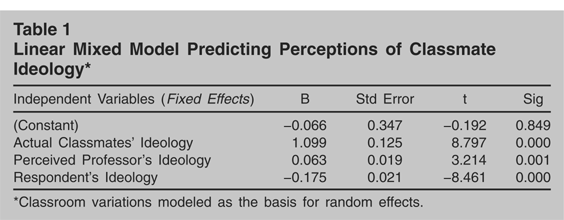
Beyond the apparent similarities between the politics of our sample and the leanings of political science faculty at large, we do have one additional indicator that bolsters our assertion that students can judge the ideological disposition of their professors. Whereas the student surveys contain no independent measure of the instructors' politics, collectively the surveys do provide an objective measure of the students' ideology. Since each student survey contains an ideological self-placement score, the collective ideological disposition of the class is simply an average of the individual surveys within the class. By comparing the average ideological disposition of each class to the students' subjective ideological assessment of their classmates, it is possible to determine whether the assessments of their peers bear any relationship to reality. The link between perceptions of classroom ideology and the actual classroom ideology are demonstrated in Table 1.
Linear Mixed Model Predicting Perceptions of Classmate Ideology*

We hypothesized that students' assessments of class ideology would vary based on perceptions of the professor's ideology and the respondents' appraisals of their own ideological beliefs. Notwithstanding our suspicion that students could gauge their classmates' views, it seemed reasonable to assume that other more visible indicators would color their perceptions of the classroom. The results outlined in Table 1 lend credence to this position. Not surprisingly, the objective measure of classmates' actual ideologies stands out as one of two key predictors in the model, with a more conservative group of classmates leading to corresponding assessments of their classmates. Students' perceptions of the professor also appear to affect evaluations of the class as a whole. Contrary to our expectations, students do not appear to project their own ideological leanings onto their classmates. The negative correlation between respondent's ideology and perceived classmates' ideology indicates that, the more conservative a student, the more she tends to view her classmates as liberal.
The sheer strength of the relationship between actual classmates' ideology and perceived classmates' ideology is, to some extent, surprising. After observing three months of lectures, we were confident that students could guess the ideological leanings of their professors. However, gauging the dispositions of one's classmates requires a collective ideological assessment with relatively little information. Students presumably speak far less often than the instructor does. Accordingly, if students are capable of making reasonable assessments of their classmates' beliefs with comparatively few observations, it seems all the more plausible that, over the course of a semester, respondents can accurately gauge the ideological disposition of their professors.
Finally, while the data seems to support our assertion that students are capable of judging their professors' political leanings, we recognize that some instructors will successfully conceal their personal beliefs. However, whether students can accurately label their professors is not of fundamental importance for our analysis. Rather, we are primarily interested in the effect that students' perceptions of instructors' political views have on their experiences in the classroom. Even when perceptions and reality are not congruent, it is the students' assessments that most influence their educational experience.
Evaluation based on Ratings of Professors' Ideology/Partisanship
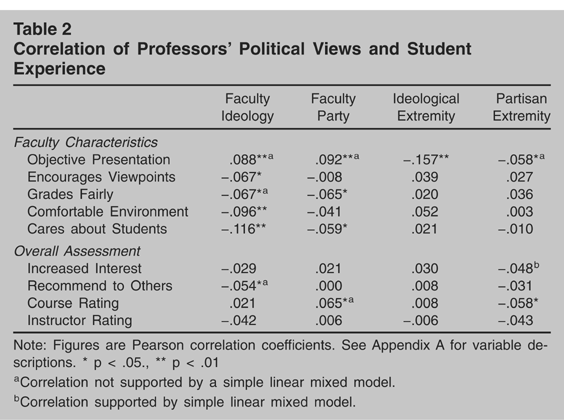
The results listed in Table 2 provide simple correlations between course assessment variables and perceptions of professors' ideology/partisanship. While a linear effects model would more accurately account for the nested structure of the data (see footnote 1), what is gained in precision with HLM modeling is lost in simplicity. We did conduct a series of hierarchical linear models using the “MIXED” command in SPSS, with classroom modeled as a random effect. We found that the relationships demonstrated in a simple correlation matrix were remarkably consistent with the results from the mixed models, with a few notable exceptions. We note these exceptions with superscripts in both Table 2 and Table 3 and limit our discussion of the results to relationships that are statistically significant with both procedures.
Correlation of Professors' Political Views and Student Experience

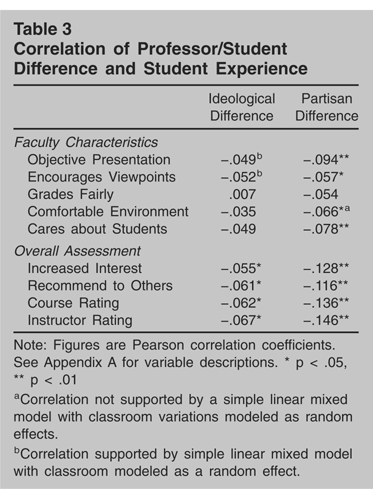
Correlation of Professor/Student Difference and Student Experience

Perceptions of professors' political orientations do appear to influence student evaluations of the course. Specifically, students rate faculty members who they perceived to be liberals more favorably on a number of faculty characteristics measures. As a whole, students are more likely to report that liberal professors “encourage students to express their own viewpoints,” and “work to provide a comfortable learning environment.” When professors are perceived as either liberal or Democrats, students are more likely to believe that their instructor “cares about students and their success.”
Notwithstanding concerns that liberal instructors may penalize conservative students for their views, the data indicate that Democratic professors are more often perceived to grade assignments “fairly and consistently.” Although this relationship is not statistically significant among Republican students, the absence of a correlation in this subpopulation is inconsistent with allegations of systematic grading bias. Nevertheless, when interpreting this characterization, researchers should exert a degree of caution. Perceptions of fairness may or may not be a reflection of true evenhandedness in the grading of assignments. If conservative professors grade more harshly, students may perceive them as “unfair” in contrast to other professors. It is unclear whether students' perceptions of fairness in grading are accurate reflections of actual grading impartiality, or simply a reflection of whether the student received a grade that was favorable.
The ideological/partisan differences observed in Table 2 do not necessarily reveal fundamental differences between liberal and conservative faculty. Again, some may argue that the relationships noted above occur because liberal professors bring different qualities to the classroom than do conservative instructors. While this may be true, there is some evidence that students' perceptions also have an effect independent of the instructor. We find significant correlations between evaluations and ideology for individual professors. For example, among 92 students taking the same instructor, those who perceive the instructor to be more liberal also report that the instructor works better to provide a more comfortable learning environment (Pearson's R = −.241, p < .05). While not all of the overall correlations are observable for each individual professor, in part due to the small sample sizes for some, the fact that some relationships are significant for some individual instructors is evidence that observed differences in classroom environment cannot be attributed to faculty characteristics alone. Liberals may conduct their classrooms differently than do conservatives. Yet, it appears also to be the case that, within individual classrooms, students' experiences differ based on their assessments of the professor's beliefs.
While students report different experiences in the classroom based on their perceptions of the instructor's ideology and partisanship, it is important to note that the statistically significant results are generally confined to specific assessments of faculty performance and not to overall assessments of the course or the instructor. Whereas instructors who are perceived to be liberals or Democrats may cultivate a better image with their students, there is no convincing evidence that these specific characteristics translate into stronger overall assessments of the course. When the nested nature of the data is taken into account with hierarchical linear models, none of the overall assessment variables appear to be related to perceptions of professors' political orientations.7
Although there initially appears to be some correlation between perceptions of professors' ideology and students' willingness to recommend the course to others, as well as between partisanship and course rating, neither of these relationships is statistically significant when we account for the nested nature of the data in a hierarchical linear model with classroom modeled as a random effect.
The third and fourth columns in Table 2 represent the effect of students' perceptions of the strength of their professors' political views on course assessment. The “extremity” variables are simply folded variables, such that a score of “0” represents someone in the center of the ideological/partisan scale, “1” represents a weak ideological/partisan rating, and “2” represents a rating at the extreme end of the scale. Whereas assessments of some faculty characteristics are correlated with perceived ideology/partisanship, individual traits have little relationship to the observed strength of the professors' convictions. Only perceptions of bias relate to ideological extremity, with students reporting that stronger ideologues are less objective in the classroom. Additionally, students are more critical of a course when it is taught by an instructor they view as highly partisan.
Evaluation based on Perception of Student/ Professor Partisan Difference
Students' experiences in a course may be, in part, a byproduct of the students' own political views. Accordingly, we examined classroom assessments in light of the perceived distance between a respondent's politics and those of the professor. Since students are more ideologically diverse than are college professors, a significant number of them will find themselves at odds with viewpoints expressed by the instructor.
The results of our analysis confirm that students are more ideologically diverse than are their professors.8
In claiming that faculty members are generally more liberal than students are, we do not simply rely on the perceptions of faculty ideology as measured in the survey instrument. Other studies have found a similar ideological propensity among college faculty (Rothman, Lichter, and Nevitte 2005).
Percentages do not add to 100 due to rounding. The detailed breakdown of self-identified ideology among students was as follows: 13% (175) extremely liberal, 30% (395) fairly liberal, 29% (383) moderate, 23% (305) fairly conservative, and 6% (75) extremely conservative.
Our survey results do provide some evidence that students' own ideological ratings are related to their ratings of their professors' ideologies (Pearson's R = .182, p < .01). Similarly, students' assessments of professors' party identifications are correlated with students' own identifications (Pearson's R = .169, p < .01). There are several explanations for why this may occur. It may be the case that professors are having an effect on students and are altering their political views. However, it is also possible that students are projecting their views onto the professor. Finally, it is possible that students are more likely to take courses with politically likeminded professors, preferring to minimize exposure to views that contradict their own. While the relationship between student ideology and perceptions of the professor's ideology is certainly worthy of study, it is beyond the scope and limitations of our data to explain this observation. Rather, we limit our focus to the problem of attitude incongruence. That is, when attitudes between professor and student fail to align, what is the effect on the student's classroom experience?
In order to assess ideological difference, we compared students' self-ratings on the partisan/ideological scales to their placement of the professor on the same scale. A difference measure of “0” indicates that the students believe their political affiliations are identical to those of their professor. A difference measure of “4” indicates that the students placed themselves and the professor at opposite ends of the 5-point partisan/ideological scale.10
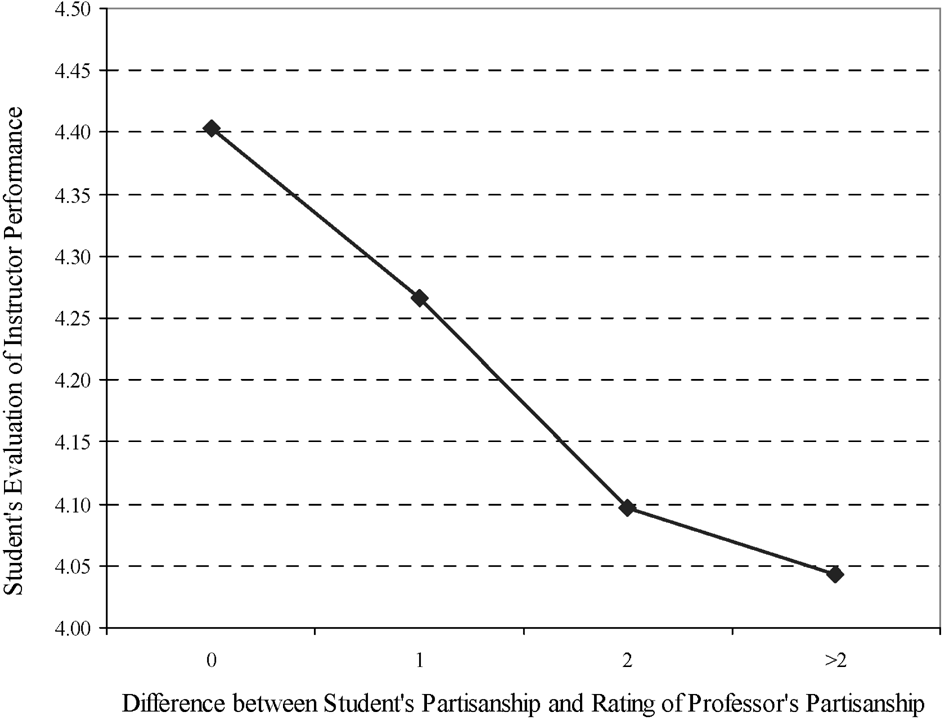
For the purpose of Figure 1 and the correlations in Table 3, ideological/partisan difference scores of “3” and “4” are collapsed into one measure, with a score of “3” representing any difference greater than two points. These scores are combined to compensate for the small number of respondents with high difference scores.

Effect of Partisan Difference between Student and Professor on Evaluation of Professor
Of the 1,314 valid survey questionnaires, 462 students (35%) place themselves and the professor at identical locations on the ideological scale, 545 (42%) report a difference score of “1”, and the remaining 307 (23%) respondents indicate that they differ from their professor by two or more points.11
Of these 307 respondents, 221 had difference measures of “2”, 73 had difference measures of “3”, and only 13 respondents placed themselves and the professor at complete opposite ends of the scale.
The measures of student/professor ideological and partisan difference correlate with a number of faculty-characteristic scores and all of the overall assessment measures. In all cases, greater ideological/partisan difference results in more negative course evaluations (see Table 3). As expected, partisanship difference results in stronger correlations than does ideological difference due to the greater variance in this variable. Accordingly, students perceive professors to be less objective as the partisan difference score increases. When students perceive that professors differ from them in partisan affiliation, they are also more likely to indicate that the professors do not care about students. Finally, greater partisan differences result in lower ratings of the instructors' openness to diverse viewpoints. These results are consistent with the research on confirmation bias. Students are less comfortable with the classroom environment when counter attitudinal messages are the norm. They attempt to discredit the information presented by reasoning that professors are biased and not trustworthy sources of information. Additionally, they appear to denigrate the source of the information and conclude that professors do not care about students and their success.
All of the overall assessment variables are statistically correlated with both ideological and partisan difference scores. Greater ideological and partisan differences between professors and students result in lower evaluations of the courses, lower evaluations of the instructors, and less student interest in the subject. Students are also less likely to recommend a course to others when they perceive that the course instructor's views differ from their own. Although the correlations appear moderate or small, they are statistically significant. Furthermore, the differences in ratings are meaningful. Students who believe that there is no difference between their partisan affiliation and that of their professor assign an average instructor rating of 4.4, while those who believe they are three or more points apart on the partisan scale assign the professor an average rating of 4.04 (Figure 1).12
Difference scores of “3” and “4” are combined here and in Figure 1, due to the relatively small number of respondents in the latter category.
Conclusion and Recommendations
Students' impressions of professors' political views do appear to have some effect on their educational experiences. While some differences are present when politics is measured in absolute terms (based solely on the perceived faculty politics), the greater effects occur when political views are measured in relative terms (measured against the students' personal views). Students who perceive their professors to be political allies rate courses more favorably than do students who perceive their professors to be political foes.
Somewhat surprisingly, the results of this study suggest that, from a purely strategic standpoint, instructors who come across as political moderates are not necessarily safe from criticism. In a class filled with liberal Democrats, even a political moderate would frequently find himself at odds with the students as a whole. Consequently, if the goal were simply to win the love and adoration of the students, clever instructors would merely pander to the median “voter.” By mimicking students' views and reinforcing long-held beliefs, professors might score well on student evaluations, while providing no useful information at all. Indeed, many students would be more comfortable with a course if they could skip the readings or forego exams. Yet, college is not Club Med. As instructors, we ought not to refine our pedagogy exclusively for the purpose of making students comfortable or improving course evaluations. There are times when students must confront new and controversial ideas in order to help them think critically or broaden their perspective of the world, even if they find these new ideas to be unsettling.
While we do not advocate that faculty members adopt their students' political orientations or fail to challenge students' beliefs, some level of sensitivity to students' values may be in order. Perhaps most troubling, political differences between students and professors appear to reduce students' interest in the subject matter. Especially in the field of politics, where public disinterest has large and direct consequences for society, professors hope to generate student interest in the subject matter. Arguably, this is a far more important objective than learning facts and terminology, since interest in the subject is likely to generate lifelong learning and political participation. Accordingly, professors may be well advised to strive for political balance—vigorously challenging students' viewpoints and presenting multiple perspectives without identifying their own political orientations. Lacking a clear indication of the professor's politics, many students may conclude that the instructor shares their values, thus minimizing the apparent ideological divide. Students can learn a great deal about the political world without gleaning much about the professor's personal views on politics.
The results of this study provide valuable insight into a heretofore-unreported phenomenon. For those charged with interpreting student evaluations for tenure and promotion decisions, the results of this study are somewhat sobering. To the extent that student evaluations are partly a function of perceived partisan/ideological distance, some faculty members have a greater disadvantage than others. Since college students, as a whole, are more likely to identify with ideological liberals than with conservatives, right-leaning college professors may be at a slight disadvantage when it comes to course evaluations. Likewise, on campuses that are more conservative, liberal professors may face unique challenges. Institutions that are committed to ideological diversity ought to recognize these unique challenges as they evaluate faculty performance in the classroom. While instructors strive to judge students solely on the merits of their ideas and not by the political views they espouse, it seems quite probable that classroom evaluations are, in part, a byproduct of student ideology.
Biographies
April Kelly-Woessner is assistant professor of political science at Elizabethtown College. Her research interests include political psychology and political behavior. She can be reached by email at kellya@etown.edu.
Matthew C. Woessner is assistant professor of public policy at Penn State Harrisburg. His specializations include political behavior, constitutional law, constitutional history, and research methodology. He can be reached via email at mcw10@psu.edu.
Appendix A: Question Wording and Coding