INTRODUCTION
The number of described and named insect species is over 900 000 but a large part of the total insect species has not yet been discovered (Price Reference PRICE, Herrera and Pellmyr2002). Estimates of global insect species range from 30 million (Erwin Reference ERWIN1982) to a more recent 4–10 million species (Basset et al. Reference BASSET, SAMUELSON, ALLISON and MILLER1996, Novotny et al. Reference NOVOTNY, BASSET, MILLER, WEIBLEN, BREMER, CIZEK and DROZD2002a, Ødegaard et al. Reference ØDEGAARD, DISERUD, ENGEN and AAGAARD2000, Thomas Reference THOMAS1990). In order to better estimate the global number of insect species, inventories should be made at several sites inside a given region during at least 1 y, because insect communities can vary spatially and temporally (Erwin et al. Reference ERWIN, PIMIENTA, MURILLO and ASCHERO2005, Molleman et al. Reference MOLLEMAN, KOP, BRAKEFIELD, DE VRIES and ZWAAN2006). However, few studies have analysed spatial and temporal variability in community composition of tropical herbivorous insects (Brehm et al. Reference BREHM, HOMEIER and FIEDLER2003).
Because of the latitudinal increase in species richness towards the equator and a latitudinal decrease in species’ range of distribution (Rapoport's rule), spatial species turnover in the tropics should be high (Rosenzweig Reference ROSENZWEIG1995, Stevens Reference STEVENS1989). Dyer et al. (Reference DYER, SINGER, LILL, STIREMAN, GENTRY, MARQUIS, RICKLEFS, GREENEY, WAGNER, MORAIS, DINIZ, KURSAR and COLEY2007) found turnover in species composition of Lepidoptera in tropical forests in South America. However, in several studies in tropical rain forests, the local species pool represents a large proportion of the regional insect community (Bartlett et al. Reference BARTLETT, PICKERING, GAULD and WINDSOR1999, Gaston & Gauld Reference GASTON and GAULD1993). In these cases, the alpha diversity is higher than the species turnover. Little change in species composition of herbivorous insects was also found in tropical lowland rain forest in Papua New Guinea by Novotny et al. (Reference NOVOTNY, MILLER, HULCR, DREW, BASSET, JANDA, SETLIFF, DARROW, STEWART, AUGA, ISUA, MOLEM, MANUMBOR, TAMTIAI, MOGIA and WEIBLEN2007). Novotny & Weiblen (Reference NOVOTNY and WEIBLEN2005) suggest that species turnover around the equator is low because most insect species are specialized on plant genera and families rather than on single species, and many species-rich plant genera are widely distributed (Condit et al. Reference CONDIT, PITMAN, LEIGH, CHAVE, TERBORGH and FOSTER2002, Novotny et al. Reference NOVOTNY, BASSET, MILLER, DROZD and CIZEK2002b, Pitman et al. Reference PITMAN, TERBORGH, SILMAN and NUÑEZ1999). The same kind of high alpha diversity and low species turnover is common in tropical tree species (Kochummen et al. Reference KOCHUMMEN, LAFRANKIE and MANOKARAN1992). On the other hand, in studies of compositional variation, the proportion of rare species may have been underestimated (Erwin Reference ERWIN1991).
The purpose of this study is to explore the extent of spatial and temporal variation in community composition of herbivorous insects at seven primary tropical rain-forest areas on five sampling dates during 1 y in Kibale National Park, Uganda. We use a locally abundant tree species, Neoboutonia macrocalyx Pax, and its associated insect community as our model system. We hypothesize that spatial variation in community composition is low because the study sites represent relatively homogeneous primary rain forest, and because N. macrocalyx produces leaves around the year (Kasenene & Roininen Reference KASENENE and ROININEN1999). Furthermore, Kibale National Park constitutes a quite small and isolated habitat. By contrast, temporal variation in community composition is hypothesized to be high due to marked variation in temperature, precipitation and resource competition throughout the year (Savilaakso et al. Reference SAVILAAKSO, KOIVISTO, VETELI and ROININEN2009, Skippari et al. Reference SKIPPARI, VETELI, KASENENE, NIEMELÄ and ROININEN2009).
METHODS
Study area
The study was conducted from April 2008 to April 2009 in Kibale National Park (766 km2) located in Western Uganda (0°13′–0°41′N, 30°19′–30°32′E) (Struhsaker Reference STRUHSAKER1997). The area represents moist transitional forest between lowland tropical forest and montane forest (Struhsaker Reference STRUHSAKER1975). The park contains various habitats including mature forest, secondary forest, swamp, grassland and woodland thicket. The altitude changes from about 1590 m asl in the northern parts of the park to 1110 m asl in the southern parts (Struhsaker Reference STRUHSAKER1997). The mean annual rainfall was 1749 mm during 1990–2001 and the area has two rainy seasons, the first from March to May, and the second from October to December (Chapman et al. Reference CHAPMAN, CHAPMAN, STRUHSAKER, ZANNE, CLARK and POULSEN2005). Mean daily temperatures during 1990–2001 ranged between 14.9 °C and 20.2 °C.
Study tree
Neoboutonia macrocalyx Pax grows in gaps of medium-altitude rain forests, in moist areas, and in valley bottoms in central and eastern parts of tropical Africa (Chapman et al. Reference CHAPMAN, CHAPMAN, KAUFMAN and ZANNE1999, Lovett et al. Reference LOVETT, RUFFO, GEREAU and TAPLIN2006). Neoboutonia macrocalyx is a pioneer tree, which colonizes gaps and disappears when the gaps close during forest succession. It is common especially in partly logged secondary forests (Kasenene & Roininen Reference KASENENE and ROININEN1999). The trees are 10–20 m tall and the canopy width is typically 7–12 m (Hamilton Reference HAMILTON1991). Neoboutonia macrocalyx is one of the 20 most common tree species in Kibale National Park (Cords Reference CORDS1990). It produces new leaves throughout the year, so access to food should not limit the abundance of insect herbivores on the plant (Kasenene & Roininen Reference KASENENE and ROININEN1999).
Insect sampling
Seven primary-forest areas were selected for this study: Sebitoli (0°37′24.00″N, 30°24′18.00″E), Compartment K30 (0°33′27.24″N, 30°21′31.26″E), Mpanga River (0°33′58.50″N, 30°28′58.80″E), Machwamba River (0°31′36.18″N, 30°23′22.20″E), Ngogo (0°29′39.48″N, 30°25′29.52″E), Dura River (0°27′30.84″N, 30°22′47.58″E) and Mainaro (0°21′34.02″N, 30°23′17.76″E). The size of the sampling sites varied from 4.7 to 19 ha when measured with 50-m radius around the outermost sampled trees. The distances between sites varied from 4.8 km to 31.2 km, and altitudinal differences ranged from 20 to 242 m.
From each site, insect community samples were collected five times: The first, 22 April–21 May 2008; the second, 9 July–23 July 2008; the third, 15 September–2 October 2008; the fourth, 6 November–25 November 2008; and the fifth, 29 March–7 April 2009. Hereafter, the sampling dates will be referred to by the starting month of the sampling. During each sampling, 20 N. macrocalyx trees were chosen randomly from each area, and six random branches were cut from each tree using tree pruners. The branches were cut from the lower parts of the canopy at 6–13 m height, and dropped down to a 4-m2 sheet under the tree. All insect larvae observed to feed on leaves were collected from the branches, and then stored in 95% ethanol. Also the galls and mines on the leaves and tunnels caused by a petiole-boring Curculionidae species were counted.
The sampled larvae were separated into morphospecies and counted. For lepidopteran larvae, family- and genus-level identifications of most morphospecies were confirmed by sequencing the standard 658-bp DNA barcode region of the mitochondrial COI gene (Hebert et al. Reference HEBERT, CYWINSKA, BALL and DEWAARD2003) from a subset of the sampled larvae (1–8 individuals per morphospecies) using standard protocols. In order to check that larval morphospecies grouped together as single species, we constructed a neighbour-joining tree of the samples based on Kimura 2-parameter distances in Mega version 5 (Tamura et al. Reference TAMURA, PETERSON, PETERSON, STECHER, NEI and KUMAR2011). Working names for morphospecies were given based on the identification tool of the BOLD barcode database (Ratnasingham & Hebert Reference RATNASINGHAM and HEBERT2007) (Appendix 1). COI barcode sequences of these samples have been submitted to GenBank under accession numbers KC172703–KC172825. A total of 299 (2.1% of the total sample) individuals belonging to the lepidopteran families Geometridae, Erebidae, Gelechiidae, Oecophoridae, Pyralidae, Psychidae and Noctuidae were excluded from further community analyses, because we were not able to reliably classify them by morphological characters and/or because barcoding of the putative morphogroups indicated that they did not constitute species units.
The number of herbivore individuals per morphospecies was divided by the total leaf area in each sample, in order to standardize insect density with respect to sample sizes. For this, the midribs of all leaves from cut branches were measured in order to estimate the leaf area, which can be calculated using the formula Y = 5.03x + 0.83x2, where x is the midrib length and Y is the leaf area (Savilaakso et al. Reference SAVILAAKSO, KOIVISTO, VETELI and ROININEN2009).
Tree community
The area for the study of tree community was determined as a matrix of 50-m around the outermost sampled trees of N. macrocalyx at each site. Ten sampling plots (20 × 20 m) were randomly set inside the determined area. All trees having a diameter of at least 10 cm at breast height (dbh1.3) were sampled and identified to species or in a few cases only to genus (Appendix 2). The summed cross-sectional area of each tree species at breast height was used as a measure of abundance in analyses of tree community composition.
Data analyses
Accumulation curves of insect species richness at each site and at all sites combined were estimated by EstimateS (version 8.0, R. K. Colwell, http://purl.oclc.org/estimates). Simpson's diversity index and Berger–Parker dominance index were calculated for every study site during each sampling date with Species Diversity and Richness (version 4.0, Pisces Conservation Ltd, Lymington, UK), and the averages were used as a measure of total alpha diversity of each site. Species richness with 95% confidence intervals was estimated using sample-based rarefaction in EstimateS as proposed by Gotelli & Colwell (Reference GOTELLI and COLWELL2001), because the number of insect individuals differed among samples. To test the hypotheses that sampling site and/or date affect the alpha diversity indices (species richness, Simpson's diversity index and Berger–Parker dominance index) and/or the density of the insects, multivariate analysis of variance (MANOVA) was conducted using log-transformed data, while using site as a fixed factor and dates as covariates, and vice versa. If the MANOVA indicated significant differences between sites or dates, univariate analysis of variance (ANOVA) was performed for each variable.
The number of shared insect species between sites was calculated using Species Diversity and Richness. In order to estimate the pairwise similarity of sampling sites in percentages, the Bray–Curtis similarity index was calculated with PRIMER (version 6, PRIMER-E Ltd, Plymouth). For this, the density data were fourth-root transformed to reduce the effect of the most common species, and a dummy variable of one was added because of the many zero observations (Clarke & Gorley Reference CLARKE and GORLEY2006). Non-metric multi-dimensional scaling (NMDS, 50 restarts) in PRIMER was used to represent the sampling sites across five sampling times and the five sampling times across seven sampling sites in two-dimensional ordination space. NMDS seeks an ordination in which the distances between the points in ordination space are in the same rank order as their similarities in species composition, in our case Bray–Curtis similarity. Distances among centroids of sampling sites and dates were used. The stress value measures how well NMDS fitted the multidimensional data into two-dimensional space.
Transformed Bray–Curtis similarity data were also used for permutational multivariate analysis of variance (PERMANOVA) in PRIMER, which was used to test for differences in composition of insect species among different sampling sites and dates. Main tests were conducted across two random factors, and 9999 unrestricted permutations were performed. The same tests were applied for tree-abundance data with the same transformations and similarity measures as for the insect density data, except that only the effect of study site was tested. To find the insect species that contributed most to the observed differences among sites, a similarity percentage (SIMPER) analysis was performed on fourth-root-transformed density data with PRIMER.
Finally, Mantel tests in PC-ORD (version 5.0, MjM Software, Gleneden Beach) were used to test for correlations between the similarity of insect community structure, the similarity of tree community composition, geographical distances and altitudinal differences among sites. Significances are based on 9999 randomizations.
RESULTS
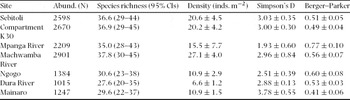
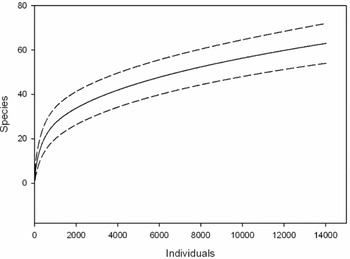
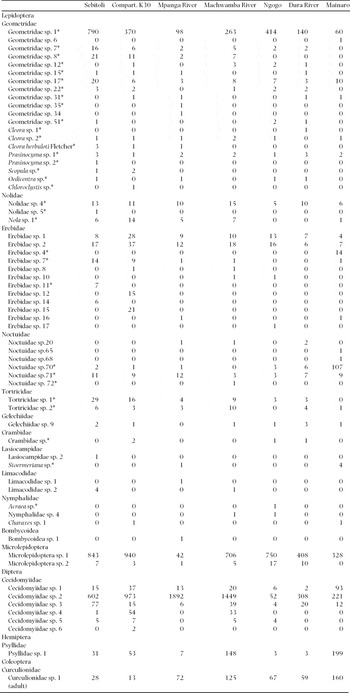
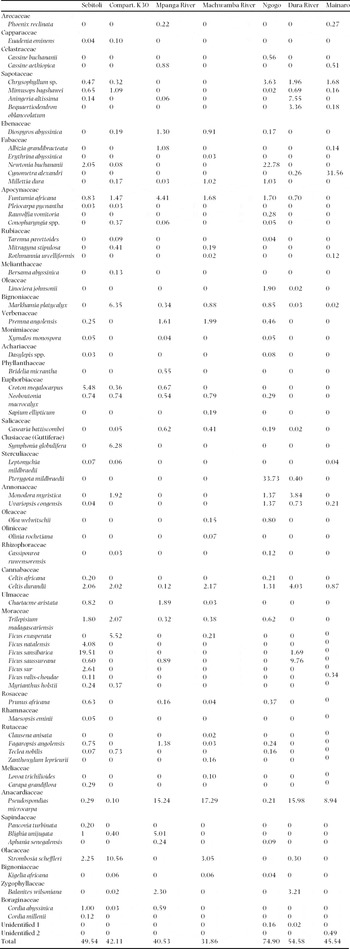
In total, 14 024 individuals representing 63 insect herbivore species were captured. The average insect density was 16.2 individuals m−2 of leaves. The species represented four orders: Lepidoptera, Diptera, Hemiptera and Coleoptera. The most common morphospecies were Cecidomyiidae sp. 2 (the hard leaf gall), Microlepidoptera sp. 1 (the round miner) and Geometridae sp. 1, which altogether represented 83% of all individuals. Out of all species, 24% were represented by only one individual, and 9% were represented by two individuals. The highest number of individuals was found from Machwamba River (2901) and lowest from Dura River (1015) (Table 1). Out of all sampling months, the number of individuals was highest in March (3815) and lowest in November (1773) (Table 2). The species-accumulation curve did not reach an asymptote when all sites were pooled (Figure 1).
Abundance, species richness, density (± SE), Simpson's D (± SE) and Berger–Parker Dominance index (± SE) of insect communities on Neoboutonia macrocalyx for the seven study sites in Kibale National Park.

Abundance, species richness, density (± SE), Simpson's D (± SE) and Berger–Parker Dominance index (± SE) of insect communities on Neoboutonia macrocalyx for the five sampling dates in Kibale National Park.

Species-accumulation curve of the herbivorous insects on Neoboutonia macrocalyx in Kibale National Park with 95% confidence intervals for all sites pooled.

The overall effect of sampling site on alpha diversity indices and density of insects was statistically significant (MANOVA; F (24, 85) = 1.85, P = 0.02; Wilks’ Lambda = 0.23; Table 1). This was caused by the density of the insects, which varied among sampling sites (ANOVA; F (7, 35) = 3.85, P = 0.007), while species richness, Simpson's D and Berger–Parker dominance index did not differ significantly among sites (ANOVA; F (7, 35) = 2.08, P = 0.089; F (7, 35) = 2.18, P = 0.076; F (7, 35) = 2.34, P = 0.06, respectively). The overall effect of sampling date on alpha diversity indices and density of insects was also significant (MANOVA; F (16, 80) = 4.22, P < 0.001; Wilks’ Lambda = 0.16; Table 2). This was caused by species richness, which varied among the sampling dates (ANOVA; F (5, 35) = 3.51, P = 0.019), while the density of insects, Simpson's D and Berger–Parker dominance index did not differ significantly among dates (ANOVA; F (5, 35) = 0.57, P = 0.690; F (5, 35) = 1.38, P = 0.267; F (5, 35) = 1.00, P = 0.424, respectively).
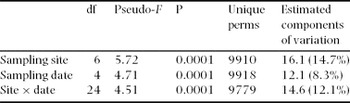
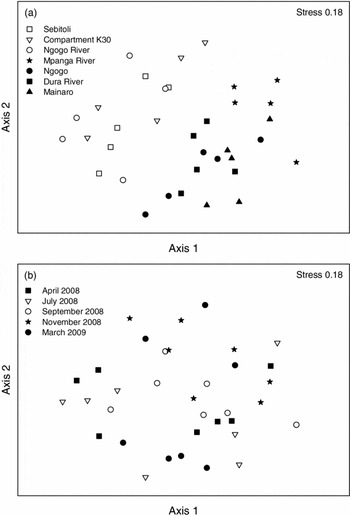
The composition of insect communities differed significantly among the sampling sites and dates (Table 3, Figure 2a, b). There was also a statistically significant interaction between sites and collection dates. Compartment K30 and Sebitoli had the highest number of shared insect species (29), while Mainaro and Ngogo had the least (16). Based on the sampling dates, March and April, and March and November, had the highest number of shared species, while July and November had the least. The species that contributed most to the differences between the forest sites were also the most abundant species: Cecidomyiidae sp. 2 (hard leaf gall), Microlepidoptera sp. 1 (round miner), Geometridae sp. 1 and Curculionidae sp. 1 (petiole borer, adult). Also the tree community composition differed significantly between sampling sites (Permanova; pseudo-F = 3.59, P = 0.0001).
PERMANOVA main tests for differences in community composition of herbivorous insects on Neoboutonia macrocalyx among sampling sites, sampling dates and the interaction between sites and dates in Kibale National Park. Degrees of freedom (df), Pseudo F-value (Pseudo-F), permutational p-value (P), unique values of the test statistic obtained under 9999 permutations (Unique perms) and estimated components of variation are shown.

Non-metric multidimensional scaling ordination of the seven study sites during five sampling times (a) and the five sampling times at seven study sites (b) based on their herbivorous insect communities on Neoboutonia macrocalyx in Kibale National Park. Distances among centroids of sampling sites and dates were used. The stress value indicates that the ordination is a fairly good representation of the data.

Faunal and floristic similarity, distance among sites and altitudinal differences among sites correlated with each other. The similarity of insect community composition correlated positively with similarity of tree communities (Mantel test, r = 0.54, P = 0.03). Insect community similarity was negatively correlated with both geographic distance and altitudinal separation (Mantel test, r = −0.60, P = 0.03; Mantel test, r = −0.50, P = 0.02). Geographic distances and altitudinal differences among the sites correlated also significantly (Mantel test, r = 0.61, P = 0.005).
DISCUSSION
Spatial variation in community composition
We found considerable change in community composition of herbivorous insects in a tropical rain forest, despite the fact that the maximum distance between our study sites was only 31.2 km. The greater the difference in distance or altitude was between study sites, the more their community compositions differed. This is most likely a typical phenomenon for medium-altitude rain forests, since the landscape is a combination of hills and river valleys that cause isolation among patchy populations of tree species such as N. macrocalyx. Few studies of variation in insect community composition have been made in tropical areas that are assumed to be environmentally relatively homogeneous. In a beetle study conducted in Venezuelan rain forest, the community composition changed between sites 20 km apart (Davies et al. Reference DAVIES, STORK, BRENDELL, HINE, Stork, Adis and Didham1997). Spatial turnover was also high among caterpillars in other South American rain forests (Dyer et al. Reference DYER, SINGER, LILL, STIREMAN, GENTRY, MARQUIS, RICKLEFS, GREENEY, WAGNER, MORAIS, DINIZ, KURSAR and COLEY2007). Like ours, these studies contradict the hypothesis of low spatial change in tropical rain-forest insect communities suggested by Novotny et al. (Reference NOVOTNY, MILLER, HULCR, DREW, BASSET, JANDA, SETLIFF, DARROW, STEWART, AUGA, ISUA, MOLEM, MANUMBOR, TAMTIAI, MOGIA and WEIBLEN2007). In their study on Papua New Guinean insect communities, they found that among-site variation in species composition in caterpillars (Lepidoptera), ambrosia beetles (Coleoptera) and fruit flies (Diptera) was low even up to distances of 500 km. Likewise, weevils in the Western Amazon Basin show low species turnover when distance between study sites was 21 km (Erwin et al. Reference ERWIN, PIMIENTA, MURILLO and ASCHERO2005). In a study on Bornean butterfly communities, Cleary & Genner (Reference CLEARY and GENNER2006) found that community similarity decreased with geographical distance over small distances (< 2 km), but increasing inter-site distances led to only minor changes in mean similarities. Only 43–60% of all the species found in this study were present at one study site when the whole year sampling was considered. This is less than what Basset et al. (Reference BASSET, CIZEK, CUÉNOUD, DIDHAM, GUILHAUMON, MISSA, NOVOTNY, ØDEGAARD, ROSLIN, SCHMIDL, TISCHECHKIN, WINCHESTER, ROUBIK, ABERLENC, BAIL, BARRIOS, BRIDLE, CASTAÑO-MENESES, CORBARA, CURLETTI, DUARTE, ROCHA, DE BAKKER, DELABIE, DEJEAN, FAGAN, FLOREN, KITCHING, MEDIANERO, MILLER, GAMA, OLIVEIRA, ORIVEL, POLLET, RAPP, RIBEIRO, ROISIN, SCHMIDT, SØRENSEN and LEPONCE2012) estimated in Panama where over 60% of all local insect species were assumed to be present in 1 ha of rain forest. However, all the aforementioned studies have been performed on multiple host plants whereas in our study only one host species was considered.
Although our study sites were selected from seemingly uniform primary rain forest, we found clear local differences in tree community composition. Also Chapman et al. (Reference CHAPMAN, CHAPMAN, WRANGHAM, ISABIRYE-BASUTA and BEN-DAVID1997) found variation in vegetation between the southern and northern parts of Kibale National Park. Differences in plant communities can influence the community structure of herbivorous insects (Crist et al. Reference CRIST, PRADHAN-DEVARE and SUMMERVILLE2006, Savilaakso et al. Reference SAVILAAKSO, KOIVISTO, VETELI and ROININEN2009, Summerville & Crist Reference SUMMERVILLE and CRIST2003, Whitham et al. Reference WHITHAM, BAILEY, SCHWEITZER, SHUSTER, BANGERT, LEROY, LONSDORF, ALLAN, DIFAZIO, POTTS, FISCHER, GEHRING, LINDROTH, MARKS, HART, WIMP and WOOLEY2006). Herbivorous insects are entirely dependent on plants as nutrition, and differences in plant species composition change the insect species composition especially when there are generalist species. Generalists can use different host species and move to N. macrocalyx or away from it according to the phenology of other available hosts.
Intercorrelated biotic (similarities in insect and tree communities) and abiotic (geographic and altitudinal distances) factors make evaluation of causal factors underlying observed spatial variation in insect communities difficult. In our study, community composition was linked to altitudinal differences among sites despite the fact that maximum differences in altitude were minor (< 242 m). Sebitoli and Mainaro differed the most in elevation, but at the same time they were also located the furthest away from each other. These two places also differed greatly in their insect species composition. Because the elevational and geographic distance correlated, it is hard to determine the factor that most affects the change in insect assemblages. We would emphasize the influence of elevation, because it has an effect on both climate and vegetation of the Kibale National Park. Even small changes in the microclimate, e.g. temperature or humidity, can influence insect communities (Basset Reference BASSET1991, Intachat et al. Reference INTACHAT, HOLLOWAY and STAINES2001, Savilaakso Reference SAVILAAKSO2009). In Kibale, the climate is relatively stable but the microclimate can vary locally (Savilaakso et al. Reference SAVILAAKSO, KOIVISTO, VETELI and ROININEN2009). Chapman et al. (Reference CHAPMAN, CHAPMAN, WRANGHAM, ISABIRYE-BASUTA and BEN-DAVID1997) found that in Kibale National Park average temperatures rise and precipitation decreases from north to south. Local climate changes also temporally, mostly because of unpredictable timing of the rainy seasons (Chapman et al. Reference CHAPMAN, CHAPMAN, STRUHSAKER, ZANNE, CLARK and POULSEN2005). Howard et al. (Reference HOWARD, DAVENPORT and MATTHEWS1996) found differences in moth species composition between different elevations in Kibale. Certain species were found only in the southern parts of the park at low elevations, and some only in the northern parts which are about 200 m higher in altitude. Other studies have as well found changes in community composition along an altitudinal gradient. Brehm et al. (Reference BREHM, HOMEIER and FIEDLER2003) found significant species turnover of Geometridae along the altitudinal gradient ranging from 1040 to 2677 m asl in an Ecuadorian montane rain forest. Also in Papua New Guinea Lepidoptera assemblages feeding on four species of Ficus changed between tropical lowland (100 m asl) and highland (1800 m asl) (Novotny et al. Reference NOVOTNY, MILLER, BASSET, CIZEK, DARROW, KAUPA, KUA and WEIBLEN2005).
Temporal variation in community composition
The community composition of herbivorous insects changed markedly between sampling dates. We also found a statistically significant interaction between spatial and temporal variation, which means that temporal changes in faunal composition are not synchronized among sites on this relatively small local scale. This apparently indicates asynchronous seasonal patterns inside the study area. Temporal variation in insect communities has been studied even less than spatial variation (Grøtan et al. Reference GRØTAN, LANDE, ENGEN, SÆTHER and DEVRIES2012, Novotny & Weiblen Reference NOVOTNY and WEIBLEN2005, Valtonen et al. in press). Beetles belonging to the family Carabidae exhibited significant temporal species turnover in a 3-y study by Lucky et al. (Reference LUCKY, ERWIN and WITMAN2002). In a 1-y study in Ecuador, nymphalid butterflies also showed temporal variation in community structure (DeVries et al. Reference DEVRIES, MURRAY and LANDE1997). In a 12-y study, A. Valtonen et al. (in press) found a seasonal pattern in the similarity of fruit-feeding butterfly assemblages in Kibale National Park. In the beginning of both rainy seasons communities became very similar but the two dry seasons sent the assemblages in different directions. Communities differed significantly among sampled years but annual changes in butterfly communities were unidirectional. Grøtan et al. (Reference GRØTAN, LANDE, ENGEN, SÆTHER and DEVRIES2012) found annual cycles in fruit-feeding butterfly community similarities in Ecuador, and also a gradual decline in similarities with increasing time lag. Therefore, it seems that tropical insect communities exhibit predictable within-year changes, while differences among years are far more unpredictable.
Species richness and abundance
Our study confirms a common observation in tropical insect research, that the species-accumulation curve does not reach an asymptote (Novotny & Basset Reference NOVOTNY and BASSET2000). The insect communities were strongly dominated by a few abundant species. The same kind of community pattern was found in Papua New Guinea (Novotny et al. Reference NOVOTNY, MILLER, BASSET, CIZEK, DROZD, DARROW and LEPS2002c). The dominant species Cecidomyiidae sp. 2 (the hard leaf gall), Microlepidoptera sp. 1 (the round miner) and Geometridae sp. 1 can be assumed to be specialists that use only N. macrocalyx as a host because geometrids are usually specialists, as are most leaf miners and gall inducers (Bairstow et al. Reference BAIRSTOW, CLARKE, MCGEOCH and ANDREW2010, Dalbem & Mendonça Reference DALBEM and MENDONÇA2006, Holloway Reference HOLLOWAY1994, Lopez-Vaamonde et al. Reference LOPEZ-VAAMONDE, GODFRAY and COOK2003).
Diversity indices showed only minor differences among sites, despite the fact that densities and faunal communities varied. The presence of one dominant species can greatly affect the value of Simpson's diversity index (Davies et al. Reference DAVIES, STORK, BRENDELL, HINE, Stork, Adis and Didham1997). Traditional diversity indices, like Simpson's diversity index and Berger–Parker dominance index, alone are not very useful for measuring the diversity of a given locality, because they do not consider changes in community composition (Horner-Devine et al. Reference HORNER-DEVINE, DAILY, EHRLICH and BOGGS2003, Summerville et al. Reference SUMMERVILLE, BOULWARE, VEECH and CRIST2003, Uehara-Prado et al. Reference UEHARA-PRADO, BROWN and FREITAS2007). The variation in density and faunal communities of herbivorous insects can be caused by among-site differences in host plant density or quality, micro-environment, or abundance of natural enemies (Chapman et al. Reference CHAPMAN, CHAPMAN, WRANGHAM, ISABIRYE-BASUTA and BEN-DAVID1997, Denno et al. Reference DENNO, LEWIS and GRATTON2005, DeVries et al. Reference DEVRIES, MURRAY and LANDE1997, Yamamoto et al. Reference YAMAMOTO, YOKOYAMA and KAWATA2007).
We detected clear seasonal variation in the total abundance of insects, despite the fact that N. macrocalyx produces leaves throughout the year. Therefore, it is evident that food availability is not the main factor regulating the densities of insects associated with this tree species. The highest number of insects was collected in March and the lowest in November. Skippari et al. (Reference SKIPPARI, VETELI, KASENENE, NIEMELÄ and ROININEN2009) got exactly opposite results. They found the highest number of individuals in October–November and, like DeVries et al. (Reference DEVRIES, ALEXANDER, CHACON and FORDYCE2012), found that precipitation had no effect on the abundance of herbivorous insects. But Nummelin (Reference NUMMELIN1989) found that arthropod abundance in Kibale correlated with rainfall with a time lag of 1–3 mo. Valtonen et al. (in press) found that there is a 1-mo lag between the rainfall peak and the vegetation greenness peak, while butterfly abundance reaches its maximum 3 mo after the vegetation greenness peak. Therefore, they predicted highest butterfly abundances in February–March and August–September based on 12 y of data on fruit-feeding butterflies from Kibale National Park. The time lag could be explained by the development time of insect larvae into adults, which varies among species. During the dry months (June–August), herbivory, measured in percentage of leaf area eaten, on N. macrocalyx was much lower, which would suggest also lower insect abundance during the dry season (Kasenene & Roininen Reference KASENENE and ROININEN1999). However in our study the insect abundance in July was quite high, but samples in July were dominated by Microlepidoptera sp. 1, which represented over 50% of the individuals. Also the high Berger–Parker dominance index shows the dominance of this species, which is a leaf miner and benefits if the level of folivory is low. Without Microlepidoptera sp. 1, July would have had the lowest abundance. Seasonal variation is common among tropical rain-forest insects (DeVries et al. Reference DEVRIES, MURRAY and LANDE1997, Wolda Reference WOLDA1992). Therefore, the well-known fluctuation in precipitation and changes in the timing of rainy seasons in Kibale National Park might cause the irregular variation in insect abundances (Struhsaker Reference STRUHSAKER1997). Our results and previous studies suggest that 1 y of sampling is not sufficient to fully detect the variation in insect abundance in this area.
We also found temporal variation in species richness. The fewest species were collected in November, while the number of species peaked during the rainy season in March. Savilaakso (Reference SAVILAAKSO2009) detected that species richness of Lepidoptera larvae correlated positively with monthly precipitation, which would explain the high species richness in March, but not the low number of species in November. In Ecuador, Grøtan et al. (Reference GRØTAN, LANDE, ENGEN, SÆTHER and DEVRIES2012) found highest butterfly diversity during the dry season and lowest during the wet season. Also Valtonen et al. (in press) predicted highest species richness for butterflies during dry seasons. Both studies found a time lag of 2 mo between the peak in rainfall and maximum species richness. Also in other studies, rainfall has been found to affect the number of insect species collected (Bairstow et al. Reference BAIRSTOW, CLARKE, MCGEOCH and ANDREW2010, DeVries et al. Reference DEVRIES, ALEXANDER, CHACON and FORDYCE2012).
Conclusions
The observed spatial variation in community composition of herbivorous insects feeding on N. macrocalyx in Kibale National Park is most likely caused by differences in vegetation, altitude and microclimate among the study sites. The temporal variation in herbivore assemblages is probably caused by seasonal changes in climate and the phenology of other host plants used by generalist herbivore species. These environmental differences may have a great influence on the herbivorous insect species, which are dependent on their host plants and climate. To better understand the global patterns of spatial and temporal variation in community composition, more studies are evidently needed in tropical rain forests.
Globally, the most important reason for species extinction is the destruction of their natural habitats (Pimm & Raven Reference PIMM and RAVEN2000). If spatial species turnover is low, communities do not suffer as much from habitat loss as when turnover is high (Fonseca Reference FONSECA2009). Thus, when biodiversity is evaluated or studied in Afrotropical rain forests, it is important to take into consideration that spatial and temporal variation of community composition can be high. The reliable diversity of an area can be measured only if the faunal composition has been monitored during a long period of time from many sites. As our study shows, compositional turnover can be surprisingly high even across relatively small distances.
ACKNOWLEDGEMENTS
We thank Makerere University Biological Field Station for making this work possible, and the following people for their contributions: A. Valtonen, P. Nyeko, E. Akaba, R. Sabiiti, J. Koojo and I. Mwesigye, as well as K. Männistö for the laboratory work needed in barcoding. We are also grateful to two anonymous referees for their helpful comments for improving the manuscript. Funding was provided by the Finnish Academy (project no. 138899 to H.R. and no. 14868 to T.N.) and Joensuu University Foundation (to A.V.). This work conforms to the legal requirements of Uganda (permits from Uganda Wildlife Authority, and the Ugandan National Council for Science and Technology).
List of the insect species and their abundances at each study site. Morphospecies for which generic and familial assignments were confirmed by DNA barcoding and the BOLD database are indicated by asterisks.
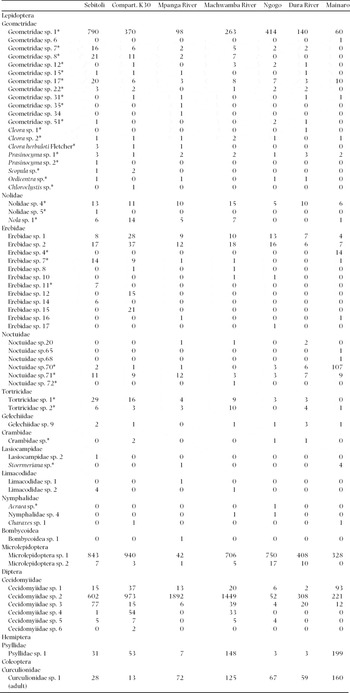
List of tree species and their basal areas (m2 ha−1) found from each study site. Nomenclature follows Hamilton (Reference HAMILTON1991) and Kalema & Beentje (Reference KALEMA and BEENTJE2012).