A recent spate of studies suggests that there is a mental health crisis among graduate students (Bernstein Reference Bernstein2015; Bolotnyy, Basilico, and Barreira Reference Bolotnyy, Basilico and Barreira2021; Evans et al. Reference Evans, Bira, Jazmin Beltran-Gastelum and Vanderford2018; Müller Reference Müller2020) and that the nature of some aspects of political science research have negative impacts on mental health (Hummel and El Kurd Reference Hummel and El Kurd2021). Focusing on graduate students in political science, we found that they have far worse mental health than other populations across a range of outcomes.Footnote 1 Disparities in mental health and well-being are significantly related to how individuals experience their PhD program. For instance, students with low well-being scores are much more likely to consider quitting their program and feel much less satisfaction with their work.
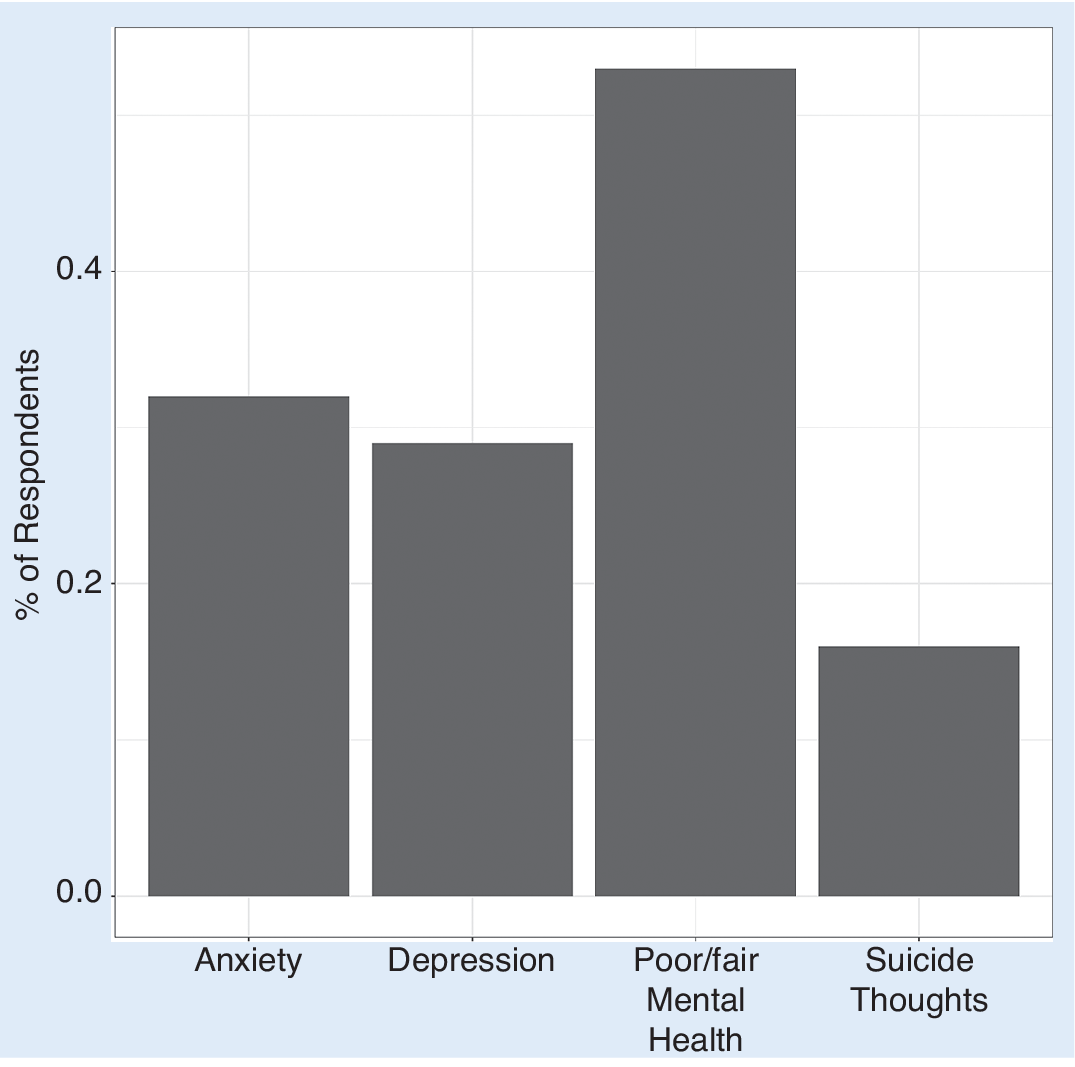
The results are alarming and demand immediate action. About 30% of respondents exhibited symptoms consistent with depression and 32% consistent with anxiety. Most of these students were not receiving treatment. In the two weeks leading up to the survey, 16% of students exhibited suicidal ideation. Poor mental health is a plausible contributor to the fact that only 39% of non-STEM doctoral students in the United States complete their degree (Zhou and Okahana Reference Zhou and Okahana2019). Not acknowledging and attending to this issue could mean a tremendous waste of resources and human potential. Moreover, since we fielded the survey, the COVID–19 pandemic has likely made these issues more acute (Czeisler et al. Reference Czeisler, Lane, Petrosky, Wiley, Christensen, Njai, Weaver, Robbins, Facer-Childs, Barger, Czeisler, Howard and Shantha2020).
About 30% of respondents exhibited symptoms consistent with depression and 32% consistent with anxiety. Most of these students were not receiving treatment.
The article proceeds as follows. We first describe our sample and survey design, emphasizing what we can and cannot learn from the type of survey we fielded. We present findings on mental health conditions before discussing whether PhD students in political science are aware of available resources for addressing mental health concerns and whether they use them. We also discuss the environmental correlates of mental health, assessing the importance of professional relationships, advising, and experiences within respondents’ PhD programs. These data provide systematic evidence to support the conclusion that there is a mental health crisis among PhD students in political science departments. To highlight the experiences and problems facing graduate students in their own words, we also present findings from a brief open-ended questionnaire that concluded our survey. These responses enable us to explore how identity intersects with the graduate school experience and provide a first attempt at suggesting actions that individual departments and the discipline as a whole might take to improve student experiences.
SURVEY SAMPLE AND DESIGN
We fielded the survey in February–March 2020 among students of seven graduate political science programs ranked in the top 10 according to US News and World Report. Footnote 2 We recognize that this survey population might have different resources, opportunities, requirements, and pressures than those not included; future research will be required to understand the nature of this bias. Each department assisted in dissemination and all responses were voluntary. We sent the survey to 653 students in total; 308 students responded, yielding a 47% response rate.Footnote 3 About 54% of respondents identified as male and 45% as female; 72% identified as American and 28% as international. The survey instrument was a shortened version of the survey in Bolotnyy, Basilico, and Barreira (Reference Bolotnyy, Basilico and Barreira2021) with the addition of three new open-ended questions.Footnote 4
The survey included a series of modules designed to measure symptoms consistent with depression and anxiety. To assess depression, we used the Patient Health Questionnaire (PHQ-9), an instrument that asks how often respondents experienced each of nine depression symptoms in the past two weeks. For assessing anxiety, we used the Generalized Anxiety Disorder screener (GAD-7). Both instruments have been widely validated and shown to accurately probe the symptoms of depression and anxiety, respectively, and both have high sensitivity and specificity (Kroenke, Spitzer, and Williams Reference Kroenke, Spitzer and Janet2001; Löwe et al. Reference Löwe, Decker, Müller, Brähler, Schellberg, Herzog and Herzberg2008). Health care providers commonly administer them together as screeners.
Two primary concerns threaten the external validity of our descriptive findings. First, our survey was voluntary, with 47% of students completing the survey. This response rate is consistent with similar studies; response rates in recent surveys on mental health have ranged from 14% (Chirikov et al. Reference Chirikov, Soria, Horgos and Jones-White2020) to 57% (Hefner and Eisenberg Reference Hefner and Eisenberg2009). In the study of economics graduate students, which most closely matches our design, 45.1% of students completed the survey (Bolotnyy, Basilico, and Barreira Reference Bolotnyy, Basilico and Barreira2021).
It is difficult to know who may select into or out of a survey on mental health. Existing evidence, however, suggests that the bias might be minimal. For example, Bolotnyy, Basilico, and Barreira (Reference Bolotnyy, Basilico and Barreira2021, 11) conducted a two-wave survey of mental health outcomes among economics graduate students and did not find that those with poorer mental health were more likely to drop out from the sample for the second wave. Other studies compared voluntary to reluctant responders by conducting follow-up face-to-face surveys with non-responders. They found that although the prevalence of anxiety and depression is higher among reluctant responders, the difference is small, and the associations between demographic and environmental factors and mental health were not biased by non-response (Cheung et al. Reference Cheung, Ten Klooster, Smit, de Vries and Pieterse2017; Vink et al. Reference Vink, Willemsen, Stubbe, Middeldorp, Rozemarijn, Baas, Hanneke, Eco and Boomsma2004). Our sensitivity analysis indicates that the potential bias introduced by the response rate does not dampen the severity of our results.
A second concern is that the timing of the COVID-19 pandemic in the United States may have influenced responses, especially because recent studies demonstrated worsening mental health among university students during the crisis (Chirikov et al. Reference Chirikov, Soria, Horgos and Jones-White2020). We omitted the 10.4% of responses received on or after March 8, 2020—the earliest date that a participating school (i.e., Columbia) announced a shift to remote learning.
The cross-sectional nature of our survey does not allow us to make causal claims. To protect our respondents’ anonymity, we also omitted several important demographic questions, including race and ethnicity. Because many departments lack racial and ethnic diversity, including a question about race might have made respondents identifiable.
SURVEY FINDINGS
Figure 1 shows the distribution of mental health evaluations across four key outcomes: depression, anxiety, suicidal thoughts, and poor/fair subjective mental health. We coded students as suffering from depression and anxiety if their responses to the PHQ-9 and GAD-7 scales exceeded the cut points used to diagnose major depression and generalized anxiety disorder (Löwe et al. Reference Löwe, Decker, Müller, Brähler, Schellberg, Herzog and Herzberg2008). Approximately 29% of respondents experienced depression and 32% experienced anxiety. There is significant overlap between these two groups: about 21% of respondents suffered from both depression and anxiety. It is noteworthy that none of these findings differed significantly across schools.
Prevalence of Negative Mental Health Outcomes
Note: This figure shows the distribution of mental health evaluations across depression, anxiety, suicidal thoughts, and poor/fair subjective mental health.

Suicidal ideation is a particularly important subitem of the PHQ-9 instrument. Almost 16% of students in the sample reported having thought about suicide in the past two weeks. This is similar to the rate of suicidal thoughts among adult outpatients treated for mental health conditions (Rossom et al. Reference Rossom, Coleman, Ahmedani, Beck, Johnson, Oliver and Simon2017). Among the general population, approximately 4% of American adults reported having such thoughts during the past year (Crosby et al. Reference Crosby, Han, LaVonne, Parks and Gfroerer2011), whereas 7% of young adults (i.e., aged 18–25) exhibited suicidal ideations, based on the same survey item (Rossom et al. Reference Rossom, Coleman, Ahmedani, Beck, Johnson, Oliver and Simon2017). Finally, a full 53% of our respondents subjectively rated their mental health as poor or fair (i.e., the bottom half of a four-point scale).
Almost 16% of students in the sample reported having thought about suicide in the past two weeks.
We recalculated the estimated prevalence of anxiety or depression, rates of poor/fair subjective mental health, and suicidality according to different sensitivity bounds of non-respondent mental health. If no one in the non-response sample had negative outcomes (which means that we recorded all of those struggling with mental health), 22% of the graduate-student population would have subjectively poor mental health, 18% would have anxiety or depression, and 8% would express suicidality. These percentages remain somewhat worse than the general population.Footnote 5 Conversely, if everyone who did not respond had negative outcomes, those percentages would have been 75%, 60%, and 77%, respectively. This also seems unlikely. Our results are similar to other recent studies of graduate-student mental health (Bernstein Reference Bernstein2015; Bolotnyy, Basilico, and Barreira Reference Bolotnyy, Basilico and Barreira2021).
We also asked respondents if they had been diagnosed with any mental health issues before starting their PhD program. Across our entire sample, 24% of respondents had preexisting diagnoses. Among students who had never been diagnosed before starting a PhD program, rates of diagnosable depression (27%), anxiety (27%), and suicidal thoughts (12%) were still remarkably high. This suggests that poor mental health among graduate students is not caused (only) by PhD programs attracting students with poor mental health.
Treatment and Coping Strategies
Mental health disorders can be manageable when treated (Cook, Schwartz, and Kaslow Reference Cook, Schwartz and Kaslow2017). Yet, we found that less than half of students screened for depression and anxiety (33% and 42%, respectively) were receiving treatment. What holds people back? Information does not seem to be an important stumbling block: 93% of students reported that they knew where to turn for help. However, only 64% stated that they at least would be moderately likely to do so. Moreover, respondents who reported poorer mental health were less likely to actually turn to others for help. Among students who had recently sought help, most relied on informal networks: 61% turned to friends and family (including fellow students); 53% reported going to a mental health professional; and only 7% turned to department staff or faculty.
Differential PhD Experiences
Struggling with mental health is likely to affect students’ experience of graduate school. Respondents with good or excellent mental health rated their satisfaction with the program at 7.52 out of 10, on average. Respondents with poor or fair mental health, conversely, rated their satisfaction with the program at 5.76. The difference between these two groups is statistically significant. Heterogeneity in graduate-school experiences between those with good and poor mental health not only illuminates the differential experiences that people have during the PhD program but also can point to potential environmental factors that may exacerbate—or be exacerbated by—poor mental health.
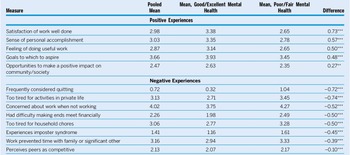
Table 1 shows the differences in how people experience their PhD program across a variety of outcomes. These findings point to equity concerns in graduate school opportunities and experiences for those who struggle with mental health. Respondents with worse mental health were more likely to think about quitting the program and had more thoughts consistent with imposter syndrome. Table 1 shows the average value (on a scale from 1 to 4) of people who agree with both positive and negative statements about graduate school. People with poor or fair mental health scores were consistently less likely to agree with positive statements and more likely to agree with negative statements.
Agreement with Statements about Graduate School (1–4 Scale)

Notes: **Indicates significance at the 5% level; ***indicates significance at the 1% level.
It is noteworthy that the sources of the greatest divergence of experiences between those with good and those with poor mental health were related to the work itself rather than interpersonal dynamics with advisers and other students. Students with poorer mental health were less likely to feel as if they were doing useful or satisfying work and could make a positive impact on society, replicating similar findings by Bolotnyy, Basilico, and Barreira (Reference Bolotnyy, Basilico and Barreira2021) among economics graduate students. These students also were more likely to feel a negative impact of the work on their personal life. This suggests that the intensity and stress of graduate school may be rooted in the nature of the work, and solutions may require broader structural changes. More research is needed, however, to systematically explore how different environmental factors may contribute to variation in mental health outcomes among graduate students.
Department Strategies and Mental Health
The survey concluded with three open-ended questions. We first asked: “What could students, staff, or faculty in your department do that could improve graduate students’ mental health or well-being?” The most common answers included the need for departments to provide more encouraging (yet constructive) feedback and better professional mentorship. Additional responses included research advice (22%); the need for more honesty about the highly competitive job market and support for nonacademic career paths (20%); and the need for clearer guidance about departmental requirements and expectations (20%). Other concerns included not discussing mental health (18%); fixing toxic department culture around work intensity and competition (18%); improving access to resources including professionalization workshops and funding (17%); reexamining course load and exam intensity (13%); ending inappropriate behavior by particular faculty members (9%); and addressing the lack of discussion on identity in general and race in particular (6%).
Second, we asked: “What are students, staff, or faculty in your department already doing that supports graduate students’ mental health or well-being?” The most positive answers included having a good department culture (40%). Other positive aspects included having an adviser who provides academic mentoring and more general career and personal advice and who also is flexible (26%); having designated spaces and groups for underrepresented populations and for mental health discussions (22%); clearly communicating about performance and expectations (13%); providing the necessary resources (12%); and providing sufficient social activities (10%).
Respondents consistently emphasized the importance of relationships within their department. Some students who described their struggles had unproductive relationships with their advisers, were situated in a department with toxic cultures, or both. Respondents shared that having supportive faculty can make or break a student’s experiences. They suggested that some (but not all) advisers and staff members “are really awesome and go out of their way to check in on students” but that, ultimately, “the onus never leaves the student” to protect their mental health.
Respondents shared that having supportive faculty can make or break a student’s experiences.
Other responses focused on the uncertainty and fear that graduate students face, especially as they relate to adviser relationships, the job market, and the lack of departmental guidance. Students recommended that advising should include regular performance feedback after coursework is finished; that advisers should receive “holistic” mentor training, including dealing with mental health issues, how to structure work hours and post-coursework timelines, and dealing with the job market; that faculty should not choose favorites; and that advisers should avoid valuing a student’s worth based on research and productivity. Many respondents suggested that departments should focus on “reforming the mentorship/advising relationships…. There are a lot of GREAT mentors, but there are a lot of poor ones.” For example, students noted that some faculty do not “demonstrate interest in [their] lives beyond the work [they] produce.” To remedy these issues, they suggested that advisers should go beyond academic and professional mentoring by being cognizant of and sympathetic to the personal struggles that students face. They need not serve as mental health professionals; rather, advisers should be aware that their sympathy, flexibility, and support can have a significant positive influence on students. Although these changes would not shift the structural conditions that significantly impact the lives of students, respondents believed that they are important first steps.
Regarding the job market, the most common suggestions were to put “less pressure on getting a tenure-track job” at top institutions and to openly discuss nonacademic job possibilities. This finding is consistent with the closed-ended survey, which found that 75% of respondents were concerned about job prospects. Several respondents complained that “no one seems to be willing to openly talk about the fact that we are admitting more and more students into [a discipline with] an already-saturated job market” and that discussing the issues about the job market without providing advice is “unhelpful and demoralizing, especially since none of them say anything about alternatives to tenure-track jobs.”Footnote 6 Even among those who were pursuing tenure-track jobs, many respondents noted that they felt underprepared for the job market.
Identity and Mental Health
Third, we asked whether respondents felt that any aspect of their identity or background (e.g., gender, country of origin, race, and sexual orientation) makes it more difficult for them to feel personally or professionally supported at their department and what could be done to improve their experience, if anything. The most common identities that our respondents referenced with regard to their experiences were gender (29%) and race (21%). Those answering “gender” were almost exclusively women; those answering “race” were mixed genders. Other common answers included socioeconomic status (12%), not belonging to the “old boys’ club” (10%), international status (7%), LGBTQ+ identity (6%), and religion (5%). Many respondents explicitly answered “no” (22%), indicating that identity does not impact their relationship with the department.
Data from the closed-ended survey suggest that women experienced more incidents of sexual harassment and impostor syndrome. Our respondents echoed these experiences, with one student noting that she felt that “men are often treated more seriously and women are told to act like men,” an undertaking that often is unsuccessful as well as emotionally and mentally draining. Many women felt that they do more work and receive less credit, have their successes minimized, are made uncomfortable or left out of conversations, and often are interrupted. They felt less supported by male-identifying faculty and sometimes by overburdened female-identifying faculty. One respondent said that her department “is still very much a boys’ club and male faculty spend a lot of time informally with male graduate students, but not with female ones. They could make an effort to include women in these informal meetings. Hiring more female faculty would also help integrate and support female graduate students.” About 10% of respondents noted concern about how casual interactions between male-identifying students and faculty tend to exclude female-identifying students.
People of color experienced similar issues in their concerns about hiring faculty and the undercutting of their successes due to their identity. “I’m a woman of color and a couple of white men in the department have brought it up. For example, one guy once ‘jokingly’ said that the reason I had gotten into the program was because the one non-white professor in my subfield ‘wanted more students like him.’ Another guy told me I had no reason to worry about the job market.” In addition, they noted the need for groups or spaces for students of color to gather informally. A trend on Twitter confirms that similar thoughts and experiences are shared widely among people of color and especially Black scholars in American institutions (see the hashtag #BlackInTheIvory). This suggests that isolation is a concern for students of color. As noted in the closed-ended survey, isolation and poor mental health outcomes were highly correlated.
Students from different or less privileged socioeconomic backgrounds noted their unique circumstances that made them feel marginalized. Many responded that they “don’t know how to conform to certain class-based behavioral expectations” and that “those that are from nonacademic families/backgrounds and who have little guidance outside of the institution” would benefit from more “formalized guidance with professional socialization and navigating the field/department.” Finally, students with families found the nature of social activities and workshops to be unaccommodating.
CONCLUSION
Our analysis presents a disturbing image of mental health among PhD students in political science. Echoing studies of other academic fields, we found that the current state of PhD student mental health demands attention (Barry et al. Reference Barry, Woods, Warnecke, Stirling and Martin2018; Evans et al. Reference Evans, Bira, Jazmin Beltran-Gastelum and Vanderford2018; Flaherty Reference Flaherty2018; Levecque et al. Reference Levecque, Anseel, De Beuckelaer, Van der Heyden and Gisle2017). Although it is difficult to conclude from a cross-sectional survey whether graduate programs cause poor mental health, some findings point in that direction. For instance, rates of depression, anxiety, and suicidal thoughts are still high among students who were never diagnosed with any mental health problems before starting their PhD program. Moreover, when asked to select their most important job stressors, students chose aspects including job uncertainty (76%), never feeling “off” work (71%), and unclear expectations (63%). These are factors that are indeed typical for PhD programs and well-known causes of work-related stress (e.g., Barry et al. Reference Barry, Woods, Warnecke, Stirling and Martin2018; De Witte, Pienaar, and De Cuyper Reference De Witte, Pienaar and De Cuyper2016; Schmidt et al. Reference Schmidt, Roesler, Kusserow and Rau2014; Wepfer et al. Reference Wepfer, Allen, Brauchli, Jenny and Bauer2018), which in turn is associated with depression and anxiety (Colligan and Higgins Reference Colligan and Higgins2006). We identify various aspects of the PhD program that correlate with particular mental health outcomes, serving as a first step toward understanding whether specific components cause or exacerbate mental health issues.
We hope that these findings galvanize faculty, administrators, and students to evaluate how departments can do a better job in mitigating mental health struggles among students. Given the severity of the problem and the relative scarcity of resources in terms of time, money, and energy, it will be impossible for individual students, faculty, and staff to resolve the crisis alone. This study’s findings suggest short-term solutions that can be implemented at the department level, such as training faculty in holistic advising in which students are treated as both mentees and advisees, as well as clearer communication about academic expectations. However, other issues are systemic and require a concerted effort across the discipline to be addressed. The oversaturated academic job market is one example.
This survey provides a step toward better understanding holistic experiences with graduate school and the consequences for mental health. Future tasks include collecting longitudinal data on graduate student mental health in order to disentangle causes and effects. Also, it will be important to document the extent to which the COVID-19 pandemic has exacerbated the prevalence of mental health disorders among university students (Chirikov et al. Reference Chirikov, Soria, Horgos and Jones-White2020). We also encourage departments to continue collecting data and to find creative ways to understand how identity differentially affects mental health experiences of students in these programs. The current study leaves unanswered important questions about diversity, identity, and racial justice from a mental health perspective. Finally, it will be critical to understand how mental health struggles influence PhD graduates who move into postdoctoral, tenure-track, nonacademic, and other positions, particularly if they are mentoring graduate students.
As departments begin to rigorously investigate what works and what does not in mitigating mental health concerns within the profession, it will be critical to continue sharing results as they are collected. Such an archive of experiences could be used as a form of accountability. Although the individual-level data from this and future surveys are too sensitive to share, we developed supplementary materials to aid in replicating our survey at other institutions. We will release the Qualtrics survey instrument and our analysis code to interested parties along with an executive summary and a how-to guide for preparing similar surveys.Footnote 7 Armed with more systematic data, we can aspire together to take steps as a discipline to address the ongoing mental health crisis.
ACKNOWLEDGMENTS
We thank Andrea Campbell, David Singer, Fotini Christia, Rich Nielsen, and Ariel White for their suggestions and support throughout the study. Valentin Bolotnyy provided the model for our research and was generous with his time and advice as we undertook this project. We also are grateful to Guillermo Toral for suggesting this survey. For their comments, we thank Guillermo Toral, Ariel White, and Gabriel Nahmias. The efforts of our liaisons in departments across the country, including Rebecca Marwege, Lauren Konken, Rebecca Dudley, Hayden Jackson, Jennie Barker, Max Kagan, and Marco Alcoce, were critical in disseminating the survey, as were the associated administrators and faculty supporters. Finally, we thank the students who willingly shared experiences with their mental health and recommendations that we hope will be beneficial to many graduate students moving forward.