Communicating about the locations of objects is essential in everyday life. For example, children and adults often are asked to provide location information about items such as toys, coats and shoes. Being able to describe the location of missing objects and direct a listener to the location in an efficient manner is an important cognitive skill that emerges early in life, but becomes more precise over development. In fact, cultural conventions of communication shape these abilities, highlighting the importance of socio-cultural influences. The main purpose of this project was to better understand how the social world affects the development of spatial language in young children. First, this project addressed how parents scaffold their children's use of the spatial terms between and middle by assessing their interactions in a direction-giving task with their four- and five-year-old children. In addition, this project specified the impact of overhearing on children's use of these spatial terms. A final purpose was to add to the sparse literature regarding young children's use of the spatial terms between and middle.
Vygotsky's (Reference Vygotsky1978) socio-cultural theory provides a broad framework for investigating the role of social interactions and culture in child development. It was Vygotsky's contention that children first learn on a social plane then translate that learning to the individual plane. As such, interactions with others within everyday activities embedded in cultural contexts powerfully shape development (Rogoff, Reference Rogoff1990; Reference Rogoff, Kuhn and Siegler1998). Language plays a vital role in development as people share ideas with one another. For example, more skilled members of society (e.g. adults) may help less skilled members (e.g. children) learn by designing interactions in the children's zone of proximal development (i.e. the range between children's individual problem solving and problem solving with more capable peers or adults). With assistance, children are able to master more complex tasks than they could master alone.
Wood, Bruner and Ross (Reference Wood, Bruner and Ross1976) coined the term ‘scaffolding’ to describe the process by which more skilled people provide supportive strategies to children. Adults control parts of the activity that are initially too complex for children to complete individually. As children gain knowledge and experience, adults gradually remove support and transfer responsibility to children. That is, adults tailor the amount and type of guidance they provide depending on the age and experience of the learner (e.g. Bellinger, Reference Bellinger1979; Kermani & Brenner, Reference Kermani and Brenner2000; Robinson, Burns & Winders-Davis, Reference Robinson, Burns and Winders-Davis2009; Rogoff, Ellis & Gardner, Reference Rogoff, Ellis and Gardner1984; Wood et al., Reference Wood, Bruner and Ross1976). For example, Wertsch, McNamee, McLane and Budwig (Reference Wertsch, McNamee, McLane and Budwig1980) found that mothers provided more direct assistance, such as pointing to the model puzzle, for younger children than for older children during a puzzle completion task, indicating that they were sensitive to the amount of support children need.
How do children benefit from scaffolding? A wealth of observational evidence suggests that scaffolding aids children's ability to solve everyday problems such as putting away shoes (Levine, Reference Levine, Chaiklin and Lave1996), building with blocks (Gregory, Kim & Whiren, Reference Gregory, Kim, Whiren and Lytle2003), and solving math problems (Stevenson & Baker, Reference Stevenson and Baker1987; see also Gauvain Fagot, Leve & Kavanagh, Reference Gauvain, Fagot, Leve and Kavanagh2002; Hughes & Ensor, Reference Hughes, Ensor, Lewis and Carpendale2009; Landry, Miller-Loncar, Smith & Swank, Reference Landry, Miller-Loncar, Smith and Swank2002). An important next step is to test the effectiveness of scaffolding strategies. Toward that end, Callanan (Reference Callanan1985; Reference Callanan1989) assessed whether the type and amount of scaffolding parents provide affects how much children learn from social interactions. The research involved two steps. First, parents used picture cards to teach their two-, three- and four-year-old children familiar and unfamiliar concepts in an observational study. Then, Callanan (Reference Callanan1989) empirically tested the effectiveness of specific strategies for teaching young children novel words by having puppets teach three-, four- and five-year-old children nonsense words using the four most common strategies parents employed. Strategies that provided more information resulted in more correct interpretations of unfamiliar words than did less specific strategies.
More recently, Plumert and Nichols-Whitehead (Reference Plumert and Nichols-Whitehead1996) employed a similar two-step approach to investigate the role of parental scaffolding of young children's use of the spatial terms in, on and by. In the first study, three- and four-year-old children were asked to give directions to their parents about the location of a hidden object (e.g. a mouse) in a dollhouse. The mouse was hidden in one of two identical small landmarks (e.g. two bags) that were placed next to or in/on large landmarks (e.g. a dresser). While the parents were not looking, the experimenter and children hid the mouse. Children then were asked to tell their parents where the mouse was hiding without pointing to its location. Parent prompts were classified in one of four categories: no prompt (parents were able to find the hidden mouse without additional prompting given correct initial directions); repeat (parents asked children to explain where the mouse was hiding again or repeated children's initial directions); non-directive (parents alerted children to ambiguity in their directions but did not provide information about how to remedy the ambiguity); or directive (parents alerted children to ambiguity in their directions and provided information to resolve the ambiguity, such as, “I see two bags. Is it the bag on the couch or the bag by the couch?”). As expected, parents adjusted the amount and type of support they provided depending on their children's age and experience with the task. Three-year-olds received significantly more directive prompts than did four-year-olds, and these prompts came earlier in the session, indicating that parents are sensitive to the amount of support that children need.
A second study was conducted to determine whether there are developmental differences in the way children respond to directive and non-directive prompts (Plumert & Nichols-Whitehead, Reference Plumert and Nichols-Whitehead1996). Instead of giving directions to their parents, children gave directions to a doll. When children produced ambiguous directions, they received a non-directive or directive prompt. A control condition (no prompt) was included to test whether children were improving over the course of trials due to experience alone. Three-year-olds performed less well in response to nondirective prompts than did four-year-olds. However, by the end of the session, three-year-olds were performing just as well as the four-year-olds. These results suggest that with appropriate scaffolding, three-year-olds can perform just as well as older children.
Recently, researchers have become increasingly interested in documenting the impact of overhearing on children's language comprehension and production. For example, findings demonstrate that children aged 1 ; 6 and 2 ; 0 can learn object labels via overhearing (Akhtar, Jipson & Callanan, Reference Akhtar, Jipson and Callanan2001; Floor & Akhtar, Reference Floor and Akhtar2006; Martínez-Sussmann, Akhtar, Diesendruck & Markson, Reference Martínez-Sussmann, Akhtar, Diesendruck and Markson2011), that children aged 2 ; 6 can learn verbs via overhearing (Akhtar et al., Reference Akhtar, Jipson and Callanan2001), that children aged 2 ; 0 and 2 ; 6 can learn object labels from overhearing even in the face of distraction (Akhtar, Reference Akhtar2005), and that young children benefit from overhearing personal pronouns (Oshima-Takane, Goodz & Derevensky, Reference Oshima-Takane, Goodz and Derevensky1996) and languages more generally (Au, Knightly, Jun & Oh, Reference Au, Knightly, Jun and Oh2002). Nonetheless, research investigating children's verbal response to overhearing complex spatial terms has not been conducted. The inclusion of overhearing conditions in our second study was valuable in this regard, specifying the impact of overhearing on children's use of complex spatial terms.
Spatial language
Early research focused on the order of acquisition of spatial terms during childhood (e.g. Clark, Reference Clark1973; Cox, Batra, & Singhal Reference Cox, Batra and Singhal1981; Dromi, Reference Dromi1978; Erreich & Valian, Reference Erreich and Valian1979; Jackendoff & Landau, Reference Jackendoff, Landau, Napoli and Kegl1991; Johnston, Reference Johnston1981; Johnston & Slobin, Reference Johnston and Slobin1979; Messick, Reference Messick1988), demonstrating that children first produce terms such as in, on, under and beside, and later produce terms such as between, back and front. Most of the subsequent research describing the acquisition of spatial language has focused on the first three prepositions produced: in, on and under (e.g. Bremner & Idowu, Reference Bremner and Idowu1987; Clark, Reference Clark1973; Corrigan, Halpern, Aviezer & Goldblatt, Reference Corrigan, Halpern, Aviezer and Goldblatt1981; Meints, Plunkett, Harris & Dimmock, Reference Meints, Plunkett, Harris and Dimmock2002; Plumert, Ewert & Spear, Reference Plumert, Ewert and Spear1995; Plumert & Hawkins, Reference Plumert and Hawkins2001). Recent research has focused increasing attention on the term by (e.g. Hund, Reference Hund2010; Hund & Plumert, Reference Hund and Plumert2007; Hund & Naroleski, Reference Hund and Naroleski2008; Plumert & Hawkins, Reference Plumert and Hawkins2001), but very little is known about the term between. Between is an important term to study because it requires comparison of a target location with respect to the locations of two reference objects (e.g. “the napkin is between the plates”), making it considerably more difficult conceptually for children than spatial terms requiring comparison of a target location with only one reference object's location (e.g. “the napkin is by the plate”). Moreover, between is relatively infrequent in language corpora and requires complex syntactic constructions involving non-singular noun phrases (Durkin, Reference Durkin1981; Reference Durkin1983; Weist, Lyytinen, Wysocka & Atanassova, Reference Weist, Lyytinen, Wysocka and Atanassova1997). It is therefore not surprising that children's understanding of between becomes more precise throughout early childhood (Durkin, Reference Durkin1981; Reference Durkin1983; Internicola & Weist, Reference Internicola and Weist2003; Johnston & Slobin, Reference Johnston and Slobin1979; Messick, Reference Messick1988; Washington & Naremore, Reference Washington and Naremore1978; Weist & Lyytinen, Reference Weist and Lyytinen1991; Weist et al., Reference Weist, Lyytinen, Wysocka and Atanassova1997).
Like between, middle requires comparison with two reference points, making it relatively difficult conceptually. In precise usage, middle may require detailed information about distance from reference points, rendering middle equidistant from each one. Middle also may refer to the center of a region. Further complication arises because, in English, middle can be used to describe horizontal and vertical reference frames. Moreover, middle adheres to complex syntactic constraints, often involving multiple prepositions (e.g. “in the middle of the trees”, “in the middle of the living room”), and these constraints differ across reference frames (e.g. “on the middle shelf”). These conceptual and syntactic aspects pose difficulties for young children, though children show remarkable developmental gains across the preschool years.
Previous research investigating when young children first understand and produce the spatial terms between and middle is relatively sparse. Studies focusing on between have yielded conflicting findings. In the relatively simple production task employed by Johnston and Slobin (Reference Johnston and Slobin1979), children viewed a target object (e.g. a plate) and reference object(s) (e.g. one or two stones) and were asked to explain where the target object was located with regard to the reference object(s). Four-year-old children were able to produce complex spatial terms, such as back, front and between, when describing the target object's location. However, findings from more complex comprehension tasks have produced contradictory results. For example, Durkin (Reference Durkin1983) investigated at what age children consistently comprehended the spatial term between. Three-, four-, five- and six-year-old children were shown three sets of picture cards that depicted different items in various locations. For each set of cards, children were asked to point to the card depicting the scene that the experimenter explained. For example, a bird, rabbit and fish were alternated so that in each picture, each animal had a different position in a straight line. Children were asked, “Which card shows the rabbit between the bird and the fish?” Two-thirds of the three- and four-year-olds were able to correctly identify the picture card depicting the appropriate configuration. Five-year-olds were able to correctly identify more pictures than both the three- and four-year-olds, and six-year-olds chose only correct pictures. In another test of comprehension, three- to seven-year-old children were asked to put a blue brick between two green bricks (presented next to and touching each other). Only 5 out of 20 three- to five-year-old children were successful, whereas 13 out of 20 six- to seven-year-old children were successful, revealing dramatic improvement across childhood. When simpler object set-ups were utilized, only the three-year-olds had marked difficulty (Durkin, Reference Durkin1981). Together, these findings reveal important improvements in the conception and utilization of between in early childhood, particularly between three and five years (see also Internicola & Weist, Reference Internicola and Weist2003; Messick, Reference Messick1988; Washington & Naremore, Reference Washington and Naremore1978; Weist & Lyytinen, Reference Weist and Lyytinen1991; Weist et al., Reference Weist, Lyytinen, Wysocka and Atanassova1997).
Details about children's acquisition of the spatial term middle are extremely limited. Middle is not included in comprehensive discussions of spatial language and its acquisition (e.g. Clark, Reference Clark1973; Johnston & Slobin, Reference Johnston and Slobin1979; Landau, Reference Landau, Bloom, Peterson, Nadel and Garrett1996; Logan & Sadler, Reference Logan, Sadler, Bloom, Peterson, Nadel and Garrett1996). To our knowledge, there is only one direct report of comprehension (or production) of middle in the literature. Loewenstein and Gentner (Reference Loewenstein and Gentner2005) tested comprehension by asking young children to point to the spatial position described, probing several spatial terms such as on, in, under, top, middle and bottom. Their findings revealed that by age 3 ; 8, children were correct on 84% of trials when asked to point to the card that was on the middle shelf. Although detailed findings from language production and comprehension tasks including middle and between administered by Simms and Gentner (Reference Simms and Gentner2008) were not provided in their brief report, it appears as if children's spontaneous production of middle and between during their search task increased from three to four and five years, consistent with general trends regarding spatial language acquisition. Specifically, three-, four- and five-year-old children were asked to search for a treasure chest hidden in the middle of two flags in a box filled with packing peanuts. Following training, the flags were expanded to assess whether children would search in the middle of the flags or use some other strategy. The proportion of correct middle searches increased with age. Importantly, children who spontaneously produced the spatial terms middle or between during the search task were more likely to search correctly than were those who did not produce these terms, and as noted above, spontaneous production increased with age. This finding is consistent with earlier reports from Loewenstein and Gentner (Reference Loewenstein and Gentner2005) showing that hearing the spatial term middle facilitated preschool children's searches (see Casasola, Reference Casasola2005; Reference Casasola2008; Casasola & Cohen, Reference Casasola and Cohen2002, for related looking time findings during infancy). Together, these findings provide important preliminary details about young children's understanding of middle.
The present investigation
One goal of this project was to specify children's use of the spatial terms between and middle. Very little is known about the ways young children use these complex terms, so further specification would be beneficial. Another goal was to document the impact of scaffolding on young children's use of the spatial terms between and middle. Previous scaffolding work focused on simpler spatial terms, such as in, on and by (Plumert & Nichols-Whitehead, Reference Plumert and Nichols-Whitehead1996). This project was an extension, focusing on more complex spatial terms. It is possible that directive scaffolding would be particularly beneficial for children given the complexity of the spatial terms between and middle. We focused on four- and five-year-old children (slightly older than the three- and four-year-olds tested by Plumert & Nichols-Whitehead, Reference Plumert and Nichols-Whitehead1996) given the complexity of the spatial terms used here (e.g. Durkin, Reference Durkin1981; Internicola & Weist, Reference Internicola and Weist2003). In the first study, children hid a mouse in a dollhouse while their parents were not looking. Parents were then called back, and children described the mouse's location to their parents. The mouse was hidden in one of two identical objects (e.g. small bags, one between two furniture items and one by a furniture item), making it necessary for children to differentiate. It was expected that children would first give ambiguous directions to the mouse's location, and parents would need to prompt them for more information. Further, it was expected that parents would provide more support (i.e. directive prompts) for their four-year-old children than for their five-year-olds. Study 2 probed the impact of scaffolding and overhearing using an experimental design.
Study 1
METHOD
Participants
Seventeen four-year-old children (M=4 ; 7, range=4 ; 1 to 4 ; 11 months, 7 boys, 10 girls) and eighteen five-year-old children (M=5 ; 7, range=5 ; 3 to 5 ; 11, 5 boys, 13 girls) and their parents participated (33 mothers, 2 fathers). Thirty-two parents were White non-Hispanic (91%), two were Asian (6%), and one was Other (3%). Thirty-one children were White non-Hispanic (88%), two were Asian (6%), and two were Other (6%). Four parents had completed some college (11%), fifteen had completed an undergraduate degree (43%), and sixteen had completed (at least) some graduate study (46%). All children were native English speakers. Data from two additional parent–child dyads were omitted from analyses because they did not understand the task and did not complete the session. Participants were recruited through a department child participant database. Children received a small gift.
Apparatus and materials
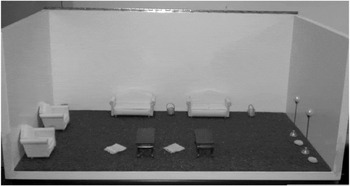
The experimental space was a 28 in. wide×12 in. high×16 in. deep dollhouse with a clear Plexiglas cover (Plumert & Nichols-Whitehead, Reference Plumert and Nichols-Whitehead1996). The cover was used to ensure children did not point directly to the hidden object or attempt to retrieve the hidden object before giving directions. The dollhouse was decorated to look like a living room (see Figure 1), and it contained four sets of furniture items: two chairs (3 in. wide×3 in. high×2½ in. deep), two tables (3¾ in. wide×1½ in. high×1½ in. deep), two couches (5 in. wide×3 in. high×2½ in. deep), and two floor lamps (¾ in. wide×4½ in. high×¾ in. deep). Four sets of small identical objects served as hiding locations: two pillows (¾ in. wide×¾ in. deep×½ in. tall), two paper bags (¾ in. wide×½ in. deep×1¼ in. tall), two towels (1¼ in. wide×1½ in. deep×¼ in. high), and two baskets (1 in. wide×1 in. deep×1½ in. tall). A miniature mouse (½ in. wide×¾ in. deep×¼ in. tall) served as the hidden object.
Dollhouse used in the direction-giving task. It contained four pairs of small objects and four pairs of furniture items. The small objects served as hiding locations.

Design and procedure
Each parent–child dyad was tested individually in a quiet room. A Canon ZR600 digital camcorder was used to record parent–child interactions. The dollhouse was placed on a low table, and children were seated directly in front of it. The experimenter sat to the children's right, and parents sat to the children's left. Parents and children were told they would be playing a hiding and finding game in which the children and the experimenter would hide a mouse in the dollhouse while the parents were not looking. Parents and children were familiarized with all the objects in the dollhouse by asking the children to name each item. The experimenter pointed to the objects in a random order and ensured that children saw all identical pairs of objects. The experimenter helped children if they had trouble naming an item, and that item was noted again to make sure children remembered it (see also Plumert & Nichols-Whitehead, Reference Plumert and Nichols-Whitehead1996).
On each trial, the mouse was hidden in a small object (e.g. a bag) directly between two furniture items (e.g. tables). An additional identical object (e.g. another bag) was located by one of the furniture items (e.g. table). The pairings of small objects and furniture items was randomized across participants. Four hiding locations were used during the session. These hiding locations were presented in random orders during the first four and last four trials with the constraint that the fourth and fifth trial could not be identical. Comparison across the two trial blocks facilitated within-subjects comparisons of parental scaffolding and child language.Footnote 1
Coding and measures
Each parent–child dyad's conversation was transcribed verbatim from video recordings. Children's initial directions and parent–child interchanges were coded. The last prompt that parents provided to their children, which elicited enough information for parents to locate the mouse, was coded for prompt type. Four types of prompts were coded based on previous research (Plumert & Nichols-Whitehead, Reference Plumert and Nichols-Whitehead1996): no prompt, repeat, non-directive prompt and directive prompt. A no prompt response was coded when parents provided no prompting because they were able to find the mouse based on children's spontaneous directions. A repeat was coded when parents asked their children to repeat their directions or when parents repeated their children's directions in searching for the mouse. A non-directive prompt was coded when parents provided feedback to their children about the ambiguity of their directions but did not provide disambiguating information concerning the mouse's location (e.g. “I see two bags”). Directive prompts were subdivided into three categories: Between Directive, Middle Directive and other directive. Parents' directive prompts were coded as Between Directive if they used the spatial term between in helping their children explain the mouse's location (e.g. “Is the mouse in the bag between the couches?”). Middle Directive prompts used the term middle to describe the location of the mouse (e.g. “Is the mouse in the bag in the middle of the lamps?”). Other directive prompts included parental references to the hiding location without using the terms between or middle (e.g. “Is the mouse in the bag on my side of the dollhouse or in the bag on your side of the dollhouse?”). After pilot testing, another category was added. This was a clarifying and teaching category coded when parents engaged in a teaching lesson (e.g. “Do you know your left from your right?”) or asked for clarification regarding where the mouse was hiding (e.g. “Is the mouse hiding under something between the tables?”). Children's spontaneous directions were coded for use of the prepositions between and middle and other references to location (e.g. “my side of the dollhouse”).Footnote 2
Inter-coder reliability was calculated by having two coders independently assess nine randomly selected protocols (36% of sample) after the two coders were trained to criterion. Intra-class correlations for coding of children's spontaneous inclusion of between, middle and other spatial language were 1·0 for all coding categories. Intra-class correlations for coding of parental prompts for no prompt, repeat, non-directive, clarification-teaching, Between Directive, Middle Directive and other directive were 1·0, 0·90, 0·84, 0·73, 1·0, 1·0 and 0·98, respectively.
RESULTS
Children's spatial language
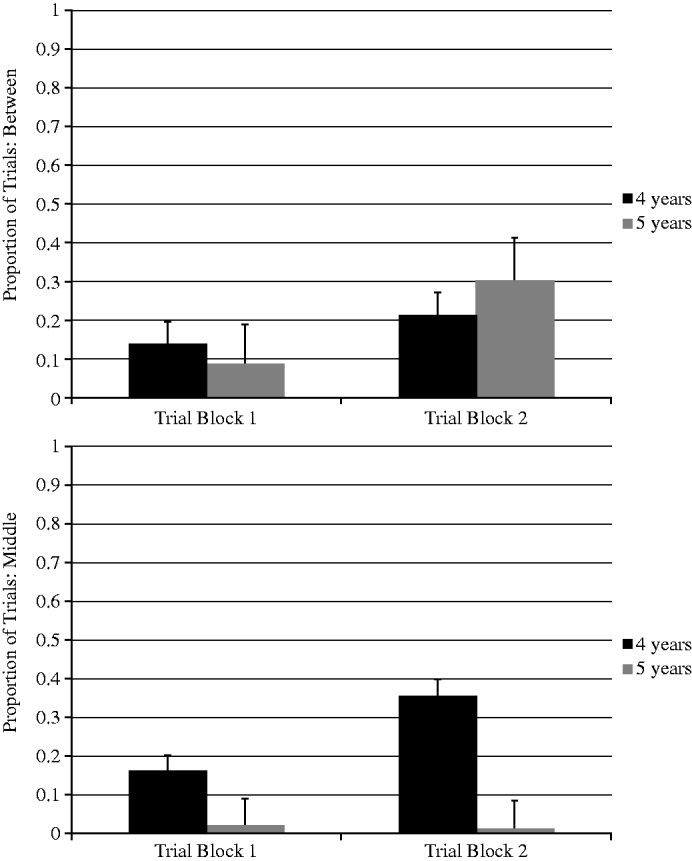
One goal was to specify children's use of the spatial terms between and middle in a direction-giving task. To determine how children use the spatial term between to describe object locations, the proportion of trials in which children spontaneously used the spatial term between before any parental prompting (on that trial) was analyzed. Proportion scores for between were entered into an Age (4 years, 5 years)×Gender (boys, girls)×Trial Block (1, 2) mixed model Analysis of Variance (ANOVA) with the first two factors as between-subjects variables and the third as a within-subjects variable. All findings reaching traditional significance levels (p<0·05) are reported here and in all subsequent analyses. All unreported effects yielded p values greater than 0·05. This analysis yielded a significant main effect of trial block (F(1, 31)=10·17, p<0·01, Partial Eta 2=0·25) (see Figure 2a). Children used the spatial term between in a lower proportion of trials in Trial Block 1 (M=0·11, SE=0·04) than in Trial Block 2 (M=0·26, SE=0·07) (see Figure 2a). These results reveal that as children gained experience with the task, they were able to hone their direction-giving skills to include more specific directions, particularly the spatial term between.
Proportion of trials on which children produced between (Panel a, top) and middle (Panel b, bottom) across trial blocks in Study 1.
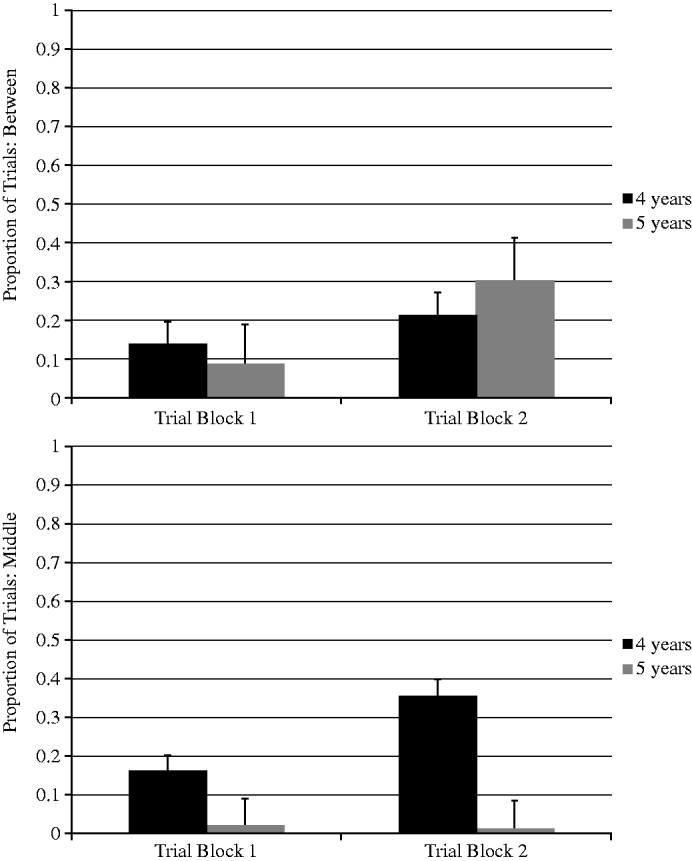
Proportion scores for middle references were entered into an Age (2)×Gender (2)×Trial Block (2) mixed model ANOVA. This analysis yielded a significant main effect of age (F(1, 31)=10·47, p<0·01, Partial Eta 2=0·25), and a significant main effect of trial block (F(1, 31)=6·35, p<0·05, Partial Eta 2=0·17). These effects were subsumed by a significant Age×Trial Block interaction (F(1, 31)=7·75, p<0·01, Partial Eta 2=0·20) (see Figure 2b). Simple effects tests revealed that four-year-olds' use of middle increased significantly across trial blocks (F(1, 16)=6·30, p<0·05, Partial Eta 2=0·28), whereas five-year-olds' low use of middle did not differ significantly across trial blocks (F(1, 17)=1·00, p=0·31, Partial Eta 2 0·06). These findings suggest that four-year-olds use middle with increasing frequency as they gain experience describing locations over trial blocks.
Parental prompting
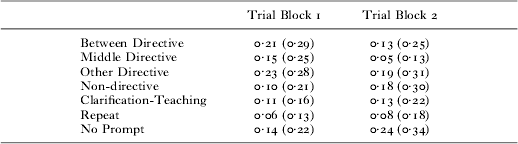
Another goal of Study 1 was to determine the kinds of support parents provide their children, given their children's age and experience with the task. Summary statistics can be seen in Table 1. Comparisons across trial blocks provided a measure of parental sensitivity regarding children's level of understanding and experience with the task. Mean proportion scores for Between Directive prompts were entered into an Age (2)×Child Gender (2)×Trial Block (2) mixed model ANOVA. No effects were significant.
Proportion of trials containing each type of parental prompt
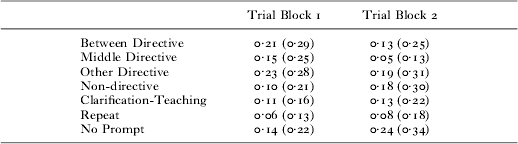
note: Standard deviations are listed in parentheses.
Mean proportion scores for Middle Directive prompts were entered into an Age (2)×Child Gender (2)×Trial Block (2) mixed model ANOVA. This analysis yielded a significant main effect of trial block (F(1, 31)=7·25, p<0·05, Partial Eta 2=0·19). Parents' use of middle when prompting their children for more information during the first trial block (M=0·15, SE=0·05) was significantly higher than during the second trial block (M=0·05, SE=0·03). These results suggest that prompts containing middle declined over the course of the session as children gained experience with the task, documenting parental sensitivity to child experience and understanding.
Mean proportion scores for non-directive prompts were entered into an Age (2)×Child Gender (2)×Trial Block (2) mixed model ANOVA. No effects were significant.Footnote 3
DISCUSSION
One goal of this study was to examine how four- and five-year-old children use the spatial terms between and middle in a direction-giving context with their parents. We found no age differences in children's use of between (4 years: M=0·17, SE=0·07 ; 5 years: M=0·19, SE=0·07), though our findings revealed robust increases in children's spontaneous use of between across trial blocks. These findings clearly show that four- and five-year-old children can produce the spatial term between in a supportive context (i.e. a direction-giving task with their parent), but that their spontaneous inclusion of the term increases dramatically throughout the task session.
Interestingly, analyses involving children's use of the spatial term middle revealed a more nuanced developmental pattern. Five-year-old children used middle with relatively low frequency, and frequency did not differ across trial blocks. In contrast, four-year-old children's use of middle increased over trial blocks. To our knowledge, theoretical and empirical work comparing the spatial terms between and middle is very sparse (for an exception, see Simms & Gentner, Reference Simms and Gentner2008), but the integration of the present findings and this literature point toward a complex developmental pattern in which young children may use middle quite frequently in some spatial contexts.
The results from the present study also revealed that parents adjusted the amount and type of support they gave to their four- and five-year-old children as children gained experience with the task. That is, Middle Directive prompting occurred more frequently during the first trial block than during second trial block. These findings suggest that parents reduce the frequency of directive scaffolding as children gain experience with the task. The overall pattern of results revealed no gender differences. Neither children's production of spatial terms nor parental prompting differed based on child gender.
An important next step in our investigation was to examine experimentally developmental differences in how children respond to three common and consistent prompt types – Between Directive, Middle Directive and non-directive prompts – in relation to responding to no prompts or overhearing a conversation containing between or middle. The prompting portion is an extension of previous research specifying the impact of scaffolding on children's use of spatial terms (Plumert & Nichols-Whitehead, Reference Plumert and Nichols-Whitehead1996). Inclusion of two overhearing conditions is consistent with recent interest in documenting the impact of overhearing on children's language comprehension and production (e.g. Akhtar, Reference Akhtar2005; Akhtar et al., Reference Akhtar, Jipson and Callanan2001; Floor & Akhtar, Reference Floor and Akhtar2006; Martínez-Sussmann et al., Reference Martínez-Sussmann, Akhtar, Diesendruck and Markson2011; Oshima-Takane et al., Reference Oshima-Takane, Goodz and Derevensky1996), providing an important extension to investigate overhearing of complex spatial terms. Moreover, these two approaches are consistent with broader socio-cultural notions that children learn language (and many skills) both through directed activity and instruction (i.e. scaffolding) and through keen observation and listening (i.e. overhearing), though cultures differ in the extent to which these socio-cultural practices are expressed (e.g. Akhtar, Reference Akhtar2005; Morelli, Rogoff & Angelillo, Reference Morelli, Rogoff and Angelillo2003).
A second study was conducted in which children were randomly assigned to receive one of four types of prompts (Between Directive, Middle Directive non-directive, no prompt) or to overhear conversations containing between or middle. The task was the same as that used in the first study, except that children gave directions to and received prompting from a doll. Based on previous research demonstrating the strong, positive impact of scaffolding and the potentially positive impact of overhearing on spatial language, it was expected that children who received directive prompts would use the corresponding spatial term with much higher frequency than would those children who received non-directive or no prompts or overheard conversations. Moreover, it was expected that children who received non-directive prompts or overheard conversations might use between and middle more frequently than would children who received no prompts.
Study 2
METHOD
Participants
One hundred ten four-year-old children (M=4 ; 7, range=4 ; 0 to 4 ; 11, 64 boys, 46 girls) and seventy-one five-year-old children (M=5 ; 4, range=5 ; 0 to 5 ; 11, 39 boys, 32 girls) participated. Demographic details were available from 116 families (64% of sample). Ninety-five children were White non-Hispanic (82%), nine were Asian (8%), one was Black (1%), five were Hispanic (4%), one was Native Hawaiian (1%), and five were Other (4%). Five parents had completed high school (4%), seven had completed some college (6%), sixty-five had completed an undergraduate degree (58%), and thirty-six had completed (at least) some graduate study (32%).Footnote 4 Data from eight additional four-year-old children and one additional five-year-old child were omitted from analyses due to experimenter error. Data from three additional four-year-old children who did not complete the task also were omitted. One hundred eighty-two children were recruited from area preschools and childcare facilities. The remaining eleven children were recruited from the same child participant database used in the first study. All children received a small gift.
Apparatus and materials
The same dollhouse, furniture, small objects, mouse and camera were used as in Study 1 (see Figure 1). In addition, two small toy dolls (3½ in. tall×1 in. wide×½ in. deep) were used. Boys gave directions to the boy doll, and girls gave directions to the girl doll.
Design and procedure
Children were tested individually in a quiet room. They were told that they would be playing a hiding and finding game in which they would be hiding a mouse in the dollhouse. The familiarization process was identical to that used in Study 1. Children in both age groups were randomly assigned to one of six conditions: Between Directive (n=31), Middle Directive (n=25), Non-directive (n=49), No Prompt (Control, n=32), Overhearing Between (n=22), or Overhearing Middle (n=22). In the Between Directive condition, children received directive prompts containing the term between. For example, if children told the doll that the mouse was in the basket, the doll would respond, “I see two baskets. Is the mouse in the basket between the couches or in the basket by the couch?” In the Middle Directive condition, children received directive prompts containing the term middle. For example, if children told the doll that the mouse was under the towel, the doll would respond, “I see two towels. Is the mouse under the towel in the middle of the tables or under the towel by the table?” In the Non-directive condition, children received less specific prompting. For example, if children told the doll that the mouse was in the bag, the doll would respond, “I see two bags. Can you tell the doll anything more?” In the Control condition, no prompting was given to children. The experimenter simply waited a few seconds for children to provide more information. In the Overhearing Between condition, the two adult experimenters carried on two brief conversations (following familiarization and following the fourth trial) describing the dollhouse set-up to one another so that children overheard their conversations. Children overheard the spatial term between eight times throughout these conversations. The Overhearing Middle condition included eight instances of middle in the conversations involving the experimenters (see ‘Appendix’ for details). No prompting was used in the overhearing conditions.
At the beginning of each trial, the doll was placed behind the dollhouse so that he/she did not ‘see’ where the children and experimenter hid the mouse. After the mouse was hidden, the doll came out from behind the dollhouse, and children were instructed to tell the doll exactly where the mouse was hiding without pointing to its location. In all trials where children did not provide enough information for the doll to find the mouse, the doll walked to the incorrect (foil) small object and simply stated that there was no mouse there and that they would try again. In all trials where children provided enough information for the doll to find the mouse, the doll walked to the correct small object and retrieved the mouse. As in the first study, there were eight trials, divided into two trial blocks.
Coding and measures
Children's directions were transcribed verbatim and coded in the same manner as in Study 1, yielding proportion scores for child language. Inter-coder reliability was calculated by having two coders independently assess forty-two randomly selected protocols (23% of sample). Intra-class correlations for coding of children's inclusion of between, middle and other spatial language were 1·0, 1·0 and 0·80, respectively.
RESULTS
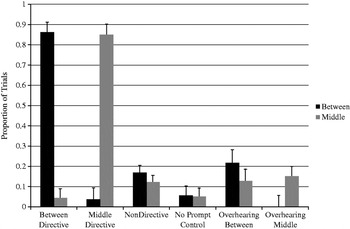
The primary goal of Study 2 was to determine the effectiveness of prompting and overhearing in eliciting between and middle from young children. That is, over the course of the session, were children able to incorporate between and middle into their directions when describing an object's location? This issue was addressed by analyzing children's overall spatial language provided. The proportion of trials in which children used the spatial term between was entered into an Age (4 years, 5 years)×Gender (boys, girls)×Condition (Between Directive, Middle Directive, Non-directive, Control, Overhearing Between, Overhearing Middle)×Trial Block (1, 2) mixed model ANOVA with the first three factors as between-subjects variables and the fourth as a within-subjects variable. This analysis yielded a significant main effect of condition (F(5, 157)=40·34, p<0·001, Partial Eta 2=0·56) (see Figure 3). LSD follow-up tests revealed that children used the spatial term between in a much higher proportion of trials when given Between Directive prompts than when provided with Middle Directive prompts, non-directive prompts, no prompts, Overhearing Between conversations or Overhearing Middle conversations, indicating that children were able to incorporate between in their directions when they were prompted using this term. In addition, children in the Overhearing Between condition used between in a higher proportion of trials than did children in the Overhearing Middle, Middle Directive or No Prompt conditions, indicating that overhearing the spatial term was somewhat effective. Moreover, children in the Non-directive condition used between in a higher proportion of trials than did children in the Overhearing Middle condition.
Proportion of trials on which children produced between and middle in each prompting or overhearing condition in Study 2.

This analysis also revealed a main effect of trial block (F(1, 157)=15·69, p<0·001, Partial Eta 2=0·09), indicating that children used between more frequently in the second trial block than in the first trial block. These main effects were subsumed by significant Condition×Trial Block (F(5, 157)=2·37, p<0·05, Partial Eta 2=0·07), Condition×Gender (F(5, 157)=2·30, p<0·05, Partial Eta 2=0·07), and Condition×Gender×Trial Block interactions (F(5, 157)=2·90, p<0·05, Partial Eta 2=0·09). Tests of simple effects revealed that these interactions were driven by increased usage of between during the second trial block (relative to the first trial block) among boys in the Overhearing Between condition and boys in the Non-directive condition.
To determine how children used the term middle to describe locations, the proportion of trials in which children used the spatial term middle was entered into an Age (2)×Gender (2)×Condition (6)×Trial Block (2) mixed model ANOVA. This analysis yielded a main effect of age (F(1, 157)=5·85, p<0·05, Partial Eta 2=0·04), revealing that five-year-olds (M=0·27, SE=0·03) used middle more frequently than did four-year-olds (M=0·18, SE=0·02). The analysis also yielded a main effect of condition (F(5, 157)=37·69, p<0·001, Partial Eta 2=0·55) (see Figure 3). LSD follow-up tests revealed that children used middle in a much higher proportion of trials when given Middle Directive prompts than when provided with Between Directive prompts, non-directive prompts, no prompts, Overhearing Middle, or Overhearing Between, indicating that they were able to incorporate the term middle in their directions when provided with the term as part of directive prompting.
The analysis also yielded a main effect of trial block (F(1, 157)=11·20, p<0·01, Partial Eta 2=0·07), indicating that children used middle with higher frequency during the second trial block than the first trial block. Finally, the analysis yielded a significant Condition×Trial Block interaction (F(5, 157)=2·73, p<0·05, Partial Eta 2=0·08). Tests of simple effects indicated that children in the Overhearing Middle condition used middle more frequently during the second trial block than during the first trial block, indicating a somewhat subtle impact of overhearing the spatial term middle that increases with experience. Trial block differences were not significant in any other condition.
DISCUSSION
The results of this study reveal that four- and five-year-old children benefited from directive prompts. That is, children who received Between or Middle Directive prompts were able to incorporate these specific spatial terms (i.e. between or middle) into their directions. Children who received non-directive prompts rarely used between and middle, and only boys showed an increase over trials. Children in the Control condition who received no prompting very rarely used between or middle when describing the mouse's location and did not show a significant increase in their use of these terms over trials, indicating that mere exposure to the direction-giving task is not the key determinant of changes in spatial language.
These findings indicate that the specific types of directive prompts children receive are important in eliciting spatial language. That is, those children receiving Between Directive prompts used this term with greater frequency than children receiving any other prompt type or overhearing condition when describing the mouse's location. Similarly, those children receiving Middle Directive prompts used middle in their directions with greater frequency than children receiving any other prompt type or overhearing condition. These results reveal that directive prompting facilitates children's production of complex spatial terms. It is important to note that the relatively constrained nature of interaction utilized in this study was necessary for empirical reasons. Although it is less similar to everyday experiences than the naturalistic parent–child interactions captured in the first study, it nonetheless involved complex cognitive and social aspects of interaction among the child participants, doll and experimenters. For these reasons, we believe that communicative conventions conveyed via social interactions are key for helping children understand subtle differences in these complex spatial terms. In fact, we note that, in this cultural context, directive prompting is particularly relevant for such complex, subtle distinctions (see also Callanan, Reference Callanan1989).
Interestingly, children who overheard conversations containing the terms between or middle evinced some evidence of using these terms, but not nearly as frequently as in the directive prompting conditions. In particular, children who overheard the term between eight times during conversations carried out by the experimenters were more likely to use between than were children in the Middle Directive, No Prompt and Overhearing Middle conditions. Note, however, that this frequency was much lower than that of children in the Between Directive condition. Interestingly, the frequency of using between for boys in the Overhearing Between condition increased across trial blocks, indicating that experience was influential. Similarly, the frequency of using middle for children in the Overhearing Middle condition increased across trial blocks, again indicating that experience was influential. These findings add to a growing body of literature specifying the impact of overhearing on children's language (e.g. Akhtar et al., Reference Akhtar, Jipson and Callanan2001).
The present pattern of results did not differ as a function of gender, except for the complex notion that only boys in the Non-directive and Overhearing Between conditions evinced increased usage of between across trial blocks. The lack of systematic gender differences in children's production of the spatial terms between and middle is consistent with results from the first study. Interestingly, the present results revealed a clear age difference in children's use of middle, indicating that five-year-olds used middle with higher frequency than did four-year-olds. This finding is in stark contrast to the findings from the first study, which revealed that four-year-olds used the term middle with increasing frequency over trials, whereas five-year-olds used the term infrequently throughout the entire session. What might account for these conflicting results? One possibility is that differences in the task structure led to differences in the developmental pattern evident here. It is possible that the naturalistic context with parents was highly salient, leading to benefits for four-year-olds when producing the term middle, but that the scripted nature of the prompts and conversations in the second study were not particularly salient, leading to an advantage for five-year-olds. Another possibility is that the term middle is a more variable term that goes through considerable change during the preschool years. Currently, very little is known about this term and when young children produce it. Moreover, detailed comparisons of children's understanding of middle and between are not available, making specification of developmental trajectories difficult. One recent investigation suggests that three-, four- and five-year-old children understand and produce the spatial terms middle and between, and that these language skills closely parallel children's search abilities (Simms & Gentner, Reference Simms and Gentner2008). Given the paucity of research in this area, future research should investigate children's use of the spatial terms middle and between, particularly the factors that influence changes in comprehension and production across age and experience. We expect that this work will show that the protracted development of the spatial terms between and middle is consistent with an overlapping waves model in which several conceptualizations co-exist across development, though their relative frequencies vary over age and experience (Siegler, Reference Siegler2007).
GENERAL DISCUSSION
The present findings clearly demonstrate the importance of scaffolding in a task that requires spatial discourse. In particular, the results of the first study provided evidence regarding the most frequent ways in which parents help their children produce spatial language in a direction-giving task, gaining valuable experience with cultural conventions of communication. Similar to other studies documenting scaffolding in parent–child interactions (e.g. Gauvain et al., Reference Gauvain, Fagot, Leve and Kavanagh2002; Rogoff et al., Reference Rogoff, Ellis and Gardner1984; Wertsch et al., Reference Wertsch, McNamee, McLane and Budwig1980), our results revealed that parents alter the type of support they provide their children when describing the locations of objects. In particular, parents provided more frequent Middle Directive prompting early during the session relative to later in the session, indicating that they remove support once their children have gained experience with the task. Results from the second study confirmed that children who received directive prompting involving the spatial terms between or middle were highly likely to incorporate these terms into their directions. In fact, their frequency of usage of these spatial terms was significantly higher than that of children in all other conditions. These findings indicate that children's incorporation of between or middle into their descriptions in response to directive prompting was not solely due to priming effects, but was facilitated by the directive nature of the scaffolding provided. Future research that further specifies direct links between parental input and child language would be beneficial, perhaps utilizing correlational or logistic regression approaches. These findings would provide additional details regarding the impact of scaffolding on child spatial language. Nonetheless, the present results add to the growing body of literature suggesting that parents aid their children's cognitive development generally (e.g. Kermani & Brenner, Reference Kermani and Brenner2000; Rogoff et al., Reference Rogoff, Ellis and Gardner1984; Wood et al., Reference Wood, Bruner and Ross1976), and their spatial language acquisition specifically (Plumert & Nichols-Whitehead, Reference Plumert and Nichols-Whitehead1996).
Interestingly, children who overheard conversations containing the terms between or middle showed some evidence of using these terms. In particular, children who overheard the term between eight times during conversations carried out by the experimenters were more likely to use between than were children in the Middle Directive, No Prompt and Overhearing Middle conditions. Note, however, that this frequency was much lower than that of children in the Between Directive condition. These findings add to a growing body of literature specifying the impact of overhearing on children's language, social skills and cognitive abilities. For example, children aged 1 ; 6 and 2 ; 0 can learn object labels via overhearing (Akhtar et al., Reference Akhtar, Jipson and Callanan2001; Floor & Akhtar, Reference Floor and Akhtar2006; Martínez-Sussmann et al., Reference Martínez-Sussmann, Akhtar, Diesendruck and Markson2011). By age 2 ; 6, children can learn verbs via overhearing (Akhtar et al., Reference Akhtar, Jipson and Callanan2001). In naturalistic contexts, children with older siblings benefit from overhearing personal pronouns, evincing more nuanced usage of these complex terms (Oshima-Takane et al., Reference Oshima-Takane, Goodz and Derevensky1996). Our findings suggest that four- and five-year-old children benefit from overhearing the complex spatial terms between and middle.
The present finding that children benefit from both overhearing and scaffolding is consistent with broader socio-cultural notions that children learn language (and many skills) both through keen observation/listening and through directed activity/instruction. While it is evident that specialized child-focused activities involving scaffolding are common in middle-class European American cultural contexts (especially when parents have much experience with Western schooling) and that interactions in which children sustain attention and subsequently learn much from ongoing adult activities are common in traditional indigenous cultural contexts (Correa-Chávez & Rogoff, Reference Correa-Chávez and Rogoff2009; López, Correa-Chávez, Rogoff & Gutiérrez, Reference López, Correa-Chávez, Rogoff and Gutiérrez2010; Morelli et al., Reference Morelli, Rogoff and Angelillo2003), it is possible that children learn through both types of activities (in different proportions) across cultural contexts. Future research focusing on divergent cultural contexts is needed to further specify this notion. Moreover, research probing the benefits and limits of learning via scaffolding and overhearing would be fruitful, perhaps focusing on whether younger children would benefit from directive scaffolding and whether older children would evince additional benefits from non-directive prompting and overhearing within a context similar to the one utilized here (for similar ideas, see Akhtar, Reference Akhtar2005).
The results of this investigation also help specify when young children produce the spatial terms between and middle. Analyses of children's initial directions were used to determine when children spontaneously produce between and middle when describing the locations of objects. In the first study, both four- and five-year-old children spontaneously produced the term between with increasing frequency across trial blocks. In contrast, five-year-olds produced middle with low frequency that did not change across the session, whereas four-year-olds' use of middle increased over trial blocks. In the second study, children's production of spatial terms closely matched their experimental condition, such that children who received Between Directive prompts incorporated between in their directions, whereas children who received Middle Directive prompts incorporated middle. Moreover, five-year-olds produced middle more frequently than did four-year-olds. These findings suggest that due to their complexity, between and middle are two of the last spatial prepositions that children produce. This is because these terms require judgments regarding how the target location relates to two other locations, as well as complex syntactic understanding (see also Durkin, Reference Durkin1983; Internicola & Weist, Reference Internicola and Weist2003; Johnston & Slobin, Reference Johnston and Slobin1979).
In general, children's incorporation of between and middle demonstrated these syntactic complexities. That is, children almost always mentioned more than one reference object explicitly when using these terms. For instance, they noted that the mouse was hiding “under the pillow between the couches”, “in the bag in between the tables”, or “under the towel in the middle of the chairs”. Though less common, children sometimes described the mouse as hiding “in the middle basket”, implying that this basket differed from other potential hiding places. Interestingly, none described the mouse as hiding “in the between basket”. Together, these data demonstrate children's nuanced understanding of complex conceptual and linguistic issues marking between and middle as similar, though distinct, spatial terms.
Our developmental findings are consistent with the general progression of understanding simpler spatial concepts before more complex spatial concepts (Quinn, Reference Quinn1994; Quinn, Adams, Kennedy, Shettler & Wasnick, Reference Quinn, Adams, Kennedy, Shettler and Wasnick2003; Quinn, Cummins, Kase, Martin & Weissman, Reference Quinn, Cummins, Kase, Martin and Weissman1996). That is, children first understand spatial concepts involving one categorical relation (i.e. in, on, under), later understand concepts involving relations with more than one relation (i.e. between), still later understand concepts involving projective relations (i.e. back and front for objects with inherent sides), and finally understand concepts involving undifferentiated projective relations (i.e. back and front for objects without inherent sides). In fact, Guttman scaling revealed remarkable consistency in this developmental pattern across languages, highlighting the important role of conceptual understanding in the acquisition of spatial language (Johnston & Slobin, Reference Johnston and Slobin1979). Our findings also are consistent with young children's increasing ability to understand comparisons, particularly those involving multiple aspects (e.g. Gentner & Rattermann, Reference Gentner, Rattermann, Gelman and Byrns1991; Zelazo & Frye, Reference Zelazo and Frye1998). For instance, Gentner and Ratterman (Reference Gentner, Rattermann, Gelman and Byrns1991) claim that children shift from relying on perceptual features of objects to relying on relational information during the preschool years (see also Blades & Cooke, Reference Blades and Cooke1994; Halford, Reference Halford1993). For instance, three-year-olds often rely on object similarities (i.e. another coffee cup), whereas older children rely on relational similarities (i.e. the biggest object) when making comparisons. This change in relational thinking depends on both increases in domain knowledge and general improvements in processing capacity. Similarly, researchers focusing on the development of executive functioning have documented profound gains in preschool-aged children's abilities to use multiple feature-based rules in demanding situations such as the dimensional change card sorting task (e.g. Carlson, Reference Carlson2005; Zelazo & Frye, Reference Zelazo and Frye1998). Again, these changes depend on gains in component skills such as attention, working memory and inhibition, as well as understanding of complex task domains. Interestingly, recent findings document the importance of parental scaffolding in facilitating the development of executive functioning during infancy and early childhood (Bernier, Carlson & Whipple, Reference Bernier, Carlson and Whipple2010).
The ability to communicate about the location of objects is an important skill that emerges early in life but goes through considerable change during early childhood. Investigating when young children produce the terms between and middle is an important addition to the literature on spatial language development because it demonstrates when children are able to make judgments relating a target location to two other locations and embed these terms in complex syntactic frames. Furthermore, the present findings demonstrate the importance of scaffolding and overhearing in facilitating the development of spatial language during early childhood, adding to our growing understanding of the role of diverse socio-cultural interactions in cognitive development.
APPENDIX
This summary provides specific details regarding the overhearing conditions in Study 2. In the Overhearing Between condition, following familiarization, the secondary experimenter said (with the rules indicating [small object]), “Oh, ___ [primary experimenter name], do you have the dollhouse set up for today's game? Remember that one __ is between the couches and the other ___ is by the couch. One ___ is between the tables and the other ___ is by the table. One ___ is between the chairs and the other ___ is by the chair. One ___ is between the lamps and the other ___ is by the lamp.” The primary experimenter responded, “Yes, the dollhouse is set up just right”, before telling the child that they were ready to play the game. Following the fourth trial, the secondary experimenter again engaged in a brief conversation with the primary experimenter, saying, “___ [primary experimenter name], I want to check that the dollhouse is set up just right. I see one __ between the couches and another ___ by the couch. There is one ___ between the tables and another ___ by the table. There is one ___ between the chairs and another ___ by the chair. And there is one ___ between the lamps and another ___ by the lamp. Is that right?” The primary experimenter replied, “Yes, that's just right”, and continued with the remaining four trials.
In the Overhearing Middle condition, following familiarization, the secondary experimenter said, “Oh, ___ [primary experimenter name], do you have the dollhouse set up for today's game? Remember that one __ is in the middle of the couches and the other ___ is by the couch. One ___ is in the middle of the tables and the other ___ is by the table. One ___ is in the middle of the chairs and the other ___ is by the chair. One ___ is in the middle of the lamps and the other ___ is by the lamp.” Following the fourth trial, the secondary experimenter said, “___ [primary experimenter name], I want to check that the dollhouse is still set up just right. I see one __ in the middle of the couches and another ___ by the couch. There is one ___ in the middle of the tables and another ___ by the table. There is one ___ in the middle of the chairs and another ___ by the chair. And there is one ___ in the middle of the lamps and another ___ by the lamp. Is that right?” The primary experimenter replied, “Yes, that's just right”, and continued with the remaining four trials.