Mycobacterium avium subsp. paratuberculosis (Map) is the causative agent of a chronic granulomatous enteritis known as paratuberculosis, one of the most important diseases for cattle and the livestock industry worldwide, due to its considerable economic impact triggered by progressive and fatal weight loss of the animals, reduction of productivity, infertility and decreased milk production. The major routes of infection in ruminants are intrauterine and fecal-oral, through contact with fecal material from an infected animal and/or ingestion of contaminated colostrum and milk (Windsor & Whittington, Reference Windsor and Whittington2009). Transmission of Map usually occurs during the first months of life, with calves under 6 months of age being the most susceptible to infection due to their immature immune systems, meaning an infective dose of about 50–103 CFU per calf (Windsor & Whittington, Reference Windsor and Whittington2009).
Dairy farmers often feed calves with waste milk (Duse et al. Reference Duse, Waller, Emanuelson, Unnerstad, Persson and Bengtsson2015), a mixture of excess colostrum, transition milk and non-saleable milk from cows that have been or are still being treated with antibiotics. Feeding calves with waste milk may represent an economic benefit for farmers not only because it leads to savings in milk replacer, but also because feeding whole milk has been shown to lead to higher growth rates than feeding milk replacer with the same gross composition (Lee et al. Reference Lee, Khan, Lee, Yang, Kim, Ki, Kim, Ha and Choi2009). This practice may, however, present a risk for calves due to the potential development of antimicrobial resistant faecal flora (Duse et al. Reference Duse, Waller, Emanuelson, Unnerstad, Persson and Bengtsson2015) and infection with pathogens, including Map that leads to the spread of paratuberculosis (Ridge et al. Reference Ridge, Baker and Hannah2005).
The diagnosis of paratuberculosis is difficult and time consuming, due to the characteristics of the agent, and is influenced by the stage of the disease. Faecal culture is considered the gold standard method for Map diagnosis, but it may take up to 6 months for growth of the mycobacteria. The introduction of molecular diagnostic techniques has contributed to a faster and more sensitive detection of Map from biological samples including tissues, faeces and milk. Real time PCR is increasingly used for the direct detection of Map from biological samples due to its higher sensitivity and faster analysis time than conventional PCR and culture.
The present work aimed at evaluating the presence of Map in milk samples used to feed calves in selected farms by nested IS900 real time PCR and culture, and to investigate potential risk factors for the presence of Map in those farms.
Materials and methods
Full details of the methodology are provided in Supplementary File Materials and Methods
Questionnaires
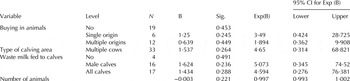
A questionnaire was performed on 37 Portuguese dairy farms in 3 geographic locations. It included questions related to possible risk factors or transmission of Map in dairy cattle comprising animal replacement policy, type of calving area, waste milk use and size of the lactating herd (Table 1). Other questions were included in the questionnaire to evaluate awareness of paratuberculosis by the farmers.
Results of the logistic regression based on questionnaire data and on the detection of Map in milk samples

N, number of observations; B, coefficient; Sig, Significance; Exp(B), odds ratio; CI, confidence intervals.
Milk samples
Waste milk fed to calves was sampled on three different days on each farm, separated at least 1 week between collections, to increase the likelihood that the source of the milk included different animals. Whenever waste milk was not fed to calves a single bulk tank milk sample was collected. Four milk samples had insufficient amount for processing and therefore 99 milk samples, comprising 95 waste milk samples and 4 bulk tank milk samples were analysed by culture and nested IS900 real time PCR.
Preparation and culture of samples for Map isolation
Milk samples were prepared for culture according to Dimareli-Malli (Reference Dimareli-Malli2010), with minor modifications. The incubation was performed at 37 °C for up to 6 months.
Treatment of samples for genomic DNA extraction
All the milk samples were submitted to a first treatment procedure, as described by Gao & Colleagues (Reference Gao, Mutharia, Raymond and Odumeru2007) with minor modifications. The DNA extraction was performed with the commercial extraction kit – Invisorb® Spin Tissue Mini Kit – protocol 1 (Stratec) with mechanical disruption and according to manufacturer's instructions with some modifications (Supplementary File). The genomic DNA was eluted with 100 µl of elution buffer and stored at −20 °C until being tested.
Amplification assays
A nested PCR approach was used, combining a first amplification step by standard PCR using the extracted DNA as template followed by a second amplification step by real time PCR where the amplified product was used as template. The amplification system was previously optimised for fecal samples (C. Leão, unpublished data) targeting the IS900 multi-copy region. For the first conventional PCR step, external primers EXT-IS900-FW and EXT-IS900-RV were used, followed by real time PCR, using internal primers IS900QF/IS900QR and IS900QP targeted probe, described by Sidoti & Colleagues (Reference Sidoti, Banche, Astegiano, Allizond, Cuffini and Bergallo2011). The limit of detection (LOD) of the assay for milk samples was determined with spiked milk samples (Supplementary file). β-actin gene-targeted probe/primers were used as internal control in the real time PCR to discount the presence of amplification inhibitors.
Statistical analysis
A multivariable logistic regression was performed using SPSS® version 22, to evaluate if the presence of potential risk factors for the occurrence of paratuberculosis at herd level, had a relation with the detection of Map through PCR in milk.
Results and discussion
The 37 farms included in the survey had between 16 and 715 lactating animals (median = 70) on the day the questionnaire was performed. Thirty-three out of the 37 respondents (89·2%) fed waste milk to calves, with 45·9% reporting to feed waste milk to both male and female calves and 43·2% reporting to feed waste milk only to male calves. Feeding waste milk to male calves alone is used by some farmers as an attempt to mitigate some of the possible problems of feeding waste milk, as male calves generally leave the farms at a young age for meat production.
All the farms that used waste milk to feed calves, included in it milk taken from animals during the treatment of clinical cases of mastitis or other diseases that were treated with antimicrobials, and milk taken during the withdrawal period of those treatments. Besides that, 66·7% of farmers also incorporated milk from cows with high cell counts to avoid penalties or maintain a bonus in milk price. Out of the 33 farms that fed waste milk to calves, only one pasteurised the milk before feeding it to calves, which was positive on the PCR after pasteurisation.
Twenty-four milk samples, representing 17 (51·5%) out of the 33 farms that fed waste milk were positive for nested IS900 real time PCR. Only one of the four farms that did not feed waste milk to calves had a positive result on bulk tank milk for Map. None of the 99 cultured milk samples showed visible colonies after the incubation period of 6 months, with culture presenting a contamination rate of 18%. The difficulty in the isolation of Map from milk samples despite positive results being obtained through molecular detection is in accordance to Hanifian & Colleagues (Reference Hanifian, Khani, Barzegari and Shayegh2013), who reported ten times higher rates of positive results by real time PCR detection than with culture. Since these milk samples were collected from animals with other infections (e.g. mastitis) and from animals under treatment, the contamination rate of the cultures and the presence of antimicrobials could restrict the growth of a fastidious agent like Map. A positive culture result depends on the viability of the bacteria, the animal's infection load, the quality of the milk sample and the sample volume that is used in the analysis. It has been described that the number of cells that are excreted in milk of asymptomatic cattle is low, around 2–8 CFU per 50 ml of milk (Slana et al. Reference Slana, Paolicchi, Janstova, Navratilova and Pavlik2008), and the volume that should be used for testing should thus be as high as possible, from 1 to 250 ml per sample (Slana et al. Reference Slana, Paolicchi, Janstova, Navratilova and Pavlik2008). In this work we used only 20 ml of milk for culture and 10 ml of milk for DNA extraction, due to limited availability of higher sample volumes. Detection of Map DNA was thus used as a proxy for the presence of viable Map.
Feeding waste milk to calves has been found to be a significant risk factor for transmission of paratuberculosis (Ridge et al. Reference Ridge, Baker and Hannah2005). Conflicting results have been published regarding the efficacy of pasteurisation to eliminate Map cells from milk, with some authors observing complete destruction of the agent either through pasteurisation at 65·5 °C for 30 min or through high temperature short time pasteurisation (Stabel et al. Reference Stabel, Hurd, Calvente and Rosenbuch2004), and other authors reporting incomplete destruction of the agent following heat treatment (Slana et al. Reference Slana, Paolicchi, Janstova, Navratilova and Pavlik2008). Using waste milk to feed calves only from cows that tested negative for paratuberculosis is not a valid strategy as most of the diagnostic methods for paratuberculosis have fairly low sensitivities. Simultaneously, there is evidence that a high proportion of dairy cows that are negative for Map on fecal culture, have Map DNA on their colostrum, which suggests frequent environmental contamination of teats and milk with the agent (Pithua et al. Reference Pithua, Wells, Godden and Stabel2011). In our study, the validity of milk pasteurisation as a preventative measure to control paratuberculosis could not be assessed as there were no positive cultures for Map, even though there were many positive milk samples when using the PCR. The risk of perpetuating paratuberculosis on these farms through the practice of feeding waste milk to calves is thought to be potentially high.
In terms of biosecurity, 48·6% (n = 18) of the farmers reported to have bought animals within the last 5 years. Out of the 18 farmers that kept an open farm, 66·7% (n = 12) bought animals from multiple sources, whereas the remainder bought animals from a single farm.
It was apparent from the results of the questionnaire that farmers’ awareness on paratuberculosis was limited, with 78·4% (n = 29) of respondents stating they had no paratuberculosis on their herd, even though 32·4% (n = 12) stated they had seen, in the previous year, animals with a clinical picture highly suggestive of paratuberculosis (loss of body condition, chronic incurable diarrhoea and normal appetite). Only one farmer stated he did not know if there were infected animals in his herd. Many farmers also seemed to be unaware of the risks of feeding waste milk to calves, as 45·9% of all the farmers in the survey, fed waste milk to both male and female calves, with only one farm having the practice of pasteurising that milk.
None of the studied potential risk factors (Table 1) were significantly associated with the presence of Map in milk samples, therefore valid conclusions could not be drawn on potential risk factors for positive waste milk samples, probably due to the small scale of this study.
For the studied farms, the prevalence of having a sample positive for Map on PCR was 3·5 times higher for farms that bought in animals from a single origin and 1·9 times higher for farms that bought from multiple farms, when compared with closed farms. The fact that the risk seems higher from farms buying in from single sources than from multiple sources is contrary to what was expected. A previous survey of 122 dairy farms in Portugal showed that 45·9% of the herds had animals with positive serologies (Correia-Gomes et al. Reference Correia-Gomes, Mendonça and Niza-Ribeiro2010). Given this prevalence, it is very likely that buying in replacements will ensure the introduction of animals with paratuberculosis into the herd. In our survey, there was an increased risk of positive Map samples for farms buying in replacements either from a single or from multiple sources.
Only four farms had single calving pens, limiting the usefulness of statistical analyses of single v. multiple animals per calving pen as a risk factor.
This was a small scale study aiming at investigating the risks of feeding waste milk to calves indiscriminately. The potential deleterious effects of this practice are not limited to the transmission of Map, with other infectious agents including Mycoplasma bovis and Salmonella spp., potentially being transmitted from adult cattle to calves in this way. Another possible risk of feeding waste milk to calves is the emergence of antimicrobial resistance in calves’ faecal flora (Duse et al. Reference Duse, Waller, Emanuelson, Unnerstad, Persson and Bengtsson2015). Considered together, these risks should lead farmers to implement mitigation strategies. These might include pasteurisation of waste milk and colostrum at a temperature/duration that guarantee elimination of the agent, not feeding milk with antimicrobials and feeding milk replacer.
Supplementary material
The supplementary material for this article can be found at https://doi.org/10.1017/S0022029917000164.
Farmers and practitioners involved in the study are acknowledged for their collaboration. Funding for materials was provided by InVivoNSA Portugal, S.A. Célia Leão holds a PhD grant from “Fundação para a Ciência e a Tecnologia” SFRH/BD/62469/2009.