Significant outcomes
• The glutamate antagonist memantine induced distinct changes in the motor activity patterns with increased variability and alterations in healthy subjects
• The memantine‐induced changes partly resembled those found in schizophrenia patients
Limitations
• The study design was open and exploratory, and the findings must be tested in hypothesis‐driven studies
• The schizophrenia patients used antipsychotic drugs which could be a confounder
Introduction
Glutamate is the principal excitatory neurotransmitter and is implicated in numerous physiological and pathological processes in the central nervous system Reference Tzschentke1. Glutamate acts on different receptors and the ionotropic N‐methyl‐d‐aspartate (NMDA) receptor has been a major neuroscience research target in the last decades, resulting in several new agents for neurological diseases including epilepsy and Alzheimers disease Reference Tzschentke1, Reference Kalia, Kalia and Salter2. There is evidence from studies in animals and healthy human subjects implicating the NMDA receptor also in the regulation of movements, including the demonstration of heightened locomotor activity and disturbed motor coordination in rats exposed to the NMDA antagonist memantine (1‐amino‐3,5‐dimethyladamantane hydrochloride) Reference Sukhanov, Zakharova, Danysz and Bespalov3, Reference Mares and Mikulecka4. Furthermore, memantine has been shown to protect against haloperidol‐induced oral dyskinesias in rats Reference Andreassen, Aamo and Joorgensen5, Reference Andreassen, Waage, Finsen and Jorgensen6. In double‐blind, placebo‐controlled randomised trials in healthy human subjects, repeated memantine administration has been shown to block muscular training‐induced physiological changes in the motor cortex as determined by transcranial magnetic stimulation Reference Schwenkreis, Witscher, Pleger, Malin and Tegenthoff7; and a single‐dose of memantine decreased the stimulus‐evoked movement time of a finger to a response button Reference Rammsayer8. However, the evidence is nevertheless fragmented with few studies, and further research is needed, particularly regarding the role of dysfunctional transmission at NMDA receptors in relation to gross motor function and variability in humans. Disturbance of movement is intrinsic to several neurological and neuropsychiatric disorders, e.g. schizophrenia Reference Morrens, Hulstijn and Sabbe9, Reference Pappa and Dazzan10, and contributes significantly to the stigma and disability of these conditions. Thus, further insight into the neurochemical mechanisms involved is critical in order to develop more targeted treatment strategies.
Berle et al. Reference Berle, Hauge, Oedegaard, Holsten and Fasmer11 have demonstrated the usefulness of actigraphic registration for measuring time‐dependent gross motor activity in humans. In recent years, a new framework for analysis and evaluation of time series has emerged. Methods from nonlinear dynamics have been applied to various areas in physiology and clinical medicine Reference Di Mascio, Di Giovanni, Di Matteo and Esposito12, Reference Ehlers13, Reference Huikuri, Makikallio, Peng, Goldberger, Hintze and Moller14, Reference Ilias, Vgontzas, Provata and Mastorakos15, Reference Kramlinger and Post16, Reference Liu, Iranmanesh, Keenan, Pincus and Veldhuis17, Reference Tuzcu, Nas, Borklu and Ugur18. These methods range from studying the randomness versus chaos by measuring the nonlinearity in a signal to estimating the fractal dimension of its corresponding attractor. A number of researchers have, by using different algorithms, studied the entropy of a time series, i.e. different measures of the order and predictability in the series Reference Aboy, Cuesta‐Frau, Austin and Mico‐Tormos19.
Aims of the study
The primary aim of this exploratory study was to investigate the influence of an NMDA antagonist drug on motor function and variability in healthy human subjects by using actigraph registration, and to analyse the data by means of linear and nonlinear methods. We further re‐analysed previously collected actigraph data obtained on patients with schizophrenia, and as a secondary analysis compared the results for the two groups.
Materials and methods
Subjects
A total of 29 right‐handed healthy subjects were included for this explorative study with a mean age of 24.1 [standard deviation (SD) 3.9] (range 18–36) years. Thirteen (44.8%) subjects were women. The healthy participants were screened by a psychiatrist before inclusion. Exclusion criteria were psychiatric or neurologic diagnosis, current pregnancy or breastfeeding, other ongoing medication (except for oral contraceptives), epilepsy, cardio‐vascular diseases, special diet and allergies. Female participants were required to have a negative urine pregnancy test at baseline, and to use an effective method of birth control before entry and throughout the study. All 29 participants were included after the screening procedure. Actigraph data for the healthy participants were compared with data from 24 schizophrenia patients that have been published previously Reference Hauge, Berle, Oedegaard, Holsten and Fasmer20. The data for the patients were re‐analysed and statistically compared with the healthy sample as secondary analyses. The mean age of the schizophrenia group was 47.4 (SD 11.1) years and 21 (12.5%) were females. The mean Brief Psychiatric Rating scale Reference Rhoades and Overall21 score with SD was 51.5 (9.5) of a possible maximum score of 176. Nine patients used clozapine, nine used other second generation antipsychotics, whereas six patients used first generation antipsychotic drugs. For each patient the dose of the individual antipsychotics used at the time of the actigraph recordings were converted to defined daily doses (DDDs) as developed by the World Health Organization Collaborating Center for Drug Statistics Methodology (http://www.whocc.no/atcddd/ Accessed on 13 March 2012). The basic definition of the DDD unit is the assumed average maintenance dose per day for a drug used for its main indication in adults. The DDD system has been compared to the use of chlorpromazine equivalents and has been found to be a reliable tool for standardising antipsychotic doses Reference Nose, Tansella and Thornicroft22.
The patients were only tested once, without memantine. The study was approved by the regional ethics committee and the Norwegian Medicines Agency. All participants provided signed informed consent.
Intervention
An open‐within‐subject design was used in the healthy subjects, in which both the researcher and the participants were aware of whether they were administered memantine or not. The participants acted as their own controls and were tested twice, with‐ and without memantine, in a counter‐balanced order. The participants had personal contact with a psychiatrist (H. A. J) who was responsible for the drug administration and continuous follow‐up on three occasions; on the day the drug administration period started (day 1), after 7 days and after 14 days. Memantine (Ebixia®; H. Lundbeck AS, Copenhagen, Denmark (EU/1/02/219/002/NO), was used for the pharmacological intervention. Memantine is generally well‐tolerated, and the most frequently occurring adverse events in patients taking memantine include dizziness, headache, constipation, somnolence and hypertension (http://www.medicines.org.uk/emc/medicine/ 10175 Accessed on 5 October 2011). Memantine has 100% bio‐availability with maximum serum concentration 3–8 h after drug administration. Memantine was administered orally as tablets to be taken every day for 21 days. The memantine dose was increased weekly from 10 to 15 to 20 mg/day to obtain close to steady‐state plasma level after 21 days which is reported from clinical trials estimated to remain in the order of 0.5–1 µmol, when increasing the weekly dose from 10 to 15 to 20 mg/day the risk of side effects are reduced Reference Parsons, Danysz and Quack23. The elimination follows an exponential curve with a terminal half life of 60–100 h which means that medication for 21 days are needed to reach a close to steady‐state level. To ensure compliance the blister packages were controlled three times during the drug administration. The control ensured that the correct number of blisters has been opened and tablets removed but did not ensure that the tablets had been swallowed.
Motor activity recordings
Motor activity was measured for 24 h in the non‐memantine condition before memantine was administered. In the memantine condition motor activity was recorded for 24 h between day 20 and 21 after starting memantine. Motor activity was monitored with actigraphs worn at the wrists (Actiwatch, Cambridge Neurotechnology Ltd, Cambridge, England) by means of a piezo‐electric accelerometer that is programmed to record the integration of intensity, amount and duration of movement in all directions. A corresponding voltage is produced and is stored as an activity count in the memory unit of the actigraph. Total number of activity counts was recorded for 1‐min intervals for a continuous period of 24 h, from 09:00 h. The actigraphs were worn at all times except when taking a shower, and the periods without the actigraph were noted. The time series were searched manually to identify periods with continuous motor activity. From each participant the longest continuous period, containing not more than nine consecutive minutes with zero activity was selected.
Statistical analyses
The SD, the root mean square successive differences (RMSSD), the RMSSD/SD ratio and the autocorrelation (lag 1), were calculated using the time series with continuous motor activity. Sample entropy was also calculated from these time series.
Sample entropy
Data were normalised before analysis, by transforming the time series to have sample mean 0 and sample variance 1. Sample entropy is a nonlinear measure, indicates the degree of regularity (complexity) of time series, and is the negative natural logarithm of an estimate of the conditional probability that subseries of a certain length (m) that match point‐wise, within a tolerance (r), also match at the next point. We chose m = 2 and r = 0.2. Sample entropy was used since it is regarded as the best measure of entropy in biological time series Reference Richman and Moorman24.
Fourier analysis
From each of the time series with continuous motor activity the first period of 256 min, containing not more than four consecutive minutes with zero activity was selected. Data were normalised before analysis. No windows were applied. Results are presented as the ratio between variance in the low (0.00007–0.001 Hz, corresponding to the period from 16 to 256 min) and the high frequency range (0.001–0.008 Hz, 2–16 min).
The software used for the sample entropy and Fourier analyses were obtained from the PhysioToolkit Research Resource for Complex Physiologic signals; see http://www.physionet.org Reference Goldberger, Amaral and Glass25.
The obtained data were analysed in the SPSS version 18. For comparisons between the non‐memantine and memantine conditions linear mixed effects (LME) models were applied. Fixed effects were non‐memantine versus memantine groups, and random effects were the subjects that defined the grouping variable for actigraph recordings from both arms. LME was considered the analysis of choice, as there were actigraph recordings from both arms for both the non‐memantine and memantine conditions in the individual subjects and missing data was non‐ignorable. Given the exploratory nature of the study, no adjustments for multiple comparisons were made.
For comparisons between the re‐analysed data from the schizophrenia patients and the healthy subjects an independent samples t‐test was used and supplementary sensitivity analyses adjusting for age differences were conducted by means of univariate general linear models (GLM).
Pearson correlation analyses were applied for exploring associations between variables.
Results
No serious adverse events occurred in the healthy subjects during the study. Slight tiredness and dizziness during the first few days of treatment were the most frequent side effects reported by half the sample. In a few instances, this was also reported at the highest dose (20 mg). In two persons dizziness was combined with slight nausea.
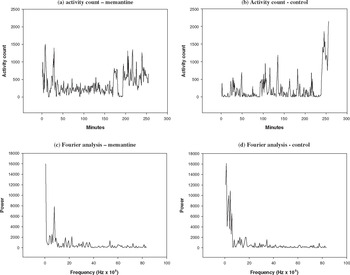
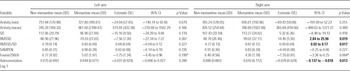
The actigraph outcomes are presented in Fig. 1 and Table 1. The RMSSD and the RMSSD/SD ratios were significantly higher in the memantine condition compared to in the control situation. Furthermore, memantine was associated with lower autocorrelation in the lag 1. These differences were present for the right arm only. There was a trend towards lower low frequency high frequency variance ratio in the 256‐min period (Fourier 256l/h) for the memantine condition compared to the non‐memantine condition for the right arm. When both arms were analysed collectively the difference reached statistical significance [LME: p = 0.030; difference estimate −1.72; 95% confidence interval (CI) −3.26 to −0.17].
Activity counts and Fourier analyses. (a) activity count – memantine. (b) Activity count – control. (c) Fourier analysis – memantine. (d) Fourier analysis – control.

Results from actigraphic recording of 300‐min periods with continuous motor activity in the healthy subjects

SD, standard deviation; SE, standard error; RMSSD, root mean square successive differences; SAMPEN, sample entropy; Fourier 256l/h, Fourier256 low frequency spectrum [0.00007–0.001 Hz (16–256 min)]/Fourier 256 high frequency spectrum [0.001–0.008 Hz (2–16 min)]. Differences with a p‐value (p) < 0.05 are in bold.
*p < 0.05 compared to control condition when both arms analysed collectively.
The RMSSD/SD ratio was strongly inversely correlated with the autocorrelation lag 1 (Pearson Correlation r = −0.936, p < 0.001). Both the RMSSD/SD ratio (Pearson Correlation r = 0.354, p = 0.001) and the autocorrelation lag 1 (Pearson correlation r = −0.413, p < 0.001) were significantly correlated with the sample entropy.
There were outliers for one healthy subject during the period of memantine use, as the mean activity registered were approximately 10‐fold that of the rest of the sample. In sensitivity analyses excluding the outliers the results remained essentially unaltered.
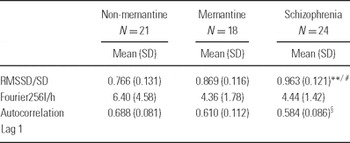
A total of 24 schizophrenia patients from the previously published study were re‐analysed Reference Hauge, Berle, Oedegaard, Holsten and Fasmer20. Comparisons with the healthy subjects in the memantine and non‐memantine conditions are presented as secondary analyses in Table 2. The RMSSD/SD and autcorrelation in the first lag were statistically different in the schizophrenia patients compared to in the healthy subjects in the non‐memantine condition. Furthermore, the Fourier 256l/h ratio difference towards the non‐memantine condition reached borderline statistical significance (t‐test: p = 0.052; mean difference 1.96; 95% CI −0.02 to 3.95). There were no substantial differences among the schizophrenia patients and the healthy subjects in the memantine condition for the Fourier 256l/h ratio or the autocorrelation lag 1, whereas the RMSSD/SD ratio was higher in the schizophrenia patients compared to in the memantine condition (t‐test: p = 0.015; mean difference 0.09; 95% CI −0.17 to −0.02). In sensitivity analyses adjusting for the age difference between the schizophrenia patients and the healthy subjects the results remained essentially unaltered with the exception of the schizophrenia versus non‐memantine condition for the autocorrelation lag 1 outcome, as in the age‐adjusted analyses the difference was a trend (GLM: p = 0.08) towards significance. The corresponding CI only marginally included zero (−0.011 to 0.162). The DDDs of the antipsychotics were not associated with neither the Fourier 256l/h ratio; the RMSSD/SD ratio, nor the autocorrelation lag 1, as determined by Pearson correlation analyses.
Schizophrenia group compared to the healthy subjects in the non‐memantine and memantine conditions, adjusted for age

SD, standard deviation; SE, standard error; RMSSD, root mean square successive differences; h, Fourier256 low frequency spectrum [0.00007–0.001 Hz (16–256 min)]/Fourier 256 high frequency spectrum [0.001–0.008 Hz (2–16 min)].
**p < 0.001 compared to non‐memantine.
#p < 0.05 compared to memantine.
§p = 0.084 compared to non‐memantine.
Discussion
The main findings of this study were the different profiles of motor activity during the memantine and non‐memantine conditions for RMSSD, RMSSD/SD, and the autocorrelation in the first lag, and that these differences were restricted to the right arm. The memantine condition was associated with an increased RMSSD and RMSSD/SD ratio in the recordings, indicating increasing alterations in successive registrations. Interestingly, the latter finding is in correspondence with that of Hauge and collaborators Reference Hauge, Berle, Oedegaard, Holsten and Fasmer20 who found a significantly higher RMSSD/ SD ratio in schizophrenia patients compared to in depressed patients and healthy controls. Furthermore, the autocorrelation between adjacent registrations (Autocorrelation lag 1) was significantly lower in the memantine condition. When autocorrelation analyses were run in the previously published data by Hauge et al. Reference Hauge, Berle, Oedegaard, Holsten and Fasmer20 in schizophrenia patients, and then compared to the healthy subjects, a partly corresponding relationship towards the non‐memantine condition was disclosed, which may suggest that both the memantine condition and schizophrenia are associated with similar alterations in motor activity patterns. The fact that the differences between the non‐memantine‐ and memantine conditions were disclosed in the right arm only may indicate a stronger impact of NMDA antagonism in the dominant arm as all the healthy subjects were right‐handed but the present study does not provide further explanations for this observation .
Not surprisingly, there was a very strong association between the RMSSD/ SD ratio and autocorrelation at lag 1. Unlike our findings, Hauge et al. Reference Hauge, Berle, Oedegaard, Holsten and Fasmer20 found significantly increased sample entropy in the schizophrenia group compared to the healthy controls. They also found a statistically significant correlation between sample entropy and RMSSD/SD. In this study sample entropy did not differ between the memantine and non‐memantine conditions. We did, however, find statistically significant correlations between sample entropy and RMSSD/SD, and between sample entropy and autocorrelation lag 1, respectively.
The ratio between the variance in the low versus the high frequency compartment of the spectrum was significantly lower in the memantine condition when data from both arms were analysed collectively but a similar trend was found also for the right arm isolated. Hauge et al. Reference Hauge, Berle, Oedegaard, Holsten and Fasmer20 correspondingly found reduced variation in the low‐frequency compartments and higher variation in the high‐frequency compartments of the spectrum for schizophrenia patients compared to the other groups. Hauge et al. Reference Hauge, Berle, Oedegaard, Holsten and Fasmer20 suggest this to be a fundamental difference between schizophrenia patients and the other groups. In the direct comparison of the schizophrenia patients to the non‐memantine condition in the healthy subjects the difference followed the same pattern and reached borderline statistical significance.
Indeed altered motor function is well documented in schizophrenia and related psychoses Reference Morrens, Hulstijn and Sabbe9, Reference Berle, Hauge, Oedegaard, Holsten and Fasmer11, Reference Fink, Shorter and Taylor26 but has gained far less attention than the positive psychotic symptoms. The evidence suggests that abnormal movements might also be caused by the common pathogenesis of schizophrenia Reference Morrens, Hulstijn and Sabbe9, Reference Pappa and Dazzan10 although the association between motor symptoms and psychosis may easily be confounded as most antipsychotic drugs have the propensity to induce adverse motor effects including the extrapyramidal syndrome (EPS) and akathisia Reference Tandon and Jibson27. At the molecular level dopaminergic receptors remain the most robust neurochemical drug target in schizophrenia Reference Howes and Kapur28, and the dopaminergic system is strongly implicated in movement regulation Reference Korchounov, Meyer and Krasnianski29. Moreover, all antipsychotics antagonise dopaminergic transmission at the dopaminergic type 2 (D2) receptors, and with striatal D2 occupancies above about 80% there is a high likelihood of EPS Reference Abi‐Dargham and Laruelle30. Importantly, there is also strong evidence for glutamatergic dysfunction at the NMDA receptors in schizophrenia Reference Abi‐Dargham and Laruelle30. The finding in this study of memantine inducing movement patterns partly similar to those seen in schizophrenia patients is interesting and could point to the involvement of the NMDA receptor in schizophrenia‐associated movement disturbances.
Some limitations to the study should be discussed. There were only statistically significant differences among the memantine and non‐memantine conditions for some of the outcomes, and no adjustments for multiple analyses were made. There is accordingly a hypothetical risk of statistical type I errors. We do not believe this to be the case; however, as the differences were consistent internally as RMSSD, RMSSD/SD and autocorrelation are different measures of the same phenomenon although we do not know what biological substrates the outcome measures correspond to. Our results in the memantine condition were only partly in correspondence with findings in a schizophrenia group Reference Hauge, Berle, Oedegaard, Holsten and Fasmer20 and should be interpreted with caution. The schizophrenia patients used antipsychotic drugs which could confound the suggested association between motor disturbances, schizophrenia and decreased NMDA receptor transmission, as motor side effects are associated with antipsychotic drugs Reference Tandon and Jibson27. Nine patients used clozapine and nine used other second seneration antipsychotics (SGA). The SGAs as a group and clozapine in particular are associated with reduced tendencies for parkinsonian movement disturbances compared to the older antipsychotic drugs Reference Leucht, Corves, Arbter, Engel, Li and Davis31. Also, there were no associations between the DDDs of the antipsychotics, and the Fourier256l/h ratio; the RMSSD/SD ratio; or the autocorrelation lag 1. Obviously, the potential bias posed by the antipsychotic drugs can only in part be addressed by controlling for the doses used. The drugs are very heterogeneous pharmacologically and display very diverse receptor affinities. Several receptors could directly or latently be implicated in motor functioning. Future studies should aim at including preferentially antipsychotic drug‐naïve patients to avoid this potential bias. The moderate affinity of memantine for the NMDA receptor Reference Parsons, Danysz and Quack23 may not be sufficient to induce changes in glutamatergic transmission that fully correspond to those found in schizophrenia. No serum level assessments of memantine were made, which could be a source of bias if the subjects were not adherent to the dosing regimen. This would tend to decrease the magnitude of differences between the memantine and non‐memantine condition, thus increasing the risk of statistical type II errors. No blinding procedure was applied in this exploratory study, which theoretically could introduce bias. We lack an interpretation of how knowledge of the treatment may have affected the outcome measures. Finally, the schizophrenia patients were older than the healthy subjects which could also be a potential confounder. However, no correlation with age for any of the outcomes reported was found in the schizophrenia group as disclosed by Hauge et al. Reference Hauge, Berle, Oedegaard, Holsten and Fasmer20. Moreover, in a recent actigraph study in schizophrenia patients the motor activity parameters were influenced by neither age, gender, nor duration of illness Reference Walther, Horn, Razavi, Koschorke, Muller and Strik32. Lastly, adjusting for age left the results essentially unaltered.
In summary, memantine was found to be associated with changes in the motor activity patterns that were distinct and partly resembled those found in a schizophrenia group using antipsychotics. However, the results should be interpreted with caution because of the open design and the lack of known biological substrate to which the outcome measures correspond, and accordingly the study should be regarded as hypothesis‐generating. New hypothesis‐driven studies should be undertaken with more rigid designs and preferably drug‐naïve patients.
Acknowledgements
The work was supported by public funding sources including the University of Bergen and the Division of Psychiatry, Haukeland University Hospital. The funding sources had no role in study design; in the collection, analysis and interpretation of data; in the writing of the report; or in the decision to submit the article for publication.
E. J. has received honoraria for lectures given in meetings arranged by Bristol‐Myers Squibb, Eli Lilly, and AstraZeneca and for a contribution to an information brochure by Eli Lilly. E. J. has been reimbursed by the Eli Lilly Company and the Janssen Cilag Company for attending conferences. H. A. J. has received honoraria related to meetings arranged by the AstraZeneca and Eli Lilly companies.
E. R. H. has received an unrestricted grant from Eli Lilly and Company.
E. J. interpreted the data, drafted the manuscript and did the statistical analyses. O. B. F. collected the data, interpreted the data, co‐drafted the manuscript and participated in the statistical analyses. H. A. J., H. V. W. and E. R. H. participated in the data collection, interpreted the data and made contributions to the drafting of the manuscript. K. H. contributed to the drafting of the manuscript, interpreted the data. All authors participated in revising the manuscript for important intellectual content and read the final version of the manuscript.