INTRODUCTION
Strategic management scholars have paid increasing attention to the role of the board of directors in making decisions around strategic change, especially when firms are faced with environmental discontinuities or performance decline (Forbes & Milliken, Reference Forbes and Milliken1999; Goodstein, Gautam, & Boeker, Reference Goodstein, Gautam and Boeker1994; Hoppmann, Naegele, & Girod, Reference Hoppmann, Naegele and Girod2019). Strategic change refers to the overall change of a firm's resource allocation pattern in multiple key strategic dimensions (Carpenter, Reference Carpenter2000; Finkelstein & Hambrick, Reference Finkelstein and Hambrick1990; Zhang & Rajagopalan, Reference Zhang and Rajagopalan2010). According to literature emphasizing the strategic role of the board, strategic change decisions are discussed and selected by the board based on strategic alternatives generated by the chief executive officer (CEO) (Castro, De La Concha, Gravel, & Periñan, Reference Castro, De La Concha, Gravel and Periñan2009). For this reason, by taking a resource dependence theory, agency theory, or upper echelons perspective, prior studies have examined the impact of the board of directors on strategic change. These studies focus on board characteristics such as size (Goodstein et al., Reference Goodstein, Gautam and Boeker1994), composition (Brunninge, Nordqvist, & Wiklund, Reference Brunninge, Nordqvist and Wiklund2007), gender diversity (Sidhu, Feng, Volberda, & Van Den Bosch, Reference Sidhu, Feng, Volberda and Van Den Bosch2021; Triana, Miller, & Trzebiatowski, Reference Triana, Miller and Trzebiatowski2014), industry expertise (Oehmichen, Schrapp, & Wolff, Reference Oehmichen, Schrapp and Wolff2017), and social capital (Haynes & Hillman, Reference Haynes and Hillman2010).
Prior studies have greatly enhanced our understanding of the board’s role in strategic change. However, existing literature mainly focuses on the external observable characteristics of the board as a group of individuals, and little is known about how internal group processes or dynamics among board members influence strategic change when the focal company faces performance decline (Hoppmann et al., Reference Hoppmann, Naegele and Girod2019; Müller & Kunisch, Reference Müller and Kunisch2018). Many studies from behavioral theory of the firm show that performance decline is an important stimulus for initiating strategic change (e.g., Greve, Reference Greve1998; Park, Reference Park2007), thus providing a good opportunity for in-depth exploration of group process of boards in addressing such issues. It stands to reason that insights into group processes are essential for better understanding the formation process and the mechanism of strategic change decisions, and also have important practical implications for the design of corporate governance.
Group psychology research shows that in group decision-making (such as board decisions on strategic change) group members are prone to cognitive bias in group discussions, which will affect decision-making (Baron & Kerr, Reference Baron and Kerr2003). We investigate how group polarization, a typical group-level cognitive bias, affects strategic change decisions made by boards, and how other group-level factors mitigate this bias. Group polarization occurs when an initial tendency of individual group members toward a given direction is enhanced after group discussion (Isenberg, Reference Isenberg1986). For example, ‘when prior premium experience would lead directors on average to support a relatively high premium prior to board discussions, they will support a focal premium that is even higher after discussions’ (Zhu, Reference Zhu2013: 800). Strategic change is a key topic for board discussion because of its strategic importance, especially when firms face declining performance.
Group polarization theory suggests that there is a group polarization effect in board decisions about strategic change. Specifically, we argue that if the average degree of strategic change related to declining performance experienced by board members before the discussion is relatively high, the board tends to support a higher degree of strategic change to address a current decline (the focal strategic change in this study). At the same time, we argue that if the average degree of strategic change related to declining performance experienced by board members before the discussion is relatively low, the board will tend to support lower strategic change in tackling performance after discussion.
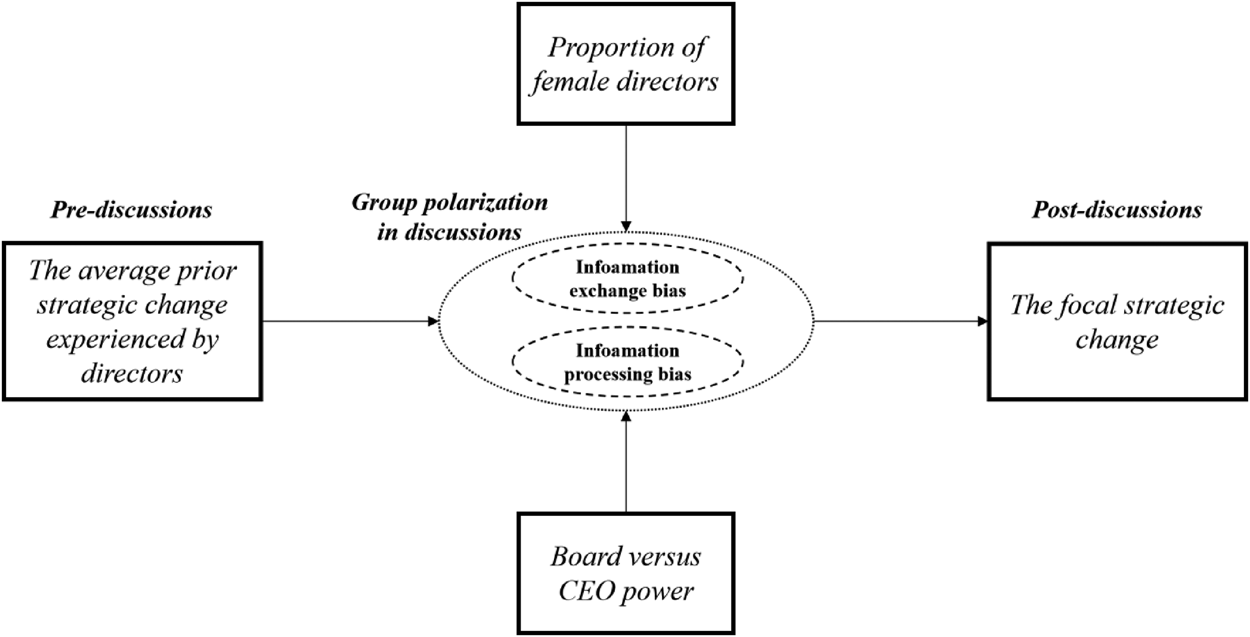
We go a step further to explore the conditions that may shape the group polarization effect. Group-induced polarization is essentially enhancement of the group's dominant trend (Lamm & Myers, Reference Lamm, Myers and Berkowitz1978), the formation of which is closely related to the bias of information exchange and information processing by group members during the group process (Zhu, Reference Zhu2013, Reference Zhu2014). Factors that increase or reduce this bias can serve as potential boundary conditions (Zhu, Reference Zhu2014). A well-established view in social psychology holds that group processes are influenced by both the demographics of intragroup members and intergroup relations (Hogg & Abrams, Reference Hogg and Abrams1988). In terms of intragroup members, existing research has found that female directors can increase the diversity of information exchange and thoroughness of discussions in the boardroom (Kolev & McNamara, Reference Kolev and McNamara2020; Terjesen, Sealy, & Singh, Reference Terjesen, Sealy and Singh2009). For intergroup relations, we focus on the top management team (TMT) (Hambrick & Mason, Reference Hambrick and Mason1984), and in particular prior research has pointed out that TMT's influence on board's decision-making process actually depends on the board–CEO power relationship (Boyd, Haynes, & Zona, Reference Boyd, Haynes and Zona2011; Haynes & Hillman, Reference Haynes and Hillman2010). We, therefore, examine the moderating effects of the proportion of female directors and board versus CEO power. Figure 1 shows the conceptual model for this article.
Conceptual model

We used a longitudinal sample of 8,172 observations from 2,537 Chinese listed companies between 2008 and 2018 to test our hypotheses. We found a strong group polarization effect in board decisions about strategic change. We also found that the proportion of female directors and the board versus CEO power could help alleviate the group polarization effect. The framework and findings of this study make several important contributions. First, it contributes to a better understanding of the group process of strategic change by focusing on the influence of group polarization (Powell, Lovallo, & Fox, Reference Powell, Lovallo and Fox2011). Second, it contributes to the contextualization and refinement of group polarization theory by identifying its boundary conditions (Boyd, Haynes, Hitt, Bergh, & Ketchen, Reference Boyd, Haynes, Hitt, Bergh and Ketchen2012). Third, it contributes to the corporate board literature on female directors by finding that the proportion of female directors can reduce group cognitive bias, thus providing strong evidence for increasing the proportion of female board directors.
THEORETICAL BACKGROUND
Common Group-Level Cognitive Biases and Strategic Decision-Making
Cognitive bias refers to a systematic deviation from rational norms that may arise from cognitive shortcuts. Cognitive bias is often critical to decision-making in an uncertain environment (Tversky & Kahneman, Reference Tversky and Kahneman1974). ‘Cognitive biases are an ever-present ingredient of strategic decision-making. Clearly, a better understanding of how biases influence strategic decision processes should help managers in becoming more effective in achieving their goals’ (Das & Teng, Reference Das and Teng1999: 757).
Previous studies have found that cognitive bias plays an important role in a variety of fields such as strategic management (Das & Teng, Reference Das and Teng1999), entrepreneurship (Shepherd, Williams, & Patzelt, Reference Shepherd, Williams and Patzelt2015), innovation (Galasso & Simcoe, Reference Galasso and Simcoe2011), and corporate social responsibility (Tang, Qian, Chen, & Shen, Reference Tang, Qian, Chen and Shen2015). The existing literature has focused mainly on cognitive bias at the individual level and has paid little attention to cognitive bias at the group level. Considering that most enterprise decisions are made by groups rather than individuals, we believe that group cognitive bias may offer an in-depth explanation for variations in strategic decisions. Indeed, paying attention to group cognitive bias helps us open the ‘black box’ of group decision-making process.
In a few studies focusing on group cognitive bias, scholars have identified the impact of different types of group-level cognitive bias on firms’ decision-making. For example, Zhu (Reference Zhu2013) found that there was a group polarization effect on board decisions regarding acquisition premiums. Specifically, when previous premium experience leads directors, on average, to support a relatively high (low) premium before board discussions, they tend to support a focal premium that is even higher (lower) after discussions. This group polarization effect also occurs in board decisions regarding CEO compensation (Zhu, Reference Zhu2014). Malhotra, Zhu, and Reus (Reference Malhotra, Zhu and Reus2015) found another group cognitive bias in acquisition premium decisions, namely the anchoring effect. The authors found that managers tended to view a market's preceding acquisition premium as an anchor for their own decisions regarding the acquisition premium. This anchoring effect is also found in international equity ownership decisions (Malhotra, Morgan, & Zhu, Reference Malhotra, Morgan and Zhu2018).
This article focuses on strategic change, an important topic of group decision-making. Over the past four decades, strategic management scholars have studied strategic change from different perspectives (see Müller & Kunisch, Reference Müller and Kunisch2018; Rajagopalan & Spreitzer, Reference Rajagopalan and Spreitzer1997, for a review). Among these, the cognitive perspective is regarded as an important perspective (Rajagopalan & Spreitzer, Reference Rajagopalan and Spreitzer1997), whose underlying assumption is that the environment cannot be determined objectively but can only be perceived/presented through the decision-makers’ cognition (Johnson, Reference Johnson1992). In other words, their cognition plays a key role in their company's strategic change, especially when the decision environment is extremely uncertain.
Although strategic change literature emphasizes decision-makers’ cognition or cognitive bias, the difficulty in measuring has led most studies to take an upper echelons perspective and use demographic characteristics of groups as a proxy variable of cognitive bias such as faultline (Richard, Wu, Markoczy, & Chung, Reference Richard, Wu, Markoczy and Chung2019) and diversity (Sidhu et al., Reference Sidhu, Feng, Volberda and Van Den Bosch2021). Although some studies have focused on the role of cognitive bias in strategic change, most focus on individuals (i.e., CEOs) and pay little attention to cognitive bias at the group level (e.g., Delgado-García & De La Fuente-Sabaté, Reference Delgado-García and De La Fuente-Sabaté2010; Wu & Gong, Reference Wu and Gong2018). An exception is the study by Westphal and Bednar (Reference Westphal and Bednar2005), who found that, in the face of low performance, the board of directors had problems initiating strategic change mainly because of a group cognitive bias of pluralistic ignorance, which led to directors having a tendency to underestimate other directors’ concerns about the company's viability. This tendency made it less likely that individual directors would express concern about current corporate strategy at board meetings, and ultimately less likely that the board would initiate strategic changes in response to poor corporate performance. Furthermore, in this seminal article, which integrates strategic management and group psychology, the authors called on future researchers to actively explore the impact of other types of group cognitive bias on strategic change decision-making.
As a response, this article aims to examine the effect of group polarization on board decisions about strategic change for two reasons. On the one hand, group polarization is a typical group cognitive bias. In particular, the existing literature has found that group cognitive bias exists in board discussions, which will affect board decisions on mergers and acquisition (M&A) premiums (Zhu, Reference Zhu2013) and CEO compensation (Zhu, Reference Zhu2014). On the other hand, however, little attention has been paid to group polarization in management. Zhu (Reference Zhu2013, Reference Zhu2014) called on future researchers to explore the influence of group polarization on other strategic board decisions in a non-American context. To the best of our knowledge, this article is among the first to examine the group polarization effect of boards on strategic change decision-making in the context of China, which will contribute to research on the microfoundations of strategic change and the contextualization of group polarization theory.
Group Polarization as a Common Group-Level Cognitive Bias
The concept of group polarization can be traced back to Stoner's (Reference Stoner1961) graduate thesis, in which he found that participants increased the risk of decision-making (‘risk shift’) after group discussion (Stoner, Reference Stoner1961). Inspired by Stoner's work and later studies in social psychology, Myers and Lamm (Reference Myers and Lamm1976) used the term ‘group polarization’ to describe polarization of post-discussed views in the same direction as pre-discussed views. As a common group-level cognitive bias, group polarization has been widely applied in psychology and communication research. Unfortunately, although organizational decision-making is essentially done by groups, strategic management research has been slow to apply group polarization logic, with some notable exceptions (Zhu, Reference Zhu2013, Reference Zhu2014).
The literature suggests that information exchange and information processing bias in group discussions can lead to group polarization (Isenberg, Reference Isenberg1986; Myers & Lamm, Reference Myers and Lamm1976; Zhu, Reference Zhu2013, Reference Zhu2014). The idea that information exchange causes bias comes from social comparison theory (Festinger, Reference Festinger1954), which assumes that individuals tend to compare themselves with others to evaluate their abilities and perspectives, and that individuals expect to be positively recognized by society. Accordingly, in a discussion, when an individual's initial opinion is consistent with the group's mainstream opinion, the individual will be more confident in expressing a consistent opinion. When an individual's initial opinion is not consistent with the group's opinion, the individual will tend to hide her/his views due to social risk concerns. In this way, mainstream views are strengthened, though opposing views are retained after group discussions, resulting in group polarization. Baldwin and Mussweiler (Reference Baldwin and Mussweiler2018: E9067) found that ‘social comparison is linked to cultural practices that promote strong norms and punishment for deviance (tightness) and those that promote relational self-construal (collectivism)’. Considering that Chinese culture is characterized by tightness (Mu, Kitayama, Han, & Gelfand, Reference Mu, Kitayama, Han and Gelfand2015) and collectivism (Hofstede, Reference Hofstede1984), we believe that the bias of information exchange in group discussion will be significant in the Chinese context.
Information processing in group polarization is derived from persuasive arguments theory (Deutsch & Gerard, Reference Deutsch and Gerard1955; Vinokur & Burstein, Reference Vinokur and Burstein1974). This theory posits that for any discussion topic, there are a set of arguments that have been shared by some members of the group. In the discussion, arguments that support the mainstream direction will be mentioned and addressed in more detail. Moreover, the fact that an individual's initial opinion is consistent with the mainstream opinion will increase the individual's confidence in the correctness of the initial opinion. Strong belief by supporters can further strengthen the mainstream view, leading to group polarization. However, we need to note that group polarization differs from path dependence in two ways. On the one hand, path dependence is about stability or lock-in because ‘the notion of path dependence highlights the inability of organizations to change’ (Sydow, Schreyögg, & Koch, Reference Sydow, Schreyögg and Koch2020: 717), whereas group polarization reflects the change of group attitude away from the original direction after discussion (Myers & Lamm, Reference Myers and Lamm1976). On the other hand, group polarization can be tested (Friedkin, Reference Friedkin1999), but, path dependence cannot be tested directly, because ‘no indicators are available that allow for examining whether or not the organizational phenomena in question are actually path dependent’ (Sydow, Schreyögg, & Koch, Reference Sydow, Schreyögg and Koch2009: 689).
In fact, social comparison theory (represented by information exchange) and persuasive arguments theory (represented by information processing) are complementary rather than mutually exclusive in explaining the phenomenon of group polarization (Burnstein & Vinokur, Reference Burnstein and Vinokur1977; Sanders & Baron, Reference Sanders and Baron1977; Sieber & Ziegler, Reference Sieber and Ziegler2019). While social comparison theory emphasizes the information exchange bias as individuals have the tendency to avoid being different from the majority, persuasive arguments theory highlights the information processing bias as individuals’ confidence is enhanced by the dominant opinion. In other words, information exchange bias reinforces information processing bias, and the result is that the weaker expression of minority opinions makes mainstream opinions more visible and accessible in the discussion, ultimately leading to group polarization. The poor representation of minority opinions in the discussion is an important source of group polarization effects (Zhu, Reference Zhu2014).
HYPOTHESES DEVELOPMENT
Group Polarization in Board Discussions on Strategic Change
Social psychology research into group polarization (e.g., Isenberg, Reference Isenberg1986) compares the average trend before and after discussion by examining whether the average trend after the discussion has the same direction as the average trend before the discussion. Accordingly, in our study, the decision before discussion refers to the average degree of strategic change experienced by board members in addressing performance decline, and the decision after discussion is defined as the current degree of strategic change of the target company in addressing performance decline. We explain why and how the degree of strategic change is polarized after board discussion with a focus on bias in group information exchange and information processing (Zhu, Reference Zhu2013, Reference Zhu2014).
First, opposing opinions about strategic change exist before board discussion. When some directors experienced a relatively high degree of strategic change before the discussion, they tend to support a high degree of strategic change. They will emphasize that this could improve the likelihood of an organization's survival (Haveman, Reference Haveman1992) and improve business performance (Zajac & Kraatz, Reference Zajac and Kraatz1993). Therefore, it can effectively cope with the current performance decline. In contrast, when some directors experienced a relatively low degree of strategic change before the discussion, they will emphasize that low-level strategic changes are an effective way to adapt to the external environment, which can improve performance (Zhang & Rajagopalan, Reference Zhang and Rajagopalan2010) and avoid organizational failure (Amburgey, Kelly, & Barnett, Reference Amburgey, Kelly and Barnett1993).
Second, according to social comparison theory (Festinger, Reference Festinger1954), directors who initially disagree with mainstream views may not speak out because of the social risks associated with expressing minority opinions. For example, if one director expresses doubt and concerns about high-level strategic changes in the discussion (changes that are strongly supported by most directors), this director might be regarded as being different, as trying to challenge the collective judgment, or as failing to understand the importance of strategic change. As a result, this director may not be nominated again to sit on the next board, or other directors will not recommend her/him as a director to other companies. In terms of information exchange (Zhu, Reference Zhu2013, Reference Zhu2014), when the average degree of strategic change experienced by directors in addressing performance decline before the discussion is high (low), the information exchange bias in the discussion will tend toward a high (low) degree of strategic change in addressing performance decline.
Third, as suggested by persuasive arguments theory (Deutsch & Gerard, Reference Deutsch and Gerard1955; Vinokur & Burstein, Reference Vinokur and Burstein1974), when a view in favor of high (low) levels of strategic change becomes mainstream, obvious and noticeable (Echterhoff, Higgins, & Groll, Reference Echterhoff, Higgins and Groll2005), board directors will become more confident in that view. Indeed, when directors realize that a view is shared by others (Baron, Hoppe, Kao, Brunsman, Linneweh, & Rogers, Reference Baron, Hoppe, Kao, Brunsman, Linneweh and Rogers1996; Echterhoff et al., Reference Echterhoff, Higgins and Groll2005), they tend to attribute the supported decision to their confidence in this view rather than the avoidance of exposing minority opinions (Ross & Nisbett, Reference Ross and Nisbett1991; Westphal & Bednar, Reference Westphal and Bednar2005). Moreover, this information process bias cannot be easily corrected due to the lack of informal discussion about strategic issues among directors outside the meeting room (Lorsch & Maclver, Reference Lorsch and Maclver1989; Westphal & Bednar, Reference Westphal and Bednar2005). Social psychology research also shows that individuals’ reinforced confidence in a view is likely to manifest by supporting a more extreme version of the view (Stroebe & Fraser, Reference Stroebe and Fraser1971; Zalesny, Reference Zalesny1990).
Taken together,
Hypothesis 1: When the average prior strategic change experienced by directors in addressing performance decline is relatively high (or low), the focal strategic change in addressing performance decline will become even higher (or lower).
Indeed, the representation of minority opinions during group discussion is critical to the group polarization effect. If minority opinions are fully expressed, the information exchange bias and information processing bias are reduced, and the group polarization effect is reduced. If minority opinions are poorly expressed, the group polarization effect will be enhanced. A well-established view in social psychology holds that both the demographic of intragroup members and intergroup relations can affect group processes (Hogg & Abrams, Reference Hogg and Abrams1988). Gender is one of the easiest demographic characteristics to observe. The literature on board gender diversity finds that female directors can bring different information and perspectives (Kolev & McNamara, Reference Kolev and McNamara2020; Terjesen et al., Reference Terjesen, Sealy and Singh2009), which may create an inclusive atmosphere that encourages those in the minority to speak up in group discussions. Meanwhile, the TMT led by the CEO is another important decision-making group in the company (Hambrick & Mason, Reference Hambrick and Mason1984). The existing literature mainly focuses on the board–CEO power relationship when discussing intergroup relations between these two groups (Boyd et al., Reference Boyd, Haynes and Zona2011; Pearce & Zahra, Reference Pearce and Zahra1991), and believes that without a powerful CEO, the board's discussions are fuller and more thorough (Haynes & Hillman, Reference Haynes and Hillman2010). Therefore, we further explore the moderating effect of the proportion of female directors and board versus CEO power, respectively.
Proportion of Female Directors and Group Polarization
The number of women on boards of directors is increasing, and the important role of female directors in strategic decisions and corporate performance has been widely recognized (Liu, Wei, & Xie, Reference Liu, Wei and Xie2014; Post & Byron, Reference Post and Byron2015). We contend that the proportion of female directors can reduce group information exchange and information processing bias in board discussions by improving the representation of minority opinions, thus mitigating the impact of group polarization on strategic change decisions (Letendre, Reference Letendre2004; Nielsen & Huse, Reference Nielsen and Huse2010; Terjesen et al., Reference Terjesen, Sealy and Singh2009).
On the one hand, female directors can reduce group polarization caused by information exchange bias. Many scholars have found that female directors bring different, and sometimes conflicting, perspectives to the board and spark heated discussion (Bilimoria & Wheeler, Reference Bilimoria, Wheeler, Davidson and Burke2000; Letendre, Reference Letendre2004). For example, Pearce and Zahra (Reference Pearce and Zahra1991) found that boards with a higher proportion of female directors were more likely to participate in open discussions. Huse and Solberg (Reference Huse and Solberg2006) also found that the presence of female directors could help build more effective communication between board members. The presence of women directors helps foster an atmosphere of open debate and free discussion. In this atmosphere, different or conflicting views on strategic change to deal with declining performance will fully emerge, minority opinions are more likely to be expressed and as this occurs, information exchange bias is reduced, and the group polarization effect is ultimately lessened.
On the other hand, the presence of female directors also reduces information processing bias in discussions. The full expression of minority opinions in an open debate and free discussion atmosphere will increase its accessibility and salience, thus improving the information processing of minority opinions by board members. In the face of these different views on the degrees of strategic change in response to performance decline, the board will conduct comprehensive, thorough and cautious analysis (Hogg & Terry, Reference Hogg and Terry2000). Chen and colleagues provide strong evidence for these arguments, finding that ‘boards with one or more female directors will be associated with more thorough intra-board discussions’ which take more time to reach consensus, resulting in fewer and smaller acquisitions (Chen, Crossland, & Huang, Reference Chen, Crossland and Huang2016: 306). Therefore, we believe that when boards have one or more women directors, they engage in more comprehensive and thorough discussion of different opinions, thus reducing the visibility of mainstream opinions and the confidence of supporters of the mainstream opinions in the correctness of those opinions, and finally reducing the information processing bias in board discussions and the resulting group polarization effect. This leads us to:
Hypothesis 2: The effect of the average prior strategic change experienced by directors in addressing performance decline on the focal strategic change in addressing performance decline will be negatively moderated by the proportion of female directors.
Board versus CEO Power
Although the board of directors is the main decision-maker for board decisions on strategic change, the CEO is usually the proposer and executor of the strategic change plan. ‘In other words, the corporation's course of action for the future, which has been developed by the managers, should be thoroughly discussed in the boardroom before implementation’ (Hambrick, Werder, & Zajac, Reference Hambrick, Werder and Zajac2008: 383). We believe that the board's discussion of strategic change in addressing performance is affected by the balance of power between the board and CEO.
In information exchange, when the board has more power than the CEO, whether the CEO is a member of the board or not, the board will discuss the strategic change plan proposed by the CEO more openly and fully because it is less affected by the social risks of questioning the CEO's proposal. As Haynes and Hillman (Reference Haynes and Hillman2010: 1150) point out, ‘without a powerful CEO … directors engage in more discussion and debate that allows more diverse viewpoints to surface’. We surmise that such open communication will help minority opinions be more fully expressed, thus reducing information exchange bias and the group polarization effect. When the power of the CEO is greater than that of the board, whether the CEO is a member of the board or not, the independent judgment of the board will be threatened (Dalton & Kesner, Reference Dalton and Kesner1987). In this case, directors may support the CEO's stance as a type of flattery to increase their chance of appointments or of gaining social capital (Keeves, Westphal, & McDonald, Reference Keeves, Westphal and McDonald2017; Park, Westphal, & Stern, Reference Park, Westphal and Stern2011; Westphal & Stern, Reference Westphal and Stern2007). Directors may also be afraid to express minority opinions because of the social risks associated with questioning the CEO. This will increase the information exchange bias and resulting group polarization effect.
The above arguments show that, compared with the situation where the boards’ power is less than that of the CEO, when the power of the board is greater than that of the CEO, minority opinions will be more fully expressed when it comes to discussing strategic change in addressing performance decline, thus reducing information exchange bias and resulting group polarization effect. Based on the upper echelons theory and managerial discretion literature, one may argue that as a board that is more powerful than the CEO is less constrained by the CEO, the degree of strategic change of the focus company in addressing performance decline can better reflect the will of the board, thus making the main effect more pronounced. However, the same logic may not apply here. First, the independent variable of this article focuses on the degree of strategic change experienced by directors rather than the board's strategic change experience. In other words, we focus on the event itself rather than the individual experiencing it. Second, the mechanism that explains the main effect is the information exchange bias and information processing bias between directors in the group process, which is different from the explanation mechanism provided by the upper echelons theory.
When the board has more power than the CEO, there may also be less information processing bias in board discussions. Minority opinions may be expressed and emphasized more and thus receive more attention, perception, and interpretation from directors. This is true even of those who support mainstream opinions, whose confidence in those opinions will be reduced. Supporters’ ‘strong belief’ is reduced, thus reducing the information processing bias in board discussions and resulting group polarization effect. This leads us to:
Hypothesis 3: The effect of the average prior strategic change experienced by directors in addressing performance decline on the focal strategic change in addressing performance decline will be negatively moderated by the board versus CEO power.
METHODS
Sample and Data
Our initial sample included all Chinese A-share firms listed on the Shanghai and Shenzhen stock exchange from 2008 to 2018. We obtained the basic information from the China Stock Market and Accounting Research (CSMAR) database, which is an authoritative and comprehensive provider of information on Chinese listed companies and is widely used by strategic management scholars (e.g., Richard et al., Reference Richard, Wu, Markoczy and Chung2019). Because the Chinese Ministry of Finance introduced new accounting standards in 2007, statistical data before and after 2007 are not comparable (Xu, Zhou, & Du, Reference Xu, Zhou and Du2019). Given the need to judge a decline in performance, we began our investigation in 2008.
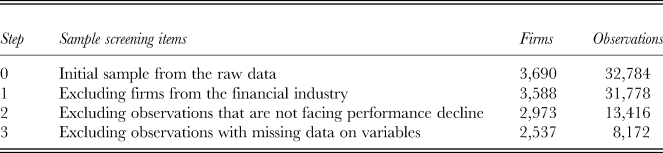
As in previous studies (Xia, Ma, Lu, & Yiu, Reference Xia, Ma, Lu and Yiu2014), we omitted financial firms because of their specific structure and values. Because we were focusing only on strategic changes related to performance decline, we just kept observations of companies facing a decline in performance (see the measures section for specific definitions). After allowing for missing variables information, our final sample was an unbalanced panel of 8,172 observations across 2,537 listed companies from 2008 to 2018. See Table 1 for the specific screening process for the study sample. Two sample t-tests indicated no significant differences between initial strategic change decisions and final strategic change decisions with respect to the dependent variable. The data in this study are from the CSMAR database. We lagged all independent variables by one year.
The specific screening process of the research sample

Variables and Measures
Focal strategic change
Following previous studies (Carpenter, Reference Carpenter2000; Zhang & Rajagopalan, Reference Zhang and Rajagopalan2010), we used a set of financial indicators to create our strategic change measures: (1) advertising intensity (advertising/sales), (2) research and development intensity (R&D/sales), (3) plant and equipment newness ratio (net P&E/sales), (4) nonproduction overhead ratio (sales, general and administrative [SGA] expenses/sales), (5) inventory levels (inventories/sales), and (6) financial leverage (debt/equity). These dimensions capture distinct aspects of a firm's strategic profile (Finkelstein & Hambrick, Reference Finkelstein and Hambrick1990). We first calculated the differences in these ratios between current and previous years – for example, Δfirm R&D intensity = (firm R&D intensityt – firm R&D intensityt −1). We adjusted for the industry effect by subtracting the industry median changes in these ratios. The relevant industry was defined as the focal firm's primary three-digit industry, and the focal firm was excluded in calculating industry median values. For example, industry-adjusted ΔR&D intensity = (firm R&D intensityt – firm R&D intensityt −1) – (industry median R&D intensityt – industry median R&D intensityt −1). We then calculated the absolute values of the industry-adjusted changes in these ratios and standardized the absolute values within the sample (mean = 0, standard deviation = 1). The average of the six standardized values was used as our composite measure of strategic change.
Average prior strategic change experienced by directors
This variable was calculated as the grand mean of all strategic change experienced by a focal board of directors across all boards that the directors have served, including the focal board, during the preceding four-year period (year t−4 to t−1, inclusive) of performance decline. The grand mean is the mean of individual-level average prior strategic change, which is the average of strategic change for a given director in response to performance declines during the preceding four-year period (year t−4 to t−1, inclusive). According to relevant research in social psychology, individuals’ subsequent decisions and judgments often respond to collective decisions they have previously endorsed, as prior behavior updates their beliefs (Festinger, Reference Festinger1954; Whyte, Reference Whyte1993). Observations were omitted when a quarter of the board of directors lacked data on strategic change experience (Zhu, Reference Zhu2013).
Performance decline is specifically defined as follows. Drawing on the concept of Cyert and March's (Reference Cyert and March1963) behavioral theory of the firm, we use the comparison of firm performance and aspiration level rather than absolute performance to identify performance decline. Specifically, if actual performance (P) of a firm (measured as return on assets – ROA) is lower than its aspiration level (A), it is defined as performance decline. Aspiration can be generally divided into historical aspiration based on a firm's past performance and social aspiration based on the performance of other firms (Chen, Zhong, & Lv, Reference Chen, Zhong and Lv2022). Given the difficulty of defining reference points in social comparisons (Kim, Finkelstein, & Haleblian, Reference Kim, Finkelstein and Haleblian2015), we mainly use the definition of performance decline under historical comparisons. Consistent with Chen (Reference Chen2008) and Chen et al. (Reference Chen, Zhong and Lv2022), we model historical aspiration (HA) as an exponentially weighted moving average of past performances, calculated as follows:

where the HA of firm i in year t (HA i, t) is the weighted linear combination of the P of firm i in year t–1 (P i, t−1) and the HA of firm i in year t−1 (HA i, t−1). The weight α 1 was set to 0.4 following Chen (Reference Chen2008) and Chen et al. (Reference Chen, Zhong and Lv2022).
Proportion of female directors
Following previous studies (Nielsen & Huse, Reference Nielsen and Huse2010), the proportion of female directors was measured as the number of female directors divided by total board size.
Board versus CEO power
Following previous research (Haynes & Hillman, Reference Haynes and Hillman2010), we used the following four indicators for a composite measure of CEO versus board power: (1) the ratio of non-independent to the total number of directors, (2) CEO duality (equaling 1/0 for a CEO/non-CEO chairman), (3) the ratio of CEO to board equity holdings, and (4) the ratio of directors appointed after the CEO began their tenure to the total number of directors. We performed principal component analysis on the above four indicators and took the first principal component to measure CEO versus board power. Finally, we took the opposite number to ensure that higher values indicate higher levels of board power in relation to CEO power.
Control variables
Following previous research, we controlled for variables that could affect strategic change at three levels. At the group level, we controlled for board-related variables that would influence strategic change. A large board may bring rich resources and diverse perspectives to the firm but may also increase conflict and make it difficult to reach consensus (Goodstein et al., Reference Goodstein, Gautam and Boeker1994). We measured board size as the total number of directors on the board. We also controlled for TMT- and CEO-related variables that would affect strategic change (Boeker, Reference Boeker1997; Le & Kroll, Reference Le and Kroll2017; Richard et al., Reference Richard, Wu, Markoczy and Chung2019; Wiersema & Bantel, Reference Wiersema and Bantel1992). TMT size was measured as the total number of TMT members (Richard et al., Reference Richard, Wu, Markoczy and Chung2019). TMT members refer to senior managers with the titles of vice president, deputy general manager, chief accountant, chief economist, chief engineer, and so on, as disclosed in the company's annual report. TMT members with long tenure are expected to have more social cohesion, which might make them reluctant to challenge the status quo and change existing strategy. For this reason, we controlled for TMT tenure, measured by taking the average of the aggregate tenure of all top managers (Boeker, Reference Boeker1997). TMT tenure diversity was measured using the coefficient of variation, defined as the standard deviation divided by the mean.
Following Boeker (Reference Boeker1997), we took the logarithm of the heterogeneity measure to capture the decreasing rate of the effect of dissimilarity of TMT tenure on strategic change. Previous research found that TMT functional diversity increased the likelihood of strategic change by providing a diversity of perspective (Lant, Milliken, & Batra, Reference Lant, Milliken and Batra1992). TMT functional diversity was computed as the Blau index (Blau, Reference Blau1977) of individual top executives’ current functions using the expression ${\rm B} = 1-\sum\nolimits_i {P_{ijt}^2 }$ , where P ijt refers to the percentage of category i members in the TMT of firm j in year t. Using the background information of the executive functions of the CSMAR database, we formed the following three categories: (1) Production, R&D and design, (2) Human resources, administration and marketing, and (3) Finance, accounting and law. As older CEOs are less likely to initiate strategic change (Datta, Rajagopalan, & Zhang, Reference Datta, Rajagopalan and Zhang2003), we controlled for CEO age. For CEO succession, when the CEO succession event occurred in the year t–1, the value was 1; otherwise, it was 0.
At the firm level, we controlled for several specific factors that could have an impact on strategic change. With the growth of firms, bureaucracy and inertia may also increase, making it harder for firms to initiate changes (Hannan & Freeman, Reference Hannan and Freeman1984). Therefore, we controlled for firm size and firm age. Firm size was the natural logarithm of the total asset and firm age was the natural logarithm of the number of years after listing. We also controlled for the ownership nature of firms given significant differences in governance structures, management patterns, and institutional backgrounds of firms with different types of ownership. Ownership nature was coded as 1 if the firm was state-owned, and 0 otherwise. We measured firm slack, defined as the logarithm of current assets divided by current liabilities, as slack can affect the willingness and ability to initiate strategic change (Kraatz & Zajac, Reference Kraatz and Zajac2001). We controlled for prior firm performance, defined as ROA, to rule out the effect of prior firm performance on strategic change (Zhang & Rajagopalan, Reference Zhang and Rajagopalan2010).
At the industry level, consistent with existing research on strategic change (Haynes & Hillman, Reference Haynes and Hillman2010; Nakauchi & Wiersema, Reference Nakauchi and Wiersema2015), we controlled for industry complexity, dynamism, and munificence. Industry complexity was measured as one minus the sum of squared market shares of all firms in the industry. Industry dynamism was measured as the variation coefficient of company sales income over the past five years after the industry median adjustment. Industry munificence was measured as the industry's average growth rate of sales revenue in the past five years. We also included year, industry, and province dummies in all regressions to control for potential year, industry, and region heterogeneity.
Analytical Methods
We used the xtgee command in Stata to fit a population-averaged panel-data model to test our hypothesis, as it allowed us to specify the within-group correlation structure for the panel and obtain consistent estimates (Ziegler, Reference Ziegler2011). We also needed to specify a set of model parameters, including distributional family, link function, and within-group correlation structure. First, considering that the dependent variable presented a Gaussian distribution, we specified the distributional family as gaussian and the link function as identity. Second, considering the correlation of observations within the same group in longitudinal data, we assumed that the correlation option forced the correlation parameters to be equal (i.e., have an exchangeable structure). With an exchangeable correlation structure, we generated an equi-correlated linear regression estimator that was asymptotically equivalent to the weighted-GLS estimator and the full maximum-likelihood estimator (StataCorp, 2017).
We took several initiatives in our analysis to address potential endogeneity. First, we lagged the explanatory variables by one year to reduce the possible impact of reverse causation. Second, we controlled a set of board-, executive-, firm-, and industry-level variables that could affect the firm's strategic change. Third, we included the year, industry, and province fixed effects in the regression model to account for within-group variation over time and limit omitted variable bias.
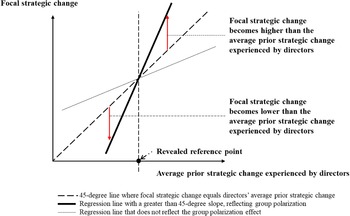
Following previous studies on group polarization (Friedkin, Reference Friedkin1999; Zhu, Reference Zhu2013, Reference Zhu2014), we used focal strategic change to regress average prior strategic change experienced by directors to test whether there was a group polarization effect. If the regression coefficient of average prior strategic change was significantly greater than 1 (that is, the slope of the regression line was greater than 45 degrees), it indicated that there was a group polarization effect; otherwise, it did not exist.
As shown in Figure 2, the 45-degree line indicates that the focal strategic change equals the average prior strategic change experienced by directors, all else equal. The intersection of the estimated regression line (the bold solid line) with the 45-degree line reveals the reference point. The estimated regression line on the right side of the reference point indicates that the focal strategic change after discussions is higher than the average prior strategic change experienced by directors, all else equal. The estimated regression line on the left side of the reference point indicates that the focal strategic change after discussions is lower than the average prior strategic change experienced by directors, all else equal. Therefore, an estimated regression line above the 45-degree line can indicate the existence of a group polarization effect. In contrast, an estimated regression line below the 45-degree line indicates that there is no group polarization effect. As with empirical research in strategic management, we tested the moderating effect through the interaction of independent and moderating variables.

RESULTS
Descriptive Statistics
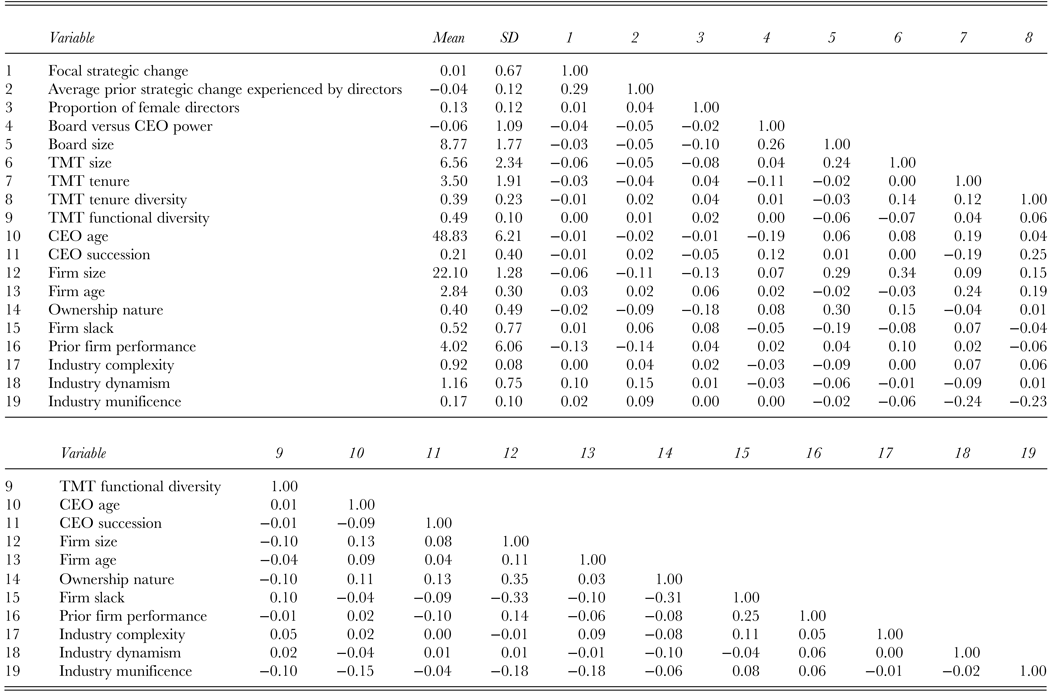
Table 2 provides the descriptive statistics and correlation matrix for all the variables in this study, except industry, province and year dummies.
Descriptive statistics and correlations

Notes: N = 8,172; Coefficients are significant at p < 5% when absolute values are greater than 0.02.
Hypotheses Testing
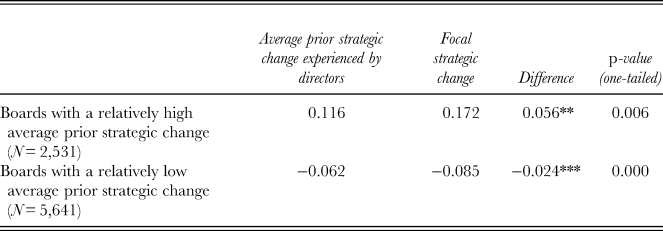
Table 3 presents the results based on a paired t-test. The results from Table 3 suggest that, if directors’ average prior strategic change before discussions is relatively high, the focal strategic change after discussions tends to be significantly higher than average prior strategic change. In contrast, if directors’ average prior strategic change before discussions is relatively low, then the focal strategic change after discussions tends to be significantly lower than average prior strategic change. Although the above results do not control the impact of other variables on the focus strategic change, they do provide preliminary evidence to support Hypothesis 1 in this article.
Results from a paired t-test (N = 8,172)

Notes:**p < 0.01; ***p < 0.001.
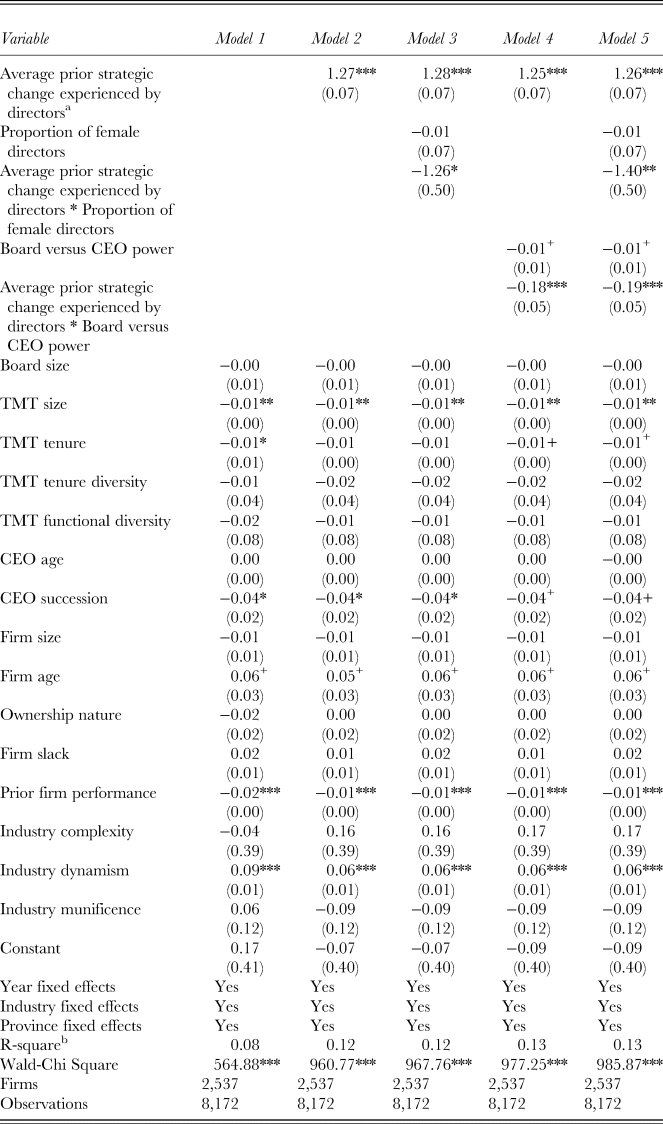
Table 4 reports the main regression results for this study. The dependent variable of the model is the focal strategic change. Model (1) is the baseline model and includes only all control variables. Model (2) introduces the average prior strategic change experienced by directors based on model (1). Models (3) and (4) further increase the moderating variables and interaction terms between moderating variables and independent variables. Model (5) is a full model including all variables.
Regression results on focal strategic change

Notes: +p < 0.10; *p < 0.05; **p < 0.01; ***p < 0.001. Standard errors are in parentheses. Two-tailed tests.
a Coefficients for average prior strategic change experienced by directors are significantly greater than 1 at p < 1% (one-tailed test).
b R-square is derived from OLS estimation.
Hypothesis 1 proposes that when the average prior strategic change related to performance decline experienced by directors is relatively high (or low), the focal strategic change in performance decline will become even higher (or lower) than the average prior strategic change experienced in performance decline by directors. As shown in model (2), the coefficient of average prior strategic change is significantly greater than 1 (beta = 1.27 [95% confidence interval, 1.14–1.40], p < 0.01). The effects also hold in our full model (5). Thus, Hypothesis 1 is supported.
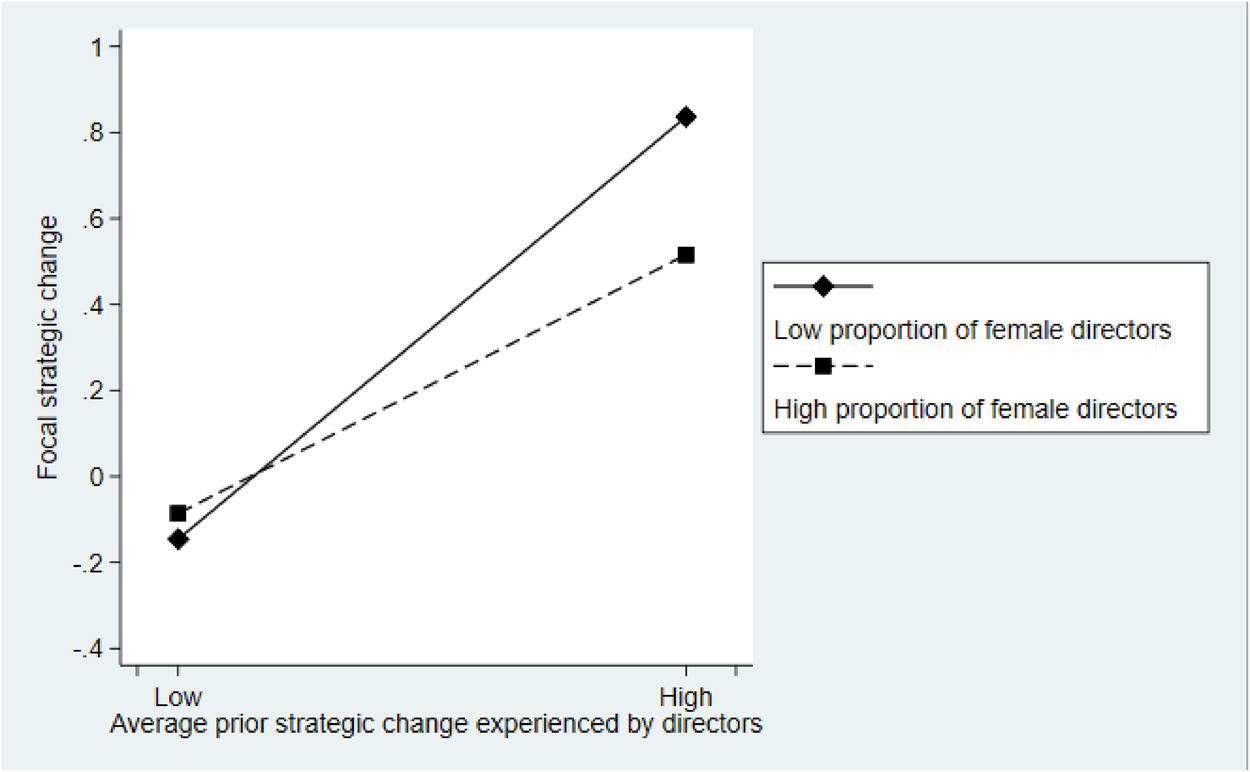
Hypothesis 2 proposes that when the average prior strategic change experienced in performance decline by the director is relatively high (or low), the proportion of female directors will reduce the extent to which the focal strategic change exceeds (or falls below) the average prior strategic change experienced by directors. As shown in model (3), the coefficient of the interaction term between the proportion of female directors and average prior strategic change is negative and significant (beta = −1.26 [95% confidence interval, −2.25 to −0.28], p < 0.05). The effects are more significant in our full model (5). These results support Hypothesis 2. The results also suggest that when the firm's female director ratio reaches 22.22% (about 24.08% of the sample data), the polarization effect will completely disappear (i.e., when the coefficient of directors’ average prior strategic change falls below 1). The moderating effect of the proportion of female directors is shown in Figure 3, which covers the whole range of values of the independent and moderating variables.
Schematic diagram of the moderating role of proportion of female directors

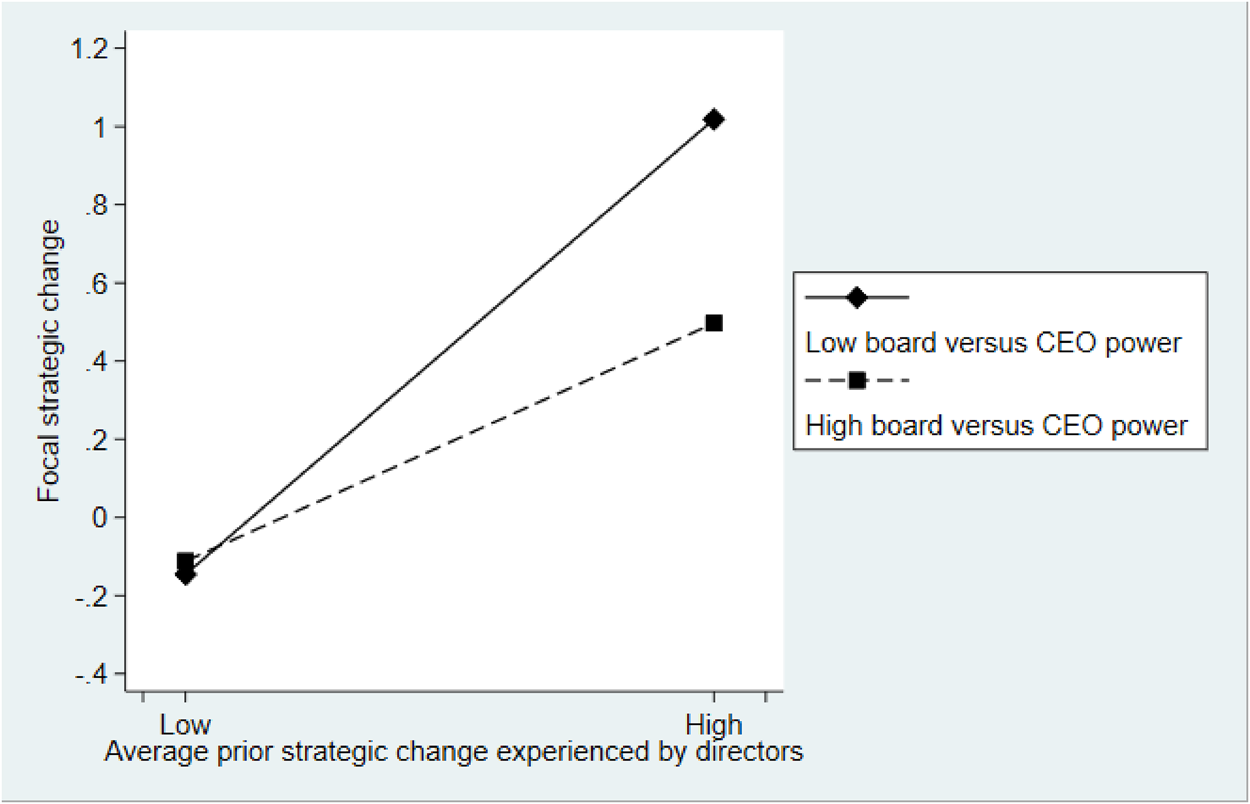
Hypothesis 3 proposes that when the average prior strategic change experienced in performance decline by directors is relatively high (or low), a board with greater power than the CEO reduces the extent to which the focal strategic change exceeds (or falls below) the average prior strategic change experienced in performance decline by directors. As shown in model (4), the coefficient of the interaction term between board versus CEO power and average prior strategic change is negative and significant (beta = −0.18 [95% confidence interval, −0.29 to −0.07], p < 0.001). The effects also hold in our full model (5). These results support Hypothesis 3. The results also suggest that when board versus CEO power is higher than 1.389 (about 9.04% of the sample data), the polarization effect will completely disappear (i.e., when the coefficient of directors’ average prior strategic change falls below 1). The moderating effect of board versus CEO power is shown in Figure 4, which covers the whole range of values of the independent and moderating variables.
Schematic diagram of the moderating role of board versus CEO power

In addition, the unexplained variance (87%) in Table 4 suggests that there may be other factors at work which account for some unexplained variance. In fact, the 87% unexplained variance in strategic change is consistent with the findings of previous related studies (e.g., Nakauchi & Wiersema, Reference Nakauchi and Wiersema2015; Richard et al., Reference Richard, Wu, Markoczy and Chung2019; Sidhu et al., Reference Sidhu, Feng, Volberda and Van Den Bosch2021). In the discussion section, we will further discuss possible theories and factors that can account for unexplained variance, in order to provide valuable guidance for future research.
Robustness Tests
We conducted a set of robustness tests. First, we used different lag structures (e.g., t–5 to t–1 and t–3 to t–1) to replace the average prior strategic change. The results are consistent with our main findings.
Second, we used social aspirations instead of historical aspirations to measure the level of firm aspirations. Consistent with Chen (Reference Chen2008) and Chen et al. (Reference Chen, Zhong and Lv2022), social aspiration (SA) was calculated as follows:

where the SA of firm i in year t (SA i, t) is the weighted linear combination of the median of the actual performance (P) of all firms in the same three-digit China Securities Regulatory Commission (CSRC) industry code (IP i, t−1) of firm i in year t–1 and the SA of firm i in year t−1 (SA i, t−1). The weight β 1 was similarly set to 0.4 following Chen (Reference Chen2008) and Chen et al. (Reference Chen, Zhong and Lv2022). The result is robust after changing the definition of aspiration level.
Third, we used the number of female directors to measure female director influence, and recalculated board versus CEO power using the sum of the four indicators after standardization rather than principal component analysis. The results further supported the hypotheses.
Given that we removed observations that did not experience a decline in performance, there may be some sample selection bias here. Consistent with Xu et al. (Reference Xu, Zhou and Du2019), we used a Heckman selection model to alleviate this problem. In the first-stage model, we set the dependent variable to performance indicator (dummy variable: below = 1, above = 0). To improve the effectiveness of the model estimate, we introduced the exclusion restrictions variable in the first stage: financial crisis. This does not appear in the Heckman model in the second stage. If the observation year is 2008, the financial crisis is set to 1, otherwise it is 0. The estimation model of the first stage also includes all control variables and dummy variables in this article. After calculating the Inverse Mills ratio and introducing it into the regression results of the second stage, we found almost identical results to the previous analysis. The results of these tests of robustness are reported in the Supplementary Materials, which can be accessed upon request.
DISCUSSION
Theoretical Contributions
The research framework and empirical findings of this study make three important theoretical contributions. First, this study contributes to strategic change literature by providing an explanation of group-level cognitive bias. Many scholars have noted a lack of literature around the decision-making process when boards of directors consider strategic change (Hoppmann et al., Reference Hoppmann, Naegele and Girod2019; Westphal & Bednar, Reference Westphal and Bednar2005), due to the fact that the group process is difficult to measure directly, and data are hard to acquire. Some investigations use case studies to reveal the group process (e.g., Hoppmann et al., Reference Hoppmann, Naegele and Girod2019). As far as we know, this article is one of the first large-scale empirical studies to examine the group process of strategic change decision-making. This article offers a new explanation for variations in strategic change decision-making from the perspective of group-level cognitive bias. Examining the cognitive bias of boards may provide new insights into understanding strategic change. Our study thus responds to the microfoundation movement of strategic management research (Felin, Foss, & Ployhart, Reference Felin, Foss and Ployhart2015).
Second, this study contributes to group polarization theory in two significant ways. We applied group polarization theory, a typical social psychology perspective, to strategic management research. Although recent strategy studies have explored the effect of group polarization on M&A premiums (Zhu, Reference Zhu2013) and CEO compensation (Zhu, Reference Zhu2014), our research is among the first to examine group polarization effects on board decisions around strategic change. Most studies on group polarization in the field of organization and management have also been carried out in the context of developed countries (Zhu, Reference Zhu2013, Reference Zhu2014). Our study examined the group polarization effect in the context of an emerging economy: China. These two elements make significant contributions to the contextualization of group polarization theory. The second theoretical contribution comes from the boundary conditions of group polarization theory identified in this study. This article not only examined the intragroup moderator (proportion of female directors) but also discussed the intergroup moderator (board versus CEO power). Our expansion from intragroup to intergroup has enriched previous studies on in-group moderators (Zhu, Reference Zhu2013, Reference Zhu2014). In the corporate governance of modern enterprises, the board of directors and CEO are two major power subjects, one of which is influenced and restricted by the other (Hambrick et al., Reference Hambrick, Werder and Zajac2008). It is possible for the board's decisions to be influenced by the CEO, even though the CEO may not be a member of the board. This fact has been neglected in previous literature.
Third, this study contributes to the knowledge about corporate boards and gender diversity by finding that female directors can reduce group decision-making bias. Currently, the proportion of female directors on boards is still very low in countries around the world. For example, a 2015 report by the Deloitte Global Center for Corporate Governance showed that only 10.7% of board members of listed companies in China were women. Governments around the world have adopted strong policies to increase the proportion of female directors on boards, and researchers provide strong evidence for this. Previous studies have suggested that female directors contribute to board decision-making through their professional knowledge, industry expertise, and personality characteristics (see Terjesen et al., Reference Terjesen, Sealy and Singh2009, for a review). Our study found that female directors can reduce group cognitive bias, thus providing a new channel for female directors to improve the effectiveness of board decisions. Our study also expanded on the research of Chen, Leung, Song, and Goergen (Reference Chen, Leung, Song and Goergen2019) who found that female directors could help reduce male CEO overconfidence, a typical individual-level cognitive bias.
Practical Implications
This article has important practical implications for strategic change. Many researchers have studied the process of implementing strategic change and offered practical insights. Our article focused on the decision-making process behind strategic change when facing performance decline and found that there was a polarization effect in board decisions. This means that directors should clearly recognize that the board's strategic change decisions are group decisions rather than individual decisions. From the perspective of group decision-making, we can better understand how strategic change decisions are made. Along with recognizing individual cognitive limitations and biases, directors should also be aware of group cognitive biases in group discussions or meetings and their consequences.
This article also has practical implications for corporate governance reform in China's emerging market. Focusing on the monitoring function of the board of directors, the emphasis of current corporate governance reform is on improving board independence. Our research suggests that corporate governance reforms should also focus on measures to improve the board's strategic decision-making process. Our study shows that the group polarization effect occurs in board decision-making around strategic change when facing performance decline, and this group-level cognitive bias will affect the decision outcome. Our study also found that when the proportion of female directors is higher and the board of directors is more powerful than the CEO, group polarization effect is reduced. We, therefore, believe that corporate governance reform should strive to build boards with open and free communication. Considering that China is a relational society, due to the influence of personal interests and mianzi (面子) factors, it may be easier to conform to opinion in group discussions, and this may lead to group polarization. We suggest, therefore, that corporate governance reform should take cultural values into account when taking steps to improve the board's decision-making process.
Limitations and Future Research Directions
The limitations in this article may serve as a guide for future research. First, boardroom discussions remain a ‘black box’ and are not directly revealed in our study. This article reflects and describes possible situations in board discussions from the perspective of group polarization, a cognitive bias, but we did not directly measure group polarization. Future research could develop new methods to accurately measure group polarization. Another effective, but possibly costly, approach is to participate in board discussions as an independent director and use case studies to uncover the ‘black box’ of board discussions.
Second, we followed previous studies by using the average degree of strategic change experienced by board members before the discussion to reflect the average tendency of the board of directors to the level of strategic change. Time or social factors may affect the accuracy of this measurement. Future research could use questionnaires to ascertain average tendencies of directors on specific issues before discussion, and then compare this with decisions after discussion to test the effect of group polarization. In addition, we do not consider the performance consequences of a high or low level of strategic change experienced by directors in the previous period, which could affect the measurement of average prior strategic change. This is because directors with inferior performance track record may not continue to be appointed to the board.[Footnote 1] Future studies can take this factor into account and address it with experimental methods.
Third, although we control for a set of variables at the group, firm, and industry levels, a significant portion of unexplained variances in the regression model means that there may be other theoretical explanations. Future studies can introduce new theories to provide additional explanations for strategic change. For example, stakeholder theory might be applied in the setting of this study (Freeman, Reference Freeman1984). As the existing literature on strategic change tends to implicitly assume that strategic change is a top-down process, it focuses on internal actors of enterprises, such as CEO, TMT, board of directors, and shareholders (Zhong, Wan, & Peng, Reference Zhong, Wan and Peng2021), but pays less attention to the important role of external stakeholders such as customers. Indeed, the importance of customers is emphasized both in the strategic management literature and in the new demand-side perspective (Hult, Ketchen, & Slater, Reference Hult, Ketchen and Slater2005; Priem, Reference Priem2007). The changing demand of customers might provide directions for the firm's strategic change. Therefore, we call for future studies to explore the impact of external stakeholders, particularly customers, on strategic change.
Fourth, this article only focuses on the group polarization effect of board strategic change decisions in a scenario of declining performance. Performance decline is not only an important stimulus factor of corporate strategic change, but also a booster to activate directors’ previous experience with strategic change in the context of performance decline. This means that the group polarization effect may be less significant in broader strategic changes, which provides a potential direction for future research.
Finally, although this article promotes the contextualization of group polarization theory, we should also be aware of the peculiarities of the Chinese context. There are obvious differences between the cultural values of China and western countries (Barkema, Chen, George, Luo, & Tsui, Reference Barkema, Chen, George, Luo and Tsui2015). For example, the Chinese attach great importance to harmony in interpersonal communication (Luo & Child, Reference Luo and Child2015), and always give priority to collective interests, which has an impact on board discussions. Directors may choose to not challenge mainstream views, preferring to maintain harmony among board members, or they may choose to sacrifice their own interests to avoid expressing minority views for the benefit of the whole. Therefore, we believe that China's unique cultural values may reinforce the effect of group polarization in board discussions. Our findings can be applied to other emerging economies in Asia where cultural values are very similar.
Another peculiarity of the Chinese context is the two-tier system, in which the board of directors is overseen by a supervisory board (Dahya, Karbhari, Xiao, & Yang, Reference Dahya, Karbhari, Xiao and Yang2003; Heyden, Oehmichen, Nichting, & Volberda, Reference Heyden, Oehmichen, Nichting and Volberda2015; Xiao, Dahya, & Lin, Reference Xiao, Dahya and Lin2004). China's two-tier system is influenced by, but differs from, Germany's two-tier system. For example, Chinese supervisory boards cannot appoint and dismiss board members as German boards can. Another important difference is that German supervisory board members usually hold important positions within or outside the company, while Chinese supervisory board members generally occupy marginal positions within the company. In China's listed companies, the board of supervisors has less power and a lower status than the board of directors (Chen, Li, & Shapiro, Reference Chen, Li and Shapiro2011). The role of the supervisory board is limited and even considered token (Tam, Reference Tam1995). On December 24, 2021, the Company Law of the People's Republic of China (Revised Draft) was officially released and made available for public comments. The revised draft does not require Chinese listed companies to adopt a two-tier system.[Footnote 2] Considering the limited role of the supervisory board and its inability to vote on the board's decisions (Chen et al., Reference Chen, Li and Shapiro2011), the existence of the supervisory board is unlikely to affect directors’ discussions; therefore, we conclude that the research results of this article can also be applied to other Asian emerging economies with a one-tier system. Although we infer that the results of this study can be applied to other emerging Asian economies, they also present a potential direction for future comparative studies, in which researchers compare the effect of group polarization in different contexts.
CONCLUSION
In this study, we examined whether the average degree of strategic change experienced by board members in the past had a group polarization effect on their board's current level of strategic change, and how group-level factors influenced the group polarization effect. By building on group polarization theory and using a longitudinal sample of Chinese listed firms, we found there was a group polarization effect when boards made decisions about strategic change. We also found that having a higher proportion of female directors and a powerful board reduced this polarization effect. We hope our study will prove a significant step for further strategic management research into the effect of group cognitive bias on board decisions.
SUPPLEMENTARY MATERIAL
The supplementary material for this article can be accessed upon request.
DATA AVAILABILITY STATEMENT
The data that support the findings of this study are openly available in Open Science Framework (OFS) at: https://osf.io/kabqr/