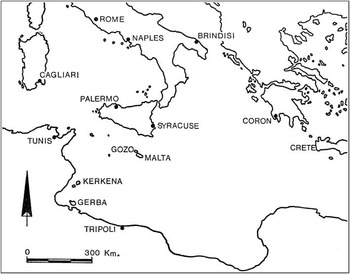
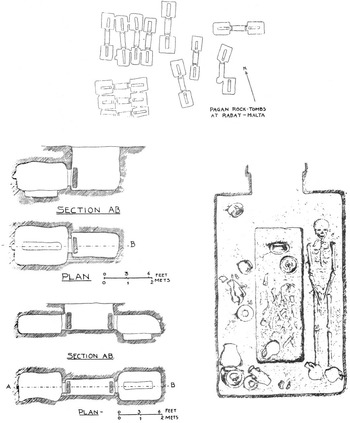
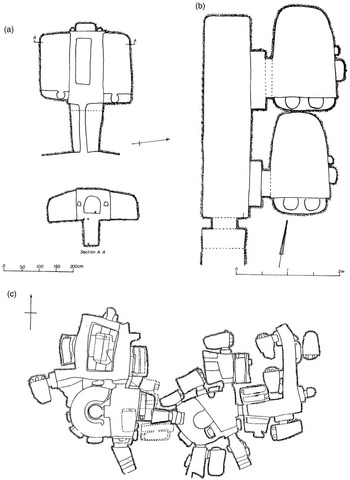
The Maltese archipelago occupies an area of c 316sq km and owes its importance in history to its strategic location in the centre of the Mediterranean, 93km south of Sicily and 288km east of Tunisia (fig 1). The culture of rock-cut tombs has a long history in these islands, dating from the prehistoric period.Footnote 1 The digging of underground burial places was facilitated by the availability of a malleable limestone that is easy to quarry and work. The most famous subterranean cemetery is the Hal Saflieni Hypogeum, a World Heritage Site, which dates to the Temple Period of the prehistoric sequence.Footnote 2 The Phoenicians, who established firm contact with the islands in the first millennium bc,Footnote 3 brought with them a typology of shaft-and-chamber tombs (fig 2) which reflected the Levantine influence that characterized the west Mediterranean in general, and Malta in particular, from around 900 bc to about the second century ad.Footnote 4 The late Roman, early Christian and Jewish hypogea of Malta are a development of their layout and architectural and stylistic idiosyncrasies and, to a marked extent, an elaboration of their tomb typologies (fig 3).Footnote 5
The Maltese archipelago and its central Mediterranean location. Map: after Luttrell Reference Luttrell1975

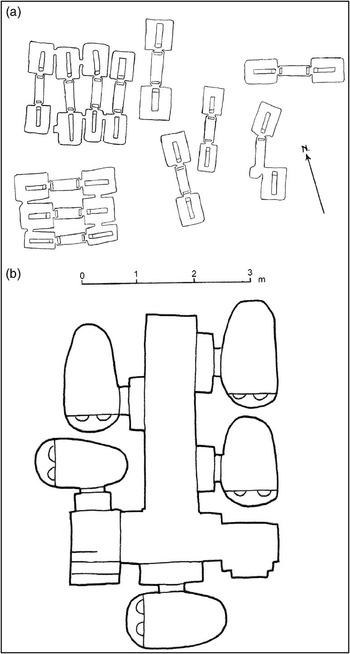
Tac Caghqi, Rabat: a group of Romano-Punic shaft-and-chamber tombs that belonged to the necropolis outside the city of Melite, discovered and surveyed by Themistocles Zammit in 1907. Drawing: after Buhagiar Reference Buhagiar1986

The development of the Maltese late Roman hypogeum between approximately the first and fifth centuries ad: a) first- to second-century chambered tomb at Torre Mamo, on the outskirts of Zejtun and St Thomas Bay; b) a third- to fourth-century single-galleried hypogeum with two burial chambers at the Bimgemma necropolis, on the outskirts of Rabat; c) two interconnecting fourth- to fifth-century Christian hypogea at the St Agatha complex, Rabat. Drawings: after Buhagiar Reference Buhagiar1986

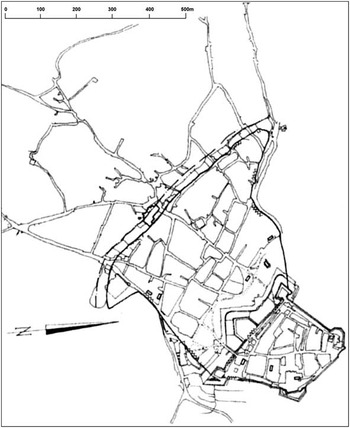
In spite of the Roman conquest in 218 bc, at the outbreak of the Second Punic War,Footnote 6 Malta remained a centre of Punic culture,Footnote 7 and it is significant that neo-Punic inscriptions have been noted in Romano-Punic tombs around the start of the first century ad.Footnote 8 Such tombs are scattered all over the islands,Footnote 9 but the largest, and most important, concentration is in the extensive necropolis outside the ditch of the city of Melite, in what is now the prosperous market town of Rabat (fig 4). The accidental or, perhaps, intended fusing together of neighbouring shaft-and-chamber tombs led, in the first centuries ad, to the creation of intimately sized hypogea (fig 5), or miniature catacombs, that served a late Roman and Byzantine community that included both Christians and Jews.
Site plan of Mdina and its suburb of Rabat, showing the boundaries and extent of the Roman city of Melite. Image: after Bonanno Reference Bonanno2011

a) Tac-Caghqi, Rabat: neighbouring and interconnected Romano-Punic shaft-and-chamber tombs; b) Hlantun, on the outskirts of Safi: two-galleried hypogeum with burial chambers, probably from the third or fourth century ad. Drawings: after Buhagiar Reference Buhagiar1986

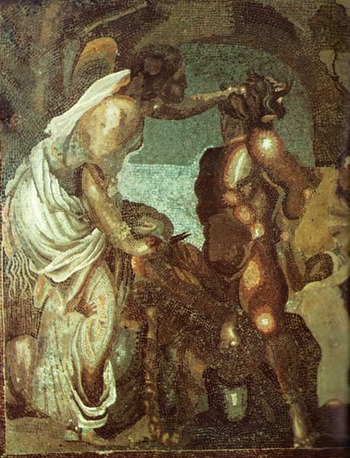
Melite, built on the north-eastern half of a flat-topped ridge in the centre of the largest island, to which it gave its name, was a provincial city with a good standard of living. Archaeology and the literary and epigraphic evidence suggest cultural awareness and artistic sophistication.Footnote 10 One house, discovered in February 1881, has high-quality mosaic pavements that seem to hint at Alexandrian influence and are datable, on iconographic, stylistic and technical considerations, to between 125 and 50 bc.Footnote 11 An emblema (fig 6), or central panel, in opus vermiculatum, 600 × 630mm, shows a nude, muscular man standing naked with his hands bound behind his back, held captive by two women, one of whom holds his hair from behind, while the other grabs him by the beard and prepares to shave him with a pair of scissors. Writing in 1913, the German Palaeochristian archaeologist, Erich Becker, read the scene as a representation of the Old Testament narrative of Samson and Delilah, and saw in it a possible evidence of Judaic influence.Footnote 12
Roman house, Rabat: mosaic emblema in opus vermiculatum of nymphs, or perhaps maenads, punishing a satyr. Becker (Reference Becker1913) and Ashby (Reference Ashby1915) thought it represented the Biblical narrative of Samson and Delilah. Photograph: after Gouder Reference Gouder1978; courtesy of Midsea Books

In 1915, Thomas Ashby was in agreement and, like Becker, took it as an added indication of the influence of the Jewish Bible on the art of Imperial Rome.Footnote 13 Both Ashby and Becker supported their argument with other presumed examples: notably the painting, thought to represent the Judgement of Solomon, discovered in 1882 in the cycle of murals on the inner facing of the podium surrounding the so-called House of the Doctor in Pompeii.Footnote 14 A footnote to Ashby concedes, nonetheless, that there are iconographic difficulties because Delilah shaves Samson's head, not his beard, in the Biblical account (Judges 16: 4–31), and does so while he is asleep, not by binding his hands.Footnote 15 A non-Biblical explanation is, as a matter of fact, more plausible, and Albert Mayr, who discussed the mosaic before it came to the notice of Becker, perceptively remarked that the emblema ‘definitely shows a mythological representation, but it may prove difficult to find a suitable explanation’.Footnote 16 A A Caruana, who excavated the house in 1881, thought it represented Heracles and Omphale.Footnote 17 A safer interpretation is to read it as a playful picture of nymphs, or perhaps maenads, punishing a satyr.Footnote 18
The scene in the emblema need not, therefore, be of Judaic inspiration. The only certain evidence for a Jewish presence in Melite comes from their rock-cut burial places (fig 7) and there is no evidence that these pre-date the fourth/fifth centuries ad.Footnote 19 In spite of their essentially Maltese layout and architectural idiosyncrasies, and the Greek bias of their surviving inscriptions, it is important to discuss them in the context of the Jewish colony phenomenon that manifested itself in all the provinces of the Empire, and sometimes beyond its frontiers, at the start of the first century ad.Footnote 20 Although made up of people from diverse socio-economic backgrounds, such colonies generally presented a compact homogeneity in their strict observance of religious mores and customs.Footnote 21 This set them apart from the rest of society and attracted attention that was sometimes hostile. Diaspora Jews nonetheless integrated into the social networks of the Empire and, in the East, communities of Hellenized Jews were common, as shown, among others, by references to them in the Pauline Epistles and the Acts of the Apostles. The exclusive use of Greek in the surviving Maltese inscriptions seems to suggest an essentially Hellenized colony, possibly with close associations to Sicily, the major centre of Greco-Byzantine culture, where a large Jewish community is recorded in the sixth century ad.Footnote 22
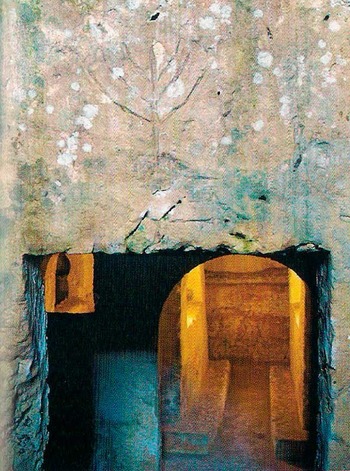
St Paul and St Agatha necropolis: Jewish hypogeum 13. Detail of the square-headed main entrance with its seven-branched Menorah. Photograph: after Bonanno Reference Bonanno2005; courtesy of Midsea Books

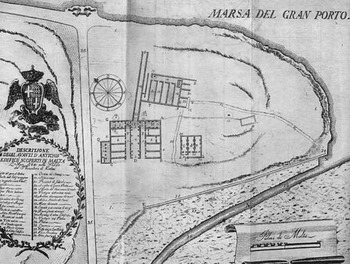
Jewish colonies were particularly strong in harbour cities and commercial centres and Malta's fine harbours made the island naturally attractive to shipping and commerce. There is archaeological evidence for a prosperous port town in the inner reaches of the Grand Harbour (fig 8), and it is tempting to identify this with the  mentioned by Ptolemy in one of the transcriptions of his Geographia (Geog 4, 3, 13).Footnote 23 The documented finds include the extensive remains of probable warehousesFootnote 24 and a large necropolis.Footnote 25 A road, which continued to be documented as strada antica Footnote 26 until the seventeenth century, connected this harbour town to the city of Melite.Footnote 27
Map by Barbaro (Reference Barbaro1794) of the Ta’ Cejlu promontory, in the inner reaches of the Grand Harbour, showing the remains of probable warehouses discovered in 1768. The site may correspond with the peninsular city mentioned by Ptolemy. Photograph: after Bonanno Reference Bonanno2005; courtesy of Midsea Books

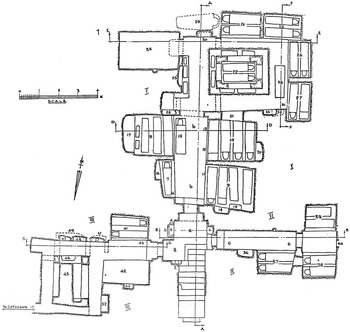
The presence of a Jewish community in the harbour town is not improbable.Footnote 28 The smallness of the island makes it, nonetheless, more likely that there was only one colony, centred in Melite. Diaspora Jews lived in closely knit colonies and isolated communities were rare. The presence of a road made it easy for them to commute between the city and the harbour town for trade and commerce. Their principal activity was, as elsewhere, presumably mercantile. The size of the colony is unknown. A count of the burial spaces in the six known Jewish hypogea adds up to a rough estimate of around 300.Footnote 29 There is, in addition, evidence for an ossuary (discussed below) in hypogeum 14 in the St Paul and St Agatha necropolis (fig 9).Footnote 30 Given that the hypogea were used over a long period of time (until at least the seventh century ad), and that they started from smaller nuclei that were enlarged and improved upon as the need arose, a colony of a couple of hundred appears plausible. Jean Juster, writing in 1914, calculated the number of Jews in the Roman world, at the height of the Empire, at around a twelfth of the total population, an estimate with which Michael Grant was in broad agreement.Footnote 31 Considering that the Maltese islands do not seem to have supported a population of more than 10,000, the estimate of 300 suggested by the hypogea does not seem unreasonable.
St Paul and St Agatha necropolis: Jewish hypogeum 14. Drawing: after Buhagiar Reference Buhagiar1986

The colony that used the hypogea may have resulted from different diasporas. Architectural idiosyncrasies suggest, as already indicated, a date for the known cemeteries of the fourth century ad or later. Jews may, however, have settled in Malta at earlier dates. It is, for example, not unlikely that a community arrived in the diaspora that followed the ruthless suppression of the Bar-Kokhba rebellion of ad 132 and the persecutions that followed it. There is, however, no archaeological testimony for that, or for earlier presences. If there were indeed such earlier communities, the use of shaft-and-chamber-tombs of the Romano-Punic variety would be indicated.
A record (fig 10) of a Council of Elders, or ýéρονσία (gerousia), of the fourth- or fifth-century colony, and of its ýéρονσιαρχης (gerousiarch), is provided by a fragment of an apparently three-line inscription in Greek, incised with a stylus or sharply pointed tool, on the reddish-brown cement rendering of an arcosolium in Jewish hypogeum 13, in the St Paul and St Agatha necropolis. The letters (c 30–40mm high) are filled with red paint to make them more legible. The first line, which presumably contained the name of the gerousiarch, is thought to be missing. The inscription (fig 11) passed unnoticed until April 1948, when it was discovered by C G Zammit, FSA, Curator of Archaeology and later Director of the Valletta Museum,Footnote 32 who transcribed it and referred it to the epigraphist and Palaeochristian archaeologist, Padre Antonio Ferrua, SJ, at the Istituto Pontificio di Archeologia Cristiana, in Rome. Ferrua dated it to the fourth or fifth century ad,Footnote 33 a date that was later corroborated by Dr Joyce Reynolds, FSA.Footnote 34 It remained largely unknown to international scholarship until 1985, when it came to the notice of Ross S Kraemer, who published it in the Harvard Theological Review.Footnote 35
St Paul and St Agatha necropolis: Jewish hypogeum 13. Inscription on an arcosolium tomb recording the resting place of a gerousiarch and his wife, the presbytera Eulogia. The letters are incised with a stylus and filled with red paint. Photograph: Keith Buhagiar

The gerousiarch's inscription as transcribed by Charles George Zammit, FSA, after its discovery in 1948. Drawing: courtesy of Heritage Malta

Professor Kraemer's translation – ‘… gerousiarch, lover of the commandments, and Eulogia the elder, his wife’ – agrees with that of Ferrua except for the fact that he, more correctly, does not translate Eulogia's Greek title of πρεσβντηρα (presbytera). Professor John Strugnell of Harvard suggested that ϕιλεντóλι[ος] (filentoli[os]), in line 1, was the gerousiarch's proper name, and that therefore there was no missing first line. This has the attraction of making the inscription complete. Filentolios (‘lover of the commandments’) does feature frequently in Jewish inscriptions, but, as Professor Kraemer points out, there is no record of its use as a proper name, at least in the west.Footnote 36
The importance of the inscription lies not only in its reference to a gerousia and gerousiarch but also, and more especially, in its use of the title ‘presbytera’ in the case of Eulogia. This is a significant addition to the seven Diaspora texts, collected by Bernadette Brooten, that use the title presbytera, presbyterissa or presbytis Footnote 37 for women who served on Councils of Elders in Hellenistic Jewish synagogues.Footnote 38 Ferrua suggests that the title presbytera was an honorary one, resulting from the high office of Eulogia's husband. Brooten has, on the other hand, argued perceptively that only two of her seven inscriptions, both of them from Venosa,Footnote 39 contain a reference to a male relative (in both cases the presbytera's father) and that there is nothing to suggest that the women owed their title to him.Footnote 40 The Malta inscription is the only known one in which the presbytera is the wife of a gerousiarch. This may, perhaps, suggest that she, too, occupied a position of some importance in the running of the colony or the synagogue.
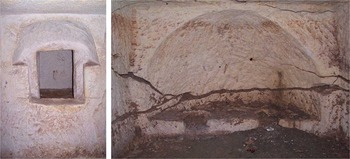
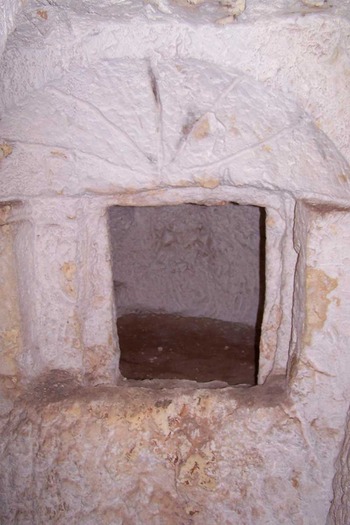
Also significant for the study of Jewish women is a second inscription (fig 12), in a nearby hypogeum (St Agatha 17), that records the resting place of a lady named Dionisia who was also known as Irene (τοπος Διονυσίας/ήκέ Eίρήνας). The inscription, discovered and published by Antonio Ferrua,Footnote 41 is engraved above the arched entrance to a window-tomb. This (fig 13) is the mostly widely diffused tomb type of the Maltese hypogea and is essentially a late Roman development of the Romano-Punic tomb's funerary cell. It gets its name from the window-like entrance to a usually oval burial chamber that generally had a rock-cut pillow with head-rests.Footnote 42 The window-tomb in question was intended to take four burials, but the funerary text mentions only the lady Dionisia – perhaps because she was the most special or virtuous. It has been suggested that the second name, ‘Irene’ (which means ‘peace’), is a ‘ritualistic name, the name of a blessed state’.Footnote 43 At the bottom of the text is a seven-branched Menorah which is, almost always,Footnote 44 an explicitly Jewish symbol.
St Agatha necropolis: Jewish hypogeum 17. Inscription with a seven-branched Menorah commemorating Dionisia, also known as Irene. Drawing: A Ferrua; courtesy of Heritage Malta

A window-tomb: the entrance arrangement and the burial chamber with its head-rests. Photograph: Keith Buhagiar

St Agatha 17 had, in addition, three other funerary texts, but these survived in a poor and sadly mutilated state. Of one, painted in red on the sealing slab of a window-tomb, Ferrua could only make out what he called ‘letter fragments’ (‘brandelli di lettere’). The other two were engraved on other window-tombs. One had the word κуριε,Footnote 45 which he thought was part of a farewell salutation. The other was better preserved but he was only certain about ‘Boetio’ (ΒΩΗΘΗΟ), perhaps a proper name or part thereof. Dr Richard Barnet thought he could read more and (in a personal communication of 25 September 1978 to the curator of the St Agatha necropolis, Fr Victor Camilleri) suggested, as a tentative translation: ‘… help the soul of … Mano … Ripe … and of …’.Footnote 46 If this is correct, the inscription contained the names of at least two of the deceased.
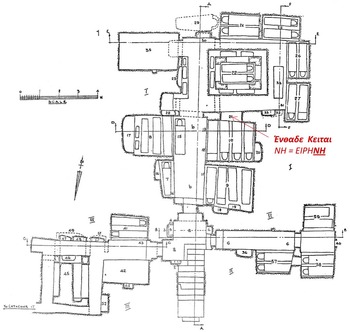
Dr Joyce Reynolds, FSA, thought that the two surviving letters NH (fig 14) towards the right-hand end of a two-line Greek inscription, incised in the greyish-brown cement rendering of an arcosolium in the aforementioned St Paul and St Agatha hypogeum 14, may suggest a woman called, or nicknamed, EIPHNH (Irene).Footnote 47 The inscription, already very fragmentary, was noticed in 1911 by Erich Becker and was carefully transcribed by Themistocles Zammit,Footnote 48 but remained unpublished until 1986.Footnote 49 Dr Reynolds reconstructs it as the common funerary formula ‘here lies’ or ‘here is buried’ (line 1) followed by the name of the deceased (line 2). The formula suggested is  , or a variant of it.
St Paul and St Agatha necropolis: Jewish hypogeum 14, showing the location of a fragmentary inscription, possibly commemorating a woman called Irene. Drawing: after Buhagiar Reference Buhagiar1986

In the same hypogeum, on the right-hand pilaster of the front of an imposing and very finely excavated baldacchino tomb, are a Menorah painted in a red ochre pigment, the representation of a sea vessel and two almost identical one-word inscriptions (fig 15). Both the boat and the inscriptions are deeply engraved in the stone and filled with red paint. They were discovered by C G Zammit when the baldacchino tomb was cleaned of a thick film of powdery white mould in April 1948. Antonio Ferrua was once again asked to give an interpretation.Footnote 50 The baldacchino tomb (fig 16) is a rock-cut sarcophagus with arched corner pilasters that link up with the ceiling of the burial chamber to form a canopied superstructure. It is both space-consuming and imposing and carries with it a sign of distinction. Unlike the window-tomb, it is not exclusive to Malta and frequently occurs in the smaller Sicilian catacombs, particularly in the districts around Syracuse. In Malta it was popular with both the Christian and the Jewish communities.
a) St Paul and St Agatha necropolis: Jewish hypogeum 14. A painted geometrically stylized Menorah, incised sailing boat and two apparent farewell messages on a baldacchino or canopied tomb; b) Richard Barnett's reading of the ‘farewell’ messages and Honor Frost's drawing of the sailing boat. Drawings: a) after Buhagiar Reference Buhagiar1986; b) Richard Barnett and Honor Frost

A baldacchino, or canopied tomb. Photograph: Keith Buhagiar

Ferrua suggested that the boat could be either a representation of Noah's Ark or, perhaps, a trade symbol marking the tomb of a boatman. Dr Mark Redknap, FSA, and Mark Hassall, FSA, who studied drawings that I made in May 1979, confirmed that it was what they expected for a Roman ship,Footnote 51 and their view was shared by the late Honor Frost, FSA, underwater archaeologist, who examined it on site and corrected my drawing.Footnote 52 If it is really a trade symbol, as Ferrua suspected, the possibility is that we have here the burial place of a rich Jewish merchant who plied his trade between Malta, Sicily and beyond. The inscriptions baffled Ferrua because some of the letters were unknown to him, but he perceptively proposed a farewell message similar to the Latin valeas.Footnote 53 Dr Richard Barnett, who examined them on site in 1981, agreed with a funerary salutation and suggested the work of a semi-literate who intended to write εύη χαιρε but messed up his letters. Dr Reynolds thinks that this suggestion is at least a positive proposal but is not entirely convinced.Footnote 54
Also in hypogeum 14 is a forma, or floor-tomb, which Themistocles Zammit and Erich Becker thought was, at some time, reutilized as an ossuary.Footnote 55 Zammit investigated it on 24 January 1911, and recorded that it measured 170 × 34 × 23cm, noting in addition a head-rest at one end. Of more significant interest was the fact that the tomb was only partially sealed by three unequally sized slabs, 49 × 60cm, 51 × 57cm and 59 × 14cm, ‘that left a gap the inner end of which was closed by two irregular stones’. The ‘gap’ contained a miscellany of bones, including the skulls of two adults and two children. Becker, who thought that hypogeum 14 ‘might be the latest or the one that was used longest’, suspected the presence of other ‘floor ossuaries’,Footnote 56 but the possibility was not investigated. More regrettably, it has since been securely sealed with flagstones, which prevents further study and photographic documentation.
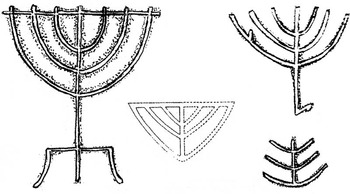
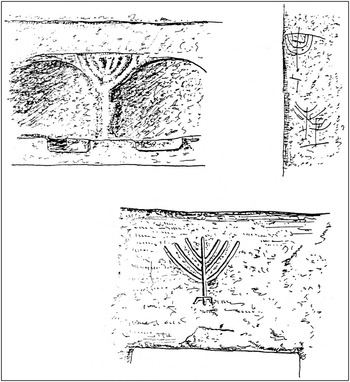
All of the six known hypogea are marked by the seven-branched Menorah (fig 17), which can be painted, finely carved or rudely scratched on the walls of burial chambers and tombs. The most significant is St Paul and St Agatha 13 (fig 7), which is one of the largest and most complex. Here, a large Menorah on a three-legged stand greets the visitor going down the steep, rock-cut steps in a narrow shaft. A small forecourt at the bottom of the shaft has three doors, at right angles to one another, through which one enters the three zones of the cemetery. The middle door, the one with the Menorah, leads through an antechamber to a spacious burial hall with three baldacchini and several wall-tombs of the arcosolium and window variety. Of greater interest is the zone entered through the door in the east wall. This has two galleries that branch out at right angles to one another on a respective west–east, south–north axis. The south–north gallery is lined with arcosolia, one of which carries the gerousiarch inscription. Another arcosolium, in the wall opposite, has a Menorah between the head-rests inside its trough-like double sarcophagus (fig 18). This seems to suggest another important tomb, maybe of another gerousiarch and his wife. The west–east gallery has a free-standing baldacchino, the front side of which (fig 19) is covered with graffiti of lightly scratched Menorahs. It seems obvious that this hypogeum held a special significance for the Melite Council of Elders.
Typologies of the seven-branched Menorahs of the St Paul and St Agatha necropolis. Drawing: after Buhagiar Reference Buhagiar2007

St Paul and St Agatha necropolis: Jewish hypogeum 13. A relief of a seven-branched Menorah between the two head-rests of an arcosolium tomb. Photograph: Keith Buhagiar

St Paul and St Agatha necropolis: Jewish hypogeum 13. Seven-branched Menorah typologies. Drawings: after Buhagiar Reference Buhagiar1986

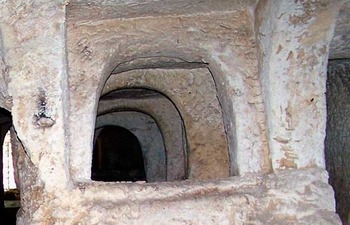
Hypogeum 13 is sandwiched between hypogeum 14 on one side and hypogeum 12 on the other. Taken as a group, the three hypogea form a compact island of Jewish religious steadfastness in an essentially Christian necropolis. The Menorah and the terse, fragmentary inscriptions are the only features that distance them from the Christian cemeteries that surround them on all sides. Otherwise they share identical plans, tomb typologies and architectural idiosyncrasies. The funerary triclinia (fig 20), which are, in many ways, the characteristic feature of Maltese early Christian hypogea, are nonetheless absent. These normally consisted of a cylindrical rock-cut table and reclining U-shaped couches on which a ritualistic, and largely symbolic, meal (refrigirium) was partaken, in commemoration of the dead, at funerals and on the anniversaries of their deaths.Footnote 57 Obviously the refrigirium did not feature in the Jewish liturgical practice.
Tal-Mintna Catacombs, Mqabba: Christian hypogeum 3. Funerary triclinium with cylindrical table. Photograph: Keith Buhagiar

Hypogeum 12 (fig 21) does not have the usual galleried layout and consists instead of two halls with free-standing baldacchini and wall-tombs of the arcosolium and window variety. At the entrance is a large, finely engraved Menorah (fig 22), which greets the visitor going down the steep steps of the deep shaft. Another Menorah is lightly carved above one of the two side doorways. Evidence that some of the tombs may have had a painted decoration is suggested by a few daubs in flaky, cheap earth colours. One of the window-tombs (fig 23) has, in addition, a lightly scratched scallop-shell. It is the only known instance in Malta of this popular motif used in a Jewish sepulchral context.
St Paul and St Agatha necropolis: Jewish hypogeum 12. Drawing: after Buhagiar Reference Buhagiar1986

St Paul and St Agatha necropolis: Jewish hypogeum 12. Seven-branched Menorah at the entrance to the hypogeum. Photograph: after Bonanno Reference Bonanno2005; courtesy Midsea Books

St Paul and St Agatha necropolis: Jewish hypogeum 12. Window-tomb with scallop-shell motif. Photograph: Keith Buhagiar

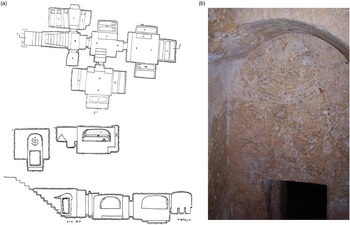
A few metres away from this tightly knit cluster, but in the same necropolis, a fourth hypogeum (no. 10; fig 24) has a large Menorah lightly scratched above the entrance to a burial cubicle. The latter is of particular interest because of its stone pivot door (fig 25). This measures 137 × 66 × 18cm, is cut from one piece of hard coralline limestone and has locking arrangements. Such doors were common in Maltese late Roman hypogea but this is the only one that survives in situ.Footnote 58
St Paul and St Agatha necropolis: Jewish hypogeum 10. a) plan and sections; b) lightly scratched seven-branched Menorah above the entrance to a burial cubicle. Drawings: after Buhagiar Reference Buhagiar1986; photograph: Keith Buhagiar

St Paul and St Agatha necropolis: Jewish hypogeum 10. Monolithic stone door to a burial cubicle. Photograph: Keith Buhagiar

St Agatha 17 and St Agatha 18 are two other hypogea that are located in another essentially Christian necropolis, in the same manner as the four already discussed.Footnote 59 Hypogeum 17 has a simple, two-galleried layout but is of special interest on account of its Dionisia/Irene inscription and its seven-branched Menorah. Two other Menorahs flank the door, on the inside, and emphasize the Jewish identity of the place. ‘Hypogeum 18’ was badly mutilated by the foundations of a recently constructed wall in an overlying church dedicated to St Agatha, but the small section of a gallery that survives preserves two Menorahs, one of which is beautifully carved.
A four-line Hebrew inscription, deeply chiselled in a block of limestone from a necropolis known as Qbur il-Lhud (‘the Jewish Cemetery’) at Mtarfa, the flat-topped ridge adjacent to the Rabat plateau, was published in 1961 by A M Honeyman, according to whose translation it records the resting place of Rach(el), the wife of Yeshu'a, with the added invocation ‘May her soul be bound up in the bundle of life’.Footnote 60 Honeyman was careful to point out that ‘the palaeography affords no decisive evidence of date’ and the probability is that the inscription is late medieval. As happened in the other dominions of the King of Spain, the Maltese Jewish community was exiled in 1492,Footnote 61 but the Mtarfa cemetery was still a landscape feature in 1647 when it was investigated by G F Abela, whose description makes interesting reading:
On the same hill (Mtarfa), in a public place, are Jewish sepulchres. To this day one can see some that are dug out of the living rock with inscriptions in Jewish letters that record the names of those buried inside them. In these tombs were buried Jews resident in the city (Mdina) and its suburb (Rabat) until the time of King Ferdinand.Footnote 62
The stone, which presumably blocked the entrance of a rock-cut tomb, was first recorded by A A Caruana in 1882.Footnote 63 Becker saw it in the Mdina residence of Count Sant Cassia, who owned the Mtarfa property where it was found. He realized that it belonged ‘to a considerably later period’ than the Melite hypogea and noted its similarity to medieval Hebrew inscriptions that he had seen in Syracuse in 1910.Footnote 64 The stone was later acquired by the Malta Museums Department and was, for many years, displayed at the entrance to the Museum of Roman Antiquities, in Rabat. It is now in the reserve collection of the National Museum of Archaeology, in Valletta.
Returning to the Melite hypogea, the only securely documented find is a narrow copper bangle, with a simple decoration of thinly grooved lines, accidentally discovered in one of the tombs of hypogeum 13 in 1956. More worthy of attention, but of insecure provenance, is a standard North African red ware Hayes Type IIA lamp, of a type frequently met with on Maltese early Christian sites (fig 26). Such lamps have been securely dated to around the fifth century ad.Footnote 65 The discus, which normally carries a gemmed cross or a Christian motif, instead has two coiled serpents on either side of an altar. What suggests a Jewish provenance is the seven-branched Menorah, incised on the flat stand of the lamp, where it is flanked by a horn-like motif, and a possible palm frond. Similar motifs featured, with other symbols, on a now lost fragment of either glass or marble, discovered in 1866 in a Jewish catacomb in Via Cimarra, Rome. A drawing of the fragment, published in the Corpus Inscriptionum Judaicarum (CIJ 281a) shows a palm frond sprouting from the stand of the Menorah.Footnote 66
North African red ware Hayes Type IIA lamp of apparent Jewish origin, provenance and present whereabouts unknown. Drawing: after Bellanti (1918)

The probability is that, like most Christian lamps, it comes from the hypogea. A Hayes Type IIA lamp with two Menorahs on the discus was reported and illustrated by Paolo Orsi, from a tomb in a fifth/sixth-century ad necropolis at Cittadella, near Noto, Sicily, which he excavated in 1898.Footnote 67 It is probably contemporary with the Malta lamp and may come from a similar milieu. The lamp allegedly reached the Valletta Museum in the early twentieth century, but the circumstances are unknown and Themistocles Zammit was unable to give Becker any information.Footnote 68 The probability is that it was acquired from a private collection. It is also possible that it may not be Maltese at all. There are several known instances of Hayes Type IIA lamps reaching Malta as antiques from North Africa, where there was a strong Maltese colony at the turn of the twentieth century. The lamp is depicted in the archaeological notebook of P F Bellanti,Footnote 69 but its present whereabouts are unknown.
Antonio Ferrua correctly emphasizes that what makes the Melite hypogea unique is their location in a Christian necropolis.Footnote 70 This, he maintains, is in contradiction both to the hostility of the Jews to the early Christians and to Christian abhorrence at being buried close to the tombs of other religious denominations. The Sicilian Palaeochristian scholar and archaeologist, Giuseppe Agnello, agreed and pointed out that the phenomenon was unknown in Sicily, where the great cemetery complexes in and around Syracuse show no evidence ‘of Jewish infiltration’.Footnote 71 Dura Europos, on the Euphrates river in present-day Syria, where the pre-ad 256 paintings in the Christian baptistry follow the Hellenistic Jewish tradition and could have involved an artist active in the decoration of the city's Jewish synagogue,Footnote 72 and, more arguably, the fourth-century Via Latina Catacomb, in Rome,Footnote 73 may suggest that Judeo-Christian relations could at times be cordial. Ferrua may have had Dura Europos in mind when he talks about ‘certain regions of Asia Minor’ where, as in Malta, the two communities lived at peace with each other.Footnote 74 In 2007, I suggested that Christianity, which arrived from Sicily in the post-Constantinian age, made its first converts from the Jewish community of Melite and that the location of the hypogea is a possible indication of a Jewish community ‘gradually adopting Christianity’.Footnote 75 The gerousiarch inscription points, on the other hand, to a community committed to Judaic orthodoxy. The phenomenon remains, as a result, the most intriguing feature of the Jewish hypogea of Roman Melite.
ABBREVIATIONS AND BIBLIOGRAPHY
- Abbreviations
- NLM
National Library of Malta, Valletta
- NMA
National Museum of Archaeology, Valletta