Implications
Delayed feed intake after hatch for broiler chickens resulted in lower BW gain. Thus, changing hatchery and farm management towards direct feeding after hatch can shorten the growth period. Feeding medium chain fatty acids (MCFA) during the first week after hatch resulted in higher BW gain and improved feed efficiency during the first week after hatch. A shortened growth period, as well as improved growth performance due to feeding MCFA, may result in economic benefits for the farmer.
Introduction
Although commonly accepted in modern broiler farming, a delayed first feed and water intake for chickens due to spread of hatch, handling at the hatchery and transport to the grow-out facility, may impair BW gain and organ growth (Van de Ven et al., Reference Van de Ven, van Wagenberg, Decuypere, Kemp and van den Brand2013; Lamot et al., Reference Lamot, van de Linde, Molenaar, van der Pol, Wijtten, Kemp and van den Brand2014). Additionally, delayed feed intake was found to result in relatively smaller immune organ sizes up to at least 2 weeks of age (Bar-Shira et al., Reference Bar-Shira, Sklan and Friedman2005). Although delayed feed intake seems to have limited effect on (mucosal) immune function in healthy broiler chickens (Simon et al., Reference Simon, de Vries Reilingh, Bolhuis, Kemp and Lammers2014), it does seem to affect the specific antibody response to an immune challenge in later life and colonization of T and B lymphocytes in the cecum and colon (Bar-Shira et al., Reference Bar-Shira, Sklan and Friedman2005).
The effect of delayed feeding on BW gain and immune function may also interact with diet composition. Direct and delayed fed chickens may have different dietary requirements due to their metabolic state and as such diets may skew immune function differently when fed immediately or delayed. Diet composition is also important during the first days after hatch as the gastrointestinal tract is still immature (Christensen, 2009) and enzyme secretion is not fully functional. Thereby, nutrient digestibility during the first week after hatch is not optimal yet and needs to be accounted for.
While the role of protein and amino acids in pre-starter diets has been studied extensively (Wijtten et al., Reference Wijtten, Hangoor, Sparla and Verstegen2010), studies on the use of dietary fat are limited due to the general perception that fats are not well digested at that age (Batal and Parsons, Reference Batal and Parsons2002; Thomas et al., Reference Thomas, Ravindran and Ravindran2008). However, these fats and oils might have an effect on immune function. Two profound examples are fish oil (rich in n-3 long chain polyunsaturated fatty acids) and medium chain fatty acids (MCFA). Fish oil has been found to reduce inflammatory responses at 2 weeks of age when fed to broilers (Korver and Klasing, Reference Korver and Klasing1997). On the contrary, MCFA (especially lauric acid; C12:0) were found to increase IL-1α expression in vitro in a dose response manner through toll-like receptor (TRL-4) activation (Lee et al., Reference Lee, Sohn, Rhee and Hwang2001). Although effects of nutrition on immune function in poultry have been extensively reviewed (Korver, Reference Korver2012), most studies do not focus on effects of nutrition in the 1st week after hatch. Moreover, mostly general effects of feed and water access on immune function and function are studied, ignoring effects of diet composition (Walstra, Reference Walstra2011; Simon et al., Reference Simon, de Vries Reilingh, Bolhuis, Kemp and Lammers2014).
The current experiment aimed to determine whether (1) moment of feed and water access after hatch and (2) pre-starter composition affected growth rate and innate and specific humoral immune function in broiler chickens until 28 days. It is hypothesized that inclusion of fish oil or MCFA in a pre-starter diet will result in higher BW gain and feed efficiency and altered humoral immune function.
Material and methods
The procedures applied in this experiment were approved by the Animal Care and Use Committee of the Animal Sciences Group of Wageningen University and Research Centre, the Netherlands.
Experimental design and diets
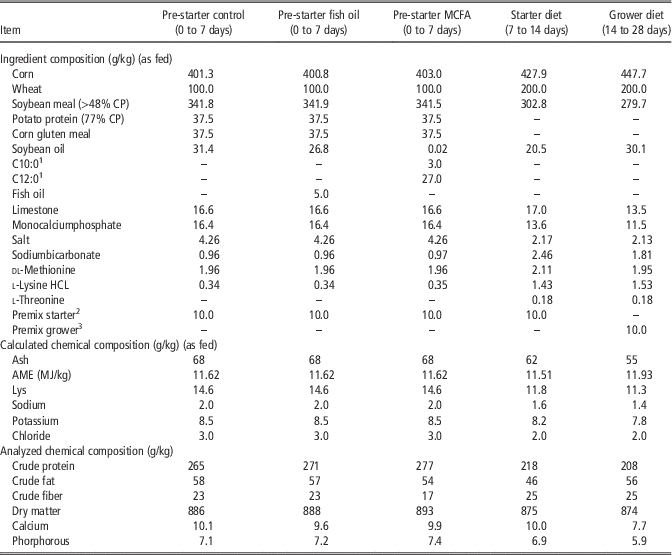
Effects of moment of first feed and water access (for the remainder referred to as ‘feed access’), and pre-starter composition were studied using a 2×3 factorial arrangement of treatments. Direct fed chickens received feed access directly after placement in the grow-out facility, wheras delayed fed chickens were withheld from feed access for 48 h after placement onward. Pre-starter diets contained either soybean oil (control), fish oil at 5 g/kg diet, or a MCFA blend at 30 g/kg diet (3 g/kg diet C10:0 and 27 g/kg diet C12:0; Sigma-Aldrich Chemie B.V., the Netherlands). Fish oil and MCFA were exchanged against soybean oil to keep the diets isocaloric. Pre-starter diets (2.0 mm pellet; 0 to 7 days) were followed by a starter (2.5 mm pellet; 7 to14 days) and grower diet (3.0 mm pellet; 14 to 28 days) that were similar for all treatment groups. Diets were formulated based on digestibility and nutrient data provided by CVB (2007), the compositions of the pre-starter, starter and grower diets are provided in Table 1. Pre-starter diets were manufactured using one basal diet and together with starter and grower diets produced and pelleted by Research Diet Services (the Netherlands). All chicken were fed ad libitum from the moment of feed access till the end of the experiment. At 21 days, all chickens were immunized by injection in the pectoralis major with 1.0 ml of 25% volume-based sheep red blood cells (SRBC) suspension in phosphate-buffered saline.
Ingredient and nutritional composition of the experimental diets

MCFA=medium chain fatty acids.
1 Sigma-Aldrich Chemie B.V., the Netherlands.
2 Contributed per kilogram of diet: vitamin A, 12 000 IU; vitamin D3, 5000 IU; vitamin E, 30 mg; vitamin K3, 2.3 mg; vitamin B1, 1.0 mg; vitamin B2, 4.5 mg; vitamin B6, 2.7 mg; vitamin B12, 20 μg; niacine, 40 mg; d-pantothenic acid, 9 mg; choline chloride, 500 mg; folic acid, 0.5 mg; biotin, 100 μg; FeSO4.H2O, 150 mg; CuSO4.5H2O, 40 mg; MnO, 100 mg; ZnSo4.H2O, 145 mg; KJ, 2.0 mg; Na2SeO3, 0.56 mg; antioxidant (oxytrap PXN), 125 mg.
3 Supplied per kg diet: vitamin A, 10 000 IU; vitamin D3, 2000 IU; vitamin E, 20 mg; vitamin K3, 2.3 mg; vitamin B1, 0.8 mg; vitamin B2, 4.5 mg; vitamin B6, 1.9 mg; vitamin B12, 20 μg; niacine, 30 mg; D-pantothenic acid, 8 mg; choline chloride, 400 mg; folic acid, 0.5 mg; biotin, 50 μg; FeSO4.H2O, 150 mg; CuSO4.5H2O, 40 mg; MnO, 100 mg; ZnSo4.H2O, 145 mg; KJ, 1.9 mg; Na2SeO3, 0.50 mg; antioxidant (oxytrap PXN), 125 mg.
Housing and management
Hatching eggs (n=2160; weight range 58 to 69 g) of a Ross 308 breeder flock (42 weeks of age) were incubated at a temperature of 37.5°C and 54.0% relative humidity. After removal from the incubator, 576 male chickens were kept in a grow-out facility for 28 days. Female chickens were excluded from the experiment. The facility contained 96 cages (50×50 cm) with six chickens per cage. Treatments were randomly assigned to cages within 16 blocks, resulting in 16 replications per treatment. Cage floors were covered with 2 cm of wood shavings. Each cage was equipped with two nipple drinkers adjustable in height. Artificial lighting was set to 23 h/day from 0 to 2 days, 20 h/day from 2 to 6 days and 18 h/day from 6 days onwards. Temperature was set at 34°C at the start and set to decrease gradually until a final temperature of 22.1°C was reached at 18 days. Temperature was fixed at this level for the remainder of the experiment.
Growth performance
Feed intake and BW were determined at 0, 2, 7, 14, 21, 25 and 28 days during the grow-out period. Feed intake was recorded per cage, while BW was recorded individually. Gain to feed ratio was calculated based on calculated BW gain and feed intake per cage.
Immunological analysis
At 2 days (in advance of feed access for delayed fed broiler chickens), one randomly chosen chicken per cage was killed by decapitation for blood collection. From 7 days onward, one chicken per cage was selected for weekly blood sampling from the brachial vein. In addition, a sample was collected at 4 days after immunization (day 25). Blood samples were taken before switching to a new feeding phase and in advance of immunization. Serum was stored after decantation at −80°C for further analysis.
Immunoglobulins
Serum samples were analyzed to detect natural antibodies (NAb) IgM and IgY titers against Keyhole Limpet Hemocyanin (KLH) using similar methodology as described by Lammers et al. (Reference Lammers, Klomp, Nieuwland, Savelkoul and Parmentier2004). Antibody titers measured against KLH were expressed as the 2log values of the dilutions that gave an extinction closest to 50% of the highest mean extinction of a standard positive present on every microtiter plate.
Agglutination titer
Total serum antibody titers to SRBC were only determined at 21, 25 and 28 days (0, 3 and 7 days post immunization). SRBC antibody titers were assessed by agglutination according to methodology previously described by Van der Zijpp and Leenstra (Reference Van der Zijpp and Leenstra1980). Antibody titers measured against SRBC were expressed as the 2log of the reciprocal of the highest serum dilution giving complete agglutination.
IFN-γ
Serum was analyzed using a commercial sandwich type ELISA kit (Chicken IFN-γ CytoSetTM; cat. no. CAC1233; Invitrogen, CA, USA) and expressed as the amount of picogram per mililiter.
Complement activity
Complement activity was not measured at day 2. Activity was measured using a hemolytic technique as described by Parmentier et al. (Reference Parmentier, Baelmans, Nieuwland, Dorny and Demey2002) with an adapted light-scattering method. Serum was diluted and incubated with either sensitized sheep erythrocytes (Hemolysins, ref. no. 72 202; Biomérieux, the Netherlands) to measure activity of the classical pathway (CPW) or rabbit erythrocytes to measure activity of the alternative pathway (APW). Hemolytic complement activity was scored and expressed as ‘yes’ or ‘no’ based on lysis of erythrocytes.
Statistical analysis
Data were analyzed in SAS (Version 9.3, 2011, SAS Institute Inc., Cary, NC, USA) using cage as the experimental unit. The dietary treatment period (0 to 7 days), grow-out period (7 to 21 days) and immunization period (21 to 28 days) were separately analyzed as the chicken underwent different physiological processes during these periods.
Growth performance data (BW gain, feed intake and gain to feed ratio) and immune data until 2 days were subjected to mixed model analysis using the PROC MIXED procedure. The following statistical model was used: Y ijk =μ+α i +β j +α×β ij +b k +e ijk, where Y ijk is the dependent variable, μ the overall mean, α i the fixed effect of moment of feed access (i=direct or delayed), β j the fixed effect of pre-starter composition (j=control, fish oil or MCFA), b k the random block effect (k=1, 2, 3, …, 16) and e ijk the residual error term. For data from 0 to 2 days, effects of feed access and the interaction with pre-starter composition were excluded from the model. Mortality data were analyzed as survival data to test homogeneity of survival curves, using the PROC LIFETEST procedure.
Immunological data were considered repeated measures from 7 days onwards and therefore subjected to mixed model analysis using the repeated lines statement. Hemolytic complement activity was analyzed using the PROC GLIMMIX procedure including the repeated lines statement. The three-way interaction between day, feed access and pre-starter composition did not solve and was therefore omitted from the model. Output is expressed as the chance for a complement response.
As the applied dietary treatments had only limited effects on humoral immune function, outcomes of the immunological analysis are only described in the Results section. However, a tabular overview is provided in Supplementary Tables S1 to S4 of Supplementary material S1. Although not the aim of the experiment, the current experiment also provided insight in general humoral immune responses in time (0 to 28 days) of broiler chickens. These results are described in Supplementary material S1 and presented in Supplementary Tables S1 to S4 and Supplementary Figure S1.
Data are reported as least square means and differences between treatment means are assumed to be significant when P⩽0.05.
Results
General
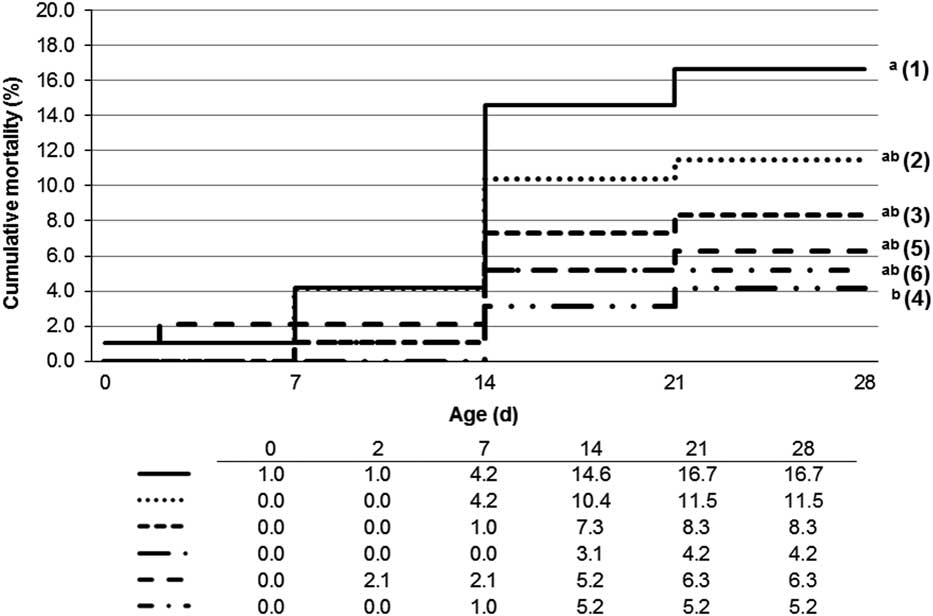
For mortality from 0 to 28 days, an interaction was found for feed access and pre-starter composition (P=0.014; Figure 1). Chickens with direct feed access fed the control pre-starter diet had higher risk for mortality than chickens with delayed feed access fed the control pre-starter diet (16.7% v. 4.2%).
Mortality rate of broiler chickens, expressed per treatment. (1) Direct feed access & control pre-starter, (2) direct feed access & fish oil pre-starter, (3) direct feed access & medium chain fatty acids (MCFA) pre-starter, (4) delayed (48 h) feed access & control pre-starter, (5) delayed (48 h) feed access & fish oil pre-starter, (6) delayed (48 h) feed access & MCFA pre-starter. Feed access effect: P=0.002, Diet effect: P=0.428. Moment of feed access x diet interaction effect: P=0.014. Cumulative mortality rates with different superscripts differ significantly at P<0.05.

Dietary treatment period (0 to 7 days)
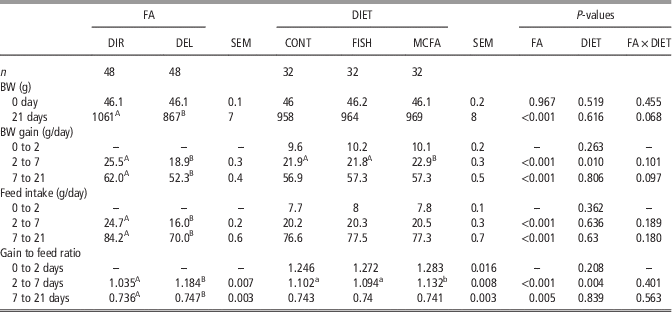
No interaction was found between feed access and pre-starter composition for any of the performance and immune variables from 2 to 7 days. BW gain and feed intake from 2 to 7 days of direct fed chickens were 34.9% and 54.0% higher compared with delayed fed chickens (both P<0.001; Table 2). Gain to feed ratio was lower for direct fed chickens compared with delayed fed chickens (−0.149; P<0.001; Table 2).
Effects of moment of feed access and pre-starter composition on BW, BW gain, feed intake and gain to feed ratio of broiler chickens 0 to 21 days (LSmeans)Footnote 1

FA=feed and water access; DIR=direct access; DEL=delayed access (48 h); DIET=pre-starter diet; CONT=control; FISH=fish oil; MCFA=medium chain fatty acids.
A,BValues within a row with different superscripts differ significantly at P<0.01.
1 Each cage contained six male broilers at the start of the experiment. For analysis of data collected from 0 to 2 days, effects of feed and water access and the interaction with pre-starter composition were excluded from the model.
Provision of MCFA in the pre-starter diet resulted in a higher BW gain from 2 to 7 days (4.8% on average; P=0.010), and a higher gain to feed ratio (1.132 v. 1.102 and 1.094, respectively; P=0.004) compared with the control and fish oil pre-starter diets (Table 2). Feed access and pre-starter composition did not affect KLH specific NAb levels, IFN-γ, and the complement CPW and APW response during the pre-starter period.
Grow-out period (7 to 21 days)
A tendency for interaction between feed access and pre-starter composition was found for BW gain from 7 to 21 days (P=0.097; Table 2). Within the direct fed chickens, provision of MCFA in the pre-starter diet resulted in a 1.6% lower BW gain compared with the control and fish oil containing pre-starter diets, whereas this was opposite for delayed fed chickens (3.4% higher BW gain for the MCFA pre-starter diet). BW gain and feed intake from 7 to 21 days of direct fed chickens were, respectively, 18.5% and 20.3% higher compared with delayed fed chickens (both P<0.001; Table 2). Gain to feed ratio was lower for direct fed chickens compared with delayed fed chickens (0.736 v. 0.747; P=0.005; Table 2). Starter diet composition tended to affect the alternative complement pathway response from 7 to 21 days (P=0.093), where MCFA and fish oil containing starter diets had a lower chance for an APW complement response compared with the control starter diet. Feed access and pre-starter composition did not affect KLH specific NAb levels, IFN-γ, and complement CPW response during the grow-out period.
Immunization period (21 to 28 days)
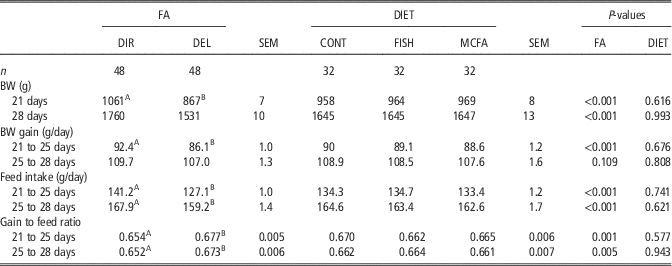
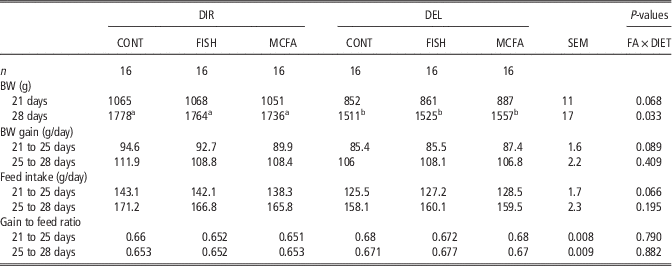
The results are reported in Tables 3 and 4. An interaction was found between feed access and pre-starter composition for BW at 28 days (P=0.033; Table 4). Within the direct fed chickens, the control pre-starter diet had the highest BW and the MCFA containing pre-starter diet the lowest (Δ=2.4%), whereas this was the opposite for the delayed fed chickens (Δ=3.0%). Furthermore, a tendency for interaction between feed access and pre-starter diet was found for feed intake between 21 and 25 days (P=0.066; Table 4). Within the direct fed chickens, the control pre-starter diet had a higher feed intake than the MCFA pre-starter diet (Δ=3.5%), whereas this was opposite in the delayed fed chickens (Δ=2.4%). BW gain between 21 and 25 days for direct fed chickens was 7.3% higher compared with delayed fed chickens (P<0.001; Table 3), but no treatment effect was found on BW gain from 25 to 28 days. Feed intake from 21 to 28 days of direct fed chickens was 8.3% higher compared with delayed fed chickens (P<0.001; Table 3). Gain to feed ratio from 21 to 25 days, as well as from 25 to 28 days, was lower for direct fed chickens compared with delayed fed chickens (P=0.001 and 0.005; Table 3).
Effects of moment of feed access and pre-starter composition on BW, BW gain, feed intake and gain to feed ratio of broiler chickens 21 to 28 days (LSmeans)Footnote 1

FA=feed and water access; DIR=direct access; DEL=delayed access (48 h); DIET=pre-starter diet; CONT=control; FISH=fish oil; MCFA=medium chain fatty acids.
A,BValues within a row with different superscripts differ significantly at P<0.01.
1 Each cage contained six male broilers at the start of the experiment.
Interaction effects of moment of feed access and pre-starter composition on BW, BW gain, feed intake and gain to feed ratio of broiler chickens 21 to 28 days (LSmeans)Footnote 1

FA=feed and water access; DIR=direct access; DEL=delayed access (48 h); DIET=pre-starter diet; CONT=control; FISH=fish oil; MCFA=medium chain fatty acids.
a,bValues within a row with different superscripts differ significantly at P<0.01.
1 Each cage contained six male broilers at the start of the experiment.
Direct fed chickens had higher serum IFN-γ concentrations compared with delayed fed chickens (on average 96.9 v. 80.5 pg/ml; P=0.017). Furthermore, provision of MCFA in the pre-starter diet tended to result in higher IFN-γ concentrations from 21 to 28 days compared with the control and fish oil containing pre-starter diets (98.5 v. 84.0 and 83.5 pg/ml on average from 21 to 28 days; P=0.074). Feed access and pre-starter composition did not affect KLH specific NAb levels, agglutination titers, and the complement CPW and APW response during the immunization period.
Discussion
Moment of feed access
Delayed feed access resulted in lower BW gain from 0 to 25 days compared with direct fed chickens. A lower BW gain might be explained by impaired intestinal development, which is a direct consequence of delayed feed access as demonstrated by Noy et al. (Reference Noy and Sklan2001). Impaired intestinal development has been described by a lowered relative weight of the intestinal tract, shortened intestinal length, changed villi density, lowered villi height and a lowered number of goblet cells per villus (Maiorka et al., Reference Maiorka, Santin, Dahlke, Boleli, Furlan and Macari2003). A too long period of feed withdrawal may cause a permanent impairment of growth from which chickens do not recover by means of compensatory growth and performance. In the current experiment, chickens were indeed not capable to recover from delayed feed access for 48 h, although differences became smaller and non-significant from 25 days onwards. In the current experiment, the partial compensatory growth was reflected by chickens with delayed feed access having a higher gain to feed ratio throughout the experimental period than those with direct feed access. An improved feed efficiency of broiler chickens from 0 to 21 days after a period of feed restriction was found not to be related to a lowered maintenance requirement nor continued lower metabolic rate as a consequence of feed restriction. However, a higher metabolizable energy intake as a result of a higher feed intake relative to body size, does improve feed efficiency (Zubair and Leeson, Reference Zubair and Leeson1994).
In the current experiment, an interaction was found for mortality rate from 0 to 28 days between feed access and pre-starter composition, although this was primarily caused by differences between direct and delayed fed chickens that were fed the control pre-starter diet. Differences in mortality might relate to the metabolic status of the chicken during the first week after hatch. Various studies have suggested a positive relationship between restricted feeding and a lowered mortality risk due to lower occurrence of ascites (Balog, Reference Balog2003; Wijtten et al., Reference Wijtten, Hangoor, Sparla and Verstegen2010). Delayed feed access after hatch can be considered as a form of feed restriction too and as such may cause a similar effect. Feed restriction has been related to a lowered metabolic rate and subequently a lower oxygen requirement, possibly resulting in less ascites associated health problems (Wijtten et al., Reference Wijtten, Hangoor, Sparla and Verstegen2010). Therefore, delayed feed access after hatch may result in a physiological benefit over direct feeding by means of a lowered mortality risk. However, in other research where chickens were delayed fed for 1 or 2 days, the mortality risk was not affected (Corless and Sell, Reference Corless and Sell1999). In chickens that were infected with the malabsorption syndrome, inclusion of MCFA resulted in a lower mortality risk (Gutierrez Del Alamo et al., Reference Gutierrez Del Alamo, Enting, De Los Mozos and Perez de Ayala2007) of which the effect was contributed to the antimicrobial properties of MCFA (Van Immerseel et al., Reference Van Immerseel, De Buck, Boyen, Bohez, Pasmans, Volf, Sevcik, Rychlik, Haesebrouck and Ducatelle2004). Inclusion of MCFA in a pre-starter diet can be hypothesized to have similar antimicrobial properties, possibly preventing the colonization of pathogenic microflora associated with increased mortality risk. It remains up for discussion then why a similar effect of MCFA on mortality risk was not found in delayed fed broiler chickens and if this for example is related to the amount of feed intake or timing of feeding.
Chickens with direct feed access had higher concentrations of IFN-γ 21 to 28 days compared with chickens with delayed feed access for 48 h. IFN-γ is predominantly produced by natural killer cells as part of the innate immune response, followed by CD4+ and CD8+ T cells during the acquired immune response (Schoenborn and Wilson, Reference Schoenborn and Wilson2007). This advocates that also T cells are capable of producing IFN-γ when stimulated by antigens, next to natural killer cells. Delayed feed access may result in delayed colonization of the cecum and colon by T cells, as well as expression of IL-2 mRNA in hindgut T cells (Bar-Shira et al., Reference Bar-Shira, Sklan and Friedman2005). The latter might suggest that chickens with delayed feed access are less able to produce IFN-γ around the gastrointestinal tract compared with direct fed chickens, as T cells produce IFN-γ in response to IL-2 stimulation.
In the current experiment, delayed feed access did not strongly affect the measured parameters for humoral immune function and response after a SRBC challenge, while in other experiments the immune response was impaired when exposed to an immunological challenge in later life (Bar-Shira et al., Reference Bar-Shira, Sklan and Friedman2005; Simon et al., Reference Simon, de Vries Reilingh, Kemp and Lammers2015). This suggests that the measured immune responses that are initially related to a dietary treatment, may also strongly depend on the type of immunological challenge used.
Pre-starter composition
Inclusion of MCFA in the pre-starter diet resulted in higher BW gain and gain to feed ratio (not feed intake) compared with the control and fish oil containing pre-starter diets, but only during the period the pre-starter diet was provided (till 7 days). However, a tendency for interaction between moment of feed access and pre-starter composition was found as well for BW gain and feed intake from 7 to 25 days. It appears that a MCFA pre-starter diet is most effective for chickens with delayed feed access and it might be hypothesized that inclusion of MCFA in a pre-starter diet had a beneficial effect on the recovery of the gastrointestinal tract after an initial period of feed deprivation. MCFA are known to increase tight junction permeability of mucosal tissue (Lindmark et al., Reference Lindmark, Kimura and Artursson1998). Increased tight junction permeability may impair the intestinal barrier functionality and may thus result in increased susceptibility to pathogens and a transfer of larger toxic molecules. However, the disadvantage of increased tight junction permeability seems to be outweighed in an intestine that is already damaged, because it may also result in a more rapid absorption of nutrients, such as glucose (Ballard et al., Reference Ballard, Hunter and Taylor1995). These nutrients may be required as an energy source for intestinal recovery. Besides increasing tight junction permeability of mucosal tissue, MCFA by themselves may also function as an easily accessible energy supply for enterocytes and thus cell recovery due to their relatively high digestibility coefficient at hatch compared with other fats (0.86 for polyunsaturated fatty acids v. 0.61 for soybean oil; Noy and Sklan, Reference Noy, Geyra and Sklan1995, Turner et al., Reference Turner, Applegate and Lilburn1999, Batal and Parsons, Reference Batal and Parsons2002). Hence, MCFA might have a beneficial effect in the intestine of delayed fed chickens only during a restoration phase, meaning that in direct fed chickens that do not need to restore their intestinal integrity, MCFA lack this beneficial effect.
Inclusion of fish oil in the pre-starter diet did not affect natural anti-KLH IgY titers. However, Wang et al. (Reference Wang, Field and Sim2000) found increased IgY levels (+30%) when feeding layer chickens from 0 to 8 weeks of age fed a diet containing 5% fish oil v. sunflower oil, animal oil blend or linseed oil. Therefore, the current inclusion level of fish oil (0.5%) may have been too low to find effects on the humoral immune system.
In summary, delayed feed access for day old chicks resulted in lower growth performance compared with direct access. Based on partial compensatory growth, it can be suggested that the current period of delayed feed access did not result in a permanent impairment of the chickens’ growth capacity. Feeding MCFA in the pre-starter diet resulted in higher BW gain and gain to feed ratio, but only during the period the diets were provided. Feeding a MCFA containing pre-starter diet tends to be most effective for delayed fed broiler chickens by means of higher growth performance, but most effective for direct fed chickens with respect to a lowered mortality risk. Current inclusion levels of fish oil and MCFA in the pre-starter diet appear to have limited (long-term) effects on growth and development, as well as on humoral immune function.
Acknowledgments
The authors gratefully acknowledge the help and assistance from the staff of the Cargill Animal Nutrition Innovation Center Velddriel (the Netherlands) and the Adaptation Physiology Group of Wageningen University (the Netherlands) during the study.
Conflicts of Interest
The authors declare that there is no conflict of interest.
Supplementary material
For supplementary material/s referred to in this article, please visit http://dx.doi.org/10.1017/S1751731116000288