1. Introduction
Civil wars are more frequent, more deadly, and longer lasting than are interstate wars. They create what is called the ‘conflict trap’, where conflict undermines the very base of a country, leaving the state vulnerable to yet another conflict (Collier et al., Reference Collier, Elliott, Hegre, Hoeffler, Reynal-Querol and Sambanis2003). Civil wars eventually end, but far too often they recur (e.g., Angola or Indonesia). Owing to enormous human and material cost involved in civil wars and the high risk of conflict trap, scholars and policy makers of conflict resolution are hard-pressed to find a convincing explanation for the failure of post-civil war peace. While the importance of durable peace after civil war has attracted academic attention and public interest, the reasons behind civil war recurrence have surprisingly been very little studied and hence poorly understood. What are the factors that contribute to civil war recurrence?
The argument of Walter (Reference Walter2004) and other scholars that civil war recurrence is likely to be caused by the same factors that instigate civil war onset, such as economic underdevelopment, low level of democracy, and ethnic fragmentation, is not convincing, because it does not consider the effect of civil war termination on the durability of peace. One of the most significant differences between civil war onset and recurrence is that the latter has once experienced termination of civil war, while the former has not. Previous research has not paid much attention to the relationship between the types of civil war termination and the likelihood of recurrence. Therefore, to find the causes of recurrence, this paper conducts quantitative analysis of 114 civil war cases from 1944 to 1999 and examines how different war termination types influence the duration of peace after civil war. From the result of empirical analysis, one can understand in greater detail the effect of civil war outcomes on the longevity of post-war peace.
The remainder of the paper is structured as follows. The next section reviews existing literatures and discusses the relationship between civil war outcomes and the duration of post-civil war peace. The third section outlines the research design of empirical studies, and explains the operationalization of variables and research methods used in this research. In the fourth section, I conduct several quantitative tests and interpret the results. The last section concludes the paper by summarizing the main finding of this research and offers suggestions for future research.
2. Civil war outcomes and the duration of peace
Every civil war eventually ends, either through government military victory, rebel military victory, negotiated peace settlement, or some other types of outcome. When a civil war ends, the combatants have to remain in the same territory with the same people who were earlier trying to kill them, and they need to cooperate among themselves and work together under a common government to recover from civil war damages. In contrast to this, after the end of interstate war, the combatants return to their respective countries. Because of this basic difference, achieving durable peace after civil war is generally believed to be more difficult than after interstate war (Licklider, Reference Licklider1995). Since the end of the Cold War, researchers have been increasingly focusing on this difficult relationship between civil war termination and its recurrence. Since most scholars have viewed negotiated peace settlement as most significant when trying to find the causes of recurrence or durable peace in a post-civil war country, they have focused only on negotiated peace settlement cases and tried to reveal the determinants of successful implementation of peace settlement (e.g., Hartzell, Reference Hartzell1999; Hartzell and Hoddie, Reference Hartzell and Hoddie2003; Hartzell et al., Reference Hartzell, Hoddie and Rothchild2001; Walter, Reference Walter1997, Reference Walter2002).
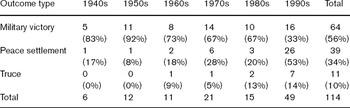
Table 1 shows the trend of civil war outcomes from 1944 to 1999.Footnote 1 Compared with the Cold War era, negotiated peace settlements clearly increased in number and they were the dominant type of termination in the 1990s.Footnote 2 Therefore, it is appropriate that a considerable part of research on recurrence would tend to focus on civil wars that ended in negotiated peace settlements. Nevertheless, the percentage of civil wars that ended in military victories was 56% after World War II and 33% after the Cold War. These observations suggest that the cases of military victory, other than the cases of negotiated peace settlement, are significant to the contemporary civil war scenario and that a comparative analysis of the impact of each termination type on the duration of peace throws light on the crucial factors that lead to recurrence of civil war.
Trend in civil war outcomes, 1944–1999

2.1 Peace through military victory
Most people may have a negative image of military victory, such as higher causalities or winner-takes-all. Therefore, ‘peace through military victory’ is difficult to understand intuitively. Why does military victory tend to achieve durable peace?
Wagner (Reference Wagner and Roy1993) compares the characteristics of military victory and peace settlement and offers a convincing argument for the relationship between civil war outcomes and post-civil war peace. According to Wagner (Reference Wagner and Roy1993: 255), negotiated peace settlement is more likely to result in a balance of power relationship between former combatants and in unstable peace because the former combatants can continue to retain the military capability required to resume civil war in the future. On the other hand, military victory destroys the organizational capability and identity of the loser, and allows only the winner to hold military weapons and thus it is possible to prevent the loser from re-igniting civil war. In sum, he argues that military victory is more likely to lead to stable peace than is negotiated peace settlement because of capability asymmetry between the winner and the loser.
Wagner successfully conducted the pioneering work on the relationship between military victory and the risk of conflict recurrence. This proposition is called the ‘the Wagner hypothesis’ (Licklider, Reference Licklider1995: 685). Luttwak (Reference Luttwak1999) takes a similar stand, contending that the international community should not mediate combatants to end by negotiated peace settlement, but rather should ‘give war a chance’ (Luttwak Reference Luttwak1999: 44).
Besides Wagner's argument, military victory can ease the information problem after conflict. When civil war ends in negotiated peace settlement, warring parties not only preserve their own military forces but also have an incentive to disguise information about their military capacities and political will in the peace process (Walter, Reference Walter2002). Such incomplete information about military strength and political will can be a critical cause for the re-occurrence of conflict (Fearon, Reference Fearon1995). In the case of military victory, the winning side can display its relative strength and political will to the losing side and potential rebel groups (Walter, Reference Walter2004: 374). Therefore decisive military victory can prevent them from (re)starting civil war.
Wagner's research lumps government military victory and rebel military victory together as military victory and does not investigate the differences between the two. After military victory, the winning side can control the bureaucracy, national economy, and territory. Whereas a government can continue to use its regime after government military victory, a rebel group has to first overthrow the former government regime before establishing its new regime to run the country. Since a rebel group tends not to have much experience in state management, the new regime the rebel group establishes after military victory may not be as strong as that of a government regime. Civil war is less likely in states with enough capacity (Fearon and Laitin, Reference Fearon and Laitin2003). States with enough capacity can resolve grievances and prevent insurgencies by using competent bureaucracy and deploying a well-organized army. In other words, the lack of adequate capacity is positively related to the likelihood of conflict recurrence. Therefore, military victory by a rebel group leads to less stable peace than does military victory by a government.
In spite of its importance in academic and policy fields, Wagner's hypothesis has not been directly studied, with a few exceptions. Licklider (Reference Licklider1995), using a simple cross tabulation analysis, shows empirical evidence supporting Wagner's hypothesis that military victory is likely to lead to more durable peace than is negotiated peace settlement. Toft (Reference Toft2010) also examines the relationship between civil war termination and conflict recurrence. She finds that military victory, especially rebel military victory, is more likely to lead to durable peace in post-conflict period, whereas negotiated settlement and cease-fire increase the risk of civil war recurrence. Although the researches cited above are the few empirical studies which deal with civil war outcomes as main independent variables, they do not deal with duration analysis and use time-varying covariates. The shortcomings of the analytical method render the reliability of empirical results doubtful.
DeRouen and Berocovitch (Reference DeRouen and Bercovitch2008), using duration analysis for civil wars between only enduring internal rivalries, partially confirm the relevance of Wagner's hypothesis. Mukherjee (Reference Mukherjee2006) demonstrates that military victory does not always have a statistically significant effect on the longevity of peace. He examines all civil war cases and shows that military victory decreases the risk of civil war recurrence only when there is a political power-sharing agreement.
On the other hand, several studies find weak or no connection between military victory and durable peace. Quinn et al. (Reference Quinn, Mason and Gurses2007), analyzing the effect of rebel military victory and negotiated peace agreement on the risk of civil war recurrence, show mixed results that civil war, which ends in a rebel victory or a negotiated peace agreement supported by international peacekeeping operations, is less likely to recur than is the civil war that ends in a government victory. Doyle and Sambanis (Reference Doyle and Sambanis2000) demonstrate through cross-sectional analysis that there is no statistically significant relationship between military victory and stable peace. Walter (Reference Walter2004) also argues that military victory and other characteristics of previous civil war (e.g., cost of war) do not substantially impact the risk of recurrence. In her research, the characteristics of countries (e.g., living conditions) have a significant effect on the likelihood of renewed war.
Disagreement among existing empirical studies on Wagner's hypothesis and the lack of comparative studies suggest the need for further investigation.
2.2 Negotiated peace settlement, commitment problem, and durable peace
Although some studies demonstrate that negotiated peace settlement is more likely to lead to less durable peace than does military victory in a post-civil war country, not all negotiated peace settlements necessarily lead to unstable peace after civil war. In fact, 57% of the peace settlements between 1940 and 1992 were successfully implemented and contributed to durable peace in post-civil war societies (Walter, Reference Walter2002: 6).
According to the peace settlement school, the lack of credible commitment of advantaged groups on implementation increases the likelihood of peace settlement failure and civil war recurrence.Footnote 3 This hypothesis suggests that the failure of peace settlement implementation results from the combatants’ inability to provide a credible commitment not to renege on possible compromise agreements because of two structural features: quasi anarchy and the shadow of power transition. Quasi anarchy means that no central government exists to ensure implementation of order or law (Walter, Reference Walter1997: 338−40). Next, peace agreement requires a rebel group to disarm and demobilize and the creation of a new national army, and such a requirement makes the rebel group more vulnerable to surprise military attacks and coercion than before. In this situation, a government cannot offer the rebel group any credible commitment to implement the peace agreement. This encourages a rebel group to renege on the settlement and return to civil war. Even though both sides would prefer peaceful settlement to the cost of war, they cannot avoid the failure of the peace settlement if a credible commitment is lacking.Footnote 4
The main reasons for the failure of peace settlement implementation, and civil war recurrence, are the fear of military attack and excessive concessions, and the mistrust of the adversary's commitment to the implementation of peace settlement. Several scholars suggest that third-party interventions, usually in the form of peacekeeping operations, and the introduction of power-sharing pacts can guarantee combatants’ security and remove these obstacles to successful implementation (Hartzell, Reference Hartzell1999; Hartzell and Hoddie, Reference Hartzell and Hoddie2003; Hartzell et al., Reference Hartzell, Hoddie and Rothchild2001; Walter, Reference Walter1997, Reference Walter2002).
Most civil war researchers advocate that peace, in general, lasts longer when third parties intervene in post-civil war countries than when they do not intervene (e.g., Doyle and Sambanis, Reference Doyle and Sambanis2000; Fortna, Reference Fortna2004). Third parties can monitor and verify the compliance and implementation of a peace agreement better than the former warring parties, and thus provide reliable information to eliminate distrust between the combatants (Walter, Reference Walter2002). The information that is collected by third parties can play an important role at various stages of peace process − bargaining stage, negotiation stage, and implementation stage. In addition, third-party monitoring activity can reduce the incentive to cheat and renege on peace agreements (Werner, Reference Werner1999: 916–917). Peacekeeping operations increase the cost of surprise attack and promote disarmament and demobilization.
The introduction of a power-sharing mechanism has also been identified as one of the most effective ways to establish sustainable peace (e.g., Hartzell, Reference Hartzell1999; Hartzell and Hoddie, Reference Hartzell and Hoddie2003). The main reason for implementation failure is the fear of surprise attack and distrust in commitment on implementation. A power-sharing arrangement is designed to give both a government and a rebel group sufficient opportunity and ability to prevent the opponent from dominating politics, from launching a surprise attack, from occupying a territory, and from monopolizing welfare and resources. Thus, a power-sharing arrangement can ease the hostility between former combatants and lead to more stable peace in post-civil war society. Power-sharing between social groups is one of the most fundamental means of sustaining peace and resolving disputes without violence (Lijphart, Reference Lijphart1977).
Some empirical studies successfully show the importance of third-party interventions and power-sharing arrangements. From a quantitative analysis of all peace settlement cases, Walter (Reference Walter2002) finds that third-party security guarantees or power-sharing pacts significantly increase the likelihood of successful implementation of peace agreements. Hartzell et al. (Reference Hartzell, Hoddie and Rothchild2001) also show, with empirical evidence, that third-party interventions reduce the risk of peace agreement failures and civil war recurrence. Hartzell and Hoddie (Reference Hartzell and Hoddie2003) divide power-sharing pacts into political, military, territorial, and economic power-sharing pacts and investigate their effects on peace duration after a peace settlement using a duration model. According to their findings, the addition of one more category of power-sharing terms reduces the risk of peace settlement failure by 53%.
Although the result of these studies indicates that third-party interventions and power-sharing pacts increase the likelihood of successful implementation of a peace settlement and lengthen the duration of post-civil war peace, they do not compare negotiated peace settlement cases with other post-civil war cases and discuss how these two important supportive factors influence the post-conflict peace after military victory.
2.3 Which is the best outcome for post-conflict peace?
Wagner (Reference Wagner and Roy1993) argues that military victory is more likely to lead to durable peace than peace settlement, and Licklider (Reference Licklider1995) and other scholars find empirical evidence in support of this hypothesis. The existing research on peace settlement contends that a peace agreement with third-party security guarantees or power-sharing pacts increases the likelihood of successful implementation compared to an agreement without such supports. Neither the research on military victory nor the research on peace settlement makes comparisons with the case that is considered a more durable peace by another school. Quinn et al. (Reference Quinn, Mason and Gurses2007) simultaneously investigate the effects of rebel victory and of peace settlement with peacekeeping operations on the risk of war recurrence. Mukherjee (Reference Mukherjee2006) includes a one-side military victory and military victory with a political power-sharing agreement in the same regression model. However, they do not explain which is the best route for post-conflict peace?
In civil war research, the motivation and feasibility of armed groups are considered crucial for the onset of civil war (Collier and Hoefller, Reference Collier and Hoeffler2004; Fearon and Laitin, Reference Fearon and Laitin2003). The motivation for rebellion derives from people's grievance against a government, which arises from political oppression, relative deprivation, social exclusion, ethnic and religious fractionalization, and inequality, or people's greed for accumulating private wealth. Sharing the common motivation for insurgency enables a potential rebel group to overcome the collective action problem during costly war. As rebel leaders have to organize their own groups and procure arms and belligerents to wage civil war, the feasibility of civil war is determined by the availability of financial and military resources. The logic of civil war onset is partially applicable to civil war recurrence.
Military victory can destroy the loser's organized capability, such as their military arsenals and bases, and political and military leaders can be arrested or executed. Mobilizing human and material resources to restart armed conflict, namely the feasibility of renewing insurgency, becomes more difficult for the loser than ever before. However, as much as decisive victory deprives the losers of their political, economic, and social opportunities, it aggravates their grievances and increases the motivation of potential belligerents for insurgency.
In contrast to military victory, negotiated peace settlement allows the warring parties to preserve the feasibility of their armed operations in the new integrated national army. If the peace settlement is supported by third-party peace operations or power-sharing pacts, these supports attenuate the fear and mistrust of belligerents, and provide former combatants the opportunities to achieve their political, economic, and social goals through non-violent means. In such an environment, while the motivation to rebel is likely to decrease, the feasibility of military operation still remains. In the case of a truce, the warring parties not only preserve their own armed forces, but also any disagreements are not resolved. Thus, the motivation for insurgency and feasibility of belligerents continues after truce.
In most cases, power-sharing arrangements are achieved when civil wars end in negotiated peace settlements. However, sometimes, combatants agree to power-sharing arrangements after military victory (Mukherjee, Reference Mukherjee2006), and third parties intervene in a post-conflict country to maintain internal order, even if civil war ends with a victory. Third-party interventions and power-sharing arrangements are not always a subset of negotiated peace settlements.
As mentioned above, military victory can reduce the feasibility of rebellion, but it cannot eliminate the source of motivation for rebellion. However, if third-party peacekeeping operations or power-sharing arrangements support a post-conflict country which ends in a military victory, its civil war outcome can decrease the loser's motivation for, as well as feasibility of, rebellion. In other words, military victory, supported by peacekeeping operations or power-sharing arrangements, can lead to longer peace spells than does negotiated peace settlement, supported by peacekeeping operations or power-sharing arrangements, and military victory without support.
From the above argument, it is anticipated that in the case of military victory with support, the motivation for, and the feasibility of, insurgency may be alleviated, and the risk of recurrence is lower than in other civil war outcomes. Previous works have not considered the case of military victory with support or conducted a comprehensive comparative study of different civil war outcomes and the durations of peace spells.Footnote 5
3. Research design
3.1 Data
In order to test the relationship between civil war outcomes and the durations of post-civil war peace, I use Fortna's (Reference Fortna2004) dataset to identify a sample of 114 civil war episodes for the period 1944–1999.Footnote 6 The definition of civil war followed by Fortna's (Reference Fortna2004) dataset is the same as the one given by Doyle and Sambanis (Reference Doyle and Sambanis2000: 783): a civil war ‘causes more than 1,000 battle deaths overall and in at least a single year; challenges the sovereignty of an internationally recognized state; occurs within the recognized boundaries of the state; includes rebels with the ability to mount organized armed opposition to the state; and has parties concerned with the prospect of living together in the same political unit after the end of the civil war’.
The dataset is preferable to others for the following two reasons. First, Hartzell and Hoddie (Reference Hartzell and Hoddie2003), Hartzell et al. (Reference Hartzell, Hoddie and Rothchild2001), and Walter (Reference Walter2002) focus only on negotiated peace settlement cases and exclude other civil war outcomes (i.e., military victory by one side and truce). For this research, the different termination types, government military victory, rebel military victory, negotiated peace settlement, and truce, are incorporated into the dataset to compare the effects of different civil war outcomes. Second, most researchers on civil war recurrence use time-constant covariates (e.g., Hartzell et al., Reference Hartzell, Hoddie and Rothchild2001). In this paper, since the characteristics of countries and third-party interventions vary with time after civil war, several time-varying covariates, such as peacekeeping operation, level of democracy, and economic condition, are incorporated into the dataset.
3.2 Dependent variable
The dependent variable is operationalized as the duration of peace after the end of civil war. Many former studies consider that a spell of peace is successful if the civil war does not resume during a certain period following the termination of civil war (e.g., Doyle and Sambanis, Reference Doyle and Sambanis2000; Licklider, Reference Licklider1995; Walter, Reference Walter1997, Reference Walter2004).Footnote 7 They operationalize the length of post-civil war peace as a dichotomous variable (either two or five years), but the arbitrary time period may be problematic. Therefore, the entire duration of peace spell is used here. Fortna's dataset includes detailed information about the cease-fire dates and the recurrence dates of civil wars. Such information enables one to count the exact duration of peace spells.Footnote 8 Unlike the existing studies, in which the duration of peace is measured by the number of months or years (e.g., Hartzell and Hoddie, Reference Hartzell and Hoddie2003; Hartzell et al., Reference Hartzell, Hoddie and Rothchild2001; Mukherjee, Reference Mukherjee2006), for this research it is measured by the number of days that peace endured following termination of civil war, through to 31 December 1999. A spell of peace is therefore the time between the termination of fighting (by a decisive military victory, negotiated peace settlement, or truce after a military stalemate) and the recurrence of civil war, if any, between the same protagonists.Footnote 9 When a civil war does not recur, the duration of peace is right-censored on 31 December 1999. With this operationalization of dependent variable, the 114 post-civil war peace events are at risk of failure for a total of 581,648 days.
3.3 Independent variables
Civil war outcome. The main independent variables, in this research, are civil war outcomes that are based on the Fortna's (Reference Fortna2004) dataset.Footnote 10 The variable Military Victory was measured here by a dummy variable coded 1 if civil war ended in a military victory of a government or a rebel group, 0 if otherwise. More detailed military victory variables, Government Victory and Rebel Victory, are also created for this study. Government Victory is a war termination in which a government decisively defeats a rebel group in the battlefield. Rebel Victory is a war termination in which a rebel group militarily defeats a government's forces in the battlefield, overthrows the incumbent regime, and establishes a new regime. Moreover, it includes secessionist civil wars in which a rebel group secedes from the government and builds a new state or autonomous region in the territory controlled by the defeated government. Peace Settlement is a formal peace treaty, in which a government and a rebel group agree to stop fighting and promise to resolve the issue of conflict through mutual cooperation in a new political order with a formal peace agreement. Therefore, an informal settlement or a cease-fire is not included in Peace Settlement. In Truce, there is no formal settlement between a government and a rebel group, but there is an informal settlement or a cease-fire which stalemates any further large-scale fighting. All variables are dummy variables.
Third-party peacekeeping. In this analysis, a third-party peacekeeping operation in a post-civil war country is used as a third-party intervention. To identify third-party peacekeeping operations, the websites of several International/Regional Organizations (UNDPKO, OSCE, and ECOWAS) are used, besides the Doyle and Sambanis’ (Reference Doyle and Sambanis2000) dataset, Fortna's (Reference Fortna2004) dataset, and UCDP database. Peacekeeping Operation is coded 1 for each peace year when there is at least one third-party peacekeeping operation (UN or non-UN) in post-civil war countries and 0 if otherwise. In addition, interaction terms between third-party peacekeeping operation and military victory and negotiated peace settlement (Peacekeeping Operation × Military Victory and Peacekeeping Operation × Peace Settlement) are calculated to estimate the effect of military victory and negotiated peace settlement with third-party peacekeeping operations on the post-civil war peace.
Power-sharing arrangement. Power-Sharing Arrangement is obtained from Hartzell and Hoddie (Reference Hartzell and Hoddie2003) and Walter (Reference Walter2002). Hartzell and Hoddie define power-sharing as ‘those rules that, in addition to defining how decisions will be made by groups within the polity, allocate decision-making rights, including access to state resources, among collectives compositing for power’ (Harzell and Hoddie Reference Hartzell and Hoddie2003: 320). Three types of power-sharing arrangement are identified here: political power-sharing, military power-sharing, and territorial power-sharing. Power-Sharing Arrangement is coded 1 if a government and a rebel group agree with more than one power-sharing pact, 0 if otherwise. Interaction terms are created between power-sharing arrangement and military victory and negotiated peace settlements (Power-Sharing Arrangement × Military Victory and Power-Sharing Arrangement × Peace Settlement) to unravel the effects of military victory and negotiated peace settlement with power-sharing arrangements on peace spells.
3.4 Control variables
Once civil war terminates and a peace spell begins, several factors may influence whether the peace will last long or end soon. To identify these factors and to understand their influence on the duration of peace spell, first three characters of a previous civil war are taken into account: cost of civil war, duration of civil war, and war type. Next, it is expected that some factors, which are thought to be the causes of civil war onset, may also become the causes of civil war recurrence. Therefore, several characteristics of countries, such as the level of democracy, economic conditions, oil export, and ethnic heterogeneity are included in the analysis models.
Cost of civil war. To estimate the impact of civil war cost on the duration of peace spell, the number of causalities, that is the total number of the dead (both civilian and battle deaths) during the civil war, is used in this analysis (Cost of Civil War). The variable is obtained from Doyle and Sambanis (Reference Doyle and Sambanis2006) and is measured using the natural log of the number of the dead people to ease the problem of outliers and skewness. Intuitively, high war costs may have a positive impact on the duration of peace spells. However, several scholars find that the higher the civil war cost, the greater is the risk of civil war recurrence (Doyle and Sambanis, Reference Doyle and Sambanis2000: 787; Fortna, Reference Fortna2004: 287; Hartzell et al., Reference Hartzell, Hoddie and Rothchild2001: 198). High casualty rates may create high levels of hostility between the combatants. High levels of hostility can cause more hatred and distrust between combatants and people, and thereby render conflict resolution and peace maintenance very hard. The increase in the cost of civil war is expected to increase the probability of civil war recurrence.
Duration of civil war. The duration of previous civil war also has an impact on the risk of civil war recurrence (Duration of Civil War). The duration of war varies from 1 month (Uganda 1966–1966 and Yemen–South/Peoples’ Rep. 1986–1987) to 600 months (Israel–Palestine 1947–1997). This variable is also obtained from Fortna (Reference Fortna2004) and measured using the natural log of monthly duration. According to previous research, a long duration of civil war offers combatants a chance to learn the opposing group's military ability, interests, and political will, and thus diminishes the former combatants’ incentive to restart civil war (Hartzell et al., Reference Hartzell, Hoddie and Rothchild2001: 198). The duration of civil war is therefore negatively related to the likelihood of civil war recurrence.
Identity war. Identity War is a variable that distinguishes ethnic, religious, and identity conflicts from ideological, revolutionary, and other wars. Identity War is coded 1 if it is an ethnic, religious, or identity conflict, 0 if otherwise. The variable is obtained from Fortna (Reference Fortna2004). The stakes in identity conflicts, involving ethnic, religious, racial, and linguistic issues, are less divisible than those in politico-economic conflicts, concerning ideological and socioeconomic interests (Hartzell et al., Reference Hartzell, Hoddie and Rothchild2001: 189). Identity conflicts are assumed to involve higher stakes, and thus compromise and accommodation are much harder to achieve than they are with politico-economic conflicts. The post-civil war peace is, therefore, expected to be more difficult to sustain after an identity civil war.
Level of democracy. Polity IV democracy–autocracy scale (–10 to 10) is used to measure the level of democracy after a peace spell starts (Democracy). Democratic countries are less likely to experience a civil war because the democratic institution and process give people an opportunity and a tool to express their grievance without violence. Therefore, the level of democracy after civil war is expected to lead to longer durations of peace spells following civil war termination.
Economic condition. To find the relationship between the duration of peace spells after civil war and economic conditions, GDP per capita, from Fearon and Laitin's (Reference Fearon and Laitin2003) dataset, is included in this empirical analysis (GDP per capita). Fearon and Laitin (Reference Fearon and Laitin2003) and others find that economic conditions are strongly and negatively correlated to susceptibility to civil war. In addition, low economic and living conditions mean low opportunity cost to becoming involved in civil war (Collier and Hoeffler, Reference Collier and Hoeffler2004). GDP per capita is therefore expected to have a negative impact on the risk of civil war recurrence.
Oil export. Natural resource dependence is one of the most important indicators for the risk of armed conflict. Especially, oil dependence is closely related to weaker stake capacity and civil war onset (Fearon and Laitin, Reference Fearon and Laitin2003). Oil Export is coded 1 when states receive more than one-third of their export revenues from oil exports, 0 if otherwise. This variable is obtained from Fearon and Laitin (Reference Fearon and Laitin2003). Several scholars suggest that oil dependence is positively related to the risk of civil war onset (de Soysa, Reference de Soysa2002; Fearon and Laitin, Reference Fearon and Laitin2003). A similar relationship is expected to hold for civil war recurrence. Thus, oil dependence is expected to increase the probability of civil war recurrence.
Ethnic heterogeneity. Vanhanen's (Reference Vanhanen1999) dataset of ethnic heterogeneity is included in the empirical model to test the impact of racial, religious, and linguistic divisions on the chances for recurrence of civil war (Ethnic Heterogeneity). This index ranges from 0 (minimum heterogeneity) to 144 (maximum heterogeneity). Greater ethnic heterogeneity may increase the opportunity for mutual contact among different ethnic groups. More contacts can exacerbate ethnic divisions and lead to enhancement of hostilities after civil war. Therefore, ethnic heterogeneity is expected to have a positive impact on the recurrence of civil war.
3.5 Method
Since duration of post-civil war peace is the dependent variable in this analysis, duration analysis (survival analysis or event history analysis) is used here to estimate the effect of the independent variables on the post-civil war peace spells.Footnote 11 One of the most important advantages of duration analysis, compared to other regression models, is that it enables one to estimate appropriately for the censored data. As the observations of peace spells are censored on 31 December 1999, the data are right censored. In other words, at the end of an observation, if the relevant event (the recurrence of civil war) has not yet occurred (the spell end date is unknown), then the total duration of post-civil war peace between entry into and exit from the peace spells will be unknown. Therefore, duration analysis allows scholars to employ a more precise degree of variation in the dependent variable. When one fails to account for the right-censored data, the empirical analysis can lead to biased results (Box-Steffensmeier and Jones, Reference Box-Steffensmeier and Jones2004).
A number of duration models exist, but each assumes a different functional form for the hazard rate. The hazard function is the distribution of the probability of failure across time. If the functional form of the hazard rate can be assumed with reasonable confidence at the outset of the analysis, parametric models, such as the Weibull model, the Gompertz model, and the Log-logistic model, should be employed; otherwise, semi-parametric models (Cleves et al., Reference Cleves, Gould and Gutierrez2004) should be used. As the shape of hazard function is not assumed theoretically, this study employed the Cox semi-parametric proportional model (henceforth, the Cox model). It allows one to estimate the relationship between the hazard rate and independent variables without making any assumptions about the shape of the baseline hazard function. In addition to this, the Cox model is well suited for handling time-varying covariates.
Some conflicts have experienced more than one recurrence. The failure of post-conflict peace aggravates domestic stability, relationship among combatants, economic and social conditions, and fear of people. Therefore, it can be assumed that the risk of civil war recurrence of a conflict that has already experienced the failure of post-conflict peace is higher than that of the conflict with no previous peace failures. To control the effect of prior history, the Stratified Cox model is used, instead of the standard Cox model. Before estimation, I generate ‘strata’ which is a count variable of events (failures); the first peace failure, the second failure, the third failure, or more and stratify by strata. In this estimation method, the baseline hazard was allowed to differ by strata, but the coefficients are restricted to be the same across strata (Box-Steffensmeier and Jones, Reference Box-Steffensmeier and Jones2004: 160; Cleves et al., Reference Cleves, Gould and Gutierrez2004: 144).
4. Results
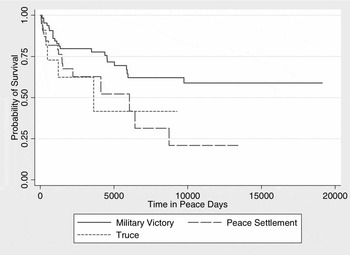
Figure 1 illustrates the relationship between three civil war outcomes and the duration of peace spells, using a non-parametric model: the Kaplan–Meier Survival Estimates. From this figure it can be clearly confirmed that civil war outcomes have different effects on the duration of peace spells.Footnote 12 Military victory cases (solid line) have a higher probability of survival than that of other civil war outcomes; that is, military victory produces more durable peace in a post-civil war country than does negotiated peace settlement (dashed line) or truce (dotted line).
Civil war outcomes and the duration of peace Kaplan–Meier survival estimates

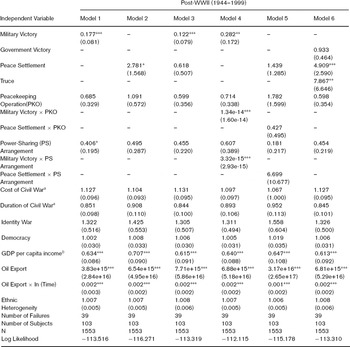
Table 2 shows the results from different Cox models for the entire post-WWII period (1944–1999).Footnote 13 In this table, the hazard rate, which is defined as the exponent of coefficient, is reported because its interpretation is easier than that of the coefficient. A hazard rate lower than 1 indicates lesser likelihood of civil war recurrence, and higher than 1 greater likelihood.Footnote 14
The stratified Cox regression results for determinants of civil war recurrence

Notes: Harzard rates are reported. Variables in parentheses are robust standard errors (cases clustered by conflict). a Logged; b ln 1000s.
*significant at 10%; **significant at 5%; ***significant at 1%.
Military victory has a positive and statistically significant effect on the duration of peace spells level in Model 1. Compared with peace settlement and truce cases, the risk of civil war recurrence drops by about 82% when civil war ends in a military victory. In Model 3, truce is omitted from the model to avoid perfect multicollinearity and hence it can be treated as the omitted category (benchmark). Model 3 indicates that military victory produces much longer peace spells than does truce. These findings, in line with Licklider (Reference Licklider1995), offer supportive evidence for Wagner's hypothesis: the civil war that ends in a military victory produces more enduring peace than the one that ends in negotiated peace settlement and a truce.
On the other hand, the hazard rates of peace settlement are higher than 1 in all models except Model 3. These results imply that peace settlement does not lead to stable peace in a post-civil war country. The hazard rate of peace settlement, in Model 3, is lower than 1 but does not reach a statistically significant level. From Model 3, one can compare the effect of peace settlement on peace spells with the effect of truce. As mentioned before, truce may produce less durable peace than does negotiated peace settlement because a government and a rebel do not pursue disarmament and demobilization of own armed forces and not agree with formal peace agreements when civil war ends in a truce. However, this result does not lend support to the argument that truce is probably less likely to lead to durable peace than is negotiated peace settlement.
In Model 4, the result of interaction terms – military victory and peacekeeping operation and power-sharing arrangement – show that military victory with peacekeeping operations or power-sharing operations produces remarkably durable peace after civil war. In my data, almost all civil wars that end in military victories supported by third-party peacekeeping operations or power-sharing arrangements do not experience civil war recurrences.Footnote 15 Therefore, these lead to quite small estimated hazard rates. While previous studies have not examined the relationship between military victory with supports and the risk of civil war recurrence, the results here show that peacekeeping operations and power-sharing pacts are highly effective in achieving durable peace after military victory.
In Model 5, the estimated hazard rates of interaction terms between peace settlement and peacekeeping operation and power-sharing arrangement are statistically insignificant in contrast to those of military victory. Walter (Reference Walter2002) and others propose that peace settlement with third-party peacekeeping operations or power-sharing pacts can produce durable peace. But, the present study suggests that negotiated peace settlement, even when supported by peacekeeping operations or power-sharing arrangements, does not significantly affect the duration of peace. Although previous research on peace settlement cases finds that peacekeeping operations and power-sharing pacts lead to durable peace settlements, the present study of all civil war outcome cases fails to find any supporting evidence for durable peace settlements from Model 5.
In summary, the present study confirms the previous finding that military victory is more likely to lead to durable peace than is negotiated peace settlement or truce. However, it does not find any evidence in support of the standard explanation that peacekeeping operations and power-sharing arrangements decrease the likelihood of the failure of peace spells that follow negotiated peace settlements. Most importantly, the results of interaction terms show that military victory with peacekeeping operations or power-sharing arrangements is more likely to achieve remarkably stable peace than peace agreement with these supports and other civil war termination types. It indicates that military victory supported by peacekeeping operations or power-sharing arrangements tends to alleviate the motivation for and feasibility of insurgency, and thus substantially decreases the risk of civil war recurrence. This is a significant finding for the debate of civil war outcome and durable peace.
In Model 6, rebel victory is the omitted category. The hazard rate of government victory is smaller than 1, but not statistically significant. Therefore, it cannot be concluded with confidence that government victory leads to longer peace spells than does rebel victory. Quinn et al. (Reference Quinn, Mason and Gurses2007) found, using logistic regression analysis, that civil war ending in a rebel victory is less likely to experience a civil war recurrence than the one terminated with a government victory. However, the result presented here, using survival analysis, does not confirm their finding.
The hazard rates of peacekeeping operations are not statistically significant in any model. These results may invalidate the commonly accepted explanation that third-party peacekeeping operations decrease the risk of civil war recurrence. Although the hazard rates of power-sharing arrangement are not always statistically significant, they are consistently lower than 1 in all the models. That the introduction of power-sharing arrangement tends to decrease the likelihood of peace failure is only weakly evidenced by the finding of this study.
Table 2 also tells us something about the environments in which peace is either more difficult or easier to maintain after civil war. Whereas the hazard rates of cost of civil war are higher than 1 and the hazard rates for civil war duration are lower than 1, both variables are not statistically related to the risk of recurrence. The estimates of identity war are higher than 1, but covariates are insignificant in all models. This proves that the issue of civil war does not have significant effect on civil war recurrence. The hazard rates of level of democracy and ethnic heterogeneity are almost equal to 1, but are statistically insignificant. The results signify that level of democracy and ethnic heterogeneity may have no substantive effect on the likelihood of peace failure. While the estimates of oil export variable are higher than 1, the interaction term is positive and statistically significant. This indicates that oil export dependence significantly increases the risk of peace breaking out into civil war, but this effect diminishes across time. The hazard rates of GDP per capita are lower than 1 and highly significant. This indicates that improvement in economic and living conditions can reduce the probability of civil war recurrence.
5 Conclusion
This article tries to explain why some countries experience civil war recurrence and others do not. Most studies on the duration of peace focus on negotiated peace settlement cases (e.g., Hartzell, Reference Hartzell1999; Hartzell and Hoddie, Reference Hartzell and Hoddie2003; Walter, Reference Walter1997) without paying much attention to other termination cases. This article examines how different war termination types, including military victory, negotiated peace settlement, and truce, influence the duration of peace after civil war with the Stratified Cox model. As a result, the empirical findings presented in the article suggest two important implications for both academic research and policy decisions.
First, durable peace can be achieved when civil wars end in a military victory. Empirical results clearly indicate that the peace spell which follows military victory is more likely to be durable than that which follows negotiated peace settlement or truce. This confirms the theoretical argument of Wagner (Reference Wagner and Roy1993) and the empirical finding of Licklider (Reference Licklider1995). Moreover, the investigation of the relationship between military victory and peacekeeping operation and power-sharing arrangement indicates that these two supports significantly lower the risk of civil war recurrence after military victory. Based on this result, one can assert that by sending peacekeeping forces and establishing power-sharing mechanisms, international and domestic communities can achieve sustainable peace in civil war countries which end in military victories.
Second, negotiated peace settlement, supported by peacekeeping operations and power-sharing arrangements, is not directly related to sustainable peace. The peace settlement school, analyzing only peace settlement cases, argues that peacekeeping operations and power-sharing arrangements can lead to durable peace after civil war. However, the finding of this paper, considering several civil war outcome cases, shows that durable peace is hard to achieve after peace settlement, even when peacekeeping forces and power-sharing institutions support the implementation.
This study attempts to find the relationship between civil war outcomes and post- war peace. The research presented in this article needs to be further investigated to make the findings more robust. First, because the dependent variable is the peace duration after civil war, this study does not squarely address the quality of post-conflict peace or society, such as post-conflict justice, democratization, and economic development. The quality and content of peace after civil war and the termination types will have to be addressed directly in future research. Second, while the findings show that military victory, especially the one supported by third-party peacekeeping operations or power-sharing arrangements, has a positive and significant effect on the durability of peace after civil war, they do not shed light on the causal mechanism for this. Future research should, therefore, investigate the causal mechanism through case studies.
About the author
Hirotaka Ohmura is Lecturer of International Relations at Faculty of Economics, Shiga University. His primary research interests include international and intrastate conflict. He has some works on the relationship between civil war and natural resources.
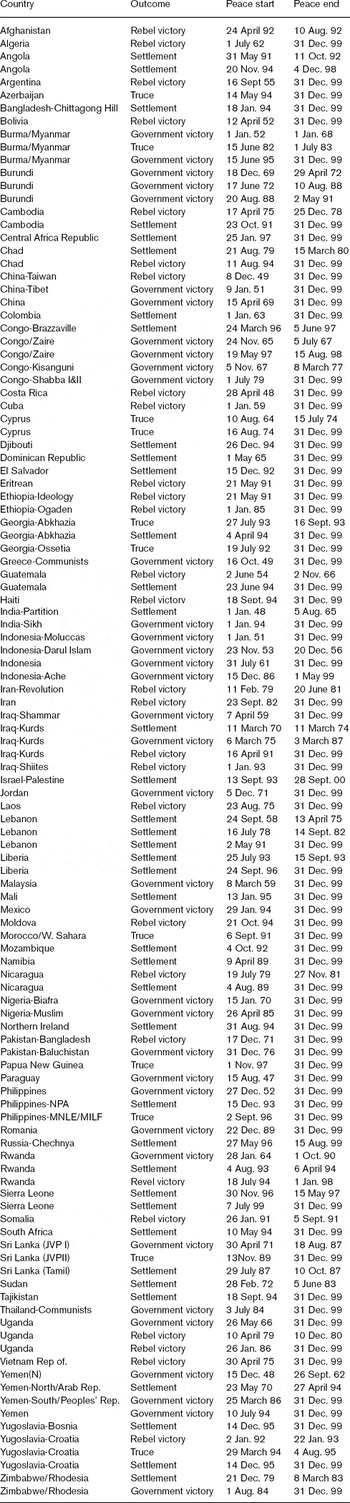
Civil wars list (1944–1999)