Contrary to the predictions of outsiders, the Chinese Communist Party (CCP) regime did not collapse after the turmoil of the Tiananmen Incident in 1989, but remains steadfastly in place to this day. Many observers have attempted to explain why this may be the case. In particular, Andrew J. Nathan argues that the Chinese political system possesses a strong degree of adaptation and can thus be classified as a resilient authoritarian regime.Footnote 1 There are many facets to the regime's resilience, but this article will consider the specific factors of cadre training and the consolidation of the regime's autonomy over personnel recruitment.Footnote 2 These factors afford the CCP the opportunity to ensure that its ability to govern remains persistently strong, thereby boosting the Party's resilience and adaptability. Academics have already put forward various ideas concerning the CCP's monopolistic personnel management systems.Footnote 3 This article will focus on a largely overlooked aspect – the CCP's reserve cadre (houbei ganbu 后备干部) system – in order to investigate precisely how this mechanism nurtures the new talents needed by the CCP and helps to sustain and perpetuate the resilient authoritarian regime.
Outside of the CCP, understanding of the reserve cadre system is minimal.Footnote 4 In fact, a CCP civil servant revealed that even within the Party reserve cadres are considered at once a very familiar and yet inscrutable concept. Very little has been revealed about their selection and training procedure.Footnote 5 However, this does not detract from the significance of the mechanism. Theoretically speaking, Soviet systems lack the scope for smooth power transitions,Footnote 6 but the robust reserve cadre system allows for a more orderly manner in which to transfer power. To a certain extent, the Mao-era emphasis on the concept of “revolutionary successors” (geming jieban ren 革命接班人) can be seen as the predecessor to the reserve cadre system. However, that concept came to an end following the launch of the Cultural Revolution.
Since 1978, the CCP has gradually built up a comprehensive reserve cadre system on the premise that, “in general, Party and government leaders should be selected from the ranks of the reserve cadres.”Footnote 7 Many of the political “stars” within the CCP, including Tianjin Party secretary, Sun Chunlan 孙春兰, Shanxi provincial secretary, Yuan Chunqing 袁纯清, president of the Supreme People's Court, Zhou Qiang 周强, and Guangdong Party secretary, Hu Chunhua 胡春华, were originally reserve cadres at the provincial/ministerial level (sheng bu ji 省部级).Footnote 8
This article points out that the reserve cadre system is already highly meticulous in design, allowing the CCP to mould a legion of “ideal cadres” with the advantages of youth, “correct” political attitude and superior governing abilities. The Party is then able to select the cream of the crop to fill important positions around the country. In other words, reserve cadres are essentially the Party's “disciples.” The CCP guides reserve cadres through a programme of rigorous cultivation and performance evaluation in order to ensure the quality and correct political thinking of the regime's future leaders. Through an institutional examination of the reserve cadre system, it is possible to illuminate one of the key ways in which the CCP continues to reinforce and perpetuate its resilient authoritarian regime.
The Foundation of Resilient Authoritarian Regimes: The Perspective of Elite-Centralism
How are resilient authoritarian regimes able to survive? Minxin Pei pinpoints several different explanations, including the fact that the regime's firm grip on the vast part of the country's economic resources, and in particular state-owned enterprises, means that close mutual economic ties are generated between those in power. In addition, in an authoritarian regime, it is possible to manipulate the extent of political participation and obstruct the fair electoral victory of competing parties. The regime has access to sources of power and so can crush any forces of social resistance. Minxin Pei also observes that the CCP is built on a foundation of institutionalized learning and organization which serves to strengthen its overall governing ability.Footnote 9 Finally, the perpetuation of the CCP's resilient authoritarian regime is closely associated with the Party's autonomy in terms of personnel management, which can go some way to explaining why democratic transition has yet to occur in China despite rapid and long-term economic development.Footnote 10
However, the term “resilient authoritarian regime” is as yet simply an abstract and descriptive concept; it is important to identify which precise factors support the resilient nature and continued survival of such regimes. Elite-centralism, which attributes the CCP's resilience to the nature and functioning of the elite, offers an answer to this question. For example, there is research which focuses on the personnel structures in place within the CCP that enable cadres to achieve a high degree of governing ability. Some studies consider this from the perspective of the cadre evaluation system by analysing the CCP's emphasis on cadres' political performance.Footnote 11 Others consider the institutional evolution of cadre appointment mechanisms through an investigation into how the Party is able to filter out the least able cadres through a competitive selection system.Footnote 12 Studies have also considered the recent official aim of rejuvenating the system by reducing the average age of cadres, a move which is thought to allow more time and opportunity to inculcate superior governing ability and unified political ideology in the next generation of young cadres.Footnote 13 Research also shows that higher educational standards and richer professional experiences are crucial for guaranteeing the quality of the cadres within the system.Footnote 14 In sum, these studies use the concept of elite-centralism to explain how the political leadership maintains its ability to govern.
However, most crucially for this research, some scholars suggest that the existence of unity and consensus between political elites is one of the most crucial factors with regards to regime stability, as it reinforces the inner autonomy of the authoritarian political system.Footnote 15 In this way, the political elite will not waver in their support of the regime, despite any number of outside challenges, such as Western pressure to democratizeFootnote 16 or demands from civil society for more open political participation. Political leaders acting in this manner have been described by Michael Burton and his colleagues as the “ideologically unified elite.”Footnote 17 According to this definition, it is possible to predict the existence of a unified and strong elite core within the resilient CCP regime.
In this article, “ideological unification” refers to a general consensus upheld by the CCP elite regarding the key principles of the one-party dictatorship, and does not necessarily indicate that the CCP is monolithic in nature. Despite certain conflicts between inner Party factions and bureaucratic organs over respective points of interest,Footnote 18 political elites today retain a firm consensus on fundamental political principles such as “one central task and two basic points” (yige zhongxin, liangge jiben dian 一个中心, 两个基本点). Furthermore, scholars have identified that many CCP cadres hail from the ranks of the societal elite and have a strong “red” political ideology.Footnote 19 Within society, the emerging class of “red capitalists” does not tend to advocate democratic reform, but is far more likely to favour political stability.Footnote 20 In short, among the societal, economic and political elite, there appears to be a firm adherence to the basic tenets of stability and supremacy of the one-party dictatorship, regardless of different viewpoints on other issues. But, is there any particular mechanism ensuring this ideological unification?
This article responds to this question from the perspective of elite-centralism and argues that the CCP not only draws its elite from the ranks of the reserve cadres but also employs long-term training and cultivation of these “disciples” to ensure their ideological unification.Footnote 21 The cornerstones of the CCP regime's stability lie in the strong political consensus and high standard of administrative ability of the Party's cadres. This research will attempt to elucidate the survival and perpetuation of China's resilient authoritarian regime through a discussion of the reserve cadre system, first by offering a brief overview of the origins and evolution of the reserve cadre institution, and then by expounding upon its embedding in the institutional logic of the National Party Congress (NPC) schedule. The study also examines the selection criteria for reserve cadres and the methods of training and evaluation used to cultivate this group of loyal and capable Party disciples, thus informing the subsequent discussion of the reserve cadre system's influence on the survival of the CCP's resilient authoritarian regime.
The Evolution of the Reserve Cadre System
From the early 1980s onwards, the CCP has gradually built up the reserve cadre system, which has been meticulously honed and developed during its 30 years of evolution. Hu Yaobang 胡耀邦 first proposed the idea of assembling a group of 1,000 provincial/ministerial-level (sheng bu 省部,) reserve cadres in 1983; this represented China's first large-scale reserve cadre mechanism.Footnote 22 Later, in addition to provincial/ministerial-level cadres, the structure was extended to incorporate prefectural/bureau (di ting 地厅) and county/division (xian chu 县处) levels. In the 1980s, it was intended that this system would be the mechanism by which the “third echelon of cadres” (di san tidui 第三梯队) would be established.Footnote 23
The term “third echelon of cadres” reveals that it was a deliberate aim of the CCP to construct a reserve cadre management system led by the state. In 1980, the CCP began to refer to revolutionary Party elders such as Deng Xiaoping 邓小平 and Chen Yun 陈云 as the “first echelon of cadres.” The highest Party and government leaders at the time, such as Hu Yaobang and Zhao Ziyang 赵紫阳, were labelled the “second echelon of cadres.” The possible future successors of the Party and government leadership (i.e. the ranks of reserve cadres) were to be the third echelon of cadres. In order to organize the selection of the third echelon efficiently, Chen Yun set up a youth cadre bureau (qingnian ganbu ju 青年干部局), which was affiliated to the Central Organization Department (COD) and initially headed by Chairman Mao's former secretary, Li Rui 李锐. It was the CCP's intention that the main function of this unit should focus on the selection of the third echelon.Footnote 24 In addition to the central youth cadre bureau, each level of organization department was required to establish its own youth cadre division to handle the selection of reserve cadres.
The CCP drew up lists of reserve cadres and divided them into three separate levels: provincial/ministerial, prefectural/bureau, and county/division. Each level was made up of acting cadres from the level below. For example, a township-level cadre might have the opportunity to enter the list of county/division reserve cadres; a prefectural/bureau-level cadre would be eligible for the provincial/ministerial reserve cadre list, and so on.Footnote 25 When it was time to promote leading cadres, each level of organization department made its selections from the respective list of potential reserve cadres. Furthermore, the list would be adjusted and supplemented (tiaozheng buchong 调整补充) at certain times to guarantee a constant number of listed reserve cadres.
At the end of the 1990s, the reserve cadre system was further consolidated – for example, the compilation of the lists took on a more detailed design. The CCP dictated that two reserve cadres must be listed for each full leadership position within the system and one reserve for each deputy leadership role. In addition, the register of reserve cadres must include a certain proportion of non-CCP members.Footnote 26 Around 2010, the total number of reserve cadres stood at about 50,000, including at least 1,000 at provincial/ministerial level, 6,000 at prefectural/bureau level, and 40,000 at county/division level.Footnote 27
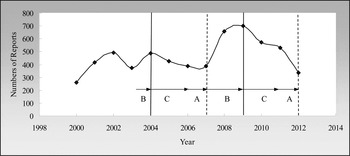
In 2004, in addition to ever more exacting specifications, a very important but largely unnoticed change took place within the reserve cadre system: the timing of the adjustment and supplementation began to fall squarely between NPCs. In the past, the CCP had timed the adjustment and supplementation of the reserve cadre name lists for around the time of the NPC. For example, at the 13th National Party Congress in 1987, the COD published a notice to direct the completion of the reserve cadre list adjustment and supplementation.Footnote 28 However, since 2004, the timing of updates to the list has been steered to fall between two congresses. It is possible to glean some information on the timing of the adjustment and supplementation from databases. This article relies on data from the year 2000 onwards, sourced from newspapers published in China, Hong Kong, Taiwan and Singapore, to locate the time periods during which increased numbers of reports were made on the selection of CCP reserve cadres, and to extrapolate the adjustment and supplementation time periods.
From Figure 1, it can be clearly seen that 2004 and 2009 were peak periods of adjustment and supplementation of the reserve cadre name lists. Comparison with officially published CCP documents further corroborates this finding. For example, the CCP announced in both 2004 and 2009 that adjustment and supplementation of the reserve cadre lists must be properly accomplished.Footnote 29 Reports also conjecture that the CCP intends to carry out the next periods of adjustment and supplementation in 2014 and 2019 (both dates fall between the dates of two NPCs).Footnote 30 From this information, it is possible to conclude that the adjustment and supplementation of the reserve cadre name lists has been deliberately timed to take place between NPCs.
Timing and Functional Logic of the Reserve Cadre Adjustment and Supplementation Period

The timing of the adjustment and supplementation of the lists has, of course, undergone careful consideration by the CCP. As depicted in Figure 1, one year before the NPC, each level of Party committee carries out a reshuffle and selects leading cadres (Section A). During this period, many reserve cadres are promoted to full cadres at the next level above. This leaves vacancies on the name lists which must be filled in order to maintain the specified quota of reserve cadres. However, during the time when officials are settling into their new roles, it is not convenient to commence the adjustment and supplementation of the lists, lest it upset the stability of the system. Thus, the CCP begins to update the lists of reserve cadres gradually, two to three years after the NPC, in order to prepare for the next upcoming period of cadre reshuffle and selection (Section B).Footnote 31 For example, a large-scale adjustment and supplementation took place in 2009. Once the new cohort of cadres has been selected for the name lists, their training and evaluation will begin, with the aim of enhancing their professional capabilities (Section C). One year before the next NPC, each reserve cadre's performance during training is evaluated to assess their suitability for promotion to full cadre status at the the next level up, circling back to Section A once more. The cycle of the reserve cadre system thus follows an A → B → C → A pattern. This article will now consider Section B and then Section C in greater depth.
Selecting the Party's Disciples
The CCP particularly favours drawing cadres from the reserve cadre system to fill leading positions such as provincial secretary or governor. This is because these roles require broad vision, outstanding political ability and firm support for the Party's fundamental principles, all of which can be cultivated through the careful selection and subsequent training that are entailed within the system. In addition, in accordance with the Party's principle of youthful rejuvenation, relatively younger cadres are preferred. The Party's ambitious young high flyers are thus eager to compete for vacancies on the reserve cadre lists in order to secure the most important positions, which increases the level of competition within the CCP personnel structure. In order to be eligible for selection as an elite “disciple,” candidates must meet a strict set of criteria drawn up by the CCP. The two most essential specifications are “correct” political ideology and youth. Both qualities play a significant role in terms of the perpetuation of the CCP regime, and as such, great importance is attached to both in the selection of reserve cadres.
The first criterion is concerned with political ideology. The chosen reserve cadres are destined to be promoted to high positions, and it is therefore of extreme importance that their political thinking be perfectly in line with that of the Party as a whole. In this way, the CCP is able to build up a legion of ideologically unified political elite with unwavering “Party spirit” (dangxing 党性). Organization departments at each level base most of their assessments of a cadre's Party spirit on his/her personnel files, and in particular on the “inspection information,” which is a 1,500-word document written by the organization department at the cadre's current level. Historical indiscretions in terms of political ideology go “on record” (jilu zai an 记录在案), and, in general, any cadre whose files show any cause for concern is highly unlikely to make it onto the reserve cadre lists.Footnote 32 In the early 1980s, in order to avoid resistance to its new opening up and reform policies, the CCP ensured that any cadres suspected of supporting the Cultural Revolution were prevented from being included on the reserve cadre name lists. In addition, after 1990, organization departments began to investigate whether cadres' standpoints during the 1989 Tiananmen Square Incident tallied with the government's official stance.Footnote 33 After 1995, following the launch of Jiang Zemin's “three stresses” (san jiang 三讲),Footnote 34 the behaviour of cadres during the subsequent educational campaign was also scrutinized.Footnote 35 In this way, the CCP is able to whittle down the size of the pool of potential candidates and ensure that the CCP cadres remain an ideologically unified elite group overall.
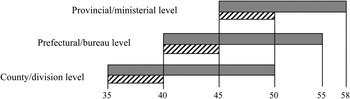
The second criterion for the selection of reserve cadres is youth. Generally speaking, reserve cadres are relatively young when compared to the average incumbent at their professional level. This allows plenty of time for the reserve cadre to undergo thorough cultivation and training. Under new rules introduced in 2000, it was decided that the majority of those included on the list for provincial/ministerial-level reserve cadres must be between 45 and 50 years of age; prefectural/bureau-level list candidates must be between 40 and 45; and county/divisional-level list candidates must be between 35 and 40. However, each level must also include a limited number of even younger reserve cadres.Footnote 36 In general, if a cadre reaches the upper age limit for a level without being selected for promotion, his status as reserve cadre is rescinded.Footnote 37
There is a direct convergence between the average age of reserve cadres and the CCP's convention for cadre ages at each level. According to recent COD regulations, cadres selected for provincial/ministerial-level leading positions must be between 45 and 58 years of age; those chosen for prefectural/bureau-level positions between 40 and 55; and county/divisional-level cadres should be between 35 and 50.Footnote 38 The convergence between these leading cadre age ranges and the age ranges for reserve cadres can be seen in Figure 2. The age ranges for selection to reserve cadre name lists are encompassed in the entire age range for promotion to leading cadre positions. This means that the CCP is able to observe the performance of reserve cadres constantly and promote them into the leading ranks as and when they meet the Party's expectations.
Age Ranges for the Three Levels of Leading and Reserve Cadre Positions

The CCP's control over the political ideology and age of eligible reserve cadres demonstrates the evident state strategy approach of the Party towards personnel management. Nominally speaking, in addition to ideology and youth, the professional capabilities of reserve cadres should be the most important consideration in their selection. However, there is no doubt that cadres often call upon the help of influential contacts to manoeuvre their way onto name lists. One interviewee reported that, whilst political performance is significant, whether or not a reserve cadre has a senior level “backer” may be of even greater importance.Footnote 39 To combat this, the COD has announced that if cadres are found to be acting in this way, they will be barred from promotion for at least two years and may even lose their current positions.Footnote 40 Nevertheless, cadres continue to use their contacts. Some reserve cadres even resort to bribery in order to exact support from an influential superior. For example, the 2004 corruption case of former Jiangsu provincial organization department chief, Xu Guojian 徐国健, was centred on Xu's acceptance of bribes from provincial/ministerial-level reserve cadre, Wang Yimin 王益民.Footnote 41 Some cadres may also offer bribes to their associated organization department to falsify their personnel files, creating fraudulent records of their professional or educational achievements or even their age. In 2010, the CCP investigated the case of Wang Yali 王亚丽, the deputy secretary of the Communist Youth League in Shijiazhuang, Hebei, who had become a reserve cadre after altering his personnel files.Footnote 42 The intense competition to gain a place in the reserve cadre ranks makes it almost impossible for the CCP to eradicate such instances of malfeasance entirely.
Training and Evaluation: The Disciples' Baptism of Fire
After finding their way onto the reserve cadre name lists (Section B) and before the period of large-scale cadre promotion (Section A), officials are put to the test through a carefully designed process of training and evaluation, which can be readily likened to a baptism of fire. This process, which represents Section C of Figure 1, includes the cultivation of political ideology and administrative abilities, and adaptation to the norms and culture of CCP officialdom. The former involves formal arrangements for cadre training, whereas the latter is the responsibility of the cadres themselves if they wish to succeed. Cadres' performance during this time, and in particular during specific training activities, may determine their chances for progression, as it is hoped that these future political successors will be able to put their training to use in high-level leadership positions. The CCP is able to screen and filter out the best cadres by evaluating their capabilities and performance during training designed to mould these ideal Party disciples into the next generation of highly competent political elite. However, some unsuccessful candidates spend their entire careers buried in the reserve cadre name lists, without ever gaining an opportunity for promotion.Footnote 43
The CCP's emphasis on the further cultivation of reserve cadres' ideology is clear from an official COD document from 2000, which states in a straightforward manner that: “Reserve cadre political ideology education must be strengthened.”Footnote 44 Party schools at each level are crucial to this reserve cadre education and organize “young cadre training courses” (zhong qingnian ganbu peixun ban 中青年干部培训班) for cadres who have been selected for the lists.Footnote 45 For example, the Central Party School's young cadre training course is attended by provincial/ministerial reserve cadres, who take the course during a period of compulsory full-time study leave (tuochan xuexi 脱产学习) lasting six months to a year. Hu Jintao (then a prefectural/bureau-level full cadre) entered a young cadre training course at the Central Party School in 1983.Footnote 46 Noteworthy sixth generation cadres, Hu Chunhua and Sun Zhengcai 孙政才, took the training course in 1996 and 2000, respectively. The COD is in complete control of the cadres' studies. For example, the COD assigns liaison officers to keep watch over the classes throughout the Central Party School's youth cadre training course, and they even participate in certain class discussions.Footnote 47 In recent years, the training courses have combined explorations of practical and theoretical problems with a strict examination procedure. A Central Party School professor stated that there have been occasions when a student's entire political career has suffered owing to the suspension of his/her studies by the COD as a result of poor performance or behaviour.Footnote 48
Classes on the youth cadre training course mainly focus on political ideology. Upon commencement of the course, students receive a set of classic Marxist-Leninist tracts, including Das Kapital and Anti-Dühring, which they are required to study within a period of three months. Fieldtrips to revolutionary sites such as Yan'an 延安 and Jinggangshan 井冈山 are organized in order to instil in students a deeper understanding of the Party's revolutionary tradition and awaken a sense of honour and pride.Footnote 49 The subject matter of class discussions is relatively open and unrestricted in order to encourage cadres to debate solutions for effective reforms. This also enables the CCP to determine whether a cadre has the potential to be innovative within the regime's boundaries. However, topics which may have any detrimental effect on the principle of one-Party rule, such as democratic elections or multi-party competition, are strictly off the agenda.Footnote 50
For ambitious cadres, the young cadre training courses also provide an excellent opportunity to build up a personal network of influential peers.Footnote 51 For example, many cadres from the 1995 Central Party School's young cadre training course have gone on to assume important positions, including the state-level leaders, Zhou Qiang and state councillor Guo Shengkun 郭声琨. Course mates at the provincial-level include Wang Jun 王君, the provincial secretary of Inner Mongolia; Zhejiang provincial secretary, Xia Baolong 夏宝龙; Guizhou provincial secretary, Zhao Kezhi 赵克志; Henan provincial secretary, Guo Gengmao 郭庚茂; and Ningxia provincial secretary, Li Jianhua 李建华. The mayor of Tianjin, Huang Xingguo 黄兴国, Yunnan provincial governor, Li Jiheng 李纪恒, and Hunan provincial governor, Du Jiahao 杜家豪, were also on the 1995 course.Footnote 52
In addition to these largely theoretical training courses, the modern CCP also emphasizes the importance of cadres developing “hard skills,” including, for example, attracting investment and maintaining social stability. An organization department official stated that the level of difficulty in these fields is extremely high, so cadres must first undergo training and gain experience in order to take on these tasks at a higher level later on in their careers.Footnote 53 As such, reserve cadres are often required to embark on a form of work-based training known as temporary transferred duty (guazhi duanlian 掛职锻鍊). Cadres are assigned by their current work unit (dispatching unit) to a different unit (receiving unit), in order to gain experience of a different working environment and duties, for an average period of one to three years. Afterwards, the cadre returns to his/her original unit.Footnote 54 In general, during and after a reserve cadre's period of temporary transferred duty, the relevant organization department will organize an inspection team, made up of human resources staff from both the dispatching and receiving unit, to investigate the cadre's performance. Those who rate highly in their performance are more likely to be selected for promotion. However, those who perform badly may not only be required to terminate their temporary transferred duty immediately and return to the original unit, but may also have their status as a reserve cadre revoked.Footnote 55
Reserve cadres are generally assigned to carry out the most urgent, difficult, dangerous or onerous work. By observing how cadres perform in the most arduous and taxing of fields, it is possible to draw conclusions about their overall abilities and potential. After about 2004, the CCP began to dispatch reserve cadres to undertake temporary transferred duty in two of the most demanding fields of work: attracting business and investment (zhaoshang yinzi 招商引资) and complaint letters and visits (xinfang gongzuo 信访工作).
Qiu He's 仇和 methods for training reserve cadres in attracting business and investment are particularly notable. Dubbed by the media to be “the most controversial secretary,” Qiu He began work as the municipal Party secretary of Kunming in 2008, and, declaring that attracting business and investment was of the utmost importance, promptly assigned 100 reserve cadres to temporary transferred duty in this field.Footnote 56 Attracting business and investment is challenging as it requires a vast network of contacts in the locality in question,Footnote 57 meaning reserve cadres have no choice but to sharpen their social and networking skills rapidly.
Complaint letters and visits is another important field. As early as 2008, regulations were drawn up in some locations, for instance Shenyang, stating that those hoping to be eligible for promotion must first undertake obligatory temporary transferred duty in complaint letters and visits work.Footnote 58 Reserve cadres taking on this work are faced with a range of petition cases covering, for example, forced relocation and compensation, unfair agricultural levies, and wage arrears. Whilst dealing with these thorny issues, successful reserve cadres must demonstrate that they have the ability to handle sudden incidents that crop up in civil society by using their skills to placate the public and negotiate with relevant units and authorities. This type of temporary transferred duty (as well as rural duty – another taxing field) will give a cadre the training and experience to develop the techniques necessary to maintain social stability, one of the key preoccupations of the CCP.Footnote 59
In addition to these two key fields, the CCP also places great emphasis on the importance of a cadre's overall governing ability, and in particular at the provincial/ministerial level. Reserve cadres at this level are eligible for promotion to some of the highest positions across the country, which will afford them great influence over the state's political stability as a whole. The CCP's cultivation of its provincial/ministerial-level reserve cadres is thus not limited to the discrete tasks of attracting business and investment or handling complaint letters and visits, but focuses rather more strongly on the comprehensive governing ability of a cadre who is expected to take on the role of important local leader within a short time frame.
However, it is arguable whether these baptisms of fire in temporary transferred duty are conducive to the development of hard skills in practice. Interview data demonstrates that once cadres are transferred to their receiving unit, they tend to focus most of their efforts on forging close ties with the unit's director and upholding the director's interests. This is chiefly because the unit director is responsible for writing an appraisal (jianding 鉴定) of the cadre's performance during his time at the unit. This appraisal is then submitted to the supervising organization department. Cadres with an outstanding or particularly outstanding appraisal are more likely to earn promotion. With this in mind, many cadres are more preoccupied with maintaining good relations with the director and avoiding any errors which may affect their appraisal than with attempting to score any significant political achievements or make any progressive changes. Footnote 60
In addition to theoretical and work-based training, reserve cadres must also acclimatize themselves to the world of cut-throat politics. It is best to adopt a low-key attitude when building close relations with higher level leaders. Once included on the name lists, reserve cadres are immediately pitted against one another. One reserve cadre claimed that in such an intensely competitive atmosphere, it is risky to not be on one's guard at all times.Footnote 61 After the reserve cadre system was established in the 1980s, the CCP attempted to prevent excessively ruthless competition amongst the reserve cadres by keeping the name lists secret. However, it is hardly a stretch for cadres to identify their rivals, particularly when they are required to attend youth cadre training courses by the COD or are publicly dispatched to take on temporary transferred duty.Footnote 62 According to one reserve cadre, those on the name lists must remain guarded at all times and not accept interviews or put forward too many comments in order to avoid trouble caused by speaking out of turn or by revealing something sensitive.Footnote 63 The system therefore helps reserve cadres to develop a humble and cautious official attitude, which will benefit them in their future careers and chances of promotion.
Resilience or Breakdown of the CCP Regime: Can the Reserve Cadre System Last?
Will the CCP regime remain resilient, as Nathan argues, or will it ultimately break down? Although scholars such as Cheng Li claim that China's resilient authoritarianism will be difficult to sustain,Footnote 64 this article puts forward a more conservative opinion. After nearly three decades of evolution, the reserve cadre system represents a special institution with an elaborate design unseen in other Leninist or authoritarian regimes. This system may well unlock the mystery of the continued elite unity in the CCP and ensure the perpetuation of the resilient authoritarian regime.
Following the break up of the Soviet Union and the later fall of the communist regimes in Eastern Europe, the CCP has recognized the urgent need to strengthen the Party's governing ability and its autonomy in terms of personnel recruitment and management. A COD official declared that the priming of reserve cadres should be seen as a “strategic task.”Footnote 65 In a 2009 official document, the CCP also stated that, in response to schemes by Western powers to Westernize and “split” China, cultivating young cadres is a necessary strategic task to ensure the regime's continuity.Footnote 66 The establishment and consolidation of the reserve cadre system springs from this context.
From a comparative perspective, there is an even more rational explanation as to why the regime in China has avoided breakdown and democratization. Scholars have observed an interesting phenomenon: a key pre-condition for democratic transition may be a split among the elite.Footnote 67 Within competitive authoritarian regimes, elections allow for a marginal degree of opposition within the political system. The elections are, however, far from democratic and fair, and the ruling party often leverages its influence to retain power.Footnote 68 Nevertheless, there is still an opportunity for a rival party or more reformist ruling party members to enter the political ranks, paving the way for divisions within the elite. Once an authoritarian ruling party begins to splinter into hard-liners and soft-liners, the regime becomes unable to resist international pressure to democratize and civil society's demands for political participation. Examples of this abound, including the fall of many military regimes in the 1970s,Footnote 69 Gorbachev's Soviet Union, and Taiwan in the late 1980s.Footnote 70
However, through mechanisms such as the reserve cadre system, the CCP has been able to avoid implementing the direct election of Party cadres, and has thus retained a far higher degree of autonomy in personnel appointments than seen in orthodox competitive authoritarian regimes. This article links the cultivation of reserve cadres to distinctive elite unity and therefore continuing authoritarian resilience. The rigorous screening and strict training programmes of the reserve cadre system further allow the CCP to generate a legion of elite loyal disciples with a unified political ideology. The CCP is thus able to avoid the danger of a split among the ruling elite by grooming the next generation of leaders to be ideologically unified, youthful, well-trained and primed to take on the burden of China's modernization programme.
This sui generis mechanism is certainly not found in other similar regimes. For example, the Kuomintang (KMT) regime in Taiwan did not possess a carefully designed system such as this. Despite attempts to use Chiang Ching-kuo's 蔣經國 China Youth Corps (jiu guo tuan 救国团) to source and nurture “new blood” for the KMT, the Corps was more a private network developed by Chiang Ching-kuo for his own purposes.Footnote 71 In other words, the KMT did not resemble the CCP with its institutionalized reserve cadre cultivation mechanism providing the Party with a continual source of new political talent to support the resilient authoritarian regime. The KMT regime was vulnerable to fissures among its elite under the increasing international and domestic pressure to democratize; in contrast, the CCP's resilient authoritarian regime is buttressed by the reserve cadre system. Whilst the system is not necessarily the only element contributing to the regime's perpetuation, it is certainly a factor which should no longer be overlooked.
However, it must be noted here that the reserve cadre system is not the only route for promotion in the CCP. Although the vast majority of officials are indeed promoted from the ranks of reserve cadres, there are in some cases promotions through other pathways, such as open selection and the civil service. The CCP developed open selection (gongxuan 公选),Footnote 72 a system which allows leaders to select cadres from the next level down, towards the latter half of the 1990s. Open selection increases competition for posts through the public nomination of candidates and differential quota elections (cha'e xuanju 差额选举). The system was originally intended to merge with the reserve cadre system in order to guarantee a degree of fairness in promotions. However, open selection ultimately has not come to function in this way, and many of those promoted through this system are not drawn from the ranks of reserve cadres. For example, some secretaries (mishu 秘书) of high officials gain promotion through open selection with the backing of their powerful former bosses, despite never appearing on a reserve cadre name list.Footnote 73 However, unlike reserve cadres, those promoted via open selection may not necessarily meet the preferred criteria of being relatively young and adhering to the unified political ideology. Open selection is less predictable in its outcomes than the reserve cadre system, and for certain positions is even open to non-CCP members. Nevertheless, the open selection system seems to be gaining traction and represents a burgeoning alternative route to promotion to prefectural/bureau positions.
The national civil servant (guojia gongwuyuan 国家公务员) system, on the other hand, although useful for supplying officials with the technical and administrative skills needed for grassroots-level work,Footnote 74 rarely turns out cadres considered suitable for leadership roles by the CCP, i.e. cadres imbued with broad political vision and the initiative to promote institutional reform.Footnote 75 Thus, unlike open selection, only in exceptional circumstances can the national civil service pose any real challenge to the monopoly the reserve cadre system holds over the promotion of high-level officials.
These exceptions aside, in recent decades the CCP has institutionalized the reserve cadre system as the most important pathway to promotion to high-ranking Party and government positions. In fact, the higher the position, the higher the likelihood that the successful candidate will be drawn from the ranks of reserve cadres, whose advantages lie in the fact that their youth, ideology, and training provide a guarantee of their future performance. This key aspect of the CCP's personnel management and appointments system is beneficial to strengthening the Party's overall governing ability and ideological unity. Put simply, this article argues that the existence of the reserve cadre system allows the CCP to maintain a firm hold over personnel management and appointments. Furthermore, the competitive selection, strict training and evaluation process of the reserve cadre system enable the Party to pinpoint much-needed political talent and cultivate an able and ideologically unified elite. This reduces the chance of an elite split and consolidates the resilience of the regime. As such, seen from the perspective of elite-centralism, the reserve cadre system goes some way to explaining why the CCP is able to maintain a resilient authoritarian regime, despite the potential demands of civil society and international pressure.
Conclusion
This article has discussed the origin, consolidation and workings of the reserve cadre system, as well as its impact on the perpetuation of the CCP's resilient authoritarian regime. Reserve cadres are in effect the Party's disciples, created and nurtured through a detailed process of limited eligibility and rigorous education and training in order to take on their future roles as the regime's loyal political successors. Once these disciples are assigned to high positions, they are expected to continue the mission to uphold the Party's principles and make every effort to sustain the CCP regime.
The origins of the reserve cadre system lie with the “third echelon of cadres” in the 1980s. The CCP used a thought process similar to that behind the concept of the planned economy, that is, they sketched out a precise and long-term direction for the selection and nurturing of the regime's political successors. By using this model, it is possible to develop a political elite that fulfils the requirements of correct political thought, youthful advantage, excellent governing ability, and adaptability to the culture of CCP officialdom. As this trained elite core assume the top leadership positions in the country, it is inevitable that the Party's autonomy and resistance to external democratizing pressures are strengthened. Thus, it is the reserve cadre system that provides the crux for this resilient authoritarian regime.
Although alternative routes such as open selection represent growing opportunities for more open-minded or reformist soft-liners to enter the Party ranks, thus opening the door to the possibility of an elite split, a more conservative perspective is that the CCP will choose to make changes to the reserve cadre system to meet its needs as and when they arise – for example, by finally integrating open selection with the reserve cadre system. In fact, this kind of adaptable evolutionary process would once again confirm David Shambaugh's view of the CCP as a “reasonably strong and resilient institution.” Furthermore, although the regime faces numerous and constant challenges, “none present the real possibility of systemic collapse.”Footnote 76