1. Introduction
Intermediate-mass black holes (IMBHs;
 $\sim10^2$
–
 $\rm 10^5\,M_\odot$
) occupy the gap between stellar-mass BHs (sBHs;
 $\rm \lesssim100\,M_\odot$
) and supermassive BHs (SMBHs;
 $\rm \gtrsim10^6\,M_\odot$
). Observational evidence for their existence is mounting. In particular, fast-moving stars in the core of Omega Centauri are consistent with the presence of an IMBH (Häberle et al. Reference Häberle2024), while additional candidates have been found in dwarf galaxies and extragalactic clusters (Lin et al. Reference Lin, Strader and Carrasco2018; Pechetti et al. Reference Pechetti2022). The first confirmed detections of low-mass IMBHs (
 $\rm \sim10^2\,M_\odot$
) have come from binary BH mergers observed in gravitational waves (GWs) by the LIGO–Virgo-KAGRA (LVK) collaboration, including GW190521 and GW231123 (LVK Scientific Collaboration et al. 2025).
Dense clusters, with short relaxation times and frequent stellar encounters, are favorable sites for seeding and growing IMBHs. Several pathways have been proposed (see Askar, Baldassare & Mezcua Reference Askar, Baldassare and Mezcua2024, for a detailed review and references therein), including runaway stellar collisions that form a very massive star (VMS) which may later collapse or merge with a sBH (e.g., Portegies Zwart & McMillan Reference Portegies Zwart and McMillan2004; Freitag, Gürkan & Rasio Reference Freitag, Gürkan and Rasio2006; Giersz et al. Reference Giersz, Leigh, Hypki, Lützgendorf and Askar2015; Di Carlo et al. Reference Di Carlo2021; Fujii et al. Reference Fujii, Wang, Tanikawa, Hirai and Saitoh2024; Rantala, Naab & Lahén Reference Rantala, Naab and Lahén2024; Sharma & Rodriguez Reference Sharma and Rodriguez2025; Vergara et al. Reference Vergara, Askar and Kamlah2025a). Here we briefly summarize results from complementary N-body and MOCCA Monte Carlo simulations of compact, centrally concentrated star clusters. We examine the formation of a VMS through collisional runaway, the conditions for IMBH seeding, and its subsequent growth through stellar and compact-object mergers, while highlighting caveats and implications for gravitational-wave and high-energy observations.
2. First study: Million-body compact cluster model
We model the evolution of an extremely dense, isolated cluster with
 $N=10^6$
single stars and no primordial binaries at metallicity
 $Z=0.01$
, using Nbody6++GPU (Vergara et al. Reference Vergara, Askar and Kamlah2025a). The cluster has
 $\rm M = 5.87\times10^5\,M_\odot$
, a King (Reference King1966) profile with
 $\rm W_0=6$
, and half-mass radius
 $\rm r_h=0.1$
pc. Stars are initialized on the zero-age main sequence with masses between
 $0.08$
and
 $\rm 150\,M_\odot$
, drawn from a two-component Kroupa (Reference Kroupa2001) initial mass function (IMF). For comparison, we also ran a MOCCA simulation with the same initial modelFootnote †. These conditions yield a core density
 $\rm \rho_c=4\times10^8\,M_\odot\,\mathrm{pc}^{-3}$
and half-mass relaxation time of 8.6 Myr. Massive stars segregate on much shorter timescales, driving high encounter rates that lead to runaway collisions and formation of a VMS of
 $\rm \gtrsim5\times10^4\,M_\odot$
within
 $\lesssim5$
Myr.
Both simulations were evolved to 5 Myr. By
 $t\simeq4.5$
Myr, the runaway produced a VMS that collapsed into an IMBH at the cluster center in both runs. The VMS grew to
 $\rm \gtrsim5\times10^4\,M_\odot$
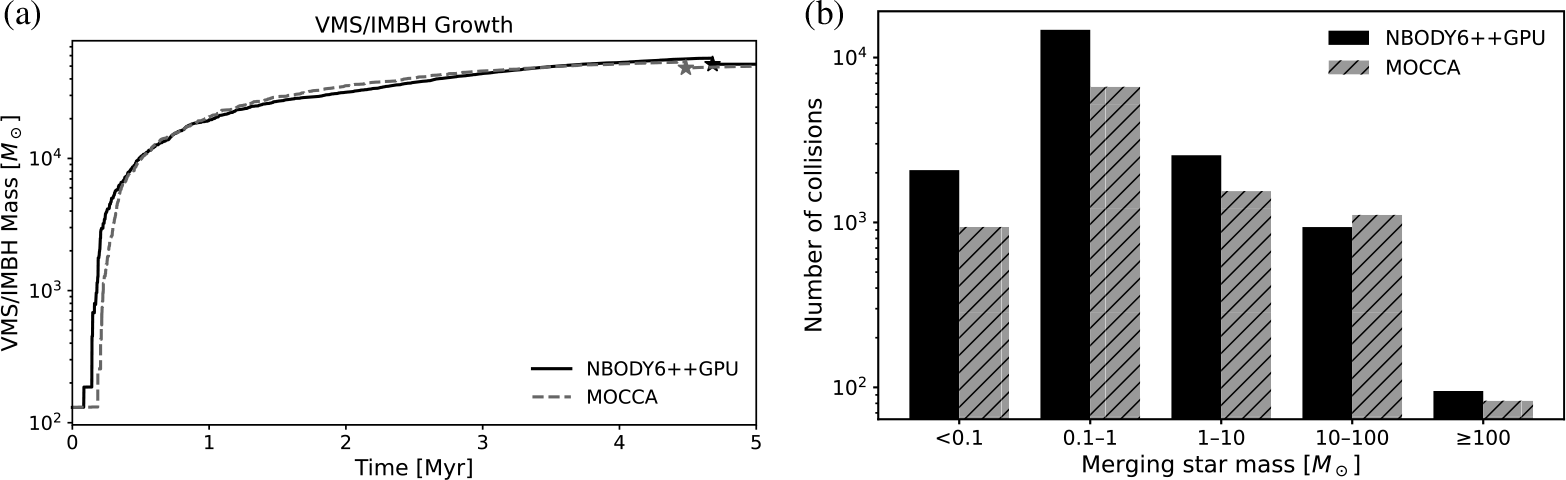
through successive collisions, most within the first 2–3 Myr (Fig. 1a). Stellar evolution followed updated SSE/BSE prescriptions (Hurley, Tout & Pols Reference Hurley, Tout and Pols2002; Kamlah et al. Reference Kamlah2022), with improved treatment of VMS properties, rejuvenation, and mass loss (Vergara et al. Reference Vergara, Askar and Kamlah2025a).
(a) VMS/IMBH mass growth up to 5 Myr from NBODY6++GPU (solid) and MOCCA (dashed). The star marks IMBH formation. (b) Mass distribution of stars colliding with the VMS during runaway growth, from NBODY6++GPU (black) and MOCCA (gray).

The two approaches agree on the overall growth pathway and timing of IMBH formation, but the N-body run produced nearly twice as many VMS collisions, mainly with low-mass stars. At higher masses, the distributions agree more closely, with both methods yielding on the order of
 $10^3$
collisions involving stars above
 $\rm 10\,M_\odot$
(Fig. 1b). These differences arise from MOCCA’s probabilistic treatment of collisions, which tends to underestimate the frequency of low-mass mergers in this type of cluster. As a result, IMBH formation occurs slightly earlier (
 $\sim4.5$
Myr vs.
 $\sim4.7$
Myr in the N-body run), owing to weaker rejuvenation of the VMS. As a cautionary point, collisions in the rapid early growth phase (first 2 Myr) occur on 200–1000 yr timescales, shorter than the thermal timescale of the VMS (
 $\sim10^4$
yr). Consequently, the structure of the runaway product before collapse remains uncertain, and its inferred mass should be considered an upper limit.
3. Second study: MOCCA simulations of dense clusters
We also ran a suite of MOCCA simulations of dense clusters with
 $N=2\times10^6$
objects (10% binaries), metallicity
 $Z=0.0005$
, total mass
 $\rm M=1.29\times10^6\,M_\odot$
, and circular orbits at 10 kpc. We adopted King (Reference King1966) models with
 $\rm W_0\in\{5,8\}$
and varied
 $\rm r_h$
to span
 $\rm \rho_c=8.7\times10^5$
–
 $\rm 4.4\times10^8\,M_\odot\,\mathrm{pc}^{-3}$
(Table 1). Stellar and binary physics included rapid SN/fallback (Fryer et al. Reference Fryer2012), metallicity-dependent winds (Belczynski et al. Reference Belczynski2010), and updated low-Z massive-star evolution (Tanikawa et al. Reference Tanikawa, Yoshida, Kinugawa, Takahashi and Umeda2020). In BH–star collisions, 25% of stellar mass was accreted; MS–MS collisions followed BSE rejuvenation; and GW recoil kicks were applied with natal BH spins sampled uniformly in
 $[0,0.1]$
.
Key initial conditions and outcomes of the MOCCA models. All runs have
 $N=2\times10^6$
objects (10% binaries),
 $Z=0.0005$
,
 $\rm M=1.29\times10^6\,M_\odot$
, and stars initialized on the ZAMS with masses
 $0.08$
–
 $150\,M_\odot$
from a two-component Kroupa (Reference Kroupa2001) IMF. Here
 $\rm W_0$
is the King concentration parameter and
 $\rm T_{rh}$
is the initial half-mass relaxation time.

Table 1 Long description
A table comparing initial conditions and outcomes of MOCCA models. The table has 5 rows and 5 columns. Column headers are Model, r_h (pc), W_0, rho_core (M_sun pc^-3), T_rh (Myr), and IMBH?. Row 1: Model, rh0.25-W08; r_h (pc), 0.25; W_0, 8; rho_core (M_sun pc^-3), 4.38 x 10^8; T_rh (Myr), 42.7; IMBH?, (2.762 x 10^4 M_sun). Row 2: Model, rh0.5-W08; r_h (pc), 0.50; W_0, 8; rho_core (M_sun pc^-3), 5.86 x 10^7; T_rh (Myr), 121.0; IMBH?, (1.537 x 10^4 M_sun). Row 3: Model, rh0.5-W05; r_h (pc), 0.50; W_0, 5; rho_core (M_sun pc^-3), 4.34 x 10^6; T_rh (Myr), 121.0; IMBH?, x. Row 4: Model, rh1.0-W08; r_h (pc), 1.00; W_0, 8; rho_core (M_sun pc^-3), 7.36 x 10^6; T_rh (Myr), 342.3; IMBH?, (6.244 x 10^3 M_sun). Row 5: Model, rh2.0-W08; r_h (pc), 2.00; W_0, 8; rho_core (M_sun pc^-3), 8.67 x 10^5; T_rh (Myr), 965.6; IMBH?, x.
IMBHs form only in the three densest models (
 $\rm\rho_c\gtrsim10^7\,M_\odot \, \mathrm{pc}^{-3}$
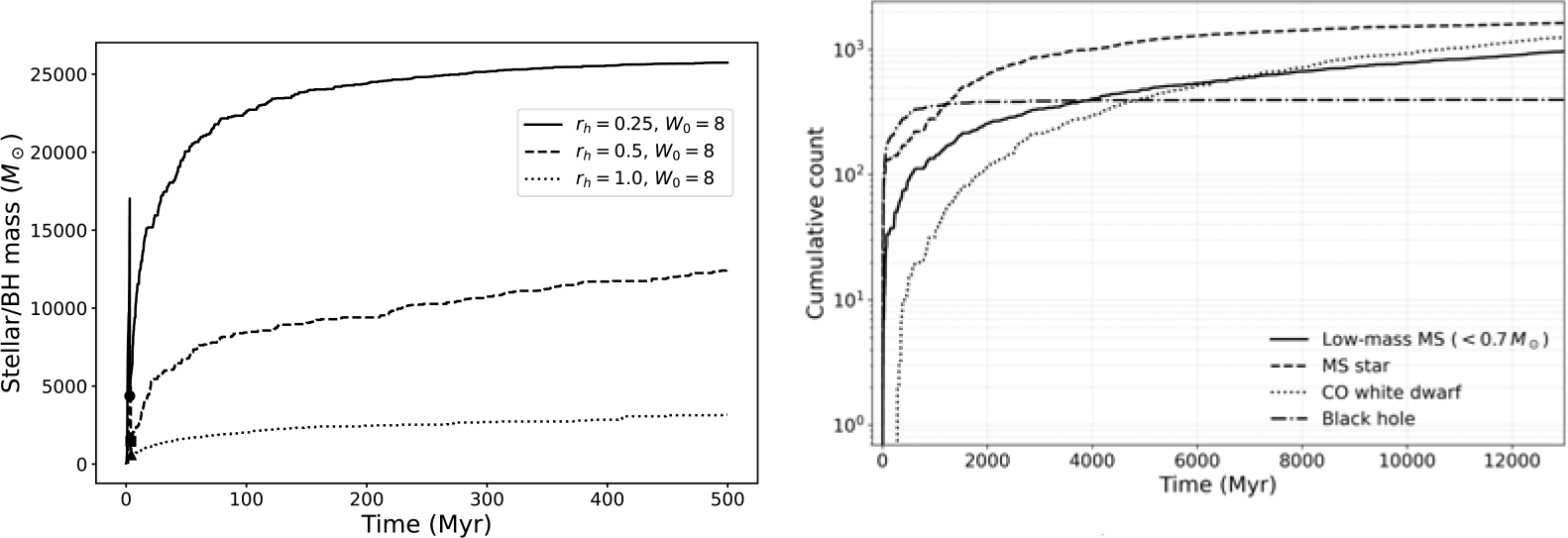
; Table 1), underscoring the strong dependence on central density (Sharma & Rodriguez Reference Sharma and Rodriguez2025) and half-mass relaxation time. As shown in Fig. 2, a VMS forms within the first few Myr and seeds an IMBH through a VMS-BH collision at
 $\sim3$
Myr. Over the next 0.5 Gyr, the IMBH grows by a factor of
 $\sim3$
–4, primarily through mergers with sBHs, supplemented by mergers with stars and other compact remnants. IMBH-sBH mergers both drive this growth and rapidly deplete the sBH population, with 524, 390, and 178 such events in models rh0.25–W08, rh0.5–W08, and rh1.0–W08, respectively. These mergers produce “light IMRIs” (LIMRIs), most of which have characteristic strains and frequencies within the sensitivity band of next-generation GW detectors such as the Einstein Telescope. At later times, tidal disruption events contribute an additional
 $\sim10^3$
–
 $\rm 10^4\,M_\odot$
to the IMBH, with massive MS stars dominating early and white dwarfs at later epochs (Fig. 2b).
Formation and growth of IMBHs in MOCCA models. Left: rapid seeding via VMS–sBH collisions and early sBH mergers. Right: long-term growth from MS stars, WDs, and BHs.

4. Conclusions and Outlook
Our N-body and MOCCA studies show that collisional runaway in extremely dense clusters can produce IMBHs within a few Myr, though growth histories depend on collision prescriptions, rejuvenation, and the internal structure of the VMS. IMBHs form only in the most compact models (
 $\rm\rho_c \gtrsim 5\times10^6\,M_\odot\,\mathrm{pc}^{-3}$
and
 $T_{rh} \lesssim 500\,\mathrm{Myr}$
), underscoring their sensitivity to cluster density and relaxation time. While both methods agree on the overall pathway, they differ in the number of collisions and the timing of collapse, reflecting their respective approximations. These results assume monolithic cluster formation, which may not be universal. Key uncertainties remain, including the structure and evolution of the VMS and the use of simplified stellar evolution prescriptions. Continued cross-validation of N-body and Monte Carlo approaches (Vergara et al. Reference Vergara, Askar and Flammini Dotti2025b), coupled with improved VMS physics, will refine predictions and guide searches for IMBH signatures in tidal disruptions and GW sources such as LIMRIs.
Acknowledgements
We thank M. Giersz, R. Spurzem, F. Flammini Dotti, A. Kamlah, D. Schleicher, M. Arca Sedda, A. Hypki, J. Hurley, P. Berczik, A. Escala, N. Hoyer, N. Neumayer, X. Pang, A. Tanikawa, R. Cen, T. Naab, G. Wiktorowicz, L. Hellström, and J. Szyndler. AA and SA acknowledge support from project No. 2021/43/P/ST9/03167 co-funded by the Polish National Science Center (NCN) and the EU Horizon 2020 Marie Skłodowska-Curie grant agreement No. 945339. For the purpose of Open Access, the authors have applied for a CC-BY public copyright license to any Author Accepted Manuscript (AAM) version arising from this submission. MCV acknowledges funding through ANID (Doctorado acuerdo bilateral DAAD/62210038) and DAAD (funding program number 57600326). MCV acknowledges the International Max Planck Research School for Astronomy and Cosmic Physics at the University of Heidelberg (IMPRS-HD).

 N=2×10⁶
 Z=0.0005
 M=1.29×10⁶M⊙
 0.08
 150M⊙
 W0
 Trh