Introduction
This paper explores keramat, or the venerated graves of notable figures, as a location of socially and culturally diverse practices in the history of Muslim Southeast Asia (also referred to as the ‘Malay world’ here). While these sites comprise the graves of people of a variety of ethnic backgrounds, histories, and faiths, they are usually associated with Muslims, and frequently with Hadramis. In the course of studying Hadrami migrations to Java, I was struck by the observations of keramat made by the colonial scholar-bureaucrats C. Snouck Hurgronje and L. W. C. van den Berg. Both men noted the high stature of the keramat of a Hadrami scholar in Luar Batang, Batavia (present-day Jakarta, Indonesia), as well as the multi-ethnic following it had in the late nineteenth century. In this paper, I revisit keramat with the hope of gaining further insight into the dynamics of cultural and social diversity in the modern history of Muslim Southeast Asia.
This paper draws together two areas of interest to me. The first is the significance of ubiquitous popular shrines—often intimately tied to the land—to the contemporary societies of Indonesia, Malaysia, and Singapore. The second is the study of Hadramis and Islam in Southeast Asia. The latter is a long-standing area of research for me and hence a subject that I approach with some surefootedness. The former is a more recent interest about which my knowledge is still at a formative stage. Altogether, this paper is a preliminary exploration that is necessarily sketchy in parts, especially as examples from across national boundaries are drawn far too selectively and without always the necessary substantiation.
In this paper I explore the meaning of the conjunction between the migrations of Hadramis and the localized veneration of their prominent members after death. I examine two questions in particular. First, in what ways do keramat embody cultural diversity? Keramat nicely offer a means of mapping syncretic practices across time, as well as within and beyond nation-state boundaries. That keramat constitute sites of reverence, if not worship, for people of different faiths and ethnic backgrounds is my point of departure. Furthermore, I propose that the culturally diverse population in question possesses a shared respect for, if not reverence of, keramat as sacred spaces.
Secondly, I ask where do keramat stand in relation to state- and organization-driven Islam? Given its uncertain position in Islamic discourse, keramat—and, more broadly, the veneration of graves—constitute a terrain that has long been contested by Muslim scholars and intellectuals. In this connection, Henri Chambert-Loir makes the following observation: ‘The cult of saints is universal in Islam. It is a subject of fierce debate between the partisans of a strict interpretation of the scriptures and the exponents of a local, “traditional” way of being Muslim.’Footnote 1 At the same time, he notes that this popular practice offers insights into the complex process of Islamization in the region which began around 700 years ago.Footnote 2
Together the two questions are aimed at exploring the social history and contemporary manifestations of syncretic practices that have been integral to the spiritual life of people in the region, and the significance of these practices in the face of what has typically been their antithesis: state- and organization-driven Islamic politics.
Mapping syncretic practicesFootnote 3
Keramat is the Malay word for popular sites of prayer that dot the social and physical landscapes of much of Muslim Southeast Asia. Typically, a keramat is the burial site of a person who in life gained the respect of their community through outstanding spiritual piety, learning, historical accomplishment or some other notable distinction. The word ‘keramat’ is derived from the Arabic noun karāmāt which refers to the miracles performed by a walī, a revered spiritual figure or ‘saint’ as it is often translated in English. Chambert-Loir describes such a figure as ‘an individual who, by birth, by talent, through science or spiritual exercise, is endowed with supernatural powers’.Footnote 4 Almost without exception male, the gifted divine can assume the status of keramat not only after death but also in his lifetime. Keramat hidup (living keramat) nevertheless tend to be rare.
Importantly, a keramat is person- and site-specific, hence the phenomenon is local, tied to the landscape, and not transportable. Chambert-Loir adds, ‘with very few exceptions, the cult of a saint is performed in one place only: at his grave. One does not pray to the saint at home, or in another place where he would be represented by some kind of symbol.’Footnote 5 As Richard Winstedt notes, over time the grave develops into a place of ziarah (pilgrimage).Footnote 6 For the pilgrim, the keramat serves as a mediator of prayers that God is too busy to address and, as Snouck Hurgronje observes, people visit his tomb ‘almost exclusively for the fulfilment of vows’.Footnote 7 Many—though not all—keramat are the grave sites of Hadrami migrants or their descendants.
Transoceanic field
Historically the ethnicity of keramat has been as diverse as the social composition not only of Southeast Asia but of the Indian Ocean region as a whole. Indeed, the location of keramat themselves stretch from as far afield as the island of Mindanao in the southern Philippines and Cape Town in South Africa.Footnote 8 The rise of keramat as sites of multi-ethnic and hybrid cultural practices may be linked to the emergence of Muslim social networks and Islam in the Indian Ocean region as a transregional cultural framework from the fifteenth to the eighteenth centuries.Footnote 9 Networks of Muslim scholars, traders, statesmen, and others spanned the Indian Ocean. They consisted not only of Hadramis but also of Gujaratis, Tamils, and others, many (if not most) of whom were of mixed descent. Azyumardi Azra believes that the transmission of Islamic thought to the Malay world was conducted by scholars of various and mixed ethnicity who travelled through the culturally cosmopolitan port cities between Mecca and Aceh, Pattani, Melaka, Banten, and so forth.Footnote 10 From this perspective, the rise of colonial states and the intensified economic exploitation of the nineteenth century increasingly constrained the cosmopolitanism of the Indian Ocean and marked the beginning of what Engseng Ho calls the era of ‘parochialization’.Footnote 11
It may not be coincidental then that many outstanding keramat emerged in the period between 1500 and 1800 in placed like Aceh, Penang, Melaka, Jakarta, and Surabaya. Among the oldest and most well known are the graves of the nine walī (Wali Songo) who are credited with introducing Islam to Java. Dating back to the sixteenth century, these graves constitute one of the most auspicious of present-day pilgrimage routes. Keramat Tuah in Penang is another well-known site, which is said to be the grave of a Malabari who died in 1715.Footnote 12 Others include the grave of Teuku Anjong in Aceh which dates back to 1782.
Given their prominence along the cosmopolitan trading routes of the Indian Ocean as well as their claims to descent from the Prophet, Hadramis or those of part-Hadrami descent were the paradigmatic keramat. They were likely to have been scholars, traders, and statesmen. Notably, however, they were also intermediaries. By plying their command of several languages, their diplomatic skills, and their knowledge of other lands, they were intermediaries between the local ruler and the outside world. As traders, they were generally the link between the agricultural hinterland and the wider world of commerce. Finally, as keramat, they interceded between the temporal and spiritual worlds.
Unsurprisingly, many prominent keramat are typically located in littoral areas where there has been a considerable amount of sea traffic and trading, often in or around long-established urban centres. Hadramis, Chinese, and other migrants to the region were characteristically based in urban settlements along the coast, even more so in the late nineteenth century when their movement was increasingly controlled by the colonial state.
Local character
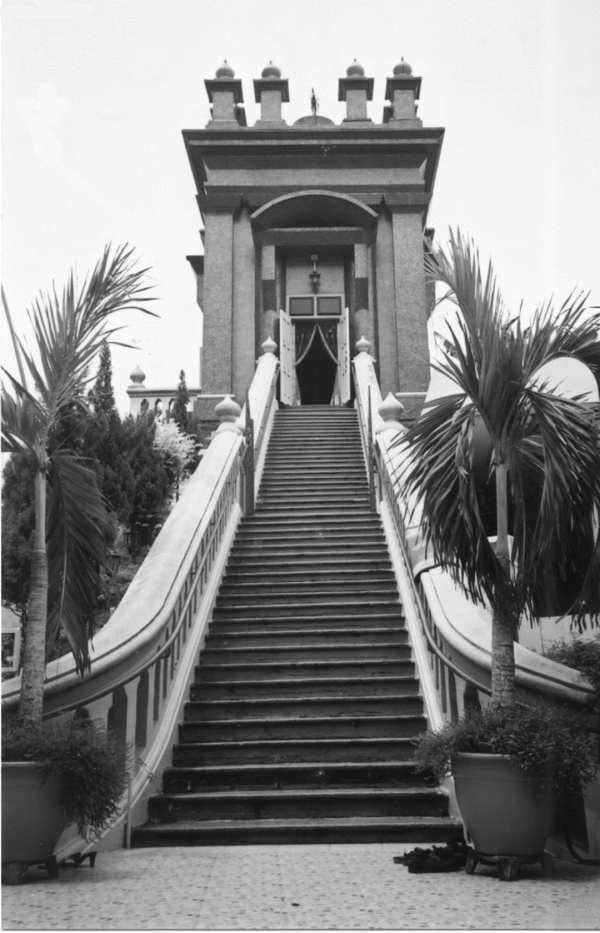
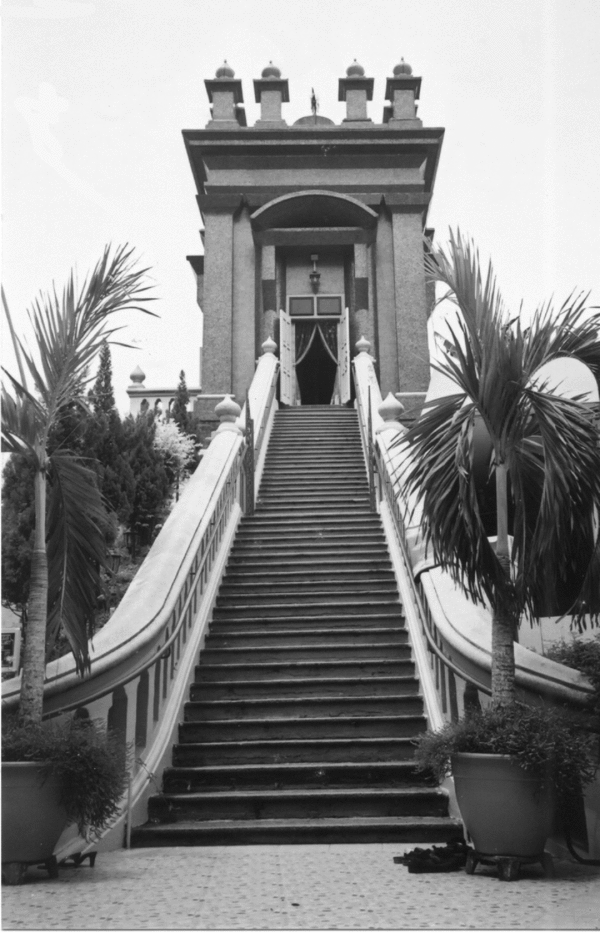
Although my focus has been on urban areas, keramat are located in a variety of locations, some far-flung or, in the case of the keramat of the Orang Asli (indigenous people in Malay), deep in the jungle.Footnote 13 They can be found in areas that have never been heavily populated or are no longer on present-day travel routes, as in the case of the relics of the Hindu-Buddhist past. Keramat can be built up, visible, and even quite outstanding such as the Habib Noh grave in Singapore (see Figure 1) or they can be isolated and difficult to approach as is the case of the grave in Tanjung Tuan (also known by its Portuguese name, Cape Rachado) in Melaka.
The stairway leading up to the keramat of Habib Noh in Singapore. Source: Photograph by Sumit K. Mandal.
So tied are keramat to the landscape that they are a source of numerous place names throughout the Malay world. Take for instance Datuk Keramat, where the honorific ‘Datuk’ is added as a sign of respect for the gravesite. This is a commonplace name for many areas, most famously the Datuk Keramat neighbourhoods of Penang and Kuala Lumpur respectively. As it often happens that a grave is located at the top of a hill, the name Bukit Keramat (Keramat Hill) recurs in places as far-flung as Negri Sembilan and the island of Mindanao.
The multi-ethnic and hybrid practices of keramat build on the traditions of the Hindu-Buddhist—and perhaps an even more ancient—past in the region. This is the case not only terms of prayer and paying homage but in their physical location. Keramat are often built on pre-existing Hindu-Buddhist sites in Java.Footnote 14 In Malaysia too keramat are found at sites of previous spiritual or otherworldly significance. A notable example is the Keramat Ujong Pasir in Negri Sembilan. The grave—reputedly of a Hadrami—lies adjacent to three megaliths attributed with supernatural powers.
Furthermore, while they may be broadly understood to be Islamic in cultural origins, Tong Cheu Hock observes that keramat in Penang have become integral to a distinctive ‘Sino-Malay spirit cult’. Similar local spirit cults can be found in Indonesia.Footnote 15 The klenteng (Chinese temple) of Ancol in Jakarta was built in the seventeenth century and is dedicated to Da-Bo Gong, the earth deity, and his wife. Claudine Salmon and Denys Lombard note that this temple is special because it houses a keramat that is revered by Muslims and Taoists alike. Similarly to numerous other places in the Malay world, the local spirit cult here is associated with Zheng He, the Ming-era Muslim admiral, and his companions. It is the only ‘combination temple’—as Salmon and Lombard put it—in Jakarta, though such centuries-old hybrid worship may also be found in a temple in Semarang on Java's north coast and Palembang in Sumatera respectively.Footnote 16 Apparently, this temple has preserved a tradition of disallowing pork to be consumed at its premises because it is a site revered by Taoists and Muslims alike.Footnote 17
Hadrami keramat
Arabs have travelled to Southeast Asia in the course of the last millennium, venturing well beyond the Malay world to China. However, significant migrations are identifiable in the fifteenth, eighteenth, and nineteenth centuries respectively, with the specific movements of people from the Hadramaut, the narrow valley along the southern littoral of the Arabian Peninsula. Hadrami traders, scholars, and statesmen arrived in small but influential numbers and, over time, became an intimate part of the coastal polities of the region. Groups landed in Sumatera and Java in the fifteenth century to perform the tasks of syahbandar (port captains), engage in trade, and proselytize Islam, thereby assuming a place of importance in the royal courts. Hadramis were dominant in Aceh after 1699 and were assimilated into the ruling elites of Perlis, Siak, and Jambi in the course of the seventeenth and eighteenth centuries. A member of the Al-Qadrī family established the sultanate of Pontianak in Borneo, while other Hadramis were prominent in Riau and Palembang as well as other parts of the archipelago.
Hadrami migrations increased in number and took a distinctive turn when the Dutch colonial state grew in power and extended its territory in the course of the nineteenth century. The migrants now included many more from the lower social classes and the poor than in the past. At this juncture they were far less likely to establish ties with local ruling families. By the end of the nineteenth century, Hadramis found themselves in a position much like the Chinese: a minority whose position was closely monitored by the Dutch colonial authorities, with economic exploitation and political stability in mind.
Since the early days of Islamization in the region, numerous Hadramis had assumed the status of keramat. Snouck Hurgronje observes that the most highly honoured keramat in Aceh was that of the previously mentioned Teuku Anjong, an Arab (and presumably Hadrami) member of the ruling family who died in 1782.Footnote 18 His tomb outshone that of Abdur Rauf of Singkel, a famed seventeenth-century Acehnese walī. A walī, it appears, was usually of foreign origin in Aceh, and as it was in Java, ‘many of the greatest walīs came from beyond the seas, and were said to be of Arab descent’.Footnote 19
As noted already, while scholarship and piety were significant factors in the making of keramat, this was not true in every instance. In Singapore in 1823, Sayyid Yassin stabbed Colonel Farquhar, a British magistrate who had passed a sentence against him.Footnote 20 ‘Sayyid’ or ‘Syed’, as it is sometimes rendered, is in this instance an honorific indicating descent from the Prophet Muhammad. Upon Sayyid Yassin's capture and execution his body was strung up for public viewing, an act which was said to have enraged the Malay community. The community appealed to Stamford Raffles, who governed the island, and was granted permission to retrieve the body for proper burial. It was only later that the curious fate of Sayyid Yassin was sealed, as rendered below, in the language of the colonialist:
The body was then buried at Tanjong Pagar, where the result of the proceedings was (which Sir Stamford did not anticipate) that it became a place of pilgrimage and Syed Yassin was considered a great saint, because the holy Syed had only killed a Fakir (the Hindoo) and wounded a Nazarene (Colonel Farquhar).Footnote 21
While numerous keramat were those of pious and scholarly figures, it is clear that others were those of individuals who had in some way distinguished themselves in a particular community. As such, Sayyid Yassin the trader became a keramat and was venerated until the twentieth century when his tomb was superseded by another Hadrami, Habib Noh, who has already been noted.Footnote 22
Moving from Singapore to Jakarta, we find older and even more auspicious grave sites. Established in the eighteenth century, Luar Batang is a keramat with a long and illustrious history in the region. The grave, which is located within a mosque complex, lies on the northern outskirts of Jakarta, well integrated into the kampung (urban quarter) of the coastline. While its history is uncertain, a traveller from China in 1736 made reference to a sacred tomb in the area.Footnote 23 Buried here is a Hadrami from the al-‘Aydarūs family who was a reputable scholar of Islam. Over the centuries Luar Batang became a culturally heterogeneous place of worship. Van den Berg observed the following about this keramat in 1886:
. . . Sayyid Hosain bin Abou Bakr al-’Aidrous died in 1798 after having taught for many years. Soon after his death he acquired a great reputation for holiness. On the site of his tomb at Luar Batang, near the estuary of the river of Batavia, a great mosque has been erected which is in our day one of the principal places of pilgrimage in the Indian Archipelago. Not only the natives, but also Chinese and European mestizos come here to make vows for success in their undertakings, for gaining children, and so forth.Footnote 24
This keramat not only provided miracles to the throngs of people who visited, it was also the source of an infamous dispute over the rights to pilgrims’ donations. Its eventual settlement involved, among other interventions, a fatwā (legal opinion) issued in 1878 by the famed scholar Ahmad Dahlan in Mecca.Footnote 25
A local—and perhaps even parochial—phenomenon thus drew the attention of an authority a great distance away. Responses from Mecca and also Cairo, however, were not unusual when disputes and issues arose in Muslim societies of the Malay world. As we know from Azra's work, a Muslim—especially one inclined towards Islamic scholarship—could feel a sense of belonging to a world well beyond narrow local confines, to the cosmopolitan centres of learning spread across the Indian Ocean region.Footnote 26 As such, we could take a transoceanic view as we ask: was there a conjunction in keramat of Hadrami migrations and local cultural practices?
Conjunction?
As acknowledged at the outset, a keramat is site- and person-specific, tied to the landscape, and not transportable. A pilgrim at Luar Batang may feel no need to consider the relationship of this site to any other as their primary goal is to fulfil a vow at a particular keramat. Of course, the graves of the Wali Songo, discussed earlier, differ in this regard as they constitute a well-established and interconnected ziarah. Sites are nevertheless ranked in stature and Luar Batang, for instance, is surpassed by the better known graves of the Wali Songo.Footnote 27
Nevertheless, Hadrami ethnicity—and especially descent from the Prophet Muhammad—has historically enhanced the stature of keramat. Attributing Hadrami—rather than, in many instances, Arab—origins to a site is a significant cultural trope and is exemplified in the recurrent naming of certain sites in Java as either Syekh Abdul Rahman or Syekh Abdul Rahim. Chambert-Loir doubts the authenticity of these reputedly Arab figures as their names are ‘derived from the Basmala (Bismillāh al-Raḥmān al-Raḥim [in the name of God the Compassionate and the Merciful])’ which is read at the beginning of chapters in the Qur'an.Footnote 28 Furthermore, he observes that the graves are located on pre-existing sacred sites.
While there may not be a cosmological unity to keramat in the eyes of pilgrims, the figure of the Arab as a recurrent trope signifies the incorporation of the migrant or outsider within the local cultural landscape. Arabs have been incorporated in this way in numerous other instances, notably the literary-historical genre hikayat which, among other topics, frequently tell the proverbial story of the coming of a learned Arab who converts the local ruler and his subjects to Islam.
The picture changes considerably when we look at the question of cosmology from the profoundly genealogical world-view of migrant Arabs. The dispersion of Hadrami migrants and their grave sites within the Malay world followed particular spiritual and historical trajectories. Ho outlines the movement and intermediary role of what he calls a distinctive ‘creole Arab’ community, while Muhammad Adlin Sila offers a close study of the very same in a highly localized setting: the descendants of a member of the Al-Aidid family in South Sulawesi.Footnote 29 Ho locates such localized family dynamics within a larger genealogical dynamic characteristic of the Hadrami diaspora.Footnote 30
The problem at hand is nicely illustrated when Ho turns to what appears to be a coincidental recurrence of Hadrami figures in particular fields of public life in the region. He highlights the persistence of a separate creole Arab identity and attributes to it a historical significance. Far from coincidental, however, Ho observes of the said recurrence that, ‘it is a pleasant non-surprise in the Hadrami homeland and diaspora. The mysterious ways in which recessive genes move are not foreign to those with historical imaginations and genealogical inclinations.’Footnote 31 The character and spread of keramat make sense within the genealogical imagination of Hadramis.
The meeting of the Hadrami genealogical chart and local cultural practices could be viewed as a conjunction of Islam and indigenous spirit cults. According to Chambert-Loir, the keramat assume the role of a venerated ancestor who intercedes between man and God, and bridge vastly different conceptual systems. The preservation of the tradition of worshipping graves, as Chambert-Loir suggests, concerns continuity with ancestors and, possibly, the ancestor-centred religious practices that predated Islam. When we consider that many keramat in Muslim Southeast Asia are genealogically charted, we understand that distinctively Hadrami conceptions have come together with long-standing spiritual practices tied to the land and thereby shaped local cultural identity and society. The keramat thus may be seen as a physical manifestation of the conjunction of Hadrami and autochthonous ancestors.
Politics of diversity
Ethnic categories such as ‘Arab’ were not hermetically sealed—so to speak—in Southeast Asian history nor in the vast diasporic reach of Hadrami migrants in global history. Transoceanic religious flows and movements of people to and from the Malay world constructed diversity, but not along bloodlines nor in a categorical manner as we have come to understand ethnicity, citizenship, and nationhood today. As Ho observes, in many ways we uncritically cultivate the racialized notions of ethnic groups and minorities, which reflect the parochializing imprint of European colonial rule in the nineteenth century. We remain in the grips of parochialization when ‘we venture to speak with confidence of Arab entrepreneurs in Indonesia, Arab families in Singapore, Arab interventions in Malayan politics and so on. In doing so, we employ precisely the national and minority markers bequeathed by parochialization.’Footnote 32
Keramat represent a historical period when religious practices were distinctly hybrid, emerging from the migratory flows, or rather the movements back and forth, of people and ideas. The contact between diverse cultural groups brought about local cultural practices that were mirrored across the Indian Ocean region. Hadramis were one of many cultural groups—but a paradigmatic one—in the making of keramat. As such, the transoceanic flows in this instance do not resemble the more conventional interpretations of migration as a one-way movement from one location to another.
A distinctive feature of the transoceanic migration described in the preceding pages is the inclusion of the migrants’ cultural constitution within local narratives. There has been an accretion of layers upon layers of cultural interactions as different waves of migrants arrived in the region. Not only is the migrant made part of the local narrative through keramat, but also through hikayat, the performing arts, symbols of social hierarchy (such as the turban), and so forth. The process varies considerably from cases where migrants assimilate or conform to a dominant cultural framework. As Ho puts it, echoing Oliver Wolters, ‘Malay polities were absorptive, accumulative entities that actively incorporated foreign elements into their symbolic constitutions.’Footnote 33 Such a regional quality could be argued to be behind a number of contending processes taking place in the region today. Certainly in Malaysia it would appear that a belated, and even anachronistic, exploration of a national community that is inclusive of cultural differences has been afoot, in what appears to be a post-nationalist era in global history.Footnote 34
Colonial and nationalist politics brought about parochialization, and with it a gulf between Malaysian (as well as Singaporean) and Indonesian notions of citizenship and cultural diversity. A notable exception to the dominant nationalist historiography is the Indonesian author Pramoedya Ananta Toer, who, in his 1960 social history titled Hoakiau di Indonesia (Chinese in Indonesia), rendered a Chinese identity as inseparable from Indonesian history.Footnote 35
Chambert-Loir's insights into keramat as ancestor worship provide some basis for a model that not only accommodates differences but also intercultural empathies. In the following excerpt, he offers his reasoning on the question of ‘saint’ worship:
Founding ancestors[’] (cikal bakal). . . most important task was to conquer the right to settle there from the local spirit of the land. . . The aim of the ancestor was not to kill the spirit, but rather to make a pact with it and to obtain the right for his community to live in peace on the land they had elected. . . The cikal bakal is an exceptional human being who was able to contend with the forces of the invisible world and to make an alliance with them. . . The Islamic saint is an exceptional man who is sitting on God's side after having experienced the frightening stage of death. He is the natural intercessor between man and God. In other words, the cult of saints was one of the most accessible bridges between the extremely different spiritual concepts of Islam and Javanese traditional religion. In Java to this day, the cult of Muslim saints is largely also a cult of ancestors.Footnote 36
With Chambert-Loir as my point of departure, I propose that historically there has existed a belief in spirits tied to the land that was common to both migrants and those indigenous to the Malay world. Admittedly, I have barely provided enough evidence for this and have taken examples from across national boundaries unsystematically. Let me nevertheless advance the tentative and exemplary proposition that it is this commonly held belief that is one of the sources of inter-cultural empathy in the region. It has informed and shaped an appreciation of cultural differences besides tempering them.
What I propose is not a simplistic, happy multiculturalism as exemplified by the official tourist agency's slogan: ‘Malaysia, Truly Asia’. Rather, as a site intimately tied to the land, I suggest that spirit beliefs draw the reverence, if not respect, and—at the very least—the tolerance of the culturally diverse population. As mentioned already, the Datuk Kong spirit cult emerged out of active efforts to partake and to appropriate local spirits to the point of developing practices that are transcultural. The small acts of praying at keramat and empathy for different spirit beliefs have characterized local practice in the region. They are less regulated and more porous across the board. It may be valuable and necessary to pay attention to such small acts which have been erased, or whose significance has been obscured, on the ‘national stage’.
Both state religious bodies and organized groups such as the Parti Islam SeMalaysia (All-Malaysia Islamic Party) oppose long-standing practices that they regard as being antithetical to Islam, in many ways extending the parochializing design of the colonial state. The Parti Islam SeMalaysia has effectively banned the wayang kulit (shadow puppet theatre) and other art forms that were integral to Kelantan, the state which this political party controls. Splits between ‘traditional’ ways of being Muslim versus the disciplining force of those leaning towards orthodox praxis also mark contemporary Indonesian society as well as other contexts.Footnote 37
The persistence of keramat then becomes important as historical markers of a valuable cultural politics of diversity. Prem Shankar Jha offers an example of such politics in an article on the festering communal divisions in contemporary India. Standing in sharp contrast to the antagonism between Hindu and Muslim social groups are historic shrines and small sacred sites whose role may be comparable to keramat. Jha writes as follows: ‘Shrines like Hazrat Nizamuddin, the Dargah Sharif at Ajmer, and Kashmir's Chrar-e-Sharif stand as monuments to [syncretism], but there are thousands of little places of worship where poor people still go to pray first and ask whether they are Muslims or Hindus later.’Footnote 38
Conclusion: Whither keramat?
We could safely assume that Islamic keramat—as opposed to what Chambert-Loir calls ‘traditional keramat’—appeared on the Southeast Asian horizon more or less 700 years ago. Are there new keramat or keramat-in-the-making other than what are mostly historical graves? Do current circumstances allow for the formation of keramat? At least in Java, the development of small and highly localized keramat takes place unhindered. Indeed, the practice of venerating the dead has only intensified since the 1970s for a variety of reasons which include the increased disposable income in the population and infrastructural improvements.Footnote 39 An increase in new sites that will have the stature of Luar Batang, however, does not seem promising. A relatively recent keramat is the grave of Sukarno, the first president of Indonesia, who died in 1970 and is buried in Blitar. R. Kevin Jaques examines the signs and the possibility of the assumption to keramat status of Ibu Tien, the wife of the disgraced second president, Suharto, who died in 1996.Footnote 40 It is left to be seen if she will be made keramat based mostly on claims to spiritual power due to her royal lineage.
The future of keramat veneration would appear to be drastically different when we consider contemporary Indonesia, Singapore, and Malaysia respectively. In Indonesia, we know that prayers at the keramat Luar Batang and other sacred sites remain unhindered by pressures from official or organizational structures seeking reform, though such voices are evident at national-level politics and in society generally. In Singapore, for the most part, although the keramat Habib Noh remains popular and prominent, and is well preserved, it is regarded differently by the religious authorities and the worshippers respectively. It would appear that the former prefer to contain keramat veneration and play down its historical prominence as much as possible. A similar zeal informs government institutions in Malaysia, though the socialization of a reformist discipline through state and organizational initiatives is already well advanced.
We turn now to consider the globalizing zeal of Malaysians to conquer unIslamic practices, especially via the Internet. Blogger Nurulhuda Soid, for instance, firmly admonishes against the unIslamic practices of Kosovan Muslims. She reports the observations of a volunteer on a Malaysian aid mission to Kosovo and dwells on a massacre which took place there. She notes that Muslims here ‘worship the graves of learned people and consider them to be keramat, lighting candles as is the practice of Christians in churches’.Footnote 41 Although the Kosovan Muslims in question do not see themselves worshipping graves as much as seeking intimacy with God, Nurulhuda nevertheless condemns the practice. She believes firmly that it is precisely such unIslamic practices that brought on the massacre.
On the whole, it appears rather difficult, if not impossible, to stop, let alone curtail, keramat veneration, short of taking radical steps such as the destruction of shrines by Ibn ‘Abd al-Wahhāb's followers over 200 years ago in the Arabian peninsula. More often than not, Malaysia's state religious authorities appear to approach the question with care and try to mitigate the historical influence of keramat. Take, for instance, the question of honouring the dead on its own. The National Fatwa Council ruled that it was permissible to place flowers on the graves of loved ones as long as it did not contravene Islamic principles. The Council nevertheless ‘hopes [the practice] would gradually fritter away’ since it is not part of the Islamic tradition.Footnote 42
I would like to tentatively suggest that the continued existence of keramat within Islamic discourse is vital, even if it should amount to little more than a challenge to bureaucratic or other forms of power speaking in the name of the world religion. Keramat in themselves do not offer a moral order of the scope of a universalizing Islam. They do not necessarily constitute an alternative modernity or provide an institutional framework comparable to the world religion. It would appear to be easy, then, to relegate keramat to obscurity, perhaps by calling it a form of pre-modern worship of little consequence. Little and pre-modern they may be, but perhaps not inconsequential: keramat constitute a significant public site of popular and historically grounded cultural diversity.
I do not believe that keramat represent either idealized notions of cultural diversity or a front against forces leaning towards orthodox praxis in Islam. Rather, I would argue that the persistence of keramat is in itself necessary as an indication of the continuity of plurality in cultural practices. Keramat have seen the conjunction of vastly different movements of faiths, world-views, and peoples. Intimately tied to the landscape, the names they have given to places are ubiquitous. This is far from a merely instrumental naming. Keramat turn hills, capes, jungles, seafronts, trees, and other markers of the landscape into sacred spaces.