Introduction
Respiratory failure in pediatric patients suffering from acute severe transmissible bacterial or viral infections might require airway management and non-invasive or invasive ventilation.Reference Turner1 Droplet-producing procedures like endotracheal suction, endotracheal intubation or nebulization as well as the direct contact with patient's saliva pose a significant infection risk to health care professionals.
In addition to the challenges of naturally occurring epidemics,Reference Scarfone, Coffin, Fieldston, Falkowski, Cooney and Grenfell2 the respiratory-related threats of an intentional release of toxic or pathogenic substances have been highlighted by many governmental and non-governmental health care specialists.Reference Patel, Schier and Belson3 Children can either be specifically targeted as in the September 2004 attack on a school in Beslan, Russia or as in the thwarted attempt to release chlorine gas in Disney World,Reference Cieslak and Henretig4 or they can become “collateral damage,” as occurred with the deliberate Sarin releases in the Tokyo underground in 1995 which affected 16 children and five pregnant women.Reference Okumura, Takasu and Ishimatsu5 Conversely, in 1997, during the accident at a bioweapons facility in the Soviet city of Sverdlovsk, none of the 66 fatalities was younger than 24 years,Reference Meselson, Guillemin, Hugh-Jones, Langmuir, Popova, Shelokov and Yampolskaya6 because the inadvertent release of anthrax spores occurred during the night, when children are unlikely to be outdoors.Reference Cieslak and Henretig7 The renewed study of epidemic illness is essential, and there are many analogies from normal epidemic outbreaks that are relevant to deliberate biological warfare attacks, particularly by terrorists.Reference Byers, Russell and Lockey8, Reference Baker9 Since 2001, public health and health care system preparedness for terrorism has been broadened to the so-called all-hazards approach, in which response plans for terrorism are blended with plans for a public health or health care system response to unintentional disasters (eg, pandemic flu or man-made catastrophes such as a hazardous-materials spill).Reference Michael and Julia10
Following exposure to specific airborne biological agents, whether accidental or deliberate, patients might need to be isolated and health care staff would require ongoing respiratory protection. To ensure an adequate level of personal protection for the attending medical staff, guidelines have been published in the United Kingdom by the Department of Health11 and the Health Protection Agency.12 The most commonly used respiratory protection devices are air-purifying respirators (APRs) with P3 particulate filter cartridges, also referred to as negative-pressure respirators, where the wearer draws air through a filter.Reference Martyny, Glazer and Newman13, 14 The cannister will remove aerosols from the inhaled air, depending on the filter capacity and effectivity for various droplets sizes.14 The resulting increase of breathing resistance may have a significant effect on the wearer's ability to function. In recent years, powered air-purifying respirators (PAPR) have been introduced; these employ a pump which draws ambient air in through a filter and supplies it to the loose-fitting hood. The pump fan and filters may be carried by the user; with some units, the air is fed to the user via tubing while the pump fan and filters are remotely mounted. Although they are more expensive, PAPR-hoods eliminate the problems of heat build-up, dead-space ventilation, and airflow resistance.Reference Martyny, Glazer and Newman13 However, their weight, bulk and the connection to a corrugated breathing tube might immobilize the wearer to a certain extent, especially in confined spaces like an ambulance. Furthermore, if the battery is discharged, the wearer has to leave the scene immediately. Conventional air-purifying respirators, on the contrary, are independent from electrical power because the wearer spontaneously inhales the air through the filter and out of the respirator mask.
The aim of this study was to compare tight-fitting APRs and loose-fitting PAPR-hoods on simulated first-response emergency treatment of children suffering from serious transmissable diseases.
Methods
Study design was a randomized, controlled, crossover study. Sixteen paramedics carried out a standardized emergency pediatric life support (EPLS) scenario inside an ambulance, either unprotected (control) or wearing a conventional APR or a PAPR-hood. Treatment times and wearer comfort were determined and compared, scaled with a rating of “0” for the worst and “5” for the best.
Paramedic Recruitment
The study received National Research Ethics Service approval by the South London REC Office 3 and Trust Research and Development approval from the London Ambulance Service NHS Trust. Paramedic study subjects gave written and informed consent after having been given a detailed explanation of the treatment protocol and the respiratory protection devices. All sixteen volunteers had been instructed that they could withdraw from the study at any time. Exclusion criteria were asthma or claustrophobia. None of the paramedics had experience wearing personal respiratory protection, either in a military or civilian situation.
Personal Protective Equipment
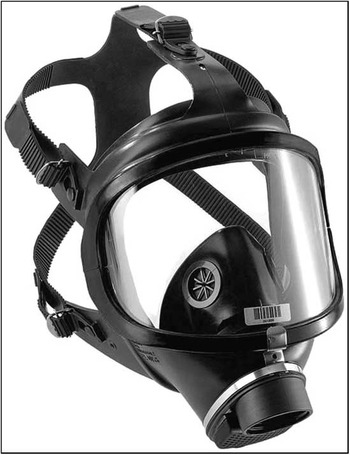
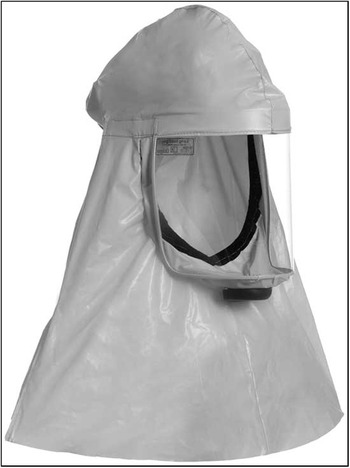
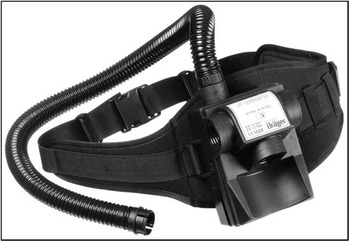
A tight-fitting full face panoramic visor respirator (CDR4500, Draeger Safety, Hamburg, Germany) was used for the conventional APR group (Figure 1). This respirator face-piece is designed to protect personnel against chemical, biological, radiation, and nuclear (CBRN) and riot control agents as well as toxic industrial chemicals, and is compliant with the American National Institute for Occupational Safety and Health (NIOSH) and the European EN 136 regulations. The APR group had a light weight particulate filter drum (P3 RD40, 35 g, Draeger Safety, Germany) directly connected to the facepiece. The PAPR group had a loose-fitting hood connected to the remotely mounted fan and filter unit (X-plore Long Hood and X-plore 7500, Draeger Safety, Germany, Figure 2) by a corrugated hose. The fan/triple-filter unit weighs 1050 g and was mounted on a waist belt (Figure 3).
Tight-Fitting Full Face Mask CDR4500 Without P3 Cartridge

XPlore Long Hood

Belt-Mounted Blower Unit Xplore 7500 Without P3 Cartridge

Patient Simulator
The emergency treatment was carried out on a Resusci Junior manikin (Laerdal Medical Ltd, Orpington, UK), which has the size and weight of a five-year-old child. This pediatric patient simulator can be intubated, cannulated and defibrillated during EPLS exercises. All skills were performed using the standard paramedical equipment of the London Ambulance Service NHS Trust at one of their designated training centers. The manikin was placed on the stretcher of an ambulance vehicle, the simulation scenarios were recorded on video and the individual treatment times for each task digitally analyzed.
Study Protocol
The treatment protocol was taken from the standard European Resuscitation Council EPLS algorithm and was strictly compliant with the guidelines and the routine equipment used by the London Ambulance NHS Trust.
At the start of the scenario, the medical team approached the simulator manikin. After apnea and cardiac arrest were diagnosed, the first task (Task 1) to be accomplished was the successful management of the airway by bag-valve-mask ventilation, aided by a Guedel oropharyngeal airway, by one team member. In the meantime, the other paramedic was applying the ECG/Defibrillator (Heartstart FR2, Laerdal Medical Ltd, Orpington, UK). The next task (Task 2) involved readying the endotracheal tube (ID 5.5 mm), pediatric laryngoscope (Macintosh, size 2 blade) and cuff syringe. Following successful intubation of the pediatric manikin's trachea, the tube was secured with a Thomas ETT holder. Task 2 was completed after connection and commencement of manual bag-valve-mask ventilation. This was immediately followed by Task 3: intraosseous vascular access using the EZ-IO infusion system with a 25 mm needle, followed by injection of a 10 ml bolus of normal saline. Task 4 required identification and preparation of the emergency intravenous drugs and giving atropine and adrenaline, followed by injection of a second 10 ml bolus of normal saline. Throughout the whole procedure (Tasks 1-4), continuous external chest compression was carried out.
The time taken to complete each task was recorded. Each paramedic was allocated to all three study arms, whereby the sequence was randomized to counter any learning effects (longitudinal study, randomized crossover design, the order of the sequence was determined by sealed envelopes).
Immediately after the treatment module, the participants completed study questionnaire forms in isolation from each other. This was to determine four key qualities of the respirator system: mobility, ease of communication, heat buildup and dexterity.
Statistics
All values are given as mean (standard deviation). Normal distribution of the time periods was confirmed by the Kolmogorov-Smirnov test. The comparison of the time periods between the groups was analyzed by a one way ANOVA and a Tukey-Kramer honestly significant difference (HSD) post hoc test. P values of < .05 were defined to show significance. Statistical analysis was performed using SPSS (Statistical Package for the Social Sciences, Version 18, IBM, Armonk, New York USA).
Results
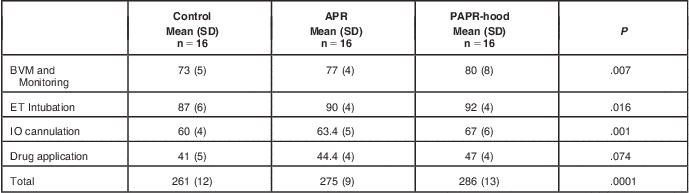
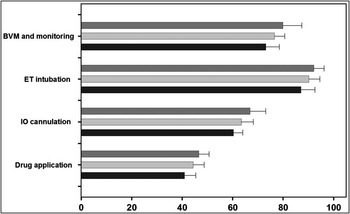
All sixteen paramedics successfully accomplished the treatment objectives of all study arms without adverse events. The treatment times are displayed in Table 1. The overall treatment times were 261 seconds (SD = 12 seconds) for the controls, 275 seconds (SD=9 seconds) for the APR group, and 286 seconds (SD = 13 seconds) for the PAPR-hood group. Overall treatment times ranged from 244-286 seconds for the controls, 259-288 seconds for the APR group and 264-318 seconds for the PAPR-hood group. Treatment times for individual tasks are displayed in Figure 4.
Treatment Times of Tasks (in seconds)
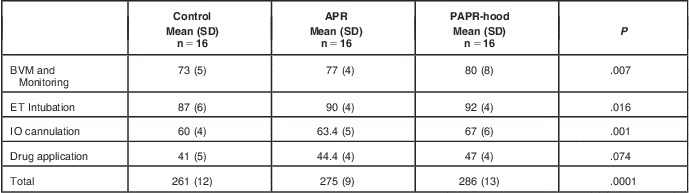
Abbreviations: BVM, bag-valve-mask; ET, endotracheal tube; IO, intraosseous; SD, standard deviation.
Treatment Times (in seconds)a
aBlack bar, control; dark gray bar, PAPR; light grey bar, APR.
* P < .05

The most time-consuming task carried out was the implementation of successful endotracheal intubation (87-92 seconds) and the least time consuming task was the identification and application of the drugs (41-47 seconds). Endotracheal intubation was carried out successfully during all runs. A tracheal tube bougie (angled, 800 mm, 10ch, P3, Bristol, UK) was used by 12 of 16 volunteers.
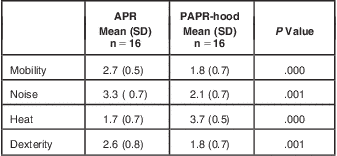
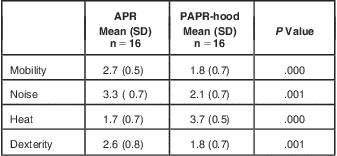
The participating paramedics rated the mobility, ease of communication and dexterity of the tight-fitting APR system significantly better compared to the loose-fitting PAPR-hood (Table 2). The wearer comfort with respect to heat buildup was significantly better in the loose-fitting PAPR-hood group.
Wearer Comfort Questionnaire Results, “0” indicating the worst and “5” the best performance.
Discussion
This is the first study investigating the influence of respiratory protection equipment on simulated pediatric resuscitation. In addition to naturally occurring epidemics, the threat of mass casualties caused by an intentional release of toxic or pathogenic substances has been highlighted by many governmental and non-governmental health care specialists.Reference White15, Reference Sardesai, Brown and Menon16 The Committee on Environmental Health and Committee on Infectious Diseases states that disaster-response agencies and public health authorities increasingly embrace the concept of an “all-hazards approach.”Reference Michael and Julia10 The all-hazards approach is designed to augment public health infrastructure, using an integrated model of disaster response. With this approach, the same protocol created to respond to the appearance of smallpox can easily be modified to contain an outbreak of avian flu. In 2004, there was considerable concern about the spread of the new severe acute respiratory syndrome associated corona virus (SARS-CoV), which provides a good model for the spread of a new infectious pathogen in a world linked by fast air flight connections.Reference Baker9 As airborne virulent biological agents may enter the body via the respiratory system, the majority of serious respiratory infections occur via the inhalational route.
During the 2010 H1N1 flu pandemic, the majority of UK health care workers were equipped with disposable half mask respirators and visors for splash protection. To ensure an adequate level of personal protection of the attending medical staff, guidelines have been published by the United Kingdom Department of Health and the Health Protection Agency.11, 12 The most commonly recommended respirator in the health care setting is a N99 respirator, previously called a high-efficiency-particulate-air (HEPA)-filter respirator which is capable of filtering 99.97 percent of airborne particulates with a median diameter of greater than 0.3 mm.Reference Martyny, Glazer and Newman13 The primary limitation of the half-face disposable respirator is the anatomical fit. Because of leakage, they may not provide the protection necessary for situations involving high levels of exposure or immediately life-threatening pathogens.Reference Martyny, Glazer and Newman13, Reference Howie17 In addition to the genuinely limited face seal, half-mask respirators need to be combined with goggles or a face shield for eye protection. Goggles and face shields have the disadvantage of fogging, especially during longer operation times. If the wearer is exposed to immediately life threatening pathogens or toxic chemicals, full face respirators with a genuinely better seal are recommended.Reference Martyny, Glazer and Newman13 They are available as tight-fitting negative pressure masks, known as air-purifying respirators, with the wearer drawing air through a filter. The other advantage over the combination of a half mask and goggles is the genuine airflow management of modern full-face respirators: The filtered inspiratory airstream is directed across the visor to prevent fogging, then enters an oronasal inner mask inside the main face mask. The inner mask seals the oronasal space from the eye space, and an expiratory valve ensures that the humid warm exhaled air leaves the inner mask directly into the atmosphere.Reference Wetherell and Mathers18 The breathing resistence of the filter depends on the type and amount of the adsorption media, and the type and surface area of the microfibre paper. Modern APRs only exert a resistance of 1-2 mbar; however this can substantially increase the work of breathing by increasing the resistance to both inspiratory and expiratory airflow, and by increasing dead-space ventilation. The increase in inspiratory resistance is the dominant physiological effect.Reference Louhevaara19, Reference Harber, Shimozaki, Barrett, Losides and Fine20 To counteract these burdens, powered air-purifying respirators have been developed that employ a pump which continuously draws ambient air in through a filter and supplies it to the loose-fitting hood. The constant airstream is directed across the visor to prevent fogging. The fan and filters may be carried by the user; with some units the air is fed to the user via tubing with the fan and filters unit remotely mounted. Although they are more expensive, PAPRs eliminate the problems of heat build-up, dead-space ventilation, and airflow resistance.Reference Martyny, Glazer and Newman13 Loose-fitting PAPR-hoods can be worn by people with facial hair and seem to be tolerated for longer periods, all this possibly resulting in better compliance with respirator use. On the contrary, their weight, bulk and the connection to a breathing tube might immobilize the wearer to a certain extent, especially during delicate medical tasks in confined spaces such as an ambulance vehicle.
In this study, it was found that the PAPR-hood, but not the tight-fitting APR, led to a significant delay in treatment compared to the controls. The authors assume that the bulky, loose-fitting hood and its rigid connection by a corrugated hose to the belt-mounted fan unit led to a more cautious and protective operation, which prolonged the treatment times. The tight-fitting APR ensemble was evaluated as more reassuring and less cumbersome by the majority of the volunteers. This might have been an encouragement to gather momentum during the scenario, even in the limited space provided by an ambulance. This explanation might also be supported by the findings of a previous investigation during adult advanced life support. By using a tight-fitting face mask in one group as an APR, in the other as a PAPR, the participants felt equally safe and confident during the tasks.Reference Schumacher, Gray, Weidelt, Prior, Brinker and Stratling21
The results of this study are inconsistent with a survey of health care workers who had used the loose-fitting hood PAPR in clinical practice during the SARS-CoV outbreak in Singapore, when use of a PAPR was mandatory and widespread.Reference Khoo, Leng, Ibrahim and Lim22 Only a minority of respondents found the PAPR uncomfortable, despite some interference with communication. Despite its much higher cost, the majority (84%) preferred to use the PAPR rather than the N-95 respirator when treating suspected SARS-CoV patients. However, the survey was undertaken within the adult Intensive Therapy Unit/High Dependency Unit (ITU/HDU) setting, whereas the subjects in this study were operating in the prehospital setting inside an ambulance.
In 2007, Greenland et al examined the impact of three types of personal protection equipment on the ability of anesthetists to intubate manikins using four different intubation techniques.Reference Greenland, Tsui, Goodyear and Irwin23 While focusing on the skill of tracheal intubation, they found no delay in their PAPR-hood group. This might be explained by the multiple tasks including CPR and intraosseous access volunteers in the current study had to perform within the limited space of the ambulance and the pediatric airway paramedics had to manage. In regards to the feasibility of intraosseous access, the results of this study are comparable to the recent publication of Lamhaut in which the superiority of intraosseous compared to intravenous access in adults under CBRN conditions was investigated.Reference Lamhaut, Dagron and Apriotesei24
Limitations
This study had a number of limitations. Despite the fact that the study was designed to simulate exposure to a highly contagious pediatric patient, it was performed under safe and secure conditions without any distressing haste. Furthermore, the treatment time was limited to perform only the immediate resuscitation measures, and only a single patient was being cared for at any one time. In an actual prolonged mass-casualty situation, the conditions would clearly be much less favorable.Reference Baker9
Conclusions
This study showed that when using lightweight particulate filters, conventional tight-fitting APRs are preferable to loose-fitting PAPR-hood ensembles during simulated emergency pediatric life support in the limited space of an ambulance. Despite their cooling, air-conditioning qualities, PAPR-hoods were rated less favorably with respect to mobility, communication and dexterity during pediatric cardiopulmonary resuscitation.