




No CrossRef data available.
THE EFFECTS OF LEARNING CONTEXTS ON MORPHOSYNTACTIC AND LEXICAL DEVELOPMENT
Published online by Cambridge University Press: 23 April 2004
Abstract
Context of learning, such as whether a learner studies a second language (L2) in a formal classroom—“at home” or abroad—may be a key factor in developing grammatical and lexical abilities. Yet, little empirical data is available comparing the effects of study abroad (SA) and formal instruction “at home” (AH) experiences on such development (Freed, 1995). The scant research that exists presents conflicting results (DeKeyser, 1986, 1991; Isabelli, 2002; Lennon, 1990; Regan, 1995; Ryan & Lafford, 1992; Schell, 2001). This paper provides a multivariate analysis (see Biber, 1988) of the effects of learning context on grammatical and lexical abilities in oral conversational discourse. The data compare the abilities of two groups before and after studying Spanish as an L2 for approximately one semester (N = 46): (a) a SA group in Alicante, Spain, and (b) a formal-classroom AH group at an American university. The corpus comprises oral segments produced by the learners in an Oral Proficiency Interview before and after the experimental period. In a corpus-based analysis, each segment was transcribed and tagged for various lexical and grammatical features. In two discriminant analyses, I identified various grammatical and lexical features that differentiated the two groups in terms of program gains. The results indicated that the AH context facilitated more development on discrete grammatical and lexical features. However, quantitative discourse analyses of the corpus revealed that the SA group achieved better narrative abilities and could produce language that was more semantically dense. The data are explained in consideration of the SA group's improved fluency and sociolinguistic pressures that distinguished its learning conditions.I would like to express my gratitude to the Council on International Educational Exchange, Barbara F. Freed, and Norman Segalowitz, whose sponsorship and support for the experiment reported here made this article possible. I also would like to thank Barbara F. Freed, Barbara Lafford, Norman Segalowitz, and the two anonymous SSLA reviewers for the valuable feedback on earlier versions of this article. Special thanks is due to Nicole Lazar for her expertise in planning and interpreting the statistical procedures reported in this article.
Information
- Type
- Research Article
- Information
- Copyright
- © 2004 Cambridge University Press
An examination of the comparative effects of study abroad (SA) and “at home” (AH) contexts on grammatical and lexical growth is important for at least three reasons: First, our understanding of the comparative effects of different learning contexts on acquisition suffers from a dearth of studies comparing SA and AH contexts; second, although, for all intents and purposes, SA programs promise accelerated rates of acquisition, they may be limited to vocabulary growth (Milton & Meara, 1995), but there is cause to doubt that the SA context leads to significant grammatical gains (DeKeyser, 1991; Freed, 1995); third, preprogram grammatical and lexical abilities appear to be important predictors of the overall gains that SA contexts provide students (Brecht & Davidson, 1991; Golonka, 2001).
From an SLA research perspective, the proposed task of exploring grammar and vocabulary use in SA and AH contexts may seem daunting, possibly leading to conclusions that mix “apples with oranges.” Yet, Gass (1999) recently reminded us that lexical errors may account for a large amount of perceived grammatical shortcomings in second language (L2) learners.
GRAMMATICAL AND LEXICAL GROWTH IN SA CONTEXTS
Three general observations account for why we know little about grammatical and lexical growth in different learning contexts: One suggests that the precision of the insights provided to date is weak, whereas the other two suggest that our insights are limited in generalizability. First, studies have relied on discrete-point tests such as the MLA Cooperative Tests and the College Entrance Examination Board, which provide information about global abilities (i.e., based on test items, or sets thereof, any one of which often simultaneously tests lexical, grammatical, and reading knowledge), thus lacking precision (Freed, 1990, 1995; Kaplan, 1989; Milleret, 1991). Second, as Freed (1995, 1998) has discussed, SA studies that have focused specifically on grammatical or lexical effects have rarely provided comparative data between the SA and AH contexts or even a control group to factor out the potential effects of learnability issues (i.e., gains, or lack thereof, that are natural because of a group's preprogram grammatical and lexical developmental state). Important exceptions are DeKeyser's (1986, 1991) SA-AH comparisons, reporting no grammatical advantage for SA. Third, most studies on SA's grammatical and lexical effects suffer from small sample sizes (see Freed, 1995).
For SA program directors, although the available data are not very generalizable, program effects on overall grammatical development are not entirely promising. Small sample-size studies of both cross-sectional and longitudinal nature have found little evidence of a positive effect for SA contexts on overall grammatical progress, as defined by grammatical errors and syntactic complexity (Möhle, 1984; Möhle & Raupach, 1983; Raupach, 1987; Regan, 1995). Interestingly, Möhle and Raupach qualified their conclusions by noting that overall fluency—or the ability to “sound good”—in the L2 does improve. Indeed, Freed, Segalowitz, and Dewey (this issue) as well as Segalowitz and Freed (this issue) provide convincing evidence that increased fluency—as measured by temporal and hesitation phenomena as well as gains in oral proficiency—is one of the key areas in which the SA context is advantageous for learners.
More recent research has examined the effects of SA on particular grammatical structures rather than overall grammatical abilities, and it is uncovering positive effects. Lennon (1990) reported that German students of English in a SA context developed increased syntactic complexity. Isabelli (2002) reported that students of Spanish in a SA context become sensitive to subject-pronoun omission and (overt) subject-verb inversion in subordinate clauses.
The recent interest in acquisition and lexical semantics (see Bardovi-Harlig, 2000) has motivated some researchers to focus on learners' development of the past tense(s). Schell (2001) studied the acquisition of tense-aspect features by learners of Spanish in a SA context (i.e., the preterit-imperfect dichotomy), showing that over 9 months learners experience various stages where lexical aspect interacts with past-tense morphology, including one in which learners misinterpret the role of the preterit and the imperfect. Howard (2001) reported that, although learners of French in a SA context struggled to make nativelike associations between lexical and inflectional aspect (e.g., associating imperfective past-tense inflections with verbs whose lexical aspect is generally imperfective, such as states), they made important gains in their abilities to generate narratives with past-tense markers. Similarly, Isabelli (2001) tracked a small group of SA learners of Spanish, finding significant improvement in tense and adjectival agreement as well as in narrative abilities.
Two SA studies provide insights into the nexus between grammatical and lexical development. Ryan and Lafford (1992) as well as Guntermann (1992) examined the order of acquisition of Spanish's two copulas ser and estar “to be” and the prepositions por and para “for,” respectively, by SA learners of Spanish. Both of these studies suggest that lexico-grammatical syntagmas (e.g., ser + adjective, estar + participle, para + destination) and formulaic chunks (e.g., por ejemplo “for example”) are important tools in SA learners' grammatical repertoires. Regan (1998) even posited that formulaics account partially for the fluency gains that SA learners develop, and Marriot (1995) as well as Siegal (1995) surmised that formulaic expressions (e.g., unanalyzed multiword segments such as Si no es ninguna molestia “If it isn't a bother,” Que te vaya bien “Take it easy”) account for much of the morphosyntactic complexity that SA learners demonstrate.1
The connectionist view not only recognizes the existence of codified multiword chunks in the lexicon, but some theoreticians propose a central role for them during production. Crick (1979) asserted that the mind has a vast storage capacity but a limited processing capacity (see Ellis, 1997, p. 230). Fluency is the use of many prefabricated and memorized lexical phrases.
If the study of lexical semantics or aspect and morphological development is reflective of Gass's (1999) contention that vocabulary and grammatical development are inextricably linked, our understanding of vocabulary development in different learning contexts is still in its infancy. DeKeyser (1986, 1991), Lennon (1990), and Walsh (1994) all provided evidence that important gains in vocabulary may be attributed to the SA experience. Milton and Meara (1995) reported that German, French, Italian, and Spanish learners of English in a SA context averaged a 23% growth in vocabulary in 6 months, although the growth was most robust among those learners who entered the experiment with weak L2 abilities. Ife, Vives Boix, and Meara (2000), on the other hand, studied the lexical development of L2 SA learners of Spanish who spent 4–8 months abroad and found that intermediate and advanced proficiency learners trended toward greater lexical growth and nativelike lexical organization.
Interestingly, the data presented to date give two pictures. The SA learning context appears to affect marginal gains in overall grammatical abilities as measured by global discrete-point tests. These instruments test learners' knowledge of grammatical phenomena that have been the focus of traditional linguistic inquiry and classroom practice. However, phenomena that do not receive exhaustive treatments in the L2 curriculum and in the literature on L2 pedagogy—for example, morphological-aspect or lexical-aspect relationships, pronoun omission, dependent-clause subject-verb inversion, and vocabulary growth that offers learners sociolinguistic appropriateness and discursive coherence—may well benefit from the SA context. Additionally, communicative strategies that are strongly influenced by external sociolinguistic factors (because they are conditioned more so by interpersonal interactions and social norms than by the need to present purely propositional content) also benefit from the SA experience, such as narrative abilities and the pragmatic appropriateness that important formulaics offer learners.
INTERNAL AND EXTERNAL AGENTS AFFECTING GRAMMATICAL AND LEXICAL SLA
Collentine and Freed (this issue) suggest that a comprehensive theory of SLA needs to consider both internal (memory, psycholinguistic input-processing principles, procedural and declarative knowledge) and external (sociolinguistic, interactional, institutional-contextual, affective) factors that affect and interact with acquisition. The following delves into important considerations within the SLA literature that shed light on the findings on the differential effects of SA and AH contexts explored in the previous section. Current linguistic and psycholinguistic thought posits a strong interaction between lexical and grammatical knowledge during SLA. The Minimalist Program (Chomsky, 1995) assigns an important role to the lexicon in determining surface-structure features. The lexicon not only stores an item's semantic definitions and argument specifications; it also stores derivational, inflectional, and free grammatical morphemes. Cook (1997) argued that the minimalist perspective views grammatical development as a process of itemization: The acquisition of grammatical knowledge for an L2 is not facilitated so much by some language acquisition device that looks for negative evidence for hypotheses; instead, grammatical acquisition stems from the accretion of lexical items and their individual idiosyncrasies. Additionally, the inclusion of functional phrases in the lexicon certainly implies that instruction might well promote the learning of formulaic chunks, such as ser + adjective. Connectionism (alternatively, emergentism; see MacWhinney, 1997) assumes that the brain stores information in networks of nodes. What distinguishes the connectionist perspective is that, whereas certain types of knowledge networks (e.g., lexical, syntactic) are localized, they are not entirely autonomous. A lexical network connects not only to semantic abstractions (e.g., a mental “picture” of a tree) but also to other aspects of linguistic knowledge, such as syntax, morphology, and phonology, which predicts that it may be difficult for SLA research to isolate the acquisition of a preconceived realm of linguistic representation without knowing how such phenomena interact among themselves during development (Hulstijn, 2002).
By definition, the SA learning context differs primarily from the AH context by the extent to which learners have opportunities to interact with real-world users of the L2 and the socioinstitutional forces that influence how those users employ the target language. SLA research indicates that such external forces have important consequences on complex L2 phenomena, such as syntactic development and narrative abilities. Swain (1985) argued that “pushed” output, which occurs in social interactions with speakers of the L2, is a crucial ingredient in the development of complex morphosyntactic abilities. Even in contexts of L1 acquisition, morphosyntactically complex and semantically and pragmatically abstract phenomena such as the subjunctive appear to require a certain level of institutional support for complete acquisition to occur (Collentine, 2003). For instance, (relatively) complete subjunctive acquisition in Spanish as a first language appears to occur in adolescence, when social pressures relating to linguistic conformity motivate young people to align their grammatical performance with prescriptive norms (Gili Gaya, 1972; Guitart, 1982). Furthermore, where critical prescriptive pressures such as public education conducted in Spanish are absent (e.g., Spanish bilinguals residing in the United States), complex and abstract phenomena like the subjunctive are never fully acquired (Silva-Corvalán, 1996).
Finally, Perdue and Klein (1992) provided data about the effects of the types of discourse in which learners engage in naturalistic, uninstructed conditions on grammatical and lexical acquisition. Examining two subjects learning English in the United Kingdom over a 2-year period, they reported noticeable progress in one of the learners' abilities to subordinate and the emergence of verbal inflections because his desire to be expressive and not just instrumental with the L2 made him sensitive of the need to narrate coherently: Instead of ordering events in a chronological fashion, the learner employed complex morphosyntactic strategies to achieve certain topicalization effects. The other learner, who participated predominantly in instrumentally oriented speech acts (e.g., requesting food, directions, greeting), did not develop as much morphosyntactically because his basic abilities sufficed (see Jordens, 1997; Klein & Perdue, 1997). To be sure, Kramsch (2000) submitted that a consideration of a learning context's repertoire of discourses (e.g., topics, interactional conventions, written and oral genres, the extent to which a lesson is teacher fronted) provides many salient data points to understand the effects of external variables on acquisition.
THE PRESENT STUDY
The present study attempts to redress the dearth in our knowledge of the comparative benefits of different learning contexts—specifically, SA and AH—on the development of learners' grammatical and lexical abilities.
- Does the study of Spanish as an L2 in a SA context benefit the development of grammatical abilities more than the study of Spanish in an AH context?
- Does the study of Spanish as an L2 in a SA context benefit the development of lexical abilities more than the study of Spanish in an AH context?
METHOD
Participants
The corpus of data for this analysis represents oral segments produced by 46 learners of Spanish as an L2 in an Oral Proficiency Interview (OPI). The study involved 46 learners of Spanish in two learning contexts during the course of a semesterlong period during the fall of 2001: an AH group consisting of a group of 20 students learning Spanish as an L2 in a formal university classroom at the University of Colorado at Boulder; a SA group consisting of 26 learners of Spanish as an L2 enrolled in a study abroad program in Alicante, Spain, that was directed by the Council on International Educational Exchange. All participants were American-born, native speakers of English who had no contact with Spanish in their past or current home environments. Prior to the experiment, all participants had at least two semesters of formal, classroom Spanish instruction, and none had studied abroad prior to the present research study. The AH group began the experiment with somewhat better overall Spanish abilities. Before the treatment period, the participants completed the SAT II Spanish Test (the version excluding the listening portion), with the AH group averaging 512.5 (SD = 108.3) placing them, on average, at the beginning of the third semester of university-level Spanish instruction in the United States; the SA group averaged 441.9 (SD = 89.9) on the SAT II, which placed them slightly before the middle of the second semester, F(1, 44) = 5.82, p = .02, eta2 = .12. Both groups averaged an OPI level of intermediate-low, although the mode of the AH group was intermediate-mid and that of the SA group was intermediate-low, χ2 (4) = 6.58, p = .162. During the experiment, the AH students were enrolled in one of two intermediate-level (n = 12) or a junior-level (n = 8) Spanish language skills class. The SA students were enrolled in three daily courses for foreign students at the University of Alicante: grammar and syntax, reading and writing, and conversation. Fifteen of the 26 SA students also took one or two elective monthlong daily content classes in Spanish on society and culture. All SA students lived with Spanish host families in Alicante during the treatment period.
Corpus
For each participant, the research team sampled two segments of an OPI conducted before the experiment (i.e., the pretest) and two segments from the OPI conducted after the experiment (i.e., the posttest). The two extracts represented minutes 7 and 8 as well as minutes 12 and 13. For the purposes of examining grammatical and lexical behaviors in speech in a corpus analysis, the OPI affords two important advantages for data collection. Learner production is spontaneous and is therefore likely to be highly reflective of the learner's L2 knowledge, and such production is likely not to be influenced by L1 knowledge. Additionally, the OPI produces surveylike answers from the learner, and it is not filled with negotiations of meaning, such that students' production is more monologuelike and unlikely to be highly influenced by input of the OPI interviewer (Johnson, 2001).
Each of the total 18,811 words in the corpus was tagged for various grammatical and lexical properties as well as accuracy. Each interview averaged 194.1 (SD = 74.8) words. The oral speech of L2 learners contains many repairs and false starts, as shown in (1).
(1) Yo voy a como … comes … comer.
“I am going to [I] eat … [you] eat … to eat.”
These frequent occurrences complicate any analysis because it is difficult to ascertain what resides in the learner's grammar. For the sake of consistency and because there is a large volume of research that suggests that short-term memory limitations interfere with learners' processing of lexical and grammatical features (see Levelt, 1989), the transcribed corpus of this portion of the study includes only corrections or repairs. Thus, given the utterance in (1), the corpus would include comer “to eat” but not como or comes.
Analysis
The first research question was addressed in two ways. First, the analysis compared the overall effects of AH and SA contexts on grammatical accuracy by examining the differences between the two groups' use of the following broad categories: gender, number, person, tense, and mood. However, given that this broad analysis examined accuracy in these structures in both marked and unmarked contexts, I expected both groups of learners to score high on all of these features both before and after the experiment.2
Lafford and Collentine (1989) demonstrated that, in conversational discourse, L2 learners of Spanish produce many unmarked and few marked grammatical forms. This presents a dilemma for the L2 researcher because accuracy measurements that consider both the marked and unmarked forms of a paradigm most likely inflate the actual expertise that a learner has with any given structure.
Marked here refers to structures that, within a given paradigm (e.g., gender, number, tense, lexical oppositions, and types of clauses) are more specified in use, such that their denotative value is more restricted than their unmarked counterparts. Feminine adjectives are thus more marked than masculine ones, just as past-tense verbs are more marked than the present (Waugh, 1982). Lafford and Collentine (1989) argued that, because marked structures are less generalizable (e.g., the present tense can connote present and past events, whereas the same is not true for a past-tense form), learners tend to acquire marked structures later in their L2 development.
Because the comparison of the two groups' grammatical abilities is multivariate in nature, I employed a discriminant analysis, which indicated whether the grammatical variables distinguish between the two groups and, if so, which ones. The analysis also provided a means to assess whether the set of the most “discriminating” variables have some underlying theme (e.g., Do gains in syntactic abilities best distinguish the two groups?). The analysis employs pretest-posttest “difference scores,” or the difference between the percentage of accurate uses of a given structure on the posttest and the percentage of accurate uses on the pretest. In the cases of coordinate-clause and subordinate-clause counts, the difference scores simply represented the percentage increase in the use of these two structures from the pretest to posttest.
The second research question was addressed in a similar fashion, on the basis of a discriminant analysis of the frequency with which the learners generated unique words (i.e., the so-called lexical types in a given interview, counting each unique word per participant per test time once) within seven lexical categories on the pretest and posttest: adjectives, adverbs, conjunctions, nouns, prepositions, pronouns, and verbs. This perspective provided a metric of the growth of the learners' lexicon (based on the available corpus), comparing the number of lexical items available to a learner at both test times.4
Type-token ratios were not the focus because such an analysis would comment more on the lexical variedness of the discourse produced by the learners rather than commenting on the growth of their lexical knowledge.
RESULTS AND DISCUSSION
The following discussion indicates that the first research question regarding the development of grammatical abilities requires a qualified negative answer. Based on the five broad analyses of gender, number, person, mood, and tense accuracy, as predicted, the learners rarely targeted the marked forms of a given grammatical paradigm, with the exception of gender (see Tables 1, 2, and 3). Regarding number, both groups targeted singular nouns and verbs with much greater frequency than plural forms. All told, the AH group targeted singular forms 74.6% of the time (total singular targets = 3,776; total targets inflecting number = 5,059) and the SA group 76.1% (5,392/7,084). Per interview, each AH participant averaged 94.4 (SD = 48.8) singular targets and 32.1 (SD = 15.2) plural targets; each SA participant averaged 103.7 (SD = 29.7) singular targets and 32.5 (SD = 13.6) plural targets. Concerning mood, both groups almost entirely targeted indicative verb forms, rarely creating contexts that would require the subjunctive. In all, the AH group targeted indicative forms 98.9% of the time (total indicative targets = 1,288; total targets inflecting mood = 1,302) and the SA group 99.0% (1,661/1,678). Per interview, the AH participants averaged 32.2 (SD = 20.6) indicative and 0.4 (SD = 15.2) subjunctive targets; each SA participant averaged 31.9 (SD = 7.8) indicative and 0.3 (SD = 0.6) subjunctive targets.
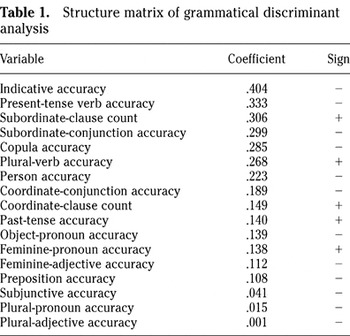
Structure matrix of grammatical discriminant analysis

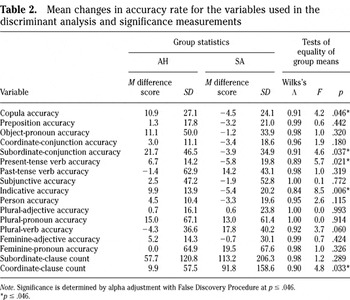
Mean changes in accuracy rate for the variables used in the discriminant analysis and significance measurements

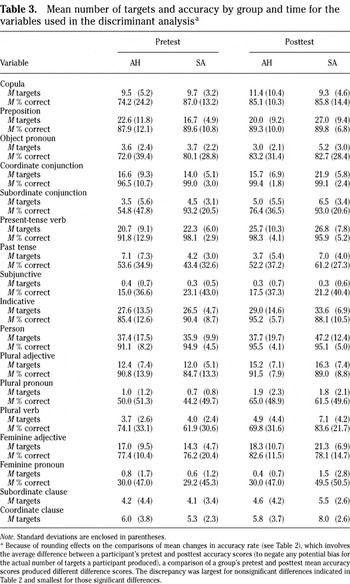
Mean number of targets and accuracy by group and time for the variables used in the discriminant analysisa

Concerning person, both groups rarely targeted anything but first- and third-person forms, addressing their interlocutor only on rare occasions. The AH group targeted first- and third-person forms 98.9% of the time (total first- or third-person targets = 1,638; total targets denoting person = 1,657) and the SA group 98.8% (2,218/2,246). Per interview, the AH participants averaged 41.0 (SD = 23.9) first- and third-person and 0.5 (SD = 1.2) second-person targets; each SA participant averaged 42.7 (SD = 12.7) first- and third-person and 0.5 (SD = 1.1) second-person targets. With respect to tense, both groups largely targeted the present. The AH group targeted the present 71.2% of the time (total present targets = 927; total targets inflecting tense = 1,302) and the SA group 76.2% (1,278/1,678). Per interview, the AH participants averaged 23.2 (SD = 9.9) present and 9.4 (SD = 17.1) nonpresent targets; each SA participant averaged 24.6 (SD = 7.2) present and 7.7 (SD = 4.4) nonpresent targets. Finally, both groups targeted equal numbers of masculine and feminine forms at both tests times. The AH group targeted masculine forms 52.0% of the time (total masculine targets = 1,708; total targets inflecting gender = 3,287) and the SA group 48.0% (2,377/4,604). Per interview, the AH participants averaged 42.7 (SD = 26.2) masculine and 39.5 (SD = 19.4) feminine targets; each SA participant averaged 45.7 (SD = 15.7) masculine and 42.8 (SD = 15.0) feminine targets.
Four of the five broad analyses of gender, number, person, mood, and tense accuracy by group and time (i.e., pretest, posttest) revealed that both groups scored high at both test times, ranging from 76.4% accuracy (AH pretest mood, 524/686) to 95.5% (AH posttest number, 2,372/2,485). The ANCOVA comparisons of the two groups on each of these broad grammatical categories employing posttest (percentage) accuracy scores as the dependent variable and pretest accuracy scores as the covariate found no main effects for group for four of the five measures, which indicates that after the treatment period both groups enjoyed similar levels of overall accuracy. The ANCOVA comparing the two groups on tense (with pretest scores as the covariate) revealed a significant main effect for group, F(1, 43) = 8.113, p = .007, r2 = .16. The marginal mean for the AH group was 90.7 (SE = 2.13), whereas the SA group's marginal mean was 82.4 (SE = 1.856), which indicates that the AH group developed better overall abilities to inflect tense as a result of the treatment.
The discriminant analysis revealed that the 17 grammatical variables—which represented pretest-posttest differences in terms of accuracy percentage—significantly distinguished between the two groups, Wilks's Λ = 0.464, χ2 (17) = 27.99, p = .045. The results indicate that the linear function resulting from the analysis could correctly classify 80.9% of all of the cases.
Five variables significantly discriminated between the two groups, with three discriminators being verbal in nature and two syntactic: copula accuracy, present-tense verb accuracy, indicative accuracy, subordinate-conjunction accuracy, and subordinate-clause count. Additionally, it is noteworthy that two of these discriminators were lexico-grammatical in nature—namely, copula and subordinate-conjunction accuracy. That is, present-tense verb and indicative accuracy entail largely morphological considerations, and subordinate-clause count involves the presence of a particular syntactic configuration; on the other hand, Spanish copula accuracy not only requires a learner to provide a copula where necessary (i.e., disallowing zero-copula predicates), but the learner must also select one of two lexical forms (ser or estar, depending on the context and speaker's intent). Likewise, subordinate-conjunction accuracy involves knowing which lexical item or phrase is appropriate for a given subordinate clause's head.
Regarding copula accuracy, it is important to keep in mind that Spanish speakers use two copulas: ser, the more generalizable (unmarked) copula, used to denote permanent states and qualities; and estar, the more specific (marked) and functionally restricted copula, connoting transitory states and the location of people, things, and places. There is a vast amount of research indicating that L2 learners of Spanish acquire the functions of estar later than they do those of ser (Geeslin, 2002). An exploratory ANOVA, comparing the two groups in terms of the number of times that each targeted each copula, helped to elucidate the groups' divergence in accuracy. The ANOVA uncovered a significant interaction between test time, group, and type of copula, F(1, 176) = 8.1, p = .005, r2 = .56. The observed variations in the difference scores between the two groups are perhaps attributable to the fact that the AH grouped increased its chances of targeting the unmarked ser form, which learners tend to employ by default (see Geeslin), whereas the SA group effectively elevated the proportion of estar forms that it targeted from the pretest to the posttest, and so the latter was more prone to error. Both groups targeted approximately the same number of estar contexts on both the pretest and posttest, averaging 9.1 per 1,000 words (SD = 9.7) per test. Yet, the AH group increased its ser targets by about 7.5 tokens per 1,000 words, increasing from 40.4 (SD = 21.9) to 48.0 (SD = 22.3); the SA group decreased its ser targets dramatically, targeting 49.9 (SD = 21.0) on the pretest and 29.4 (SD = 14.8) on the posttest.
Concerning both present-tense and indicative accuracy, the data suggest that the two groups diverged in terms of their performance. Whereas the AH group increased in accuracy significantly on both variables, the SA group experienced a decrease. As shown in (2)–(4), the SA group's decrease in indicative accuracy was due to the increased use of subjunctive and nonfinite forms where indicative forms were necessary, which is typical in Spanish SLA when numerous inflections begin to compete among each other (Collentine, Collentine, Clark, & Fruginal, 2002). Learner errors of inflexion are marked by an asterisk.

The last two variables relate to syntax. First, the AH group increased its accuracy in subordinate conjunction selection over time, whereas the SA remained stable. Indeed, the AH group saw approximately a 22% increase in its accuracy in this regard (see Table 3). Second, whereas the AH group produced 57.7% (SD = 120.8) more coordinate clauses on the posttest, the SA group produced 113.2% (SD = 206.3) more on the posttest. Of course, it must be kept in mind that the discriminant analysis employed the mean percentage difference between the participants' pretest coordinate-clause counts and their mean posttest counts (so as to employ a common metric among the factors in the analysis of variance), and so rounding errors are especially likely where learners targeted few tokens. In real terms, Table 3 indicates that participants in the AH group produced only about 6.0 (SD = 3.8) coordinate clauses on the pretest and 5.8 (SD = 3.7) on the posttest. Thus, the significant difference in coordinate-clause production is likely due to the fact that the SA group produced 5.3 (SD = 2.3) coordinate clauses on the pretest and fully 8.0 (SD = 2.6) on the posttest; note also that the variance changed little from the pretest to the posttest, which suggests that this improvement was experienced across the board. It must be kept in mind, however, that the increase in the production of coordinate clauses is most likely an artifact of the fact that the SA increased its fluency during the treatment period, producing more words per segment (see Segalowitz & Freed, this issue). To be sure, the data reveal a significant, positive correlation between increased number of words per interview and increased coordinate-clause frequency for both groups, r = .82, df = 91, p = .000. Furthermore, an examination of the structure matrix (see Table 1) points to a particularly interesting finding: Given each group's particular increase on these syntactic variables and given that the sign of the subordinate-clause count coefficient is the opposite of subordinate-conjunction accuracy (i.e., there is a disassociation between the two variables), it is likely that the SA group was able to generate more subordinate clauses at the expense of the (lexical) accuracy of the conjunctions heading the subordinate clauses they produced.
Overall, then, the SA experience did not produce students with overall improved grammatical abilities. Indeed, it was the AH group that increased most significantly on the five variables that most distinguished the groups, and the major differences between the two groups relate precisely to those grammatical aspects that Spanish formal instruction emphasizes—namely, verbs and subordinate conjunctions (i.e., which are treated with some degree of detail when attention turns to the subjunctive; see Collentine, 2003). Additionally, the discriminant analysis suggests that important differences require a consideration of the interaction between lexical and grammatical knowledge. The SA group's differential performance was highly influenced by the greater frequency with which it generated the marked Spanish copula estar and its (apparent) “disregard” for accuracy in selecting the appropriate lexemes for subordinate clauses.
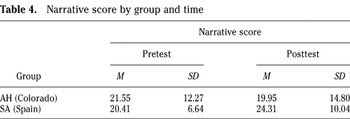
Finally, given that overall accuracy with tense was an important distinguisher and in light of the observations to date that SA facilitates the development of narrative abilities, I compared the two groups' narrative abilities. Biber (1988) identified five variables that occur most frequently in (and so are most associated with) narrative discourse: past-tense verbs, third-person morphology, past participles, present participles, and public verbs (e.g., verbs of communication and events).5
Biber employed a factor analysis of the occurrence of a multitude of discourse, grammatical, lexico-grammatical, and lexical categories to uncover co-occurrence and disassociative relationships between these features. Through this process he identified those features that are most likely to co-occur (i.e., in correlational and frequency terms) in various types of discourse. As a byproduct, he was able to identify the features that co-occur in narratives, among other types of discourse (e.g., informationally focused, such as news accounts or expository text).
Narrative score by group and time

Example (5) is typical of one of the SA students at posttest time, who received the second highest narrative score. (Words in all capital letters constitute omissions on the part of the student. Each break constitutes a new turn.)
(5) SA participant 31
En Granada el Alhambra fue muy bonito. Es un jardín que los moros construyeron y ahora es libre para la pública. Me gusta Granada. Es muy bonito … más que Alicante y fui a UN BAILE DE flamenco con los gitanos. Me gusta pero no fui a los bares y discotecas porque no me gusta y en Madrid fui a EL Prado y la reina Sofía y nada más porque nosotros estuvamos afuera DE Madrid en una ciudad muy pequeña y es muy caro para ir a Madrid. Es como de Estados Unidos a Nueva York pero no vi mucho porque no tengo tiempo y gastó mucho tiempo en el grado y cuando salí no camino sobre el ciudad porque no tengo tiempo pero no sé.
“In Granada the Alhambra was very pretty. It's a garden that the Moors built and now it is free to the public. I like Granada. It's very pretty … more than Alicante and I went to A flamenco DANCE with the gypsies. I like it but I didn't go to the bars and discos because I don't like [that/them] and in Madrid I went to THE Prado and Queen Sofia and nothing else because we were outside OF Madrid in a small city and it is expensive to go to Madrid. It's like from the United States to New York because I didn't see much because I do not have time and I spend/spent a lot of time on the grade [sic: on my grades] and when I left I do not walk over the city because I do not have time but I don't know.”
The narrative in (5) has many events, verbs in the past, and public verbs. The student describes numerous events in very few words. Yet, there appears to be a price for such fluency—namely, accuracy in verbal inflectional accuracy.
The following example in (6) is a typical narrative structure of the AH group.
(6) AH participant 25
Mi caballo está bien. Está con mis padres y es un poquito grande. Es un color de café más o menos y me gusta mucho. Yo LO monto todo. No me recuerdo toda las calles cerca de mi casa porque mi padres viven en un lugar muy tranquil. No está muchas personas y coches. Está un poquito está alegra pero un poquito chidioso … ¿ Es una palabra de español? Mi caballo quiere … no me recuerdo … mi caballo quiere hace chiste más o menos. Yo domino a mi caballo. Cuando mi caballo no se porta bien, yo quiero controlar LO pero no funciona todo el tiempo. Oh uso mis manos y uso.
“My horse is all right. He's with my parents and he is a bit large. He is a color of coffee more or less and I like him a lot. I ride HIM all [sic: all over]. I don't remember all of the streets close to my house because my parents live in a tranquil place. It is not [sic: there are not] many people and cars. He is a bit happy but a little ‘chidioso’ [neologism] … Is that a Spanish word? My horse wants … I do not remember … my horse wants to make jokes more or less. I dominate my horse. When my horse doesn't behave, I want to control HIM but it doesn't work all of the time. I use my hands and I use.”
There are many third-person forms but no past-tense forms. Indeed, a perusal of the data base shows that, whereas the SA group produced, on average, 4.1 preterit forms per student, the AH group produced only 2.3. The difference was not significant statistically, but the trend suggests that narratives for most of the AH entailed present-tense descriptions of linked events. Narratives for the SA group entailed accounts of the past, although with highly flawed verbal inflections.
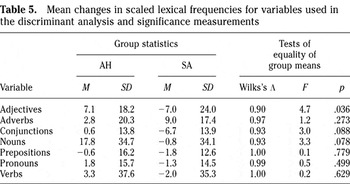
The second research question asked whether the study of Spanish as an L2 in a SA context benefited the development of lexical abilities more than the study of Spanish in an AH context. Again, the analysis suggests that this question also deserves a qualified negative answer. The discriminant analysis identified only one discriminating variable—namely, adjectives.
As shown in Table 5 comparison of the two groups' mean difference scores of the scaled data revealed that the only measure on which the two groups differed significantly was adjectives, with the AH group appearing to produce proportionally more unique adjectives after the treatment than the SA group, Wilks's Λ = 0.90, F(1, 45) = 4.69, p = .036. However, it seems unlikely that a single variable could adequately depict the differential effects of learning context on the acquisition of unique lexical items, so I submitted the data to a stepwise discriminant analysis, with entry into the structure matrix set at α = 0.05 and removal at α = 0.10. The goal of the stepwise analysis is not to identify the variables that discriminate individually; rather, it identifies a subset of variables that together (i.e., as a linear function) can serve to distinguish groups.
Mean changes in scaled lexical frequencies for variables used in the discriminant analysis and significance measurements

The stepwise discriminant analysis identified two variables whose simultaneous consideration discriminated between the groups: nouns and adjectives, Wilks's Λ = 0.797, χ2(2) = 9.51, p = .009, r2 = .45. (The standardized discriminant function coefficients were the following: .871 for adjectives and .785 for nouns.) Because this linear function only accounted for approximately 45% of the total variation between the two groups, I examined the function's classificatory abilities, finding that it classified 66.7% of the cases of both groups.
An examination of the mean difference scores in Table 5 reveals that the AH group produced proportionally more of both adjectives and nouns after the treatment; in other words, taking nouns and adjectives together, the AH group appeared to acquire more unique lexical items than the SA group.
Interestingly, the extent to which nouns and adjectives co-occurred in a segment of discourse is probably not a spurious association. The co-occurrence of these two parts of speech suggests that the discourse that the AH group produced was overall more “informationally rich” (i.e., semantically dense) than that of the SA group. Biber (1988) has identified the following to be indicative of informationally rich discourse: language samples that contain numerous nouns, attributive adjectives, prepositions, multisyllabic words (as measured by number of letter or phones), and a high type-token ratio.6
Biber and Conrad (2001) distinguished between discourse that is informationally rich to that which is involved in nature. Informationally rich discourse has an “informational purpose and [provides] ample opportunity for careful integration of information and precise lexical choice” (p. 24). Involved discourse is interactive in nature (e.g., between two speakers) and meaning is coconstructed between two participants. In this sense, lexical items such as nouns and multisyllabic words, which tend to possess various derivational affixes, are more semantically dense than items such as prepositions or conjunctions.
To better understand the different types of discourse that the two groups produced, I calculated two informational-richness scores for each participant: a scaled and a nonscaled data score. The scaled analysis entailed each feature's frequency scaled to 1,000 words (i.e., if 30 were produced in an interview with 200 words, the 30 would be scaled to 150 out of 1,000 words); the nonscaled analysis entailed the simple frequency of each feature per interview. Essentially, a consideration of both of these metrics was motivated by the fact that the SA group produced more words on the posttest than the AH group (because of its greater overall fluency; see Segalowitz & Freed, this issue), which in turn may have allowed it to generate more instances of each feature and so perhaps distorted the extent to which the discourse that its participants' generated was word-for-word more informationally rich.
According to Biber (1988), in determining the informational richness of a segment (or in this case a participant's performance on one of the interviews), the frequency of each of the five features must weigh equally into the analysis. This is accomplished by considering the frequency of a given feature produced by a participant at a given test time relative to the frequency of that feature among the other 45 participants in the study (i.e., N = 46) at that test time. Thus, a given participant's frequency is normed to a z-score relative to the mean frequency at that test time for the 46 total participants. The sum total of a participant's five z-scores (i.e., one for each feature) is the participant's relative informational richness on that interview. The difference between a participant's informational-richness scores on the pretest and posttest then becomes a metric of the extent to which he or she increased in terms of overall informational richness.7
Two assumptions underlie this technique: (a) Each feature weighs equally into the assessment of a participant's informational richness, and (b) a participant with a higher standardized score on a feature produced more informationally rich discourse based on that feature alone (see Biber, 1988).
A consideration of the scaled data suggests that the informational richness of the discourse of neither group increases significantly, although the AH group demonstrated a trend toward producing more informationally dense discourse overall than the SA group, F(1, 44) = 2.79, p = .10, eta2 = .06. Interestingly, however, a consideration of the nonscaled data produces the opposite picture: Without controlling for the number of words that each group averaged in the segments, the SA group generated many more semantically dense utterances, F(1, 44) = 7.46, p < .01, eta2 = .15. Thus, these students' greater fluency enabled them to relate more unique lexemes of high informational value. In other words, the SA group improved much more than the AH group in terms of being able to produce more instances of semantically dense lexemes by virtue, in part, of its greater fluency.
CONCLUSION
In response to the question of whether the SA context yields better overall grammatical and lexical abilities than the AH context, the answer is a qualified no. All told, we see the influence of external—institutional and social—variables differentiating between the two learning contexts. First, the discriminant analysis that searched for those (largely marked) variables that most distinguished the two learning contexts indicated that the AH learning context was more advantageous to the acquisition of grammatical phenomena that the Spanish curriculum is widely known to emphasize—namely, verbs and subordinate conjunctions. Second, the SA group demonstrated that it could produce more instances of “narrative behaviors” and more semantically dense lexical types in a given time frame than the AH group could. It may be that day-to-day interactions with the target culture permit SA learners to practice retelling their daily or weekend adventures to friends and host-family members, and so they learn to produce numerous narrative behaviors within a given turn, which would also entail improvements in their abilities to generate a series of episodes (i.e., concatenate numerous subordinate clauses, although sacrificing a degree of precision vis-à-vis the conjunctions that they produce) and to retrieve individual words that singularly connote much information (e.g., nouns, attributive adjectives, multisyllabic words). Perdue and Klein (1992) as well as Klein and Perdue (1997) contended that the development of complex means of expression like narrative abilities often results from a learner's desire to be expressive and thus to enjoy greater social integration.
Naturally, there are factors that the data-collection instrument for this study (the OPI) could not control and that should be considered in attempts to replicate the present study. It remains to be investigated whether a SA group's greater fluency (and so its better narrative abilities and more frequent instances of semantically dense lexical types) is influenced by the experiences that they relate in an OPI; such episodes may be more emotionally charged (i.e., their SA experiences constituted major life experiences) than those related by the AH group. One way to better understand the potential influence of this factor would be to conduct the same analyses on the role plays gathered from the same subjects (see Lafford, this issue). Additionally, a larger corpus of fairly spontaneous written data comparing the SA and AH groups' development would partially eliminate the potential interference of fluency gains on the narrative and informational-richness analyses.
Finally, an investigation of the differential effects of SA and AH learning contexts, such as the present one and that of Segalowitz and Freed (this issue), leads other researchers to examine language phenomena that typically do not constitute the primary premises underlying classroom content. Linguistic research, especially in the areas of discourse analysis and corpus linguistics, is beginning to uncover metrics for characterizing discursive levels of representation that combine grammatical and lexical features. There is a persistent perception that the SA learning context has a positive effect on SLA (see Collentine & Freed, this issue), and examining the effects of the SA context on narrative abilities, the semantic density of information, and overall fluency may account for educator's perceptions, even if these phenomena are not readily quantifiable by traditional metrics. In other words, those who espouse the efficacy of SA experiences may be, somehow, noticing that the SA learner can “tell a story” a little better and can “get their point across” more effectively.
References
REFERENCES
Bardovi-Harlig, K.
(2000).
Tense and aspect in second language acquisition: Form, meaning, and
use.
Oxford:
Blackwell.
Biber, D.
(1988).
Variation across speech and writing.
New York:
Cambridge University Press.
Biber, D., &
Conrad, S.
(2001).
Introduction: Multidimensional analysis and the study of register
variation. In
S. Conrad &
D. Biber (Eds.),
Variation in English: Multidimensional studies (pp.
3–13).
London:
Longman.
Brecht, R. D., &
Davidson, D.
(1991, March).
Language acquisition gains in study abroad: Program assessment and
modification.
Paper presented at the National Foreign Language Center (NFLC)
conference on language testing, Washington, DC.
Chomsky, N.
(1995).
The Minimalist Program.
Cambridge, MA:
MIT Press.
Collentine, J.
(2003).
The development of subjunctive and complex-syntactic abilities
among FL Spanish learners. In
B. Lafford &
R. Salaberry (Eds.),
Studies in Spanish second language acquisition: The state of the
science (pp.
74–97).
Washington, DC:
Georgetown University Press.
Collentine, J.,
Collentine, K.,
Clark, V., &
Fruginal, E.
(2002).
Subjunctive instruction enhanced with syntactic instruction. In
J. Lee,
K. Geeslin, &
J. C. Clements (Eds.),
Proceedings of the 4th Hispanic Linguistics Symposium (pp.
32–45).
Somerville, MA:
Cascadilla Press.
Cook, V. J.
(1997).
Inside language.
London:
Arnold.
DeKeyser, R.
(1986).
From learning to acquisition? Foreign language development in a
U.S. classroom and during a semester abroad.
Unpublished doctoral dissertation,
Stanford University,
CA.
DeKeyser, R.
(1991).
Foreign language development during a semester abroad. In
B. F. Freed (Ed.),
Foreign language acquisition research and the classroom (pp.
104–119).
Lexington, MA:
D. C. Heath.
Ellis, N. C.
(1997).
Vocabulary acquisition: Word structure, collocation, word-class,
and meaning. In
N. Schmitt &
M. McCarthy (Eds.),
Vocabulary: Description, acquisition, and pedagogy (pp.
122–139).
New York:
Cambridge University Press.
Freed, B. F.
(1990).
Language learning in a study abroad context: The effects of
interactive and noninteractive out-of-class contact on grammatical
achievement and oral proficiency. In
J. E. Alatis (Ed.),
Georgetown University Round Table on Languages and Linguistics:
Linguistics, language teaching, and language acquisition: The interdependence
of theory, practice, and research (pp.
459–477).
Washington, DC:
Georgetown University Press.
Freed, B. F.
(1995).
Language learning and study abroad. In
B. F. Freed (Ed.),
Second language acquisition in a study abroad context (pp.
3–33).
Amsterdam:
Benjamins.
Freed, B. F.
(1998).
An overview of issues and research in language learning in a study
abroad setting.
Frontiers,
4,
31–60.Google Scholar
Gass, S.
(1999).
Discussion: Incidental vocabulary learning.
Studies in Second Language Acquisition,
21,
319–333.Google Scholar
Geeslin, K.
(2002).
The acquisition of Spanish copula choice and its relationship to
language change.
Studies in Second Language Acquisition,
24,
419–450.Google Scholar
Gili Gaya, S.
(1972).
Estudios de lenguaje infantil [Studies of child language].
Barcelona:
Bibliograf.
Golonka, E.
(2001).
Identification of salient linguistic and metalinguistic variables
in the prediction of oral proficiency gain at the advanced-level
threshold among adult learners of Russian.
Unpublished doctoral dissertation,
Bryn Mawr College,
PA.
Guitart, J.
(1982).
On the use of the Spanish subjunctive among Spanish-English
bilinguals.
Word,
33,
59–67.Google Scholar
Guntermann, G.
(1992).
An analysis of interlanguage development over time: Part
1—por and para.
Hispania,
75,
177–187.Google Scholar
Howard, M.
(2001).
The effects of study abroad on the L2 learner's structural
skills: Evidence from advanced learners of French.
EUROSLA Yearbook,
1,
123–141.Google Scholar
Hulstijn, J.
(2002).
Towards a unified account of the representation, processing, and
acquisition of second language knowledge.
Second Language Research,
18,
193–223.Google Scholar
Ife, A.,
Vives Boix, G., &
Meara, P.
(2000).
The impact of study abroad on the vocabulary development of
different proficiency groups.
Spanish Applied Linguistics,
4,
55–84.Google Scholar
Isabelli, C.
(2002).
The impact of a study-abroad experience on the acquisition of L2
Spanish syntax: The null subject parameter.
Unpublished doctoral dissertation,
University of Illinois,
Urbana-Champaign.
Isabelli, C. L.
(2001).
Motivation and extended interaction in the study abroad context:
Factors in the development of Spanish language accuracy and
communication skills.
Unpublished doctoral dissertation,
University of Texas,
Austin.
Johnson, M.
(2001).
The art of nonconversation.
New Haven, CT:
Yale University Press.
Jordens, P.
(1997).
Introducing the basic variety.
Second Language Research,
13,
289–300.Google Scholar
Kaplan, M. A.
(1989).
French in the community: A survey of language use abroad.
The French Review,
63,
290–301.Google Scholar
Klein, W., &
Perdue, C.
(1997).
The Basic Variety (or: Couldn't natural languages be much
simpler?).
Second Language Research,
13,
301–334.Google Scholar
Kramsch, C.
(2000).
Social discursive constructions of self in L2 learning. In
J. Lantolf (Ed.),
Sociocultural theory and second language learning (pp.
133–153).
Oxford:
Oxford University Press.
Lafford, B., &
Collentine, J.
(1989).
The telltale targets: An analysis of access errors in the speech of
intermediate students of Spanish.
Lenguas Modernas,
16,
143–162.Google Scholar
Lennon, P.
(1990).
The advanced learner at large in the L2 community: Developments in
spoken performance.
IRAL,
28,
309–324.Google Scholar
Levelt, W.
(1989).
Speaking: From intention to articulation.
Cambridge, MA:
MIT Press.
MacWhinney, B.
(1997).
Second language acquisition and the Competition Model. In
A. M. B. de Groot &
J. Kroll (Eds.)
Tutorial in bilingualism: Psycholinguistic perspectives (pp.
113–142).
Mahwah, NJ:
Erlbaum.
Marriot, H.
(1995).
Acquisition of politeness patterns by exchange students in Japan.
In
B. F. Freed (Ed.),
Second language acquisition in a study abroad context (pp.
197–224).
Amsterdam:
Benjamins.
Milleret, M.
(1991).
Assessing the gain in oral proficiency from summer foreign study.
Association of Departments of Foreign Languages (ADFL) Bulletin,
22,
39–43.Google Scholar
Milton, J., &
Meara, P.
(1995).
How periods abroad affect vocabulary growth in a foreign language.
ITL Review of Applied Linguistics,
107–108,
17–34.Google Scholar
Möhle, D.
(1984).
A comparison of the second language speech of different native
speakers. In
H. W. Dechert,
D. Möhle, &
M. Raupach (Eds.),
Second language productions (pp.
26–49).
Tübingen:
Gunter Narr.
Möhle, D., &
Raupach, M.
(1983).
Planen in der Fremdsprach [Planning in the foreign
language].
Bern:
Peter Lang.
Perdue, C., &
Klein, W.
(1992).
Why does the production of some learners not grammaticalize?
Studies in Second Language Acquisition,
14,
259–272.Google Scholar
Raupach, M.
(1987).
Procedural learning in advanced learners of a foreign language.
Duisburg, Germany:
Universität Gesamthochschule Duisburg.
Regan, V.
(1995).
The acquisition of sociolinguistic native speech norms: Effects of
a year abroad on second language learners of French. In
B. F. Freed (Ed.),
Second language acquisition in a study abroad context (pp.
245–268).
Amsterdam:
Benjamins.
Regan, V.
(1998).
Sociolinguistics and language learning in a study abroad context.
Frontiers,
4,
61–90.Google Scholar
Ryan, J., &
Lafford, B.
(1992).
Acquisition of lexical meaning in a study abroad environment:
Ser and estar and the Granada experience.
Hispania,
75,
714–722.Google Scholar
Schell, K.
(2001).
Functional categories and the acquisition of aspect in L2 Spanish:
A longitudinal study.
Unpublished doctoral dissertation,
University of Washington,
Seattle.
Siegal, M.
(1995).
Individual differences and study abroad: Women learning Japanese
in Japan. In
B. F. Freed (Ed.),
Second language acquisition in a study abroad context (pp.
225–244).
Amsterdam:
Benjamins.
Silva-Corvalán, C.
(1996).
Language contact and change: Spanish in Los Angeles.
Oxford:
Oxford University Press.
Swain, M.
(1985).
Communicative competence: Some roles of comprehensible input and
comprehensible output in its development. In
S. Gass &
C. Madden (Eds.),
Input in second language acquisition (pp.
235–253).
Rowley, MA:
Newbury House.
Waugh, L. R.
(1982).
Roman Jakobson's science of language.
Lisse, Belgium:
Peter de Ridder.
Structure matrix of grammatical discriminant analysis
Mean changes in accuracy rate for the variables used in the discriminant analysis and significance measurements
Mean number of targets and accuracy by group and time for the variables used in the discriminant analysisa
Narrative score by group and time
Mean changes in scaled lexical frequencies for variables used in the discriminant analysis and significance measurements
 You have
Access
- 163
- Cited by