Introduction
Efforts to reach the United Nations’ Millennium Development Goal of maternal mortality ratio (MMR) reduction by 75% have failed.Reference Houy, Ha, Steinholt, Skjerve and Husum 1 Despite an annual global reduction in MMR at 2.3 %, still too many die unnecessarily. 2 In 2013, 2.8 million babies (44 % of all “under-five” deaths) never survived their first month of life, and the proportion of neonatal deaths keeps on rising.Reference Kassebaum, Bertozzi-Villa and Coggeshall 3 These children will not survive unless their mothers do, so maternal and neonatal care should be regarded as an integrated challenge. Deliveries in anemic and malnourished women can be compared to rural trauma. The majority of women who die of pregnancy-related complications, as most victims of war and conflict, die before they ever reach appropriate medical care, uncontrolled hemorrhage being the main risk variable. In settings like these, survival is a matter of immediate forward life support and appropriate damage control at an early stage. With a general lack of health professionals in low-income countries, there is no other way than delegating life-saving skills to the best resource persons at hand.
In 1997, a three-tier prehospital trauma system was set up in the vast minefields of Cambodia and North Iraq. The systems comprised thousands of layperson first helpers providing Basic Life Support; a few hundred health center (HC) paramedics trained in Advanced Trauma Life Support; and hospital emergency room staff trained in damage-control interventions. The intervention reduced trauma mortality rate from 40% to 10%. 4 , Reference Husum, Gilbert, Wisborg, Heng and Murad 5 Later studies of the chain-of-survival model in Iraq confirmed that immediate life support by trained laypersons was the single most important factor for survival in rural trauma with long transit times outside hospital.Reference Wisborg, Murad, Edvardsen and Husum 6 , Reference Murad and Husum 7 In the 1990s, delegating life-saving skills to non-doctors was controversial; however, today most rescue systems are founded on forward trauma and cardiac life support, emphasizing the role of immediate interventions.Reference Murad, Larsen and Husum 8 , 9 Despite these evidence-based advances, the role of traditional birth attendants (TBAs) in maternal health care remains controversial.Reference Field, Hazinski and Sayre 10 - Reference Bergstrom and Goodburn 12
The aim of this study was to examine the effect on maternal and perinatal mortality rates of merging providers of maternal care with an existing Cambodian rural prehospital trauma system.
Material and Methods
The Delivery Life Support (DLS) program was implemented as a five-year prospective interventional study with time-cohort design. The study areas were selected inside the minefields of Northwestern Cambodia in cooperation with the health authorities in the provinces of Battambang and Pailin. The total population in the two provinces is 1.1 million people. Both provinces have urban referral hospitals where medical care is available if the patient can pay for it. However, the vast majority of the rural population have little or no access to basic and necessary treatment due to financial, cultural, or geographical barriers. The study population was defined by purposive sampling based on criteria of remoteness, poverty, and poorly developed medical infrastructure. Consequently, the intervention was carried out in a remote rural population of 200,000 inhabitants in 266 villages.
Intervention
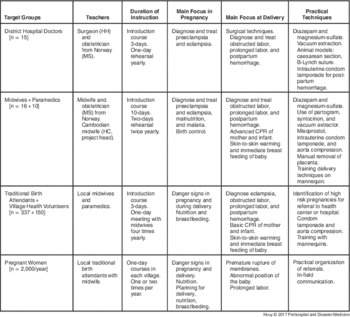
Each village had at least one TBA, and normally one village health volunteer (VHV) previously trained in Basic Trauma Life Support. The HCs were staffed by paramedics with extensive trauma experience and two to four professional midwives. The training program was implemented at 17 HCs and three referral hospitals from December 2004 through December 2005. The teaching focused on resuscitation of blue babies and obstetric emergencies such as hemorrhage, eclampsia, and prolonged labor. A core group of 27 experienced midwives and trauma paramedics were trained as instructors to conduct two-day courses for 337 TBAs and 150 VHVs in the villages. The surgeons at three hospitals were upgraded in emergency operative obstetrics and surgical skills. Throughout the five-year study period, the local TBAs with HC midwives conducted one-day antenatal classes for pregnant women in all 266 villages with emphasis on danger signs before and during delivery. To enhance the cooperation and performance within the chain-of-survival system, the TBAs met four times yearly with their midwife supervisor to audit cases managed in the previous period. Each year, rehearsal class was arranged for the midwives and paramedics to audit critical cases throughout the study period. The curricula and treatment protocols for the formal training are described in Table 1.
The Delivery Life Support Training Program

Abbreviation: CPR, cardiopulmonary resuscitation.
Data Management
All deliveries were registered consecutively in case record forms: simple charts for TBAs and more comprehensive ones for HC staff. The program coordinator collected the forms, validated entries, and collected missing information. The main outcome variable for the maternal study was the death of a woman while pregnant after 22 weeks of gestation or within four weeks after delivery. The International Classification of Diseases/ICD criteria define maternal death as all pregnancy-related complications within 42 days postpartum. However, in an area of high internal migration and difficult travel conditions, it was not feasible to track the study subjects for more than four weeks postpartum. The main outcome variable for the babies was perinatal mortality defined as stillbirth or death within one week after birth. Explanatory variables included demographic factors, maternal age, and number of previous deliveries.
The DLS network had a vast outreach and it took two years to achieve adequate interaction between the three tiers of the system and to establish reliable systems for data gathering. For this reason, the cohort of 2005 and 2006 patients was used as baseline for the time controls. Miscarriages and deliveries before gestational week 22 were excluded. The women in the study areas seldom attended more than one antenatal visit, so for most of the patients, there was little or no information recorded before gestational week 22. This left a study population of 10,540 women. The World Health Organization (WHO; Geneva, Switzerland) definition of stillbirths excludes miscarriages before week 28.Reference Prata, Passano, Rowen, Bell, Walsh and Potts 13 Consequently, 10,491 babies were included for study.
The intervention was approved by the National Committee for Research Ethics in Cambodia (NECHR Ref. No. 2004/045) and the Regional Committee for Research Ethics in Norway (REK Vest No.199.04).
Statistical Methods
Proportions are reported with confidence intervals and are considered significantly different when the 95% confidence interval for the difference between two proportions (95% CI Diff) does not contain zero. 14 Logistic regression models were used in time cohort analysis to adjust for confounding variables. All assumed predictors of death were included using a backward selection process with inclusion at significance level of five percent. The logistic model was evaluated by Receiver Operating Characteristics (ROC) analysis. A predictor is considered “fair” if the area under the ROC curve is 0.7-0.8 and “good” if larger than 0.8.Reference Altman, Machin, Bryant, Gardner and Gardner 15 The data were processed in Excel (Microsoft Corporation; Redmond, Washington USA) and then transferred to Stata (12/SE for Windows; College Station, Texas USA) and JMP (SAS; Cary, North Carolina USA) for statistical analyses.Reference Zweig and Campbell 16
Results
Maternal Mortality
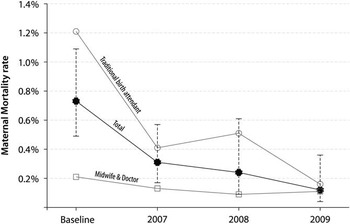
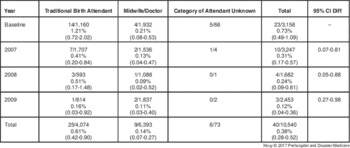
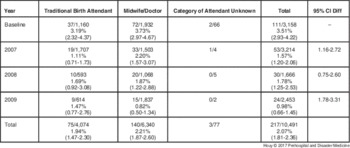
The mean age of the women included in the study was 27 years, 20% being 20 years or younger. There were 25% first-time mothers; 60% gave birth for the second, third, or fourth time; and 15% had five or more previous deliveries. A steep decline in TBA-assisted deliveries was observed in the 2008 and 2009 cohorts. There were 40 maternal deaths among the 10,540 women included in the study (0.38 %). The proportion of births with a fatal maternal outcome was significantly lower in the three intervention cohorts as compared to the baseline (Table 2). The most profound reduction was observed in TBA-assisted deliveries (Figure 1). Out of the 40 fatalities, 24 died of postpartum hemorrhage, three women died of eclampsia, and three from malaria. Only one woman was recorded as dead before giving birth. Her diagnosis was “bleeding combined with transverse position of the fetus.” In nine fatalities, the cause of death was not noted. For 73 deliveries, the category of birth attendant was not known and in this group, six women died. A subset of 75 patients were diagnosed with circulatory shock. Among these there were two fatalities. No trauma-related deaths were recorded. Of all demographic factors and presumed death predictors entered into the regression model, age, parity, and TBA-assisted delivery remained predictors of maternal death (P values<.005). The regression model had a ROC area of 0.83. The time cohorts remained a significant explanatory variable when adjusted for the risk factors.
Maternal Mortality Rates by Year and Category of Birth Attendant. Note: The vertical bars represent 95% confidence intervals of the total mortality estimates.

Number of Maternal Deaths and Births by Year and Category of Birth Attendant

Note: The proportions are expressed with 95% confidence intervals in brackets. Mortality rates per year are compared to the baseline by 95% confidence intervals for the difference (95% CI Diff).
Perinatal Mortality
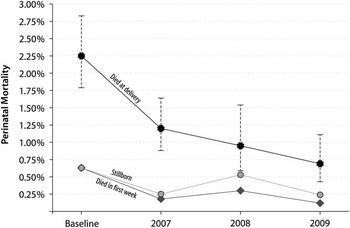
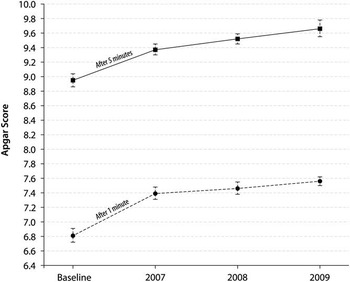
The perinatal mortality rate in the study period was 2.1%. The overall death rate did not differ significantly between the subsets of TBA and midwife/doctor-assisted deliveries (Table 3). There was a significant reduction by year of mortality rates in babies suffering early deaths, 50% of fatalities occurring in TBA-assisted deliveries (Figure 2). The prevalence of stillbirths and late neonatal deaths did not change significantly during the study period. In the subset of babies delivered by professional midwives, the mean Apgar Scores improved during the intervention period. Especially the score registered after five minutes showed a significant improvement by year (Figure 3). Birth weight was a significant Apgar Score predictor; however, adjusted for this variable, the time cohort effect on Apgar Score outcomes was still significant. Caesarean section was done in 164 cases. In this subset, one woman and 14 babies died. Of all demographic factors and presumed death predictors included in the regression model, the significant risk factors for perinatal mortality were birth weight, twins, eclampsia, blood loss, which year the delivery took place, and maternal death (P values<.001). Adjusted for these risk factors, the year of delivery and birth weight remained significant explanatory variables. The regression model had a fair fit with an ROC area of 0.73.
Perinatal Mortality Rates by Year for the Three Fatality Subsets. Note: The vertical bars represent 95% confidence intervals of the died-at-delivery estimates.

Mean Apgar Scores by Year in the Subset of Deliveries with Skilled Attendants. Note: The vertical bars express the 95% confidence intervals of the estimates.

Number of Perinatal Deaths and Deliveries by Year and Category of Birth Attendant

Note: The proportions are expressed with 95% confidence intervals in brackets. Mortality rates per year are compared to the baseline by 95% confidence intervals for the difference (95% CI Diff).
Discussion
The authors report a new approach to avoidable maternal and perinatal deaths in low-resource communities. Like the understanding of trauma care, also in obstetric critical care, the mother and the baby start dying at the time of delivery, especially so when the patient is fragile with poor pre-event physiological capacity. In the actual study, the most profound decline in mortality was observed in deliveries assisted by trained non-professional attendants. This corresponds to results from trauma system studies in war; immediate Basic Life Support by trained bystanders was the most significant risk variable in a large cohort of war injured in Iraq.Reference Wisborg, Murad, Edvardsen and Husum 6 , Reference Murad and Husum 7 Also, recent studies in emergency obstetrics document the effect of forward care. In Bangladesh, TBAs were successfully trained to use misoprostol in postpartum hemorrhages. 17 , Reference Bell, Passano, Bohl, Islam and Prata 18
The Cambodian study was implemented under rough conditions; consequently, there are several poorly controlled variables. Firstly, some maternal and perinatal deaths may have passed unrecorded in the study period. Most women left HCs and hospitals with their babies just days after delivery, so late deaths may therefore have escaped registration. In addition, close to 40% of the study population delivered at home in remote villages where there is no formal system for referral and documentation. Among these TBA-assisted deliveries, some fatal outcomes probably went unregistered, especially during the baseline period of 2005-2006 when deep distrust was observed between TBAs and HC staff, villagers fearing condemnation, and abusive behavior from professional health workers.Reference Prata, Quaiyum and Passano 19 Secondly, like any study with historical controls, the epidemiology of the study population may change during the study period. A marked decrease in TBA-assisted deliveries was observed in 2008 and 2009, which could reflect at least two factors. As an effect of the antenatal classes in the villages, more high-risk cases were probably transferred for delivery at HCs and hospitals (Table 2). Also, political factors should be considered. In 2009, the Cambodian government passed a law to ban home deliveries. This had a clear negative impact in areas where professional health care is unavailable due to geographical and financial reasons. Most likely, dedicated TBAs continued to assist clandestine deliveries in the remote villages, efforts going unreported due to fear of sanctions from the authorities. Despite these methodological challenges, the decline in maternal and perinatal mortality is presumably real. The DLS network was well-embedded at local level, and data were scrutinized during verbal autopsies in the villages by trained midwives during the entire study period.
Due to ethical reasons, the study had to be conducted without controls: “Members of any control group should be provided with an established effective treatment, whether or not such treatment is available in the host country.”Reference Chandy, Ol, Heng and Husum 20 Designs with historical controls require validation of both the baseline and contextual changes. In 2004, a pre-intervention household survey was conducted in the actual study area documenting a MMR of 20/4,482 (0.45%). This is similar to the 2005-2006 baseline used in the time cohort study (95% CI Diff, 0.06-0.68). The survey identified a perinatal mortality rate of 209/4,180 (5.0%), which is higher than the actual time-cohort baseline (95% CI Diff, 0.06-0.24).Reference Prata, Quaiyum and Passano 19 Hence, the time cohort comparisons under the DLS intervention are acceptable. During the study period, the officially reported MMR in Cambodia declined from 4.7 per 1,000 live births in 2005 to 2.1 per 1,000 live births in 2010. 21 , 22 However, crude national figures on MMR in Cambodia are based on secondary data gathering in remote areas and also include urban center deliveries. They may not therefore be comparable to the low-resource settings of the DLS program. The 500 rural health workers who participated in the study confirmed that the catchments areas did not achieve much of the reported improvements. Except for mobile phones and motorbikes, contextual changes were few. The cost for medical treatment, one of the main reasons for not using professional maternal health services, remained the same throughout the study period.
The regression models of this study had modest explanatory power. This reflects the complexity of the study context. Especially for perinatal mortality, the ROC value is low, indicating that the model poorly explains variations of mortality patterns due to inadequate explanatory information. Recent studies in the DLS catchments area indicate a prevalence of anemia in pregnant women at 50% in rural remote areas (personal communication; midwives Leang Ladat and Loeur Pyrun) and more than 40% of mothers being underweight (personal communication; Khay Rattana, MD). Poverty has a negative effect on health, but quantitative indicators cannot fully measure the hardship of poverty, landlessness, oppression, and infectious diseases. It is also difficult to estimate the adverse effects of traditional medicine, which still stands strong in the study area: mothers being urged to drink rice wine postpartum and newborn being washed in cold water.
Despite methodological challenges, it is apparent that the improvement in indicators to a large extent was the result of the intervention. The marked reduction in maternal and perinatal deaths observed in TBA-assisted deliveries should be emphasized. This is an indication of better individual skills, but probably also an effect of closer networking between the TBAs and the local HC improving timely referrals of risk patients. Many TBAs told the authors they felt relieved just by having their work acknowledged by professional health staff. Being part of the DLS network made the TBAs more confident when advising young women to go to a HC or hospital, especially if they knew the staff working there. The TBAs in this study were all highly respected members of their villages, and most of them had decades of experience as birth attendants. During the intervention period, the number of TBA-assisted deliveries declined substantially. For most of the TBAs, this was a welcomed development as they were all aware of the risks of childbirths. A preliminary survey of the DLS intervention in 2007 documented improved confidence and networking between the village and professional care providers. 23 During the intervention, parts of the study area got access to mobile phone networks. This represented a huge improvement for counseling and emergency referrals. There are no data gathered on this variable in this study; however, a recent controlled trial from Zanzibar shows that mobile phone advising of pregnant women significantly reduced perinatal mortality.Reference Chandy, Steinholt and Husum 24
The Cambodian intervention had positive effects beyond reducing death counts. One of the most striking changes observed during the study period was a change in attitudes among professional health staff towards poor women. During the initial study years, several families and village care providers reported to be blamed if a delivery had an adverse outcome. Over time, this attitude changed as hospital and HC staff gained insight and understanding in the patients’ harsh lives and the difficult working conditions for the TBAs. Regular antenatal classes conducted by the TBA-midwife teams in the remote villages are not only a tool for more accurate identification of danger signs, but also a method of rooting and improving of the entire chain of emergency care.Reference Lund, Rasch and Hemed 25
Conclusion
Based on the Cambodian experience, alternative approaches to reduce maternal and perinatal mortality in low-resource settings are recommended. There are lessons to learn from years of evidence-based trauma system intervention. Basic obstetric care and life support reduces the risk of maternal and perinatal death if provided timely and appropriately. Traditional birth attendants are life-savers if well-integrated in the chain-of-survival. Moreover, the study illustrates that it is possible to conduct major interventional studies in remote and rough scenarios. This is vital in order to scientifically identify key factors for better survival systems.
Acknowledgements
The authors want to thank the care providers in rural Cambodia who readily participated in the study collecting data under challenging conditions. Professional advice from the Provincial Health Directorates in Battambang and Pailin and the Department of Mother and Child Health in Battambang is acknowledged. Battambang Central Blood Bank and the blood banks in Sompouv Lun and Pailin gave generous support in emergencies. The authors also want to thank Professor of International Health Staffan Bergström, Karolinska Institutet, Stockholm and Professor Ellen Blix, Oslo University College of Applied Sciences, who helped design and initiate the intervention. Professor Anne Eskild, University of Oslo, advised in writing up the findings. The study was sponsored by The Norwegian Research Council (Oslo, Norway) and humanitarian grants from The Norwegian Ministry of Foreign Affairs (Oslo, Norway).
Authors’ Contribution
The study was conceived by HH and implemented by CH, MS, and HH. CH and SOH gathered the data and undertook the analysis together with ES and HH. CH, MS, and HH drafted the manuscript. All authors read and approved the final edition.