In the variationist paradigm, the variable choices speakers make in language use are modeled as independent random events, with a complex set of social and linguistic weights affecting the outcome in each instance. But the view of language variation as a string of binomial trials has been known to be a convenient fiction at least since Sankoff and Laberge's (Reference Sankoff, Laberge and Sankoff1978) demonstration that one of the most powerful influences on a choice between pronominal options in Montreal French is simply which option the speaker used last. This repetition effect, here called persistence, is thought to be akin to what psycholinguists call priming: the increased ease with which a speaker remembers or recognizes a word or structure that she has recently encountered.Footnote 1
In this paper I argue that persistence is complex in that it reflects the operation of multiple processes, with the evidence for this complexity being found in data from two of the best-studied sociolinguistic variables in English: ING, the -ing/in’ alternation, and TD, the variation between dropping or pronouncing a /t/ or /d/ at the end of a word in consonant clusters (as in old versus ol’). Both of these variables can be used in morphologically simple words (morning, act) as well as in morphologically complex ones (jump-ing, work-ed). The quantitative evidence indicates that repetition arises only under very particular circumstances: (a) only when the prime (prior instance) and target (current instance) belong to the same morphological category, and (b) within the morphologically simple context, only when the prime and target are also the same lexical item. I argue that this pattern of results motivates an analysis where both the linguistic structures and cognitive processes at play are multifactorial—in other words, that there is not just one “TD” or “ING” variable, and there is not just one “priming” effect. Specifically, I propose that the observed pattern of results may arise from a combination of (a) lexical repetition priming acting on morphological variation, and (b) episodic memory for lexical items influencing the outcome of phonological and/or phonetic variation. This sensitivity of persistence to morphological structure suggests that it can serve as a diagnostic of the envelope of variation for variables at the phonology–morphology interface.
BACKGROUND
Persistence in conversational speech
Some of the earliest evidence for persistence in conversational speech comes from the study of pronominal alternations, both in choices between overt pronouns (Sankoff & Laberge, Reference Sankoff, Laberge and Sankoff1978) and the use of null subject pronouns (Cameron, Reference Cameron1992, Reference Cameron1993; Cameron & Flores-Ferrán, Reference Cameron and Flores-Ferrán2004; de Omena, Reference de Omena1978; Mayol, Reference Mayol2012; Travis, Reference Travis2007). Morphological persistence effects also appear repeatedly in studies of verbal and nominal inflections, including inflectional /s/- and /n/-deletion in Puerto Rican Spanish (Poplack, Reference Poplack1980, Reference Poplack1984), verbal /s/ in nonstandard English varieties (Poplack & Tagliamonte, Reference Poplack and Tagliamonte1989), and /s/-deletion in Brazilian Portuguese (Scherre, Reference Scherre2001; Scherre & Naro, Reference Scherre and Naro1991, Reference Scherre and Naro1992). Scherre and Naro (Reference Scherre and Naro1992) noted that, across these studies, persistence effects are large in magnitude and robust to different approaches to coding and analyzing the data. Persistence also extends to higher-level syntactic alternations, such as the choice between active and passive (Estival, Reference Estival1985; Weiner & Labov, Reference Weiner and Labov1983). Gries (Reference Gries2005) and Szmrecsanyi (Reference Szmrecsanyi2005, Reference Szmrecsanyi2006) added the dative alternation, particle placement, future marking, complementation, comparatives, and genitives to the list of syntactic alternations that show persistence in both spoken and written corpora.
Psycholinguistic accounts of persistence
Studies of persistence in conversational speech have emphasized the psychological underpinnings of such repetitiveness. Scherre and Naro (Reference Scherre and Naro1991:30) suggested that “formal parallelism … should be considered as a serious candidate for a universal of language use and processing”; a number of studies since then have suggested more concrete implementations. For example, Cameron and Flores-Ferrán (Reference Cameron and Flores-Ferrán2004), in a study of null subject realization in Spanish dialects, turned to Spreading Activation Theory (Dell, Reference Dell1986) to explain persistence. In this model of speech production, utterance planning involves the construction of a frame of slots that are connected both vertically (across linguistic levels) and horizontally (across the time course of an utterance). Insertion of linguistic material into the slots is controlled by the activation level of different available nodes, representing linguistic items and rules. Activation can spread across similar nodes, increasing the likelihood that slots near each other will be filled in similar ways. Cameron and Flores-Ferrán (Reference Cameron and Flores-Ferrán2004) found in this framework a natural explanation for the tendency toward repetition of subject realization as null or overt: the activation of the null or overt subject nodes spreads across frames to promote variant choice in the same way as speech error tendencies may extend beyond a single sentence.
A related psycholinguistic model of speech production from Pickering and Branigan (Reference Pickering and Branigan1998) was adopted by Gries (Reference Gries2005) in his corpus-based study of syntactic persistence in the English dative alternation and particle placement. Pickering and Branigan (Reference Pickering and Branigan1998), building on Roelofs (Reference Roelofs1992), emphasized the links between syntactic constructions, lemmas (the base forms of words), and linking category/feature nodes. The relevant lemma node is inherently activated when a word is used, and that activation spreads to not only the category and feature nodes of the form used (such as present tense) but also to what they call the combinatorial nodes, which capture possible different syntactic constructions. A wide range of experimental studies of syntactic priming, many using picture description tasks in the paradigm pioneered by Bock (Reference Bock1986), have produced results consistent with this model (see Pickering and Ferreira [Reference Pickering and Ferreira2008] for an overview). Gries (Reference Gries2005) found that corpus results on datives and particles are strikingly similar to experimental work on those alternations, with construction choice in both cases showing persistence that is strengthened by lemma repetition. Similar results were reported by Szmrecsanyi (Reference Szmrecsanyi2006) for future marking, particle placement, complementation, comparatives, and genitives across five English corpora. While much experimental work on syntactic priming has involved written stimuli presentation, and therefore needs to be treated with caution when related to spoken language processing, the fact that Gries (Reference Gries2005) obtained parallel results across written and spoken corpora suggests that comparisons are not inappropriate.
The reflection of grammatical structure in persistence
When persistence is treated as having a psychological (as opposed to, for example, stylistic) basis, it becomes possible to exploit patterns of repetition to address questions of grammatical identity in conversational speech. Psychologists working on structural priming have acknowledged the experimental analog of this possibility for some time; Branigan, Pickering, Liversedge, Stewart, and Urbach (Reference Branigan, Pickering, Liversedge, Stewart and Urbach1995:490) contended that “If the processing of a stimulus affects the processing of another stimulus, then the two stimuli must be related along a dimension that is relevant to the cognitive system. Under certain circumstances, we can conclude that they are represented in a related manner.” In other words, facilitation resulting from priming manipulations may serve as a diagnostic of syntactic-representational relationships between sentences. Pickering and Ferreira (Reference Pickering and Ferreira2008:429) discussed a possible extension of the use of persistence to diagnose relationships: that in the face of overwhelming general evidence for structural priming, a failure to observe priming by the same methods may indicate that the prime and target are not representationally related.
There is evidence from both experimental and corpus studies to support the claim that surface similarity produces priming only in the presence of a shared grammatical representation, motivating the use of priming as a diagnostic for relatedness across surface-similar strings where the relatedness is in question. On the experimental side, for example, Bock and Loebell (Reference Bock and Loebell1990) showed that prepositional phrases headed by to, but not infinitival primes containing to, promote the choice of the prepositional object word order in describing double-object pictures. Similarly, Griffin and Weinstein-Tull (Reference Griffin and Weinstein-Tull2003) found that the use of infinitive object-raising sentences as primes leads participants to misrecall such sentences' finite counterparts as infinitives at a higher rate than object control or subject control primes do. Ferreira (Reference Ferreira2003) also showed that sentences with complementizer that, but not ones containing determiner that, prime use of the optional sentence complementizer. The sensitivity of priming to syntactic structure is not limited to laboratory contexts. In conversational speech data, Estival (Reference Estival1985) found that persistence of the passive differs by passive type, with both transformational passives (“John is believed to have left”) and lexical passives (“John is interested in music”) promoting reuse of the same type but not of the other type. Ecay and Tamminga (Reference Ecay, Tamminga, Mathieu and Truswellin press) argued that the persistence facts regarding Middle English negation weigh in favor of one of two competing syntactic analyses. These latter studies hinted that priming analyses may be successfully applied to corpus data as a diagnostic tool for structural identity.
Similar to cases where syntactic identity is in question, the study of variation at the phonology–morphology interface raises questions of variable definition that have not found satisfactory answers in traditional quantitative methods. The variables in the current study have received extensive scrutiny in the sociolinguistics literature, yet their basic structural definitions remain in dispute. In the next section, I review the contested linguistic definitions of ING and TD.
DATA AND METHODS
Defining and coding the variables
To a first approximation, ING is the alternation between unstressed [ɪŋ] and [ɪn], as in working versus workin’, while TD is the variable deletion of coronal stops word-finally in consonant clusters, as in old versus ol’.
The definition of ING
Although ING is perhaps the most familiar English sociolinguistic variable, defining it precisely and circumscribing its context of occurrence are not easy tasks. On the surface, variation between unstressed [ɪŋ] and [ɪn] occurs in a range of morphological contexts. The alternation can occur as a verbal morpheme or as a phonological string within a monomorpheme, as well as in the quantifiers something and nothing. It is a well-replicated finding that ING rates are sensitive to morphological context (Fischer, Reference Fischer1958; Forrest, Reference Forrest2015; Hazen, Reference Hazen2008; Houston, Reference Houston1985; Labov, Reference Labov1989, Reference Labov2001; Tagliamonte, Reference Tagliamonte, Gunnarson, Bergström, Eklund, Fidell, Hansen, Karstadt, Nordberg, Sundergren and Thelander2004), with the basic generalization being that the [ɪŋ] variant is more frequent in nominal contexts than in verbal contexts.
An unsettled issue is whether ING should be treated as a phonological variable, with different nasal place realizations, or a morphological variable, with different allomorph options. One advantage of the morphological account is that it is consistent with the variable's origin in the conflation and competition of two distinct Old English suffixes, participial -inde/ende and the verbal noun ending -inge/ynge (Houston, Reference Houston1985; Labov, Reference Labov1989). A consequence of the morphological account, though, is that the alternation between [ɪŋ] and [ɪn] in presumably simple nouns, such as morning and ceiling, as well as in something and nothing, must be attributed to a different source because these words do not contain a distinct morpheme to serve as the locus of variable allomorphy. This is somewhat dissatisfying in that not only does the variation across these cases appear in identical form on the surface, but also these forms seem intuitively to serve the same sociostylistic purpose regardless of whether they are plausibly analyzed as a distinct morpheme or not. Hazen (Reference Hazen2008:121) provided a possible reconciliation of these views with his suggestion that “as a sociolinguistic variable, (ING) is a coherent whole with two variants; however, (ING) is not the result of a single linguistic process.”Footnote 2 It is not yet clear, though, that the sociostylistic evaluation of these two contexts is the same; Tagliamonte (Reference Tagliamonte, Gunnarson, Bergström, Eklund, Fidell, Hansen, Karstadt, Nordberg, Sundergren and Thelander2004), for example, found that the effect of learned versus everyday words operates in opposite directions in nominal and verbal ING.
ING is also phonologically conditioned, although the evidence for the details of the conditioning pattern is mixed. Because phonological conditioning is not the primary area of interest in this study, I adopt a simplified treatment of the phonological environment with the aim of controlling, rather than investigating, the effects of phonological context. Based on exploratory data analysis of the current dataset and in keeping with the most consistently recurring proposal from the literature, I code the preceding segment, which triggers regressive assimilation, simply as coronal versus noncoronal, and the following phonological environment, which triggers progressive dissimilation, as velar, nonvelar, or phrase-final (prepausal).
For the current study, I focus on two classes of ING that should be relatively uncontroversial: monomorphemic words, such as ceiling, morning, awning, or pudding, and polymorphemic words with a verbal suffix and a transparent root, such as working, kicking, singing, or running. The latter are included only when used in an unambiguously verbal context, with possible gerundial or other noun-like constructions excluded. So, for example, She was swimming would be included but She likes swimming and Swimming is fun would be excluded. I also set aside the something/nothing/everything/anything cases and monomorphemic proper nouns. The treatment of such exclusions with respect to persistence and the envelope of variation is discussed in the section on coding and statistical issues.
The definition of TD
I now turn to TD (also known as coronal stop deletion), the variation between retention and deletion of final apical stops (/t/ and /d/) word-finally in consonant clusters. In some words, the deletion targets a single phoneme within a monomorphemic word, as in old or west, while in others it targets a phoneme that is coterminous with a morpheme, as in grazed or kicked. The TD literature has accordingly distinguished between deletion in monomorphemes and regular past tense verbs, with the former, at least in American English, showing reliably higher rates of deletion than the latter (Santa Ana, Reference Santa Ana1991; Fruehwald, Reference Fruehwald2012; Guy, Reference Guy and Labov1980, Reference Guy1991; Guy & Boyd, Reference Guy and Boyd1990; Labov, Cohen, Robins, & Lewis, Reference Labov, Cohen, Robins and Lewis1968; Neu, Reference Neu and Labov1980). A collection of different irregular past tense forms are generally found to undergo deletion at an intermediate rate (Fruehwald, Reference Fruehwald2012). Parallel to the approach described for ING, I exclude all irregular and negative contraction (e.g., wasn't tokens) in order to focus on the distinction between simple monomorphemic and regular polymorphemic contexts. Although the analysis of TD as a phonological or phonetic deletion process is perhaps more obvious than for ING, there is also a potential role for allomorphy in this case. Patrick (Reference Patrick1991) argued for a null past tense allomorph in Jamaican Creole, and Fruehwald (Reference Fruehwald2012) suggested that a similar analysis might account for the intermediate status of semiweak verbs (such as lost) in data from the Buckeye Corpus (Pitt, Dilley, Johnson, Kiesling, Raymond, Hume, & Fosler-Lussier, Reference Pitt, Dilley, Johnson, Kiesling, Raymond, Hume and Fosler-Lussier2007).
For TD coding, glottalization and palatalization are counted as indicating /t,d/ presence. Tokens with a following coronal stop, affricate, or fricative are labeled as neutralization contexts where the evidence for /t,d/ presence is not audible; the inclusion of the fricatives in the environments treated as neutralizing is particularly important in the Philadelphia dialect where noncontinuant pronunciations of the voiced fricatives (“/dh/-stopping”) are common in working-class conversational speech (Labov, Reference Labov2001:95–101). Tokens with a preceding /n/ and a following /s/ are also treated as neutralization contexts because they categorically give rise to an excrescent /t/ (so that prince and prints are homophonous). The TD variable does not include clusters where the segment preceding the /t/ or /d/ is /r/, as these do not undergo deletion in Philadelphia. The lexical item and is also excluded based on previous research suggesting that it is best treated as exceptional in its underlying representation (Guy, Reference Guy2007; Neu, Reference Neu and Labov1980). The clusters including /r/ and the word and are both excluded entirely from the consideration of the variable, for the reasons described in the section on coding and statistical issues.
The Philadelphia Neighborhood Corpus
The data for this paper are taken from the Philadelphia Neighborhood Corpus of LING560 Studies (PNC) (Labov & Rosenfelder, Reference Labov and Rosenfelder2011), a collection of sociolinguistic interviews conducted between 1973 and 2012 by students in a graduate-level sociolinguistic field methods course at the University of Pennsylvania. Interviews from the PNC are generally recorded in the speaker's home or another familiar community location and usually last around an hour. Following the theory and methods described in Labov (Reference Labov, Baugh and Scherzer1984), the interviews focus on eliciting narratives of personal experience to mitigate the Observer's Paradox by drawing the speaker's attention away from the interview task.
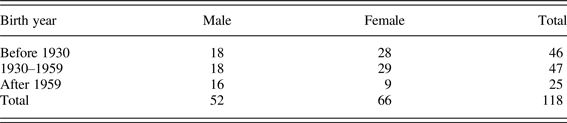
The interviews included in the current study are the available PNC recordings with white speakers from the working-class Irish and Italian neighborhoods of South Philadelphia that had at least 15 min of conversational speech transcribed. With these criteria, 118 interviews were available to be included, as shown in Table 1. This sample reflects both asymmetries in the demographic groups that make up the corpus and current transcription priorities in its development. There are more women than men included, and the early years of the corpus are somewhat overrepresented due to the project's current emphasis on transcribing the older available data. The asymmetry in the gender distribution is most relevant in the case of these stable variables, as it is expected that the nonstandard form will be used at higher rates by men in Philadelphia (Labov, Reference Labov2001:98–100). To account for this, the fixed effect of speaker gender as well as random intercepts for speaker identity are always included in the mixed-effects logistic regressions presented in the results. Although the sample contains approximately three generations, the variables of interest have been established to be stable in Philadelphia (Labov, Reference Labov2001); exploratory data analysis produced no evidence to doubt this previous claim.
118-speaker PNC sample for ING and TD coding

The transcribed interviews in the PNC have been forced-aligned using the FAVE suite (Rosenfelder, Fruehwald, Evanini, & Yuan, Reference Rosenfelder, Fruehwald, Evanini and Yuan2011), which in turn allows efficient hand-coding of variables facilitated by a Praat script.Footnote 3 The normal practice when coding morphophonological variables in this way is to set the search parameters so that tokens occurring in contexts that will later be excluded are not picked up as part of the coding process. However, to allow for the revised approach to the variable context that I discuss next, I included neutralization contexts (such as TD before a coronal stop) in the search criteria and assigned an exclusion code for the dependent variable. This ensures later access to the timing and sequence of even possibly irrelevant tokens. I then used R (R Core Team, 2015) to code each token for the variant choice, morphological class, and lexical item of the previous token (the prime) as well as the distance between the members of the prime–target pair.
Coding and statistical issues
It is standard practice in the variationist paradigm to exclude two types of contexts for any variable that is studied quantitatively (Tagliamonte, Reference Tagliamonte2006:14): contexts where the variant chosen cannot be detected by the analyst (neutralization contexts), and contexts where the linguistic feature in question is not variable (invariant contexts). The set of detectable, variable environments is retained and referred to as the envelope of variation or the variable context. Once the variable context has been defined, the excluded contexts generally disappear permanently from any further consideration. While this approach to defining the variable context has been widely used in quantitative variationist research for decades, and in fact has been used in studies that include persistence as a predictor of interest, it requires some adaptation to be well suited to investigations of this topic.
Of the two standard types of exclusions, invariant contexts and neutralization contexts, the latter poses the more serious issue for the analysis of persistence. The invariant context is assumed to be irrelevant to the definition and operation of the variable and, by extension, to its mental representation. If we interpret invariant contexts as not being linked to the representation of the variable at all, they can be excluded in the coding of persistence. The standard exclusion of neutralization contexts, however, is a methodological necessity due to imperceptibility on the hearer's end. This does not rule out the possibility that the speaker intends (on some level) to produce a particular variant. Say there are two perceptible TD tokens—call them A and C—separated by a TD token in a neutralization context—call it B. It is not trivial to decide on which token is the most appropriate “prime” for C. If the neutralization contexts are excluded during the initial round of coding, as would normally be done, then it will look like the previous token is A. From the perspective of the speaker's production system, though, it may well be the case that B was an instance of the variable, eligible to exert an effect on the probability of deletion in C.
The most cautious approach to this area of uncertainty is to exclude not only the tokens in neutralization environments, but also the tokens that depend on them. However, it is not necessary to entirely exclude a token following a neutralized token—it may still form part of the analysis as a preceding token for some other token. In other words, persistence coding involves the formation of prime–target pairs, in which pairs that include neutralized tokens (whether as prime or target) are excluded, rather than simply the neutralized tokens themselves. In the interest of obtaining the purest possible reflection of potential persistence effects, I adopt this maximally cautious approach throughout the following analyses; whether it is necessary is an empirical question for future work.
Another issue that is unique in the coding of persistence is the role of the interlocutor. It is likely that the use of a variant by a speaker's interlocutor (in the PNC, for example, the interlocutor might be the interviewer) will affect the speaker's subsequent production of the same variable (see, e.g., Eisikovits, Reference Eisikovits1987; Gries, Reference Gries2005). The question of persistence across speakers broaches the issue of accommodation, by which I mean a general tendency for people to behave more like each other as they interact by aligning their verbal and nonverbal behavior on a number of levels (Chartrand & Bargh, Reference Chartrand and Bargh1999; Garrod & Pickering, Reference Garrod and Pickering2004, Reference Garrod and Pickering2009), possibly for reasons of interpersonal social motivation (Giles, Reference Giles1973, Reference Giles1980). Just as I draw a distinction between the observation of variant repetitiveness in speech (persistence) and the facilitation effect of a recently produced form (priming), there is at least in principle a conceptual distinction to be drawn between socially motivated alignment between speakers and the more mechanistic effect of facilitation from having perceived and processed the linguistic objects used by the interlocutor. Accommodation is an important phenomenon in its own right, and its relationship to cross-speaker persistence is beyond the scope of this study. To avoid the direct influence of accommodation, I exclude pairs of tokens that are interrupted by speech from other conversational participants, whether the interviewer, family members, friends, or neighbors.
In practice, the exclusion of interruptions is accomplished by including time-stamped transcript lines from interlocutors in the data frame being coded for persistence in R. A variable token that occurs immediately after an interruption from a different speaker, then, functions just as the initial token in an interview does: it serves as a prime for the next target, but is not itself considered a target with a valid prime. In the case of ING, I only include interlocutor transcript lines containing an ING token (extracted from the full transcripts using a Python script) as interruptions. For TD, on the other hand, it is more efficient to simply treat all substantial speech from an interlocutor as interrupting the formation of prime–target pairs, because utterances so frequently contain TD tokens. I do not, however, treat channel cues or feedback, such as laugher or pause fillers, as interruptions.
Finally, a statistical issue that needs to be addressed prior to the analysis of persistence is that there is a relationship between prime and target created not by any true sequential dependence across tokens, but by the fact that both are drawn from the same distribution. It is more likely that the members of a prime–target pair share a variant than it would be if all of the observations in the sample were drawn from the same distribution. Apparent priming in an aggregate dataset is thus partly epiphenomenal of the mixture of individual speakers' distributions, rather than a true effect of any given prime on its subsequent target. This issue can be straightforwardly resolved with the inclusion of by-speaker random intercepts in mixed-effects logistic regression (Baayen, Davidson, & Bates, Reference Baayen, Douglas and Bates2008; Barr, Levy, Scheepers, & Tily, Reference Barr, Levy, Scheepers and Tily2013); these account for the covariation between prime and target that is attributable to their being drawn from the same distribution (that is, produced by the same speaker).
PHONOLOGY AND MORPHOLOGY IN PERSISTENCE
The central goal of this paper is to exemplify the application of persistence measures to reasoning about the envelope of variation in quantitative sociolinguistics. ING and TD pose challenges for standard approaches to defining the envelope of variation as a result of encompassing both morphologically simple and morphologically complex contexts of variation. Comparing these contexts, which I refer to across variables as “monomorphemic” (ceiling, act) and “polymorphemic” (working, kicked) words, offers an informative case study in the development of persistence evidence as a diagnostic tool.
Each prime–target pair can be classified into two broad categories: morphologically “matched,” where the prime and target are of the same morphological category, or morphologically “mismatched,” where prime and target are of opposite morphological categories. Within the matched condition, the prime and target might both be monomorphemic (act … old) or both be polymorphemic (kicked … jumped); within the mismatched condition, there may be a monomorphemic prime with a polymorphemic target (act … jumped) or a polymorphemic prime with a monomorphemic target (kicked … old). Furthermore, within the matched condition, a distinction of “lexical repetition” can be made between cases where the prime and target are or are not the same lexical item. The analyses in this section are aimed at detecting the subsets of the data within which persistence appears or fails to appear. I ask whether matched and mismatched prime–target pairs both provide evidence of persistence, because if the morphological categories are simply different contexts within which a single variable can occur, then we might expect persistence to extend across morphological categories. I further ask whether persistence is sensitive to lexical repetition in contexts where it does arise. All models are fit using the lme4 package (Bates, Machler, Bolker, & Walker, Reference Bates, Machler, Bolker and Walker2015) in R (R Core Team, 2015).
Matched and mismatched TD pairs
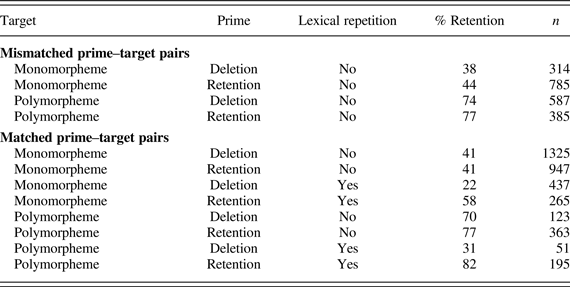
I begin with the question of whether TD persistence extends across morphological categories. Table 2 contains a descriptive summary of variant rates in the relevant cross-tabulated contexts.
TD rates in cross-tabulated contexts
n = 5777

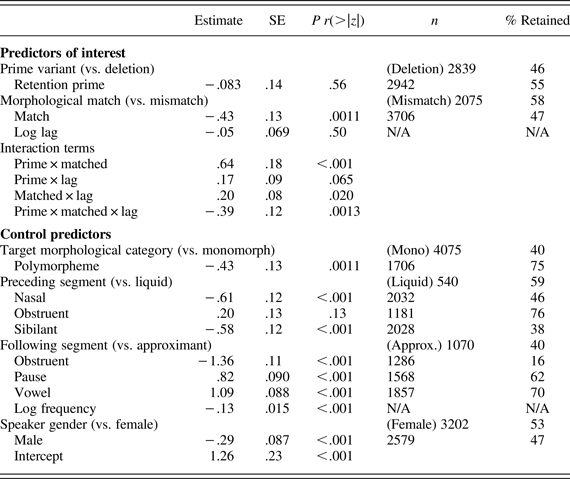
In addition to the predictors of interest, the models in this section all include as control predictors the preceding segment (liquid, nasal, obstruent, or sibilant), following segment (approximant, obstruent, pause, or vowel), log whole-word SUB TLEX frequency (Brysbaert & New, Reference Brysbaert and New2009), and speaker gender. Table 3 shows the effect of the prime variant on the target outcome by the morphological status of the prime–target pairs. The log of the lag (time elapsed in seconds) between the prime and target is included in a three-way interaction with the prime variant and the match between prime and target, to control for decay of persistence effects over time. When the prime and target are of different morphological categories (the reference level for the Match predictor), there is no evidence for a main effect of prime variant, but when the prime and target are of the same morphological category, there is a significant effect of the prime variant on the target outcome. In more concrete terms: if a speaker deletes a coronal stop in a polymorphemic word like kicked, she has an increased likelihood of subsequently deleting again in another polymorphemic word like jumped, but not in a monomorphemic word like mist (and vice versa).
GLMM predicting retention by morphological match in TD data
n = 5781
AIC = 6251.5

AIC, Akaike information criteria; GLLM, generalized linear mixed model; N/A, not available.
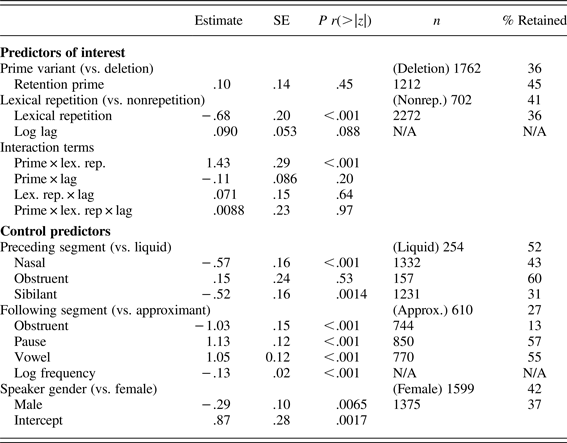
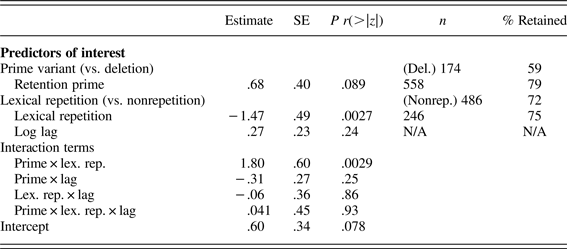
Because the results in Table 3 show that TD persistence is limited to contexts where the prime and target are of the same morphological category, I fit a second model to the matched monomorphemic pairs. The results of this second model are presented in Table 4. When the prime and target are both monomorphemic but are different lexical items, there is no significant persistence effect. There is, however, a significant effect of persistence in cases of lexical repetition. Within the matched polymorphemic pairs, the evidence is less clear. Table 5 presents a model in which the control predictors had to be excluded to achieve model convergence; the output of this model should thus be treated with great caution. As in the monomorphemic case, there is clear evidence for an effect of the prime when the prime and target are the same lexical item. There is also, however, some suggestion in this model that persistence in polymorphemic TD extends more generally than in monomorphemic TD: the effect of the prime variant in non-lexical-repetition cases has a p-value < .10. In combination with the exclusion of the control predictors, this should be taken only as tentative evidence, but it is suggestive of an effect that did not appear in the monomorphemic case.
GLMM predicting retention in monomorphemic subset of TD data
n = 2974
AIC = 3371.6

Note: Abbreviations as in Table 3.
GLMM predicting retention in polymorphemic subset of TD data
n = 732
AIC = 800.6

Note: Control predictors excluded. Abbreviations as in Table 3.
By way of summary, TD is persistent only when the prime and target are of the same morphological category. Within the monomorphemic prime–target pairs, persistence is limited to cases where the prime and target are the same word. Within polymorphemic prime–target pairs, there may be some evidence for persistence arising regardless of whether or not the prime and target are the same word. When polymorphemic prime and target are the same word, though, the persistence effect is significant.
Matched and mismatched ING pairs
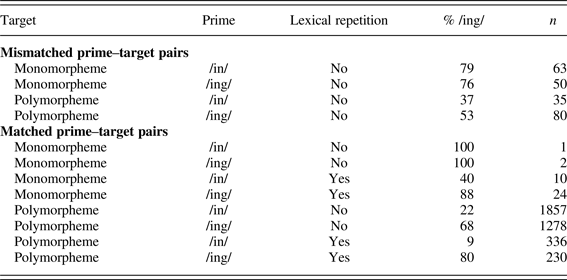
I now turn to the analysis of whether ING persistence extends across matched and mismatched contexts. Table 6 contains a descriptive summary of variant rates in the relevant cross-tabulated contexts.
ING rates in cross-tabulated contexts
n = 3966

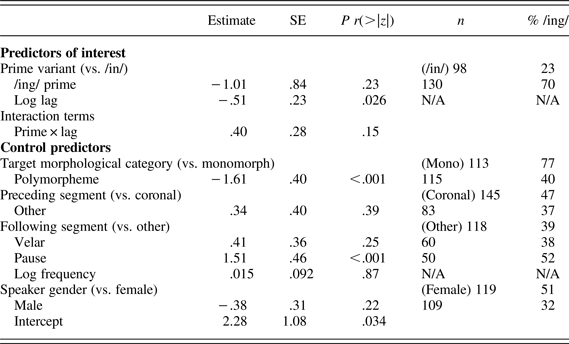
The control predictors included in the models for ING are the preceding phonological segment (coronal, other), the following phonological segment (velar, pause, other), log word frequency, and speaker gender. An obstacle in the analysis of ING is that the data is unbalanced; there are far fewer tokens of monomorphemic than polymorphemic ING, and matched monomorphemic pairs are very rare. Combining these unbalanced contexts in a single regression can cause model convergence problems, particularly when interaction terms are included. Table 7 presents the effect of the prime variant on the target outcome only in mismatched prime–target pairs. This regression indicates that, as with TD, persistence in ING does not arise when the prime and target are of different morphological categories.
GLMM predicting /ing/ in morphologically-mismatched subset of ING data
n = 228
AIC = 278

Note: Abbreviations as in Table 3.
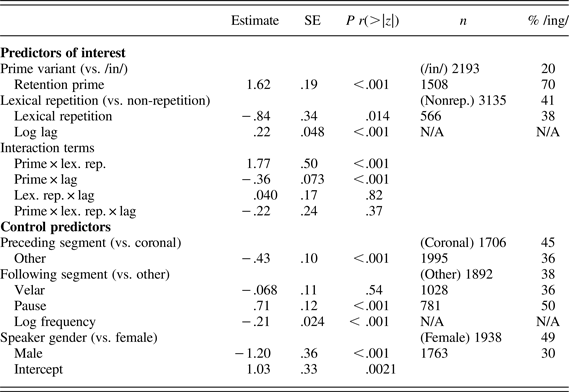
To look at the case where the prime and target are matched, it is necessary to focus exclusively on matched polymorphemic pairs, for which there is much more data. The model for this data is presented in Table 8, in which we see that matched polymorphemic ING shows a significant persistent effect. This is the case whether the prime and target are the same lexical item or not. As was the case for TD, then, persistence in ING is driven by pairs where the prime and target are morphologically matched.
GLMM predicting /ing/ in polymorphemic subset of ING data
n = 3701
AIC = 3277

Note: Abbreviations as in Table 3.
DISCUSSION
When the analysis of persistence in morphophonological variation is refined to dissociate effects within and across morphological contexts, previously unseen complexity becomes apparent. The previous section suggested that there are parallel asymmetries in data from ING and TD. Most notably, for both variables persistence arises only within, but not across, morphological contexts. It is also clear that persistence effects are strongest when the prime and target are the same lexical item and may in fact be lexically restricted in monomorphemic contexts but generalized across lexical items in polymorphemic contexts. In the following sections, I suggest that these quantitative results motivate the adoption of analyses with multiple distinct processes in two respects. First, persistence effects should play a role in discussions of how variables should be defined: in the ING and TD cases, I argue that the persistence data bring novel support to analyses involving multiple linguistic variables. Second, asymmetries in persistence effects can help connect quantitative conversational data with domain-general psychological processes in the real-time production of variation, leading to the suggestion that there are multiple cognitive processes underlying the observation of corpus persistence.
Phonological and morphological variation
The results presented here add a new line of evidence to analyses in which ING and TD are treated as cover terms for sets of distinct probabilistic processes that produce similar surface outcomes.Footnote 4 Specifically, I suggest that in both cases there is (at least) one morphological alternation and one variable phonological rule. We saw first that persistence arises in TD when the prime and target are both polymorphemic or both monomorphemic, but not when the prime and target belong to different morphological categories. The same pattern appeared for ING: there is persistence in the morphologically matched pairs but not in the morphologically mismatched pairs. Under a treatment of both ING and TD as monolithic variables, it would be difficult to account for this lack of persistence in certain contexts, particularly when it has such a strong effect in other contexts. Once we adopt the hypothesis that each of these putative variables actually subsumes (at least) two distinct variable processes, the persistence facts find a natural explanation with roots in the experimental structural priming literature: instances of a variable linguistic process affect only subsequent instances of that same process and not subsequent instances of some other variable process, even if there is surface resemblance between the process outcomes. In this perspective, persistence can serve as a new diagnostic tool for the envelope of variation when that envelope is contested.
The fact that the relevant line of persistence demarcation in both the ING and TD cases is suffix presence suggests that the polymorphemic cases are characterized by alternation between suffix allomorphs while the monomorphemic cases are the outcome of phonological variation. Further investigation of the persistence effect's sensitivity to lexical repetition gives some additional weight to this analysis, although the picture here is less complete due to insufficient data in certain key subsets. For TD, persistence is limited to cases of lexical repetition in monomorphemic pairs, whereas in polymorphemic pairs, there is both a robust persistence effect with lexical repetition and provisional evidence for a more generalized persistence effect. In ING, persistence arises in polymorphemic pairs regardless of whether or not the lexical item is repeated, though with a lexical boost. Monomorphemic pairs are rare and only provide evidence about lexical repetition cases, which, as in monomorphemic TD, appear to be persistent insofar as we can make any generalizations. This additional asymmetry in the behavior of persistence under different lexical repetition circumstances would again be difficult to capture under any analysis where there is only one ING or only one TD. But if, as proposed, the phenomena at play include a morphological TD variable, a phonological TD variable, a morphological ING variable, and a phonological ING variable, the lexical repetition asymmetry could be captured by the suggestion that persistence operates differently for different types of variables or at different grammatical levels. One possibility that would be compatible with the results presented here is that morphological variables show generalized persistence while persistence in phonological variables is limited to cases of lexical repetition, as suggested in Tamminga (Reference Tamminga2014). This possibility is not entirely compatible with evidence from other speech communities, though; Clark (Reference Clark and Lawson2014), for example, provides evidence for persistence in TH-fronting in Fife, which is unlikely to be a morphological variable. To understand exactly when and where persistence arises in sociolinguistic variation, we will need more research based on very large datasets, as well as controlled laboratory experimentation. The following section discusses how such work can connect to the psycholinguistic literature, building on the suggestion of a potential difference between phonological and morphological variables.
The cognitive source of persistence
If indeed persistence turns out to show different degrees of generality for phonological and morphological variables, that will be an additional fact in need of an explanation. To say that morphological variation gives rise to generalized persistence does not tell us why it should be so, and why in contrast phonological variation might produce only lexically specific persistence. I suggest that to find the source of this suggested difference, we should turn to psycholinguistic questions of how words and word forms are stored and accessed. The observation of generalized persistence in polymorphemic ING and TD prime–target pairs suggests a process targeting the morpheme, whereas the lexically specific persistence found for monomorphemic TD suggests a process targeting not the phoneme but the word. In other words, just as the persistence asymmetries point to a grammatical analysis where there are multiple probabilistic linguistic processes producing ING and TD, so too do those asymmetries suggest that what we have until this point been calling persistence actually stems from multiple underlying sources.
What kinds of processes might be at work in persistence? As discussed in the background section, sociolinguists and corpus linguists usually turn to the psycholinguistics literature on experimental structural priming to answer this question. In cases where the alternation under consideration is syntactic, this makes good sense, and the involvement of a choice between two alternatives in the experimental paradigm makes the analogy to variation in natural speech appealing. But the extension of such an approach to the morphophonological variables in this study is not straightforward. Rather, I turn to the literature on lexical access, particularly as understood through morphological priming, to sketch out one possibility.
The morphological priming literature depends primarily on the experimental paradigm of primed lexical decision. Participants are asked to make a yes/no decision to the wordhood status of each of a series of words and pseudowords, presented either auditorily or orthographically. In the primed condition of a lexical decision experiment, the target words are presented after an identical or related prime word, which typically facilitates recognition of the target word as a real word as evidenced through a speeded reaction time. “Identity priming” is the facilitation observed when prime and target are the same word (cat primes cat); “morphological priming” is the facilitation observed when the prime and target are morphologically related but not identical (cats primes cat, or vice versa). But the overlap between prime and target in morphological priming need not always be a root, as in the cat–cats example. Marslen-Wilson, Tyler, Waksler, & Older (Reference Marslen-Wilson, Tyler, Waksler and Older1994) and VanWagenen (Reference VanWagenen2005) demonstrated effects of priming across words that are unrelated except for a shared derivational morpheme: for example, happiness primes darkness. The evidence that this is not merely an effect of orthographic or phonological overlap comes from the demonstration that, for example, happiness does not prime harness. Deutsch, Frost, and Forster (Reference Deutsch, Frost and Forster1998) found similar priming effects in a nonconcatenative morphological system, showing that the verbal word patterns that convey morphosyntactic information in Hebrew can be primed.
Van Wagenen (Reference VanWagenen2005:29) argued on the basis of these results that morphological priming is identity priming: that the retrieval of a suffix allomorph from the lexicon is the same as the retrieval of a root and leaves the same heightened activation that is assumed to give rise to identity priming. I suggest that the simplest way to understand the generalized morphological persistence effect in polymorphemic ING and TD, then, is as identity priming in the lexical access of the suffix allomorph. Increased activation from use of a specific variant is hosted on an abstract lexical representation of that variant, which then is more likely to be selected for subsequent use.
In contrast to the facilitatory effect of previous allomorph selection in morphological variation, which targets abstract mental representations in the lexicon, the lexical specificity of persistence effects in phonological variation, as in the case of monomorphemic TD, suggests an episodic mechanism. Episodic memory is the retention in memory of details about specific heard instances of words. While the role of episodic memory in usage-based phonological frameworks (Bybee, Reference Bybee2002; Foulkes & Docherty, Reference Foulkes and Docherty2006; Johnson, Reference Johnson2006) is well known, it is not necessary to adopt a fully exemplar-theoretic phonology to allow a role for episodic memory in phonetic implementation; indeed, hybrid abstract–episodic approaches are increasingly popular (Pierrehumbert, Reference Pierrehumbert, Gussenhoven and Warner2002, Reference Pierrehumbert2006), and any number of models of phonetic implementation could be adapted minimally to allow for a previous exemplar to have an effect on the phonetic detail of a later instance of the same word. Use of a /t/-less form of act, then, might influence a speaker to use another /t/-less form of the same word by virtue of its temporary representation in episodic memory. The most closely related experimental analogue under this analysis would be convergence in speech shadowing (Babel, Reference Babel2012; Brouwer, Mitterer, & Huettig, Reference Brouwer, Mitterer and Huettig2010; Goldinger, Reference Goldinger1998; Shockley, Sabadini, & Fowler, Reference Shockley, Sabadini and Fowler2004), where participants repeat after a model talker and in doing so pronounce words more like the model talker than they did in a baseline condition.
These suggested mechanisms may or may not find support in future corpus and experimental studies of morphophonological variation. The broader point, though, is that there are multiple possible sources of repetitiveness that could operate simultaneously when sociolinguistic variables are produced in real time. Fully understanding the role of cognitive process in sociolinguistic variation will require sustained engagement with the psycholinguistic literature.
CONCLUSION
The successful use of persistence to disentangle surface-similar variables in language variation is motivation for variationists to add persistence to their methodological toolbox as one diagnostic of the envelope of variation. It seems particularly promising for variable phenomena at the phonology–morphology interface, where there is often ambiguity regarding the locus of variation. Brazilian Portuguese /s/-deletion in nominal and verbal contexts, for example, may offer a parallel case study to the ones presented here. This approach will not, however, be appropriate for all analyses. Modeling the multiway interactions of persistence with grammatical structure, lag time, and lexical repetition can quickly reduce model power and therefore create a need for very large datasets. This may make the analysis of persistence intractable for variables that occur rarely in conversational speech. The approach taken here also requires the inclusion of by-speaker random intercepts and so will be inappropriate for any situation in which mixed-effects regression cannot be used. Furthermore, this mode of analysis involves the interpretation of null results; it therefore should be undertaken cautiously and its conclusions supported with independent evidence. A crucial source of such supporting evidence will be experimental work on the priming of sociolinguistic variation, in the vein of Sumner and Samuel (Reference Sumner and Samuel2005). For example, the analysis I have given predicts that recognition of workin’ should be speeded given prior presentation of jumpin’, but recognition of mornin’ should be unaffected.
The picture painted by the data in this paper is one of complexity on multiple levels: the processes involved in the production of linguistic variation appear to have more moving parts than is evident from the surface. On the grammatical front, I have provided a new and independent line of evidence that both ING and TD, rather than being unitary variables, represent the output of distinct morphological and phonological variables. Regarding the operation of psychological factors in the production of variation, I have suggested that the widely attested empirical phenomenon of persistence may itself be a product of (at least) two different cognitive mechanisms. The crucial evidence for both of these arguments comes from a quantitative investigation of the interaction of psychological and grammatical effects on variation. A fully elaborated model of language variation will ultimately require continuous attention to the multi-layered nature of apparently unified surface variation, as well as the influence of more general cognitive forces in shaping variation.