1. Introduction
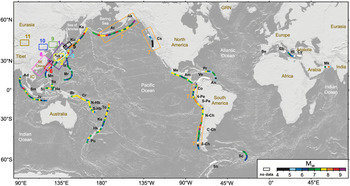
Convergent margins and associated subduction zones are the main venues and drivers for the Earth’s recycling system and continental crustal growth (Fig. 1; von Huene & Scholl, Reference von Huene and Scholl1991; Hawkesworth & Kemp, Reference Hawkesworth and Kemp2006; Takahashi et al. Reference Takahashi, Kodaira, Tatsumi, Kaneda and Suyehiro2008; Tatsumi et al. Reference Tatsumi, Shukuno, Tani, Takahashi, Kodaira and Kogiso2008; Collins et al. Reference Collins, Belousova, Kemp and Murphy2011; Dilek & Yang, Reference Dilek and Yang2018). The Mesozoic–Cenozoic Pacific Rim orogenic belts developed largely along longitudinal (c. N–S-oriented) convergent margins that operated for more than 150 Ma (Monger & Francheteau, 1987; Taira, Reference Taira2001; Dickinson, Reference Dickinson2004; Safonova et al. Reference Safonova, Maruyama, Kruk, Obut, Kotler, Gavryushkina, Khromykh, Kuibida and Krivonogov2018), whereas the coeval Tethyan orogenic belts evolved mainly along latitudinal (c. E–W-oriented) convergent margins, which were terminated by the arrival, collision and partial subduction of continents or ribbon continents (Dercourt et al. Reference Dercourt, Zonenshain, Ricou, Kazmin, Le Pichon, Knipper, Grandjacquet, Sbortshikov, Geyssant, Lepvrier, Pechersky, Boulin, Sibuet, Savostin, Sorokhtin, Westphal, Bazhenov, Lauer and Biju-Duval1986, Doglioni et al. Reference Doglioni, Harabaglia, Merlini, Mongelli, Peccerillo and Piromallo1999; Stampfli, 2000; Dilek, Reference Dilek, Dilek and Pavlides2006; Cawood et al. Reference Cawood, Kröner, Collins, Kusky, Mooney, Windley, Cawood and Kröner2009; Dilek & Furnes, Reference Dilek and Furnes2019). The longitudinal Pacific Rim orogenic belts display wide and thick accretionary complexes that are continuous for hundreds of kilometres along-strike (Taira, Reference Taira2001), well-preserved paired metamorphic belts (Brown, Reference Brown2010), and robust magmatic arc systems with well-developed middle crust and deep lithospheric roots (i.e. magmatic arcs of the Andes in western South America and the Sierra Nevada Mountains in California; Dickinson, Reference Dickinson2008; Ducea et al. Reference Ducea, Saleeby and Bergantz2015). Ophiolites are generally missing from these orogenic belts, although fault-bounded slivers of mafic and ultramafic rocks, which have no melt-residua geochemical kinship or similar age brackets, occur in mélanges of subduction channel origin or in accretionary complexes (Isozaki et al. Reference Isozaki, Maruyama and Furuoka1990; MacPherson et al. Reference MacPherson, Phipps and Grossman1990; Terabayashi et al. Reference Terabayashi, Okamato, Yamamato, Kaneko, Maruyama, Katayama, Tsutomu, Komiya, Ishikawa, Anma, Ozawa, Windley and Liou2005; Langenheim et al. Reference Langenheim, Jachens, Wentworth and McLaughlin2013; Ogawa et al. Reference Ogawa, Mori, Tsunogae, Dilek and Harris2014). On the other hand, the latitudinal Tethyan orogenic belts exhibit well-defined suture zones with 5–10-km-thick, mostly suprasubduction zone (SSZ) ophiolites derived from the upper plates of N-dipping subduction zones (Dilek & Eddy, Reference Dilek and Eddy1992; Dilek & Flower, Reference Dilek, Flower, Dilek and Robinson2003; Dilek et al. Reference Dilek, Furnes and Shallo2007; Dilek & Furnes, Reference Dilek and Furnes2009), thin or near-absent accretionary prism complexes and ultrahigh-pressure metamorphic rocks (Jolivet et al. Reference Jolivet, Faccenna, Goffé, Burov and Agard2003; Geng et al. Reference Geng, Shen and Song2018; Rehman et al. Reference Rehman, Zhang, Zhang, Schertl and Wei2018). The occurrence of complete, Penrose-type ophiolites (see Reference Dilek, Dilek and NewcombDilek, 2003a for definition) and ultrahigh-pressure metamorphic belts in those Tethyan orogenic belts was a result of the collisions of continent-facing, young (< 10 Ma in age) arc-trench systems, followed by the subduction and then exhumation of down-going continental margins, respectively (Dilek, Reference Dilek, Dilek and Newcomb2003 a). Arc–continent or continent–continent collisions have been rare in the 200 Ma of geological history of the Pacific Rim orogenic belts, although collisions of oceanic plateaus and seamount chains were common and are still ongoing processes. The longitudinal, Pacific Rim convergent margins have been the main sites of production of significant volumes of continental crust, composed mainly of fault-bounded turbiditic rock assemblages, locally approaching 20–30 km in thickness within accretionary prism complexes (Platt, Reference Platt1986; Shreve & Cloos, Reference Shreve and Cloos1986; Moores & Twiss, Reference Moores and Twiss1995).
Global geodynamic map showing the mid-ocean ridges, transform faults and fracture zones, seamount provinces and locations of the active subduction zones around the globe (modified from Schellart & Rawlinson, Reference Schellart and Rawlinson2013). Subduction zones have been divided into c. 200 km segments as indicated by the coloured line segments. GRN – Greenland; IC – Indochina. Subduction zone segments (in alphabetical order): Ad – Andaman; Ak – Alaska; Am – Central America; An – Lesser Antilles; At – Aleutian; Be – Betic–Rif; Bl – Bolivia; Br – New Britain; C-Ch – Central Chile; Cb – Calabria; Co – Colombia; Cr – San Cristobal; Cs – Cascadia; Cy – Cyprus; Ha – Halmahera; Hk – Hikurangi; Hl – Hellenic; Iz – Izu–Bonin; Jp – Japan; Jv – Java; Ka – Kamchatka; Ke – Kermadec; Ku – Kuril; Me – Mexico; Mk – Makran; Mn – Manila; Mr – Mariana; N-Ch – North Chile; N-Hb – North New Hebrides; N-Pe – North Peru; Na – Nankai; Pr – Puerto Rico; Pu – Puysegur; Ry – Ryukyu; S-Ch – South Chile; S-Hb – South New Hebrides; S-Pe – South Peru; Sa – Sangihe; Sc – Scotia; Sh – South Shetland; Sl – North Sulawesi; Sm – Sumatra; To – Tonga; Ve – Venezuela. The study areas of the papers in this special issue are outlined in coloured, lined boxes. Key to boxes: 1 (dark purple), Wakita et al.; 2 (yellow), Kawamura & Ogawa; 3 (light blue), Nitta et al.; 4 (white), Shinjoe et al.; 5 (black), Sakai et al.; 6 (red), Malavieille et al.; 7 (orange), Scholl; 8 (hot pink), Dilek & Tang; 9 (green), Feng et al.; 10 (dark blue), Niu et al.; 11 (brown), Mao et al.

Our understanding of crustal growth mechanisms at Pacific Rim continental margins has increased considerably in recent years as a result of more precise analytical methods and facilities involved in related research (Shillington et al. Reference Shillington, Van Avendonk, Holbrook, Kelemen and Hornbach2004; Plank, Reference Plank2005; Kimura & Yoshida, Reference Kimura and Yoshida2006; Yu et al. Reference Yu, Dilek, Yumul, Yan, Dimalanta and Huang2020). We can fingerprint, for example, the compositions of arc magmas and/or melts and their geochemical and isotopic makeup in more detail to define the nature of variable material flux from mantle, crustal and subducted reservoirs during their evolution (Clift et al. Reference Clift, Vannucchi and Phipps Morgan2009; Tian et al. Reference Tian, Yan, Huang, Dilek, Yu, Liu, Zhang and Zhang2020). Recent seismic and geological studies of some accretionary prism complexes along the Pacific Rim have shown the occurrence of fore-arc crustal underplates that underwent high-pressure metamorphism and rapid exhumation (i.e. Onishi et al. Reference Onishi, Kimura, Hashimoto, Ikehara-Ohmori and Watanabe2001; Ducea et al. Reference Ducea, Kidder, Chesley and Saleeby2009; Meneghini et al. Reference Meneghini, Marroni, Moore, Pandolfi and Rowe2009; Bassett et al. Reference Bassett, Sutherland, Henrys, Stern, Scherwath, Benson, Toulmin and Henderson2010; Calvert et al. Reference Calvert, Preston and Farahbod2011; Reference Li, Shillington, Bécel, Nedimović, Webb, Saffer, Keranen and KuehnLi et al. 2015a; Noda et al. Reference Noda, Koge, Yamada, Miyakawa and Ashi2020). Accretion and underplating of subducted sediments at convergent margins have been shown previously from different modern subduction zone settings as significant processes of crustal growth (i.e. Cowan & Silling Reference Cowan and Silling1978; Watkins et al. Reference Watkins, Moore, Shipley, Bachman, Beghtet, Butt, Oidyk, Leggett, Lundberg, McMillen, Niitsuma, Shepherd, Stephan and Stradner1981; Hilde, Reference Hilde1982; Moore et al. Reference Moore, Biju-Duval, Bergen, Blackington, Claypool, Cowan, Duennebier, Guerra, Hemleben, Hussong, Marlow, Natland, Pudsey, Renz, Tardy, Willis, Wilson and Wright1982; Cloos & Shreve, Reference Cloos and Shreve1988; Brandon et al. Reference Brandon, Roden-Tice and Garver1998; Park et al. Reference Park, Tsuru, Takahashi, Hori, Kodaira, Nakanishi, Miura and Kaneda2002). These exhumed crustal underplates point to an important process of sediment accretion beneath fore-arcs as low-velocity rock sequences that can reach subsurface depths of more than 10 km (Clift & Vannucchi, Reference Clift and Vannucchi2004; von Huene et al. Reference von Huene, Ranero and Vannucchi2004; Stern, Reference Stern2011). This fore-arc crustal accretion (underplating) is the opposite of fore-arc crustal subduction, also known as subduction erosion (Clift & Hartley, Reference Clift and Hartley2007), which is inferred to be responsible for > 1.7 km3 a–1 of crustal loss at convergent margins (Stern, Reference Stern2011). Subduction erosion rates are high when convergence rates are high (> 60 mm a–1) and sediment supply to the trench is low (< 40 km3 a–1) (Stern, Reference Stern2011). Crustal material removed from the overlying fore-arc basement via subduction erosion may become underplated below the fore-arc wedge, may get carried down into the melt source of arc magmatism or may be recycled into the deeper mantle. By some estimates, subduction erosion is considered as the most important mechanism to return continental crustal material into the deeper mantle at higher rates than crustal replacement by arc and plume magmatic activities (Clift et al. Reference Clift, Vannucchi and Phipps Morgan2009; Stern, Reference Stern2011). Fore-arc crustal subduction is currently underway at SW and NE Japan, Peru and northern Chile, southernmost Chile and Costa Rica as shown by seismic imaging, and has been at work for the past 5–10 Ma as evidenced by the isotopic and geochemical signatures of the magmatic products (Kay et al. Reference Kay, Godoy and Andrew2005; Scholl & von Huene Reference Scholl, von Huene, Cawood and Kröner2009; Stern, Reference Stern2011). Slabs of mafic–ultramafic rocks of different origins (seamount fragments, tectonic rags of down-going oceanic slabs, products of in situ magmatism due to ridge subduction, etc.) are also common in some accretionary complexes and indicate short-term punctuation in subduction and sediment accretion at some segments of the Pacific Rim convergent margins (Park et al. Reference Park, Moore, Tsuru, Kodaira and Kaneda2004; Clift et al. Reference Clift, Chan, Blusztajn, Layne, Kastner and Kelly2005) and in ancient Tethyan convergent margins (e.g. Tankut et al. Reference Tankut, Dilek and Onen1998; Sarıfakıoğlu et al. Reference Sarıfakıoğlu, Dilek, Sevin and Sorkhabi2017; Dilek & Furnes, Reference Dilek and Furnes2019).
We have learned over the past 15 years that three-dimensional geometries of subducting slabs evolve over time, and that their widths and lengths play a major role in subduction zone dynamics, such as trench retreat – slab rollback, upper plate deformation (contraction versus extension), timing and rates of magmatic pulses, and accretionary versus non-accretionary development of the same convergent margins (Doglioni et al. Reference Doglioni, Carminati and Cuffaro2006; Schellart et al. Reference Schellart, Freeman, Stegman, Moresi and May2007). The Pacific Rim convergent margins (Fig. 1) are an excellent natural laboratory, providing significant insights into the dynamics of a myriad of geological processes that play a major role in crustal growth and continental crust formation in subduction zone settings.
We convened a full-day oral scientific session and a half-day poster session at the 2017 Geological Society of America Annual Meeting in Seattle that included both invited and volunteered contributions in order to explore our current knowledge of convergent margin tectonics, and crustal growth and deformation mechanisms along the Pacific Rim subduction zone environments. The topics were diverse, the presentations were rich in data and new observations, and the models and interpretations provided contemporary explanations and new insights. This Special Issue contains some of the contributions presented at this meeting, as well as several other recruited papers to complement the geographic and scientific coverage of the topic.
In this introductory paper, we highlight the most salient findings reported in different papers in the Special Issue and discuss their significance in light of some of the current concepts in subduction zone tectonics. In the first part of the paper, we introduce and discuss the findings of the contributions on different aspects of the accretionary margins and subduction-related crustal growth of Japan. In the second part, we look at one of the most extensively studied modern arc–continent collision zones of the Earth, Taiwan, which is the best natural laboratory to examine the structural and tectonic consequences of oblique collision and related strain partitioning along and across a collisional orogenic belt. In the third part, we examine the nature of the convergent margins of the North and South American continents, specifically the sediment budget of accreting versus erosive active margins, and the fate of sediments arrived at trenches. In the last section of the paper, we consider a wide spectrum of ancient Pacific-type continental margins of East Asia and evaluate the magmatic evolution of the continental upper plates at such active margins during Palaeozoic and Mesozoic time. We present a synoptic review of the major highlights of this Special Issue in the closing section.
2. Accretionary margins and crustal growth of Japan
The Japanese archipelago comprises mainly late Palaeozoic – Cenozoic subduction–accretion complexes with exhumed high-P/T metamorphic complexes (Nishiyama et al. Reference Nishiyama, Ohfuji, Fukuba, Terauchi, Nishi, Harada, Unoki, Moribe, Yoshiasa, Ishimaru, Mori, Shigeno and Arai2020), in situ mafic to felsic intrusive–extrusive rock sequences and fragments of fossil oceanic lithosphere. This island chain represents a 450 Ma history of multiple subduction–accretion events, punctuated by short-lived mid-ocean ridge, seamount and island arc collisions along the western Pacific convergent margin (Maruyama et al. Reference Maruyama, Isozaki, Kimura and Terabayashi1997; Wakita et al. Reference Wakita, Nakagawa, Sakata, Tanaka and Oyama2018). Development of the Japanese archipelago is therefore widely considered as an archetype of an accretionary orogen (Jahn, Reference Jahn2010). The following papers in this section examine different aspects of the accretionary tectonics of the Japanese islands.
Wakita et al. (Reference Wakita, Nakagawa, Sakata, Tanaka and Oyama2018) discuss the Phanerozoic accretionary history of Japan and the western Pacific margins (purple box with number 1 in Fig. 1) based on their synthesis of the extant detrital zircon data available from the subduction–accretion complexes and marginal basins in Japan. Comparing main detrital zircon age peaks with the timing of well-documented magmatic events in the North China, South China and Indochina continental blocks in mainland Asia, the authors suggest that the accretionary prism tectonics of the Japanese archipelago was punctuated throughout the Phanerozoic Eon, and that the observed temporal gaps in this accretion history were coeval with intensive magmatic activities in sediment and/or zircon provenance regions. Several major assumptions are made in this study: (1) formation ages of accretionary complexes were synchronous with the timing of trench sedimentation; (2) zircons created in the arc are delivered quickly to the trench and the ages of the youngest zircons coincide with the depositional age in the trench; (3) most accretionary complexes include partially preserved ocean plate stratigraphy (OPS) derived from down-going oceanic plates; and (4) sediments and sedimentary rocks containing detrital zircons with ages of 0.7–1.2 Ga were derived from the South China block, whereas those containing detrital zircons with igneous ages of 1.6–2.6 Ga were likely sourced from the North China block. The authors have identified six major time windows for the development of accretionary complexes in Japan: (a) Cambrian – Middle Devonian; (b) Late Devonian – Carboniferous; (c) Permian – Early Triassic; (d) Middle Triassic – Early Cretaceous; (e) Middle Cretaceous – Palaeogene; and (f) Neogene–Quaternary. These periods of accretionary prism development as recorded in the Japanese archipelago also coincide with the ages of the Phanerozoic subduction–accretion complexes distributed along the eastern and southern margins of continental Asia. The collisions and amalgamations of the North and South China blocks and the Indochina block by the Middle Triassic Epoch caused two major changes in the tectonic evolution of eastern Asia and in the development of accretionary complexes in Japan: (1) convergent margin tectonics changed from mainly northerly to predominantly westerly subduction directions of the down-going plates; and (2) sediments and zircons to the E-facing accretionary prisms were derived mostly from North China during the Jurassic and Cretaceous periods. The results of this synthesis clearly show that zircon geochronology is an important tool in deciphering the history of accretionary prism construction at Andean-type convergent margin settings.
The Nankai Trough (Na in Fig. 1) is one of the most extensively studied trenches through deep-sea drilling and multiple submersible surveys (yellow box with number 2 in Fig. 1; Le Pichon et al. Reference Le Pichon, Wmant, Tokuyama, Thoué, Huchon and Henry1996; Kawamura et al. Reference Kawamura, Ogawa, Anma, Yokoyama, Kawakami, Dilek, Moore, Hirano, Yamaguchi and Sasaki2009; Moore et al. Reference Moore, Park, Bangs, Gulick, Tobin, Nakamura, Sato, Tsuji, Yoro, Tanaka, Urakki, Kido, Sanada, Kuramoto and Taira2009; Screaton et al. Reference Screaton, Kimura, Curewitz, Moore, Chester, Fabbri, Fergusson, Girault, Goldsby, Harris, Inagaki, Jiang, Kitamura, Knuth, Li, Liljedahl, Louis, Milliken, Nicholson, Riedinger, Sakaguchi, Solomon, Strasser, Su, Tsutsumi, Yamaguchi, Ujie and Zhao2009; Underwood, Reference Underwood2018), where the Philippine Sea Plate subducts WNW beneath SW Japan at a rate of 58.4 ± 1.4 mm a–1 (DeMets et al. Reference DeMets, Gordon and Argus2010). Recent observations and findings suggest that the Nankai accretionary prism has undergone rapid growth since c. 2 Ma because of the large influx of clastic sediments derived from the collision zone between the Izu–Bonin arc and Honshu Island in central Japan (Kimura et al. Reference Kimura, Koge and Tsuji2018). In addition, the collision and subduction of the proto-Zenisu Ridge, a NE–SW-trending volcanic seamount chain on the western flank of the Izu–Bonin island arc at the Nankai Trough, has caused significant uplift and large-scale submarine slides on the Nankai accretionary prism slope (Park et al. Reference Park, Moore, Tsuru, Kodaira and Kaneda2004). Kawamura & Ogawa (Reference Kawamura and Ogawa2018) report on the internal structure and active tectonics of the eastern Nankai accretionary prism toe and the kinematics of the frontal thrust fault based largely on submersible diving results (Fig. 1). Examining the accretionary prism and frontal thrust fault within the deeply incised Tenryu submarine canyon, Kawamura & Ogawa (Reference Kawamura and Ogawa2018) have determined that clastic sediments, which were buried down to depths of 250–300 m along the subduction interface, were uplifted and exhumed at the prism toe along the Tenryu frontal thrust between 3.4 Ma and 1.98 Ma, corresponding to prism toe uplift rates of 0.74–2.27 m ka–1. These values represent significantly high uplift and slip rates, making the Nankai prism frontal thrust fault one of the dynamically most active faults in Japan. A new thrust fault with a several tens of centimetre-high scarp on the seafloor occurs nearly 100 m south of the frontal thrust and was likely responsible for the 1944 East Nankai earthquake (Mw 8.1). Both the frontal thrust fault and the protothrust pose major tsunami hazards in the NW Pacific Ocean.
If deformation takes place rapidly, sediment creep and submarine slides that occur on inner trench slopes may generate devastating tsunamis at convergent margins (Masson et al. Reference Masson, Harbitz, Wynn, Pedersen and Lovholt2006; Kawamura et al. Reference Kawamura, Sasaki, Kanamatsu, Sakaguchi and Ogawa2012; Tappin et al. Reference Tappin, Grilli, Harris, Geller, Masterlark, Kirby, Shi, Ma, Thingbaijam and Mai2014). Nitta et al. (Reference Nitta, Kasaya and Kawamura2018) document the distribution and geometry of submarine slides on a deep-sea terrace at water depths of 400–1200 m on the inner slope of the Japan Trench (Jp in Fig. 1, and light blue box with number 3), and discuss their origin and potential for geohazards. The Japan Trench slope has three segments with differing slope gradients (upper, middle and lower slopes), and the upper slope displays a large deep-sea terrace with numerous arcuate-shaped lineaments that are oblique to the bathymetric contour lines. These lineaments represent c. 50-km-wide, horseshoe-shaped depressions, in which trench-ward stepping (E-dipping) active normal faults and active folds occur. Although locally buried by sediments, these faults and folds crop out on the seafloor, indicating that they are still actively deforming. The authors interpret these structures as creep deformation features caused by retrogressive sliding in response to tectonic erosion at the foot of the accretionary wedge of the Japan Trench. Mega submarine slides are likely to cause large horizontal displacements on the trench-landward slopes that may in return trigger tsunamis. The generation of both the 1896 and 2011 tsunamis in the Tohoku area (Japan) might have happened as a result of large-scale, earthquake-induced submarine slides.
Granitoid and gabbroic–doleritic rocks that are intrusive into near-trench accretionary prism strata have been widely reported from modern and ancient convergent margins (Hill et al. Reference Hill, Morris and Whelan1981; Brown, Reference Brown, Treloar and O’Brien1998; Llytwyn et al. Reference Llytwyn, Gilbert, Casey and Kusky2000; Ayuso et al. Reference Ayuso, Haeussler, Bradley, Farris, Foley and Wandless2009; Farris & Haeussler, Reference Farris and Haeussler2020). These magmatic rocks make up unusual occurrences in subduction zone environments because their melt and heat source, and magmatic evolution, are not associated with flux melting of a hydrated mantle wedge that is typically the source of arc magmatism. Such shallow-depth, trench-parallel intrusions may continue along-strike for long distances and may locally feed into overlying extrusive sequences within accretionary prisms (Sisson et al. Reference Sisson, Pavlis, Roeske, Thorkelson, Sisson, Roeske and Pavlis2003). How magmas of these intrusive–extrusive rocks were produced in a relatively cold environment beneath the accretionary wedges close to trenches is a fundamental question. Some of the proposed models include: (1) ridge subduction and associated aesthenospheric upwelling (Hibbard & Karig, Reference Hibbard and Karig1990; Underwood et al. Reference Underwood, Byrne, Hibbard, DiTullio and Laughland1993; Llytwyn et al. Reference Llytwyn, Gilbert, Casey and Kusky2000; Ayuso et al. Reference Ayuso, Haeussler, Bradley, Farris, Foley and Wandless2009; Anma et al. Reference Anma, Armstrong, Orihashi, Ike, Shin, Kon, Komiya, Ota, Kagashima, Shibuya, Yamamato, Veleso, Fanning, Fanning and Herve2009); (2) slab break-off and aesthenospheric flow through a slab window (Thorkelson & Taylor, Reference Thorkelson and Taylor1989; Kant et al. Reference Kant, Tepper, Eddy and Nelson2018); (3) ridge–trench–transform fault (RTF) intersections and related triple junction migrations (Fox et al. Reference Fox, Fleck, Curtis and Meyer1985; Cole & Basu, Reference Cole and Basu1995); and (4) subduction of a young and hot oceanic plate (Sato et al. Reference Sato, Vrublevsky, Rodionov, Pomanovsky and Nedachi2002). The first three models are not mutually exclusive; they may overlap as in the case of ridge subduction (1) leading into slab window development and aesthenospheric upwelling (2) beneath the fore-arc. Precise geochronology that is combined with isotope geochemistry and detailed trace-element geochemistry may help to distinguish these hypotheses and may in turn help to refine the geodynamic evolution of former convergent margins.
Shinjoe et al. (Reference Shinjoe, Orihashi and Anma2019) report on the U–Pb zircon ages, the Sr–Nd isotope geochemistry, and the major- and trace-element geochemistry of 15.5–13.5 Ma (middle Miocene) granitoid intrusions in the accretionary prism complexes along a 150-km-wide and 600-km-long zone between the Kyushu Island to the SW and the Kii Peninsula of the Honshu Island to the NE in Japan (white box with number 4 in Fig. 1). The new zircon ages display a very narrow time span (c. 2 Ma) and no particular spatio-temporal patterns along- and across-strike of the 600-km-long belt of plutonic rocks, and indicate that this near-trench magmatism occurred right after the cessation of the opening of the Sea of Japan back-arc basin. Active arc magmatism was ongoing in eastern Japan during middle Miocene time. The authors rule out the TTT-type (trench–trench–trench) triple junction migration (between the Japan arc and the Izu–Bonin–Mariana arc) as a possible cause and heat source for near-trench magmatism because this triple junction had already reached the east side of the Kii Peninsula by 15.6 Ma. Instead, they propose that a trench-parallel and highly segmented ridge system on the Philippine Sea Plate might have interacted with the trench, providing the heat source(s) for melting of the shallow upper mantle beneath the accretionary prism as well as for melting of accreted sediments in the prism.
Sakai et al. (Reference Sakai, Hirano, Dilek, Machida, Yasukawa and Kato2019) document the occurrence of a large (> 80 km wide) tectonic slice of a Hawaiian-type, Jurassic – Early Cretaceous seamount in a Late Cretaceous accretionary prism (Tokoro Belt) in NE Hokkaido of Japan (black box with number 5 in Fig. 1). The inferred seamount was part of the subducted Izanagi oceanic plate and developed as a shield volcano, which consisted of volcanic rocks of ocean island basalt (OIB), mid-ocean ridge basalt (MORB) and ocean island alkaline (OIA) basalt compositions. These volcanic rocks are intercalated with chert and lenticular pelagic limestone of deep-sea origin. Coeval volcanic rocks with similar geochemical affinities continue northwards into the Tonino–Aniva Peninsula in southern Sakhalin (Russia), indicating that the accreted Late Jurassic – Early Cretaceous seamount was either regionally extensive or part of a seamount chain. Accretion of this large seamount system into the active margin of NE Asia during Late Cretaceous time and its partial subduction must have affected the subduction zone dynamics (i.e. short-term punctuation of subduction in the NW Pacific Ocean) and the mode of upper plate deformation. The authors propose that the collision of the Kuril island arc with the Japan island arc system (Hokkaido Island) during Middle Miocene time (c. 12 Ma) caused the uplift and exhumation of the fossil accretionary wedge rocks and the partially subducted and buried, fossil seamount. The existence of a large, Early Cretaceous seamount in NE Japan, as documented in this paper, shows that the subduction–accretion tectonics along the Japan archipelago was punctuated by the arrival, collision, accretion and partial subduction of seamounts and seamount systems with different trenches at the active margins of Japan during the Mesozoic Era. The occurrence of Cretaceous mafic to felsic extrusive and intrusive rock sequences of seamount origin and plume-type ophiolites within the Neotethyan suture zones in the eastern Mediterranean region also points to a similar, punctuated evolution of S-facing convergent margins and their subduction zones in the Northern Neotethys during late Mesozoic time (Dilek, Reference Dilek, Dilek and Robinson2003 b; Sarıfakıoğlu et al. Reference Sarıfakıoğlu, Dilek, Sevin and Sorkhabi2017).
3. Modern arc–continent collision in SE Asia: Taiwan orogenic belt
Arc–continent collisions have been an important process in the evolution of orogenic belts in earth history and have contributed significantly to both the growth of continental crust and the recycling of continental material into the mantle (Draut et al. Reference Draut, Clift, Amato, Blusztajn and Schouten2009; Brown & Ryan, Reference Brown and Ryan2010). The Taiwan orogenic belt represents a classic example of a modern arc–continent collision zone (red box with number 6 in Fig. 1), which transitions in the south to an active subduction of the South China Sea oceanic lithosphere beneath the Philippine Sea Plate along the Manila Trench (Byrne et al. Reference Byrne, Chan, Rau, Lu, Lee, Wang, Brown and Ryan2011). The subduction of the South China Sea oceanic lithosphere ESE beneath the Philippine Sea Plate produced the Luzon volcanic arc, and the subsequent oblique collision of the rifted passive margin of SE Asia with the Manila Trench during Late Miocene time resulted in the S-wards migration of the collision front, diachronous uplift and strong strain partitioning along and across the evolving orogen (Suppe, Reference Suppe1981; Huang et al. Reference Huang, Yuan and Tsao2006; Chen et al. Reference Chen, Huang, Yan, Dilek, Chen, Wang, Zhang, Lan and Yu2017). In addition to the oblique nature of the arc–continent collision, the heterogenous structural architecture and lithological makeup of the down-going SE Asian passive continental margin likely played a major role in the kinematics and dynamics of the Taiwan orogen and in the mode of strain partitioning across the collision zone (Byrne et al. Reference Byrne, Chan, Rau, Lu, Lee, Wang, Brown and Ryan2011).
Malavieille et al. (Reference Malavieille, Dominguez, Lu, Chen and Konstantinovskaya2019) examine this young orogenic belt with a focus on deciphering the causes and consequences of deformation partitioning. They combine their own field observations with the available data in the literature and with the results of their analogue experiments to evaluate the nature of relationships between oblique collision tectonics and deformation partitioning, and the role of structural inheritance and surface processes in the mode of strain partitioning. The authors argue that the switch from oceanic to continental subduction along the Manila Trench has played a major role initially in the partitioning of deformation across the Taiwan orogenic belt (red box with number 6 in Fig. 1). Thin-skinned décollement tectonics and imbricate thrusting predominate the fold–thrust belt development in the foreland of the orogen, whereas basal accretion and continued underplating, in conjunction with horizontal contraction, result in the development of antiformal stack of crustal units and in the uplift, exhumation and erosion of deep metamorphic rocks in the hinterland of the orogen. Thus, the frontal part of the accretionary wedge experiences thrust fault kinematics in a direction sub-perpendicular to the axis of the mountain belt, while deeply buried rocks in the back of the accretionary wedge (hinterland) undergo ductile flow and stretching parallel to the axis of the mountain belt. This crustal flow at depth is accompanied by lateral and vertical extrusion, which in turn drives crustal exhumation and surface erosion. These processes are collectively responsible for two important phenomena: (1) much of the deformation in the core of the orogen is characterized by aseismic ductile strain, which is responsible for fast uplift in the hinterland; and (2) the main seismogenic faults are delimited to the western and eastern boundaries of the accretionary wedge where horizontal shortening rates are high. This behaviour of the Taiwan accretionary wedge, as discussed by Malaveille et al. (2019), is incompatible with the mechanics of fold–thrust belt development in accretionary wedges as formulated earlier in a cohesive Coulomb theory (Dahlen et al. Reference Dahlen, Suppe and Davis1984). The geological observations, the related interpretations and the model presented here may also have strong implications for the mechanics of crustal deformation in the Cenozoic India–Asia collision zone in southern Tibet.
4. Accreting versus erosive (non-accreting) convergent margins of the Americas
Convergent margins can be accreting or erosive (or non-accreting), depending on the fate of sediments on down-going oceanic plates and sediments that are tectonically eroded or fluvially and glacially delivered from upper plates to the trenches. At erosive margins, the magmatic and metamorphic fore-arc basement may extend very close to the trench with no accretionary prism buildup (von Huene et al. Reference von Huene, Miller and Krabbenhoeft2019), and all clastic material brought into a trench becomes effectively subducted and recycled into the mantle. Average sediment flux into the mantle at erosive convergent margins globally has been estimated at 20 km3 Ma–1 km–1 of margin (Clift & Vannucchi, Reference Clift and Vannucchi2004). The Aleutians margin is a type example of an erosive margin. At accreting margins, a wide (up to several hundred kilometres) frontal accretionary wedge exists between the trench axis and the fore-arc basement, and some sediments arrived at a trench are added into an accretionary prism and/or underplated beneath the overlying fore-arc basement (Meneghini et al. Reference Meneghini, Marroni, Moore, Pandolfi and Rowe2009). The global, long-term volumetric average of subducted sediments at accreting margins is estimated at 68 km3 Ma–1 km–1 of margin (Clift & Vannucchi, Reference Clift and Vannucchi2004). The Cascadia convergent margin (Cs in Fig. 1) is a good example of an accreting margin, where underplated, low-velocity zone sediment supply is estimated at c. 2000 km3 km–1 of margin (Clowes et al. Reference Clowes, Brandon, Green, Yorath, Brown, Kanasewich and Spencer1987; Brandon & Calderwood, Reference Brandon and Calderwood1990; Calvert et al. Reference Calvert, Preston and Farahbod2011). Thus, enormously wide and thick (> 10 km) sediment underplates may exist beneath the fore-arcs of accreting convergent margins.
Using the extant seismic reflection and refraction images of peri-Pacific Ocean convergent margins, Scholl (Reference Scholl2019) shows that low-velocity sedimentary rock sequences occur as underplated material, reaching down to > 10 km at depth beneath the fore-arc basements of the convergent margins of Chile, Colombia–Ecuador, Cascadia, Alaska, Japan and New Zealand (orange boxes with number 7 in Fig. 1). Such sediment underplates may also occur beneath the frontal accretionary wedges. This phenomenon, which is generally not well recognized geologically, is significant for two reasons: (1) sediment-rich trenches may point to the occurrence of wide and thick low-velocity underplates beneath accretionary prisms and fore-arcs; and (2) the majority of the Pacific Rim convergent margins have stored a vast amount of sediments subducted throughout the Cenozoic Era; this process has hindered recycling of large quantities of clastic sediments into the mantle over time. It appears that a large volume of trench sediments may bypass storage in the frontal accretionary prisms and may be taken down in subduction channels, whereby they underplate the submerged fore-arc. When exhumed from subsurface depths of 10–30 km in these settings, these sediment underplates form belts of high-P/T metamorphic assemblages. Identifying the existence of such sediment underplates at modern accreting convergent margins has been possible through seismic imaging in recent years, as Scholl (Reference Scholl2019) demonstrates, from the accretionary record of coastal North and South Americas (see orange boxes with number 7 in Fig. 1). These types of fossil sedimentary underplates and their metamorphosed and exhumed counterparts of ancient convergent margin settings should occur in ancient orogenic belts.
5. Ancient Pacific-type convergent margins of ESE Asia
The modern ESE Asia is a tectonic mosaic of continental blocks, island arc complexes, ophiolites and fossil seamounts, accreted to the Asian continent throughout the Phanerozoic Eon (Metcalfe, Reference Metcalfe1994; Hall, Reference Hall2012; Zahirovic et al. Reference Zahirovic, Seton and Múller2014). Accreted continental blocks are separated by suture zones that include ophiolites, mélanges and subduction–accretion systems, developed in the Palaeo-Asian, Palaeotethyan, Mesotethyan, Neotethyan, Palaeo-Pacific, Izanagi and Pacific Ocean basins, and in back-arc or marginal basins nested within these larger basins. Ophiolites preserved within these suture zones represent mostly the remnants of fossil oceanic lithosphere formed in fore-arc, incipient arc and back-arc tectonic settings (Dilek et al. Reference Dilek, Thy, Moores and Ramsden1990; Dilek & Whitney, Reference Dilek, Whitney, Panayides, Xenophontos and Malpas2000; Dilek & Furnes, Reference Dilek and Furnes2011, Reference Dilek and Furnes2014, Reference Dilek and Furnes2019; Li et al. Reference Li, Yang, Dilek, Zhang, Pei, Chen, Xu and Li2015 b; Xu et al. Reference Xu, Dilek, Yang, Liang, Liu, Ba, Cai, Li, Dong and Ji2015; Liu et al. Reference Liu, Dilek, Xie, Yang and Lian2018; Niu et al. Reference Niu, Liu, Yang, Dilek, Xu, Feng, Xiong, Tian and Sein2018; Furnes et al. Reference Furnes, Dilek, Zhao, Safonova and Santosh2020); oceanic lithosphere generated by mid-ocean ridge in these ocean basins was almost fully subducted and recycled into the mantle (Dilek & Furnes, Reference Dilek and Furnes2011; Furnes et al. Reference Furnes, Dilek, Zhao, Safonova and Santosh2020), and hence ophiolites with mid-ocean ridge origin and geochemical affinities (MORB type) are rare in the suture zones. Geodynamic models on the palaeogeography of these ocean basins, polarities of the subduction zones (which led to their terminal closures) and subduction zone geometries vary significantly, although recent seismic tomography studies have provided important insights into the mantle dynamics and the regional structure of different domains in this region to better constrain the existing models (Replumaz et al. Reference Replumaz, Karason, van der Hilst, Besse and Tapponnier2004; Zahirovic et al. Reference Zahirovic, Seton and Múller2014; Hall & Spakman, Reference Hall and Spakman2015; Huang et al. Reference Huang, Zhao and Wang2015).
The Mesozoic–Cenozoic geodynamic evolution of East China is particularly interesting within the larger tectonic realm of ESE Asia because it holds key pieces of information about the timing, mode and nature of a major switch from passive continental-margin tectonics during late Palaeozoic time to Andean-type active-margin tectonics in earliest Mesozoic time that persisted throughout the Cenozoic Era. Opening of a series of marginal seas (i.e. Sea of Japan) above subduction zones dipping W-wards beneath continental Asia during the Cenozoic Era has partially obscured the primary Mesozoic geology of ESE Asia (i.e. the possible location and trend of a Jurassic–Cretaceous magmatic arc) and its continental margins. There also exist different geodynamic models on the causes and mechanisms of this switch to the Andean-type active-margin tectonics in East China during early Mesozoic time (e.g. Li & Li, Reference Li and Li2007; Li et al. Reference Li, Dong, Cawood, Zhao, Johnson, Zhang and Xin2018; Zhang et al. Reference Zhang, Wu, Dilek, Zhang, Zhu and Chen2019 a). Establishment of a W-dipping subduction zone beneath the continent and interactions between this subduction zone and the overlying sub-continental lithospheric mantle throughout Mesozoic and Cenozoic time played a major role in: significant thinning of the cratonic crust (cratonic destruction, as widely referred to in the literature; e.g. Wu et al. Reference Wu, Yang, Xu, Wilde and Walker2019), particularly in the North China Block; in the development of extensive magmatic belts and associated mineralization zones (Deng et al. Reference Deng, Liu, Wang, Dilek and Liang2017); and in the formation of margin-parallel transform-transcurrent fault systems and kinematically and temporally related terrestrial sedimentary basins (Zhang et al. Reference Zhang, Chen, Dilek, Yang and Meng2017, Reference Zhang, Dilek, Zhang, Chen and Zhu2019 b). Changing slab geometries, widths and slab rollback rates, and the amount and compositions of subducted sediments affected the melt evolution and formation of different types of magmatism and mineralization in the continental upper plate (Dilek & Altunkaynak, Reference Dilek, Altunkaynak, Van Hinsbergen, Edwards and Govers2009; Dilek et al. Reference Dilek, Imamverdiyev and Altunkaynak2010; Jamali et al. Reference Jamali, Dilek, Daliran, Yaghubpur and Mehrabi2010; Conticelli et al. Reference Conticelli, Avanzinelli, Ammannati and Casalini2015; Deng et al. Reference Deng, Liu, Wang, Dilek and Liang2017; Feng et al. Reference Feng, Dilek, Niu, Liu and Yang2018; Niu X et al. 2019; Schellart, Reference Schellart2020). Thus, ESE China (Fig. 1) is a great natural laboratory to investigate different aspects of ancient Pacific-type, active continental margins of ESE Asia and their crustal growth.
The next four papers involve case studies of different mechanisms of crustal growth at Pacific-type, ancient convergent margin settings in ESE China. Dilek & Tang (Reference Dilek and Tang2020) present a detailed account of the distribution, ages and geochemical-isotopic characterization of Mesozoic intrusions on Hainan Island, and discuss the Mesozoic structural and magmatic architecture of SE China (Fig. 1) based in part on the geology of the Hainan Island, which represents a microcosm of the Mesozoic geology of SE China. The Mesozoic geology of SE China is characterized by a NE–SW-oriented, Triassic fold–thrust belt and a NE–SW-trending, Jurassic–Cretaceous rift system. The authors show that contractional and extensional deformation episodes in Mesozoic SE China were accompanied by magmatism, whose products evolved geochemically from alkaline to tholeiitic and OIB to calcalkaline compositions through time. They propose that a slab-driven tectonic mode switch from push-over geodynamics (Lister & Foster, Reference Lister and Foster2009) during Triassic – Early Jurassic time to pull-away geodynamics in later Jurassic–Cretaceous time along the active margin of East Asia was responsible for the contrasting tectonic regimes in the continental upper plate. The essence of this model is that changes in subducting slab widths, subduction velocities, and degree of coupling–decoupling between the lower and upper plates during Mesozoic time must have played a major role in driving these tectonic mode switches in SE China, not external events such as collision of an oceanic plateau or a continental block. The authors introduce the late Cretaceous – Eocene tectonics of the Western US Cordillera (Dilek & Moores, Reference Dilek and Moores1999) as a more recent analogue for the Mesozoic tectonics of SE China.
Feng et al. (Reference Feng, Dilek, Niu, Liu and Yang2018) present new U–Pb zircon geochronology, whole-rock geochemistry and Sr–Nd–Hf isotopic data from an Early Jurassic diorite pluton, which is intrusive into the crystalline basement in the NE end of the North China Craton (see green box with number 9 in Fig. 1). Rocks of this mafic pluton display high trace-element contents, weak Nb and Ta enrichments (unlike island arc magmas), and no Zr, Hf and Ti depletions. They also have positive ε Nd(t) and positive ε Hf(t) values, consistent with an enriched mantle melt source of their magmas with minimal crustal contamination effects. The authors propose that mafic magmas of this pluton were produced by partial melting of upwelling aesthenosphere under garnet to spinel-facies conditions beneath an intra-plate extensional tectonic setting. The inferred aesthenospheric upwelling occurred in response to: (a) rapid E-wards retreat of the Palaeo-Pacific Ocean slab subducting WNW beneath East Asia during Early Jurassic time; and (b) the corresponding lithospheric thinning in the continental upper plate. Partial melting of fertile lherzolitic peridotites produced the OIB-like alkali basaltic melts, which were transported into upper crustal depths along extensional fault systems within a continental back-arc tectonic setting. Thus, magmas of this mafic pluton evolved outside of the mantle wedge of the Palaeo-Pacific subduction zone and behind the E-propagating, coeval island arc system in NE China. This geodynamic scenario and the melt evolution of OIB-like alkali basalt volcanism are reminiscent of the Late Cenozoic – Quaternary tectonic and magmatic evolution of the Aegean extensional back-arc province above the Hellenic Trench in WSW Anatolia (Dilek & Altunkaynak, Reference Dilek, Altunkaynak, Van Hinsbergen, Edwards and Govers2009, Reference Dilek and Altunkaynak2010).
Ultrapotassic magmatism at convergent margins poses an important question about the source of unusual potassium enrichment in the sub-continental lithospheric mantle (SCLM). Such enrichment may be caused either by dehydration of altered oceanic crust in down-going slabs, or by fluids and melts derived from subducted sediments that become incorporated into the peridotites in the overlying mantle wedge (Dilek & Altunkaynak, Reference Dilek and Altunkaynak2010; Conticelli et al. Reference Conticelli, Avanzinelli, Ammannati and Casalini2015). Dehydration of altered oceanic crust triggering hydrous flux melting in a mantle wedge is a common phenomenon at convergent margins, but does not always lead into ultrapotassic magmatism. Existence of extensive networks of phlogopite, amphibole, olivine and clinopyroxene vein systems in the upper mantle may be an important a priori condition to produce silica undersaturated melt, which then leads into ultrapotassic magmatism. These veins form when carbonated pelitic sediments become subducted and partially melted, producing potassium-rich metasomatic melts, which react with SCLM peridotites. Partial melting of such vein networks earlier than their host peridotites in the presence of an aesthenospheric heat source triggers the formation of strongly alkaline magmas. Thus, pre-conditioning of SCLM peridotites by metasomatism through infiltration of melts and fluids derived from recycled carbonates and pelitic sediments is an important condition for ultrapotassic magmatism.
Niu et al. (Reference Niu, Dilek, Liu, Feng and Yang2019) present a case study of Early Devonian ultrapotassic magmatism along the northern edge of the North China Craton (see dark blue box with number 10 in Fig. 1). Early–Middle Devonian and Late Triassic ultrapotassic plutonic and volcanic rocks occur along nearly 1500-km-long, E–W-trending belts, parallel to the northern edge of the North China Craton. Both the Devonian and Late Triassic ultrapotassic magmatic events have been previously interpreted as post-collisional in nature that involved aesthenospheric melt and heat input as a result of slab break-off or lithospheric delamination. However, neither of these geodynamic processes is plausible as a trigger for partial melting of the metasomatized SCLM beneath the North China Craton because the subduction of the Palaeo-Asian oceanic plate was continuous throughout middle and late Palaeozoic time (Xiao et al. Reference Xiao, Windley, Hao and Zhai2003; Wilhem et al. Reference Wilhem, Windley and Stampfli2012). The authors report new U–Pb zircon age data, zircon in situ oxygen isotope, mineral chemistry, whole-rock geochemistry and Sr–Nd isotopic compositions from the Early Devonian ultrapotassic Gucheng pluton, one of numerous coeval intrusions along the northern part of the craton. The Gucheng pluton consists mainly of K-feldspar-bearing clinopyroxenite, clinopyroxene-bearing syenite and alkali-feldspar syenite that display high zircon in situ oxygen compositions, significantly negative Nd (ε Nd(t)= −23.4 to −10.1), relatively homogeneous Sr isotopic compositions and high (La/Sm)PM and (Tb/Yb)PM ratios (where the subscript PM refers to primitive mantle). The authors infer that the SCLM beneath the northern edge of the North China Craton was initially metasomatized by melts and fluids derived from subducted metapelites of the Palaeo-Asian Ocean floor. With steepening and rolling back of the subducted slab, aesthenospheric flow and the related heat source caused partial melting of metasomatic veins of the SCLM in the garnet stability field in an incipient back-arc extension setting behind the N-wards migrating Bainaimiao magmatic arc during the Early Devonian Epoch (415–405 Ma).
Strike–slip faulting and lateral displacement of narrow lithospheric blocks may occur in fore-arc tectonic settings of subduction zones when the plate convergence is oblique, the upper plate is continental and interplate coupling is strong (Jarard, Reference Jarard1986). This scenario may result in the development of fore-arc slivers and their trench-parallel translation along lithospheric-scale faults for hundreds of kilometres per million years with respect to the magmatic arc and back-arc regions, and in the formation of en échelon pull-apart step-overs that experience extensional normal faulting (Sieh & Natawidjaja, Reference Sieh and Natawidjaja2000; Mann, Reference Mann and Mann2007; Alvarado et al. Reference Alvarado, DeMets, Tikoff, Hernández, Wawrzyniec, Pullinger, Mattioli, Turner, Rodriguez and Correa-Mora2011; Pérez-Flores et al. Reference Pérez-Flores, Cembrano, Sánchez-Alfaro, Veloso, Arancibia and Roquer2016). Fracture patterns and fault systems within and across such fore-arc slivers may play an important role in migration and transportation of hydrothermal fluids and magmas, and in development of syn-tectonic eruption centres and shallow-depth intrusions (Pérez-Flores et al. Reference Pérez-Flores, Cembrano, Sánchez-Alfaro, Veloso, Arancibia and Roquer2016). Such magmatic products may still show strong subduction influence in their geochemical character, although they may look different from magmatic arc sequences in terms of their lithostratigraphy and isotopic compositions.
Mao et al. (Reference Mao, Xiao, Windley, Yu, Sun, Ao and Zhang2019) propose that Early Permian (285–275 Ma) extrusive and intrusive rocks in the Turpan Basin in the East Tianshan Mountains of NW China (see brown box with number 11 in Fig. 1) formed as a result of transtensional deformation and attendant magmatism in a fore-arc sliver setting during the closure of the Palaeo-Asian Ocean. These rocks occur with coeval volcaniclastic and clastic sedimentary rock assemblages within restricted basins along a series of curvilinear fault systems (e.g. Kangueer Fault, Xingxingxia Fault), and are composed of basalts, basaltic andesites, andesites and rhyolites with high ε Nd(t) values (+4.6 to +8.2) and low 87Sr/86Sr ratios (0.70342–0.70591). The authors argue that oblique subduction of the Palaeo-Asian Ocean floor north of the Tarim Block created a transtensional stress regime in the continental upper plate that in turn caused decompression melting of the subduction-metasomatized and highly depleted fore-arc mantle. Resulting magmas were preferentially erupted and intruded along transtensional fault systems in East Tianshan. The authors suggest that the large outcrops of 27–22 Ma mafic, intermediate and felsic extrusive rock suites straddling the Jinsha, Aliaoshan and Red River strike–slip fault systems in the Yunnan Province (SW China) and in northern Vietnam are possible analogues for the Early Permian fore-arc sliver tectonics and related magmatism in the Eastern Tianshan Mountains.
6. Summary and conclusions
Pacific Rim convergent margins have been most important sediment repositories, prolific factories of magmatism and continental crust generation, and major conveyor belts recycling oceanic lithosphere into the deep mantle and to the core–mantle boundary during the past 200 Ma. Some major scientific highlights based on the results of the papers in this special issue include the following.
1. Collisions and subductions of oceanic seamounts at the Western Pacific convergent margins have been a common phenomenon throughout Mesozoic and Cenozoic time. The arrival, collision, accretion and partial to total subduction of seamounts and seamount chains caused major punctuations in the developments of magmatic arcs and accretionary wedges that can be detected through detrital zircon geochronology.
2. Collisions of island arcs and seamount chains with trenches at the Pacific Rim convergent margins invariably resulted in rapid uplift and erosion of accretionary prisms. The Nankai accretionary prism has grown rapidly and has undergone major uplift since 2 Ma because of the arc–arc (Izu–Bonin and Honshu arcs) and the trench–seamount chain collisions (proto-Zenisu Ridge seamount chain). The arc–arc collision provided a large influx of clastic and volcaniclastic sediments locally to the trench, whereas the seamount collision and subduction caused giant submarine slides and tsunami events. Mega-submarine slides and associated tsunamic events are also known from the Japan Trench historically and in modern times, and continue to pose a major hazard for the Pacific Rim countries.
3. At accreting convergent margins, sediments may bypass accretionary prisms and underplate beneath the fore-arc igneous basement, forming sedimentary underplates that can reach several tens of kilometres in thickness. Such sedimentary underplates make up significant sediment reservoirs at depth. They generally undergo high-P metamorphism and may subsequently become exhumed and incorporated into accretionary wedges in fault-bounded slivers. Development of such sedimentary underplates inhibits recycling of vast amounts of clastic sediments into the deep mantle over time.
4. Oblique arc–continent collisions result in significant strain partitioning across the orogenic belts, and hence in different deformation modes. The frontal part of such a collision zone undergoes imbricate thrust faulting and folding. The hinterland experiences tectonic stacking, uplift, ductile flow and stretching parallel to the axis of the orogenic belt, exhumation of deep metamorphic rocks, and surface erosion. Correspondingly, aseismic ductile flow accommodates much of the deformation in the core of a collisional orogen.
5. The convergent margin tectonics of East Asia was controlled predominantly by N-dipping subduction zones in different oceans prior to the amalgamation of the North and South China blocks during the Middle Triassic Epoch. Concomitantly with the timing of the suturing of these two cratonic blocks, or even earlier during latest Permian – Early Triassic time, a westerly subduction zone dipping beneath East Asia was initiated in the Palaeo-Pacific Ocean. This major geodynamic shift was caused by the changes in subduction velocity partitioning and the degree of coupling and decoupling between the continental upper plate (Asia) and the down-going Palaeo-Pacific Plate. As the Palaeo-Pacific slab geometry changed from flat to steeply dipping during the Jurassic Period, deformation style in the upper plate also changed from contractional to extensional, and the geochemical nature of the accompanying magmatism evolved from alkaline to tholeiitic, ocean island basalt, and to calcalkaline in composition during the Jurassic–Cretaceous periods. These slab dynamics and continental tectonics of the Mesozoic East China are reminiscent of the Late Cretaceous – Eocene tectonics of the Western US Cordillera.
6. Alkaline and ultra-alkaline magmatism in continental upper plates of subduction zones commonly results from aesthenospheric upwelling, facilitated by rapid rollback of a subducting oceanic slab. Partial melting of fertile lherzolitic peridotites produces OIB-like alkali basaltic melts in a continental back-arc setting. If the subcontinental lithospheric mantle peridotites contain extensive networks of metasomatic veins (phlogopite, amphibole, olivine, clinopyroxene veins), produced by melting of previously subducted carbonaceous pelitic sediments, subsequent partial melting of these vein systems can produce ultrapotassic magmas and their intrusive and extrusive products in a continental back-arc environment.
7. In non-collisional convergent margins, where subduction of a down-going oceanic plate is oblique, the upper plate is continental and interplate coupling is strong, lithospheric-scale, trench-parallel strike–slip fault systems may develop, forming fore-arc slivers. These fore-arc slivers may experience hundreds of kilometres of trench-parallel displacement per million years and may be the foci of shallow-depth magmatism and eruptive centres along curvilinear belts.
Acknowledgements
We thank all the reviewers who provided thoughtful comments on all papers in this issue. We would like to express our sincere gratitude and thanks to Tim Byrne and an anonymous referee for their constructive comments on an earlier version of this paper. We have benefitted from insightful input, support and encouragement from the science editor, Professor Peter Clift. We gratefully acknowledge the tireless work of Mrs Susie (Bloor) Cox, Managing Editor of the journal, for her effective and cheerful assistance with the review processes in the preparation of this issue.