In 1979 an Israeli family of four was awoken in their apartment near the Lebanese border by four armed men who kidnapped the father and four-year-old daughter as the mother and the younger daughter hid. The kidnappers took them to the beach and shot the father and killed the girl by smashing her head in with the butt of a rifle (Kaiser Reference Kaiser2003). More than 20 years later—and a little more than 1,000 miles away—on 1 September 2004, the traditional first day of school in Russia, 32 armed men and women took over a school in the Ossetian town of Beslan by force. By the time a firefight ended the hostage situation, there were “326 dead, including 159 children, and some 540 wounded” (Lynch Reference Lynch2005, 141). During this action, hundreds of children spent more than two days without food and water, held captive in a hot and overcrowded room, and witnessed violence to (and the murder of) people they knew (Moscardno et al. Reference Moscardno, Axia, Scrimin and Capello2007). Both of these instances were touted as political acts of violence by the aggressors, and in neither case were the civilian deaths the result of a mistake or collateral damage from an attack against a security target. They are stark examples of how some groups fighting against a state specifically and consciously choose to kill civilians.
Terrorism is a notoriously difficult concept to define. Researchers employ many different, often contradictory, definitions (Badey Reference Badey1998), and there is continual disagreement over which definition best captures the concept’s meaning. This may be an intractable debate, yet it is essential to employ some definition of terrorism in order to distinguish it from other forms of political violence (Coady Reference Coady1985, 2004). Many identify the targeting of civilians as a key factor that delineates terrorism from other forms of political violence, like civil war or insurgency (Lia and Skjolberg Reference Lia and Skjolberg2004a; LaFree and Ackerman Reference LaFree and Ackerman2009). Although this is a controversial position, and is contested by those who think states should be exempted from being classified as terrorists (Hoffman Reference Hoffman1998; Byman Reference Byman2005) and those who focus on the symbolic characteristics of terrorism (Crenshaw Reference Crenshaw1981), among others, the targeting of civilians is one of the most widely accepted criteria for distinguishing terrorism from other types of violence. Moreover, even when targeting civilians is not singled out as the primary characteristic of terrorism, it is frequently identified as one attribute of terrorism. Important to understanding terrorism as a different functional form of political violence is examining the fundamental issue of what makes non-state actors likely to use this tactic as opposed to others. Under what circumstances do organizations intentionally try to kill civilians for a political cause? We address this question here.
In doing so, we fill several gaps in the extant literature on terrorism, which generally has four major limitations.Footnote 2 First, it tends to focus on “psychological and societal” factors that lead to terrorism (LaFree and Ackerman Reference LaFree and Ackerman2009, 355). Second, even though there has been important theoretical, comparative case study and single-country work on the issue of organizational use of terrorist tactics (Crenshaw Reference Crenshaw1981; Hofnung Reference Hofnung1994; Bieber Reference Bieber2003; Oberschall Reference Oberschall2004; Bloom Reference Bloom2005), there is still very little cross-national or quantitative work (for some important exceptions, see Drake Reference Drake1998; Sánchez-Cuenca and De la Calle Reference Sánchez-Cuenca and de la Calle2009; Weinberg, Pedahzur and Perliger Reference Weinberg, Pedahzur and Perliger2009). Third, most of the extant analysis focuses either on state-level variables or on ideological differences, or does not take into account organizational power (Drake Reference Drake1998?; Sánchez-Cuenca and De la Calle Reference Sánchez-Cuenca and de la Calle2009; Weinberg, Pedahzur and Perliger Reference Weinberg, Pedahzur and Perliger2009). Fourth, the cross-national research focuses on organizations that target civilians, without analyzing them within the larger context of, or against, organizations that do not use terrorist tactics.Footnote 3 This is an important limitation, because without such a comparison it is impossible to properly identify the causal factors related to the use of this tactic. While some work improves on this limitation by examining organizations that use violence generally (Humphreys and Weinstein Reference Humphreys and Weinstein2006; Weinstein Reference Weinstein2007; Sánchez-Cuenca and De la Calle Reference Sánchez-Cuenca and de la Calle2009), it is still not possible to distinguish between the factors associated with not choosing to use violent tactics, using violent tactics generally and using terrorism specifically.
It is difficult to determine when organizations intend to use violence against civilians, as the intentions of violent actors are rarely known, and any public statements they make are apt to be self-serving. We therefore take actual attacks on civilians as our indication of when civilians are being targeted. This comes at the cost of making it impossible to distinguish between intentional violence against civilians and incidental violence that is inflicted as a result of attacks on security forces or material objects. However, we argue that incidental violence against civilians can be fairly classified as reflecting a decision to target civilians, because it is often the result of a reckless disregard for civilian life. Conversely, we believe that groups that are averse to targeting civilians will be more inclined to refrain from exposing civilians to incidental harm. It is likewise difficult to determine the extent to which the use of violence is the product of free choice or structural constraints. Throughout this essay we will describe terrorist organizations as choosing or not choosing to target civilians, but this is not meant to imply that the choice is ever freely made. As we show, this choice is affected by a number of structural constraints that direct what kind of targeting decisions violent organizations will make.
We extend previous analyses by focusing first on all ethno-political organizations, not just those that have used terrorism previously, and differentiating between general violence and targeting civilians. We attempt to determine why organizations target civilians using the recent dataset of ethno-political organizations in the Middle East covering the years 1980–2004, which was created through a collaboration between the National Consortium for the Study of Terrorism and Responses to Terrorism at the University of Maryland and the Minorities at Risk (MAR) Project.Footnote 4 This project collected yearly organizational-level data for all organizations in the Middle East that claimed to represent a MAR group and that survived for at least three years during the period from 1980–2004. This dataset, Minorities at Risk Organizational Behavior (MAROB), includes information on organizational attributes as well as organizational behavior pertaining to violence and whether organizations target civilians for violence.Footnote 5
Following much of the terrorism literature, the model we propose includes variables that capture organizational capabilities and support (Crenshaw Reference Crenshaw1981; Sánchez-Cuenca and De la Calle Reference Sánchez-Cuenca and de la Calle2009), the impact of ideology or norms (Drake Reference Drake1998; Darby Reference Darby2001; Juergensmeyer Reference Juergensmeyer2003; Della Porta Reference Della Porta2006), and repression or discrimination from the government (Piazza Reference Piazza2006). These factors are also used to explain the outbreak of other types of political non-state violence (for example, see Gurr Reference Gurr2000; Goldstone Reference Goldstone2001; Collier and Hoeffler Reference Collier and Hoeffler2004). Utilizing a bi-probit analysis that allows us to model the joint probability of the separate but related choices of using violence generally and terrorism specifically, we find that a democratic values orientation and state repression are significantly related to both functional forms, but that religious ideology helps explain the targeting of civilians and not general violence, while organizational factors like controlling territory and fissure explain general violence but not targeting civilians.
Why Would Political Organizations Target Civilians?
In examining the reasons for terrorist activity, there has been some success in identifying factors that relate to a country’s general levels of terrorism as well as what specific kinds of tactics are likely to be used within some groups and states (see, for example, Hamilton and Hamilton Reference Hamilton and Hamilton1983; Hewitt Reference Hewitt2000; Krueger and Maleckova Reference Krueger and Maleckova2002; Borum Reference Borum2004; Li and Schaub Reference Li and Schaub2004; Li Reference Li2005). There is also a relatively large literature on individual participation in terrorism (Post Reference Post1998; Borum Reference Borum2004). There has been much less research focused at the organizational level of analysis (LaFree and Ackerman Reference LaFree and Ackerman2009). However, there has been a great deal of research on the role of grievance and opportunity structure (Gurr Reference Gurr1970, Reference Gurr2000; Collier and Hoeffler Reference Collier and Hoeffler2001; Collier Reference Collier2002; Collier and Sambanis Reference Collier and Sambanis2002; Fearon and Laitin Reference Fearon and Laitin2003). Again, this is mostly at the state and ethnic group level but not at the organizational level. For example, there has been very good work explaining why groups such as the Basques or the Palestinians use violence and other ethnic groups do not, but this does not answer the question of why, when faced with the same types of grievances and similar opportunity structures, some organizations claiming to represent a group use terrorism and others do not. As Goodwin (Reference Goodwin2004, 259–60) argues:
What we must explain in order to explain terrorism is not simply why some people are aggrieved and how they are organized, nor even why they resort to violence, but why they employ violence against civilians or noncombatants in particular.
When one looks at the literature on organizations’ choice to use terrorism, many of the explanatory factors are similar to those that explain why general political violence is used. As mentioned above, the organizational causes that have been posited for the targeting of civilians, including mistreatment by the government (Crenshaw Reference Crenshaw1981; Ross Reference Ross1993; Byman Reference Byman1998; Feldmann and Perala Reference Feldmann and Perala2004; Turk Reference Turk2004), ideology (Drake 1998b; Laqueur Reference Laqueur1999; Enders and Sandler Reference Enders and Sandler2000; Sharpe Reference Sharpe2000; Wilkinson Reference Wilkinson2001), capabilities (Weinstein Reference Weinstein2007; Sánchez-Cuenca and De la Calle Reference Sánchez-Cuenca and de la Calle2009) and weak organizational support (Carr Reference Carr1997; Blomberg, Hess and Weerapana Reference Blomberg, Hess and Weerapana2004; Engene Reference Engene2004), have also been identified as being causes of violence in general (Zimmerman Reference Zimmermann1987; Lia and Skjolberg 2004). As Lia and Skjolberg (2004) point out, research on the causes of terrorism has demonstrated that causal relationships between economic and political conditions and terrorism are quite similar to those previously found in civil war studies. These causal similarities are important, and help explain why violence is used, but they fail to explain why non-state actors would choose to target civilians specifically.
One reason that organizations may target civilians is that civilians are easier to kill than security personnel. Civilians generally do not have guns and thus cannot shoot back. As in the case of the attack on the Cave of the Patriarch by Baruch Goldstein, unarmed civilians can stop a gunman, but it is much harder for civilians than for soldiers who, at least in theory, have been trained to kill and have the means to do so (Sprinzak Reference Sprinzak1999). Since civilians are weak targets that may appeal to weak organizations that are unable to attack state security forces directly, organizational weakness is central to much of the theorizing about terrorist behavior (Zimmermann Reference Zimmermann1987; Ross Reference Ross1993; Carr Reference Carr1997; McCormick Reference McCormick2003; Blomberg, Hess and Weerapana Reference Blomberg, Hess and Weerapana2004; Engene Reference Engene2004). As Crenshaw (Reference Crenshaw1981, 387) argues:
The observation that terrorism is a weapon of the weak is hackneyed but apt. At least when initially adopted, terrorism is the strategy of a minority that by its own judgment lacks other means. When the group perceives its options as limited, terrorism is attractive because it is a relatively inexpensive and simple alternative, and because its potential reward is high.
Thus the literature suggests that the key reasons why terrorists target civilians is that there is a severe power imbalance between the group and the state and a lack of public support for the group (Zimmermann Reference Zimmermann1987; Blomberg, Hess and Weerapana Reference Blomberg, Hess and Weerapana2004; Engene Reference Engene2004; Kalyvas Reference Kalyvas2004). Even terrorists themselves cite comparative weakness as one of their motives for attacking civilians. As Hoffman points out, terrorists argue that power imbalances may lead an organization to terrorism because targeting civilians makes them a “poor man’s air force” (1998, 34). Sánchez-Cuenca and De la Calle (Reference Sánchez-Cuenca and de la Calle2009) go so far as to argue that organizations that have achieved a certain degree of power—that of being able to control territory—should not be defined as terrorists but as guerrillas, and that the term terrorism should be restricted to reflect this.
Although capacity is among the leading reasons given for why groups target civilians, it is unclear whether this is a sufficient explanation. Sánchez-Cuenca and De la Calle (Reference Sánchez-Cuenca and de la Calle2009) correctly acknowledge that many powerful organizations, as judged by their ability to control territory, do attack civilians. We agree that controlling territory should make it more likely that an organization will use violence (Arriguin-Toft Reference Arreguin-Toft2001; Alimi Reference Alimi2003), but we believe that this kind of capability should not have a significant impact on whether civilians are targeted. Control of territory is a direct challenge to the state; to maintain such control, a group needs to protect itself from state security forces. While strong organizations may use all kinds of violence, fringe organizations face such a capability gap that targeting civilians might be an attractive option if they decide to use violence. Yet we see no reason why being a fringe organization should necessarily motivate an organization to use violence in the first place. Thus we hypothesize that:
Hypothesis 1: If an organization controls territory it will be more likely to use general violence, but there will be no differential impact on the targeting of civilians.
Hypothesis 2: Fringe (or weak) organizations will be no more likely to use general violence, but will be more likely to target civilians if they do use violence.
Closely related to organizational capacity and relative power is the tendency of organizations to fragment into two or more antagonistic groups that have to compete for the same resources. Organizational splits have been shown to be a key factor in the use of political violence (Stedman Reference Stedman1997; Darby Reference Darby2001; MacGinty Reference MacGinty2001; Della Porta Reference Della Porta2006; Cronin Reference Cronin2009). Such splintering has been shown to radicalize groups, which leads to the use of violence (Weinberg and Eubank Reference Weinberg and Eubank1990; Sprinzak Reference Sprinzak1995). Although there is no compelling theoretical reason why this violence should be directed at civilians, the literature connecting fragmentation to violence and radicalization suggests that fragmentation should be considered a potential cause of the decision to use violence. It is possible that—because violence against civilians is easier to commit—when groups split, the process itself is destabilizing and thus taking this tactical path is less costly in the short run. Thus we hypothesize that:
Hypothesis 3: If an organization suffers an organizational split, it will be more likely to use general violence.
While we theorize that an extreme lack of support may make an organization more likely to target civilians, the key factor that should affect its willingness to target civilians is its normative/ideological make-up. Choosing to intentionally kill civilians is fundamentally a normative decision (even more so than the decision to kill in the first place), and certain ideologies should make it more or less likely. Ideology has often taken center stage in explaining why terrorism might be used as a strategy (Drake 1998b; Laqueur Reference Laqueur1999; Enders and Sandler Reference Enders and Sandler2000; Sharpe Reference Sharpe2000; Wilkinson Reference Wilkinson2001). As Drake says about targeting, ideology “… sets out the moral framework within which [organizations] operate” (1998a, 53).
Non-state political actors see themselves as the moral “good guys” (Marighella Reference Marighella1971; Crenshaw Reference Crenshaw1981; Drake Reference Drake1998). Terrorists themselves seem to agree, and have identified the importance of the ethical dimension in their decision to target civilians. McCormick points to the case of Karl Heinzen, to whom he attributes the “first systematic justification for terrorism” (2003, 475). While murder was wrong for Heinzen, he argues that (as summarized by McCormick):
When confronted by murderers, he wrote, men of principle are bound to act, for neither party under these circumstances can “escape either murdering or being murdered”. To show any conscience and to hesitate to kill, in such cases, is itself “unprincipled”. “We do not desire any killing, any murder,” Heinzen claimed, “but if our enemies are not of the same mind, if they can justify murder, even going so far as to claim a special privilege in the matter, then necessity compels us to challenge this privilege (McCormick Reference McCormick2003, 475).
We should note, though, that a focus only on ideologies that increase the likelihood of targeting civilians is myopic. Ideological commitments are norms, and norms can lead to positive (Keck and Sikkink Reference Keck and Sikkink1998) as well as negative behavior (Gressang Reference Gressang IV2001). As such, different ideologies should account for differing behaviors, lowering or raising the likelihood of targeting civilians. In our analysis we focus on two ideologies that we feel are likely to have the largest impact on whether an organization is likely to target civilians: religious ideology and democratic ideology.
While all the organizations in our database have an ethnic or ethno-religious component, only some of them embrace religion ideologically and religious behavior or change as a goal. The literature on terrorism suggests that embracing religion in one of these ways is a key factor in making organizations less discriminatory in their targeting (Hoffman Reference Hoffman1999; Laqueur Reference Laqueur1999; Gressang Reference Gressang IV2001; Simon and Benjamin Reference Simon and Benjamin2001) and, by extension, more likely to target civilians. Gressang (Reference Gressang IV2001) suggests that religious ideology has this impact because religious organizations are less concerned about how possible constituents might view them and more concerned with how God sees them. Juergensmeyer argues that this distinction leads terrorists to see themselves as engaged in a “cosmic war” (2003, 148) in which everyone on the other side is a legitimate target. As Hoffman argues specifically in the context of the intensity of terrorism:
[R]eligious terrorism tends to be more lethal than secular terrorism because of the radically different value systems, mechanisms of legitimization and justification, concepts of morality, and Manichean world views that directly affect the “holy terrorists” motivation. For the religious terrorist, violence is a sacramental act or divine duty, executed in direct response to some theological demand or imperative and justified by scripture (1999, 19–20).
Religious ideology should have a differential impact on decisions to attack civilians and engage in general violence. Motivated by religious ideology, the line that separates civilians from “legitimate” targets is blurred. We do not draw a distinction between religious organizations (those that advocate “policies that incorporate religion into public life” (MAROB 2009)) and fundamentalist religious ideology. Juergensmeyer, one of the chief theorists arguing that religious ideology is linked to a greater likelihood that an organization will target civilians, makes a convincing case that the key problem related to religion and the targeting of civilians is not fundamentalism per se, but the absolutist possibilities that religion allows, the very advocacy of “involvement of religion in public life” (2004, 4).
If ideology can account for a decision to target civilians, then it should also be able to account for a decision to refrain from attacking civilians. Democratic ideologies seem to hold the greatest potential to discourage the use of violence because democracy is opposed to the kind of absolutism and intolerance of difference that commentators like Juergensmeyer identify as marks of extreme religious ideologies. While there has been a great deal of literature examining the impact of democracy on levels of terrorism (Schmid Reference Schmid1992, Reference Schmid2005; Eubank and Weinberg Reference Eubank and Weinberg1994, Reference Eubank and Weinberg2001; Reinares Reference Reinares1998; Weinberg and Eubank Reference Weinberg and Eubank1998; Hegre et al. Reference Hegre, Ellingsen, Gates and Gleditsch2001; Wilkinson Reference Wilkinson2001; DesRosiers Reference DesRosiers2003; Pape Reference Pape2003; Stevenson Reference Stevenson2003; Windsor Reference Windsor2003; Lia and Skjolberg Reference Lia and Skjolberg2004b; Li Reference Li2005), little attention has been paid to the impact of democratic ideology on the behavior of organizations. This is a serious omission, given the many studies linking democracy and democratic ideologies to peaceful methods of conflict resolution.
The literature on the democratic peace suggests that a strong belief in democracy may diminish the potential use of violence in general and specifically the use of terrorism as a tactic. The international relations literature suggests that both institutional structures and democratic norms make war between democracies less likely (Russett Reference Russett1990; Huth and Allee Reference Huth and Allee2003). While the structural argument may be hard to apply to non-state actors, the norms argument can be applied. For a variety of stages in conflicts, Huth and Alee (Reference Huth and Allee2003) find that a model focusing on norms contributes importantly to explaining democratic state behavior. State-level research on democratic norms suggests that these norms have an impact on nonviolent conflict resolution (Huth and Allee Reference Huth and Allee2003) and political inclusion (Finnemore Reference Finnemore1996; Ramirez and Soysal Reference Ramirez and Soysal1997; Finnemore and Sikkink Reference Finnemore and Sikkink1998). If we borrow from this literature and accept the argument that democratic norms can impact non-state actors in a similar fashion as state actors, then we believe that such norms should mitigate against the use of violence in the first place and have an even stronger impact (democratic ideology is, after all, not pacifist) on the likelihood that an organization will target civilians. Thus we hypothesize that:
Hypothesis 4: If an organization has a religious ideology, it will be more likely to use general violence and even more likely to target civilians.
Hypothesis 5: If an organization does not have a democratic ideology, it will be more likely to use general violence and even more likely to target civilians.
Finally, whether focused on general uses of violence (Zimmermann Reference Zimmermann1987; Gurr 1998; Gurr Reference Gurr2000; Regan and Norton Reference Regan and Norton2005; Callaway and Harrelson-Stephens Reference Callaway and Harrelson-Stephens2006) or the targeting of civilians (Crenshaw Reference Crenshaw1981; Byman Reference Byman1998; Feldmann and Perala Reference Feldmann and Perala2004; Lia and Skjolberg Reference Lia and Skjolberg2004a; Piazza Reference Piazza2006), there is a great deal of theoretical and empirical support for the argument that state repression, or external pressure, makes it more likely that organizations or groups will choose violent options, particularly if the state repression is specifically targeted at the organization. Targeting by the state creates a grievance that results in a justified cause for action against the state or against wards of the state (civilians). Repression can account for the decision to use violence, but not for differential targeting, as there is no strong theoretical reason why experiencing repression would lead non-state actors to attack civilians instead of those political leaders or members of the military who may be more directly responsible for the repression. Dugan and Chenoweth (Reference Dugan and Chenoweth2012) found some support for the backlash effect of repression on terrorism, showing that the results were stronger when repression was directed indiscriminately toward Palestinian civilians. Asal et al. (Reference Asal, Gill, Rethemeyer and Horganforthcoming) found that in the case of the Irish Republican Army, the impact of state repression and who was targeted also led to a subsequent behavioral change within the group. However, in this analysis we cannot disaggregate the targets of repression, given that we are focusing on organizations rather than general population targets. Thus we hypothesize that:
Hypothesis 6: If an organization is targeted for state repression, it will be more likely to use all forms of violence.
Data And Methods
Our analysis uses the MAROB dataset that tracks the behavior of over 100 ethno-political organizations in the Middle East annually between 1980 and 2004.Footnote 6 MAROB builds on the existing MAR project, which focuses specifically on non-state communal groups that have an ethnic or ethno-religious identity. To be included as an MAR group, the group needs to be at least 1 percent of the population of its host country or have at least 100,000 members. The identity of the group must also have political significance, meaning that it either benefits or suffers from discrimination and/or the identity group is used to mobilize politically for collective action (Gurr Reference Gurr2000).The MAROB project codes every organization claiming to represent a MAR group that has survived for at least three years. It is important to note at the outset that MAROB is coded in such a way that no organizational attribute or behavior is coded as being mutually exclusive of another possible organizational attribute or behavior. In other words, an organization will be coded for as many ideologies as it professes, from nationalist to leftist to democratic.Footnote 7 At the same time, organizations are coded separately if they practice widely disparate strategies such as targeting civilians and providing social services.Footnote 8
MAROB allows us to compare violent and nonviolent organizations and to control for the use of general violence while examining the targeting of civilians, but it does impose some limitations. The dataset includes only ethno-political organizations that claimed to represent MAR groups in the Middle East. It also only includes organizations that survived for longer than three years. While the ethno-political nature of the MAROB organizations allows us to quantitatively explore the topic of ethno-political organizations targeting civilians—which has usually been explored qualitatively (Hofnung Reference Hofnung1994; Byman Reference Byman1998; Bieber Reference Bieber2003; Bloom Reference Bloom2003; Oberschall Reference Oberschall2004)—each constraint on the available data places a constraint on how far we should generalize our findings. For example, almost 33 percent of the organizational years involve an organization that is using violence—a percentage that we feel is probably much higher than many other regions in the world. In addition, some theories that attempt to explain the use of violence cannot be tested because there are no existing data to model these processes.Footnote 9 MAROB currently has data on 112 organizations, representing 29 MAR groups in the Middle East and North Africa. Branches of the same organization in different countries are coded separately. For example, the Palestinian Liberation Organization is coded three times because it has active branches in the West Bank/Gaza, Lebanon and Jordan.
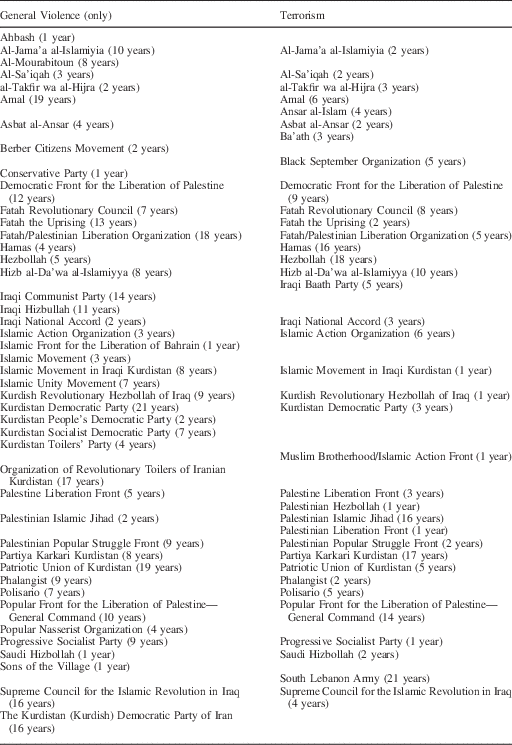
Terrorism, or the strategic use of violence targeted at civilians, is not a dominant strategy of MAROB organizations in the Middle East. Only 13.5 percent of the organizational years in our dataset employed this strategy. Table 1 displays the organizations that use violence generally, and terrorism specifically (with the number of years each tactical type was employed in parentheses). Variance among organizations in the use of terrorism as a regular strategy is also quite large, with some organizations never using terrorism (for example, the Berber Cultural Movement in Algeria), some organizations regularly using it as a strategy (for example, Fatah/PLO in the West Bank/Gaza) and some using it occasionally (like the Fatah Revolutionary Council in Jordan). As we have discussed above, while 60 MAROB organizations have used political violence in at least one organizational year, only 40 have targeted civilians for violence, and for far fewer organizational years (590 versus 231, respectively). One of the advantages of the MAROB dataset for our purposes is that it includes organizations that have both used and not used violence as well as organizations that have and have not targeted civilians.
List of Organizations by Type of Violence

Our unit of analysis is the organizational year. By organization, we mean an association with some kind of structure and a delineation of membership in which some members of the group belong and others do not. The Kurds, for example, are an ethnic group but they are not an organization. The Kurdish Peoples Party is an organization.
By terrorism we mean the intentional violent targeting of civilians for a political purpose. It is worth restating that we in no way mean to imply in this analysis that terrorism is something that only non-state actors can be involved in. While we believe that states can choose a terrorist strategy, this article’s focus is on the use of general violence and terrorism by non-state actors.
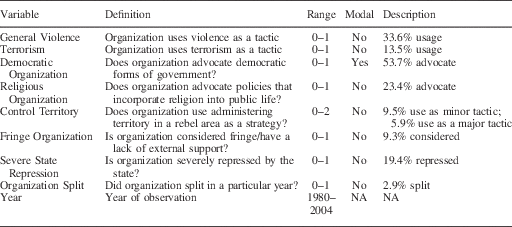
Table 2 provides the basic coding of all the variables in our analysis, as well as descriptive statistics. We code the dependent variables such that general violence includes all kinds of political violence, and terrorism captures targeting civilians. Thus terrorism is a subset of general violence and the two categories are not mutually exclusive. The logic of this choice is simple: the organizational choice of employing terrorism is a two-step decision. In the first, the organization decides whether or not violence is a good strategic approach for achieving their ideal ends. If so, the second choice is the type of violent act to use, which may include intentional attacks on civilians or attacks that will produce incidental harm to civilians. In the MAROB dataset an organization is coded as engaging in Terrorism if the “organization engages in attacks on civilians,” and civilians “include non-security state personnel (for example, civil service personnel, elected representatives and other government representatives that are not police, military, etc.)” (MAROB 2009). This variable is derived from the ORGST7 variable in MAROB. The General Violence variable is derived from the ORGLOCV variable in MAROB, which captures any use of violence in that year.Footnote 10 Both Terrorism and General Violence are dummy variables, coded 1 if the functional form is used and 0 if not.
Description of Variables

To explain the use of these different but related approaches to achieving organizational ends, we employ two types of variables: those that measure state (or external) pressures and those that measure organizational factors including different forms of capability and ideology. State Repression is a binary variable using the MAROB STORGREPRESS variable, which recodes severe state repression as 1 if an organization was labeled illegal and was subject to periodic or ongoing state repression (used for Hypothesis 6).Footnote 11 Severe state repression is only experienced in 19.4 percent of the organizational years studied. To measure Organizational Splits we use the MAROB ORGSPLIT variable (used for Hypothesis 3), which captures whether an organization experiences a split in each year. Of all of the variables in our model this is the most rare, occurring in 2.9 percent of the organizational years.Footnote 12
To identify fringe organizations, meaning those lacking external support, we created a variable called Fringe derived from the MAROB ORGPOP variable. Fringe groups are coded 1 if there is no evidence of outside support for them (used for Hypothesis 2). Less than 10 percent of the organizational years fall into this category. To code an organization’s control of territory (used for Hypothesis 1) we utilize the MAROB ORGST9 variable, which is an ordinal variable that captures whether an organization controls no territory, “controls movement into/out of/through territory but does not establish governing structures or maintain infrastructure (for example, roads)” or “sets up governing structures and/or maintains infrastructure” (MAROB 2009). Of the organizational years, approximately 84 percent control no territory, 9.5 percent control movement in and out of territory, and 5.9 percent set up governing structures and/or maintain infrastructure.
Our ideology variables are based on whether or not the organization advocated for certain institutions or behaviors in the organizational year in question. The Religious Organization (MAROB RELORG) variable (used for Hypothesis 4) is a dummy variable that measures whether an “organization advocates policies that incorporate religion into public life.” This is seen in 23.4 percent of the organizational years. The Democratic Organization (MAROB DEMORG) variable (used for Hypothesis 5) is another dummy variable that identifies whether an “organization advocates democratic forms of government.” This is seen in 53.7 percent of the organizational years.Footnote 13
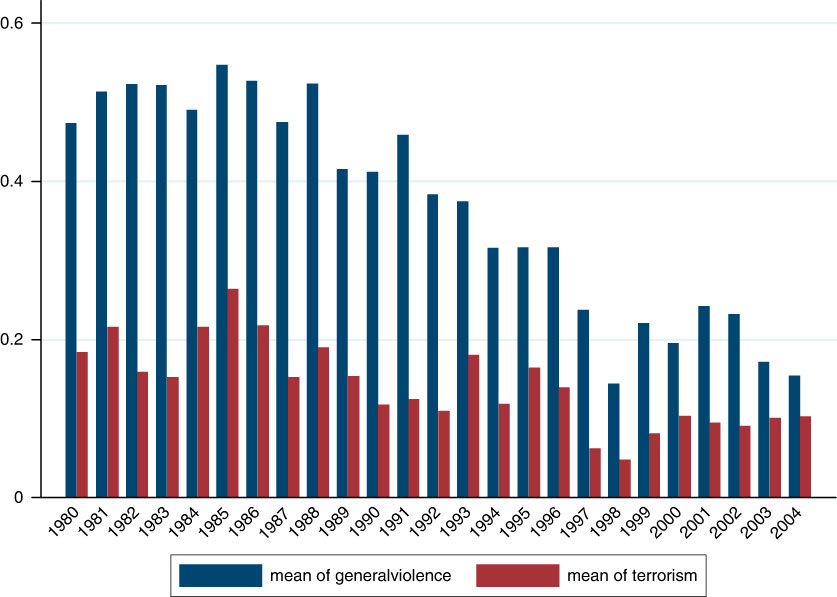
We include a year variable to account for the changing trends in the use of terrorism over time. As shown in Table 3, this variable is statistically significant and negative in the joint models, following known trends about the utilization of various violent tactics by similar groups.Footnote 14 While these relationships are not perfectly linear over time, both display a general downward trend (see Figure 1).
Averages of organizational use of general violence and terrorism over time (1980–2000).

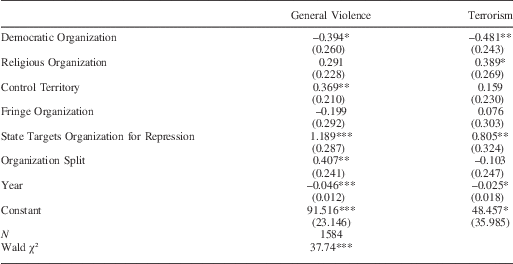
Biprobit Analysis of the Choice to Use Violence and/or Terrorism (with Clustering on Ethno-Political Organizations)

*Significant at p<0.10; **Significant at p<0.05; ***Significant at p<0.01 (one-tailed test).
Finally, because organizations are not exogenous to the groups they represent, we control for this by clustering on ethno-political group using the MAR group code variable (NUMCODE). We also considered the effects of clustering on organizations by running the same analysis with the organization (instead of the ethno-political group) as the cluster variable. The results were only marginally different than clustering on ethno-political group, with no change in statistical significance. As such, we only present the analysis clustering on the ethno-political group, which is more theoretically important.
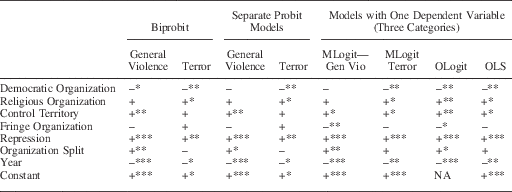
To analyze these data, we employ a bivariate probit (or biprobit) model. This method is preferable to running two separate probit models, as we believe the two decisions—while separate—are simultaneously interrelated for organizations. As such, modeling terrorism means that it will have a joint probability with the tactical choice to use violence more generally, and therefore we cannot assume that the error terms will be independent. In other words, we want to test two similar but distinct organizational choices: the choice of whether or not to use violence generally, and then the related but different choice of whether or not to engage in terrorist activity. If we simply ran two separate probit models, the implication would be that we do not believe these choices are in any way related. Yet if we put them on a three-point scale and run an ordered logit model, the implication would be that we believe the factors that lead to these choices are, in essence, the same and will impact behavior in the exact same way. We do not believe either of these to be the case. Rather, an organization’s decision to engage in violence or to engage in terrorism requires similar and related processes, but the thresholds to push organizations to one or both decisions should be different. To test this, we ran a series of robustness checks utilizing different analytic approaches and determined that, while the results are similar, the marginal effects are different (see Appendix A for a summary of direction and significance). Further, the likelihood ratio test statistic to test whether the two dependent variables, if modeled separately, are independent is 37.740, significant at p<0.000, which provides empirical evidence that our supposition that these two tactical choices are related is correct.
This approach is novel in that it is infrequently used. While sometimes used in economics, bivariate probit analysis within political science is typically employed to understand voting behavior (for example, Bergan et al. Reference Bergan, Gerber, Green and Panagopoulos2005; Arceneaux and Nickerson Reference Arceneaux and Nickerson2009). The exception to this is Kimball (Reference Kimball2006), in which this approach is utilized to examine the factors that lead to the related processes of group alliance formation and conflict initiation. Nonetheless, this type of approach is critical to understanding the decision-making processes in which advocacy groups engage when making tactical choices. By modeling these choices separately, much of the literature misrepresents the marginal impact of the key explanatory concepts for engaging in violence and targeting civilians.
Findings
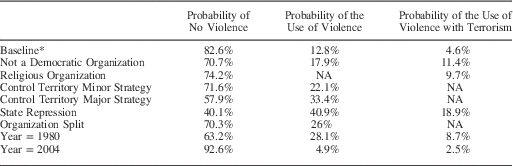
Given the caveats to our analysis discussed above (the temporal, geographic and ethno-political domain), our model underlines the similarities of the causes of general violence and the violent targeting of civilians and supports the argument that the targeting of civilians can be differentiated in some important ways from the causes of general violence. Table 3 displays the results of the biprobit analysis and Table 4 shows predicted probabilities, both of which support our hypotheses. Briefly, democratic ideology is negative and significant for both strategic choices, and state repression is a positive and significant predictor of both. Religious ideology is positive, but is only statistically significant when targeting civilians. Controlling a territory is a positive and significant predictor of general violence, but not of terrorism, as is organizational splits. Being a fringe organization is not related to the choice of whether or not to use general violence or terrorism.
Predicted Probabilities

* Baseline: Democratic Organization=Yes; Religious Organization=No; Control Territory=No; Fringe Organization=No; State Repression=No; Organization Split=No; Year=1993.
State repression (Hypothesis 6) almost quadruples the likelihood that organizations will use general violence, and slightly more than quadruples the likelihood that they will target civilians. In other words, state repression has a large effect on organizational behavior, but there is no differentiation between the two forms. Of all the variables in our analysis, state repression has the largest marginal effect on the use of violence, which suggests important policy implications. At the same time, however, this finding should be regarded with caution. The potential endogeneity between state repression and organizational use of violence limits our ability to draw concrete conclusions about this variable.Footnote 15
Organizational splits (Hypothesis 3) have a rather large impact on an organization’s use of general violence, doubling the probability that an organization splits in the same year that violence is used, but such splits appear unrelated to the use of violence specifically targeted at civilians. In line with much of the literature, we found that the control of territory (Hypothesis 3) has a significant impact on the likelihood of using violence, and the stronger (more complete) control the organization has, the larger the impact on the likelihood of the use violence. That is, at baseline the probability of using general violence is 12.8 percent. When an organization controls access to territory this probability rises to 22.1 percent, and when it controls government and infrastructure the probability of using violence rises again to 33.4 percent. However, like organizational splits, this is not related to the targeting of civilians. This finding suggests that using territory as a way of distinguishing between what we call terrorists and what we call insurgents or guerillas is an error. The control of territory does not make organizations more likely to target civilians.
A surprise in the results was that being a weak and unpopular, or fringe, organization (Hypothesis 4) has no impact on either the use of violence in general or on the targeting of civilians.Footnote 16 This contradicts much of the literature and our own thinking about the issue. Yet as far as we know, the issue of organizational weakness has never been quantitatively tested in an analytical framework that included both violent and non-violent organizations. Because we include both types in this analysis, it may be that organizational weakness and lack of external support simply are not key factors that push organizations to target civilians, but that this generalized fact was previously obscured for methodological reasons.
In terms of ideology, we find that an organization’s proclaimed norms have an important impact on both its choice of whether to use violence and whether it targets civilians. As expected, we find evidence to support the growing theoretical argument in the literature that religious organizations (Hypothesis 4)—while not more likely to use violence in the first place—are more likely to target civilians if they do use violence. Espousing a religious ideology doubles the probability that an organization will direct violence toward civilians. We believe this finding is also important because we did not specify that an organization had to be “fundamentalist” per se, but simply that it advocated religion in public life. This has important normative implications for democratic functioning.
Our findings about democratic ideology (Hypothesis 5) also matched our expectations. While a lack of a democratic ideology increases the likelihood that an organization will use violence by about one-third, non-democratic organizations are twice as likely to target civilians as the baseline. Otherwise put, not having a democratic ideology increases the probability of the use of general violence from 12.8 to 17.9 percent, and more significantly, the use of terrorism from 4.6 to 11.4 percent. While much of the literature has focused on the impact of ideology on increasing the likelihood that an organization will engage in terrorism, this finding illustrates the potentially positive effects of certain ideologies.
Conclusion
This research began with three ideas: (1) there is a fundamental normative difference between organizational use of violence generally and organizational use of terrorism, or targeting civilians; (2) that the choice to use these approaches to achieve goals are related but different; and (3) that the factors that explain these related choices will also be different. While terrorism research has wrestled with these issues, very little quantitative or qualitative work has put this choice within the context of violence in general. Failing to model the initial choice of whether to use violence obscures the factors that are related to targeting civilians.
The MAROB data have allowed us to lift this veil somewhat. We find that, while terrorism is similar to general violence in many ways, there are also ways in which it is different. Understanding these differences is important for research and policy. Modeling the joint probability of the use of violence generally and terrorism specifically, we find that a democratic values orientation and state repression are significantly related to both functional forms, with negative and positive relationships, respectively; that religious ideology helps explain the targeting of civilians and not general violence; and that the organizational factors of controlling territory and splits explain general violence but not targeting civilians.
A key difference appears to be the ideological nature of the organizations. For non-state organizations, holding a democratic ideology acts as a constraint on the use of violence in a way that conforms well with much of the international relations literature focused on the state. It is possible that the Democratic Peace hypothesis ought be re-examined to extend to organizations and non-state actors. Religious ideology acts exactly as other researchers of terrorist behavior have suggested: espousing and pursuing a religious ideology that insists on integrating religion into state and public life increases the likelihood that the organization will pursue the most negative forms of violent tactics.
It is important to reiterate the caveats to our findings. We have examined only ethno-political organizations that existed for three years or more in the Middle East during the time period 1980–2004, a time when religious ideology (and attention to religious terrorism) were on the rise. The Middle East, which has experienced more terrorism than many other regions, is in many ways sui generis. We recognize, though, that much still needs to be done. Other regions and other types of political organizations need to be examined. Despite the enormous financial challenges of such coding, the field would benefit from data on organizations with shorter life spans and from different regions.
Regardless of these caveats, this analysis advances our understanding of terrorism in important ways. Including non-violent organizations in the analysis of why organizations use terrorism is crucial. Perhaps most importantly, by providing initial support for the argument that there is something different about targeting civilians, and that one of the key differences is the impact of ideology, our findings advance the debate on what drives some groups to kill and other groups to kill the defenseless.
Appendix A
Robustness Check Summary