


Introduction
Anorexia nervosa (AN) has proven to be an illness with a high mortality rate, often with a chronic outcome (Steinhausen, Reference Steinhausen2002). Full understanding of this illness for an individual patient, usually reached by a process of psychological formulation (Bieling & Kuyken, Reference Bieling and Kuyken2003; Lavender & Schmidt, Reference Lavender, Schmidt and Tarrier2006; Persons & Tompkins, Reference Persons, Tompkins and Eells2007), is important to design and implement a successful treatment (Persons, Reference Persons2006). This formulation should be unique to the individual, although generic models of pathology (Fairburn, Reference Fairburn2008; Waller et al. Reference Waller, Cordery, Corstorphine, Hinrichsen, Lawson, Mountford and Russell2007; see also Persons, Reference Persons2006) can help therapists and patients come to a shared understanding of their difficulties, and how they are perpetuated.
Features of obsessive compulsive disorder (OCD) and obsessive compulsive personality are associated with poorer outcome and greater symptomatology in AN and other eating disorders (EDs) (Zubieta et al. Reference Zubieta, Demitrack, Fenick and Krahn1995; Steinhausen, Reference Steinhausen2002), represent frequent comorbid illnesses with EDs (Swinbourne & Touyz, Reference Swinbourne and Touyz2007), and there has also been some genetic and biochemical evidence of an association (Enoch et al. Reference Enoch, Kaye, Rotondo, Greenberg, Murphy and Goldman1998). As a result of such findings, a number of authors have looked at whether AN is actually a variant of an OC disorder, with some genetic, neurological, and developmental evidence supporting this (Milos et al. Reference Milos, Spindler, Ruggiero, Klaghofer and Schnyder2002; Serpell et al. Reference Serpell, Livingstone, Neiderman and Lask2002; Steinglass et al. Reference Steinglass, Albano, Simpson, Carpenter, Schebendach and Attia2012). Some authors (Strober et al. Reference Strober, Freeman, Lampert and Diamond2007; Waller, Reference Waller2008; Steinglass et al. Reference Steinglass, Sysko, Glasofer, Albano, Simpson and Walsh2011) have gone even further, suggesting that EDs, including AN, might be included in a wider categorization of anxiety disorders. The stance of the current article is that AN and OCD are not variants of the same condition, but that some formulation and treatment techniques used in anxiety disorders may be useful when working with individuals with AN. The article will explore whether a formulation model frequently used in OCD might be applicable to AN, describing a rationale as to why this is suggested and providing a template for its use. The model is targeted at the assessment and formulation of AN in adults, partly as systemic treatment (rather than a CBT model) is advocated in younger patients, and also that the literature referred to in this article primarily concerns adult subjects; less has been written about the overlap of OCD and AN in children, although Hildebrandt et al. (Reference Hildebrandt, Bacow, Markella and Loeb2012) discuss similarities between methods of action in family-based therapy for adolescents and CBT, specifically exposure.
A small body of evidence suggests that treatments used in anxiety disorders might be useful in EDs (Steinglass et al. Reference Steinglass, Albano, Simpson, Carpenter, Schebendach and Attia2012), although some techniques reported in ED treatments (Waller et al. Reference Waller, Cordery, Corstorphine, Hinrichsen, Lawson, Mountford and Russell2007) may achieve change through similar principles. Some authors have written about the process of formulation in EDs, proposing models to understand the illness (Lavender & Schmidt, Reference Lavender, Schmidt and Tarrier2006; Waller et al. Reference Waller, Cordery, Corstorphine, Hinrichsen, Lawson, Mountford and Russell2007; Fairburn, Reference Fairburn2008). Given that AN is a particularly difficult illness to treat, and sufferers often show denial regarding their symptoms (Vitousek et al. Reference Vitousek, Watson and Wilson1998), a formulation model that references a different condition (i.e. one that might not be seen as so egosyntonic) may offer a ‘back door entry’ to understanding the individual and his/her illness. In light of the literature discussed above, the aims of this article are to suggest how use of an OCD formulation (coming from a CBT approach) can contribute to an understanding of AN. Similarly, the focus on formulation throughout this article is designed to help therapists, particularly those who may be less experienced in the assessment and treatment of EDs, by outlining a more familiar model of formulation that might be useful in AN. Although some anecdotal data are presented, there is no formal evaluation of the utility of the model. In concert with the aims and readership of the journal, elements of the model will be individually expanded upon, although this level of detail may not be necessary with every patient.
Empirical rationale for use of an OCD model in AN
As detailed above, there is significant literature suggestive of some degree of phenomenological, diagnostic (i.e. comorbidity), and clinical overlap between AN and OC disorders, namely OCD, and a formative body of evidence supporting anxiety-based treatments in AN. There is some emerging evidence supporting the benefit of CBT for AN in adults (Fairburn et al. Reference Fairburn, Cooper, Doll, O'Connor, Palmer and Dalle Grave2013), a psychological therapy with documented effectiveness for the treatment of OCD, and there exists good reason to draw parallels between the two disorders.
Steinglass & Walsh (Reference Steinglass and Walsh2006) reviewed a number of cognitive, behavioural, and neurobiological commonalities of AN and OCD, drawing parallels between intrusive thoughts, ritualized behaviours, and cognitive inflexibility, for example. The authors note similarities in the neurobiology behind AN and OCD, and build on this in a later article (Steinglass et al. Reference Steinglass, Sysko, Glasofer, Albano, Simpson and Walsh2011). Steinglass and colleagues (Reference Steinglass, Sysko, Glasofer, Albano, Simpson and Walsh2011) describe a treatment approach, based on the original neurobiological model of Steinglass & Walsh (Reference Steinglass and Walsh2006), focused on anxiety. Their model has a strong focus on behavioural fear acquisition, although it combines some elements of eating-disordered cognitions with avoidance-based behaviours. Citing the high relapse rate of current treatments, Steinglass et al. (Reference Steinglass, Sysko, Glasofer, Albano, Simpson and Walsh2011) advocate a shift towards the use of behavioural techniques in the treatment of AN to address ‘both anxiety driven behaviours and irrational beliefs’ (p. 140), particularly emphasizing exposure and response prevention. They argue that anxiety and obsessional tendencies bring about certain eating behaviours (e.g. food avoidance) that lead to weight loss. This then increases anxiety and obsessionality, thus perpetuating the cycle (Steinglass et al. Reference Steinglass, Sysko, Mayer, Berner, Schebendach, Wang, Chen, Albano, Simpson and Walsh2010), and therefore advocate behavioural interventions that promote experiential learning. However, this model does not include early experiences and underlying beliefs, which are similar in anxiety disorder and ED (Waller et al. Reference Waller, Ohanian, Meyer and Osman2000; Pallister & Waller, Reference Waller2008), although it could be argued that the model is easily adapted in this respect.
The current article argues that a more complete model of AN would include these, but also the phenomenon in OCD often labelled ‘catastrophic misinterpretations’. Individuals with AN often report intrusive thoughts which, similar to OCD and other anxiety disorders (such as panic disorder), are misinterpreted. Cognitive behavioural treatment might then look at addressing beliefs and thinking styles related to those intrusions and trying to normalize behavioural responses (see below). Intrusive thoughts are common in the general population, but become obsessional when they are more frequent or intense, or produce greater discomfort (Rachman & de Silva, Reference Rachman and de Silva1978). Similar to the sense of ‘increased responsibility’ and catastrophic misinterpretations in anxiety (Salkovskis, Reference Salkovskis1991, Reference Salkovskis2007), an individual with AN might escalate an intrusive thought into an obsession. An example of a distortion that may be seen in EDs is provided by Cooper et al. (Reference Cooper, Todd and Wells2009, p. 127): ‘if I get fat, no-one will ever speak to me again’. It may be the case that many individuals demonstrate an aversion to fatness or obesity, or a desire to weigh less (Whitaker et al. Reference Whitaker, Davies, Shaffer, Johnson, Abrams, Walsh and Kalikow1989), but that this may be misinterpreted in those with ED pathology as having more ruinous consequences, such as extreme social isolation; a trigger might be the initial intrusion, which is subsequently catastrophized.
Given this, it is argued that individuals with AN experience intrusive thoughts that are common to the general population, but interpret these thoughts as posing significant harm to themselves, and/or that they hold greater personal responsibility. This inflated responsibility then leads to a pattern of behaviours that have the unintended effect of increasing distress and also increasing the frequency and salience of intrusions (Salkovskis, Reference Salkovskis2007). Elements of this model are expanded below but, by way of example, an intrusion in AN (e.g. about eating a certain food and subsequently gaining weight) might trigger responsibility beliefs, which then result in overt efforts to reduce or escape responsibility (e.g. by exercising, or checking for perceived weight gain).
Although some similarity with existing formulations of EDs (Waller et al. Reference Waller, Cordery, Corstorphine, Hinrichsen, Lawson, Mountford and Russell2007) exists, an OCD model (Salkovskis, Reference Salkovskis2007) includes a number of key elements, such as intrusions, responsibility appraisals, catastrophic misinterpretations, and neutralizing actions (e.g. thought suppression), that may be applicable to some patients with EDs. Indeed, a number of studies (Soetens et al. Reference Soetens, Braet, Dejonckheere and Roets2006; May et al. Reference May, Andrade, Batey, Berry and Kavanagh2010; Coelho et al. Reference Coelho, Baeyens, Purdon, Pitet and Bouvard2012) have reported evidence of such phenomena in eating pathology. The use of an OCD model with certain individuals is proposed to represent a useful account of how different thoughts and behaviours interact and it is argued that specific elements of an OCD formulation (e.g. catastrophic misinterpretations, beliefs about intrusions) may be important in understanding an individual's presenting symptoms. The model also provides a template for constructing a psychological formulation of AN. The current article does not suggest an overhaul in the way AN is conceptualized, but rather that, for some patients, a model based on OCD might offer a ‘different way in’ to their illness. An OCD model in particular is favoured over other anxiety formulations (e.g. panic disorder, health anxiety disorder) due to a larger evidence base suggestive of similarities between AN and OCD, as well as the additional flexibility and scope of an OCD model. While some elements (e.g. cognitive bias, safety behaviours) are common to many formulation models of anxiety disorders (and, sometimes, EDs), the OCD model presented here (Salkovskis, Reference Salkovskis2007) incorporates a wide range of different phenomena (see below), and is argued to present a more complete account of behaviours, cognitions, etc. that might be seen in AN. It is hoped that a useful formulation model is proposed that is accessible to both patients and clinicians who may not have a wealth of experience in EDs.
A CBT model of OCD, carefully applied, can help identify the above elements in treatment, and suggest ways of addressing maintaining mechanisms in AN. One clear advantage of using a purely OCD-type model in joint formulation with a patient with AN, in the author's opinion, is that it can be used as a Socratic, hypothesis-driven way of accessing the impact of thoughts and behaviours. Those with AN often have an egosyntonic view of their behaviours (Holden, Reference Holden1990) and it can often be difficult to objectively appraise their function. However, drawing parallels with OCD behaviours (which can often be easily understood by patients) represents a less challenging way of introducing how ED behaviours may function to modulate anxiety, rather than to maintain weight, for example; illustrations from the patient's own experience can also be incorporated.
Clinical practice
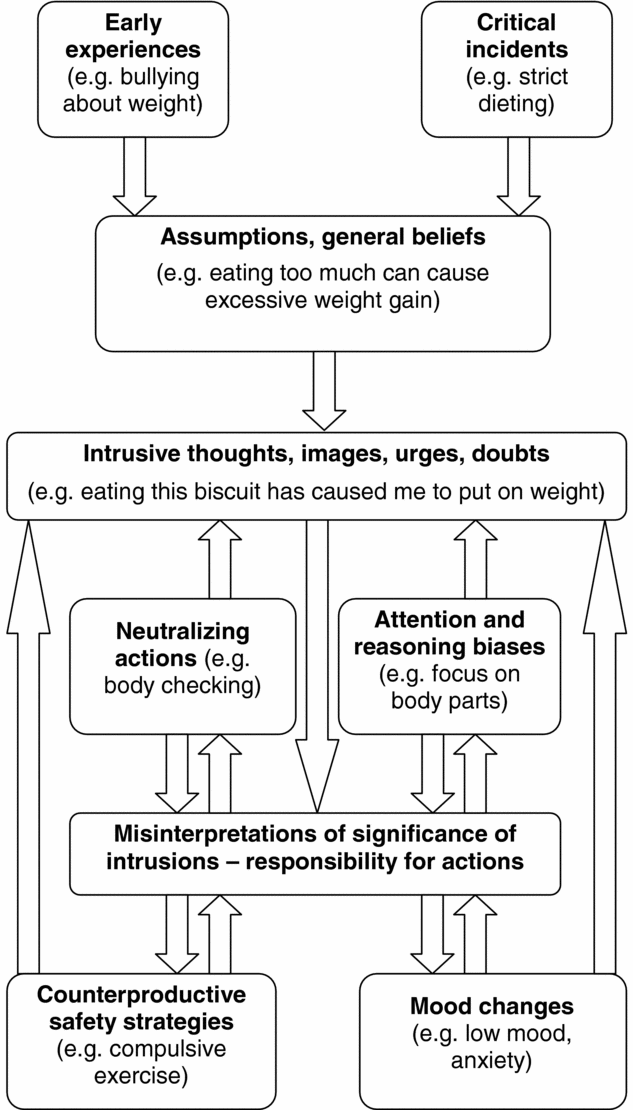
A description of how an OCD model (see Fig. 1; Salkovskis, Reference Salkovskis2007) is used in the formulation of AN now follows, and it is argued that it provides a useful and under-utilized tool in ED treatment. Although this is not a case series, some anecdotal data from patients are provided in order to support some of the assertions made.
Cognitive model of obsessive compulsive disorder (OCD) as presented in Salkovskis (Reference Salkovskis2007, p. 229). (Reproduced with permission of Elsevier B.D.)

First, as in many styles of psychotherapy formulation (Wildes & Marcus, Reference Wildes and Marcus2011), the patient is introduced to the model. It is suggested that this is done with reference to a fictional, archetypical example of OCD, such as an individual with compulsive hand-washing resulting from intrusive thoughts around contamination. The model is then talked through, helping the patient generate examples of each of the parts in Figure 1. Any questions or confusions are necessarily addressed, and the patient is collaboratively assisted to generalize this formulation to their own illness experiences (Persons & Tompkins, Reference Persons, Tompkins and Eells2007; Overholser, Reference Overholser2011). A useful, Socratically driven, question might be something like ‘Why do you think we have been discussing OCD; what relevance might it have to your eating, for example?’ Often, it is then useful to jointly go through the model, and introduce concepts of an ED specifically relevant to the patient (an example is given in Fig. 2). Time can be spent on the individual elements of the model (which are elaborated upon in the current article for educational purposes), but the main aim is to understand how anxiety processes might function in EDs. This process of introducing and discussing the formulation may only require one session of CBT, depending on the level of understanding and comprehension of the patient.
Cognitive model of obsessive compulsive disorder, applied to anorexia nervosa.
Early experiences/critical incidents
Psychological models of anxiety disorders often refer to critical incidents as activating disease-specific beliefs in vulnerable individuals, and how early experiences also contribute to the formation of specific assumptions and beliefs. This is a fairly ubiquitous viewpoint in CBT, and is extended in the current model to AN. By understanding an individual's history, a greater sense of their belief system can be agreed with the therapist, and the patient helped to understand how their experiences may have contributed to, say, an over-evaluation of weight and shape. Personality factors (see Serpell et al. Reference Serpell, Livingstone, Neiderman and Lask2002; Shafran, Reference Shafran, Frost and Steketee2002), which may also be similar across AN and OCD, are also relevant here. Critical incidents may include the onset of dieting, loss or bereavement, while developmental influences (e.g. puberty) have also been proposed as possible factors (Stewart, Reference Stewart and Graham2005).
Assumptions/general beliefs
EDs and OCD have been suggested to have a number of beliefs in common, such as perfectionism, importance of thoughts, and control of thoughts (Lavender et al. Reference Lavender, Shubert, de Silva and Treasure2006; Roncero, et al. Reference Roncero, Perpiñá and García-Soriano2011). Such beliefs might form a key maintenance mechanism, common to EDs (Roncero et al. Reference Roncero, Perpiñá and García-Soriano2011), and more specific beliefs might relate to other factors, such as exercise (Naylor et al. Reference Naylor, Mountford and Brown2011). More general beliefs (e.g. schemas) are also shared between anxiety disorders and EDs (Pallister & Waller, Reference Waller2008), which can be explored using the Salkovskis (Reference Salkovskis2007) model elaborated upon here. Negative self-beliefs in EDs have been discussed previously (Cooper et al. Reference Cooper, Todd and Wells2009), with reference to eating-specific beliefs and more general self-beliefs. Such beliefs might be open to misinterpretations (see below) and attentional bias (Jansen et al. Reference Jansen, Nederkoorn and Mulkens2005; see Aspen et al. Reference Aspen, Darcy and Lock2013, for a review of attentional bias in EDs). Individuals with OCD have been shown to have a number of cognitive biases which increase their level of intrusions, and therefore compulsions (Spranca et al. Reference Spranca, Minsk and Baron1991), part of the large literature regarding attentional bias in anxiety disorders. This is less well understood in EDs (Aspen et al. Reference Aspen, Darcy and Lock2013), and it may be that bias is a relatively automatic (unconscious) process or more deliberate, and, of particular note in AN, may also be affected by nutritional status (Placanica et al. Reference Placanica, Faunce and Soames Job2002; see below). It may be constructive to look at such biases in AN at an individual level, but this is also one area that is not overtly covered in the model of Steinglass et al. (Reference Steinglass, Sysko, Glasofer, Albano, Simpson and Walsh2011).
Intrusions
It has been suggested (Shafran, Reference Shafran, Frost and Steketee2002; Soetens & Braet, Reference Soetens and Braet2006) that individuals with EDs, and particularly those who restrict their dietary intake, are likely to experience unwanted (intrusive) thoughts around food, most often ‘bad’ foods (e.g. high calorie, high fat foods). Dieters can become preoccupied with thoughts of food and eating, and may be more likely to use thought suppression than non-dieters (Soetens et al. Reference Soetens, Braet, Dejonckheere and Roets2006). Intrusive thoughts are commonly experienced in the general population (Rachman & de Silva, Reference Rachman and de Silva1978) and may be an antecedent of eating pathology, as has been suggested in OCD (Salkovskis & Campbell, Reference Salkovskis and Campbell1994). However, it is the appraisal of these thoughts (e.g. as personally significant) that often drives pathology, associated distress, and thus attempts at control; this may be likened to the over-evaluation of weight and shape that is central to EDs (Shafran & Robinson, Reference Shafran and Robinson2004). As in OCD, individuals with AN may have intrusions of a similar nature, and react in ways that serve to maintain and encourage the disorder. For example, Salkovskis & Wahl (Reference Salkovskis, Wahl, Reinecke and Clark2004) discuss how thoughts only become intrusive ‘depending on the person's prior experience and the context in which the intrusions occur’, noting also that ‘the majority of nonclinical subjects do not regard the occurrence of intrusive thoughts as being of special significance’ (p. 141). Similarities might be drawn to EDs, with food being of central importance in many people's lives; however, in non-clinical samples, there is likely to be less emotion and personal responsibility attached to this (see Rawal et al. Reference Rawal, Park and Williams2010).
Misinterpretations
Individuals with EDs have been found to misinterpret the consequences of thoughts particularly in the domains of food, weight, and shape, but also show misinterpretations related to wider beliefs, such as perfectionism or other beliefs about the self (Vitousek & Ewald, Reference Vitousek, Ewald, Segal and Blatt1993; Williamson et al. Reference Williamson, Muller, Reas and Thaw1999; Shafran, Reference Shafran, Frost and Steketee2002). Such misinterpretations of intrusive thoughts are likely to increase the significance and persistence of these thoughts (Shafran, Reference Shafran, Frost and Steketee2002; Shafran & Robinson, Reference Shafran and Robinson2004) and can also lead to mood changes and safety behaviours (see below). A related concept is that of thought-shape fusion (TSF; Shafran et al. Reference Shafran, Teachman, Kerry and Rachman1999), a cognitive distortion akin to thought-action fusion seen in OCD. Briefly, TSF occurs when thinking about a negative cognition (e.g. eating a high-calorie food) leads to a change in the ‘real world’ (e.g. in behaviour or feelings). TSF may also be strengthened through associative learning (e.g. thinking about eating a fattening food, and then eating it) and is thought to be a cognitive bias that increases the likelihood of catastrophic misinterpretations and maladaptive coping strategies (Shafran et al. Reference Shafran, Teachman, Kerry and Rachman1999). Such processes might also be accentuated by the relationship with mood changes and beliefs, for example guilt for eating a certain food being (mis)interpreted as ‘evidence’ of personal responsibility and potential negative outcomes, which may also relate to other cognitive biases, such as emotional reasoning. As in OCD, belief in TSF is likely to motivate certain behaviours, which in the case of AN may include dietary restriction, or body checking. Although TSF is also a relatively new area of research in EDs, a few studies have documented an association with ED symptoms and have suggested that it is unique to eating pathology (Coelho et al. Reference Coelho, Baeyens, Purdon, Pitet and Bouvard2012). The relationship between such cognitive distortions and misinterpretations in AN may benefit from further research, as has been carried out with OCD (Abramowitz et al. Reference Abramowitz, Whiteside, Lynam and Kalsy2001).
Safety behaviours and neutralizing actions
Although included in the lower portion of the model, safety behaviours (see Pallister & Waller, Reference Waller2008) can be a particularly useful place to start, explaining the rationale that safety behaviours can actually increase levels of anxiety (Deacon & Maack, Reference Deacon and Maack2008). This might have impacts on recovery as one aim of treatment is to reduce safety behaviours, due to their role as maintaining factors in the illness (Pallister & Waller, Reference Waller2008). Davis & Kaptein (Reference Davis and Kaptein2006) discuss exercise as one example of a safety behaviour, drawing links to obsessional personality and ritualistic behaviours in AN. Similarly, attempts at thought suppression, designed to eliminate intrusive thoughts, can arise from misinterpretations and increase the persistence of those intrusions. Some evidence for this in eating pathology has been found and, indeed, thought suppression has been suggested (as in anxiety disorders) to increase the number of subsequent food-related thoughts (Soetens et al. Reference Soetens, Braet, Dejonckheere and Roets2006; May et al. Reference May, Andrade, Batey, Berry and Kavanagh2010). Other examples of safety behaviours include avoidance of certain foods (e.g. those deemed to contain relatively high levels of fat) and other (possibly related) dietary rules, and mirror or body checking (see Fig. 2). Although there is some similarity between neutralizing actions and safety behaviours (Veale, Reference Veale2007), it may be helpful to elaborate on this with the patient, using Socratic exploration to identify the specific function of relevant thoughts and/or behaviours. A number of different neutralizing behaviours seen in an experimental paradigm are described in Radomsky et al. (Reference Radomsky, de Silva, Todd, Treasure and Murphy2002) (see also Kostopoulou et al. Reference Kostopoulou, Varsou and Stalikas2011). Thus, in the model proposed, there is some evidence for the interactive processes between neutralizing actions, intrusions, and misinterpretations. In the therapy session, it would be important to discuss these processes with patients; treatment may involve ‘breaking the cycle’ of the problem and attempted solution (Soetens et al. Reference Soetens, Braet, Dejonckheere and Roets2006).
Mood
There are a number of suggested links between negative affect and EDs although, in a meta-analytical review, Stice (Reference Stice2002) suggests that the association might be stronger in bulimic disorders. The role of negative mood in eating pathology also needs to be considered at the individual level, particularly as depression and low self-esteem may be antecedents to ED pathology, and also consequences (Waller et al. Reference Waller, Cordery, Corstorphine, Hinrichsen, Lawson, Mountford and Russell2007).
The influence of mood on both cognitive bias and thought suppression has been highlighted, for example in that low mood may lead to more negative interpretation of thoughts (Shafran & Robinson, Reference Shafran and Robinson2004) or influence information processing and interpretation in EDs (Aspen et al. Reference Aspen, Darcy and Lock2013). Furthermore, Altman & Shankman (Reference Altman and Shankman2009) discuss how compensatory behaviours (e.g. purging in EDs, or handwashing in OCD) function to reduce negative affect, as well as anxiety, and thus may establish a mood-improving cycle. Existing models of EDs (Waller et al. Reference Waller, Cordery, Corstorphine, Hinrichsen, Lawson, Mountford and Russell2007; Fairburn, Reference Fairburn2008) also comment that negative affect may be alleviated (albeit temporarily) by ED behaviours, but that low mood might also be responsible for changes in ED behaviour. Thus, low mood (as seen in Figs 1 and 2) may form a complex part of an individual's formulation which both drives, and is driven by, symptoms of an ED.
Initial impressions
Based on the author's experience of using such a model in psychological treatment (which is not in 100% of cases seen in clinical practice), individuals with AN report positive engagement with the model, and have generally felt it to be helpful and informative. Patients appear to understand the links between intrusions, catastrophic misinterpretation, and safety behaviours, and are able to assimilate these elements into an overall formulation. The key to this technique is therefore drawing parallels to their ED. One patient, for example, remarked even before concluding the model: ‘So, is my laxative use like a safety behaviour, then?’ Another patient (see Fig. 2) felt that the model was very clear, practical, and easy to follow. She particularly highlighted the processes (i.e. ‘the arrows’) in the model as useful in understanding her illness, and felt more informed by understanding the relationships between different symptoms. She mentioned catastrophic misinterpretations (giving the example thought of ‘if I have a bit of cake, I will put on a lot of weight’), and how she would typically cope with this through compulsive exercise. She reflected that exploring this relationship in therapy helped her draw links between the thoughts and behaviours, and also linked this with emotions (e.g. ‘If you feel stressed, it gets worse’). The frequency of her compulsive exercise behaviour has since decreased in treatment. Further study of patients’ views on the use of such a model would add confidence to the suggestions provided here.
With some individuals, it may be beneficial to focus on certain elements of the model. For example, one patient was particularly interested in how she placed significant emphasis on calorie counting, and how perception of ‘minor’ differences in the calorie content of food was (catastrophically) interpreted as having a definite impact on weight. Steinglass et al. (Reference Steinglass, Sysko, Glasofer, Albano, Simpson and Walsh2011) cite many pertinent examples of these elements, such as fear (of food, ‘fatness’, weight, etc.) as akin to feared stimuli in anxiety disorders. As in OCD, such thoughts are then acted on through ritualized and rigid behaviours (Steinglass & Walsh, Reference Steinglass and Walsh2006; Pallister & Waller, Reference Waller2008), which serves to maintain (or increase) both the thoughts and associated anxiety. Neutralizing and safety behaviours may thus increase other elements of pathology (see Figs 1 and 2), such as increasing intrusions via thought suppression or by maintaining illness-related beliefs through avoidance of perceived harm or exposure, preventing disconfirmation of these beliefs. As Waller (Reference Waller2008) notes: ‘as with all such safety behaviours, the immediate effect is anxiety reduction, but the longer-term effect is maintenance and elaboration of the anxiety’ (p. 169). Pallister & Waller (Reference Waller2008) provide useful examples of seeing safety behaviours in EDs, while also pointing out some of the difficulties in decreasing the use of these in patients. Although such illustrations can probably be described to patients without reference to the complete formulation model outlined here, it is argued that the model provides a thorough understanding of how safety behaviours function, and what beliefs might underlie them. Thus, it is hoped that such a formulation can help patients to see the impact of their safety behaviours, and appreciate some of the cognitive factors that might maintain their pathology. Further study will be required to identify techniques based on these suggestions (Steinglass et al. Reference Steinglass, Albano, Simpson, Carpenter, Schebendach and Attia2012) and to look at the therapeutic effectiveness of such techniques. Furthermore, as in anxiety disorders (Sloan & Telch, Reference Sloan and Telch2002), safety behaviours might maintain fear, and also negatively affect treatment outcome. Continued exposure to anxiety-provoking triggers can provide an individual also with ‘evidence about the link between anxious stimuli and catastrophic outcomes’, and developing new memories and associations (Hildebrandt et al. Reference Hildebrandt, Bacow, Markella and Loeb2012, p. e9).
It is not yet known for which patients (if not all of those with AN) this model may – or may not – be useful, and future work may help to elucidate this. Initial suggestions from the current author are that those with a chronic presentation, or those who report high egosyntonicity and/or limited insight into their illness may benefit from this approach, which argues that a non-confrontational, Socratic approach is more likely to foster a positive therapeutic relationship and open the possibility for subsequent behavioural change. However, as noted above, AN is frequently an egosyntonic illness, and the model may be helpful for many patients regardless of level of insight. It may also be helpful in individuals who have both AN and OCD that are functionally linked, as some ED treatment manuals suggest simultaneous treatment in such cases (see Waller et al. Reference Waller, Cordery, Corstorphine, Hinrichsen, Lawson, Mountford and Russell2007, p. 250). A comprehensive formulation approach may help sufferers appreciate the impacts of their behaviours, and Waller et al. (Reference Waller, Cordery, Corstorphine, Hinrichsen, Lawson, Mountford and Russell2007) describe how good formulation is essentially a set of hypotheses that helps both patient and clinician gain insight into the illness. It can help select appropriate interventions, but it may also be necessary to include elements of more complex formulation models, and the model presented here may be useful as a starting point for understanding the illness, or as an addition to an existing model. It should also be emphasized that what is argued here is an approach to understanding AN using a formulation that has elements of existing models (Waller et al. Reference Waller, Cordery, Corstorphine, Hinrichsen, Lawson, Mountford and Russell2007) but also one that elaborates on key factors that are likely to maintain AN. AN and OCD are different psychiatric disorders, and, despite significant similarities, there are different traits that distinguish the two illnesses (Sunday et al. Reference Sunday, Halmi and Einhorn1995; Steinglass & Walsh, Reference Steinglass and Walsh2006) and considering the two as distinct entities has a number of clinical advantages (Holden, Reference Holden1990).
A note on low weight and dietary restriction
The model here has been aimed at adults with AN, a disorder for which low body weight is of central importance. The exact contribution of weight loss needs to be understood, therefore, particularly as it has been suggested that anxiety predates weight loss in many cases, and often persists after restoration of normal weight (Strober et al. Reference Strober, Freeman, Lampert and Diamond2007). It may be the case that starvation and/or weight loss are responsible for all, or many, of the OCD-type symptoms seen in AN, i.e. that obsessions and compulsions (particularly around food) can arise from malnourishment and food restriction (see Serpell et al. Reference Serpell, Livingstone, Neiderman and Lask2002).
As Davis & Kaptein (Reference Davis and Kaptein2006) note, ‘It is quite probable that some of the psychological and behavioural symptoms of AN are either caused – or at least exacerbated – by malnutrition’ (p. 210; see also Steinglass & Walsh, Reference Steinglass and Walsh2006). However, there is also some evidence that OC beliefs in EDs are present regardless of the level of emaciation (Roncero et al. Reference Roncero, Perpiñá and García-Soriano2011) although further study is needed in this area. In the context of the formulation model suggested here, the influence of low weight and dietary restriction may be evident in different parts of the model, which will need to be explored at the individual level. For example, dietary restriction may operate as a safety behaviour (to prevent the feared outcome, e.g. uncontrolled weight gain) or as a precipitating event. It might also increase attentional bias (Placanica et al. Reference Placanica, Faunce and Soames Job2002), have a reciprocal relationship with food-related anxiety (Steinglass et al. Reference Steinglass, Sysko, Glasofer, Albano, Simpson and Walsh2011) and, as Waller et al. (Reference Waller, Cordery, Corstorphine, Hinrichsen, Lawson, Mountford and Russell2007) remark, might bring about low mood. The effects of starvation have also been suggested to intensify the trait of cognitive inflexibility (Tchanturia & Hambrook, Reference Tchanturia, Hambrook, Grilo and Mitchell2010; Friederich & Herzog, Reference Friederich and Herzog2011), and thus normalizing eating patterns and restoring weight should form part of treatment goals for such individuals.
Although it as yet appears that weight restoration is only a part of long-term recovery, the importance of addressing low weight and dietary restriction is central in AN, and should be considered in a psychological formulation of an individual sufferer; this may be prioritized for treatment in light of the seriousness or risk of such behaviours. Treatment framed around the formulation will then, therefore, consider how best to address symptoms such as weight loss and restriction, and it may be that the interventions vary according to the hypothesized role of these symptoms and behaviours within a given individual.
Limitations
The current paper aims to introduce a model of formulation and offers no systematic assessment of its efficacy or acceptability. Furthermore, numerous reviews of the ‘overlap’ between OCD and AN have been expertly written (Serpell et al. Reference Serpell, Livingstone, Neiderman and Lask2002; Pallister & Waller, Reference Waller2008; Altman & Shankman, Reference Altman and Shankman2009; Steinglass et al. Reference Steinglass, Sysko, Glasofer, Albano, Simpson and Walsh2011), and the current paper does not offer a comprehensive overview of such issues. Thus, empirical studies may be needed in order to more fully examine how useful the proposed model is in clinical settings. The various similarities noted above between AN and OCD suggest that an OCD-specific formulation might be the most helpful, as it includes a number of elements thought to be similar across the two disorders. However, alternative models of anxiety may be just as helpful in understanding AN, as might current models of EDs, although it is also argued here that basic CBT principles (e.g. avoidance, exposure to feared stimuli, links with mood) can be included in the above formulation, while also including elements more in common to OCD; in this way, the model is seen as flexible but also comprehensive.
In order for treatment to work well, the principles of CBT must be adhered to, and the formulation presented here is no exception. Formulation of the complex cases that are so often seen in AN requires preparation and mindful planning on the part of the therapist. Some of the techniques, while seemingly benign, might provoke misinterpretation on the part of the patient, and may in fact be counterproductive to the aims of treatment. Novice therapists are advised to be judicious in the application of an OCD formulation model for AN and in addressing elements such as safety behaviours. Thus, therapists practising with this model should feel confident and competent in working with such individuals, and seek appropriate supervision where necessary.
Conclusions
The current article adds to existing opinion regarding the advantages of conceptualizing EDs as similar in many ways to anxiety disorders, such as OCD. It builds on existing reports (Steinglass et al. Reference Steinglass, Sysko, Glasofer, Albano, Simpson and Walsh2011, Reference Steinglass, Albano, Simpson, Carpenter, Schebendach and Attia2012) by providing clinical techniques to approach formulation in AN, a notoriously difficult-to-treat illness with frequent anxiety symptoms and high relapse rates (Steinhausen, Reference Steinhausen2002; Steinglass et al. Reference Steinglass, Sysko, Glasofer, Albano, Simpson and Walsh2011).
The formulation proposed in the current study seems acceptable to patients, and, from the author's experience, seems to help both patient and therapist understand eating behaviours in a number of ways that have not been fully explored or combined in existing models. Case series and controlled studies will be required to test the efficacy and utility of this approach.
Rather than being seen as alternative to existing models (Pallister & Waller, Reference Waller2008; Steinglass et al. Reference Steinglass, Sysko, Glasofer, Albano, Simpson and Walsh2011), the ideas advanced in the current article might be seen as complementary. It is hoped that the ideas suggested will help therapists, particularly those who feel they have a limited understanding of AN (Yager, Reference Yager, Yager, Gwirtsman and Edelstein1992; Kaplan & Garfinkel, Reference Kaplan and Garfinkel1999). Similarly, the extent to which these ideas are used might also depend on patient factors. For example, a patient's level of engagement, or perhaps insight into their illness, might suggest how direct to be in formulating their ED behaviours; patients who present with high levels of denial (Vitousek et al. Reference Vitousek, Watson and Wilson1998) might be helped to understand their condition by drawing parallels with OCD.
Summary
There is some degree of conceptual, genetic, symptom, and phenomenological overlap between anxiety disorders, such as OCD, and AN. This article describes a popular formulation model of OCD which can be used by practitioners to understand some aspects of AN. This is seen as complementing existing formulation models in EDs, and it is hoped that it can be used as a tool to both guide an intervention and also to help patients become more aware of some of the maintaining factors in their illness. Further empirical evaluation of the model is required.
Acknowledgements
The author thanks two anonymous reviewers for their helpful suggestions in revising the manuscript.
Declaration of Interest
None.
Learning objectives
(1) To understand the use of an obsessive compulsive disorder formulation in anorexia nervosa (AN).
(2) To apply a model of anxiety disorders to an eating disorder (AN).
(3) To gain insight into some of the potential maintaining mechanisms of AN.
(4) To reflect on the similarities between two distinct psychiatric disorders.




Comments
No Comments have been published for this article.