Introduction
Accumulating data suggest that attention deficit hyperactivity disorder (ADHD) persists into adulthood (Faraone et al. Reference Faraone, Biederman and Mick2006a) and is evident in about 4% of adults (Faraone & Biederman, Reference Faraone and Biederman2005; Kessler et al. Reference Kessler, Adler, Barkley, Biederman, Conners, Demler, Faraone, Greenhill, Howes, Secnik, Spencer, Ustun, Walters and Zaslavsky2006). The correlates of ADHD in adulthood are similar to the correlates of ADHD in childhood as regards psychiatric co-morbidity (Barkley et al. Reference Barkley, Murphy and Fischer2007), neuropsychological dysfunction (Barkley et al. Reference Barkley, Murphy and Fischer2007), treatment response (Faraone et al. Reference Faraone, Spencer, Aleardi, Pagano and Biederman2004a) and genetics (Faraone, Reference Faraone2004). Despite this progress, adult patients with atypical presentations of ADHD or unclear histories of the disorder create difficulties in diagnosis (Adler & Chua, Reference Adler and Chua2002). Such difficulties can lead to low levels of identification and treatment (Faraone, Reference Faraone2000; Faraone et al. Reference Faraone, Spencer, Montano and Biederman2004b).
In a series of papers (Faraone et al. Reference Faraone, Biederman, Doyle, Murray, Petty, Adamson and Seidman2006b, Reference Faraone, Biederman, Spencer, Mick, Murray, Petty, Adamson and Monuteauxc, Reference Faraone, Wilens, Petty, Antshel, Spencer and Biederman2007b), we examined the validity of two atypical groups: (1) patients meeting all criteria for ADHD except for age at onset and (2) patients having impairing symptoms of ADHD that never exceeded the DSM-IV threshold for diagnosis. This prior work compared subjects without ADHD with those with one of three types of ADHD: (1) full ADHD met all DSM-IV criteria for childhood-onset ADHD; (2) late-onset ADHD met all criteria for age at onset and (3) subthreshold ADHD had subthreshold symptoms only (Faraone et al. Reference Faraone, Biederman, Doyle, Murray, Petty, Adamson and Seidman2006b, Reference Faraone, Biederman, Wilens and Adamson2007a, Reference Faraone, Spencer, Aleardi, Pagano and Biedermanb). We evaluated the validity of these atypical diagnoses based on Robins & Guze's (Reference Robins and Guze1970) criteria for the validity of psychiatric diagnoses. In their view, the validity of any disorder derives from a pattern of consistent data. Their validation criteria include clinical correlates, family history, treatment response, laboratory studies, course and outcome. We found that late-onset and full ADHD subjects had similar patterns of psychiatric co-morbidity, neuropsychological impairment, substance use disorders and familial transmission. Subthreshold ADHD was milder and showed a differing pattern of familial transmission. These data suggested that late-onset adult ADHD was valid and that subthreshold ADHD might be a milder form of the disorder.
The present study sought to further assess the validity of late-onset and subthreshold ADHD by evaluating personality traits. Several studies have assessed personality in ADHD. Robin et al. (Reference Robin, Tzelepis, Bedway, Gilroy and Sparague1998) used the Millon Index of Personality Styles to describe personality profiles of 233 adults with ADHD compared to 50 adults without ADHD. ADHD was associated with most of the personality scales examined. Adults with ADHD had a pessimistic world view, believing that they had little control over their world. They were self-centered, introverted, withdrawn, passive, and more likely to be unconventional and rebellious. They were also less assertive, more yielding, more hesitant in their interactions with others, and more likely to voice their complaints.
May & Bos (Reference May and Bos2000) used the Millon Clinical Multiaxial Inventory-II (MCMI-II) to study 104 adults with ADHD. They created four groups based on the presence of persisting oppositional defiant disorder (ODD) or other co-morbid diagnoses (ADHD-only, ADHD-co-morbid, ADHD-ODD, ADHD-ODD-co-morbid). The ADHD-only group had mild histrionic traits whereas the ADHD-co-morbid group was more often avoidant and dependent. The ADHD-ODD group showed histrionic, narcissistic, aggressive-sadistic and negativistic traits, whereas the ADHD-ODD-co-morbid group had a combination of avoidant, narcissistic, antisocial, aggressive-sadistic, negativistic and self-defeating traits.
Jacob et al. (Reference Jacob, Romanos, Dempfle, Heine, Windemuth-Kieselbach, Kruse, Reif, Walitza, Romanos, Strobel, Brocke, Schafer, Schmidtke, Boning and Lesch2007) applied the Revised NEO Personality Inventory (NEO-PI-R) in 372 adults with ADHD and 454 adults without ADHD. Patients with ADHD had higher neuroticism and lower extraversion, openness to experience and conscientiousness. Similar findings were reported in a study that used the NEO-PI-R to compare profiles of 25 adults with ADHD and a control group of 23 non-ADHD adult out-patients being treated with psychotherapy (Ranseen et al. Reference Ranseen, Campbell and Baer1998). The ADHD adult group obtained significantly higher scores in the neuroticism domain and significantly lower scores in the conscientiousness domain than the out-patient group.
Several studies applied Cloninger's model of personality to ADHD (Cloninger et al. Reference Cloninger, Przybeck and Svrakic1991, Reference Downey, Pomerleau and Pomerleau1996; Svrakic et al. Reference Svrakic, Whitehead, Przybeck and Cloninger1993). Cloninger's biologically based tridimensional theory of personality initially posited three dimensions of personality: novelty seeking, harm avoidance and reward dependence. He associated high novelty seeking with low dopamine levels and cluster B personality disorders. High harm avoidance was associated with low serotonin levels and cluster C personality disorders, and low reward dependence was associated with low norepinephrine and cluster A personality disorders. The three dimensions were assessed by his Tridimensional Personality Questionnaire (TPQ). These dimensions are moderately heritable and fairly stable throughout the lifespan.
Cloninger later revised the model by referring to the three personality dimensions as temperament. He also added a fourth dimension of temperament (persistence) and three character dimensions for each temperament factor. The dimensions of character are: self-directedness, cooperativeness and self-transcendence. These character dimensions are weakly heritable and are influenced by learning and the family environment. Rather than being stable throughout life, with learning they show a developmental progression. The temperament and character dimensions of the revised model are measured by Cloninger's Temperament and Character Inventory (TCI).
Jacob et al. (Reference Jacob, Romanos, Dempfle, Heine, Windemuth-Kieselbach, Kruse, Reif, Walitza, Romanos, Strobel, Brocke, Schafer, Schmidtke, Boning and Lesch2007) found that the novelty seeking and harm avoidance scores of adults with ADHD were significantly elevated on the TPQ. Another study administered the TPQ to three groups of adults: current smokers with ADHD, non-smokers with ADHD, and smokers without ADHD. All groups showed elevations on TPQ novelty seeking and harm avoidance. Smokers with ADHD scored significantly higher than smokers without ADHD (Downey et al. Reference Downey, Pomerleau and Pomerleau1996). In a follow-up study, patients with ADHD showed significant elevations for novelty seeking and harm avoidance (Downey et al. Reference Downey, Stelson, Pomerleau and Giordiani1997). Anckarsater et al. (Reference Anckarsater, Stahlberg, Larson, Hakansson, Jutblad, Niklasson, Nyden, Wentz, Westergren, Cloninger, Gillberg and Rastam2006) assessed 240 consecutively referred adults with the TCI and a personality disorder interview. Patients with ADHD reported high novelty seeking, high harm avoidance and more cluster B personality disorders.
Given these findings linking ADHD with personality disorders and traits, an assessment of personality among atypical cases provides another means of assessing the similarity of atypical with gold standard cases. Based on our prior work, we hypothesized that cases of late-onset adult ADHD would show a personality similar to that seen for patients with ADHD meeting full DSM-IV criteria. We further hypothesized that adults with histories of subthreshold impairing symptoms would show a similar personality profile but would be less extreme than the other groups. Following the guidelines of Robins & Guze (Reference Robins and Guze1970), a similarity of personality profiles between atypical ADHD and typical ADHD would support the idea that the atypical cases are valid cases of ADHD. By contrast, if the atypical cases showed a distinct personality profile, then that would suggest that some atypical cases of ADHD are individuals with extreme personality traits or disorders.
Method
Subjects
Males and females between the ages of 18 and 55 years were eligible. We excluded potential subjects if they had major sensorimotor handicaps (deafness, blindness), psychosis, inadequate command of the English language, or full-scale IQ <80. Two ascertainment sources provided subjects with ADHD: referrals to Psychiatric Clinics at the Massachusetts General Hospital and advertisements in the greater Boston area. We recruited potential subjects without ADHD through advertisements in the greater Boston area. All subjects provided written informed consent.
Assessment measures
We interviewed all subjects with the Structured Clinical Interview for DSM-IV (SCID; First et al. Reference First, Spitzer, Gibbon and Williams1997). Initial diagnoses made by study interviewers were reviewed by a diagnostic committee of board-certified child and adolescent psychiatrists or licensed psychologists. The diagnostic committee was blind to the subject's ascertainment group and all non-diagnostic data. The structured interview data were reviewed by the committee so that they could make a best estimate diagnosis as described by Leckman et al. (Reference Leckman, Sholomskas, Thompson, Belanger and Weissman1982). Diagnoses were considered definite only if a consensus was achieved that criteria were met to a degree that would be considered clinically meaningful. By ‘clinically meaningful’ we mean that the data collected from the SCID indicated that the degree of symptoms and impairment reported by the subject was sufficient for the diagnosis to be a clinical concern in the judgment of the clinicians making the best estimate diagnosis.
The TCI is a questionnaire that assesses four dimensions of temperament (novelty seeking, harm avoidance, reward dependence and persistence) and three dimensions of character (self-directedness, cooperativeness and self-transcendence). We administered the TCI-144, a 144-question condensed version of the TCI-295 that uses the 20 best predictors from each personality dimension (Cloninger, Reference Cloninger1987; Cloninger et al. Reference Cloninger, Przybeck and Svrakic1991; Svrakic et al. Reference Svrakic, Whitehead, Przybeck and Cloninger1993).
Statistical analyses
We used log-linear models to analyze differences between groups in TCI subscales; we chose this over linear regression because TCI subscale scores can only take positive integer values. In this case, linear regression would yield biased estimates. We modeled each TCI score as a function of group status (as a nominal variable), age, ethnicity and socio-economic status (SES). For each TCI score considered separately, if the test statistic for the group status variable was significant at the Bonferroni-corrected level of 0.007 (i.e. corrected for the seven tests of group status as a predictor of each TCI scale), we report pairwise group comparisons and discuss these as significant if they attained the Bonferroni-corrected level of 0.008 (i.e. corrected for the six possible pairwise comparisons among the four groups). We also constructed models adjusting for co-morbid mood and anxiety disorders to see if these would account for our findings.
Results
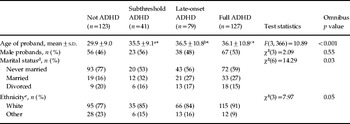
Based on the retrospective reports of ADHD, we classified probands into the following lifetime diagnostic categories: full ADHD met full DSM-IV criteria for ADHD with onset of some symptoms prior to age 7 (n=127). Late-onset ADHD met full DSM-IV criteria for ADHD except for age at onset (n=79). Because we did not place any restrictions on the age at onset for the late-onset group, the range of age at onset was wide (7–45 years); 63% had an age at onset of 7, 8 or 9 years and 83% had onset in the age range 7–12 years. Subthreshold ADHD was defined as never having met DSM-IV criteria for ADHD and reporting a chronic history of three or more inattentive symptoms or three or more hyperactive-impulsive symptoms (n=41). We defined this symptom cut-off based on our previous work (Biederman et al. Reference Biederman, Mick and Faraone2000). The remaining subjects were defined as not ADHD (n=123). The four comparison groups did not differ in gender or marital status (Table 1). Because probands without ADHD were younger and less likely to be Caucasian, all analyses corrected for age and ethnicity.
Demographic features

ADHD, Attention deficit hyperactivity disorder; s.d., standard deviation.
For the omnibus test, the Bonferroni significance level is 0.02.
For pairwise comparisons:
a versus controls; bversus subthreshold ADHD; cversus late-onset ADHD; d Multinomial logistic regression; e Logistic regression.
* p⩽0.001.
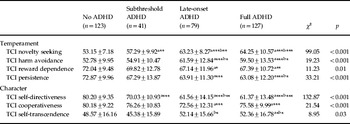
Table 2 shows the TCI subscale scores for each group. Late-onset and full ADHD were not significantly different from each other in any TCI dimension. We found no significant differences between subthreshold ADHD and subjects without ADHD in TCI harm avoidance, reward dependence, persistence cooperativeness and self-transcendence. Late-onset and full ADHD had TCI scores significantly different from subjects without ADHD in every dimension except reward dependence and self-transcendance. Subthreshold ADHD had significantly higher TCI novelty-seeking scores than no ADHD; both late-onset and full ADHD had higher TCI novelty-seeking scores than subthreshold ADHD. Late-onset and full ADHD had significantly lower self-directedness scores than subthreshold ADHD.
TCI scores across four strata of adult ADHD

TCI, Temperament and Character Inventory; ADHD, attention deficit hyperactivity disorder.
Values are given as mean±standard deviation.
a versus no ADHD; bversus subthreshold ADHD.
* p⩽0.05, ** p⩽0.01, *** p⩽0.001.
We found significantly higher TCI harm avoidance scores in late-onset and full ADHD than in subthreshold ADHD. Both late-onset and full ADHD had significantly lower TCI harm avoidance scores than subthreshold ADHD. Full ADHD had significantly lower TCI persistence scores than subthreshold ADHD. Both late-onset and full ADHD had higher TCI self-transcendence scores than subthreshold ADHD.
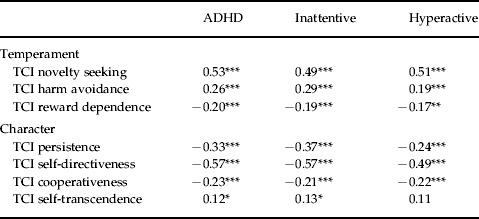
Table 3 shows the correlations between the TCI dimensions of temperament and character and three classes of ADHD symptoms: inattention, hyperactivity and impulsivity. Except for self-transcendance, each TCI dimension was significantly correlated with each type of ADHD symptom. All findings remained significant after controlling for major depression, bipolar disorder and multiple anxiety disorder (i.e. two or more anxiety disorders).
Correlations between TCI dimensions and ADHD symptoms

TCI, Temperament and Character Inventory; ADHD, attention deficit hyperactivity disorder.
Correlation coefficients for number of ADHD symptoms, Inattentive ADHD symptoms and Hyperactive ADHD symptoms with TCI dimensions, for all probands (not ADHD, subthreshold ADHD, late-onset ADHD, full ADHD; n=370).
* p<0.05, ** p<0.01, *** p<0.001.
Discussion
We have examined personality traits to provide further information about the validity of diagnosing ADHD in adults when the onset is late or the numbers of symptoms reported from childhood are subthreshold. As hypothesized, we found that full ADHD and late-onset ADHD showed similar personality profiles with significant deviations on all TCI scales except reward dependence and self-transcendence. By contrast, subthreshold cases only showed deviations on novelty seeking and self-directiveness. Our findings could not be accounted for by differences in psychiatric co-morbidity among subgroups. These data further the notion of the similarities between late-onset ADHD and full ADHD, further calling into question the stringent age at onset criteria for adults when making retrospective diagnoses of ADHD.
Our results regarding age at onset are consistent not only with our prior work described in the introduction (Faraone et al. Reference Faraone, Biederman, Doyle, Murray, Petty, Adamson and Seidman2006b, Reference Faraone, Biederman, Spencer, Mick, Murray, Petty, Adamson and Monuteauxc, Reference Faraone, Wilens, Petty, Antshel, Spencer and Biederman2007b) but also with work from other groups. One study comparing teenagers with onset before or after age 13 found no link between age at onset and severity of symptoms, types of adjustment difficulties or the persistence of ADHD (Schaughency et al. Reference Schaughency, McGee, Raja, Feehan and Silva1994). Rohde et al. (Reference Rohde, Biederman, Zimmermann, Schmitz, Martins and Tramontina2000) compared clinical features between adolescents meeting full criteria for ADHD and those meeting all criteria except age at onset. Because these two groups had similar profiles of clinical features, the authors concluded that the DSM-IV age at onset criterion should be revised. In an epidemiologically ascertained sample of adolescents, Willoughby et al. (Reference Willoughby, Curran, Costello and Angold2000) found that adolescents meeting full criteria for combined type ADHD had worse clinical outcomes than those failing to meet the age at onset criterion but found no differences attributable to age at onset for the inattentive subtype of ADHD. In DSM-IV field trials, requiring an age at onset of 7 reduced the accuracy of identifying currently impaired cases of ADHD and reduced agreement with clinician judgments (Applegate et al. Reference Applegate, Lahey, Hart, Biederman, Hynd, Barkley, Ollendick, Frick, Greenhill, McBurnett, Newcorn, Kerdyk, Garfinkel, Waldman and Shaffer1997).
We were particularly interested in the subthreshold group because our prior work suggested that this group might be heterogeneous, with some cases having an atypical manifestation of ADHD and others not. If, when compared with full ADHD, this group had a qualitatively different set of personality traits, we should have seen a marked difference in their personality profiles. We did not. However, as Table 2 shows, the deviations of the subthreshold group from the non-ADHD group, albeit smaller, are in the same direction as the deviations we observed for late-onset and full ADHD. Our findings for the subthreshold group are consistent with prior papers of ours in which, compared with full ADHD, we found lower rates of familial ADHD (Faraone et al. Reference Faraone, Biederman, Spencer, Mick, Murray, Petty, Adamson and Monuteaux2006c), psychiatric co-morbidity (Faraone et al. Reference Faraone, Biederman, Spencer, Mick, Murray, Petty, Adamson and Monuteaux2006c), substance use disorders (Faraone et al. Reference Faraone, Wilens, Petty, Antshel, Spencer and Biederman2007b) and neuropsychological dysfunction (Faraone et al. Reference Faraone, Biederman, Doyle, Murray, Petty, Adamson and Seidman2006b) for subthreshold subjects. However, in each of these domains, the subthreshold subjects were more impaired than non-ADHD controls. Such data support the idea that ADHD, like blood pressure, is a dimensional trait.
Several other lines of evidence suggest that a dimensional perspective on ADHD is valid. Many studies have found an excellent correspondence between quantitative measures of ADHD (e.g. scales derived from the Child Behavior Checklist, the Conners Scales and the ADHD Rating Scale IV) and the categorical diagnosis (Edelbrock, Reference Edelbrock1986; Bird et al. Reference Bird, Canino, Gould, Ribera, Rubio-Stipec, Woodbury, Huertas-Goldman and Sesman1987; Biederman et al. Reference Biederman, Faraone, Doyle, Lehman, Kraus, Perrin and Tsuang1993, Reference Biederman, Faraone, Mick, Moore and Lelon1996; Chen et al. Reference Chen, Faraone, Biederman and Tsuang1994; Boyle et al. Reference Boyle, Offord, Racine, Szatmari, Sanford and Fleming1997; Hudziak, Reference Hudziak, Blum and Noble1997). These studies suggest that children with ADHD are at one extreme of a quantitative dimension and that, on this quantitative dimension, there is no obvious bimodality that separates children with ADHD from other children.
Quantitative measures of ADHD are highly heritable, about 70–90%, which is similar to the heritability of the ADHD diagnosis (Edelbrock et al. Reference Edelbrock, Rende, Plomin and Thompson1995; Thapar et al. Reference Thapar, Hervas and McGuffin1995; Silberg et al. Reference Silberg, Rutter, Meyer, Maes, Hewitt, Simonoff, Pickles and Loeber1996; Judy et al. Reference Judy, Silberg, Meyer, Maes, Simonoff, Pickles, Rutter, Reynolds, Heath, Truett, Meale, Erikson, Loeber and Hewitt1997; Sherman et al. Reference Sherman, Iacono and McGue1997). In fact, twin studies of ADHD have generally applied dimensional rating scales, with clinical cut-offs applied when diagnostic categories were required. These studies all show high heritabilities regardless of where these cut-offs have been made and regardless of whether diagnostic or continuous criteria have been applied (Goodman & Stevenson, Reference Goodman and Stevenson1989a, Reference Goodman and Stevensonb; Stevenson, Reference Stevenson1992). Twin studies have used mathematical modeling techniques to directly test the hypothesis that the clinical diagnosis of ADHD is the extreme of a quantitative trait. Gjone et al. (Reference Gjone, Stevenson and Sundet1996) applied a mathematical model to determine if the heritability of attention problems increased with their severity. This model is useful because cases at the severe end of the dimension might be expected to have a categorical disorder such as ADHD. If ADHD accounted for the heritability of attention problems we would see increasing heritability with increasing severity. However, heritability did not change with severity, so the authors concluded that there was, in the population, a continuously distributed dimension of genetic liability to attention problems. A similar approach was applied by Levy et al. (Reference Levy, Hay, McStephen, Wood and Waldman1997), who concluded that ADHD was best viewed as the extreme of a behavior that varies genetically throughout the entire population rather than as a categorical disorder. Similar findings were reported by Willcutt et al. (Reference Willcutt, Pennington and DeFries2000). Thus, available data support the idea that ADHD can be viewed as the extreme expression of a trait that varies quantitatively in the population. This, in turn, suggests that personality deviations seen in ADHD can also be viewed from a dimensional perspective.
As Tables 2 and 3 show, ADHD was associated with deviations for each dimension of temperament. Our finding of elevated novelty seeking in ADHD confirms three prior studies of these personality traits in ADHD (Anckarsater et al. Reference Anckarsater, Stahlberg, Larson, Hakansson, Jutblad, Niklasson, Nyden, Wentz, Westergren, Cloninger, Gillberg and Rastam2006; Jacob et al. Reference Jacob, Romanos, Dempfle, Heine, Windemuth-Kieselbach, Kruse, Reif, Walitza, Romanos, Strobel, Brocke, Schafer, Schmidtke, Boning and Lesch2007) and in a sample of smokers with ADHD (Downey et al. Reference Downey, Pomerleau and Pomerleau1996). As discussed by Cloninger (Reference Cloninger1987), individuals high in novelty seeking are quick-tempered, curious, easily bored, impulsive, extravagant, and disorderly. We also found that ADHD was associated with increases in harm avoidance and decreases in reward dependence and persistence. Based on the work of Cloninger and co-workers (Cloninger, Reference Cloninger1987; Cloninger et al. Reference Cloninger, Przybeck and Svrakic1991; Svrakic et al. Reference Svrakic, Whitehead, Przybeck and Cloninger1993), we can interpret these traits as follows. People high in harm avoidance are fearful, socially inhibited, shy, passive, easily tired, and pessimistic even in situations that do not worry other people. Although the higher harm avoidance of ADHD subjects is consistent with ADHD's co-morbidity with anxiety disorders and depression (Biederman et al. Reference Biederman, Monuteaux, Mick, Spencer, Wilens, Silva, Snyder and Faraone2006; Kessler et al. Reference Kessler, Adler, Barkley, Biederman, Conners, Demler, Faraone, Greenhill, Howes, Secnik, Spencer, Ustun, Walters and Zaslavsky2006), the group differences we observed were not accounted for by these disorders, which suggests that this personality subscale may tap subclinical traits. The low persistence scores of adults with ADHD suggest that they tend to give up easily when frustrated, that they are less likely to strive for higher goals, and less likely to persevere at tasks. Low persistence is consistent with the executive functioning deficits seen in many patients with ADHD (Biederman et al. Reference Biederman, Petty, Fried, Fontanella, Doyle, Seidman and Faraone2007a, Reference Biederman, Petty, Fried, Doyle, Spencer, Seidman, Gross, Poetzl and Faraoneb). The low reward dependence seen in patients with ADHD suggests that they are practical, tough-minded, socially insensitive, and indifferent.
Tables 2 and 3 also show that ADHD was associated with TCI character dimensions. Adults with ADHD had increases in self-transcendence and decreases in self-directedness and cooperativeness. The higher self-transcendence seen for adults with ADHD suggests that they tend to be spiritual, unpretentious, humble, and fulfilled. Low self-directedness suggests that adults with ADHD are less responsible, reliable, resourceful, goal-oriented and self-confident and that they find it difficult to define, set and pursue meaningful internal goals. The results from the cooperativeness scale suggest that adults with ADHD show tendencies to being self-absorbed, intolerant, critical, unhelpful, and opportunistic. Such persons tend to be inconsiderate of other people's rights or feelings. These traits are consistent with ADHD's co-morbidities with ODD and conduct disorder.
Our findings should be viewed in light of some limitations. The diagnoses of ADHD relied entirely on the self-report of adult subjects. Although this method allowed us to evaluate the validity of retrospective self-reports, these findings may not generalize to diagnoses defined using data from informants. As Barkley et al. (Reference Barkley, Fischer, Smallish and Fletcher2002) showed in a study of youth followed into adulthood, informant reports can boost the validity of diagnosing ADHD in adulthood. In addition, because we had relatively few subthreshold subjects, our power to detect differences with this group was limited. Because we did not assess Axis II diagnoses, we cannot draw conclusions about personality disorders in our sample or the relationship between dimensional measures of personality and personality disorders. Because we have relied on retrospective diagnoses, our data cannot discriminate true age at onset effects from recall effects. For example, it is possible that cases of late-onset ADHD are simply patients who could not accurately recall the times when symptoms of ADHD first occurred.
Despite these limitations, these data suggest that, as regards the traits assessed by the TCI, adults with late-onset ADHD are very similar to adults with full ADHD, which provides further support for the idea that the DSM-IV age at onset criterion may be too stringent (Applegate et al. Reference Applegate, Lahey, Hart, Biederman, Hynd, Barkley, Ollendick, Frick, Greenhill, McBurnett, Newcorn, Kerdyk, Garfinkel, Waldman and Shaffer1997; Barkley & Biederman, Reference Barkley and Biederman1997; Faraone, Reference Faraone2000; Faraone et al. Reference Faraone, Biederman, Spencer, Wilens, Seidman, Mick and Doyle2000, Reference Faraone, Biederman, Doyle, Murray, Petty, Adamson and Seidman2006b, Reference Faraone, Biederman, Spencer, Mick, Murray, Petty, Adamson and Monuteauxc, Reference Faraone, Wilens, Petty, Antshel, Spencer and Biederman2007b). In the context of previous reports about psychiatric co-morbidity, family history and neuropsychological functioning and substance use disorders (Faraone et al. Reference Faraone, Biederman, Doyle, Murray, Petty, Adamson and Seidman2006b, Reference Faraone, Biederman, Spencer, Mick, Murray, Petty, Adamson and Monuteauxc, Reference Faraone, Wilens, Petty, Antshel, Spencer and Biederman2007b), our data about personality traits suggest that late-onset ADHD would meet Robins & Guze (Reference Robins and Guze1970) criteria for validity. Future research should consider what age of onset would provide the optimal balance for minimizing Type I and Type II diagnostic errors in ADHD. Although our current project did not address what age would provide the most parsimonious criterion, our data do suggest that age 7 may be too stringent. Subthreshold ADHD seems to be a milder form of the disorder. More work is needed to clarify their diagnostic status. Adults with late-onset or full ADHD should be considered for the diagnosis of ADHD with implications for treatment. Although our results have important implications for diagnostic criteria, because nearly all the TCI dimensions were deviant in ADHD cases, they appear to provide an overall index of poor functioning rather than yielding insights into the nature of personality in ADHD patients.
Acknowledgments
This work was supported in part by grants to S.V.F. from the National Institute of Health (R01MH57934).
Declaration of Interest
None.