1 Introduction
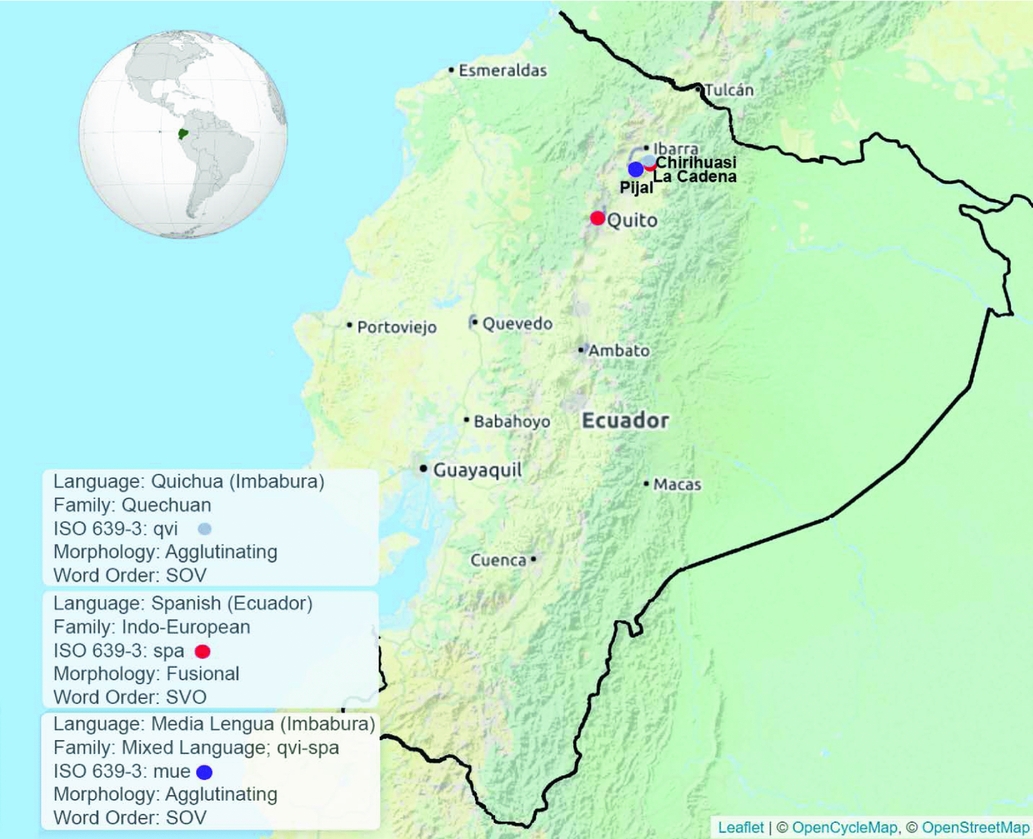
In the Ecuadorian province of Imbabura, there exists a dynamic language contact continuum that has resulted in a variety of contact scenarios involving Spanish and Quichua. This study focuses on five contact varieties identified graphically in Figure 1: (i) a rural variety of L2 Andean Spanish spoken by L1 Quichua bilinguals in the community of Chirihuasi (henceforth, L2 Spanish), (ii) another rural variety of Andean Spanish spoken as an L1 by monolinguals in the community of La Cadena (henceforth, Rural Spanish), (iii) Rural Imbabura Quichua also from Chirihuasi (henceforth, Quichua), (iv) Media Lengua, spoken in the community of Pijal, and (v) Urban Andean Spanish (henceforth, Urban Spanish) spoken in the nation's capital, Quito (located approximately 77 km to the south of Pijal, in the neighbouring province of Pichincha).
Map of Ecuador indicating the community of Pijal where Media Lengua is spoken (map created with Lingtypology, Moroz Reference Moroz2017).

Media Lengua is normally classified as a bilingual mixed language that preserves the majority of Quichua's systemic elements (e.g. phonological and morphosyntactic), while nearly its entire lexical inventory is of Spanish origin. In the following example of Media Lengua, the elements in bold are derived from Spanish; the first line contains orthography, the second – IPA transcription with morpheme boundaries, the third – interlinear glosses, and the fourth and fifth lines provide translations in Quichua and Spanish.

While there are varying degrees of sociolinguistic tolerance where these languages are spoken, conversations with speakers generally suggest the Spanish varieties carry the most prestige, with Urban Spanish taking the lead and Media Lengua carrying the least social prestige.
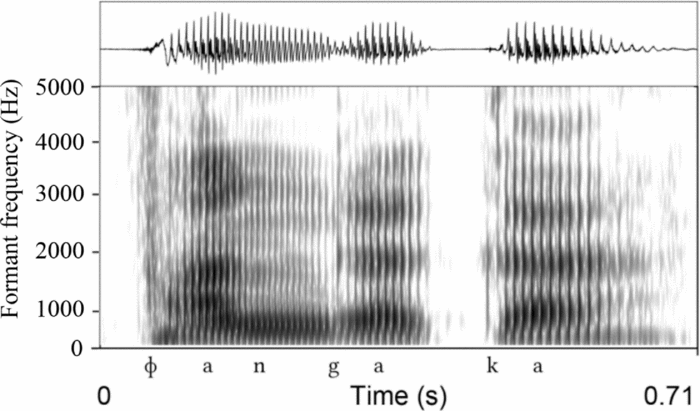
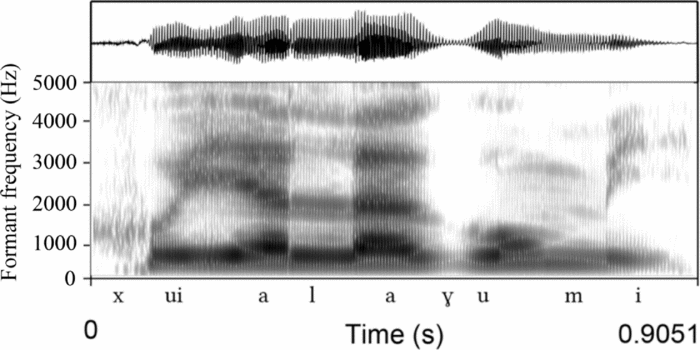
One of the more transparent phonemic conflict sites (areas of the phonology where the structure of each language differs) involving these language varieties is the contrastive voicing of stops found in Spanish and the lack of a stop voicing contrast in Quichua. The primary goal of this study is to explore how Quichua and Media Lengua speakers deal with this phonological difference by examining the degree of phonological integration of the voiced stop series. This is carried out through an analysis of voice onset time (VOT) in word-initial stops present in Spanish lexical borrowings in Quichua and Media Lengua. In addition, Quichua's influence on the VOT of voiced stops in Rural and L2 Spanish is also explored. The Spanish stop inventory includes bilabial /p/, coronal /t/, and velar /k/ (all short-lag VOT) along with their voiced counterparts: /b/, /d/, and /ɡ/ (all with negative VOT). While the stop series of Imbabura Quichua has virtually the same places of articulation as those found in Spanish: /p/, /t/, and /k/ (all short-lag VOT), Cole (Reference Cole1982: 199) describes Imbabura Quichua /t/ as ‘apico-alveolar’ and Orr (Reference Orr1962: 60) describes the same sound as alveolar. As a result, the term coronal will be used in reference to /t/ throughout this study. With the exception of Spanish borrowings, stop voicing is non-contrastive in Quichua. However, post-nasal stops undergo allophonic voicing (see Figure 2), and intervocalic stops often voice and weaken to [β], [ð], and [ɣ] (e.g. the /ɡ/ in Figure 3).
ɸanka-ka (paper-top) ‘paper’ (Consultant #77).

xuyala-gu-mi (love-dim-val) ‘pretty’ (Consultant #69).

1.1 VOT production in mixed languages
One of the rarest forms of language contact involves mixed languages, which form under situations of advanced bilingualism and often involve the wholesale exchange of entire word classes or the complete replacement of an entire lexicon with another (see Bakker & Mous Reference Bakker and Mous1994, Bakker Reference Bakker2003, Matras & Bakker Reference Matras and Bakker2003, Meakins Reference Meakins2013, Meakins & Stewart to appear). One of the most interesting areas in mixed language research involves the interactions and subsequent arrangements of their source phonologies. The degree of bilingualism and large-scale lexical replacement provide speakers with additional phonological processes to choose from beyond conventional assimilation and integration of sounds. Such a choice is not available to monolingual speakers, who may only adopt a handful of lexical items, nor are they be available to the same extent during the formation of creoles, since speakers are often not proficient in both languages. Van Gijn (Reference van Gijn2009) provided a theoretical account of mixed language phonology suggesting that the phonology from the language introduced post-contact (henceforth the introduced language) integrates into the ancestral language (the native pre-contact language) based on the type of borrowings and their relation to the prosodic hierarchy. For example, in mixed languages such as Michif, a Plains Cree-French mixed language with a split between noun and verb phrases, French origin noun phrases are expected to maintain French phonological structure, whereas Cree verb phrases should conserve Cree phonology (van Gijn Reference van Gijn2009). For Media Lengua, an agglutinating language with a split between lexical items and grammatical elements (see Muysken Reference Muysken and Thomason1997, Gómez-Rendón Reference Gómez-Rendón, Olbertz and Muysken2005, Stewart Reference Stewart2015a), van Gijn argues that because elements from both languages are found at the prosodic word level (Spanish stems and Quichua suffixes), they should conform to Quichua phonology. Example 2 illustrates a Media Lengua sentence in which each prosodic word (identified by an L+H* pitch accent on or near the penultimate syllable) contains a lexical item from Spanish (italics) and grammatical elements from Quichua (plain).

While this analysis provides a reasonable degree of predictability for impressionistic observations, not every Media Lengua utterance contains lexical and grammatical elements from both source languages. This analysis also falls short when predicting the phonological reality of other mixed languages (see e.g. Rosen Reference Rosen2006, Reference Rosen2007; Jones & Meakins Reference Jones and Meakins2013).
Research into mixed language phonology using acoustic measurements shows that while there is a strong propensity for mixed languages to maintain the ancestral phonology, they also exhibit a number of phonological changes that are not predicted by van Gijn's model. For example, under van Gijn's predictions Media Lengua should assimilate the five-vowel system of Spanish to the three-vowel system of Quichua; instead, however, it maintains the mid-vowels of Spanish /e/ and /o/, albeit with considerable overlap with /i/ and /u/ respectively (see Stewart Reference Stewart2014). Michif adopts only five of a possible thirteen vowels from French while the rest conform to Cree in F1 and F2 formant frequency and length (Rosen, Stewart & Cox Reference Rosen, Stewart and Cox2016). Under van Gijn's model, all thirteen French vowels should be preserved in French borrowings. Finally, Gurindji Kriol, a mixed language with a split between verb phrases (Kriol origin) and noun phrases (Gurindji origin), assimilates Kriol voiced stops to voiceless Gurindji stops when they should be maintained as separate phonemes under the van Gijn model (see Jones & Meakins Reference Jones and Meakins2013).
The variety of ways in which a mixed language sound system emerges better reflects the speech patterns of mid to late bilinguals akin to those found in Guion (Reference Guion2003). In Guion's analysis, simultaneous (Quichua–Spanish) bilinguals were shown to maintain distinct categories for vowels with the same basic quality (e.g. Spanish /i/ and Quichua /i/). In contrast, early bilinguals overlapped Spanish /i/ with Quichua /i/, while late bilinguals overlapped both Spanish /i/ and /e/ with Quichua /i/.
Meakins & Stewart (to appear) put forth two working hypotheses as to why the acoustic realities of mixed language phonologies do not follow the binary pattern of ‘assimilate or integrate’ proposed by van Gijn (Reference van Gijn2009). One hypothesis proposes that mixed languages are indeed created by mid to late bilinguals with an advanced L2 knowledge of the introduced language. The result of having an advanced, yet non-native, knowledge of the introduced language might make speakers aware of non-native categories even if they are unable to fully acquire them. This could lead to the partial overlap of categories instead of complete assimilation.
A second hypothesis suggests that during the large-scale transfer of lexical items, the adoption or partial adoption of a sound from the introduced language may be warranted to maintain an optimal working phonology in the new language. For example, if the introduced lexicon contains contrastive sounds with a high functional load, losing such a contrast through assimilation might place a strain on communication due to the appearance of ambiguities. There are undoubtedly a number of sociolinguistic processes that also play a role in shaping the phonology of a mixed language. For example, it has been argued that mixed languages are purposely created to mark a new ethnic identity (Bakker & Mous Reference Bakker and Mous1994: 2; Meakins Reference Meakins2011: 38). As such, the yearning to disassociate oneself from the ancestral language through a new language might manifest through deliberate sound changes.
Because of the unpredictable nature of phonological interactions in mixed languages, it is hoped that the evidence presented here will help in the pursuit of revealing the phonetic underpinnings of these languages. This study seeks to answer two questions regarding the production of VOT in word-initial stops in Media Lengua, Quichua, and Spanish. First, do Media Lengua and/or Quichua speakers merge Spanish-origin voiced stops with their voiceless Quichua counterparts, or do they integrate the voiced stop series into their respective languages? For example, does the VOT of /b/ in the Spanish origin word barato [baˈɾato] ‘cheap’ become /p/ ([paˈɾatu]) when borrowed into Media Lengua and/or Quichua, or is the /b/ maintained? Second, is there variation in the production of stop VOTs across L2, Rural, and Urban Spanish? For example, are the VOT values of Rural Spanish /b/ longer or shorter than Urban Spanish /b/?
1.1.2 Spanish voice onset time production
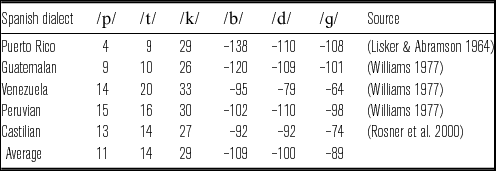
As mentioned in Section 1, the phonemic inventory of Spanish contains a two-way voicing contrast: pre-voicing (negative) VOT vs. short-lag (unaspirated) VOT, among bilabial, coronal, and velar stop pairs (/p/–/b/, /t/–/d/, and /k/–/ɡ/). The primary phonetic correlate of this contrast is VOT: the voiced stops have long negative VOT (or long pre-voicing), while the voiceless stops have short-lag VOT. Spanish dialects, however, have been shown to have variation regarding their average VOT values (see Table 1).Footnote 1 These data suggest that pre-velar voiceless stops in Puerto Rican and Guatemalan Spanish have shorter durations compared to those of other dialects, whereas both Venezuelan and Castilian appear to have shorter negative VOT durations in the voiced series of stops.
Average VOT values across five Spanish dialects.

1.1.3 QuechuaFootnote 2 voice onset time production
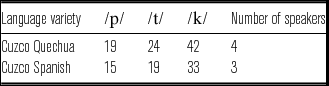
As mentioned previously, the phonemic inventory of Quichua contains a similar voiceless stop series to that of Spanish (/p/, / t/, and /k/), but lacks a contrastive voiced series (with the exception of Spanish borrowings). While many studies that have analysed Spanish VOT, only a handful have looked at acoustic correlates of VOT in a Quechuan language. Pasquale (Reference Pasquale, López and Lacorte2005) analysed VOT from Cuzco Quechua spoken in Peru, and VOT from Spanish speakers from the same region. The average durations from his study are presented in Table 2. Pasquale's analysis revealed significant differences between Cuzco Spanish and Cuzco Quechua VOT in both alveolar and velar stops but not in the bilabial pairs. These findings suggest that Cuzco Quechua stops have slightly longer VOT than Cuzco Spanish. However, it should be noted once more that some of the differences are very small and their significance is unclear based on the number of speakers in this study.
Average VOT values for Cuzco Quechua (top) and Cuzco Spanish (bottom); after Pasquale (Reference Pasquale, López and Lacorte2005).

Several other social and linguistic factors that also play a role in the realisation of VOT are considered in this study. For English, Lisker & Abramson (Reference Lisker and Abramson1967), Cooper (Reference Cooper1991), and Pierrehumbert & Talkin (Reference Pierrehumbert, Talkin, Docherty and Ladd1992) report that the VOT of a stop in an unstressed position is likely to be shorter than that of the same stop in a stressed position. Berry & Moyle (Reference Berry and Moyle2011) for English, Bijankhan & Nourbakhsh (Reference Bijankhan and Nourbakhsh2009) for Persian, Esposito (Reference Esposito2002) for Italian, Fischer-Jørgensen (Reference Fischer-Jørgensen1980) for Danish, and Higgins, Netsell & Schulte (Reference Higgins, Netsell and Schulte1998) for English, among others, show that VOT values are substantially shorter in careful speech when preceding a low vowel (e.g. [a]). Similarly for Glasgow English, Stuart-Smith et al. (Reference Stuart-Smith, Sonderegger, Rathcke and Macdonald2005) also show place of articulation, speech rate, vowel height, and word frequency significantly effect VOT in spontaneous speech. Additional evidence reported by Fischer-Jørgensen (Reference Fischer-Jørgensen1954) for Danish, Lisker & Abramson (Reference Lisker and Abramson1964) for eleven languages, Peterson & Lehiste (Reference Peterson and Lehiste1960), and Zue (Reference Zue1976) for English, reveal that the VOT of voiceless velar stops are longer in duration than VOTs of more fronted voiceless stops. Because of these findings, stress, collection method (wordlist vs. elicited speech), place of articulation, and post-stop vowel are considered in the statistical models presented in Section 3.
The last aspect of VOT considered here involves the age of a speaker. This was a particularly important variable to control for, as there are a number of contradictory studies on the role age plays in VOT production. For English, Benjamin (Reference Benjamin1982), Ryalls, Simon & Thomason (Reference Ryalls, Simon and Thomason2004), and Torre & Barlow (Reference Torre and Jessica2009) suggest that younger speakers tend to produce longer VOTs than their older counterparts whereas Neiman, Klich & Shuey (Reference Neiman, Klich and Shuey1983) and Petrosino et al. (Reference Petrosino, Colcord, Kurcz and Yonker1993) found no age-based effect on VOT production. In contrast, Stuart-Smith et al. (Reference Stuart-Smith, Sonderegger, Rathcke and Macdonald2005) showed that older speakers of venacular Glasgow English lengthened their VOTs compared to younger speakers, and Flege & Eefting (Reference Flege and Eefting1986) demonstrated that English and Spanish speaking children produced alveolar stops with shorter VOTs than adults. Moreover, when taking into account both age and speech rate, Kessinger & Blumstein, (Reference Kessinger and Blumstein1997) for Thai, French, and English, and Wesimer, Ellis & Chicouris (Reference Weismer, Weismer and Chicouris1979) for English, both showed that older speakers tend to have slower speech rates and should, therefore, produce longer VOTs.
2 Method
2.1 Participants
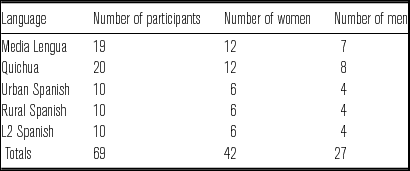
Speakers from three distinct language groups (Media Lengua, Quichua and Spanish) participated in this study. For Media Lengua, 19 trilingual speakers of Quichua, Media Lengua, and Spanish from the community of Pijal participated in this study. This group consisted of 12 women and seven men. Seventeen participants (10 women and seven men) were native speakers of Media Lengua and Quichua (acquiring both simultaneously from birth) and began learning Spanish upon entering primary school, typically at 6–7 years of age. The other two participants’ L1 was Spanish and they passively acquired Media Lengua and Quichua due to constant exposure in the community.
Twenty Quichua-speaking participants also participated in this study and all were bilingual (Quichua- and L2 Spanish-speaking) and had low-to-high proficiencies in Spanish. This group consisted of 12 women and eight men. Four women had a rudimentary level of Spanish, one man and one woman were simultaneous bilinguals, and one man acquired Spanish at the age of 18 while the rest acquired Spanish upon entering primary school, typically at 6–7 years of age. Participants were born and raised in the neighbouring communities of Chirihuasi and Cashaloma, and they lived there at the time of recording. These slightly more distant Quichua/Spanish-speaking communities were chosen instead of Pijal to collect Quichua data to avoid any influence from Media Lengua on their speech.
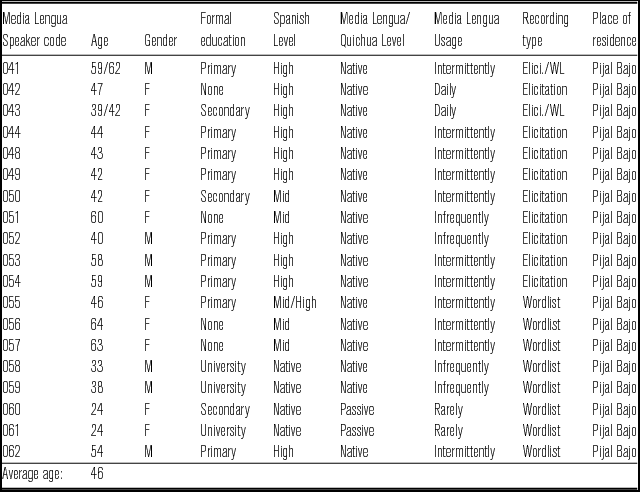
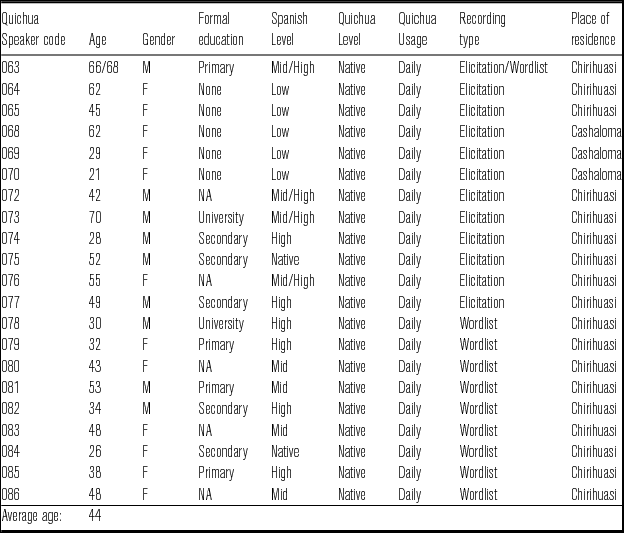
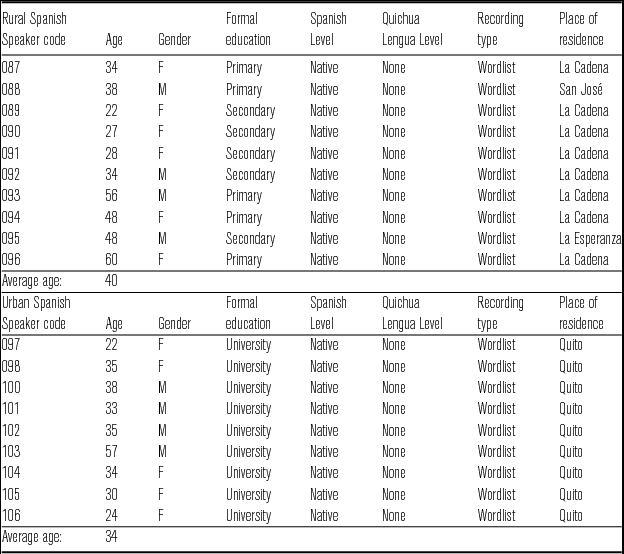
Thirty Spanish-speaking participants, 10 from each dialect group, took part in this study. From each dialect, six participants were women and four were men (for a total of 18 women and 12 men from all three groups). Both the Urban and Rural Spanish groups consisted of monolinguals with little or no knowledge of Quichua. From the Urban Spanish group, all speakers had graduated from college, were born and raised in Quito, and lived there at the time of recording. From the Rural Spanish group, speakers had mixed educational backgrounds ranging from primary to secondary school. Nine participants were born and raised in the neighbouring communities of La Cadena and La Esperanza and they lived there at the time of recording. One participant was from the community of San José near Otavalo but conducted business in the abovementioned communities. These communities were chosen because of their proximity to Chirihuasi, where the L2 data originated. Any variation in the rural L1 and L2 Spanish-speaking groups was likely related to a conscious or subconscious effort by the participants to distinguish themselves from the other group. The L2 group consisted of the same 10 participants from the Quichua group. Table 3 summarises key information on the participants in this study. Tables A1–A3 in Appendix A contain detailed information about each individual participant including: speaker code, age at the time of recording, sex, education, level of Spanish, Quichua, and Media Lengua, and place of residence.
Participant count summary.

2.2 Materials
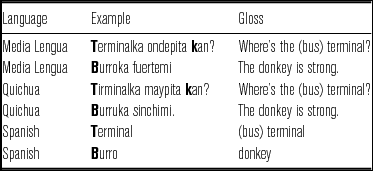
Voice onset time data came from two data sets collected by the author. The first consisted of elicited Media Lengua and Quichua translations, which constituted 35% (2,716) of the tokens under analysis. These data were elicited from a list of 2,000 Spanish sentences. Words containing all six Spanish origin stops (/p/, /t/, /k/, /b/, /d/, and /ɡ/) were present in all phrasal positions (initial, medial, and final). All six stops were also found preceding all five Spanish origin vowels (/a/, /e/, /i/, /o/, and /u/). Table 4 provides two sample sentences from the elicitation list with responses in Media Lengua and Quichua. A subset of this list, made up of 100 Spanish sentences, was used for shorter Media Lengua and Quichua elicitation sessions lasting approximately 15 minutes. Seven of the ten Media Lengua participants and nine of the eleven Quichua participants who took part in the elicitation sessions participated in these short sessions. The resulting Media Lengua translations contained Spanish lexical borrowings with all six Spanish stops in word-initial position in combination with all five Spanish vowels. All three native Quichua stops (/p/, /t/, /k/) in word-initial position were also present in the translations in combination with all three Quichua vowels (/a/, /i/, /u/). The resulting Quichua translations also included words with all three native Quichua stops in word-initial position in combination with all three native Quichua vowels. In addition, the Quichua translations also included Spanish borrowings containing the word-initial syllables /pe/, /te/, /ke/, /ko/, /be/, /bi/, /bo/, /bu/, /da/, /di/, /du/, /ɡa/, and /ɡo/.
Example sentences from the word and sentence reading lists. Bold text mark stops that were analysed in this study.

The second data set consisted of two reading lists (see Table B1 in Appendix B), a wordlist for Spanish elicitations and a sentence list containing the same Spanish borrowings in word-initial position. The Spanish wordlist was used instead of sentences to avoid sentence-initial articles that would shift the target stop segment to an utterance-medial position. However, Media Lengua and Quichua required sentences to prime the target language, e.g. seeing the word caña [ˈkaɲa] ‘cane/stick’ instead of cañawanmi [kaɲaˈwanmi] ‘cane-inst-val’ might cause a more Spanish-like pronunciation since Media Lengua and Quichua speakers also speak Spanish. Data from the lists constituted 65% (5,143 tokens) of the total data from all five language varieties. The total number of tokens under analysis from both data sets totalled 7,859. Table 4 provides example words and sentences from the word and sentence lists from each language.
2.3 Procedures
Tokens were analysed from two data sets which differed in how the speech data were gathered. The first included data gathered through elicitation sessions (Section 2.3.1) and the second includes data gathered through the reading of wordlists and/or sentence lists (Section 2.3.2).
2.3.1 Elicitation sessions
For the elicitation sessions, either the author (a fluent non-native Spanish speaker) or a native Urban Spanish-speaking assistant explained the task and received voluntary written consent from the participants before each session began. Prior to beginning the task, demographic information was also gathered from the participants. For the Media Lengua participants, each sentence was read aloud in Spanish by the author or the assistant from a printout of the sentence list. The same sentence list was also read aloud by the author or the assistant in Spanish for the Quichua participants, and a native Quichua speaker from Chirihuasi interpreted if confusion arose. Data were gathered from 10 Media Lengua speakers and 11 Quichua speakers (see appendix Table A1). Since a native speaker of Media Lengua or Quichua did not read the sentences, there may be an increased chance of accommodation to Spanish. To help reduce Spanish influence, elicitation sessions were held with three or more participants in their homes, and they were asked to speak in their language when consulting amongst themselves. Even if accommodation was an issue, we would expect an equal effect in both Media Lengua and Quichua since the elicitation conditions were the same. Because intra-language variation within individual words was also investigated, imagining a scenario where a speaker might only accommodate just one portion of a word and not the rest would be difficult.
During the elicitation sessions, participants were asked to give their best oral translation of a sentence from Spanish into the target language and wait at least five seconds before producing their translation. Participants were encouraged to consult with speakers if any doubts arose. Consultations with other participants and the five-second waiting period made it more likely that speakers were accessing their long-term memory and reducing mimicry (Guion Reference Guion2003). Participants were also asked to speak at a normal conversational speed and to repeat their utterance if needed. Although this method of data elicitation may have produced idealised specimens compared to the realities of spontaneous speech, it was preferred to limit the degree of variation due to the number of language varieties under analysis, and to provide a relatively consistent baseline for future research. Responses from the elicited sentence list were recorded in 16-bit Waveform Audio File Format (WAV) with a sample rate of 44.1 kHz on a TASCAM DR-1 portable digital recorder using TASCAM's compatible TM-ST1 MS stereo microphone set to 90˚ stereo width.
2.3.2 Reading sessions
For the reading sessions, the participants were informed that they would be asked to read a series of short sentences (for the Quichua and Media Lengua groups) or words (for the Spanish groups) from a computer screen and that their responses would be recorded. As with the elicitation sessions, written consent was received and demographic information was gathered before the session began. Eleven Quichua- and nine Media Lengua-speaking participants participated in the reading sessions (one Quichua- and two Media Lengua-speaking participants participated in both the elicitation and reading sessions). If a participant could not read (two cases in both Media Lengua and Quichua), the author (twice, once for each language) or the assistant (twice, once for each language) read the sentence and ask the participant to repeat it twice. The second utterance was used for analysis. If a participant struggled with reading, he or she would be asked to repeat the sentence from memory to allow for a more naturalistic sample. The same sentence list was used for both Media Lengua and Quichua elicitations to maintain similar data gathering conditions.
Readings of the sentence list and wordlist data were recorded using a NEXXTECH unidirectional dynamic microphone (50–13,000 Hz response) set to 90˚ stereo width. Both elicitation and reading sessions were recorded in 16-bit Waveform Audio File Format (WAV) with a sample rate of 44.1 kHz.
2.4 Measurements
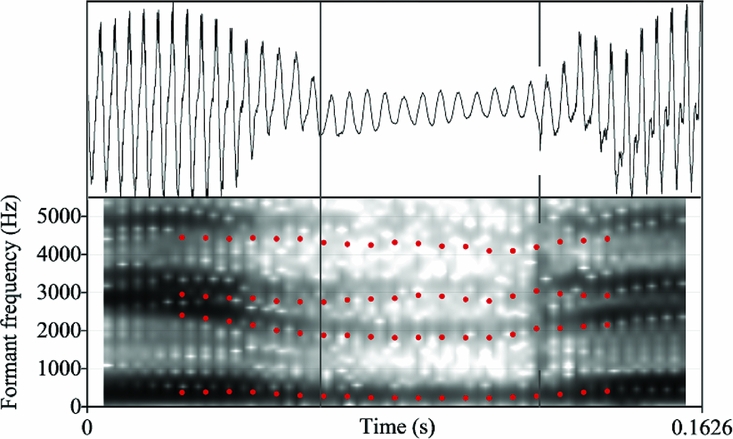
Voice onset times from all five language varieties were measured using Praat version 5.3.47 (Boersma & Weenink Reference Boersma and Weenink2013) with a script written by the author. To avoid lenited stops only utterance-initial stops were measured. Positive VOT was measured from the initial burst of the voiceless stops to the onset of voicing and negative VOT was measured from the first instance of voicing to the onset of the burst. These more restricted criteria were chosen over more standard methods of VOT measurement (e.g. full formant structure) in an attempt to reduce individual speaker and cross-language variation. Word-initial /b/ and /ɡ/ in utterance-medial position rarely showed signs of closure due to co-articulatory effects from the previous word's final segment (e.g. the first /ɡ/ in Perroka gatowan amigashka [p ˈʐ
 ka ɡaˈtwaŋ amiˈɣaʃka] ‘It turns out the dog and cat are friends’). These segments were still considered to be stops as opposed to fricatives if they showed a noticeable release (Figure 4). Under these circumstances, VOT was measured from the beginning of a steady state of either the wave form or Praat's formant track (if the wave form was not consistent).
Example of a word-medial voiced VOT measurement.

2.5 Statistical analysis
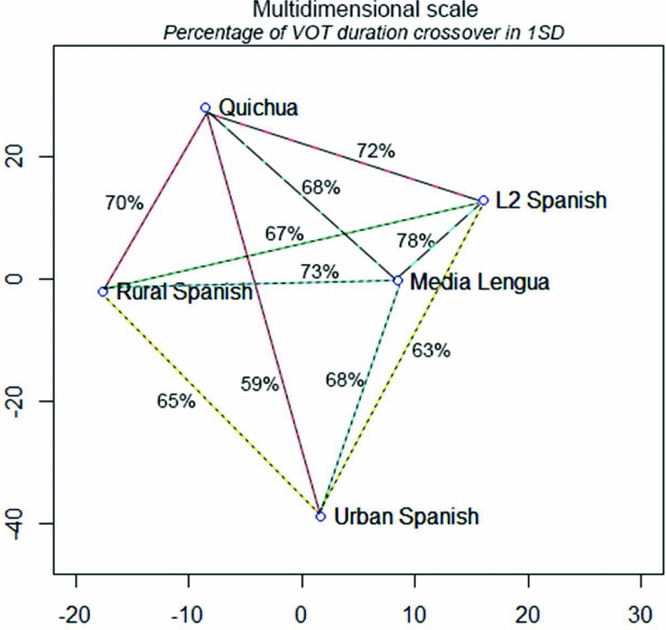
Multidimensional scaling was used in Section 3.1. This technique compares the similarities in VOT duration across each of the language varieties based on one standard deviation. Multidimensional scaling uses a matrix of distances to track structure (Baayen Reference Baayen2008). When a distance matrix is graphed in a three-dimensional space, the distances between a given variable (e.g. VOT) can be observed across multiple points (e.g. language varieties) (see Figure 5 in Section 3).
Multidimensional scale of the negative VOT distances between each language variety based on one standard deviation.

To help validate the multidimensional scaling results, mixed effects models were built for each language variety in Sections 3.2 and 3.3. The models were created in R x64 3.1.0 with the lmer function from the lme4 package (Bates Reference Bates2012). 95% confidence intervals (CI95), and p-values were estimated using the confint and summary functions from the lmerTest package (Kuznetsova, Brockhoff & Bojesen Reference Kuznetsova, Brockhoff and Bojesen2014). All models included speaker and word as random effects. Non-significant predictors were removed from the models one-by-one based on the closest t-value to zero, until only significant predictors remained. The models reported here contain no non-significant predictors.
The following fixed predictors were considered when building the models: sex (male/female), age (in years; levels: 22–70, 40), stress (stressed/unstressed position), language from which the stop originated (Spanish/Quichua), post-stop segment (vowels: front, back, and low; liquids), utterance position (initial, medial, and final), education (high/low), level of Spanish (high/low), and collection method (elicitation/wordlist).
3 Results
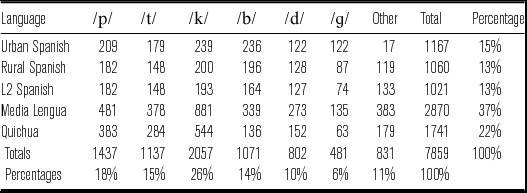
Table 5 provides the breakdown of the entire VOT data set by frequency and language. The voiceless velar /k/ was the most common stop (26%) in the data set whereas the voiced velar /ɡ/ was the least common (6%). The majority of tokens were from Media Lengua (37%) while rural Spanish and L2 Spanish contributed 13% each.
Number of VOT tokens by place of articulation, voicing, and language variety.

3.1 Multidimensional scaling analysis
The similarities in negative VOT duration across each language variety are considered based on the number of VOT measurements from each language that fit within one standard deviation. For example, the VOT average of Media Lengua [b] is −95 ms with a standard deviation of 41 ms, which gives a range from −136 ms to −54 ms (–95–41; –95+41) (see Equation 1 below). Next, the number of voiced bilabials ([b]) from each language variety within this range is extracted independently, and divided by the total number of [b]s from the language under analysis. Next, this result is multiplied by 100 then subtracted from 100 (see Equation 2). For example, there are 82 instances of Quichua voiced bilabial VOTs that fall within one standard deviation of Media Lengua voiced bilabial VOTs out of a total of 137 instances. These 82 instances are divided by the 137 total instances, which results in .60. This value is then multiplied by 100 to get 60%, which is then subtracted from 100 (to get 40%). This provides the distance in percentage between Media Lengua and Quichua [b] based on one standard deviation. This method is then repeated for each voiced stop, and the resulting percentages from all three places of articulation are averaged, thus giving us the distance between the voiced stops across all the language varieties. When arranged in a distance matrix, the resulting calculations reveal the similarities in VOT across the language varieties based on their durations.
Equation 1
The standard deviation range based on the mean average; a is the low range, and b is the high range.
 $$\begin{equation*}a = \left( {\frac{{\sum {x_i}}}{n}} \right) - \left( {\frac{{\sqrt {\sum {{(x - \bar{x})}^2}} }}{{n - 1}}} \right){\rm{\ }}b = \left( {\frac{{\sum {x_i}}}{n}} \right) + \left( {\frac{{\sqrt {\sum {{(x - \bar{x})}^2}} }}{{n - 1}}} \right)
\end{equation*}$$
Equation 2
The distance in percentage based on the number of items within the range in Equation 1 divided by the total number of items.
$$\begin{equation*}Dinstance{\rm{\ \% }} = 100 - \left( {\left( {\frac{{n{\rm{\ }}within{\rm{\ }}a{\rm{\ }}and{\rm{\ }}b}}{n}} \right){\rm{*}}100} \right)\end{equation*}$$


Based on one standard deviation from the mean average, Media Lengua differs from Quichua by 31.9%, L2 Spanish by 22.1%, Rural Spanish by 26.1%, and Urban Spanish by 32.1%. These results show that Media Lengua and L2 Spanish are the most similar with the lowest number of stops with negative VOT values outside one standard deviation. The largest distance was between Quichua and Urban Spanish with 41% of Urban Spanish negative VOT values falling outside one standard deviation of Quichua negative VOT values.
Using multidimensional scaling with inverse values provides percentages of similarity rather than of distance (i.e. the percentage of cross-over of negative VOT values within one standard deviation of each language variety). Figure 5 shows Media Lengua negative VOT values are most similar to rural varieties of Spanish (Rural (73%) and L2 (78%)) and of equal distances between Quichua and Urban Spanish (68%/68%). This suggests that Media Lengua speakers have distanced themselves from Quichua-like negative VOT production values and have aligned more with rural varieties of Spanish – a result also supported by the statistical results in Section 3.2.1.
According to Figure 5, Media Lengua speakers may even be distancing themselves from L2 Spanish, which results in VOT values that fall between those of L2 and Rural Spanish, as seen in the middle ground Media Lengua occupies between both Spanish groups. Rural varieties of Spanish, however, have more negative VOT overlap within one standard deviation with Quichua than with Urban Spanish (Rural Spanish 70% compared to 65% and L2 Spanish 72% compared to 63%). Interestingly, Rural Spanish has more overlap with negative VOT values in Media Lengua (73%) compared with L2 Spanish (67%), providing additional evidence that Media Lengua negative VOT values make up a middle ground between both groups. This result further suggests a possible shift-in-progress away from L2 Spanish negative VOT values towards Rural Spanish-like negative VOT values. Quichua and Urban Spanish were the most distant with only 59% overlap – a result also supported by the statistical results in Section 3.2.1. These data paint a dynamic picture of how Media Lengua speakers have distanced themselves from Quichua-like negative VOT values, while rural varieties of Spanish appear to have been influenced slightly more by Quichua negative VOT values than Urban Spanish-like values.
3.2 Inter-language VOT variation
This section addresses two questions. The first, can the cross-language similarities in VOT duration from Section 3.1 be validated using inferential statistics? The second, how do negative VOTs in Quichua and Media Lengua compare with those of the Spanish varieties? To answer these questions, two mixed effects models were used with the following fixed predictors: language variety (Urban Spanish, Rural Spanish, L2 Spanish, Media Lengua, and Quichua), place of articulation (bilabial, coronal, and velar) and interactions between these predictors while random effects include speaker and word. To offset some of the variation for this analysis, only data from the wordlist were analysed in this section. Separate models were run based on voicing for manageability – a model for the voiced series (Section 3.2.1) and a separate model for the voiceless series (Section 3.2.2). Level of Spanish, education, utterance position, and language of origin were excluded from the models due to the homogeneity of the predictors in one or more language varieties. The post-stop segment (front, back, and low vowels and liquids), age, and stress (penultimate syllable, non-penultimate syllable) were shown to be non-significant during the model building phase. Media Lengua was used as the baseline intercept since one of the main objectives of this study was to identify any significant difference in VOT production between Media Lengua and Quichua, which would be revealed with this configuration. This also allows for comparison with the Spanish varieties, which may reveal whether Media Lengua is shifting towards Spanish-like VOT production values.
3.2.1 Inter-language negative VOT variation
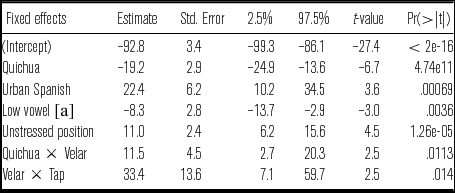
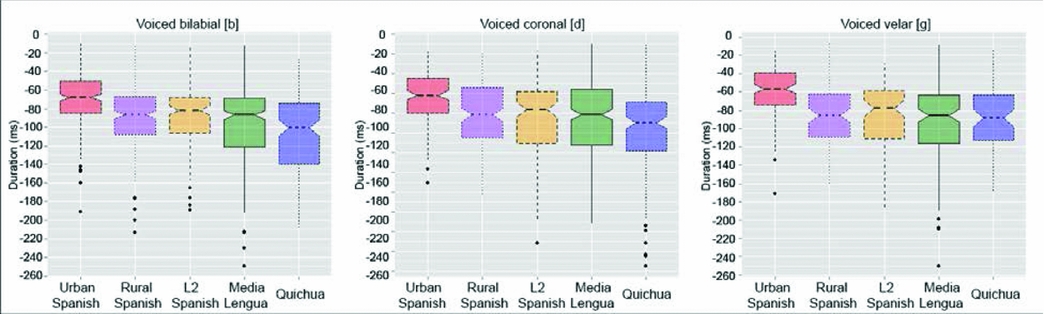
Table 6 presents the statistical results for VOT with an inter-group analysis of the voiced stop series across all five language varieties while Figure 6 presents the raw data. The baseline intercept of this model contains Rural Spanish, L2 Spanish, and Media Lengua since non-significant differences in negative VOT were computed across these language varieties. The baseline intercept also includes front vowels, back vowels, and liquids in addition to stops found in stressed syllables.
Statistical results for the inter-group VOT analysis of the voiced stop series. Data are presented in milliseconds.

VOT distribution of the voiced stop series across all five language varieties under analysis.

Quichua speakers produced overall longer negative VOTs than the baseline languages (Rural Spanish, L2 Spanish, and Media Lengua) by an average of 19 ms. In contrast, Urban Spanish speakers produced overall shorter negative VOTs than the baseline languages by 22 ms. Interactions between predictors suggest velars in Quichua were significantly shorter by 12 ms than the VOT of other Quichua voiced stops, which makes them closer to the baseline language varieties in duration.
3.2.2 Inter-language positive VOT variation
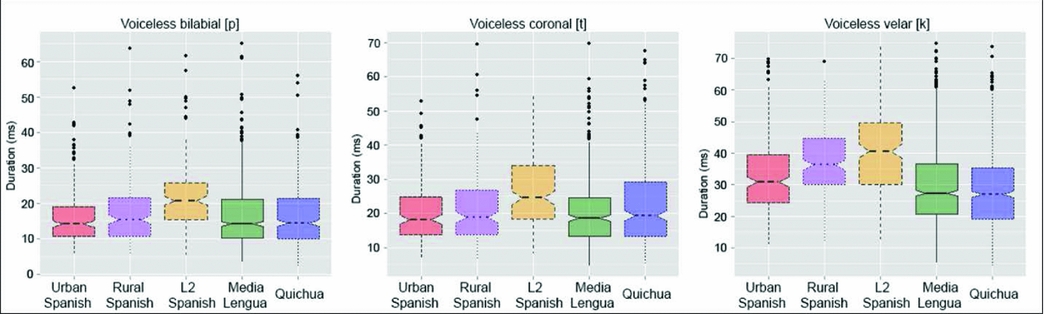
While the voiceless stop series is not considered a phonemic conflict site, its variation across the language varieties is still of interest. For the statistical model, the primary factors of interest were, language variety and place of articulation. Interactions between both predictors were also tested since these variables would reveal if any cross-group variation exists Figure 7 presents the distributions of the raw data.
VOT distribution of the voiceless stop series across all five language varieties under analysis based on place of articulation.

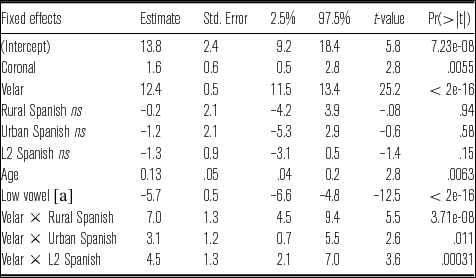
Table 7 details the statistical results for VOT with an inter-group analysis of the voiceless stop series to reveal any VOT variation in the voiceless series of stops across each language variety. The baseline intercept of this model, with a value of 14 ms, contains all five language varieties since the VOT values across Urban Spanish, Rural Spanish, L2 Spanish, Media Lengua, and Quichua were non-significantly different from each other in duration. The baseline intercept also includes the bilabial stop series and the following post-stop segments: front vowels, back vowels, and liquids.
Statistical results for the inter-group VOT analysis of the voiceless stop series. Data are presented in milliseconds.

While no one language variety was on its own significantly different from another, interactions between predictors suggest the VOT of velars in the Spanish varieties were significantly longer (3–7 ms) in duration than their Media Lengua and Quichua counterparts. Age of a speaker appears to affect VOT values of voiceless stops where the duration increased the older a speaker was, by 0.13 ms per age level (40 in total). This means that statistically, the oldest participant (68 years) should have a VOT that is 5 ms (age × 40 levels of age) longer than the youngest speaker (22 years).
3.3 Intra-group VOT Analyses
Since VOT has not been documented in any of these language varieties, the following sections describe VOT trends in each individual language variety without cross-language interference. The entire data set (wordlist, sentence list and elicitated sentences) was analysed in this section. Both voiced and voiceless VOT were also analysed together allowing for a more detailed account of VOT differences in voiced and voiceless stops from Media Lengua and Quichua.
3.3.1 Urban Spanish
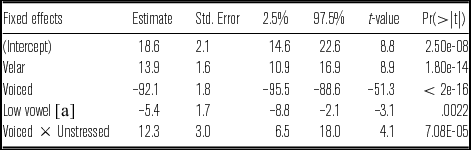
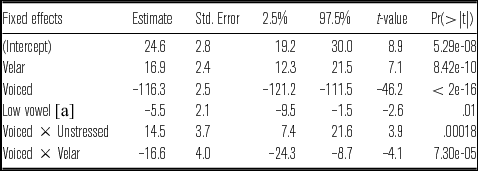
Table 8 details the statistical results of Urban Spanish VOTs. Based on the model output, the intercept, with a ‘base’ value of 19 ms, contains the following baseline categories: the voiceless stop series, the front and back vowels, and both bilabial and coronal stops, which were non-significantly different in duration. Each of the significant predictors can be added to the intercept to account for their effect on VOT. Voicing significantly affected VOT duration by –92 ms, and stops produced in the velar position significantly affected VOT by 14 ms (–59 for [ɡ] (intercept + velar + voiced) and 33 ms for [k] (intercept + velar)). Finally, there was an interaction between voicing and the VOT of stops in unstressed syllable positions, which shortened VOT by 12 ms.
Statistical results from the VOT stop durations (ms) in Urban Spanish.

3.3.2 Rural Spanish
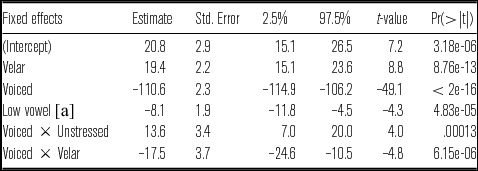
Table 9 details the statistical results of Rural Spanish VOT stop durations. Based on the model output, the intercept, with a ‘base’ value of 21 ms, contains the following baseline categories: the voiceless stop series, the front and back vowels, liquids, and both bilabial and coronal stops, which were non-significantly different in their effect on duration from each other. The following significant predictors can be added to the intercept to account for their effect on VOT. Voicing significantly affected VOT by −110 ms while producing a stop in velar position significantly affected VOT by 19 ms. There was, however, an interaction between voicing and stops in the velar position, which significantly affected VOT by −17 ms. Therefore, the average duration for [ɡ] based on this model is −87 ms (intercept + velar + voiced + voiced × velar) and 40 ms for [k] (intercept + velar).
Statistical results from the VOT stop durations (ms) in Rural Spanish.

3.3.3 L2 Spanish
Table 10 details the statistical results of L2 Spanish VOT stop durations. Based on the model output, the intercept, with a ‘base’ value of 25 ms, contains the following baseline categories: the voiceless stop series, the front and back vowels, liquids, and both bilabial and coronal stops, which were non-significantly different in duration. The following significant predictors can be added to the intercept to account for their effect on VOT. Voicing significantly affected VOTs by −116 ms, while producing a stop in the velar position significantly affected VOT by 17 ms. However, there was an interaction between voicing and the velar position, which significantly affected VOT by −16 ms. Therefore, the average duration for /ɡ/ based on this model is −91 ms (intercept + velar + voiced + voiced × velar) and 42 ms for /k/ (intercept + velar)).
Statistical results from the VOT stop durations (ms) in L2 Spanish.

3.3.4 Media Lengua
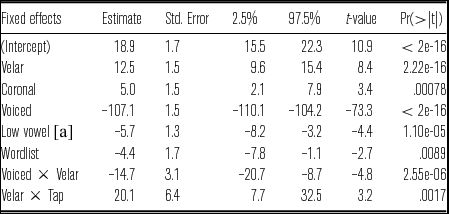
This section provides additional support that speakers of Media Lengua are producing negative VOT in Spanish origin words beginning with /b d ɡ/. Table 11 details the statistical results of Media Lengua VOT values. Based on the model results, the intercept, with a ‘base’ value of 19 ms, contains the following baseline categories: the voiceless stop series, the front and back vowels, the elicited sentences, and bilabial stops. The following significant predictors can be added to the intercept to account for their effect on VOT. Voicing significantly affected the VOT by –107 ms, and the production of a stop in velar position significantly affected VOT by 13 ms. There was, however, an interaction between voicing and the velar position which significantly affected VOT by −14 ms. Therefore, the average duration for /ɡ/ based on this model is −90 ms (intercept + velar + voiced + voiced × velar) and 32 ms for /k/ (intercept + velar).
Statistical results from the VOT stop durations (ms) in Media Lengua.

3.3.5 Quichua
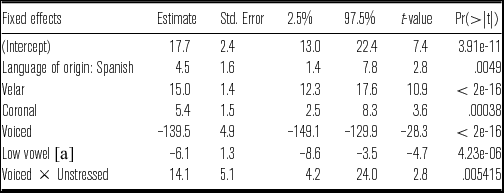
This section also provides additional support that Quichua speakers are producing negative VOT in Spanish origin words beginning with /b d ɡ/. Table 12 details the statistical results of Quichua VOT stop durations and their significant predictors. Based on the model results, the intercept, with a ‘base’ value of 18 ms, contains the following baseline categories: stops of Quichua origin, the voiceless stop series, stops in the stressed position, the front and back vowels, the elicited sentences, and bilabial stops. The following significant predictors can be added to the intercept to account for their effect on VOT. The VOTs of stops of Spanish origin are on average 5 ms longer than those of native Quichua stops. Voicing significantly affected VOT by −139 ms and the production of a stop in velar position significantly affected VOT by 15 ms: −106 ms (intercept + velar + voiced) for /ɡ/ and 32 ms for /k/ (intercept + velar). Stops produced with a coronal articulation significantly affected VOT by 5 ms.
Statistical results from the VOT stop durations (ms) in Quichua.

4 Discussion
One of the sociophonetic contributions of this study is a clear case where speakers of a substrate language borrow a previously non-existent class of sounds, modify them, and then pass on the changes to monolingual speakers in the superstrate language. In this case, it is Quichua – and not Urban Spanish – that appears to be the more influential language regarding the production of VOT in voiced stops in rural varieties of Spanish (L2 and Rural). For the L2 variety, this should not come as a surprise, since speakers might rely on Quichua for drawing on VOT information. However, for the monolingual rural variety of Spanish, it appears personal interactions with rural speakers and L2 speakers, which may also involve grandparents from neighbouring communities, play a more influential role in shaping a speaker's VOT production than the more prestigious Urban Spanish taught in schools and heard in the media. While it might be expected that speakers of a non-prestigious dialect may strive for more prestigious pronunciation, in this study, it actually appears to be the social bounds within one's typical speech community that are more influential (even when communicating with an outsider e.g. the author of this study). This finding is substantiated by the multidimensional scaling analysis (see Figure 5 above), which revealed that Rural Spanish has more VOT values in common with Quichua, L2 Spanish, and Media Lengua than with Urban Spanish.
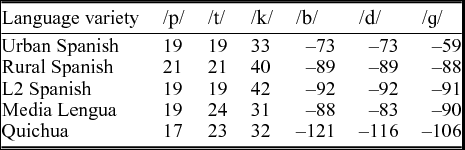
Another finding revealed that all five language varieties have similar VOT durations for the voiceless stops. Table 13 provides the ‘bare estimates’Footnote 3 in milliseconds of each VOT based on place of articulation. The intra-group results (Table 13) show that the voiceless series makes use of unaspirated VOT values and the voiced series makes use of long negative VOT values in each language variety. In addition, these results also support typical effects of place of articulation and age.
Bare estimates summary of the intra-language VOT analyses from each language variety.

Regarding the voiced stops, the interlanguage analysis showed that Urban Spanish and Quichua defined two ends of a continuum, with L2 Spanish, Rural Spanish, and Media Lengua in between. Urban Spanish had the shortest negative VOT and Quichua the longest (particularly for bilabials and coronals); in other words, Urban Spanish voiced stops were the least heavily voiced, while Quichua voiced stops were the most heavily voiced. This may suggest some degree of overshoot in VOT duration took place during the acquisition of the voiced series in Quichua or that speakers of Urban Spanish are attempting to disassociate themselves from rural varieties by shortening their negative VOTs.
While the languages in the in-between group (Media Lengua, L2 and Rural Spanish) had little variation regarding negative VOT duration in the statistical analysis, the multidimensional scaling (Figure 5) results revealed an interesting dynamic. The first point of interest suggests Media Lengua negative VOT values are of equal distance between Urban Spanish and Quichua and the most distant from Quichua in the in-between group. The second point of interest shows that within the in-between group, Media Lengua and L2 Spanish had slightly more in common regarding VOT overlap than with Rural Spanish. However, Media Lengua was in the middle of both L2 and Rural Spanish, suggesting Media Lengua and Rural Spanish had more in common regarding VOT overlap than Rural and L2 Spanish.
One hypothesis as to why Media Lengua does not seem to align with any particular variety might suggest group disassociation e.g. an attempt not to sound too Quichua or Spanish when producing the voiced series of stops. This result has precedent in the contact literature since it is suggested that mixed languages are created in an attempt to mark a new ethnic identity (Muysken Reference Muysken and Thomason1997: 376; Meakins Reference Meakins2011: 38). However, it should be mentioned that Stewart (Reference Stewart2015a) states that those who currently speak Media Lengua in Imbabura identify as Indigenous and not as Mestizo or a separate group; though this does not mean the originators of the language thought otherwise over a century ago.
Another hypothesis is that the negative VOT of Media Lengua voiced stops are undergoing or underwent a preferential shift toward Spanish-like negative VOT production. This could be due to the relexified Spanish vocabulary. If during the genesis of Media Lengua, contact with Spanish was more intense and bilingualism was at a higher level than in other groups of Quichua speakers, it would make sense that they would have adopted more Spanish-like VOT values as part of the new voiced series through the lexicon. Put differently, Media Lengua speakers may simply have had less overshoot when they acquired the voiced series due to their higher degree of bilingualism. The fact that the acquisition was not ‘perfect’, in the sense that Media Lengua negative VOT values do not assimilate to any of the Spanish varieties, might be explained in a similar fashion as to why Guion's (Reference Guion2003) non-simultaneous Quichua (L1)–Spanish (L2) bilinguals did not ‘perfectly’ acquire Spanish vowels; the originators of Media Lengua were simply not simultaneous bilinguals and therefore spoke Spanish with an accent.
Specifically regarding mixed language phonology, the acquisition of Spanish origin voiced stops by Media Lengua speakers presents an example of complete integration of a phonemic conflict site from an introduced language. Meakins & Stewart (to appear) argue that full integration either means the bilingual speakers who created the language were already aware of the contrast or the functional load of the contrast was high enough that it warranted transfer. In this case, the former argument is most probable since evidence from this study shows Quichua speakers also make use of negative VOT in Spanish borrowings containing word-initial voiced stops.
Other mixed languages with the same stop voicing conflict site, such as Gurindji Kriol and Michif, tell a different story. In both these languages, the voiced series from the introduced language undergoes assimilation instead of integration unlike in Media Lengua (Jones & Meakins Reference Jones and Meakins2013 for Gurindji Kriol; Stewart, Rosen & Cox Reference Stewart, Rosen and Cox2017). However, these results might be better explained through functional load. Both Gurindji and Kriol have very similar phonologies in which the stop voicing contrast is not highly robust, as observed in listener perception of voiceless and voiced stop pairs in both Gurindji Kriol and Kriol (Stewart et al. to appear). Preparatory work by myself and others suggests that, like Gurindji Kriol, Michif speakers do not integrate the stop voicing contrast that is found in French but absent in Cree. If these results are indeed conclusive, they might suggest that the high functional load of the stop voicing contrast in French is greatly reduced in Michif. Moreover, the fact that Michif is verb heavy (VPs are of Cree origin) further limits the number of French origin elements, thus causing an additional reduction in the number of lexical items that are distinguished based on the stop voicing contrast.
For Media Lengua, which has been traditionally shown to have Quichua-like phonology, the results from this analysis show that the acquisition of phonological material does not appear to be related to any specific prosodic or syntactic pattern suggested by van Gijn (Reference van Gijn2009). The results from this study, and other previously mentioned phonetic studies on mixed languages, suggest the acquisition of phonological material is more complicated than simply identifying the source language of a given element. Future studies in the area of mixed language phonology should consider the role of functional load and the conditions in which the L2 source language was acquired before the formation of the mixed language.
Acknowledgements
I would like to thank Kevin Russell, Nicole Rosen, and John Lipski for their valuable feedback on earlier versions of this paper. I would also like to thank the anonymous reviewers and editor for their valuable reviews and feedback. Finally, I would like to thank Gabriela Prado, Lucía Gonza, Antonio Maldonado, Elvis Tuquerres, Cecilia Ayala and all the participants who took part in this study. This research was supported by the University of Manitoba Graduate Fellowship (UMGF) and University of Saskatchewan Research Fund #416894.
Appendix A. Demographic information
Demographic information of the Media Lengua group.

Demographic information of the Quichua and L2 Spanish-speaking groups.

Demographic information of the L1 Urban- and Rural-Spanish–speaking groups.

Appendix B. Elicitation materials: Reading lists
Reading wordlist (for Spanish) and sentence lists (for Media Lengua and Quichua) used to elicit stops. Bolded segments were those under analysis. Orthographic <c> and <q> correspond to /k/ and word-initial <v> corresponds to /b/; the rest of the orthographic segments correspond to their IPA equivalent.