Introduction
Wetlands cover around 12.1 million km2 globally (Langensiepen et al. Reference Langensiepen, Opiyo, Kaudia, Rugege, Kyambadde, Akotsi, Ashitiva, Ningu, Munyazikwiye, Ngaboyamahina, Urassa, Ugen, Sebashongore, Oyieke, Misana, Kammesheidt and Becker2023) and approximately 1.341.500 km2 of Africa, excluding shallow marine water wetlands (Li et al. Reference Li, Song, Chen, Mu, Xu and Zeng2022). Ecologically, wetlands can support human health (Chuma et al. Reference Chuma, Mondo, Karume, Mushagalusa and Schmitz2021) through the provisioning of fresh water and consumable fish. Additionally, they contribute to erosion control, flooding mitigation, sediment retention (Bhowmik Reference Bhowmik2019), and provide habitat for freshwater biodiversity (Mitra and Vlek Reference Mitra and Vlek2014). In some areas, wetlands are the exclusive source of essential natural resources for rural communities, such as water for drinking, cooking, washing, and building materials such as clay, sand, wood, and papyrus reed (Janssen and Padilla Reference Janssen and Padilla1999). However, wetlands can also have negative environmental and socio-economic impacts. For example, freshwater wetlands are the sources of methane gas emissions causing global warming (Keshta, Yarwood, and Baldwin Reference Keshta, Yarwood and Baldwin2023; Mar et al. Reference Mar, Unger, Walderdorff and Butler2022). Freshwater wetlands can also serve as breeding grounds for vectors of diseases such as mosquitoes, increasing the risk of outbreaks of malaria and dengue fever, especially in tropical and subtropical regions (Okoro et al. Reference Okoro, Deme, Okoye, Eze, Odii, Gbadegesin, Okeke, Oyejobi, Nyaruaba and Ebido2023; Anthonj et al. Reference Anthonj, Rechenburg, Höser and Kistemann2017). These have negative effects on human health and human socio-economic development (Adnan et al. Reference Adnan, Ramli, Othman, Asha’ri, Syed Ismail and Samsudin2021; Sachs and Malaney Reference Sachs and Malaney2002).
In Rwanda, wetlands were originally used for hunting, fishing, and cattle grazing (Cambrezy Reference Cambrezy1981). More recently, wetlands have been exploited for agriculture. Agricultural exploitation of wetlands was introduced as a response to food and fodder shortages, particularly during the dry seasons and droughts periods (Nabahungu and Visser Reference Nabahungu and Visser2013). Currently, wetlands are classified as state property, supporting agriculture modernization and intensification of selected crops such as maize, rice, soybeans, and beans - among others (Ansoms et al. Reference Ansoms, Wagemakers, Walker and Murison2014). In some areas, the government of Rwanda has allocated wetland concessions to private investors for sugarcane plantation. Other small wetlands were allocated to farmers grouped into officially recognized cooperatives, specializing in the production of market-oriented high-value crops like rice, sugarcane, and maize (Nsengimana, Weihler, and Kaplin Reference Nsengimana, Weihler and Kaplin2017). Despite their importance, the wetlands of Rwanda are under pressure from human population growth, urbanization, agriculture and climate change effects (REMA 2022). Additionally, changes in water quality have promoted the proliferation of malaria and waterborne diseases (du Plessis Reference du Plessis2022).
Rugezi marshland is unique because it is a high-altitude marshland in northern Rwanda. It originates from runoff trapping in a synclinal depression behind a quarzitic ridge that led to the formation of a vast water loges valley (Grundling, Grootjans, and Linström Reference Grundling, Grootjans, Linström, C, G, Prentice and Davidson2018). The accumulation of water, alluvia, and the colonization of the valley by a vegetation of Sphagnum sp. contributed to peat formation. In 2004, Rugezi was heavily affected by water drainage for agriculture, terracing, and over exploitation of non-timber natural resources (Hategekimana Reference Hategekimana2007). The downstream and central areas dried up and the water quantity was reduced (Gaspard et al. 2022). These changes resulted in a decrease in water table, peat desiccation and the increase of invasive species. Furthermore, these changes were associated with a reduction in ecosystem services. Because of these negative impacts, rehabilitation processes were recommended for Rugezi marshlands (Nabahungu and Visser Reference Nabahungu and Visser2011). Rugezi was designated as a Ramsar site (REMA 2022), agriculture and other human activities were relocated out of the site and a buffer zone of 50 m (Government of Rwanda [GoR] 2018) was created by planting different species of native trees.
Studies on animal diversity from wetlands of Rwanda mainly focused on odonates (dragonflies and damselflies) (Uyizeye et al. Reference Uyizeye, Clausnitzer, Kipping, Dijkstra, Willey and Kaplin2021), and anurans (frogs and toads) (Mindje, Tumushimire, and Sinsch Reference Mindje, Tumushimire and Sinsch2020; Tumushimire et al. Reference Mindje, Tumushimire and Sinsch2020). Less is known about other arthropod biodiversity, particularly in the high altitude Rugezi marshland. This leads to a knowledge gap about marshland ecosystem health and function, because arthropods contribute to ecosystem functioning and ecological processes (Ashford et al. Reference Ashford, Foster, Turner, Sayer, Sutcliffe and Tanner2013). To address this knowledge gap, we conducted the first inventory of arthropod communities in Rugezi marshland. Our objective was to document the diversity and abundance of arthropods present in the northeast and northwest of Rugezi across the dry and rainy seasons. We hypothesized that there are significant differences between sites and seasons based on arthropod communities measured at the family level. Findings from our study serve as baseline data for future studies and help inform policy makers and managers of the Rugezi marshland about effective and sustainable biodiversity conservation planning.
Material and methods
Description of the study area
Rugezi marshland spans at an altitude of 2,050 m above sea-level (asbl). It covers 6,735 hectares. Geographically, the marshland is located between 1°21’30’’; 1°36’11’ South, and 9°49’59’’; 29°59’50’’ East (Figure 1). It is made of peat, while the plant diversity is dominated by Miscanthidium violaceum. A recent study has identified Disa stairsii and three species of Bryophytes namely Lycopodiella cernua, Sphagnum cuspidatum and Sphagnum perichaetiale as plant species recorded in Rwanda for the first time (Grundling, Grootjans, and Linström Reference Grundling, Grootjans, Linström, C, G, Prentice and Davidson2018). Rugezi marshland is also home to animal biodiversity such as the endangered grey crowned crane (Balearica regulorum). Due to its size and accumulated peat deposits, Rugezi marshland contributes to the regulation of water flow into Burera Lake used for the electrical power production and feeding water to the twin Ruhondo Lake (Hategekimana Reference Hategekimana2007).
Location of sampling sites and sampling plots in Rugezi marsh. The upper part was designated as northwest site (Butaro 1, Butaro 2, Butaro 3, Rusarabuye 1, Rusarabuye 2, Rusarabuye 3, Rwerere 1, Rwerere 2). The lower part was designated as the northeast site (Miyove 1, Miyove 2, Gatebe 1, Gatebe 2, Gaseke 1, Gaseke 2, Gatare 1, Gatare 2). Geocoordinates have been taken during data collection, shape files were obtained from Rwanda Wildlife Conservation Association (RWCA).

Data collection
Arthropod sampling and identification
Data were collected twice in 2023, once during the dry (June – July) and once during the rainy (November - December) seasons. Because the central part of Rugezi marshland is dominated by peat, it was not accessible and was not included in the studied area. The northeast and northwest sites of the marshland were demarcated using geodata and shapefiles of Rugezi marshland, using zones published from a previous study at this site (Grundling, Grootjans, and Linström Reference Grundling, Grootjans, Linström, C, G, Prentice and Davidson2018). Eight plots were established in each zone, adding up to 16 total plots for the Rugezi site. Even though Rwerere plots were close to the central zone (Figure 1), they were considered as a plot of the northwest site due to vegetation characteristics similar to that of the northwest site.
We established plots of 50 x 50 m in size and left 5 m from the edge of each plot to avoid edge effects. Plots were at least 100 m apart to avoid spatial autocorrelation. Within each plot, 9 sampling points were established, and a total of 144 sampling points were sampled using pitfall traps, sweep net and hand collection with pooters and forceps. Pitfall traps made of a transparent plastic container (6 cm in diameter, 10 cm in depth) filled with 30 ml of 75% ethanol were placed in the soil pit and collected after 24 hours to maximize chances of capturing arthropod samples (Nsengimana et al. Reference Nsengimana, Kaplin, Nsabimana, Dekoninck and Francis2021). Using hand and sweep nets, arthropods were collected for 30 minutes at each sampling point (hand collection: 15 minutes; sweep net:15 minutes). Specimens were conserved in 75% ethanol and taken to the laboratory in the Center of Excellence in Biodiversity and Natural Resource Management (CoEB) at the University of Rwanda. There, specimens were observed under microscopes and identified to the order and family levels using dichotomous keys (Mignon, Haubruge, and Francis Reference Mignon, Haubruge and Francis2016; Kirk-Spriggs and Sinclair Reference Kirk-Spriggs and Sinclair2017; Picker, Griffiths, and Weaving 2004; Delvare and Eberlenc Reference Delvare and Eberlenc1989).
Data analysis
We analyzed orders and families of arthropods by comparing abundance and diversity between dry and rainy seasons and between sampling sites. We calculated abundance of captured arthropods by counting the number of individuals collected in each season at each sampling site. To compare diversity across sites and seasons, we calculated Shannon diversity and created rarefaction curves (Shimadzu Reference Shimadzu2018). All statistical data analyses were performed using R Statistics software 2005 (R Core Team 2025).
Results
Abundance and diversity of arthropod during the dry season
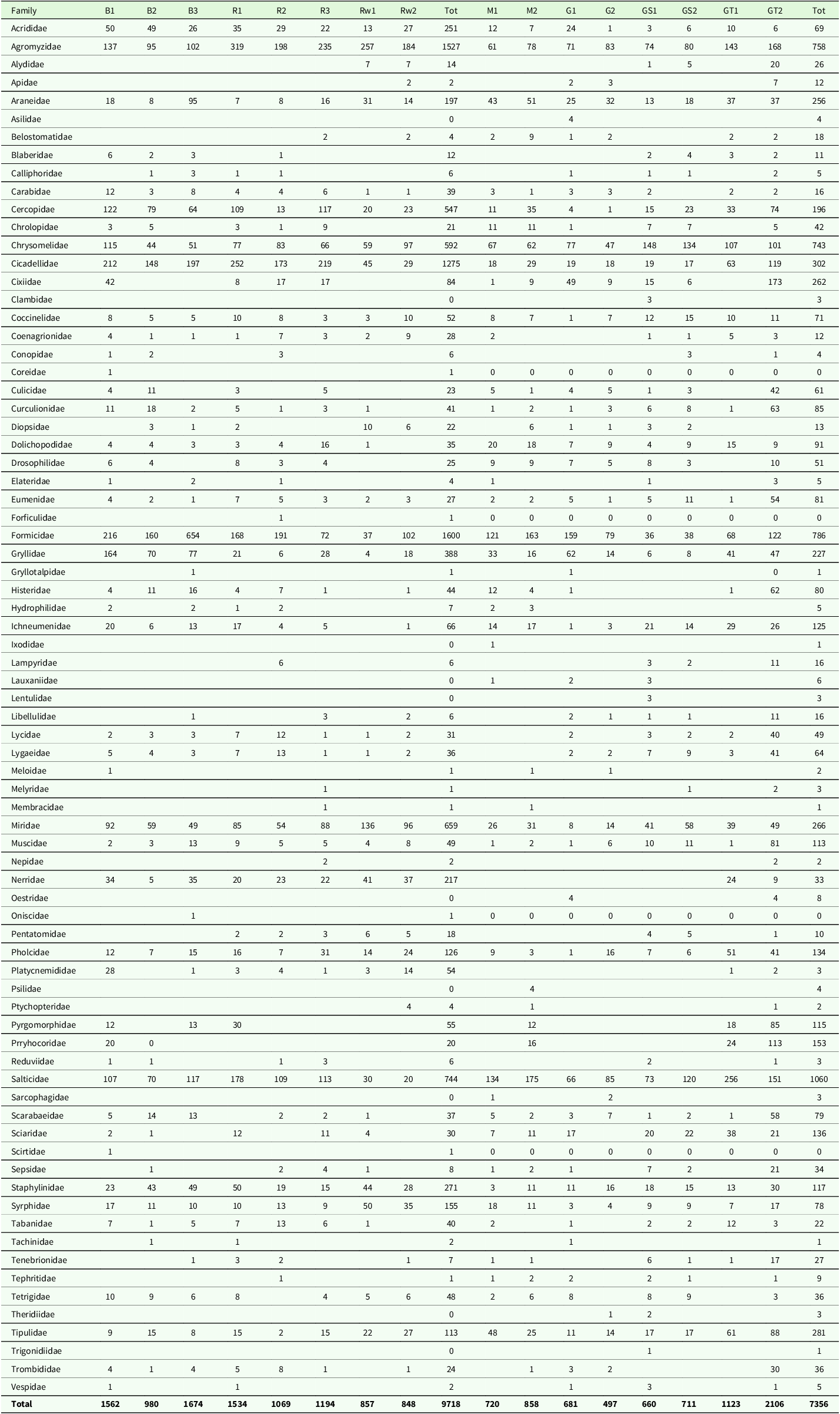
During the dry season, we collected and identified a total of 17,074 individuals of arthropods. We found higher abundances of arthropods in the northwest (N = 9,718) compared to the northeast (N = 7,356) sites. Considering all sites together (Table 1), sampled arthropods were grouped into three classes: Insecta (84.0%), Arachnida (16.0 %) and Crustacea (0.1 %). These arthropods were further classified into 12 orders dominated by insects (eight orders) and arachnids (three orders). Within the class Insecta, Hymenoptera (25.5 %), Diptera (24.6 %), Hemiptera (22.1 %) and Orthoptera (6.6%) had higher abundances than other identified orders of insects. Arachnids were dominated by the Araneae (15.7%). These orders were further classified into 79 families with the families of Formicidae (14.0%) and Agromyzidae (13.4%) having high abundance. The Salticidae family was mainly abundant in northeast (14.4 %) site compared to its abundance (7.6%) in the northwest site.
Abundances of arthropods sampled during the dry season in northeast (M1, M2: Miyove, G1, G2: Gatebe, GS1, GS2: Gaseke, GT1, GT2: Gatare) and northwest (B1, B2, B3: Butaro, R1, R2, R3: Rusarabuye, Rw1, Rw2, Rw3: Rwerere) of Rugezi marshland

Abundance and diversity of arthropod during the rainy season
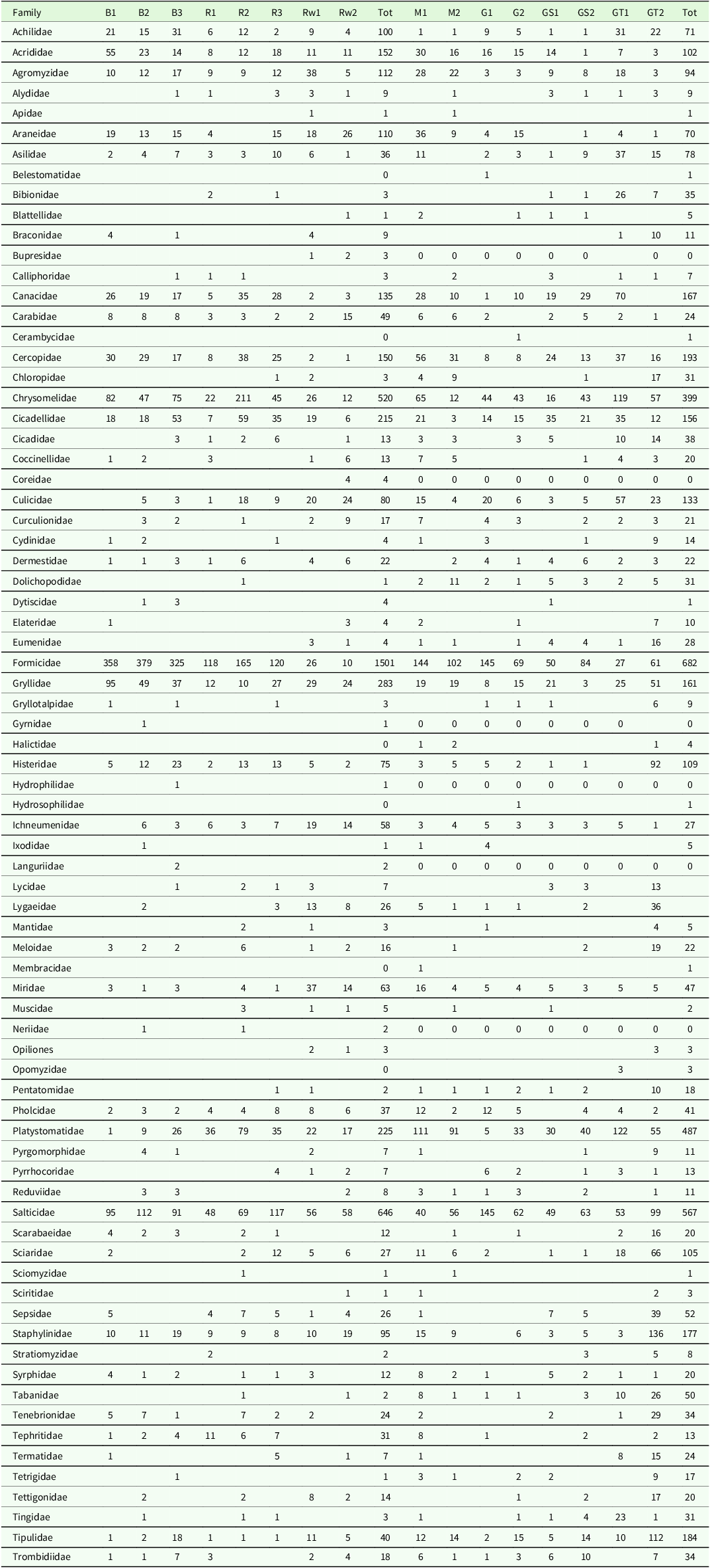
We found 9,870 individual arthropods during the rainy season, with higher abundances in northwest (N = 5,075) compared to the northeast (N = 4,795). Considering both studied sites together, identified arthropods were classified into Arachnida and Insecta. The class Insecta had higher abundance (83.2 %) than arachnids (16.8 %). These classes were further classified into 10 orders with eight orders of insects and two orders of arachnids. Hymenoptera (24.9 %), Diptera (21.5 %), Hemiptera (13.0 %), Orthoptera (9.9 %) and Coleoptera (15.5 %) were more abundant orders, while high abundance of arachnids was found for Araneae (16.0 %). These arthropods were further classified into 78 families (Table 2) dominated by Formicidae (22.1%) and Salticidae (11.7 %).
Abundance of arthropods sampled during the rainy season in northeast (M1, M2: Miyove, G1, G2: Gatebe, GS1, GS2: Gaseke, GT1, GT2: Gatare) and northwest (B1, B2, B3: Butaro, R1, R2, R3: Rusarabuye, Rw1, Rw2, Rw3: Rwerere) of Rugezi marshland

Richness of arthropods across seasons and sampling sites
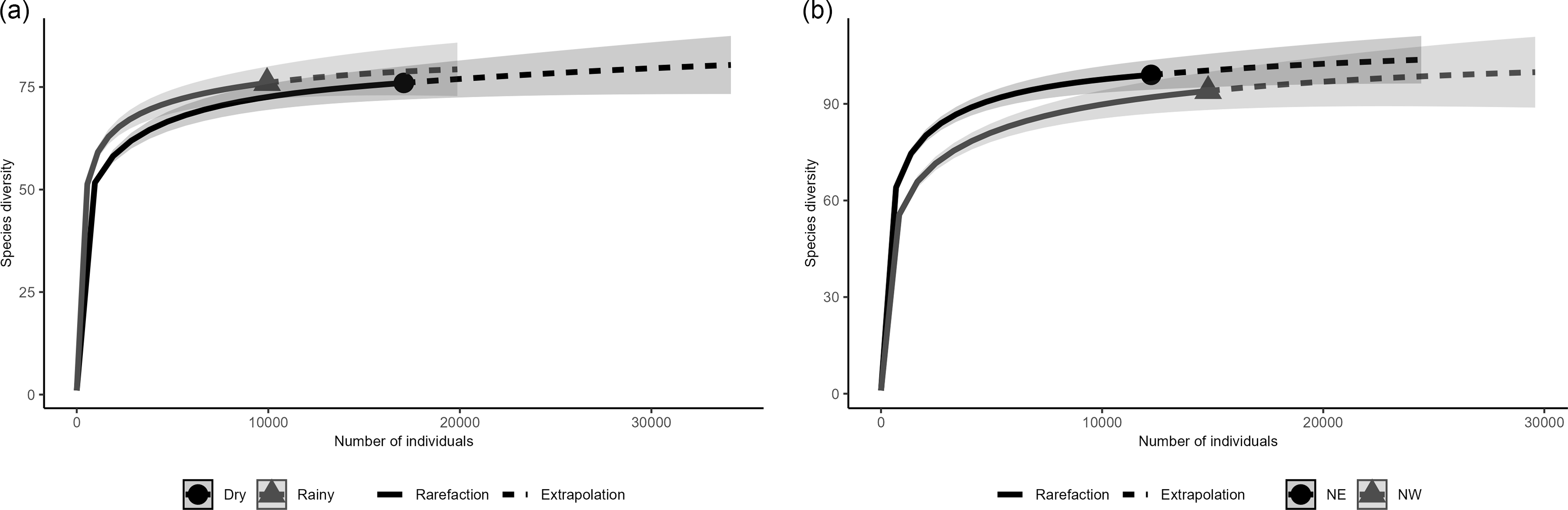
The analysis of arthropod diversity in dry and rainy seasons indicated that both dry and rainy seasons are similar in diversity, but they diverge as the sample size increases (Figure 2A). The sampling has captured a high proportion of diversity during the rainy season (H’ = 3.1) and in the dry season (H’ = 3.0), with no significant difference in diversity between seasons (F = 2.0, df = 1, P < 0.5). These results indicate that the sampling has captured most of the diversity of arthropods for both dry and rainy seasons. By considering the arthropod diversity from northwest and northeast sites (Figure 2B), there is a rapid increase in arthropod diversity at the beginning in both sites which ends with higher arthropod diversity in northwest (H’ = 3.9) than the northeast (H’ = 3.5). The shaded regions around the curve do not overlap significantly, which is a sign of distinction (F = 0.7, df = 1, P > 0.5) in arthropod diversity between the northeast and northwest.
Species diversity in two seasons and sites: (a) indicates the rarefaction curve between the number of individual and species diversity by season (b) is the rarefaction curve between the number of individuals and diversity per site. NE: northeast, NW: northwest.

Discussions
In relation with previous studies conducted in Rwanda, Rugezi marshland had a higher number of arthropod families than pastureland, coffee and banana plantations (Nsengimana et al. Reference Nsengimana, Nsenganeza, Hagenimana and Dekoninck2022; Reference Nsengimana, Iradukunda, Nsenganeza, Mberwa and Dekoninkc2023; Reference Nsengimana, Kaplin, Nsabimana, Dekoninck and Francis2021). The higher diversity of arthropods in Rugezi marshland could be explained by the fact that it is at a high-altitude, and that there are mountains found in the area. Research has indicated that complex topography, varying altitudes, and diverse microclimates of mountains create a wide range of habitats for insects (Adedoja, Kehinde, and Samways Reference Adedoja, Kehinde and Samways2020). These environmental gradients promote ecological niches and support high levels of speciation, leading to diverse communities of insects adapted to different temperature, moisture, and vegetation zones (Malard et al. Reference Malard, Mod, Guex, Broennimann, Yashiro, Lara, Mitchell, Niculita-Hirzel and Guisan2022; Schluter and Pennell Reference Schluter and Pennell2017). Additionally, mountains act as natural barriers that limit the dispersal ability of insects which leads to the increase in numbers and diverse population structure (Caplat et al. Reference Caplat, Edelaar, Dudaniec, Green, Okamura, Cote, Ekroos, Cote, Ekroos, Jonsson, Löndahl, Tesson and Petit2016). Beyond topographic differences, other factors that may explain the high arthropod diversity in Rugezi marshland are sampling techniques (Oliver and Beattie Reference Oliver and Beattie1996; Rhoades et al. Reference Rhoades, Griswold, Waits, Bosque-Pérez, Kennedy and Eigenbrode2017), vegetation type (Volf et al. Reference Volf, Lamarre, Redmond, Seifert, Abe and Auga2019) and geographic location (Fattorini Reference Fattorini2016)
Comparing the abundance of arthropods between sites, we found a higher abundance in northwest than the northeast site, mainly for the generalist insects such as ants (Hymenoptera: Formicidae), crickets (Orthoptera: Gryllidae and Acrididae), leaf-miner flies (Diptera: Agromyzidae) and jumping spiders (Araneae: Salticidae). These differences are associated with the vegetation type and the levels of disturbance by human activities. During data collection, we have found that the northwest area is still disturbed by human activities, such as fish collection in rivers and fodder collection in fields. These have caused changes in vegetation type, with more open, short grasses in the northwest compared to the vegetation type in southeast sites. Further, the northwest site is still dry with limited water quantity compared to the southeast. Studies have indicated that human activities such as agriculture can alter vegetation type and, in turn, reduce arthropod biodiversity. Disturbed vegetation can favor generalist or invasive species while reducing populations of specialist insects such as pollinators (Jaworski et al. Reference Jaworski, Thomine, Rusch, Lavoir, Wang and Desneux2023). Our findings align with the findings of Jaworski et al. Reference Jaworski, Thomine, Rusch, Lavoir, Wang and Desneux2023 as the most abundant families identified from the northwest are generalist arthropods, particularly Formicidae, and Salticidae.
We have also found differences in the abundance of arthropods between dry and rainy seasons. These findings corroborate with the findings of other studies (Grimbacher and Stork Reference Grimbacher and Stork2009; Frith and Frith Reference Frith and Frith1990; Queiroz et al. Reference Queiroz, Marques, Ribas, Cornelissen, Nogueira, Schmidt, Feitosa and Diehl-Fleig2023; Pinheiro et al. Reference Pinheiro, Coelho and Bandeira2002). These studies have indicated that the seasonal variation in abundance of arthropods, particularly insects, is a common phenomenon in tropical regions. Anu, Sabu, and Vineesh (Reference Anu, Sabu and Vineesh2009) indicated that some insects decline in abundance during the rainy season. These declines are mainly due to changes in life cycle of insects controlled by the variations in humidity, food availability, and interactions with other living organisms (Aranda et al. Reference Aranda, Peil, Rebello, Bordin, Souza and de Oliveira2021). In the Rugezi marshland, lower abundances of arthropods during the rainy season compared to the dry season are linked with changes in rainfall, which might have limited food availability for arthropods as it was found in other studies (Adedoja et al. Reference Adedoja, Kehinde and Samways2020; Anu et al. Reference Anu, Sabu and Vineesh2009; Bjornstad et al. Reference Bjørnstad, Nelson and Tobin2016).
Hymenoptera (Formicidae) outnumbered other families of insects identified in this study during both rainy and dry seasons. Hymenoptera had higher abundances in the northwest compared to the northeast site. Transitions in the use of Rugezi from agriculture to conservation may help explain the high abundance of ants that we found at both sites. Particularly, high abundance in the northwest sites is associated with high disturbance as the site is still facing human activities such as fish and fodder collection compared to the southeast having fewer human disturbances. Other studies conducted in Rwanda have also indicated that Formicidae mainly occur in disturbed areas compared to the protected areas (Nsengimana et al. Reference Nsengimana, Nsenganeza, Hagenimana and Dekoninck2022; Nsengimana et al. Reference Nsengimana, Iradukunda, Nsenganeza, Mberwa and Dekoninkc2023; Nsengimana et al. Reference Nsengimana, Kaplin, Nsabimana, Dekoninck and Francis2021). A recent study has shown that the global estimated abundance of ground dwelling ants is over 3x10¹⁵ and the number of all ants on earth is almost 20x1015 individuals (Schultheiss et al. Reference Schultheiss, Nooten, Wang, Wong, Brassard and Guenard2022). Their occurrence is mainly found in disturbed areas (Verdinelli et al. Reference Verdinelli, Pittarello, Caria, Piga, Roggero, Marrosu, Arrizza, Fadda, Lombardi, Lonati, Nota, Sitzia and Bagella2022; Frasconi et al. Reference Frasconi, Nunes, Verble, Santini, Boieiro and Branquinho2020; Cajaiba et al. Reference Cajaiba, da Silva, Gonzalez, Crespi, Santos and Périco2023) mainly due to their adaptation to environmental changes and higher trophic levels than other insects (Majer Reference Majer1983).
This study also showed a high abundance of the Agromyzidae family in both southeast and southwest sites. Individuals making this family have diversified as internal plant feeders (Kato, Yamamori, and Imada Reference Kato, Yamamori and Imada2022). It consists of around 2 860 described species, of which hundreds of species are of economic importance, causing damage to different cultivated crops and ornamental plants (Miller et al. 2008). High abundance of Agromyzidae morphospecies at Rugezi marshland could be explained by the plant diversity of the area, similar to another study conducted in the Afrotropical region (Musundire et al. Reference Musundire, Chabi-Olaye, Löhr and Krüger2011). Additionally, the Cicadellidae (Hemiptera) family is another family which had a high abundance of arthropods particularly during the dry season in the northeast site. This finding is in line with findings from a similar study, which reported a higher abundance of Cicadellidae during the spring and summer (El-Hady et al. Reference El-Hady, El-Hawagry and Soliman2020). Our findings indicate that the high abundance of Cicadellidae in Rugezi marshland could be driven by the dry season, but more studies are needed to understand the ecological mechanisms behind this pattern.
Conclusion and recommendation
Overall, we found that at the Rugezi marshland, the dry season had higher arthropod abundance than the rainy season. We also found that the northwest sites had higher abundance than the northeast sites. The diversity of arthropods was similar during the dry and rainy seasons. However, the diversity differed between sites, with higher diversity in the northwest compared to the northeast. Seasonal differences in arthropod abundances could be explained by seasonal climate variation, while between sites, differences in arthropod abundance and diversity could be due to the vegetation type and the level of disturbance from human activities. The northwest site was more disturbed than the northeast site. We recommend future studies to focus on species diversity of arthropods. Further, attention could be paid to specialist insects such as pollinators and pest controllers, to give insights into ecosystem services from these insects. We also recommend comparative studies of arthropods between the wetland and the agricultural lands around the wetland, to assess differences in the communities of arthropods between the two land-use types.
Our study provides novel baseline data on the diversity and abundance of arthropods from Rugezi. However, further data are needed to monitor and evaluate the wetlands as they are managed and restored over time. We recommend periodic sampling to record any changes in habitat conditions and in arthropod diversity. Furthermore, we recommend the development of sustainable management measures to reduce human pressure on the wetland, such as reinforcing the buffer zone, to promote effective and sustainable biodiversity conservation in Rugezi marshland.
Acknowledgements
Authors thank Rwanda Wildlife Conservation Association for initiating, championing, and providing logistic support and permissions to conduct this study. A huge thanks goes to National Geographic, Rainforest Trust, Houston, Band Foundation and the Wildlife Conservation Network for their financial support to this study. We also thank the United States Forest Service and the Field Project International for the laboratory infrastructure support and other scientific support. We equally thank the Government of Rwanda, especially the Ministry of Environment, Rwanda Environment Management Authority, Rwanda Development Board, National Council of Science and Technology and the local government for permits and other logistic support. Authors finally thank the Centre of Excellence in Biodiversity and Natural Resource Management, University of Rwanda for the support during the identification of specimens. Specimens are housed at the CoEB collection [Access number: R- RWCA-2023 (R: Rwanda, RWCA: Rwanda Wildlife Conservation Association, 2023: Year of sampling and identification)]. The authors thank Megan K. Sullivan for comments on this manuscript.
Financial support
This work was supported by Rwanda Wildlife Conservation Association (RWCA) (grant number NGS-97887C-22).
Competing interests
The authors declare none.