“You matter because you are you. You matter to the last moment of your life”
— Dame Cicely Saunders (cited in Royal College of General Practitioners and Royal College of Nursing, 2012)INTRODUCTION
Death is a phenomenon common to all peoples of every nation (Benthall & Holmes, Reference Benthall and Holmes2011). In England, 500,000 persons, predominantly older, die every year (Department of Health, 2008), thus reaching the end of their life journey. The United Kingdom has an aging population and a growing need for palliative services to care for those who are terminally ill (Kealey & McIntyre, Reference Kealey and McIntyre2005).
Indeed, end-of-life care is both current and pertinent in today's sociopolitical climate. The drive for high-quality care, choice, and control in Britain, emphasized in the 2008 End-of-Life Care Strategy and 2011 National Cancer Strategy, are reflected and mirrored in the philosophy and paradigm presented by the government's white paper; equity and excellence (Department of Health, 2010) and the new development program; Improving Quality (National Health Service, 2014). That patients should be supported, informed, and respected is prominent in the agendas of the British National Health Service (National Health Service, 2012) and Department of Health (National Institute of Clinical Excellence, 2004; 2011). Overarching all aspects of care, people wish to be treated with dignity and have a good quality of life (Department of Health, 2008).
To have a life-threatening illness is to be expected to die and to have a prognosis of six months or less left to live (Hospice Task Force, 1987, cited in Lyons et al., Reference Lyons, Orozovic and Davis2002). The timeframe for the purpose of this review is potentially more flexible than this definition suggests; however, the imperative tenet is that such individuals are beyond the reach of curative medicine (Benthall & Holmes, Reference Benthall and Holmes2011). End-of-life care is the preferred modern term for the assessment, treatment, and engagement of those with such a prognosis (National Council for Palliative Care, 2014). Traditionally termed “palliative care,” the goal of such interventions was to leave the individual free from distress and suffering in the time they had left (National Institute of Clinical Excellence, 2004).
Being free from suffering and distress is ultimately the foundational goal with every client of an Occupational Therapist, who is arguably well placed to work with this client group, having both the required generic core skills and the specialist knowledge of occupational interventions (Hagedorn, Reference Hagedorn2000). Occupational Therapists are concerned with enabling occupations to empower people to embrace positive identities, roles, aspirations, and relationships—with others, with their environment, and, importantly, with themselves (Duncan, Reference Duncan2011).
There are multiple available definitions for “occupation.” For the purpose of this review, occupation is described in a broad context as a purposeful activity that a person needs, wants, or is obliged to undertake, in order to live well as a valued citizen. Unlike tasks that are purely functional and provide no significance or fulfillment for the individual, occupations are embedded in sociocultural contexts as people choose to perform chosen activities alone, with loved ones, or in groups, in ways that are personally meaningful, spiritually enriching, or culturally appropriate. It is important to understand that what one finds valued another may disregard, as an occupation is a relative concept, one that is subjectively self-defined. The imperative to work within a client-centered framework thus becomes pressingly apparent. There is a time and place to each occupation, which necessarily requires energies, tools, skills, or resources to perform (Wilcock, 2006, cited in Park Lala & Kinsella, Reference Park Lala and Kinsella2011; Christiansen & Townsend, Reference Christiansen and Townsend2011). Occupation should, in accord with current professional paradigms in the field, be at the center of practice, theory, and philosophy for occupational therapists, and is recognized and evidenced as contributing to quality of life for individuals, groups, and communities (Finlay, Reference Finlay2004; Wilcock, Reference Wilcock2007; Christiansen & Townsend, Reference Christiansen and Townsend2011).
That occupation should be enabled for those at the end of life, in all environments, is intuitively a philosophical tautology (Jacques & Hasselkus, Reference Jacques and Hasselkus2004). However, from a theoretical perspective, there is a paucity of literature on the occupational needs and their facilitation within this client group (Park Lala & Kinsella, Reference Park Lala and Kinsella2011). All healthcare professionals, including Occupational Therapists, require a healthy evidence base upon which to lay their practice foundations (College Occupational Therapy, 2011a ). The purpose of our review converges on analyzing and synthesizing the literature to date, thus providing clarity and direction for future research and service provision. Focused ideally on work in the United Kingdom, the dearth of home-grown articles has led this critical review to expand its reach and explore worldwide papers examining occupation at the end of life, while still ultimately converging attention on British practice and palliative provision. However, there is hope that our findings may prove relevant and indeed illuminating for global discourse across multiple disciplines.
METHODS
A traditional narrative literature search was conducted in January of 2014 exploring the CINAHL, BioMed, PsychINFO, and Medline medical/scientific databases for appropriate articles (McMasters University, 2014). Manual searching was also undertaken at strategic points. Key terms utilized during the enquiry included “end of life,” “palliative,” “terminal*,” “cancer care,” “dying,” “occupation*,” and “occupational therapy.” However, primary search methodology focused on carefully chosen subject terms, alongside keyword parameters, to ensure relevance, comprehensive investigation, and consequential appropriation of the literature (University of Illinois at Chicago, 2014). Duplicates were removed from the procedure.
Literature covering pediatric topics, written before 1995, those published in nonacademic journals, written in a foreign language, focused on extraneous professions not involving occupational therapy, or irrelevant to the aims of our review were excluded. In addition, a number of articles, though congruent with the subject matter, were found to be inaccessible.
At this stage, 27 papers were found. Due to considerations of scope and scale, three studies examining end-of-life care in residential nursing homes, alongside specialist cancer or palliative care centers, were eliminated. Due to a paucity of a holistic perspective, a further four disseminations looking at a specific occupational intervention were precluded from further examination. One article exploring survival rather than palliation was also rejected.
Inclusion criteria required literature to be posited in a peer-reviewed journal and to be fully published at the time of investigation (Bennett & Bennett, Reference Bennett and Bennett2000). Through this process, the findings were ultimately supplemented with studies looking at adult and older adult populations who had a terminal life-limiting illness, not restricted to oncological diseases.
Further scrutiny was then conducted on the prevailing literature to determine the quality of research evidence presented and the potential potency of the articles for this review (Bennett & Bennett, Reference Bennett and Bennett2000). Eight opinion pieces were excluded from critique along with one case study that did not meet the advisable level of evidential strength required. While practice examples were not immediately precluded, care was taken to ensure rigor and prudence in their selection in order that considerable bias and weakness were eliminated as far as possible. For any review, a minimum level of veracity is required when examining and considering the suitability of literature that may sit poorly in any hierarchy of evidence (Petticrew & Roberts, Reference Petticrew and Roberts2003; University of Oxford, 2009; Tomlin & Borgetto, Reference Tomlin and Borgetto2011).
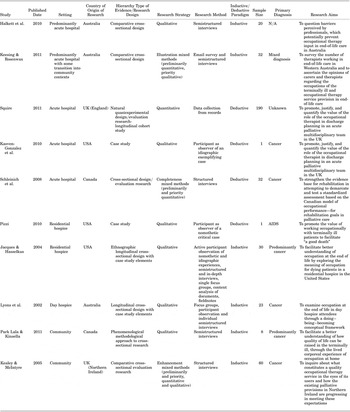
Following the selection processes, 10 papers were found that met the inclusion criteria (listed in Table 1).
Characteristics of included studies

Table guided by considerations documented in Schunemann et al. (Reference Schunemann, Oxman, Higgins, Higgins and Green2008).
RESULTS
End-of-Life Care in the Acute Hospital
One British study surveying the terminally ill revealed that only 0.76% of a sample of 132 participants expressed a desire to die in hospital (Squire, Reference Squire2011). This is starkly in contrast with statistics suggesting that 58% of deaths in the United Kingdom actually occur in acute environments (Department of Health, 2008). Pertinent for this review is the fact that large numbers of palliative patients are resident in hospitals and are indeed dying in hospitals. The importance of ensuring a good quality of life and a dignified death in this setting becomes paramount (Field & Cassel, 1997, cited in Pizzi, Reference Pizzi2010). Consequently, this provides ample justification to launch research at this promontory and evaluate current practice within the acute environment. Five articles were obtained that focused, at least in part, on hospital settings.
Discharge Planning
Two Australian studies questioned whether there was enough Occupational Therapist input for increasing service requirements. The censuses in each piece of research unfortunately contained abstruse methodologies, uncertain sampling, and unclear statistics (Halkett et al., Reference Halkett, Ciccarelli and Keesing2010; Keesing & Rosenwax, Reference Keesing and Rosenwax2011). While supporting the notion of a workforce deficit, the resulting numbers cannot perhaps be said to be demonstrative of the actual professional population.
However, findings from each of these papers have great utility for our study in potentially revealing the work and opinions of therapists in acute settings (in Oceania, at least). Health professionals (Halkett et al., Reference Halkett, Ciccarelli and Keesing2010) and carers (Keesing & Rosenwax, Reference Keesing and Rosenwax2011) saw the work of therapists as a few home visits and prescription of aids and equipment. Therapists in both surveys acknowledged their role in discharge planning but felt themselves capable of so much more. Transcendent in both articles is a widespread dissatisfaction with occupational therapy services that are inadequate, disenfranchising, and unduly lacking in focus on occupation. This has implications for all professionals working in end-of-life care and clearly signifies that needs are going unmet.
If occupational therapists are not in progressive posts in end-of-life settings, then enabling occupation and facilitating a meaningful life of significant activities, if not impossible, becomes intangible. Nevertheless, it would be convenient to purport that the problem is an entirely Australian phenomenon, where therapists are limited to reductionist work in a few acute hospitals throughout disparate regions. Undoubtedly, the generalizability of parochial opinion tests, and even workforce censuses, focalized to a specific area, must be challenged and explored.
Squire (Reference Squire2011) writes for a European audience on a UK pilot project, circumscribing an occupational therapist's work in a hospital multidisciplinary team (MDT). Evidently, she writes of a similar shortage of occupational therapy services in end-of-life care, which suggests that therapy deficits are a global and as well as a British issue.
Squire writes her paper from within a medical model and talks of therapists enabling mobility and function and not occupation that is meaningful to the individual (Law et al., 1997, cited in Jacques & Hasselkus, Reference Jacques and Hasselkus2004). While promoting the value of the occupational therapist in the MDT is much welcomed, it is perhaps a little disappointing that the presented role of the therapist is once again that of discharge planning in order to lower costs and prevent patient readmission (Boatang, 1998, cited in Kealey & McIntyre, Reference Kealey and McIntyre2005). Acute services seem in need of a paradigm shift to engage in work that acknowledges the holistic needs of the person and the eclectic skills of the practitioner (Wilcock, Reference Wilcock1998).
Rehabilitation
Across the Atlantic, two authors write of rehabilitation goals for occupational therapists in end-of-life care. Their statistics suggest that end-of-life care is more progressive in North America, but the number of employed therapists still falls short of service needs.
Some authors question the appropriateness of rehabilitation in the field (Benthall & Holmes, Reference Benthall and Holmes2011; Park Lala & Kinsella, Reference Park Lala and Kinsella2011), and yet many interventions operationalized appear to have a rehabilitative focus, and many authors promote the contribution of rehabilitation to the domain of palliative care (Kealey & McIntyre, Reference Kealey and McIntyre2005). Both Schleinich et al. (Reference Schleinich, Warren and Nekolaichuk2008) and Kasven-Gonzalez et al. (Reference Kasven-Gonzalez, Souverain and Miale2010) argue that rehabilitation is overlooked for the terminally ill.
While rehabilitation has historically potentially added to the therapist's repertoire of treatment options and is more holistic than a purely compensatory (equipment) model, it is arguably still reductionist and in being so far away from the meaningful occupational practice that is desired (Benthall & Holmes, Reference Benthall and Holmes2011).
End-of-Life Care in the Hospice
On discharge from acute hospitals, patients are sometimes fortunate enough to gain access to hospice services. The hospice movement primarily grew out of cancer care during the late 20th century (Pizzi, Reference Pizzi2010) into the holistic centers serving multiple client groups that are available today (National Hospice Palliative Care Organization, 2014).
Despite just 4% of the palliative population dying in hospices (Department of Health, 2008), the literature grounded in these settings and ideals is some of the richest and most prevalent in the occupational therapy evidence base. It would therefore be inexpedient to disregard this area of research and not explore what hospices can offer to practitioners working with the terminally ill. Three papers were selected to examine practice occurring in hospices.
An Occupational End-of-Life Narrative
Pizzi's American hospice case study (Reference Pizzi2010) attempts to exemplify the positive impact that working occupationally can have on an individual who is terminally ill. Not without an element of conceptual antithesis, the piece is centered on improving quality of life through the lived experience of occupation.
The primary contention of Pizzi's work is not with his ideals or occupational paradigm but with the strength of his evidence and the character of his writing. While purporting to convey powerful messages about enabling occupation and consequential quality of life, some might argue that Pizzi is not critical enough and relies too heavily on reproducing quoted expert opinion (Whalley-Hammell, Reference Whalley-Hammell2009).
Occupations in the Hospice
However, in defense of Pizzi's philosophical stance are Lyons et al. (Reference Lyons, Orozovic and Davis2002) and Jacques and Hasselkus's (Reference Jacques and Hasselkus2004) corroborating studies exploring occupation in the hospice. Each qualitative design takes a unique angle on capturing the occupational experiences of attendees in order to better understand occupation at the end of life.
While some may question the value of contributing subjective, qualitative research papers to a scientific evidence base, we would argue that qualitative studies justifiably deserve their place in research as client-centered papers (Whalley-Hammell, Reference Whalley-Hammell2001) as rich texts conveying experiences the reader can find plausible and relative, thus strengthening an understanding of the phenomena (Glassman & Hadad, Reference Glassman and Hadad2009; Park Lala & Kinsella, Reference Park Lala and Kinsella2011) and providing useful exploratory tools into how services can work for clients (Petticrew & Roberts, Reference Petticrew and Roberts2003).
Arguably, these two papers have contributed qualitative research of significant quality to the discourse from which we can glean the importance of the hospice movement in end-of-life care, which appears to be progressive and occupationally focused in their daily operation.
There is an existential and transcendent temporal element of each of the study's results, focusing on unique and personal occupation in the past, present, and future. There is a bifurcated purpose to occupational moments that offers a spiritual dimension to people, converging on living and dying in equal measure. These aspects are mirrored in other literature (Bye, 1998, cited in Kealey & McIntyre, Reference Kealey and McIntyre2005; Benthall & Holmes, Reference Benthall and Holmes2011) and further substantiated by Park Lala & Kinsella's phenomenological community study (Reference Park Lala and Kinsella2011).
There are also underlying themes found in all of these papers: contributing with others in families and communities, preparing and adapting for change, and continuing to appreciate everyday occurrences through occupation. Special and mundane activities are reinterpreted and given new significance in the context of the life-limiting illness (Lyons et al., Reference Lyons, Orozovic and Davis2002; Jacques & Hasselkus, Reference Jacques and Hasselkus2004; Park Lala & Kinsella, Reference Park Lala and Kinsella2011). There are echoes of needs for complete occupations, dreams, meetings, and rituals that are meaningful to the individual (Park Lala & Kinsella, Reference Park Lala and Kinsella2011). The giving of tokens, gifts, and handmade items was recurrent throughout.
In attempting to explicate occupation at the end of life, professionals are better placed to understand occupational needs and enable positive, meaningful occupational experiences for those who are dying (Wilcock, Reference Wilcock1998; Benthall & Holmes, Reference Benthall and Holmes2011).
End-of-Life Care in the Community
There is a paucity of literature contextualizing end-of-life care in the home environment, and yet domiciliary care in the community has been fast developing in recent years, representing a shift away from palliative treatment within institutions (Kealey & McIntyre, Reference Kealey and McIntyre2005). Two independent patient and population surveys identified the overwhelming desire of people to remain at home at the end of life (Kealey & McIntyre Reference Kealey and McIntyre2005; Squire, Reference Squire2011), which is counterpoised by the dichotomy of government statistics that only 18 to 25% of patients actually achieve this goal (Department of Health, 2008).
Clearly, home care may present some obstacles not least to the families and friends of patients who necessarily assume more responsibilities and duties of care (Kealey & McIntyre, Reference Kealey and McIntyre2005). However, a community service can also provide a wealth of opportunities to engage in occupation and life within a truly client-centered framework, away from clinical environments and medical operations (Park Lala & Kinsella, Reference Park Lala and Kinsella2011).
It is these possibilities that are explored in the two following rare and elusive studies that examine occupation and therapy at home.
Occupation in the Community
In Park Lala and Kinsella's paper (Reference Park Lala and Kinsella2011), through the interview transcripts, the reader is immersed in rich dialogue that captures the essence of what it means to live and die with a terminal illness, told from the perspective of the dying person. These immanent and yet conversely tangible processes (Priest, Reference Priest2002) are expressed through an occupational lens that examines six themes focused on existential pursuits, accommodation of change, and activities that promote positive effects.
If Lyons and colleagues (Reference Lyons, Orozovic and Davis2002) and Jacques and Hasselkus (Reference Jacques and Hasselkus2004) dip a toe into the palliative pool of practice to feel the warmth of occupational engagement in the hospice setting, Park Lala and Kinsella (Reference Park Lala and Kinsella2011) fully submerge the observer in a deeply spiritual plunge into the depths of qualitative inquiry, allowing the ripples of occupation to gently wash over the peruser's metaphorical body. What transpires after the swim is a realization that to enable holistic client-centered occupation at the end of life is to facilitate meaningful experiences for the individual, and thus contribute to a good end-of-life experience. Findings that such occupational engagement can occur at home is inspirational research indeed, which can be used to create guidelines for future practice.
Weight is subsequently given to the expository dialogue championing the enablement of occupation in community, and indeed in all end-of-life settings. The embodied experiences of participants are pocketed with examples of expressions of joy on engaging in favorite pursuits, while despair is expressed when valued occupations are prohibited. Interestingly, these findings were mirrored in both qualitative hospice studies, providing corroborative meat for occupational bones (Lyons et al., Reference Lyons, Orozovic and Davis2002; Jacques & Hasselkus, Reference Jacques and Hasselkus2004).
Occupational Therapy in the Community
If Park Lala and Kinsella provide us with an admirable ideal for the community, Kealey and McIntyre (Reference Kealey and McIntyre2005) hope to provide us with an insight into everyday reality. This is all the more valuable for being cited close to home in the domiciliary settings of Northern Ireland. Their study focuses on evaluation of a home therapy service from the perspective of its clients and carers.
However, in looking at the challenges and the importance of various client issues, the study focuses attention on symptoms, and on practical and psychosocial problems. There is no survey of holistic occupational needs or spiritual provision. Quality-of-life questionnaires focused on end-of-life care have found that the existential domains of satisfaction are concordant with overall levels of satisfaction and precedence (Cohen et al., Reference Cohen, Mount and Strobel1995; Reference Cohen, Mount and Bruera1997; McMillan & Weitzner, Reference McMillan and Weitzner1998), yet this research focuses on function. Tellingly, professional efforts were directed on equipment, transfers, and adaptations, with goal achievement being attained by only 15% of service users. It is thus questionable whether this service is truly meeting client needs. However, what does become clear is that clients and carers do not fully understand what occupational therapy has to offer.
SIGNIFICANCE OF RESULTS
Introduction
A “Good Death”
It has been shown in Canada that a decreased ability to participate in enjoyable activities influences decisions about euthanasia (Park Lala & Kinsella, Reference Park Lala and Kinsella2011). Conversely, pleasure in occupation and meaningful experiences, solitary and shared, has been demonstrated to facilitate an attitude of gratitude and joy—a life worth living (Lyons et al., Reference Lyons, Orozovic and Davis2002).
A quality end-of-life experience may potentially include pain and symptom control (Seymour et al., Reference Seymour, Bellamy and Gott2002). Research has demonstrated that people fear a “bad death.,” which provokes undue anxiety or physical distress (Jacques & Hasselkus, Reference Jacques and Hasselkus2004). However, a “good death” can also involve a sense of control, preparedness, awareness, holism, peace, and contribution to others—conditions that can be furthered through occupation and meaning (Lyons et al., Reference Lyons, Orozovic and Davis2002).
Fulfillment of Potential
Life-limiting illnesses for a number of reasons can be interpreted by many as difficult and full of progressive loss: loss of function, loss of desired activities, loss of energy, loss of roles, and loss of hope or morale (Kealey & McIntyre, Reference Kealey and McIntyre2005). Occupational enablement during such challenging times can conversely and perhaps counterintuitively facilitate a person's will to live, through focusing on desired goals and activities, assisting them to overcome some of the complex obstacles they face, fostering maintenance and development of valuable roles, and preserving and raising self-worth, self-identity, self-determination, and dignity (Miller-Polgar & Vrkljan, Reference Miller-Polgar and Vrkljan2001).
What follows from our discussion of the literature is a delineation of the requisite conditions, concepts, and skills needed to achieve these aims. For the purpose of clarity and to mirror professional contingents, these themes are divided into three: philosophy, theory, and practice.
Philosophy
An Occupational Paradigm
We have seen that occupation at the end of life is a significant and important phenomenon; however, for every study we have illuminated that explores occupational practice (Lyons et al., Reference Lyons, Orozovic and Davis2002; Jacques & Hasselkus, Reference Jacques and Hasselkus2004; Pizzi, Reference Pizzi2010; Park Lala & Kinsella, Reference Park Lala and Kinsella2011) there are articles on therapy that do not invest in the occupational paradigm (Schleinich et al., Reference Schleinich, Warren and Nekolaichuk2008; Kasven-Gonzalez et al., Reference Kasven-Gonzalez, Souverain and Miale2010) or discuss prevailing contemporary services that do not meet occupational needs (Kealey & McIntyre, Reference Kealey and McIntyre2005; Halkett et al., Reference Halkett, Ciccarelli and Keesing2010, Keesing & Rosenwax, Reference Keesing and Rosenwax2011; Squire, Reference Squire2011).
Occupation allows individuals at the end of life to adapt, cope, reflect, learn, live, do, appreciate, contribute, prioritize, and fulfill their potential within this special time they have left to them (Benthall & Holmes, Reference Benthall and Holmes2011). For many it can make the difference between ego integrity and ego despair (Glassman & Hadad, Reference Glassman and Hadad2009) and can assist in processing the stages of grief associated with the dying process (Kübler-Ross, 1969, cited in Gross, Reference Gross2005). For the occupational therapy profession, occupation is the medium through which therapists can catalyze positive change in the people they work with, including those at the end of life (Trombly Latham, Reference Trombly Latham, Radomski and Latham2002).
Integral to this process is facilitation of meaning, which is arguably transcendent and can promote positive effects for individuals at any stage of life (Lyons et al., Reference Lyons, Orozovic and Davis2002). When time is restricted, as is so often the case (Kealey & McIntyre, Reference Kealey and McIntyre2005), the search for emotional significance becomes all the more pressing (Carstensen et al., Reference Carstensen, Isaacowitz and Charles1999).
The definition of occupation in any modern occupational therapy syllabus is recondite without the contribution of meaning for a person (Jarman, Reference Jarman, Christiansen and Townsend2011). Occupational experiences become functional tasks or activities without spiritual purpose of direction or pleasurable gain for the participant (American Occupational Therapy Association, 2002, cited in Jacques and Hasselkus, Reference Jacques and Hasselkus2004).
In engaging with the complex dimensions of the person, the occupation, and the environment, meaning can potentially be provided, promoting well-being and quality of life (Law et al., Reference Law, Cooper and Strong1996; Strong et al., Reference Strong, Rigby and Stewart1999; Miller-Polgar & Vrkljan, Reference Miller-Polgar and Vrkljan2001).
Promoting health at the end of life is perhaps a contentious objective (VanderPloeg, Reference VanderPloeg2001). Health can be considered in a broad context to encompass an ability to care for self and others and to have a capacity to make decisions and exercise control (World Health Organization, 1986, cited in Pizzi, Reference Pizzi2010). However, this is arguably not possible in every actuality without redefining the concept of health into an unrecognizable tenet. For those with dementia, or cognitive, language, neurological, muscular, and vocal difficulties, the capacity to care for oneself or to make and communicate decisions may be considerably impaired (Seymour et al., Reference Seymour, Bellamy and Gott2002; Papapetropoulos et al., Reference Papapetropoulos, Tuchman and Laufer2007; Alzheimer's Society, 2014; Motor Neurone Disease Association, 2014; National Institute on Aging, 2014; Parkinson's UK, 2014).
Imaginably, for those at the end of life, making the most of each and every day and endeavoring to sustain a holistic well-being (Kealey & McIntyre, Reference Kealey and McIntyre2005), defensibly a subjective (Doble & Santha, Reference Doble and Santha2008) and not absolute term (Huber et al., Reference Huber, Knottnerus and Green2011), is perhaps a more realistic and achievable goal.
Quality of life, defined as experiencing enjoyment, psychological, physical, and spiritual acceptance and accord, alongside hope surrounding opportunities and possibilities (Jacques & Hasselkus, Reference Jacques and Hasselkus2004), is potentially attainable for all persons regardless of illness progression, age, or diagnosis (Pizzi & Briggs, Reference Pizzi and Briggs2004). In line with governmental and professional agendas (National Institute of Clinical Excellence, 2004; National Health Service, 2014; World Health Organization, 2014), promoting quality of life in the United Kingdom should necessarily be our overarching treatment goal (VanderPloeg, Reference VanderPloeg2001; College Occupational Therapists, 2011b ).
However, therapists require an occupational framework within which to cultivate their conceptual ideology, assessments, and subsequent interventions. Occupation may not always promote health, but it can arguably be described politically as a basic human need (Hansen et al., Reference Hansen, Dirette, Atchison, Atchison and Dirette2007; Stadnyk et al., Reference Stadnyk, Townsend, Wilcock, Christiansen and Townsend2011).
Occupational injustice occurs when an individual is excluded from participating in occupation through circumstances outside their control, extraneous to the limitations or symptoms of their presenting condition. The phenomena of boredom, loneliness, and isolation and a lack of meaningful occupation can be real for those at the end of life and can contribute to feelings of helplessness, hopelessness, and uselessness (Lyons et al., Reference Lyons, Orozovic and Davis2002; Keesing & Rosenwax, Reference Keesing and Rosenwax2011). The impact of too little occupation on well-being can be devastating (Kealey & McIntyre, Reference Kealey and McIntyre2005) and yet can be steadily overcome through the enablement of occupation (Lyons et al., Reference Lyons, Orozovic and Davis2002).
Theory: Core Constructs
A Holistic Approach to Therapy
Palliative care means adopting a holistic approach within end-of-life services and meeting the physical, psychological, social, and spiritual needs of the terminally ill (National Institute of Clinical Excellence, 2004; National Health Service, 2005; Meredith, Reference Meredith2010; World Health Organization, 2014).
Multitudinous physical interventions that are generally well documented and are arguably core to a therapist's repertoire still require being viewed through an occupational lens to ensure a truly holistic approach. Kealey and McIntyre (Reference Kealey and McIntyre2005) discuss the fact that the psychological aspects of care can be difficult to measure and yet are no less important. Concerns have been raised that services, particularly acute, do not adequately identify and address psychological distress, and instead focus on purely physical concerns (Seymour et al., Reference Seymour, Bellamy and Gott2002; Terry & Westcott, Reference Terry and Westcott2012). Time restraints have been documented as one potential barrier (Kealey & McIntyre, Reference Kealey and McIntyre2005), and yet the importance of positive emotional effects at the end of life is already a well-established fact.
Social context is additionally relevant for occupations (Kealey & McIntyre, Reference Kealey and McIntyre2005): being consumed within a social climate can contribute greatly to feelings of belonging and connectedness within the sphere of the people close around an individual (Lyons et al., Reference Lyons, Orozovic and Davis2002). Contributing to others was a predominant theme found in the literature, and it was found to enable a sense of well-being and self-esteem (Pizzi, Reference Pizzi2010), while embracing meaning was found to fundamentally mean embracing spirituality in the lives of the terminally ill (Wilcock, Reference Wilcock1998). Spirituality can be religious when practice and reflection are sometimes heightened at the end of life (Park Lala & Kinsella, Reference Park Lala and Kinsella2011), though for many it is about significance in the short time they have left (Wilson, Reference Wilson2010; Benthall & Holmes, Reference Benthall and Holmes2011).
For the Occupational Therapist, this is elementary to their discipline (College Occupational Therapists, 2014b ) and necessitates offering a flexible program to fulfill the universal requirements of service users, involving constant assessment of priorities (National Institute of Clinical Excellence, 2011), work toward occupational goals, and, of course, regular benchmarking of progress.
Client-Centeredness and the Independence Paradox
Emphasis must focus on self-determined occupation for therapists and teams to work in a truly client-centered fashion (Park Lala & Kinsella, Reference Park Lala and Kinsella2011). Attention may not necessarily rest on independence in the daily activities of living (Jacques & Hasselkus, Reference Jacques and Hasselkus2004). Washing and dressing, while important for some (Benthall & Holmes, Reference Benthall and Holmes2011), may hold little significance for others (Pizzi, Reference Pizzi2010). Furthermore, functional independence may not be possible during the final stages of life (Kealey & McIntyre, Reference Kealey and McIntyre2005). Indeed, many have pointed out that occupational lives can involve a complex mix of dependence, independence, and interdependence (Putnam, Reference Putnam2000; Whalley-Hammell, Reference Whalley-Hammell2009; Iwama, Reference Iwama, Christiansen and Townsend2011; Bonikowski et al., Reference Bonikowski, Musto and Suteu2012).
It is perhaps about understanding that individuals make unique choices, have unique needs, and offer unique levels of engagement (Lyons et al., Reference Lyons, Orozovic and Davis2002). In remaining holistic, client-centered, and occupation-focused, clients may find a locus of control over their end-of-life goals at a time when they may be experiencing so many challenges. They may also gain opportunities for meaningful engagement (Jacques & Hasselkus, Reference Jacques and Hasselkus2004).
Practice: Settings, Services, Core Skills, and Interventions
Environments: The Hospital
Illustrated in the requisite appraisal of articles, acute end-of-life services appear confluent with an ideology that focuses on symptoms and functional issues to be solved by professionals. Moreover, there is apparent global frustration and discontent with the lack of occupation focus in hospital care (Wilding & Whiteford, Reference Wilding and Whiteford2009). Given the large number of persons resident in hospitals at the end of life, this is a concern for all invested parties. The last few decades have witnessed death being sanctioned to the care of medics in acute settings, and it seems that we are potentially failing those who find themselves in these circumstances (Jacques & Hasselkus, Reference Jacques and Hasselkus2004).
However, there are some measures to remedy the existing conditions. Academic papers are highlighting the dialogue regarding reductionist treatment in hospitals (Halkett et al., Reference Halkett, Ciccarelli and Keesing2010; Keesing & Rosenwax, Reference Keesing and Rosenwax2011), while the government paper on “Improving Quality” (National Health Service, 2014) sets out special measures for improving end-of-life care in acute environments in the United Kingdom. Part of this program involves enablement of greater choice in the end-of-life setting and facilitating transfers to hospices and the community, and yet, sadly, within this mandate, there is still no discussion of holistic, client-centered, goal-focused therapy for those remaining in hospital.
Environments: The Hospice
Within the hospice, we have observed that occupational practice is operational and fruitful. In direct contradistinction to a biomedical system, holistic needs are addressed beyond disease management, enhancing quality of life for those who reside within (Jacques & Hasselkus, Reference Jacques and Hasselkus2004; National Hospice and Palliative Care Organization, 2014). Clearly, the role of hospice services in provision of palliative care is an important cynosure to acknowledge, providing a potential transverse between hospital and home (Lyons et al., Reference Lyons, Orozovic and Davis2002) and a place of respite and peace. Nonetheless, the limited capacity of hospices puts restrictions on the benefits that can be achieved by these institutions.
In the literature reviewed, small numbers of people were resident in hospices, with even smaller samples participating in the research. It could be posed that these conditions were anomalous findings of unrepresentative studies, and yet national British statistics prove otherwise: hospice beds at the end of life are in short supply (Department of Health, 2008).
Environments: The Community
The community is at times illustrated to contribute to greater freedom and ecological authenticity than institutional settings provide. It could be postulated that this provides the rationale behind patients' wishes to remain at home, alongside the pleasure found in privacy, familiarity, and comfort (Kealey & McIntyre, Reference Kealey and McIntyre2005). These findings would provide impetus to offer services to meet this need and enable residency and occupation in domiciliary environments, while simultaneously steering government agendas in this direction (Department of Health, 2008). Unfortunately, as research is limited in this area, the documented extent of success that domiciliary services are achieving in accomplishing these goals is at present lacking.
Bridging the Gaps
What has become apparent under examination of the literature is that, despite some growth in the sector (Benthall & Holmes, Reference Benthall and Holmes2011), there is a global paucity of therapists working in palliative care across all environmental settings (Squire, Reference Squire2011). Occupational Therapists are not commissioned frequently enough in end-of-life settings, and occupation is not accommodated as a central tenet of these services (Park Lala & Kinsella, Reference Park Lala and Kinsella2011). There is a prime opportunity for therapists to bridge this occupational gap.
The Person
Arguably, Occupational Therapists are well placed to work in end-of-life care. Through training and the process of professional socialization, they already possess knowledge that therapeutic relationships underlie all interventions (Hagedorn, Reference Hagedorn2000). This is never more pertinent and relevant than in the field of palliative care, where delivering client-centered services aimed at improving quality of life may involve caring, not curing (Meredith, Reference Meredith2010).
The use of compassion, kindness, humor, support, and active listening skills is frequently illustrated to form an essential and valued part of therapy (Lyons et al., Reference Lyons, Orozovic and Davis2002; Gilbert, Reference Gilbert2005), and yet the underground practice of working with distress and suffering is often neglected in the academic dialogue (Park Lala & Kinsella, Reference Park Lala and Kinsella2011).
Effective communication is fundamental to forming positive therapeutic relationships with the terminally ill (Kealey & McIntyre, Reference Kealey and McIntyre2005), which have been documented to be as meaningful and significant for some as their relationships with loved ones (Jacques & Hasselkus, Reference Jacques and Hasselkus2004). Furthermore, both British government (Department of Health, 2000; National Institute of Clinical Excellence, 2004; National Health Service, 2005) and professional (College Occupational Therapists, 2011b ; Health Professions Council, 2013) mandates delineate the importance of good interpersonal skills when engaging with clients. Clearly, working with patients at the end of life involves more than just handing out equipment. Indeed, it involves deploying the entire holistic repertoire of skills an occupational therapist possesses to meet complex needs at the end of life and understanding the “emotional magnitude” of living with a terminal disease (Benthall & Holmes, Reference Benthall and Holmes2011, p. 8).
The Occupations
There are a multitude of skilled interventions used in palliative care by Occupational Therapists, many of which are well represented in the professional literature (Lyons et al., Reference Lyons, Orozovic and Davis2002; Kealey & McIntyre, Reference Kealey and McIntyre2005; Schleinich et al., Reference Schleinich, Warren and Nekolaichuk2008; Halkett et al., Reference Halkett, Ciccarelli and Keesing2010; Kasven-Gonzalez et al., Reference Kasven-Gonzalez, Souverain and Miale2010; Squire, 2010; Keesing & Rosenwax, Reference Keesing and Rosenwax2011; Park Lala & Kinsella, Reference Park Lala and Kinsella2011). Traditional services include addressing the activities of daily living, mobility, equipment and transfers, positioning, seating and comfort, rehabilitation, and home assessments. Pain and fatigue management are also essential therapeutic tools of practice that can prove invaluable for clients. Psychological interventions can focus on stress management, relaxation techniques, and carer support.
While proficient and effectual contributions, some of these interventions are not promoted, and many of these services do not have an occupational focus (Benthall & Holmes, Reference Benthall and Holmes2011). Additional meaningful activities could be enabled, as directed by client needs, such as creative activities, social engagements, complementary, and restorative therapies, green occupations in nature, trips out, and cognitive stimulation or diversion, along with spiritual reflection, discussion, preparation, philosophical pursuits, delegation of gifts, narratives, family time, and life-story work (Pizzi, Reference Pizzi2010). However, if practitioners do not offer an occupational assessment and service users and carers do not understand the full range of services that can be offered, they cannot be expected to utilize or ask for them (Kealey & McIntyre, Reference Kealey and McIntyre2005).
Philosophy: Promoting the Role of Occupational Therapy
The Uniqueness of Occupational Therapy
There is feasibly a need to promote the role of occupational therapy in end-of-life care and raise awareness of the potential benefits among the public, commissioners, and other practitioners (Squire, Reference Squire2011).
There is a need to convey to other members of the team what an “occupation” focus can bring to the table. Without this paradigmatic perspective, practitioners risk losing their unique contribution with medics, nurses, and physiotherapists, or social workers misunderstanding the role of the therapist (Keesing & Rosenwax, Reference Keesing and Rosenwax2011). What can result is a lack of appropriate referrals, muddy role boundaries, and poor interdisciplinary communication (Wilding & Whiteford, Reference Wilding and Whiteford2009).
Multidisciplinary Working
In understanding the role of occupational therapy, other professionals can utilize it to full advantage and complement the practitioners within the multidisciplinary team (Kasven-Gonzalez et al., Reference Kasven-Gonzalez, Souverain and Miale2010). Reciprocally, therapists can also learn from others (Benthall & Holmes, Reference Benthall and Holmes2011). Communicating effectively and having clear professional goals can lead to better client outcomes, more productive teams, and higher-quality services, as laid out in professional (College Occupational Therapists, 2011a ; 2011b ; Health Professions Council, 2013) and British governmental (National Institute of Clinical Excellence, 2004; National Health Service, 2005; Skills for Care, 2012; National Health Service, 2014) guidelines and standards (Kealey & McIntyre, Reference Kealey and McIntyre2005).
Networking in the Wider Community
Indeed, efficacious communication and networking are necessary across the broad spectrum of services: individuals, social, and spiritual, and the voluntary and charitable agencies involved in end-of-life care (Benthall & Holmes, Reference Benthall and Holmes2011). This ensures seamless transitions between environments and persons, translating continuity of care, and connecting the patient with their community and avenues of support (Park Lala & Kinsella, Reference Park Lala and Kinsella2011).
Theoretical Foundations: An Occupational Evidence Base
Evidence-Based Practice
Fundamentally, there is an overwhelming need for every discipline to ensure that care delivered is of optimum quality and that the interventions carried out are grounded in the best available evidence of worth and effectiveness (Whalley-Hammell, Reference Whalley-Hammell2001). For all practitioners, this requires a healthy evidence base on which to balance practice. Occupational Therapists necessarily apply theoretical frameworks and evidence-based interventions utilizing clinical judgment and professional reasoning (Kuipers & Grice, Reference Kuipers and Grice2009; Rassafiani et al., Reference Rassafiani, Ziviani and Rodger2009; Carrier et al., Reference Carrier, Levasseur and Bedard2010). However, they primarily need a solid research foundation with which to facilitate this process.
The End-of-Life Literature
Squire (Reference Squire2011) and Halkett et al. (Reference Halkett, Ciccarelli and Keesing2010) suggest that the occupational therapy profession has an uncertain and poor evidence base, but there is growing research supporting the benefits of occupation across a broad spectrum of circumstances (Wilcock, Reference Wilcock1998; Finlay, Reference Finlay2004; Wilcock, 1991 and 1993, cited in Jacques & Hasselkus, Reference Jacques and Hasselkus2004; Kealey & McIntyre, Reference Kealey and McIntyre2005; Jarman, Reference Jarman, Christiansen and Townsend2011). Perhaps the issue then lies with the quality of research into end-of-life care.
Our present review confirmed that there is a paucity of research accenting a focus on occupational therapy and palliative care (Kealey & McIntyre, Reference Kealey and McIntyre2005). The papers available largely constitute opinion pieces and research of questionable rigor. While promising literature was found in both hospice and community settings, these occupational paragons were disappointingly few, consisting of a handful of small qualitative studies with an almost-complete absence of quantitative scholarship. Studies delineating the scope of occupational enablement, measurement of consistency or efficacy of global services, or the empirical determination of quality of life for individuals are simply not present in the published work.
In addition, there are noticeably large gaps in the literature—for instance, a discussion of hospice-at-home services (National Association for Hospice at Home, 2014) or complementary work within the charitable sector (Macmillan, 2014).
Clearly, holistically, more qualitative literature is required in the field to add to global comprehension concerning how occupation can enrich end-of-life experiences (Park Lala & Kinsella, Reference Park Lala and Kinsella2011). Potentially, a meta-ethnography synthesizing the qualitative research to date may also prove prudent along with new quantitative surveys adding numerical weight to the evidence base. It is along this vector that studies need to be directed in order that services be further developed that meet occupational needs (Kealey & McIntyre, Reference Kealey and McIntyre2005).
End-of-Life Services
Working Practice
Clearly, end-of-life care necessitates working within ethical guidelines and professional boundaries (College Occupational Therapists, 2011a ) to deliver a service that meets the needs of its users. Palliative provision should be readily accessible and prompt. Dimensions that have been shown to be important to clients and the agendas of the British government (National Health Service, 2005; Department of Health, 2008) are fundamental to delivering quality care in time-sensitive scenarios.
Future Practice
It follows that a capacity for service development in end-of-life care is imperative, where more funding is required to provide resources and fuel occupational therapy positions in a much-needed sector (Keesing & Rosenwax, Reference Keesing and Rosenwax2011). In the modern healthcare climate, accessing finance is key. Governors and practitioners need to understand the nature of the occupational therapy profession, the benefits of an occupational approach, the evidence behind the therapist's interventions, and the outcome measures that can demonstrate both quality and progress. Supplementary to this drive for professional understanding, further research is required to illustrate the value of occupational therapy practice for the patient communities we serve (Wilding & Whiteford, Reference Wilding and Whiteford2009; Parnell & Wilding, Reference Parnell and Wilding2010; Park Lala & Kinsella, Reference Park Lala and Kinsella2011; College Occupational Therapists, 2014a ; Gillen & Greber, Reference Gillen and Greber2014).
LIMITATIONS
The limitations of our study center on the circumscribed dearth of literature in the field. Needless to say, there is a lack of discussion and research surrounding non-oncological conditions such as cardiorespiratory failure, gastrointestinal complications, and end-stage neurological disorders; such terminal illnesses as motor neurone disease and Huntingdon's; certain types of muscular dystrophy and multiple-system atrophy, among many other life-threatening diseases, which bring their own obstacles and nuances of care (Lyons et al., Reference Lyons, Orozovic and Davis2002; National Health Service, 2005). There was also a deliberate filtration of studies exploring palliative care in residential and specialist care units, which would certainly create a bias in the findings that might otherwise have examined the growing concerns surrounding those with dementia at the end of life (Seymour et al., Reference Seymour, Bellamy and Gott2002; Alzheimer's Society, 2014). Globally, the lack of large-scale rigorous empirical studies, particularly with respect to the home setting, raises doubt regarding the strength of the conclusions drawn, and yet in and of itself is telling for the need of future research. However, it is posed here that the richness of qualitative debate unearthed is indeed a promise of the multitudinous benefits to be gleaned from an occupation-focused practice.
Finally, the author is unavoidably amenable to the occupational predilection of the preceding review, given the occupational nature of their profession and the current canon, along with the process of professional socialization. However, this arguably does not detract from the findings of our study, which are potentially sturdy enough to withstand critical examination and appeal.
CONCLUSIONS
The role of occupational therapy in provision of palliative care is diversified, complex, and challenging (Kealey & McIntyre, Reference Kealey and McIntyre2005). End-of-life care necessarily requires a comparative occupational shift in occupational therapy practice, particularly in the acute and community settings. There is a universal need for further research and funding across all environments and further education and promotion of the occupational therapist's role. Practitioners need to meet and continue to meet professional, governmental, ethical, and public expectations for a personalized and compassionate end-of-life service. Above all, there needs to be a recognition of the unique needs of those at the end of life, whose time is limited, and who deserve an enabling, holistic, client-centered practice that enhances dignity and respect in facilitating meaning in life and death.
ACKNOWLEDGMENTS
This article was coauthored by Katherine Mills (2014 graduate) and Angela Payne (senior lecturer) during the completion of an undergraduate occupational therapy program at the University of Derby in the United Kingdom. The piece was submitted as a final-year project under the British Association of Occupational Therapy preregistration assessment guidelines. The authors would kindly wish to thank Joan Howarth, dip.c.o.t., m.sc., m.b.a.o.t., Fiona Page, f.h.e.a., p.g.cert., b.sc., m.b.a.o.t., and Peter Richardson, m.res., m.sc., of the University of Derby, for their unerring support, insightful guidance, and thought-provoking contributions, which helped to shape the ideas and contents of this article.