Writing in the first automotive periodical in the English language, Horseless Age (1895–1919), one G. Herbert Condict begins his address to the New York Electrical Society in March 1899 by evoking the prophet Ezekiel, who “had a vision, and in this vision he saw some marvellous wheels.” Condict makes no attempt to interpret this vision, but rather coopts the statement of Ezekiel for his talk on the horseless carriage: “‘For the spirit of the living creature was in the wheels.’ What an apt and concise description of the vehicle which, having discarded the ‘living creature,’ the horse, still moves on with his ‘spirit.’”Footnote 1
For Condict, the coming of the automobile hailed the end of the horse, or at least the living, breathing fleshy horse, while the animal's symbolic value apparently survived in the wheels of the car. This particular passage (and the periodical Horseless Age more broadly) helps frame a debate largely omitted from discussions of the automobile in American culture, a debate regarding the intertwined material and symbolic relations between humans, animals, and cars at the dawn of the motor age. Exploring the intersection of literary, animal, automobility, and American studies, this paper will examine, for the first time, how these interconnected relationships appear in cultural texts from the earliest decades of American automobility.
Historian Douglas Brinkley claims that it was in 1916 that the automobile came “to the forefront of American literature.”Footnote 2 Factors including the completion of the Lincoln Highway (the first coast-to-coast road across the United States) in 1916 and the outbreak of the First World War cutting off popular European tourism destinations contributed to an explosion of road narratives documenting the automobile trips of those who ventured out to “See America First.”Footnote 3 Among that group were American authors Theodore Dreiser, Louise Closser Hale, and Sinclair Lewis, each of whom made such a trip between 1915 and 1916. Brinkley identifies Dreiser's A Hoosier Holiday (1916) as heralding the “birth of the road book,” by which is meant the first commercially published narrative structured on a road trip undertaken by automobile.Footnote 4 Chicago-born actor, playwright, and novelist Louise Closser Hale's We Discover the Old Dominion (1916) was published only a few months later (originally serialized in Harper's magazine), and although Sinclair Lewis's Free Air appeared in 1919, he is known to have taken a road trip from Minneapolis to Seattle three years later.Footnote 5
Symbolic engagement with animals was relatively widespread in automotive texts of the period (assigning horse-like characteristics to a car, for example).Footnote 6 The work of Imes Chiu has helped cement our understanding of why early automobile manufacturers and advocates emphasized the car's similarity to the horse, as well as its differences, associating “the devil wagon with the most accepted form of motive power – the horse.” As Chiu demonstrates through examples of early automotive advertising in the US, cars were often “translated into an equine idiom” to increase their cultural acceptability, coopting aspects of preexisting equine culture in order to survive.Footnote 7 While Chiu's work sheds light on the importance of animal symbolism in early car culture, its focus is rather more on the horsepower than on the horse itself, establishing the ways in which animal symbolism affected the automobile's reception without considering how such representations affected animals themselves. My concern is with automotive texts that engage with animals both materially and symbolically, demonstrating not only a care for animalized automobiles but also an endemic violence toward actual animals. Despite the abundance of animal symbols in automotive culture that existed from its outset, there is a noteworthy and ironic lack of concern for these animals’ material counterparts. The three novels featured in this study are exceptional in that while they do, to borrow Chiu's phrase, translate cars into an equine idiom, they also represent animals as sentient creatures vulnerable to harm from man-made machines. These texts suggest that the “spirit” of the horse was transferred from animal to machine in early automotive literature and culture through an ethic of car care, at once evoking the horse's ability to emotionally move humanity whilst symbolically moving the animal into the past – rendering it obsolete whilst coopting its symbolic value.
My use of the term “rendering” here draws on Nicole Shukin's discussion of the “double entendre of rendering” in Animal Capital, defined as both the “mimetic act of reproducing, making a copy, and the boiling down of actual animal remains.”Footnote 8 For Shukin, this dual meaning represents the capacity of “the animal” to be understood both materially and symbolically, or to act as “a hinge allowing powerful discourses to flip or vacillate between literal and figurative economies of sense.”Footnote 9 The notion that the horse might simply disappear at the behest of humanity and yet still continue to exist figuratively in the automobile not only suggests that Shukin's theory of rendering is applicable to American automotive culture from its very beginnings, but also hints at the skewed (bio)power dynamic in which an entire species can be discarded to make way for novel human technology. Whilst Shukin exposes the latent connections between Ford's auto-assembly lines and the animal disassembly lines of the mechanized meatpacking industry, and briefly acknowledges that “automobiles were certainly fetishized as animal in early Fordist culture,” her analysis focusses instead on the second half of the twentieth century, at a time when “capital was increasingly diverted into the symbolic as well as the material production of cars.”Footnote 10 Concentrating on “the animal” as a pivot between the literal and the figurative specifically in pre-Fordist and early Fordist and automotive literature and culture will illuminate an irony in the logic of automobility, whereby drivers not only care for their machines in the sense of ensuring their correct functionality, but also consider how their cars might feel both physically and emotionally in ways that we might assume would be reserved for sentient creatures. This care for the imagined sentience of cars is what generates the irony, as there exists a simultaneous disregard for the actual sentience of those animals who experience the deadly impact of automobility.
My analysis of these three road trip narratives will highlight the characters’ tendencies to attribute animal (specifically horse-like) qualities to their automobiles, which in turn affects how they care for their machines. I will refer to examples of this phenomenon as theriomorphism, which can be understood simply as the attribution of nonhuman-animal characteristics to an inanimate object. Whilst the classical definition of theriomorphism is the “ascription to God or to a god of the form or characteristics of a beast,” the definition of its adjective form – theriomorphic – is simply “having the form of a beast.”Footnote 11 Steve Baker draws on this latter definition when clarifying the distinction between theriomorphism and therianthropism, noting that a “theriomorphic image would be one in which someone or something (in the words of the OED definition) was presented as ‘having the form of a beast.’ Therianthropic images, in contrast, would be those ‘combining the form of a beast with that of a man.’”Footnote 12 Whilst Baker's analysis is interested in the “someone” of this definition, my work will focus on the “something,” that thing being the automobile. Theriomorphism differs from anthropomorphism in the sense that it specifically relates to animals other than human beings (for example, a “roaring” car engine). Instances of theriomorphism in automotive literature demonstrate the symbolic role that animals are made to play in establishing sympathetic bonds between humans and machines. However, it is important to consider not only the symbolic but also the material presence of animals in car culture in order to highlight the irony of caring for animals in one sense but not the other. With this in mind, I will also reflect on the fleshy materiality of animals in these examples of early automotive literature, which means looking at roadkill. The symbolic animal (whose spirit is in the wheels) has the potential to obscure the material animal (who may be under the wheels) in automotive culture, which is why it is necessary to reread the foundational texts of the road narrative genre with an eye for the horse as well as the horsepower.
As well as the three road narratives by Dreiser, Closser Hale, and Sinclair, my study also draws upon several other contemporaneous historical documents, including guidebooks for care of both horse and automobile, and numerous issues of the Horseless Age. The material and symbolic uses of animals in automotive culture can be tracked most effectively by charting their spread across different literary and nonliterary cultural forms. For example, the Horseless Age, while clearly operating in the interests of the automobile industry, offers a glimpse at the ways in which automotive culture integrated existing sentiment for the horse into automobile discourse, whilst simultaneously decrying the outdated animal and those who were sceptical about the prospect of a horseless age for sentimental reasons. The very fact that the first automotive periodical in the English language was named the Horseless Age tells us something about the interdependent relationship between the horse and the horseless carriage, the latter defined by the absence of the former. The complexities of this relationship can be explained through an ethic of car care.
ETHICS OF CAR CARE
From the very first issue of the Horseless Age, the editor – Edwards Platt Ingersoll (1861–1920) – attempted to make a sentimental argument for the substitution of horse for automobile in what he called “the humanitarian aspect of the case.” The coming of a horseless age, Ingersoll argued, was actually in the interest of horses: “To spare the obedient beast, that since the dawn of history has been man's drudge, from further service at the industrial treadmill, will be a downright mercy.”Footnote 13 Ingersoll's appeal to humanitarian concerns was certainly well timed, as the latter half of the nineteenth century saw an explosion of humane societies and literature throughout the United States. Henry Burgh founded the first of such American societies in 1866, forty-two years after the Society for the Prevention of Cruelty to Animals appeared in Britain. By 1870, Minnesota, Pennsylvania, Illinois, California, and Massachusetts all had their own SPCA, and by 1900 every state in the Union had passed legislation against cruelty to domesticated and companion animals.Footnote 14
The conspicuous cruelty inflicted upon overworked urban draft horses had made them something of a figurehead for humane societies around the turn of the century.Footnote 15 Horses were often expected to pull extremely heavy loads, and failure to do so could result in a beating. One such incident from 1896 was recorded in the New York Times:
An expressman was driving a poor broken-down horse on Adams Street. His wagon was heavily loaded with house-hold goods – a load almost too great for the starved-looking horse to haul, and the driver was cursing the brute and belaboring it with a heavy whip at every step.Footnote 16
Sadly, such cruelty to horses was “always occurring,” testified another New York resident.Footnote 17 The violence displayed toward tired horses may have been the fault of cruel individuals, but the hard labour imposed upon these animals was part of the mechanics of everyday human civilization. One horse-railroad manager summed up the expendable position of the horse in industrial capitalism with his assessment that “horses are cheaper than oats.”Footnote 18 If horses were going to be given the regard of inert machinery, it made sense to use an actual machine where possible.
This was without doubt one benefit of the automobile, and various humane societies spoke out in favour of the car for hauling heavy loads.Footnote 19 In this sense, substituting horses for automobiles could be viewed as a humane act, with public sentiment for the horse actually working in favour of the horseless carriage. However, this same sentimental attachment to horses also formed the basis of many objections to the adoption of the automobile. Despite acknowledging several practical advantages of the machine, one 1897 article in the New York Times claimed that it could never truly replace the animal as “man loves the horse, and he is not likely to ever love the automobile.”Footnote 20 Humane publications such as Our Dumb Animals abound with articles expressing similar sentiments, and many people even wrote to the Horseless Age to register their concerns at its titular concept. Of course, these objections to the automobile represent only a small proportion of the American public, and thus should not be taken as evidence of a broad rejection of automobility based on love for the horse. What is significant about these articles in relation to my argument, however, is that the responses to such concerns from automobile advocates inevitably took a somewhat cynical view of sentimental attachment to horses, despite themselves encouraging such sentiment in debates around the humane influence of cars. Responding to one contributor's claim that the “soulless machine” could never displace the “spirited animal,” Ingersoll writes that such people “have been reading romances of the days of chivalry,” and that, in the case of modern urban horses, “any spirit they naturally possess is soon subdued.”Footnote 21 Keen to dispel the heroic symbolism of the horse, “the animal of which so much poetry and gush has been written,”Footnote 22 Ingersoll here draws on the materiality of the animal to emphasize the qualities of the machine which was to replace it. However, the figure of the horse was simultaneously pivoting back to occupy a more symbolic role in automotive culture, a role which we will see it perform in the road narratives to be discussed shortly.
In the first issue of the Horseless Age, Charles Brady King proposed the formation of an organization dedicated to the interests of the automobile.Footnote 23 Two months later, the inauguration of the first automobile organization in the United States – the American Motor League – was announced in the Horseless Age, along with its aims. These aims included defending “the rights of said vehicles when threatened by adverse judicial decisions [and] assisting in the work of constructing better roads, better sanitary and humane conditions” for automobiles.Footnote 24 This statement begs the question: what does it mean to treat an inert machine humanely? In the latter years of the nineteenth century, articles began to appear in the Horseless Age equating care of one's automobile to care of a horse. Both machine and animal, one such article claimed, could be over- or underfed; both are better “when not subjected to sudden starts”; both “renew their strength and usefulness after a reasonable rest”; and “both require when ill the care of an expert.”Footnote 25 Chiu has demonstrated that articles such as this formed part of a broader project for early automobile manufacturers who sought “to emphasize the automobile's similarity to the horse rather than its novelty” so that this novel technology might become more socially acceptable.Footnote 26 Whereas Chiu's study focusses on the technological side of the evolution from horse to horsepower, however, my aim is to reveal the necropolitics at work in the process of mimicking (or rendering) the animal whilst at the same time seeking to physically displace them.Footnote 27
By the 1910s, the content of automotive advice manuals began to stray beyond technical maintenance tips and toward advocating actual care and affection for one's machine. Even if the civilization of tomorrow imagined by automobile advocates was to be free of the corporeal horse, the symbolic horse still had value in a horseless age – its “spirit” in the wheels. New York-based publishing company Outing produced a series of handbooks on various topics, including The Automobile: Its Selection, Care and Use (1910) and The Horse: His Breeding, Care and Use (1911). David Buffum, author of The Horse handbook, makes it clear from the preface that his motivation for writing this book was “none other than my love for the horse.”Footnote 28 Buffum's advice is that before anyone makes the decision to breed or train these animals, they must be sure that they have “that innate love of the horse which brings insight into character and nature as well as physical features.”Footnote 29 Technical expertise is not enough to master true horsemanship and there are few rules that apply to every equine, Buffum claims, as horses “vary in character and disposition as much as human beings do.”Footnote 30 Love, and a willingness to acknowledge the unique character of each individual, are essential qualities of horse care.
This, somewhat strangely, correlates with Josephine Donovan and Carol J. Adams's definition of the feminist ethic of care in animal rights discourse. For much of the nineteenth and into the early twentieth century, animal rights campaigners faced hostility from the scientific community for their supposed emotional excesses in debates surrounding vivisection.Footnote 31 Charles L. Dana (1862–1935) – “the dean of American neurologists”Footnote 32 – wrote in 1909 that a “hypertrophy of affection” was a sign of weakness and mental illness, to which women were particularly susceptible: “In not very stable minds, it becomes especially frequent nowadays that the emotional interests overshadow the judgment and the power of control; so that worry and concern are the complements of love and devotion.” Dana specifically identifies “excessive” care for animals as symptomatic of a nervous malady he calls “zoophil-psychosis,” and pleads for humanity to avoid “excesses in such sentiment for animals.” Victims of this psychosis, Dana claims, “are so eager to observe the unhappy horse that they do not see the human suffering.”Footnote 33 This attitude can be seen reflected in the derisive responses to horse-affection in the Horseless Age, unless of course that affection was transferred from horse to horseless carriage.
Josephine Donovan indicates that the inherent bias towards rationalism in animal rights theory (as exemplified by Dana and, in the latter half of the twentieth century, by Peter Singer and Tom ReganFootnote 34) is paradoxical in the sense that such rationalism, “in the form of Cartesian objectivism, established a major theoretical justification for animal abuse.”Footnote 35 It is by acknowledging our emotional connection to nonhuman animals that we avoid treating them as Descartes envisaged them when he likened their cries of pain to the screeching of machinery. Machines can be understood as the Cartesian archetype of things which do not require humane consideration, whereas the feminist ethic of care acknowledges the emotional connections between all sentient creatures, and “recognizes the diversity of animals – one size doesn't fit all; each has a particular history.”Footnote 36
In the case of the automobile, however, this logic is turned on its head. The following passage from another handbook in the Outing series, The Automobile, can be read as advocating an ethic of car care:
The same sort of attention is meant that a lover of horses would give to a well-selected cob or span he can afford to keep. One can learn to drive an automobile even more quickly than to drive a horse, but that is far from knowing either animal or machine … Talk with any automobile enthusiast – a real one, who has driven many cars of many makes – and if you stir him to the true mood of reminiscence, he will reveal little intimate acquaintances with machines, which will convince you that every motor has its own personality, like every horse – even as between two identical models from the same manufacturer.Footnote 37
Whilst there would certainly have been small differences between machines of the same make and model (particularly prior to Ford's mass-production line), it is telling that Sloss considers these to be markers of character or personality rather than inconsistencies in assembly and operation. Other machinery is not privileged in this sense, as can be seen in another of the Outing handbooks, on The Gasoline Motor, which dealt with “the practical problems of motor operation.”Footnote 38 At no point in this text are there any examples of little intimate acquaintances with this piece of technology, nor does the motor have its own personality. Examples of such “acquaintances” can be found, however, in the road narratives of Dreiser, Closser Hale, and Lewis.
THERIOMORPHISM: THE SPIRIT IN THE WHEELS
The following section will focus on the ways in which automobiles were rendered animal in early road narratives, exploring how human–automobile relations were affected by preexisting human–horse symbolic relations, and the differences between such theriomorphism and anthropomorphism. A Hoosier Holiday came about when illustrator Franklin Booth attended a party thrown by Theodore Dreiser in New York. Booth had recently purchased a Pathfinder touring car and invited Dreiser to join him on a road trip back to Indiana, where both were born and raised. The two men hire a chauffeur known only as Speed, who had assisted automotive pioneer Carl G. Fisher on what was assumed (by Dreiser and Booth) to be the pathfinding mission for the Lincoln Highway in 1913.Footnote 39
In keeping with the advice in Sloss's handbook on the automobile, Dreiser, Franklin, and Speed treat the car as a lover of horses would treat their favourite equine. Rather than asking to park for the night, Dreiser suggests that they “tie up” at the next hotel,Footnote 40 and when he wishes to stop the car for a moment he instinctively shouts “Whoa!” to Speed, as if he were “driving a horse” (215). The headlights, in Dreiser's words, are the “eyes of the car” (39) and even the best of engines, he acknowledges, “snort and growl” (47) on sharp grades – proven when Speed is forced to accelerate uphill at the Decker ferry, with the automobile “snorting” (447) in protest. Rather than a complex piece of inert machinery, the car is regarded by the party as “a delicate organism” (46), and therefore Franklin remains sensitive to “the wellbeing of his car” (117).
This linguistic overlap between animal and machine continues in We Discover the Old Dominion, and Closser Hale's association of the car with the animal it replaced leads her to consider the emotional state of her machine. Born in Chicago, Louise Closser Hale (1872–1933) was a successful actor, playwright, and novelist, best known for her on-screen work in Hollywood from 1917 until her death in 1933. Closser Hale also frequently wrote for Harper's, and was one of their wartime correspondents during the First World War. It was Harper's who suggested that Closser Hale publish an account of a long-distance automobile trip, which takes the party – consisting of Closser Hale, Walter (her husband and the novel's illustrator), an unnamed chauffeur, and a dog named Toby – on a round trip from New York City around Virginia. That account became We Discover the Old Dominion, a “book for motorists,”Footnote 41 which was serialized across four issues between August and November 1916 and was subsequently published as a complete novel that same year.
From the very first pages of the novel, the author describes automobiles in theriomorphic terms as “beautiful sleek creatures” (4). These creatures stop to “exchange sympathies” (225) when they meet on the road, as two dogs or horses might under the circumstances. Should any “joy riders” take to their car when they “ought to be in church … the car bucks and throws them out. ‘Steering gear goes wrong,’ reads the newspapers – but the other motors know!” (336 – my emphasis). After hearing about another motorist further down the road whose car had to be pulled from a ditch (by a team of actual horses), Closser Hale's first sympathies are not for the sentient animals but for the machine:
It makes me feel very sorry for an engine straining to do its level best, and I am impatient when they are shut up in a garage after a hard day's run without any appreciative oil or grease or kerosene in the cylinders. One might as well let a horse go supperless to bed. (163–64)
Equating the mistreatment of horses with the improper maintenance of an automobile, Closser Hale's road narrative echoes the idea that automobiles ought to be afforded humane consideration, incorporating an ethic of car care into the literary history of the automobile. The way in which automotive vocabulary draws on equine symbolism encourages humans to form emotional bonds with their automobiles, as these machines become characters in their own right rather than simply tools for the protagonists to utilize.
Sinclair Lewis's protagonist Claire Boltwood establishes such bonds with more than one automobile in Free Air, bonds which fall into the category of anthropomorphism rather than theriomorphism. Like We Discover the Old Dominion, Lewis's narrative was originally serialized before being published as a complete novel. Free Air appeared over four editions of the Saturday Evening Post from 21 May to 21 June 1919, and whilst it is considered fiction, Lewis likely drew on his own experiences driving from Minneapolis to Seattle with new bride Grace Hegger Lewis in 1916.Footnote 42 Claire Boltwood makes the same road journey of over “two thousand miles” with her father,Footnote 43 pursued by the love-smitten mechanic Milt Daggett, whose automotive expertise comes in handy over the course of a trip which lays bare many of the downsides of long-distance car travel over inadequate rural roads. Claire experiences numerous breakdowns and other technical issues with her Gomez-Dep Roadster, not all of which she is able to fix on her own. Fortunately (depending on how you look at it), Claire has Milt stalking her along the road in his Teal Bug – or as she originally terms it, the “mechanical flea” (12). Milt, enamoured with Claire, decides to follow her and her father for the remainder of their trip, providing repairs and general assistance along the way. Claire eventually becomes so reliant on Milt and his Teal Bug that she begins to form an emotional attachment not only to him, but also to his car. At one point, Milt's automobile rolls down a rocky embankment, and as Claire fears for its safety she realizes that she had come to think “of the Teal Bug as a human thing – as her old friend, to which she had often turned in times of need” (131). The car's importance to Claire develops from the equivalence of a flea to a human being over the course of their road trip, the irony of which is that surely even a flea would benefit more from humane treatment than an inert automobile.
Claire's association with the machine goes further than anthropomorphizing it. Despite the persistent difficulties and hold-ups that were part and parcel of rural motoring in the 1910s, Claire still undergoes “that magic change which every long-distance motorist knows” (18). This somewhat mystical transformation involves associating so strongly and emotionally with the machine as to become a part of it; in what we might call “mechanomorphism” of the (human) animal:Footnote 44 “Instantly she was alert, seemingly able to drive forever. The pilot's instinct ruled her; gave her tireless eyes and sturdy hands. Surely she had never been weary; never would be” (18). Claire herself becomes aware of the sensation that “she was merely a part of a machine” (38). It is in passages such as this that we can see why futurists such as Filippo Tommaso Marinetti saw the automobile as establishing a new kind of bond between human and machine. Making few concessions to gender-inclusive linguistic norms, Peter Marsh and Peter Collett describe this bond in the following terms: “Man and his transport had been joined together in a new symbiotic relationship. This was not the half-man, half-beast of mythology, but the half-man, half-machine of the modern age. Man and machine had become fused into a mechanomorhic centaur!”Footnote 45
The centrality of this “symbiotic” relation to futurist ideology underscores the endemic violence in the human–automobile bond. It is after jumping into an automobile and subsequently being involved in a violent crash – “with my wheels in the air” – that Marinetti notes down the founding principles of futurism, including the exaltation of movement, aggression, and war.Footnote 46 The increased capacity for violence conferred upon the human by this mechanomorphic bond was, for the futurists, the main attraction of automobility. As we shall see later in this discussion, the violence of this human–machine bond was directed at nonhuman animals both physically and symbolically – in the literal deaths of animals and the denial of these deaths as a result of an imagined (but definitively impossible) symbiosis between the mechanic and the anthropic.
The intersection of these various -morphisms (therio-, anthropo-, mechano-) highlights the symbolic role of the nonhuman animal in establishing relationships between humans and machines. Making a distinction between anthropomorphism and theriomorphism is arguably evidence of anthropocentrism, placing the human in a separate category from all other animal life (with much the same effect as using the word “animal” at all); however, it is important to recognize the differences between rendering automobiles as human and rendering them as equine. Anthropologist Stewart Elliott Guthrie has written on the human tendency to both “animate” and “anthropomorphize” the non-living in order to better comprehend that which we do not fully understand – “a strategy that is almost never conscious.”Footnote 47 For the authors of the road narratives discussed, and no doubt many motorists past and present, the automobile was a complex and often unfathomable piece of machinery, with which any number of things can, and often do, go wrong. Understanding these unknowns as aspects of the car's personality (as in the The Automobile guide by Robert Sloss) can be reassuring, providing meaning in an otherwise potentially hopeless situation. Why is it, though, that we see only theriomorphism in the narratives of Dreiser and Closser Hale, but anthropomorphism and mechanomorphism in that of Lewis? I believe that the difference lies in who is actually driving the car.
In both A Hoosier Holiday and We Discover the Old Dominion, the writers have chauffeurs who are responsible for all the actual driving and maintenance of the automobile. As Kevin Borg has established, it was common practice for wealthy motorists of this era to hire chauffeurs and pass on to them the duty of car care, “transposing the rules associated with horse transportation to their new horseless carriages.”Footnote 48 In this sense, Dreiser and Closser Hale are passive participants in automobility; they are served by the automobile which (along with the chauffeur) does all of the work, while they sit back and ruminate in much the same arrangement as in pre-automotive times. Although they may experience the thrill of increased speed or discomfort at bumps in the road, they are less attuned to the actual working of the machine than, for example, Claire Boltwood in Lewis's Free Air, who has what we might call the full road trip experience of trying to control the cumbersome automobile over rough terrain, and being responsible for its maintenance (at least until Milt Daggett comes along). While all three protagonists render their automobiles in animate terms, Claire is the only one who feels a direct connection to the machine – an imaginary “symbiotic” relationship between automobile and driver. In the works of Dreiser and Closser Hale, the symbolic rendering of automobiles as horses provides a vocabulary by which some of the mysteries of the automobile can be explained away, but not all of them. There remains a disconnection between the passengers and the driving force in the same way as there is inevitably a disconnection between the passengers and the nonhuman animal in horse-drawn transportation. They are never in control of the vehicle, and thus while it can become something worthy of pity and sympathy (like the automobile in We Discover the Old Dominion, which, like a poorly treated horse, goes supperless to bed), they never develop a social connection to the machine as a human-like entity.Footnote 49
As the driver of her car, however, Claire is (or at least has the illusion of being) in control of her automobile. As human and machine work together, both relying on the other to perform their roles correctly, a social connection seems to develop (of course, the social element is entirely one-sided). Claire feels that she is “able to drive forever,” and this bond with the machine gives her “tireless eyes” (18). The fatiguing, animal body Claire possesses is transformed by the automobile into something more powerful – the “half-man, half-machine of the modern age.”Footnote 50 As Ingersoll (the editor of the Horseless Age) wrote, “the motor vehicle, unlike the thing of flesh and blood, does not tire.”Footnote 51 Whilst Ingersoll was referring directly to horses, the automobile also provided the human animal with the illusion of invincibility, as if the next stage in human evolution was to leave behind our flesh and blood (that which made us animal) and strive toward the machinic. It is only after Claire has experienced this mechanomorphism that she comes to view the Teal Bug as “a human thing – as her old friend” (131), as if, due to the symbiotic bond between driver and car, each has symbolically taken on the qualities of the other – Claire is tireless; the car is friendly. Whilst theriomorphized vehicles had the potential to evoke pity amongst humans, and therefore deserve humane treatment, anthropomorphized cars could be imagined as extensions of ourselves, and thus leapfrog nonhuman animals in terms of ethical consideration in an anthropocentric society.
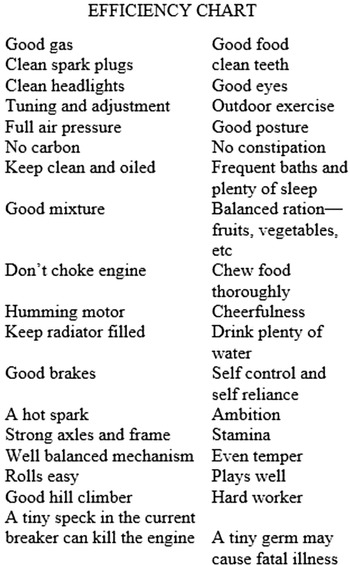
Whether rendered animate in the form of horses or humans, the equation of biological and mechanical well-being contributed to an emerging ethic of car care, through which automobiles could be understood as having personalities and emotions influenced by the facilities (such as good roads) made available to them. Nowhere is this equation more visible than in the “Efficiency Chart” which appeared in the Journal of Rural Education in 1924 (Figure 1).
Reproduced from “Efficiency Chart,” Journal of Rural Education, 4 (Nov. 1924), 137.

This chart encourages readers to treat their automobiles with the same care that they would (supposedly) treat a living being, sparing no expense in keeping their cars clean, safe, and even happy. However, an alternative way of reading this chart belies the notion that a human–machine symbiosis (as seen in Free Air) does anything to improve the efficiency of the human body, as the chart demonstrates that automobiles are just as susceptible to “illness” and malfunction as the body of flesh and blood. It is easy to read charts like this as purely humorous, and to dismiss the significance of theriomorphizing automobiles as inconsequential. However, as Shukin is keen to emphasize, animals in automotive culture do not exist in purely symbolic terms, and whilst the figurative rendering of cars as horses may have contributed to the human–machine relationship, the terrestrial cost of automobility was being paid not only by actual horses (as we shall see) but also many other animals, who were consigned to the homogeneous classification of what we now call roadkill.
ROADKILL: THE ANIMAL BENEATH THE WHEELS
As Roger M. Knutson notes in his satirical yet factually sound history of roadkill in the United States, “Fast cars and hard-surfaced roads have produced the entire flattened fauna described here in less than an eye-blink.”Footnote 52 Before the automobile, when all animals had to worry about on the roads was horse-drawn wagons, the category of “flattened fauna” consisted only of “the occasional horse-stomped snake.”Footnote 53 Knutson goes on to claim that there is little published research into flattened fauna before 1930, but Dayton Stoner succeeded in unearthing some such research, conducted by the United States Entomological Laboratory and the Illinois Natural History Survey in 1925. The report states that in a single 632-mile trip on Iowa roads in 1924, “255 dead animals were found, representing 29 species.” The investigator concluded that automobiles already demanded “recognition as one of the important checks upon the natural increase of many forms of life.”Footnote 54 Although the road narratives by Dreiser, Closser Hale, and Lewis take place in the decade prior to this study, Michael L. Berger suggests that the total number of flattened fauna was possibly greater in the 1910s, assuming that by the 1920s “farmers had taken certain precautions to keep domestic animals off the highway.” Berger also notes that the figures collected ought to be considered a minimum estimate of the deadly impact of the automobile, as animals “such as pigs and chickens” were usually removed from the road immediately after they were killed, to be used for food, and thus would not have been counted.Footnote 55
Interpretations of roadkill in these early automotive stories reflect contemporary attitudes toward nonhuman animal life in automotive culture, and the price we are happy to let others pay for progress. Written during a period of great humanitarian concern in the US, these renderings of roadkill are complicated by the care afforded to theriomorphized automobiles. By virtue of their symbolic relations to horses, the cars in these texts often receive greater ethical consideration than actual sentient animals. The very minor presence (or often complete absence) of roadkill in road trip narratives highlights the anthropocentrism of an idealized open road, where the only animals on roadways are those figurative horses powering automobile engines (and humans, of course). Closser Hale's We Discover the Old Dominion presents an intriguing question about the visibility of animals beneath the wheels. No instances of roadkill are actually described explicitly in Closser Hale's narrative, and thus it might seem like an unusual choice of text to begin with, but the text's subtle allusions to roadkill tell us much about the place of flattened fauna in automotive culture – an ever-present but often unspoken feature of car travel.
When the party stop at a hotel en route, Closser Hale is delighted to discover that for dinner they will be eating “chicken in large quantities … for the first time” on their trip, having “not met with it before except under the motor's wheels” (241). This sentence, appearing over halfway through the text, is the first mention of the word “chicken,” and the first and only allusion to roadkill of any kind. The reader can infer from this, then, that during the previous 250 pages of highly detailed travelling reports, Closser Hale's party have flattened at least one other chicken (likely more if we are to recognize the roadkill statistics of Stoner and Berger). The nonchalance with which roadkill is reported (or not reported) in Closser Hale's narrative, compared with the outpouring of sympathy for the automobile – “shut up in a garage after a hard day's run without any appreciative oil or grease or kerosene in the cylinders” (163–64) – demonstrates that chickens were considerably lower down the pecking order than automobiles in terms of deserving human care.
Despite narrating numerous encounters with farmers while motoring across their land on a trip covering over two thousand miles in total (7), Lewis's Free Air features only one passing reference to roadkill, also involving chickens. There is again a sense of indifference, even perhaps amusement, in the way Lewis describes Claire as absently watching
another member of the Poultry Suicide Club rush out of a safe ditch, prepare to take leave for immortality, change her fowlish mind, flutter up over the hood of the car, and come down squawking her indignities to the barnyard. (46)
The implication here is that the chickens are at fault for leaving the “safe ditch” and entering the unsafe road, and that it is their stupidity that endangers them, as opposed to the automobile or its driver. Claire's nonchalance towards the chickens’ peril reflects a sense of inevitability surrounding roadkill in automotive culture that remains the norm today. The banal quality to this scene of animal death (particularly the death of poultry – domestic birds bred for their corporeal economic value) demonstrates Claire's emotional detachment from the chickens; they are things rather than beings, and thus do not merit empathy. As James R. Simmons, author of Feathers and Fur on the Turnpike, would go on to acknowledge, all drivers “are aware of the fact that a great number of animals lose their lives on the highway,”Footnote 56 but this does not have any meaningful impact on the behaviour of motorists. Claire is considerably more concerned about the well-being of Milt Daggett's Teal Bug, a thing which is rendered figuratively alive, than about the chickens which are the real beings in this scene.
Of the three road narratives discussed, Dreiser's is the only one which affords roadkill any meaningful discussion. This is not to say that A Hoosier Holiday is particularly sensitive or thorough in its treatment of road fauna, but Dreiser is at least prepared to consider events from the animals’ perspectives. As they approach East Aurora, Franklin notices a hen only narrowly avoid being flattened by their onrushing vehicle. Rather than interpreting the hen's dash toward the road as stupidity or suicidal tendency, Franklin considers why hens seem to “invariably cross the road” when an automobile approaches:
It's because they always have the instinct, when any dangerous object approaches, to run toward their home – their coop, which is often just opposite where they are eating … Our car will come along, and instead of moving a few feet farther away from their home, and so escaping altogether, they will wait until the car is near and then suddenly decide to run for home – the longest way out of danger. Lots of time they'll start, as this one did, and then find when they're nearly half way over, that they can't make it. Then they start to run ahead of the car and of course nearly always they're overtaken and killed. (161–62)
Franklin is by no means a specialist on the behaviour patterns of poultry, but his explanation frames the matter as serious rather than merely comical – as in the Poultry Suicide Club. Ultimately, the point is not whether he is correct, but that he does not automatically blame the hens nor assume that their actions have no explanation. It is also significant that Franklin acknowledges the automobile as a dangerous object, thus reframing the crime as murder rather than suicide. Dreiser stops short of suggesting that humans should feel guilt over such instances, however, as when they inevitably do run down and kill a chicken later in the narrative, he claims that his “one fear in connection to this chicken incident was that the loss might prove something much more valuable than a chicken, and the thought of death by accident, to others than myself, always terrifies me” (481).
From the examples given thus far, one could argue that whilst the motorists appear to care more about their theriomorphized automobiles than about chickens, this may tell us more about the low value of chickens specifically than about the privileged place of automobiles. As a small, domesticated animal with a (relatively low) commercial value already assigned to its life, a chicken being running over is unlikely to register as much more than a bump and perhaps a squawk for the occupants of an automobile. Had any party hit a dog (like Closser Hale's dog Toby, for example) the emotional repercussions would likely have been much greater given dogs’ higher value in human society, and the fact that their deaths are mourned as tragic, unlike chickens whose deaths are seen as routine. There is one other instance of roadkill right at the end of A Hoosier Holiday, involving a larger animal, when a pig appears suddenly out of the darkness. Despite its squealing, “as though seeking human care,” their new chauffeur Bert was “quite unable … to turn quickly enough to save it” (508). We know that the party were travelling fast by the language in which Dreiser describes the collision: “There was a smash, a grunt, and then silence. We were speeding along quite as swiftly as before” (508). Such is the violent power of the automobile that even the death of a pig barely registers a blip, either physically or emotionally, for the human occupants. Of course pigs, like chickens, have a preexisting monetary valuation in the slaughter industry which makes their machine-induced deaths appear more inevitable than is truly the case. Two paragraphs later, Dreiser claims that it “had been a pleasant day, like all these days – save for the evoked spirits of dead things. We drank and smiled and paid and then sped out” (509, my emphasis). In automotive culture, then, it seems that the evocation of animal spirits is only positive when we understand the animal in a figurative sense – the horse's spirit in the wheels rather than the pig's flesh.
CONCLUSION: THE PASSING OF THE HORSE
Three of the earliest examples of the American road trip novel and the Outing guidebooks to both horse and car care demonstrate how an ethic of care for horses was transferred to horseless carriages in early automotive culture. The irony of this transference is that, from its advent, proponents of the automobile considered the machine a substitute for the horse, an attitude optimized by the title of the first automotive periodical in the English language – Horseless Age. In this sense, car care depended on the evocation of the very animal set to be replaced, benefitting from the horse's sentimental connection to humanity whilst symbolically killing it.
Given that the horse was essentially the main competitor to the horseless carriage, it is unsurprising to find periodicals such as the Horseless Age filled with articles encouraging people to “blot the horse from [their] minds.”Footnote 57 In 1903 an advert for Olds Motor Works featured an image of an automobile passing a horse on the road with the caption “The Passing of the Horse,” the implication being not only that the horse was the more laggardly mode of travel (as the car physically passed it by) but also that the time of the animal itself was passing. Such implications were not lost on those more sceptical of automobility, including Baptist minister and animal welfare campaigner Francis H. Rowley (1852–1954), who wrote that “the careful advertising statements of the automobile and autotruck salesman” were leading people to believe “that the horse [was] fast traveling into the past.”Footnote 58 Incidentally, the US horse population continued to grow until 1914, the point at which the (still officially neutral) US government began shipping horses to Europe as part of the war effort.Footnote 59
Many of the horses “liberated” from human service by the automobile, however, died more than just symbolic deaths. Fleshing out the symbolic relations between humans, animals, and automobility leads us back to Shukin's double entendre of “rendering,” a particularly apt formulation for reminding ourselves that once horses had entered into the industrial marketplace they could not simply disappear into an imagined Edenic past. The industrial rendering of dead horses in meatpacking facilities had occurred in years before the automobile (packers would often offer to collect the bodies of horses who had died in the street); their hides, hooves, and bones were all used to make various products.Footnote 60 As Susanna Forrest notes, however, this practice became increasingly common after “the first parpings of the motor car,” as the monetary value of horses as a means of transportation became lower and lower, until many former draft horses were worth more as dead than as living commodities.Footnote 61
It is in this sense that the theriomorphizing of cars as animal was a driving force that rendered actual animals disposable. While drivers could fondly remember the noble horse every time they ventured out in their cars, many horses of the supposedly horseless age entered a new kind of market. The first large-scale dog food canning operation in the US was set up in the late 1910s – Chappel Brothers, Inc. – yet, as Katherine C. Grier has shown, this company does not appear in the 1922 Packer's Encyclopaedia (the business directory of the meat industry). Grier suggests that this absence is down to the fact that Chappel Brothers was “exclusively a horse slaughtering operation,” which, in Grier's words, was a shadowy “but necessary” part of the horse world.Footnote 62 As Shukin has demonstrated, the automated assembly lines of Henry Ford's Dearborn automobile factory were inspired by a tour Ford took of a Chicago slaughterhouse, meaning that the auto assembly line, “so often taken as paradigmatic of capitalist modernity, is thus mimetically premised on the ulterior logistics of animal disassembly that it technologically replicates and advantageously forgets in a telling moment of historical amnesia.”Footnote 63 Remembering the literal as well as the figurative horse in horsepower is thus necessary if we are to understand the ethical turns made by humanity about which animals are expendable for our ideas of progress, and which are allowed to join us in reaping the benefits of their deaths. Evoking the figurative horse meant that Closser Hale's automobile was treated humanely, but it may well have been literal horses which meant that Toby the dog did not go supperless to bed.
The symbolic reverence for the horse in automotive culture, the suggestion that its spirit somehow lives on, nostalgically, in the wheels, is a welcome distraction from the corporeal reality of horses whose primitive animality meant that they needed to be “discarded” (using G. Herbert Condict's word) to make way for the automobile. It was simpler to believe that they had simply passed into the past, rather than confront the horrific literality of their being rendered obsolete. Achille Mbembe has defined necropolitics as conferring upon living entities “the status of living dead.”Footnote 64 In this sense, horses were in a state of perpetual dying, suspended in the process of passing without ever actually realizing a horseless age.