

1. Introduction
Everyday, humans coordinate diverse bodily, affective, interpersonal, material and technological resources within rich and evolving cultural and environmental contexts. Throughout human history, artistic presentation has always both exemplified and dramatically extended these verbal and non-verbal forms of embodied interaction in multi-dimensional, cross-disciplinary ways (Shusterman Reference Shusterman2000). The history of artistic milestones from drawing to still photography, motion- picture technology, and sensor based motion capture systems indicates that art has long been interpreting the human body in motion. In recent years, dynamic technologically mediated performing arts environments have been challenging and reinventing these associations whilst concurrently renegotiating relationships between art and science, and the performer and the audience (Godlovitch Reference Godlovitch1998; Birringer Reference Birringer1999; Broadhurst Reference Broadhurst2007). Such interactive environments in dance, music and new media art lend themselves to innovative forms of creative practice and aid in breaking down established distinctions between performer and audience, and between rehearsal and performance. Such practices act as a provocation to classical notions of interaction, extending clear causal action–response, excitation–sonification relationships so apparent in acoustic musical instruments (and other analogue systems) towards increasingly manifold and complex mediated relationships between the excitation source (in this article, a human performer) and the rich media output of the system.
Within such a dynamic and evolving field, it is hardly surprising that the nature of interaction remains an open question. Previous papers (Paine Reference Paine2002, Reference Paine2007, Reference Paine2008, 2009a; Paine and Drummond Reference Paine and Jon2009) sought to explore the temporal nature of interaction and interface design. They drew on concepts of morphology (Smalley Reference Smalley1986; Wishart Reference Wishart1996) that sought an open, non-predefined relationship that demonstrated reciprocity. The accepted models for musical interaction at that time reflected a concern with sensing, as illustrated in Robert Rowe’s schema formed from sensing, processing and response (Rowe Reference Rowe1993). As such, interaction has typically been predicated on the technical acquisition of information about the momentary relationship of action (body) and reaction (system). At that time the author proposed a model for interaction that drew from human conversation.
Within such an interaction the starting point is known by one of the parties, and whilst in some discussions there is a pre-existing agenda, in general, the terrain of the conversation is not known in advance. It is a process of exchange, of the sharing of ideas. It is a cybernetic-like product of the whole, a product that is unique to the journey they share during their discourse.
This process of interaction is extremely dynamic, with each of the parties constantly monitoring the responses of the other and using their interpretation of the other parties’ input to make alterations to their own response strategy, picking up points of personal interest, expanding points of common interest, and negating points of contention. (Paine Reference Paine2002: 297)
Whist this model remains useful with regards to the temporal structure and our pre-knowledge of the events of an interaction, more attention has recently been given to somatic engagement – the quality of haptic/sensory engagement with an instrument/interface, the feedback loop formed by somatosensory and listening phenomena.
Merleau-Ponty and more recently Don Ihde have argued for embodied relations (Ihde Reference Ihde1990: 72). Merleau-Ponty commented that ‘The body is our general medium for having a world’ (Merleau-Ponty Reference Merleau-Ponty1962:146) whilst Ihde expanded on this discourse to propose a set of unique relationships with technology that facilitate an embodied engagement with the world that could not occur without the technology. Reading glasses and microscopes are cited as examples, which he argues not only proffer up embodied experiences of the world around us that would otherwise be unavailable, but allow us to operate on the world in embodied ways that would otherwise be impossible. In so doing, it is argued, we are not momentarily aware of the role of the technology in facilitating that interaction, because we embody the technology. These technologies exist at a human level and so we understand their phenomenology and incorporate them easily into our body schema. A post-phenomenological example might include digital imagery from data acquired by contemporary telescopes (non-optical) which, whilst representing a domain beyond our personal experience, nevertheless provides knowledge about the greater realms of our existence that alter our phenomenal experience of self in relation to a known universe.
A similar argument might be made for a musical instrument – that through our embodied engagement with the instrument, we are able to access and make music in a manner unavailable to us without the instrument. If we extend this to digital systems, however, the embodied relationship becomes more ambiguous. The action–response, excitation–sonification relationships so apparent in analogue and acoustic instruments become opaque through mediation and thus when using an interactive system we generally remain aware of the system itself, in fact we are actively focused on building a cognitive map made up of the nuances of our input and their relation to variations in system output. This is often attributed to the newness of such an experience, meaning that we do not yet have an understood schema for the relationships our engagement with the system establishes. A unique cognitive map must be built for each interactive media system, even though there may be some commonalities such as the manner of system excitation (trigger, continuum), the aesthetic bounds of the system, the degree to which the system produces polyphony or manifold simultaneous, related streams of media and the consistency of input modality (gestural, bio-data, control device…). Moreover, rich media systems may also dynamically change these bounding characteristics so that a cognitive map must be developed for each state and for how state transitions are elicited/initiated. Such experiences are formed into a kind of simulacra, a gestalt of all states that forms a common perception of the work and its interactive potential.
However, if we consider other experiences that are more common in our lives, we find that the technology itself by and large disappears in the act of undertaking the task or engaging with the device. Indeed, as digital technologies become ubiquitous, a key design intention is that they disappear. In these cases the function outweighs the somatic, in that we are not really performing the interface, merely using it to achieve a clear and consistent outcome.
As discussed above, at this point in their development, interactive systems rarely become (largely) transparent and as such do not currently fall within Ihde’s discussion of ‘embodiment relations’. The principle objective of proposing the techno-somatic dimension is to encourage design that facilitates ‘embodiment relations’ so that new possibilities for engaging in the world become possible (real and virtual) and also so that the interface objects become part of our body schema in order to extend our action in the world.
2. The Techno-Somatic Dimension
If we unpack this gestalt, we find several layers of reference: the physical object that constitutes the instrument/interface itself, the ways in which the human body can enact intentional actions upon that instrument (the technique of performing the instrument) and a third dimension representing the somatic gestalt formed by engaging the first two layers. This somatic level is a manifold (after Kant) of the physicality of engaging the instrument (the way a cello or double bass is enveloped by the body; the external relationship of a wind instrument to the body, whilst it is simultaneously being brought to life by the performer’s breath …) and represents a cumulative experience of the instrument/interface as artefact that is enacted through technique and experienced through somatosensory and listening phenomena.
The act of performance of the instrument can then be considered an intermediate dimension that sits between the body and the instrument; a dimension that constitutes the act of interacting with the instrument; a dimension that is both technical (instrumental technique and performance practice) and somatic, that concerns how the instrument fits the body, how nuanced the relationships are between exertion of the body (breath, gesture) and the resultant sound: the gestalt of engaging the instrument/interface for the purposes of creative output. Interaction with a musical instrument might therefore be considered as an assemblage of both physical action and somatic engagement. The ‘how the instrument feels’ consideration is part of a critical feedback loop between action and instrument response. The ergonomics of instrument design are as much about this ‘feel’ as they are about the constraints of human limbs, lung capacity and so on. It is clear then that the performative act is a composite of technical and somatic relationships, where the focus shifts depending on the context – performance or practice/rehearsal.
Technical proficiency is commonly extensively practised, with highly proficient musicians reporting that technical considerations are secondary at the time of performance. In other words, focused practice of the technique allows it to become embodied in such a manner as to be manifest in the performative act and therefore transparent in performance. This can not be said for the physicality of engaging the instrument. Indeed, such physicality is often amplified in performance as the musician focuses on their relationship to the instrument in forming the nuance of the sonic outcomes. The physical engagement of the instrument is of course also part of the technical practice regime – control of the breath and embouchure, the most effective placement of the hands, and so on – but in performance it represents the affective, emotive relationship/conductor between the performer and the music and the audience.
The reason for this extended consideration of the nature of the proposed techno-somatic dimension is that designing the way in which the elements of performative engagement (technical and somatic) meet is critical to the instrument's performance, be they analogue or digital. The techno-somatic dimension defines the ‘feel’ of the instrument, formed through both somatosensory feedback and listening, and represents the cognitive map the performer develops about how to play the instrument, the technique, and how the instrument responds under differing circumstances. One illustration of this dimension is the manner in which a skilled musician will talk of how the instrument ‘speaks’. It can therefore be said that the techno-somatic dimension has material properties that establish its nature.
As outlined above, the techno-somatic dimension forms an intermediary substrate that produces a range of properties that give the interaction a materiality that may therefore be analysed and discussed. Some of these qualities may include:
∙ Somatic – energy, aesthetics (style/sonic/musical), physical fit, the degree to which ‘actional intentionality’ (Ihde Reference Ihde2010: 21) is perceived as internal/external
∙ Functionality – technical, aesthetic/musical
∙ Materiality – precision, gestural qualities of engaging the instrument, nature of control (continuum, events etc.), the fluidity or viscosity of engagement.
An important question that arises with this proposition is: how is the techno-somatic dimension established?
A techno-somatic dimension is established through a process of exploration which leads to an understanding of the material properties of that dimension and the way in which that material is substantially affected by one’s engagement with it. When interacting with a performance instrument/interface – whether that be an acoustic musical instrument, a digital music interface, a rich media performance environment or an installation work – one must come to comprehend the qualities of the media and one’s relationship to those qualities. This may be discussed in terms of technique, the fingering patterns or breath support: in other words the performance techniques that have developed over time to optimise the output, which, for acoustic instruments at least, is documented in well-known treatises on performance technique. The techno-somatic dimension will, however, also include the way in which the instrument/interface provides feedback. For instance, when one provides more breath pressure on a reed instrument (clarinet, saxophone, oboe, bassoon, duduk …) the instrument increases its resistance to the volume of air, and the performer can feel that response. The quality of this haptic engagement establishes an abstract, sensorial relationship between the intentional effort of the performer and the pliability of the instrument. This haptic sensorial relationship is multi-factorial, it varies with register (pitch range) and it is a factor in timbral variation. The musician therefore understands these relationships as dynamic.
3. Materiality Of The Techno-Somatic
Above, I have proposed that the techno-somatic dimension acts as the interconnection between human and instrument and that this dimension is posited as having a materiality that takes as its substrate somatic qualities of engaging the instrument and a functionality predicated on controlling the instrument within the requirements of the musical practice. This physicality of performance enables the ‘actional intentionality’ in a manner that may be discussed as having certain properties pursuant to its design relationships. Furthermore, these properties might be said to have a set of multistabilities (Ihde Reference Ihde2002: 23) which contribute to a definition of the materiality of the techno-somatic dimension.
It must be remembered that this materiality is founded upon the somatic and functional/pragmatic characteristics presented in the instrument and its associated performance practice. However, supplemental to that foundational materiality are qualities that emerge from the performative act. These qualities include precision, gesturality, the nature of control (continuum, events…), and the fluidity or viscosity of that engagement. The performative engagement has a perceived thickness (viscosity) which both enables the actional intentionality and constrains certain performative gesturality, where gesturality implies both physical performative acts and the quality of the resultant sonic outcome(s). The materiality of the techno-somatic dimension acts as both an enabler of the performative act and as a catalyst for idiomatic constraints. In this manner, the techno-somatic dimension establishes the fundamental qualities of the instrument and its repertoire.
The materiality of the techno-somatic dimension is of course manifold. There is no singular finite state, but rather a dynamic vector field of possibilities constrained by the somatic and functional qualities of the dimension. The dimension itself can be considered porous, where the porosity is a product of varying (hopefully increasing) technical proficiency, the context of use (performance or rehearsal), collaborative engagement and variation in body form from individual to individual and as a product of ageing, producing possible variation in somatosensory and listening phenomena.
4. Case Studies
The last several years have seen an explosion of new musical interfaces released to market and a rapid expansion of the dedicated conference on the subject, NIME.Footnote 1 In order to illustrate some of the ideas outlined in this paper, the author will apply them to several available interfaces, one built as a gaming controller but widely used in musical performance contexts and the others designed and built for music performance. The author has spent many hours using each of the discussed interfaces.
4.1. WiiMote
Immediately upon release, the Nintendo Wii Remote (WiiMote) was the focus of a groundswell of music performance, DJ and VJ experimentation. Software frameworks quickly appeared for a variety of operating systems and were compiled into objects or plugins for programming languages such as Max/MSP,Footnote 2 PD,Footnote 3 Quartz ComposerFootnote 4 (QCWii), IsadoraFootnote 5 and OSCulatorFootnote 6 (providing an OSC bridge), and embedded in a number of applications.
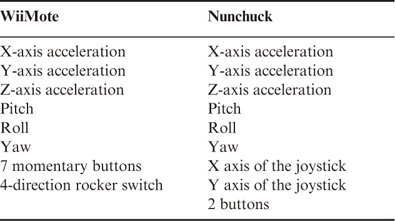
Part of the attraction is that the interface is wireless (Bluetooth), but a major factor is also the range of control afforded by the WiiMote. The more recent WiiMote Plus contains eleven buttons (momentary) and a three-dimensional accelerometer (six continuous streams of data, three direct and three second-order parameters, pitch, roll yaw – see Table 1), a dual-axis tuning fork gyroscope and a single-axis gyroscope which can determine rotational motion and provide reliable linear-motion tracking. In addition to this already substantial data set, the WiiMote accepts a nunchuck accessory, which is held in the remaining free hand and contains a second three-dimensional accelerometer, a traditional two-dimensional joystick and two trigger-style buttons (C and Z).
WiiMotc and nunchuck control parameters.

One of the characteristics of such an interface is that the buttons and or joystick can be used in parallel with, and independent of, the three-dimensional accelerometer/gyroscope data. This means that the data streams shown in Table 1 can be performed semi-independently and simultaneously.
Anecdotal evidence suggests that audiences find the perceivable relationship of gesture to musical outcome problematic in electronic music performance, failing to resolve issues pertaining to authenticity of performance.
This issue was reinforced by a review of a concert in which the author performed using both a Wacom Tablet and a WiiMote/nunchuck combination.
This emphasis on performativity was a key feature of Paine’s work in particular. Use of the spatially-operated Wii controller obviously lends a degree of theatricality to a work – in Paine’s case, this was characterised by a precise, restrained motility that had a more obvious connection to the sounds produced than is necessarily the case with other spatial instruments such as the Theremin. As far as visual musicality goes, the Wii has an edge over the incongruent sight of a performer grooving along to the minute scratching motions of a stylus on a drawing tablet. (Davis Reference Davis2008)
The author suggests that the very success of the observed link between gesture and sound originates in the techno-somatic dimension. The WiiMote as an interface provides a well-executed somatic fit to the hand and makes available a large number of control parameters of varying characteristics (momentary and continuous) and of differing resolution. It is therefore possible for the performer to use the device to instigate radical transformations through triggering state changes whilst simultaneously nuancing timbral variation.
The desired materiality and actional intentionality go literally hand-in-hand. Additionally, the controls become easily embodied so as to become unconscious in use.
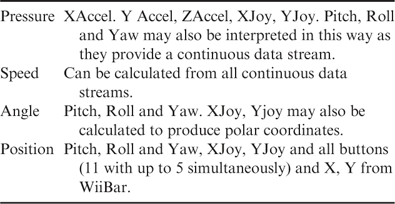
A further observation is that key musical control parameters (Paine, Stevenson and Pearce Reference Paine, Stevenson and Pearce2007) are easily mapped to the Wiimote and nunchuck as seen in Table 2. These parameter categories were shown to be fundamental to acoustic instrument control and performance, and the author’s proposition has been that they transfer with equal functionality to electronic musical interfaces.
Analysis and categorisation of WiiMote data.
The author has no method for measuring techno-somatic experience and is here using the popularity of the WiiMote as a musical controller as a measure of success in how it marries embodied actions suited to music-making whilst offering substantial independent control parameters. In this sense the techno-somatic dimension may be seen as implied and successful.
4.2. Eigenharp
The second example is the Eigenharp,Footnote 7 which was released in 2009 with a range of three models at differing price points and complexity. It includes a number of innovations including sensitive 3D keys and a coordinated approach to multi-sensor input and control which includes a wind sensor and two ribbon controllers with a set of percussion pads on the larger models, the Tau and Alpha. The Eigenharp Alpha is a complex instrument of very high build quality that presents like a top end acoustic instrument and therefore portrays an intention for serious music-making.
In Eigenharp tutorials there is little discussion about the manner in which the instrument is held – this is represented as a variable for which there are many options.Footnote 8 This discussion is common amongst controller manufacturers who focus on the application and software functionality at the expense of somatic engagement. The fact that the Eigenharp does not contain gyroscopes or accelerometers makes gesturing with the interface redundant. The development of an idiomatic style and performance literature, in large part, comes from the way the instrument is used. An instrument/interface that can be individualised in a myriad of ways may never develop an idiomatic usage, playing style or performance literature. An examination of acoustic instruments indicates a highly constrained usage style and an associated idiomatic literature. The proposition that the interface is widely customisable derives from a more engineering approach that is necessitated by the sophisticated systems engineering that produces the interface, but at the same time ignores the techno-somatic dimension and therefore, the author suggests, minimises uptake because there are minimal commonalities within the community of performers, meaning each creative expressions must derive from an individual position. The outcome is that these instruments have not, in general developed as wide a user base as the WiiMote, and whilst one might argue this is because of the price point, the author proposes that new interferes such as the Eigenharp have attracted a small user base because they have focused heavily on software features and individualisation of the controller and not so much on making the instrument fit the body. If design were approached from a techno-somatic standpoint, the ‘fit’ of the instrument/interface to the performer would be the driving factor and would constrain usage in the same way that a common playing approach is associated with each acoustic instrument. The outcome may be consistency of technique, a community of shared knowledge and approach, a shared body of compositions and a standardised pedagogic approach, all of which leads to a focus on creative expression rather than adaption and individualisation of the hardware.
4.3. Karlax
The KarlaxFootnote 9 is another high-quality musical interface, offering ten lever keys, eight pistons, accelerometer, inclination, gyroscope and many buttons as controllers along with a unique ability to twist the instrument in the middle, which provides both an axis data stream and a control stream associated with a double stop at each end of the axis movement.
In contrast to the Eigenharp, the Karlax defines a clear relationship to the body that remains relatively consistent.Footnote 10 The movement of the interface in the air provides a wide range of data including separate accelerometer, inclination, gyroscope streams which makes gesturing with the interface quite natural. The provision of handholds that essentially divide the interface in two makes the rotation axis available whilst gesturing in space and ensures that the key and piston controls fit easily under the fingers. The keys and pistons provide different qualities of somatic engagement with the lever type keys having a continuous data stream associated with the position of the key and the pistons providing an event with a velocity reading for how fast the piston was actuated. This range of types of somatic engagement with the interface, all available simultaneously, provides a way for the musician to layer differing musical elements, be they temporal or timbral whilst expressively gesturing. The accentuation of gesturing in performance was discussed earlier in this paper and is well supported by this interface, as it is by the WiiMote.
The techno-somatic dimension is clearer in the Karlax than the Eigenharp, as the hand positions and control mechanisms are all available to the musician at once and determine a common approach to performance with the interface. The Karlax ‘fits’ the body in a unique but constant manner and could therefore share a pedagogy of performance practice and, over time, develop an idiomatic literature for the instrument/interface. The fact that each of these interfaces does not produce sound itself means that idiomatic writing will never be as consistent or indeed as constrained as an acoustic instrument.
5. Overview Of Interfaces
Whilst there are many other interfaces available in the marketplace, many take the form of either a keyboard or a grid controller, or are idiocentric and not widely available to the public. Roger Linn presented a number of other musical interfaces, including his upcoming LinnstrumentFootnote 11 at Moogfest 2014. He discussed the developing critical mass of ‘multi- dimensional controllers’Footnote 12 by presenting descriptions of the Eigenharp, Continuum Fingerboard,Footnote 13 the recently developed SeaboardFootnote 14 and the Soundplane.Footnote 15 Each of these focuses on three-dimensional keys providing a degree of gesturing not previously available to keyboard performers; however, they remain firmly within the keyboard paradigm and retain the somatic qualities associated with that domain, which has classically been categorised under ‘percussion’. Continuous control of parameters is, however, designed into these control surfaces as an expressive dimension for an already excited note, which extends the percussion paradigm and begins to address the techno-somatic dimension in terms of the quality of the gesture and how gestural engagement with the interface produces expressive output. Whilst fixed to a surface, the gesturing does include three-dimensional sensitivity, and in the Continuum Fingerboard and the Seaboard, the ‘z’ dimension is of high resolution, facilitating nuanced expression.
5.1. Form and function
A common theme in new musical controllers/interfaces/instruments is a focus on their functionality. The above discussion proposes that whilst this may produce interfaces that present a high level of possible manifold control streams, these interfaces are unlikely to move past the point of being controllers into being an expressive instrument until the techno-somatic dimension is carefully designed and prioritised. The discussion of the WiiMote suggests that game controller designers are paying more attention to the somatic dimension than are instrument makers. One probable reason is that a principle design objective for game controllers is to achieve an embodied relation, where the device provides access to a dimension otherwise unavailable to the user and does so in such a manner that means, for an expert user, the technology completely disappears in use.
6. Conclusion
In conclusion, I return to Merleau-Ponty and Don Ihde’s Embodied Relations. We may argue that interactive media systems, such as digital musical instruments and interfaces or immersive interactive environments, present a new form of embodied relations. The immersive interactive rich media environment, whether a public installation experience or a bio-sensed dance work, presents a unique set of relationships with technology that facilitate an embodied engagement with the world that could not otherwise occur. They not only proffer up embodied experiences of the world around us, but in the case of rich media environments, or some forms of real-time interactive digital performance systems, our/performer’s presence and actions (gestures, speech, bio-signals …) act upon the system to create the very world we are inhabiting through a cybernetic-like causal loop. Without our presence, the world we momentarily inhabit in these systems would otherwise be unavailable; in fact, almost poetically in line with some indigenous cultural myths, without our action, the world would not be called into existence (see Australian Aboriginal song lines as one exampleFootnote 16).
In summary, this form of embodied relations not only allows us to perceive the world in a manner not otherwise available to us, and to act upon it, but in part to create it. Embodied relations traditionally come into being in part because the device of mediation is constant in its effect – the mediated outcome correlates so strongly to the perceived reality, whilst being immutably dependable that the mediation device is no longer considered in the experience and thereby ‘disappears’. However, to illustrate the fact that the techno-somatic dimension is porous, we can consider here that acting upon an interactive rich media system produces an immersive experience, which however is simultaneously real and derealised – the interaction produces an outcome that is not immutably dependable, but is consistent within an abstract scope, such as an aesthetic domain. In other words, the embodied relations exist here not as a singular mediation, but as a manifold yet bounded set of possibilities. The success of our engagement with this vector field of possibilities is through the somatic, or embodied, engagement, and the degree to which this provides us with a sense of agency is a measure of the success of such a system. Such agency is formed from the somatic and functional parts of the techno-somatic dimension and work together to produce the materiality of that dimension.
This paper has proposed a new model for considering the design of interactive systems, be they digital or analogue. In so doing the author has introduced the notion that the relationship between the system/interface and the interactor/performer has sufficient materiality so as to be considered a dimension, and that this dimension is defined as an intermediate dimension that sits between the body and the instrument; a dimension that constitutes the act of interacting with the instrument; a dimension that is both technical (instrumental technique and performance practice) and somatic, that concerns how the instrument fits the body, how nuanced the relationships are between exertion of the body (breath, gesture) and the resultant sound. The proposition is that the techno-somatic dimension informs and shapes both elements it links (instrument and performer) and, through an awareness and sensitivity to the performative potential and latent agency of the relationship between soma and techne, a materiality can be defined which is simultaneously fluid, viscous and porous. It is further proposed that if the design of interfaces for creative applications (in this case musical performance) focus on the techno-somatic dimension – that is, they design that dimension intentionally – the specification for the interface elements and their associated control parameters will result from that design activity. This proposition suggests a move away from the current paradigm of engineering solutions to a focus on how the instrument ‘fits’ the body and a consideration of idiomatic approaches to digital performance that focus on the performative potential and latent agency of the relationship between soma and techne. Such a move is critical to the development of new musical interfaces, which to date have been largely ignored by the wider public. The NIME conference has fostered a community of researchers and practitioners in this area since 2001; however, such devices are not seen in regular use in community settings where musical ensembles/bands still feature keyboards, guitars and drum kits as standard. In addition, many new interfaces have been commercialised but failed to build a sustainable user base. The CEO of Thumtronics, which developed the Thummer interface, reflects that even though he had substantial business knowledge, the venture failed for several simple reasons including:
∙ The characteristics required for ANY new product to be successful are that it be simpler, cheaper, and/or more powerful;
∙ All new musical interfaces are inherently disruptive;
∙ A disruptive new product has to be two or three times better than current offerings along at least two of these dimensions (simplicity, affordability, power);
∙ The vast majority of proposed new musical interfaces do not deliver benefits sufficient to disrupt the status quo.Footnote 17
The above list does not include new forms of musical expression because they evolve slowly and are not immediately commercialisable. The issues of perceived simplicity and expressive power could be addressed by designing the techno-somatic dimension rather than approaching the design from an engineering standpoint. In order to do this, several constraints would need to be decided upon that provided a foundation for the interfaces use. For instance, if it were to be hand held and played standing up or unfolded and placed on a table like a keyboard the affordances would be very different. In the case of the Thummer, and the other interfaces discussed in this paper, aspirations have been towards a flexible, individualisable interface that presents minimal limitations, which, whilst fulfilling an engineering challenge to support diversity of use and broaden the potential market for the product, simultaneously reduces its creative potential to a functional controller rather than an expressive interface by ignoring the need for constraints as discussed earlier in this paper.
The author suggests that placing the techno-somatic dimension at the top of the design hierarchy and deriving engineering decisions from such a techno-somatic-driven design process would make for more expressive interfaces that clearly communicated sets of intuitive constraints that direct the user to the creative task the interface is designed for. Such an approach would make the industry more attractive to end users by producing creative interfaces that demonstrate sufficient expressive potential to disrupt the status quo and be simple, affordable and powerful creative tools.