The Victorian photographer Eadweard Muybridge (1830–1904) holds two well-deserved claims on our attention as an artist of the “wide.” Through his still-powerful corpus of Yosemite images, he carved out a distinguished career as a key fashioner of the American pictorial sublime, and through his innovative work on human and animal locomotion, he was instrumental in launching the era of moving pictures.Footnote 1 In both, he enlarged his art's representational possibilities by opening the lens to novel subjects and modes of pictorial capturing. Yet Muybridge was also an important pioneer in Indigenous representation, a subject he explored in a broad transnational zone stretching from Alaska to Panama, a geographic range of some seven thousand miles. Today, Americanists employ the term “hemispheric” to describe how North–South formations challenge monolithic nationalisms by crossing, evading, and subverting political limits. Yet in the 1860s and 1870s, when U.S. national borders had largely consolidated, Muybridge was already testing a similarly supranational and geographically expansive term: the Pacific Coast. From the photographs included under this rubric, Muybridge seems to have been interested in exploring a visual horizon bounded by no one particular nation but, rather, by the interactions among a variety of human and nonhuman elements, some closely identified with a nation, most not: settler and Indigenous communities; buildings and machines; and natural phenomena, such as coastlines, mountains, rivers, and gorges. Fundamentally dynamic and territorially unstable, Muybridge's Pacific Coast poses a challenge to any nation's—and any artist's—reach and grasp. The idea of it and its photographic depiction are a paragon of the “wide,” a testing of political as well as representational horizons.
There is a risk in the overreliance on related englobing terms such as the hemispheric, the cosmopolitan, or the transnational. These terms can quickly lose their adhesive power. A useful corrective may lie in more localized terms such as the “zone” or the “Pacific Coast,” which capture the widening forces of Victorian culture without succumbing to the danger of universalizing categories.—Robert D. Aguirre
To be sure, many of Muybridge's Pacific Coast photographs may be read as briefs for the benefits of U.S. expansion. They image railroads and bridges, steamships and military installations, the logistical infrastructure for a newly emboldened national empire. In these photographs rivers are spanned, pylons driven, steamships assembled. Technology's tentacular power appears magically to subdue a rugged western landscape in an inexorable movement of Western modernization and colonization. The photographs document this process, even as they bear witness to photography's pervasive power as a new medium itself. The camera records these changes but also promotes and accelerates them.
Yet Muybridge's zonal term “Pacific Coast” implicitly counters the celebratory narrative of modernization and national consolidation. For the wider something is, the harder it is to contain; the more it holds, the more it resists definition and mapping. Capaciousness tests the limits of representation. This is both a cognitive problem and a political one, as knowing is intimately bound up with administering and dominating. It is a matter of no small interest that the U.S. military recruited Muybridge to employ his camera in coastal mapping, a recognition early in the medium's history of its strategic potential, familiar now from drones, spy planes, and satellites. Muybridge's tour of Alaska, discussed below, can be understood as isomorphic with photographic reconnaissance, the term's etymological origin rooted in the interplay between concepts of knowing and practices of power. Yet the Pacific Coast's long, transnational expanse meant that even a highly mobile traveler onboard the era's fastest ships and trains could not capture its every lineament. In many images, towering Humboldtian natural landscapes dominate. Their sheer mass alone suggests the power of nonhuman actors to impede technology's modernizing forces. In other images, dense coastal fog obscures the light, thwarting the sine qua non of the photographer's art. Even if one were to define the coast as the narrow strip where the land meets the sea (which Muybridge does not), many areas were unreachable, guarded by powerful currents and dangerous rocks. To limn the coast's entire width, from Alaska's snowy peaks to Guatemala's humid jungles, proves impossible, leaving only snapshots shored against the region's vast unknowability.
This resistance to overview also inheres in the human world Muybridge sought to record. The prominence he gives to various indigeneities encourages the viewer to see the coast not simply in frontier terms as the last unconquered parcel. The faces and bodies of the Indigenous also encourage us to see this continental limit as still-contested homeland, a dwelling place for a variety of peoples whose histories evade pictorial understanding. All along this littoral, European and new immigrant-settler cultures clashed with Indigenous ones in battles over terrain, resources, mobility, and dominion. In some cases, as in the Sitka peninsula, the conflict was muted. The fate of the Tlingit inhabitants realigned with the stroke of a treaty pen, as the land they dwelled in passed from Russia to the United States with a few formulaic phrases. In others, as in the Modoc stronghold of northern California, the tools of domination assumed the more brutal form of bullets, cannon balls, and jails. In Guatemala, the era of coffee monoculture threatened ancient ways of life that in previous decades had flourished under enlightened governmental policies. The modes of Indigenous engagement with these forces differed along with the geopolitical circumstances. The elasticity of the container “Pacific Coast” meant that within Muybridge's photographic corpus there was more difference than uniformity. Although the word “Indigenous” suggests a stable identity, the heterogeneity within Muybridge's photographic frame—Tlingit, Modoc, Miwok, Kuna, K'iche’, and others—pulls in another direction. These are all very different peoples, with their own distinct histories and traditions. In some ways, the Pacific Coast imaged in these photographs is a unity, in others a bundle of contradictions.Footnote 2
Zones [are] more spatial than geographical. The zones function to link specific peoples, entities, ideas that exist individually around the planet.—Lynn Voskuil
To focus these observations, I examine two key moments that bookend Muybridge's Pacific Coast photographs: his 1868 visit to Alaska and his 1875 visit to Central America. In each, questions of sovereignty and political self-determination are paramount. His first extended foray along the coast, the Alaska journey coincides with the U.S. acquisition of that territory from Russia. Near the end of his expeditionary career, the Central American journey coincides with the establishment of globally connected coffee production in the region, a change with profound implications for the Indigenous peoples of highland Guatemala. Taken together, these Pacific Coast images suggest a newly expanded horizon for photographic and cultural representation, combining different genres (landscapes, battlefield action shots, portraiture, anthropological types), regions (Alaska and Central America), and cultures. Implicitly organized by the theme of threatened indigeneities, Muybridge's images describe a wide arc for understanding modernity's and coloniality's uneven development across the Pacific's western littoral. They record how Indigenous peoples of the Pacific Rim were confronting new political realities and a brave new world of hypermechanization, one that also lay behind Muybridge's mobility as a camera-wielding subject and the large-scale reproducibility and global dissemination of his images. They record these processes both as localized instances in particular representational fields and as hemispheric or “wide” phenomena, ones with significant consequences for nineteenth-century photography, global capital, and imperial representation more broadly.
As such, these photographic corpora provide an important site for investigating Victorian visual practices of the “wide,” not simply as the expansion of a referential frame to encompass novel subjects, but also, and more critically, as the register of powerful narratives of temporality and modernity. My analysis of the “wide” as an incipient concept of critical spatiality is not set against the more familiar temporal dimension of the long nineteenth century (a false and ultimately unproductive opposition). I hope, rather, to place these two concerns in some fecund tension with each other, though my argument is less about periodicity than about the representation of timescales in nineteenth-century media. In Muybridge's photographs, thinking about the representational possibilities of width is impossible without also confronting their temporality. The Pacific Coast photographs are important both as explorations of timescales and artifacts in an influential nineteenth-century medium and prompts to reconsider the politico-economic networks that were central to the progress of expeditionary photography itself.
We are thinking here of the zone in a different way than Mary Louise Pratt's contact zone, which might privilege a temporal moment of encounter. Rather, we're thinking about longer temporal dimensions, with the zone indexing unfolding processes of relationality that would reveal the stakes of power, intention, will, opportunism, desire, and motivation.—Ryan D. Fong
A Correct View of Alaska
Initially for Muybridge, going wide meant going north, a photographic stretch to mirror a territorial one, as his journey coincided with the extension of U.S. sovereignty to what was formerly a part of Russia. Muybridge accepted a commission from the U.S. army to photograph the newly acquired territory of Alaska, purchased in 1868. Directed by General Henry Halleck, commander of the Military Division of the Pacific, Muybridge sailed up the Pacific coast from San Francisco, past British Columbia, and then on to Alaska to create a photographic archive that U.S. officials in Washington hoped would justify the $7.2 million price to a skeptical public.Footnote 3 On the journey he took approximately fifty stereoscopic views of steamships, harbors, military forts, gunnery stations, settlements, and local inhabitants—among the first photographic images ever taken of this region. These subjects conform to his subsequent account of the work: “to accompany General Halleck for the purpose of illustrating the Military Posts and Harbours of Alaska.”Footnote 4 Many of the images, to be sure, can be read as straightforward illustrations of Alaska's commercial and strategic value as a territory and, therefore, of the wisdom of the purchase itself, with a specific focus on coastal waterways as important assets. In Fort Tongass, View from the Fort, the featured “view” invites the spectator to look down the barrel of a cannon at the harbor below, suggesting a not-too-subtle equivalence between lens and gun, and between viewing and dominating. Here, to see is indeed to control, the camera a tool of reconnaissance that maps points of high strategic value. Images such as these led Halleck to praise the artist's ability to provide “a more correct idea of Alaska, its scenery and vegetation than can be obtained from any written description of that country.”Footnote 5 Presumably the general's reference to the “correct idea” suggests Muybridge's power to assuage public doubt by highlighting the military and commercial potential of this little-known land.
Yet, viewed as a sequence, Muybridge's images also employ a powerful nineteenth-century temporal and ideological framework that linked (wide) travel across space to journeys back in time. While any viewer could examine one photograph in isolation from the series, the images invite a sequential reading unfolding across overlapping temporal and spatial horizons, which in turn comprise journeys both of travel and cognition. The pattern they trace is familiar from the logic of nineteenth-century coloniality. The images represent the coastal journey north from San Francisco as a movement across colonialized space and a quest back in time, the culmination of which is the encounter with the Indigenous of Alaska. For several decades after Muybridge's visit, this coastal itinerary, as Robert Campbell notes in In Darkest Alaska, “never changed,” becoming a set piece of touristic exploration, a visual panorama of the scenic and the sublime.Footnote 6 Within this landscape, various Indigenous groups were depicted as clinging perilously to ways of life imperiled by the relentless, forward-moving energies of a technologized modernity. These energies, of course, also fueled the nineteenth-century technologies—steamship and camera—that enabled Muybridge's mobility and photographic examination in the first place. Alaska's incorporation into American modernity becomes framed not only as the widening of territorial expanse but also, and equally important, the broadening of new temporalities of modernity linked to these spatial ventures and the representational technologies that captured them.
Here as elsewhere, however, Muybridge's wide angle disrupts the official narrative of military and commercial expansion by picturing colonialism's violent displacements. In Alaska at the time of Muybridge's visit, colonial dominion was shifting from Russian to U.S. rule, its chief victims the Tlingit peoples that appear in many of the photographs. Haunting the transfer like a colonial unconscious, the Indigenous in these photographs stand at once as vividly realized representatives of non-Western ways of living and as fragile inhabitants of a world awaiting the consequences of the new colonial order. They enjoy a respectful particularity even as they stand forth as exemplars of that which is passing away. The British traveler Frederick Whymper (1838–1901) put it this way: “The natives have been hitherto so isolated from civilization, that perhaps in no other part of America can the ‘redskin’ be seen to greater perfection. In a few generations he will be extinct.”Footnote 7 The photos document a precise moment in time and space, when an already-colonized people tremble on the cusp of further upheaval produced by a vast northern extension, or widening, of U.S. hegemony. To stretch the temporal horizon even further is to note that, today, concerns about the northward expansion of U.S. interests also center on the threat to fragile structures, in this case the effect of arctic energy exploration on global climate change. The acquisition of the Alaskan territory might, therefore, be seen as a key moment in our current environmental and global climate narratives. These narratives share a concern with the ability of delicate formations—Indigenous life, an unspoiled northern wilderness, mother earth—to withstand onrushing modernity and industrial development. The ability to mediate these threats in compelling visual forms is crucial to any effort to withstand them.
Expansion is never into empty space. It is also into or against another space, even if not specifically defined by the national. The spaces where these thresholds collide are often sites of contested or shifting sovereignty: India, Alaska, Central America. And these spaces are not depopulated but already inhabited by others, at times the indigenous or at least those with thousand-year histories in the place.—Robert D. Aguirre
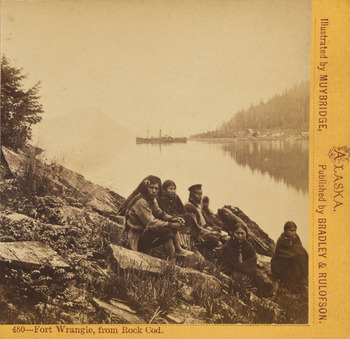
Fort Wrangle, from Rock Cod (fig. 1) illustrates Muybridge's ability to represent colonialism's disruptive forces. In this haunting image, a small group of Tlingit people hold still while the photographer goes through the exhaustive process of taking and then developing the image.Footnote 8 Implicit in the view is not only a spatial dimension but a temporal one. The time of posing and preparing for the shot—a mechanical affair as much as an aesthetic one—is set against the vast reaches of Tlingit time, a foreshortening that in its own way represents a rupture of timescales. Indigenous time collides with new orders of temporality and modernity signified by the camera. Beyond this lies the viewer's time and the circulation of the image itself, which in this period was reaching global scale. All this is implicit in the photograph and represents various dimensions of temporal and spatial widening and collapsing. Within the photographic frame are the human subjects of Muybridge's gaze. Seated near the shore on a rocky incline and placed so that each is visible to the camera's eye and receding into the depth of the stereographic image, these subjects gaze directly at the camera or off into the distance. They sit with backs turned away from the newly established fort on the far shore, a symbol of the changes in sovereignty, from Russian to American, they are now undergoing. They have also turned away from the steamship anchored behind them, a visual reminder of the technological changes that brought the photographer and his machines to their region. The compositional arrangement suggests the Tlingit's unease at the changes accelerating before them. It may also suggest Muybridge's self-consciousness about the material economy of his own medium, as the photograph is both an image of otherness and a reflection of the modern systems of transport that made its circulation possible in a larger visual economy. The photograph is implicated in the displacements it captures.
Eadweard Muybridge, Fort Wrangle, from Rock Cod, half stereo, 1868. Getty Museum. Digital image courtesy of Getty's Open Content Program.

Muybridge's photographs are well known for their compositional turbulence. In contrast to Carlton Watkins, his contemporary and competitor in Yosemite, who valued smooth, reflective surfaces, Muybridge preferred his compositions roiled and unstable. In this image, the named photographic subject is Fort Wrangell, an important military asset acquired from the Russians and, thus, an official subject in the catalog of Alaska's views. Yet Muybridge's composition reduces it to only one of several competing and conflictual elements—ship, Native people, fort, the sound, rocky foreground, and finally his own subjectivity. In a strategy accentuated in the stereographic technique of creating depth and fractured visual planes, the composition of these elements subverts rather than reinforces a dominant perspective.Footnote 9 The fort itself is literally and figuratively decentered, placed to the far right of the image and captured from a great distance, a compositional afterthought.
Muybridge further complicates the picture's meaning by concealing his nom de plume, “Helios,” among the rocks and grass just in front of the seated woman on the right. Inscribed with a stylus on the negative itself, this flickering trace of the photographic signature, aside from protecting Muybridge's brand in an era of heightened photographic competition, echoes the larger self-reflexivity about image-making everywhere in his corpus.Footnote 10 We know from Muybridge's Yosemite views that he engaged in elaborate forms of embodied self-inscription, of making a corpus of pictures that could only be his own because he alone would place himself in the precarious positions necessary to realize them. He scrambled down steep trails, clambered up rocky outcrops, dangled from ropes, and stood in icy rivers—all in an effort to achieve a signature style by putting his body at risk in the service of expanding the limits of photographic composition. He boasted that the artist “has gone to points where his packers refused to follow him, and has carried his apparatus himself rather than forgo the picture on which he had set his mind.”Footnote 11 In Fort Wrangle, this pursuit of a novel camera placement, a reflection of a singular vision, and the careful composition and personalization of the images transform a stock anthropological portrait into a deeply subjective and ultimately self-reflexive story of an imperiled Indigenous world caught between steamship and camera and the new regimes of mobility and representation they signal. By recording ways of life threatened by U.S. territorial and economic claims to ownership, and making this recordation a project of the artist's own ambition, the photos both widen the frame of the possible and work against the logic of the mission Muybridge was sent to perform, providing a “correct idea of Alaska.”
Guatemalan Coffee and Modernity
In 1875 Muybridge took his last extended journey before relocating to Philadelphia, this time sailing south along the coast from San Francisco to Central America on behalf of the Pacific Mail Steamship Company. Extending the reach of his Pacific Coast photographic series, he ventured beyond the English-speaking United States to the hispanophone Americas. His ostensible mission, as in the Alaska series, was official. The steamship company, established in the 1840s, had both capitalized on and accelerated U.S. territorial expansion along the West Coast and played a crucial role in the patterns of western mobility that made Central America important to U.S. manifest destiny. Yet during the 1860s and early 1870s, slowing gold-rush traffic and the transcontinental railroad across the United States, which opened in 1869, had damaged the company's fortunes. According to Tracy Robinson, a Panama Railroad official and longtime American resident of Panama, “The best of the California business of the Panama route was over, and the Parent Company never again pretended to skim the cream of that great traffic.”Footnote 12 It is not surprising in this context to see that U.S. commercial interests clamored for a way to regain what distant events, and new globalized routes, had imperiled. What is fascinating is that business leaders looked to photography to do the rekindling. The Panama Star, closely associated with U.S. interests in the region, focused on the touristic benefits of expeditionary photography, which mediated distant places for those unwilling or unable to travel. Muybridge, the newspaper proclaimed, was sent “to illustrate by views all the curious places that a traveller by Railroad and the Pacific Mail Company's ships can see or be within reach of in a journey from New York to San Francisco via the Isthmus.” Muybridge would thus do for Panama what “has never been so well done for it before, either by pen or pencil, in making its beauties known especially to those who will never see them otherwise.”Footnote 13 That Muybridge was sent to Panama to help reverse this trend is an important acknowledgment of his artistic stature, and more generally of the camera's role in bringing distant Central America into the fold of U.S. imperialism.
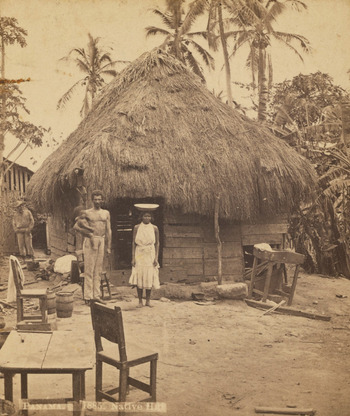
In his appointed role, Muybridge traveled throughout Panama and Guatemala, producing dozens of stereo-views and large-format photographs of each country. The Panama images trace a familiar overland journey from the Pacific to the Atlantic—along what would eventually become the path of the Panama Canal. In Muybridge's day the route was simply a railroad and a declining one at that. But through its intermodal connection to the steamships that plied the coastal waters from Peru to British Columbia, the railroad had played a vital role in settling Muybridge's “Pacific Coast” two decades previous to his arrival.Footnote 14 As in the Alaska series, Muybridge's photos revealed an unevenly distributed modernity that had left the isthmian interior largely unshaped by the industrializing changes on the coasts, where the steamers took on and disgorged their global passengers at the terminal cities. The photographs, such as his series on Panamanian “native huts” (fig. 2), suggest that the transformation of the isthmus into a hub for hemispheric trade had failed to deliver the economic benefits its promoters had promised. If the steamship directors had hoped for a more optimistic view of Panama's potential, they were surely disappointed. Muybridge's wide angle on Panama revealed, not a region on the verge of prosperity, but one seemingly doomed to irrelevance.
Eadweard Muybridge, Panama. Native Hut, half stereo, 1875–76. Getty Museum. Digital image courtesy of Getty's Open Content Program.

The Guatemalan photographs, by contrast, harness the logic of photographic serialization to drive a narrative of expanding commercial possibility and geopolitical influence. Here, width might be understood as global capital's ever-increasing circumference, which was reaching deep into the Indigenous strongholds of highland Guatemala. Here, coffee destined for the export market was being grown on a large scale for the first time. Muybridge's task, as in Panama, was to use photographic representation to demonstrate commercial viability, but in Guatemala his material was more promising, as its interior was far less known than the isthmus, which had been much before the public's eye from the 1840s onward.
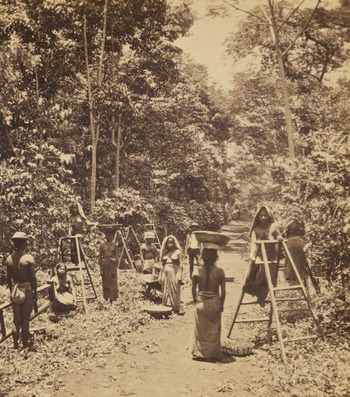
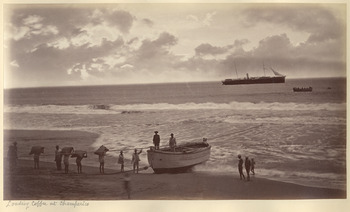
Muybridge guides the viewer on a path from the mestizo lowlands to the heart of the Indigenous highlands and, therefore, from “civilization” to the dark heart of the Guatemalan interior. Here, using the logic and techniques of serialization, he breaks down the process of producing export coffee into a sequenced set of commercially inflected images—planting, tending, harvesting, drying, packing, and shipping (fig. 3). The photographs document each step, underscoring the work of the Indigenous laborers at every stage. A final image shows workers bearing large sacks of coffee to a small boat resting on the beach at Champerico, a Pacific port opened just prior to Muybridge's visit to facilitate the integration of Guatemalan exports into global markets (fig. 4). Beyond beckons the world marketplace Guatemalan political and business leaders sought to engage. To secure the commercial point, the image depicts a steamer anchored offshore as it waits to carry the precious cargo north and into the global circuit of commodity trading that Guatemala was joining. With the end of Rafael Carrera's government in 1865, which had largely protected Indigenous rights and land, and growing demand for coffee in the United States, Guatemalan officials and capitalists moved aggressively to develop a coffee monoculture grown for export. The highlands, with their near-perfect climate and abundance of cheap Indigenous labor, presented a golden opportunity for Guatemalan and U.S. entrepreneurs alike. Soon, new efficiencies in global shipping—and a generous helping of corruption, chicanery, land expropriation, peonage, and human exploitation—brought the aromatic bean to cups across North America and Europe. The coffee business boomed. Imports to the United States alone rose from 82,243 tons in 1851 to 166,463 tons in 1880.Footnote 15 A major beneficiary was William Nelson, whose plantations at Las Nubes and San Isidro lay at the center of Muybridge's coffee series. With the Pacific Mail Steamship Company needing new sources of revenue after the decline of gold-rush traffic, Nelson, who worked for the company as its agent in Guatemala, could count on a smooth conveyance of his commodity up the coast to markets in San Francisco and beyond. Muybridge's photographs, commissioned by the directors of the steamship company, showed the systems in the best light, a well-ordered efficiency designed to soothe the worries of any nineteenth-century investor. By comprising a serialized narrative of commercial production, the images provide a visual record of the market's power to modernize and civilize Central America's dark interior.
In significant ways the papers in this cluster were about forms of habitation, especially the habitation of thresholds and liminal spaces (the Pacific Coast, the edge between jungle and village, etc.), but also about thresholds and passages between species and other domains of force and influence.—Parama Roy
Eadweard Muybridge, The Cultivation of Coffee, Harvesting at San Isidro, half stereo, 1875–76. Getty Museum. Digital image courtesy of Getty's Open Content Program.

Eadweard Muybridge, Loading Coffee at Champerico, 1876. Courtesy of the California History Room, California State Library, Sacramento, California.

Beyond this official narrative of commercial penetration and market dominance, however, Muybridge hints at another story, one in which the featured attraction is the exotic and little-understood world of the highlands and, thus, the Indigenous communities that thrived there. Difficult to reach, these communities carried on their traditional ways 350 years after Spanish colonialism had reshaped the culture of lowland Guatemala. Muybridge's photos, like those of Alaska, were among the first ever taken of these communities. Yet their significance lies not only, or not primarily, in their novelty; rather, the photographs capture highland culture at a moment of great transition, when globalized commodity demand portended drastic changes to centuries-old ways of life.
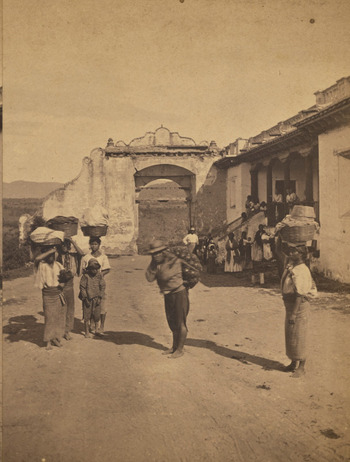
At the center of these images stand the Guatemalan highlands, a place where rich, cultural traditions and distinctive ways of life existed side by side with a modernity that was just then encroaching. This modernity, realized in Muybridge's images in the form of coffee monoculture but also in the technologized medium that captures it, threatened the very ways of life depicted in the photographs. Although commissioned to show off the smoothly running engines of agricultural industry, Muybridge's lens stretches wider. It takes in not only the Indigenous at work, crucial for reassuring investors back home of the existence of docile labor in a region known for political unrest; it also opens to include the Indigenous as Indigenous, divorced from laboring, engaged in a variety of pursuits that suggest a vibrant culture standing on its own merits. In one image a group of Maya women work their backstrap looms, weaving the traditional traje, or costume, known as huipiles, an art that goes back to pre-Columbian times. In another, a group of men in traditional garb from a local village stand arrayed before the cameraman (fig. 5). Nothing in the image suggests the ways in which their lives and customs were being transformed by the development of a globalized agriculture market in their midst, nor their assimilation or resistance to it. It's as if the photograph captures a moment of ahistorical timelessness, outside the progressive (and destructive) logic of industrialized modernity itself. The historian Bradford E. Burns, describing another such photograph (of the Ynsiensi Gate), writes that although the photograph was taken in 1876, all evidence within the frame suggests it could easily have been 1776 or 1676 (fig. 6).
Eadweard Muybridge, Group of Alcaldes at Santa Marie, 1876. Courtesy of the California History Room, California State Library, Sacramento, California.

Eadweard Muybridge, Guatemala, the Ynsiensi Gate, half stereo, 1875–76. Getty Museum. Digital image courtesy of Getty's Open Content Program.

This, of course, is an illusion that arises from privileging what's in the frame apart from the devices and technologies that do the enframing. Muybridge's Pacific Coast photographs as media are part of the historical processes they record. So are the technological apparatuses—steamship, railway, camera, and chemicals—that enabled him to travel a long coast in his quest for photographic novelty. These appurtenances and conveyances of the wide are also a part of Muybridge's photographic history. If the mythical Helios, Muybridge's nom de plume, traveled magically across the skies, his modern incarnation rather less magically relied on his era's machines for global travel, devices which themselves depended on vast networks of political and economic power. That Muybridge rather obsessively photographed these distance-collapsing technologies suggests, of course, his own self-consciousness about the material conditions of his project. It should also remind us that aesthetic and critical categories—whether Pacific Coast or “wide”—are most significant when critics remain aware of their limitations and exclusions.