INTRODUCTION
The ‘following’ behaviour is a wide range association in the marine environment which involves a variety of species (Hobson, Reference Hobson1968; Dubin, Reference Dubin1982; Diamant & Shpigel, Reference Diamant and Shpigel1985). These opportunistic strategies were described to allow individuals to benefit from an increase in foraging success or a decrease in susceptibility to predators (Strand, Reference Strand1988). A total of 531 interspecific foraging associations of reef fish following nuclear species were recorded in the tropical West Atlantic at the oceanic archipelago of Fernando de Noronha, Brazil (Sazima et al., Reference Sazima, Krajewski, Bonaldo and Sazima2007). Herein we record for the first time the yellow jack Carangoides bartholomaei (Cuvier, 1833) (Carangidae), following two species of marine turtles that were not actually foraging, Chelonia mydas and Eretmochelys imbricata. The same behavioural event was recorded on nine non-consecutive occasions.
Jacks (Carangidae) are roving hunter carnivores whose opportunistic predaceous strategies include ‘following’ behaviour with variable foraging tactics, likely associated with a large number of nuclear species, and maybe employed according to different circumstances (Hobson, Reference Hobson1968). Species of Carangoides are mainly fish and crustaceans' diurnal predators (Randall, Reference Randall1967). In a recent overview of nuclear–follower associations at Fernando de Noronha oceanic archipelago (Sazima et al., Reference Sazima, Krajewski, Bonaldo and Sazima2007), 13 nuclear species were recorded being followed by jacks. Besides yellow jack being recorded mainly as followers, they were also recorded in the nuclear role as well. Sometimes they were also observed being cleaned by Pomacanthus paru at the reefs of the Abrolhos Archipelago, off eastern Brazil (Sazima et al., Reference Sazima, Moura and Sazima1999).
MATERIALS AND METHODS
Field observations were made at Baía do Sueste (03°50′S 32°15′W) an important area for aquatic recreation in the National Marine Park of Fernando de Noronha, where juvenile green and hawksbill sea turtles are abundant year round (Sanches & Bellini, Reference Sanches and Bellini1999). This bay has an inlet with an inner protected reef flat and shallow area near shore, and an outer reef slope leading to deeper parts (Sazima et al., Reference Sazima, Grossman and Sazima2010). Depths vary from 1 to 5 m (see Maida & Ferreira, Reference Maida and Ferreira1997; Sazima et al., Reference Sazima, Grossman, Bellini and Sazima2004 for more details and area figure). From January to April of 2008 snorkelling dives (60–250 minutes, 41 non-consecutive dives) were conducted during studies on the natural history of sea turtles, in which all occurrences of specified behaviours were recorded during animal focal samplings (Altmann, Reference Altmann1974; Lehner, Reference Lehner1979). Behavioural events were observed directly, records pencilled on plastic slates, photographed, and occasionally videotape recorded. Straight carapace length (SCL) of turtles and total length (TL) of the fish were estimated using reference objects of known size close to the animals.
RESULTS
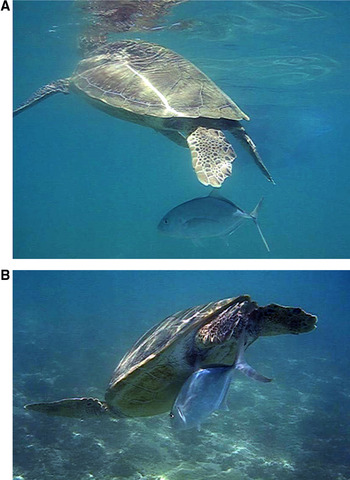
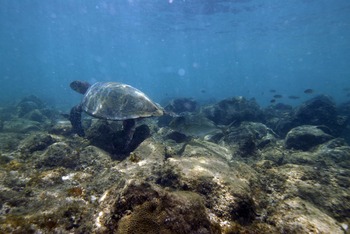
Most of the time solitary yellow jacks were observed roving over the reef flat normally in the mid-water and also foraging near the bottom. Both species of turtles roam over the reef area swimming close to the bottom and forage on algal turf in the central area (Chelonia mydas) or sponges near shore on the rocky outcrops (Eretmochelys imbricata). On 10 March 2008 a yellow jack of ~45 cm TL was recorded following a swimming C. mydas of ~60 cm SCL. During this association the fish remained close to the plastron and moved under the swimming sea turtle close to the bottom. Sometimes it left the ‘mobile cover’ trying to ambush its prey and then returned to its former position under the turtle. In two breathing events the fish followed the turtle to the surface (Figure 1). These episodes lasted 100 seconds and were video recorded. Four other similar events were also observed in the same central area of the reef flat at 2–3 m depth. Nevertheless, near shore at the inner and shallower area, another yellow jack of ~50 cm TL was recorded following a swimming E. imbricata of ~70 cm (Figure 2). Three other similar events of these ‘following’ associations were observed at the same area close to the rocky outcrops in approximately 1 m depth. Overall, nine association events were pencil-recorded at depths of 1–3 m, which involved turtles of ~60–70 cm SCL and yellow jacks of ~45–50 cm TL. The longest time recorded was approximately five minutes but associations may last longer as low water visibility (4–5 m) prevented further observations.
A yellow jack (Carangoides bartholomaei) following a green turtle (Chelonia mydas) on the central area of a reef flat at the Baía do Sueste, Fernando de Noronha Island, off north-eastern Brazil; (A) the yellow jack remained close to the plastron while the green turtle breathed at the surface; (B) a yellow jack swimming under the same green turtle while they hovered in the mid-water. (Taken from the videotape recorded by M. Proietti.)

A yellow jack (Carangoides bartholomaei) following a hawksbill turtle (Eretmochelys imbricata) in a shallow area near shore at the Baía do Sueste, Fernando de Noronha Island, off north-eastern Brazil. (Photograph: Zaira Matheus.)

DISCUSSION
To the best of our knowledge this previously undescribed association is a striking departure from the usual tendency of jacks to swim higher than the attendant in the water column while as a follower (Baird, Reference Baird1993; Silvano, Reference Silvano2001; Sazima & Grossman, Reference Sazima and Grossman2005; Sazima et al., Reference Sazima, Krajewski, Bonaldo and Sazima2007). These observations suggest that display can approach and exploit the disorientation of prey during hunting episodes and illustrates the behavioural flexibility of this important reef predator. The specialized ambushing behaviour was recorded for Caranx melampygus in the central Pacific (Sancho, Reference Sancho2000). Based on nine records involving different turtles, we suggest that this association may increase foraging opportunities for the yellow jack.
ACKNOWLEDGEMENTS
We thank Projeto TAMAR/ICMBio for logistical support; Zaira Matheus for the photographs of yellow jacks with Eretmochelys imbricata; Maíra Proietti for the video records and field support; the ICMBio for permission to study sea turtles at the National Marine Park of Fernando de Noronha. P.M. received a MS scholarship from the CNPq (National Council for Technological and Scientific Development—Brazil); J.S. and M.H. received research grants from CNPq.