Introduction
Anisakids are present as third-stage larvae (L3), in a wide variety of fish and aquatic invertebrates, which act as intermediate/paratenic hosts in the life cycle of these nematode parasites. The fish appear to act by storing the parasites and transporting them to their final hosts, fish-eating aquatic vertebrates. However, humans can intervene in the life cycle of some anisakids as an accidental host. Thus, Anisakis simplex, A. physeteris and Pseudoterranova decipiens have been found in the human body, causing different disorders given the general designations of anisakidosis, anisakiosis or anisakiasis (Clavel et al., Reference Clavel, Delgado, Sánchez-Acedo, Carbonell, Castillo, Ramírez, Quílez, Gómez-Lus and Kagei1993; Mercado et al., Reference Mercado, Torres, Muñoz and Apt2001; Umehara et al., Reference Umehara, Kawakami, Araki and Uchida2007). Allergic phenomena have also been related to the intake of fish infected with A. simplex or Hysterothylacium aduncum (Fernández-Caldas et al., Reference Fernández-Caldas, Quirce, Marañón, Díez Gómez, Gijón Botella and López Román1998; Valero et al., Reference Valero, Terrados, Díaz, Reguera and Lozano2003; Del Rey Moreno et al., Reference Del Rey Moreno, Valero, Mayorga, Gómez, Torres, Hernández, Ortiz and Lozano-Maldonado2006). Therefore, commercial fish destined for human consumption must be tested for the presence of anisakids as part of a preventive approach to reduce the increasing incidence of anisakiasis and related allergies. At our laboratory, parasitization studies are carried out on the more common varieties of fish sold in Spain. We report here the results of a study of Trisopterus luscus (common names: pouting, bib, whiting pout, pout whiting or pout) in which Anisakis larvae type I (sensu Berland, Reference Berland1961) and H. aduncum were detected in both viscera and muscle. There have only been a few reports on parasitization by anisakids in the Trisopterus genus. Køie (Reference Køie1993) reported the presence of A. simplex, Contracaecum sp., C. osculatum, H. aduncum and H. rigidum larvae in T. minutus and of H. aduncum larvae in T. esmarkii. Only Rodríguez-Merayo & Villegas (Reference Rodríguez-Merayo and Villegas1993), Abollo et al. (Reference Abollo, Gestal and Pascual2001) and Silva & Eiras (Reference Silva and Eiras2003) appear to have studied T. luscus, demonstrating the presence of Hysterothylacium and A. simplex in pouting.
Materials and methods
We purchased, in our local public fish market (Granada, Spain), 139 specimens of pouting from the port of Ondarroa (43°19.5′N, 02°25.4′W) caught in 1999 on the Spanish coast of the Bay of Biscay. They were identified as Trisopterus luscus L. (Pisces, Gadidae) by their morphological features (Cohen et al., Reference Cohen, Inada, Iwamoto and Scialabba1990). In the laboratory, the fish were measured to the nearest 0.1 cm and dissected to separate viscera and muscle, which were then subjected to pepsin digestion (Huss & Drewes, Reference Huss and Drewes1989). Larvae were gathered from the liquid resulting from pepsin digestion and washed with 0.9% NaCl solution. Subsequently, after preservation in 70% ethanol, they were cleared in lactophenol and mounted for microscopic observation and identification according to the compatibility of their morphological features with descriptions by Berland (Reference Berland1961), Petter & Maillard (Reference Petter and Maillard1988) and Petter & Cabaret (Reference Petter and Cabaret1995).
The association between fish length and prevalence was analysed by using the Fisher's exact test for comparing prevalences and the bootstrap two-sample t-test for comparing mean intensities and mean abundances. Free QP 3.0 computer software was used for these analyses. It was developed by Reiczigel & Rózsa (Quantitative parasitology 3.0, 2005, Budapest; http://www.behav.org/qp/qp.htm) to deal with the notoriously left-biased frequency distributions of parasites, based on the theoretical background published by Rózsa et al. (Reference Rózsa, Reiczigel and Majoros2000).
Results
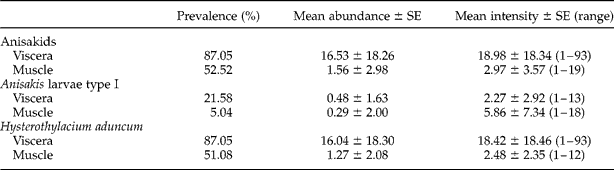
The study group comprised 139 pouting with lengths ranging from 13.2 to 24.5 cm (mean ± SD = 18.6 ± 2.4 cm). Anisakids were found in 88.49% of the fish, with a mean intensity of 20.44 and mean abundance of 18.09 (table 1). Detected species were Anisakis larvae type I (sensu Berland, Reference Berland1961) and Hysterothylacium aduncum. All individuals were in L3 stage except for one, identified as an adult female H. aduncum aduncum by morphobiometric study (Petter & Cabaret, Reference Petter and Cabaret1995). Infection parameters were much higher for H. aduncum than for Anisakis, with 87.77% of fish parasitized by the former versus 22.30% by the latter (table 1).
Parasitic infection levels by anisakid nematodes in Trisopterus luscus.

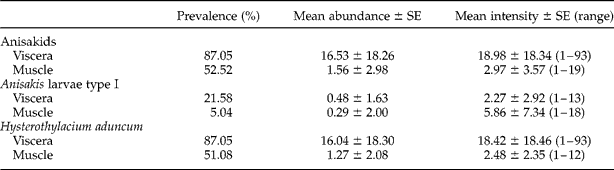
L3 were gathered from both viscera and muscles of these fish. Table 2 shows the localization of the parasites. Anisakis larvae were found in the muscle of 5.04% of fish and H. aduncum larvae in the muscle of 51.08% of fish.
Parasitic infection levels by anisakid nematodes in muscle and viscera of Trisopterus luscus.
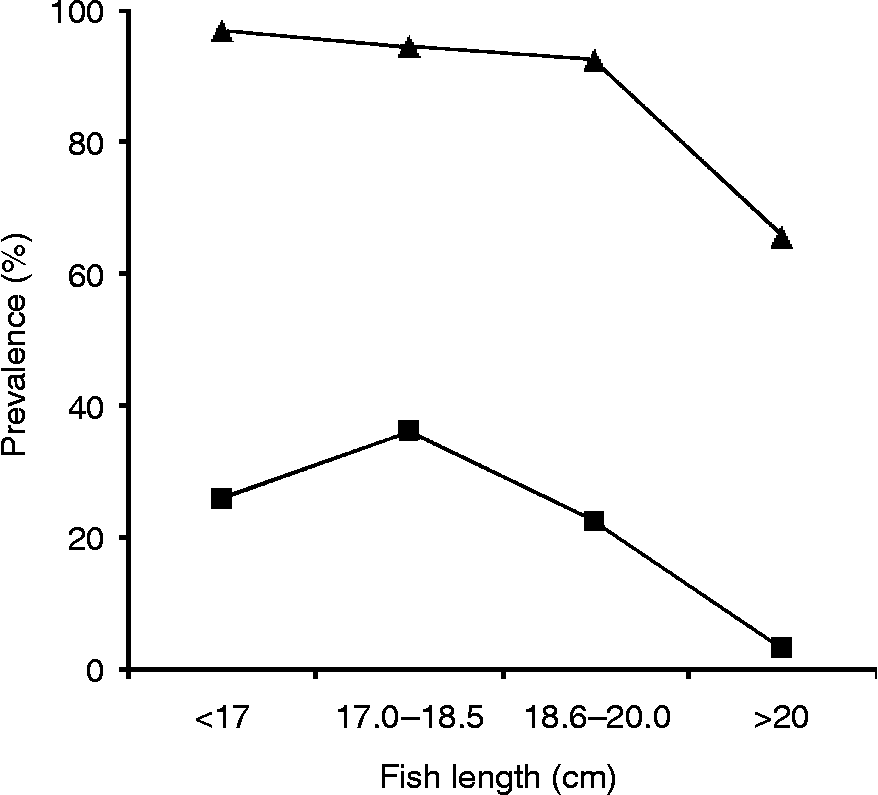
Analysis of prevalence as a function of host length revealed that parasitization by both Anisakis and H. aduncum significantly decreased with an increase in the length of the fish (fig. 1). However, the data did not show a significant correlation between parasitic intensity and host length.
Prevalence of each anisakid species in pouting as a function of fish length. The number of examined hosts per length class was: 31 ( < 17 cm), 36 (17.0–18.5 cm), 40 (18.5–20.0 cm) and 32 (>20 cm). Anisakid prevalence was significantly associated with host length for all anisakids in Trisopterus luscus [Fisher's exact test; P < 0.005 for Anisakis larvae type I (■); P < 0.001 for Hysterothylacium aduncum (▲)].
Discussion
Age–growth studies on T. luscus off the Cantabrian Asturian coast (Merayo & Villegas, Reference Merayo and Villegas1994) and off the Aquitaine French coast (Puente, Reference Puente1988), both in the Bay of Biscay, yielded comparable results and were applied to the fish in the present study. Hence, based on the global equation published by Merayo & Villegas (Reference Merayo and Villegas1994), the fish in this study are estimated to be in their first or second year of life, ranging in age from 10 to 24 months. Pouting mature sexually during their second year of life (Puente, 1986, cited by Puente, Reference Puente1988; Foucher, Reference Foucher2001), therefore the longest fish in this study (>20 cm or >17 months) could be considered mature. Pouting is a benthopelagic fish that can live up to 4–5 years.
In the present study, Anisakis L3 larvae type I (sensu Berland, Reference Berland1961) and L3 of H. aduncum were detected at higher infection rates than previously described in pouting captured in northern Spain (Rodríguez-Merayo & Villegas, Reference Rodríguez-Merayo and Villegas1993; Abollo et al., Reference Abollo, Gestal and Pascual2001). Our detection of an adult female H. aduncum is the first reported finding of an adult of this species in pouting, indicating that, at least occasionally, this fish can act as its final host.
Both Anisakis spp. and H. aduncum were previously isolated in fish (e.g. hake, mackerel, horse mackerel, bogue) from this geographical area. Studies reported that >96% of Anisakis type I sensu Berland, Reference Berland1961 larvae recovered from the fish were genetically identified as A. simplex s.s. and < 4% as A. pegreffii (Mattiucci et al., Reference Mattiucci, Abaunza, Ramadori and Nascetti2004, Reference Mattiucci, Farina, Campbell, MacKenzie, Ramos, Pinto, Abaunza and Nascetti2008). Other Anisakis species with type I sensu Berland, Reference Berland1961 L3 (i.e. A. typica, A. ziphidarum and A. simplex C) have not been reported in the Atlantic Ocean above a latitude of 40°N (Davey, Reference Davey1971; Mattiucci et al., Reference Mattiucci, Paggi, Nascetti, Portes Santos, Costa, Di Beneditto, Ramos, Argyrou, Cianchi and Bullini2002, Reference Mattiucci, Abaunza, Damiano, Garcia, Santos and Nascetti2007; Marques et al., Reference Marques, Cabral, Busi and D'Amelio2006). Therefore, the Anisakis larvae collected in the present survey can be assumed to be A. simplex s.l., predominantly A. simplex s.s.
Analysis of anisakid prevalence as a function of host length (fig. 1) showed that parasitization by Anisakis and H. aduncum was lower in fish of longer length, contrasting with reports on other host fish (Grabda, Reference Grabda1974; Bussmann & Ehrich, Reference Bussmann and Ehrich1979; McGladdery & Burt, Reference McGladdery and Burt1985; Takao, Reference Takao, Ishikura and Kikuchi1990; McClelland & Marcogliese, Reference McClelland and Marcogliese1994; Adroher et al., Reference Adroher, Valero, Ruiz-Valero and Iglesias1996; Hemmingsen et al., Reference Hemmingsen, Halvorsen and MacKenzie2000; Valero et al., Reference Valero, Martín-Sánchez, Reyes-Muelas and Adroher2000, Reference Valero, López-Cuello, Benítez and Adroher2006). We detected a markedly higher prevalence of parasitization by H. aduncum (65–97%) in pouting with lengths of 14.5–23.5 cm than was found by Rodríguez-Merayo & Villegas in Reference Rodríguez-Merayo and Villegas1993 (3–30% Hysterothylacium sp., possibly H. aduncum). Moreover, fish with lengths of 14.5–17.5 cm showed maximum parasitization (>92%) in our study and minimal parasitization (3%) in their study, which reported highest parasitization levels (35–37%) in the longest fish (32.6–41.5 cm). Likewise, the prevalence of Anisakis larvae was highest (22–36%) in the shortest fish ( < 20 cm) in the present study and lowest (3.1%) in fish with lengths of 20–24.5 cm. Although Rodríguez-Merayo & Villegas (Reference Rodríguez-Merayo and Villegas1993) reported prevalences of Anisakis larvae (probably A. simplex s.l.) of 7% in fish with lengths of 17.6–23.5 cm versus 29% in fish with lengths of 38.6–41.5 cm, prevalence was not significantly correlated with length. However, they found a significant association between intensity and length, indicating a possible accumulation of parasites with higher age (Bussmann & Ehrich, Reference Bussmann and Ehrich1979).
Taken together with previous data, the present findings indicate a progressive increase in the parasitization of pouting by anisakids in the Cantabrian Sea. In 1971, Quadros Benvegnu (Reference Quadros Benvegnu1971) had detected a low parasitization (4.8%) by ‘nematodes’ (probably anisakids) in pouting from these waters. Variations in observations do not appear to be influenced by seasonal changes (Rodríguez-Merayo & Villegas, Reference Rodríguez-Merayo and Villegas1993), and similar parasitization levels were found over the course of a year (Rodríguez-Merayo, 1991, cited by Rodríguez-Merayo & Villegas, Reference Rodríguez-Merayo and Villegas1993). However, changes in parasitization were observed as a function of the age of pouting, which showed a clear shift in diet from calanoids to mysids when a length of 50 mm was reached and a second shift to shrimp at a length of 130 mm, although fish of this size continued to feed largely on mysids (Hostens & Mees, Reference Hostens and Mees1999).
It remains to be investigated whether this apparent increase in the parasitization of pouting by anisakids (especially Hysterothylacium) is influenced by the local setting (e.g. specific littoral ecosystems) or produced by factors related to the Cantabrian Sea as a whole (e.g. increase in parasite abundance, fishing-induced decrease in host abundance), or by other factors affecting the stability of the marine ecosystem in this area. Thus, Klimpel & Rückert (Reference Klimpel and Rückert2005) showed that the abundance of H. aduncum in haddock and whiting from the North Sea is related to the abundance of hyperiids (intermediate hosts of this worm) in the surveyed area and in the stomach of the fish. Moreover, very high numbers of hyperiids were observed in stratified waters. The possibility of a successful transfer of H. aduncum is therefore much higher in these stratified areas because there is greater availability of food for intermediate and final hosts.
With regard to the public health risk posed by the consumption of this species, we found a low prevalence of Anisakis larvae in the muscle but at a high mean intensity of around 6 (table 2). Previous studies detected no Anisakis larvae in the muscle of pouting (Rodríguez-Merayo & Villegas, Reference Rodríguez-Merayo and Villegas1993; Abollo et al., Reference Abollo, Gestal and Pascual2001). A high prevalence of H. aduncum (51.08%) was found in muscle, but the intensity was only 2.48. Consumers must be informed of the need to thoroughly cook these fish, destroying all anisakid larvae, as has always been common practice in our country, to avoid the possibility of anisakiasis.
Acknowledgements
This survey has been funded by the Spanish grants PB98-1312 from the DGESIC and ACU01-027 from the INIA, and the Research Group CVI-243 grant from Junta de Andalucía. The authors thank Richard Davies for assistance with the English version.