




Good mental health and psychosocial well-being, i.e. emotional, psychological, social and collective well-being, Reference Martikainen, Bartley and Lahelma1,Reference Eiroa-Orosa2 are important for lifelong health and quality of life. 3 Many mental health difficulties start in youth Reference Patton, Sawyer, Santelli, Ross, Afifi and Allen4 and can negatively impact physical health, social, educational and occupational functioning, quality of life and well-being throughout the life course. Worryingly, the rates of diagnosable mental health disorders among children and young people (CYP) are at record highs, Reference Houtrow, Larson, Olson, Newacheck and Halfon5–Reference Piao, Huang, Han, Li, Xu and Liu7 a trend exacerbated by the COVID-19 pandemic. Reference Racine, McArthur, Cooke, Eirich, Zhu and Madigan8,Reference Cosma, Abdrakhmanova, Taut, Schrijvers, Catunda and Schnohr9 Although international surveys suggest that this is a global trend, some regions are underrepresented in this research. Reference Misra, Stevenson, Haroz, de Menil and Koenen10 One such region is central Asia, comprised of Kazakhstan, Kyrgyzstan, Tajikistan, Turkmenistan and Uzbekistan. Reference Misra, Stevenson, Haroz, de Menil and Koenen10 Compared with Central and Eastern Europe, which has been described as a ‘blind spot’ on the global mental health map, Reference Winkler, Krupchanka, Roberts, Kondratova, Machů and Höschl11 Central Asia has been coined a ‘blind spot within the blind spot’, Reference Aliev, Roberts, Magzumova, Panteleeva, Yeshimbetova and Krupchanka12 receiving comparatively limited attention in research and development to address mental health needs, services, policy and practice. Reference Misra, Stevenson, Haroz, de Menil and Koenen10,Reference Aliev, Roberts, Magzumova, Panteleeva, Yeshimbetova and Krupchanka12,Reference Samuels, Murray, Paulauskaite and Lau13 Additionally, Aliev et al’s scoping review on mental health policy and service development in Central Asia found no papers on child and adolescent mental health. Reference Aliev, Roberts, Magzumova, Panteleeva, Yeshimbetova and Krupchanka12 However, the region has a large population of CYP, and youth suicide rates are reportedly increasing. Reference Kõlves and De Leo14 To address this evidence gap, we conducted a scoping review documenting the current landscape of research on the mental health needs and experiences of CYP in Central Asia.
Although socially, economically and culturally distinct, the countries of Central Asia share a common history as Soviet republics between 1918 and 1991. Although all countries experienced economic decline following independence from the Soviet Union in 1991, there has since been rapid regional economic and social transformations. Reference Pomfret15,Reference Rechel, Ahmedov, Akkazieva, Katsaga, Khodjamurodov and McKee16 Nevertheless, large proportions of their populations are aged 14 years and below and many live in poverty (see Supplementary Table 1 for regional demographic and socioeconomic indicators), lack access to quality services and face social adversities such as discrimination, abuse, exploitation and violence. 17 An estimated 15.1% of children in Central Asia are in child labour, compared with 8.6% in Western Asia, 6.8% in Eastern Europe and 1.3% in Northern, Southern and Western Europe. 18 Child marriage and bride-kidnapping are also prevalent Reference Bekmurzaev19 – for example, in Tajikistan, 13.4% of girls and 2.2% of boys aged 15–19 were married, widowed or divorced in 2010. 20 Additionally, whereas many countries in Western and Eastern Europe report 100% coverage of children by social protection systems, the figures are much lower for Kazakhstan (57%), Uzbekistan (29%), Tajikistan (14%) and Kyrgyzstan (17%), and no data are available for Turkmenistan. 17 Finally, there are large rural populations Reference Rechel, Ahmedov, Akkazieva, Katsaga, Khodjamurodov and McKee16 (Supplementary Table 1) and high rates of rural-to-urban and international labour migration: as of 2020, there were 7.8 million international migrants from Central Asia. 21 This migration results in many CYP being left behind with one parent or other relatives, which can put CYP at risk of emotional and behavioural difficulties. Reference Costachi22,Reference Nazridod, da Pereira and das Guerreiro23
This complex interplay of social, economic and political factors impacts the risk of mental illness and access to services for CYP. 3,Reference Alegría, NeMoyer, Falgas, Wang and Alvarez24 For example, although research is limited, child labour and child marriage have been linked to significant emotional distress and specific mental health conditions. Reference Burgess, Jeffery, Odero, Rose-Clarke and Devakumar25–Reference Sturrock and Hodes27 Evidence also shows that suicide is the fourth leading cause of death among adolescents aged 15–19 years in the region, with Kazakhstan having one of the highest rates of suicide globally, Reference Sharygin and Guillot28,29 suggesting high unmet mental health needs among CYP in the region. Nonetheless, there are limited services and barriers to accessing support. Reference Aliev, Roberts, Magzumova, Panteleeva, Yeshimbetova and Krupchanka12,Reference Hook and Bogdanov30 Part of the gap in services may be due to limited knowledge and/or stigma around mental health. Reference Aliev, Roberts, Magzumova, Panteleeva, Yeshimbetova and Krupchanka12,Reference Hook and Bogdanov30 Where services are available, these have retained some features of the Soviet Union’s ‘biologically oriented’ psychiatric practice, Reference Aliev, Roberts, Magzumova, Panteleeva, Yeshimbetova and Krupchanka12 including pharmacological care and asylum-like psychiatric hospitals. During the Soviet era these services were used to confine political opponents, dissidents and those deemed to be ‘dispensable’, Reference Tomov, Van Voren, Keukens, Puras, Knapp, McDaid, Mossialos and Thornicroft31 such as people with mental illnesses and intellectual disability. Reference Tomov, Van Voren, Keukens, Puras, Knapp, McDaid, Mossialos and Thornicroft31 Today, mental health services remain concentrated in hospitals – often overcrowded and reliant on outdated and ineffective treatments – with fewer community-based and psychosocial services available. Reference Aliev, Roberts, Magzumova, Panteleeva, Yeshimbetova and Krupchanka12,Reference Rechel, Ahmedov, Akkazieva, Katsaga, Khodjamurodov and McKee16
As we have outlined in a previous publication, Reference Samuels, Murray, Paulauskaite and Lau13 more research is needed to direct attention and resources towards the mental health needs of CYP in Central Asia and to facilitate the delivery of targeted, youth-focused and culturally appropriate interventions. Given the recent call from the Regional Directors for the World Health Organization (WHO) and United Nations International Children’s Emergency Fund (UNICEF) in Europe and Central Asia for a renewed focus on child and adolescent health and well-being in the region, including early investment in children’s health, Reference De Dominicis and Kluge32 it is timely to examine the current landscape of mental health research with CYP in the region. This review will examine the research landscape on the mental health needs and experiences of CYP in Central Asia, to inform opportunities for further research, policy and practice.
Method
We selected a scoping review methodology because it is used to answer broad research questions and provide an overview of a body of literature. 33,Reference Munn, Peters, Stern, Tufanaru, McArthur and Aromataris34 In contrast to traditional systematic reviews that aim to appraise evidence and answer narrowly defined research questions, scoping reviews focus on synthesising evidence and identifying key concepts and gaps in the research and types and sources of evidence to help inform practice, policy and future research. Reference Munn, Peters, Stern, Tufanaru, McArthur and Aromataris34,Reference Arksey and O’Malley35 We followed the step-by-step process for scoping reviews from the Joanna Briggs Institute (JBI). 33 The reporting of this study conforms to the Preferred Reporting Items for Systematic reviews and Meta-Analyses extension for scoping reviews guidelines. Reference Tricco, Lillie, Zarin, O’Brien, Colquhoun and Levac36
The research question that guided this scoping review was: ‘what is the scope and nature of existing research on mental health needs and experiences of CYP in Central Asia?’
Search strategy and selection criteria
Search terms were developed through preliminary searches on Ovid Medline and Google Scholar and informed by Aliev et al. Reference Aliev, Roberts, Magzumova, Panteleeva, Yeshimbetova and Krupchanka12 We used a broad search strategy to identify relevant peer-reviewed literature. Example search terms included the following: (‘Kazakh*’ OR ‘Kyrgyz*’) (Central Asia countries) AND (‘child*’, ‘adolescen*’) (CYP terms) AND (‘mental* ill*’ AND ‘mood disorder*’) (mental health terms) (see Supplementary Table 2 for the full search strategy example). We conducted a systematic search using five databases: Ovid Medline, PsycINFO, Embase, Scopus and Web of Science. Terms within each set were grouped using Boolean odds ratio operators, with the three sets combined with AND operators. The search was conducted on 24 January 2025 and was limited to publications in English from any date. We also conducted a basic Google Scholar search (11 April 2025) to review non-indexed material and searched the reference lists of included publications.
We used the population, concept and context framework to develop key search terms related to CYP (population), mental health and/or psychosocial well-being needs, experiences or outcomes (concept) and countries in Central Asia (context). Reference Peters, Godfrey, McInerney, Munn, Tricco, Khalil, Aromataris, Lockwood, Porritt, Pilla and Jordan37 Regarding ‘population’, we defined CYP as those aged 6–24 years, with the upper age range to capture the United Nations definition of youth 38 and the lower age range given that the onset of psychological conditions, such as anxiety-related disorders, often starts in middle childhood (6–12 years). Reference Costello, Mustillo, Erkanli, Keeler and Angold39,Reference Kessler, Berglund, Demler, Jin, Merikangas and Walters40 The average age of participants therefore had to be 24 years or below, unless the publication related to caregiver or service provider perspectives (concerning a target youth population). In regard to ‘concept’, publications had to relate to mental health as per the WHO definition of ‘a state of mental well-being that enables people to cope with the stresses of life, to realise their abilities, to learn well and work well, and to contribute to their communities’. 41 For ‘context’, publications had to be based in one or multiple countries in Central Asia (Kazakhstan, Kyrgyzstan, Tajikistan, Turkmenistan or Uzbekistan), and these had to comprise the majority of countries (>50%) in which the research was based (i.e. large, multi-country studies were excluded). This was to focus our review on research within the region to capture the Central Asia-specific research landscape, and to ensure that findings were region-specific and not skewed towards research topics, methods and populations at a global or alternative region level – i.e. those excluded were analyses of large, multi-country data-sets, in which Central Asia typically represented less than 10% of included countries. We included primary research that involved any study design, e.g. qualitative, quantitative (observational mixed-methods, reports and case studies). We excluded secondary research (e.g. systematic reviews, book chapters), grey literature, study protocols and conference abstracts. Because the aim of this scoping review was to map the primary research to inform further research, policy and practice, inclusion was limited to primary studies to avoid duplication of evidence (e.g. through inclusion of systematic reviews) and enable direct characterisation of this evidence base.
All references from the databases were imported into Covidence Systematic Review software 42 to assist with the screening process. All titles and abstracts were screened independently by at least two reviewers: A.M. screened 100% and L.P. and J.Y.F.L. each screened a proportion. Any discrepancies at this stage were discussed and resolved by consensus among A.M., L.P. and J.Y.F.L., with F.S. consulted where necessary. Third, two reviewers (A.M. and L.P.) independently screened all potentially relevant full-text articles against the eligibility criteria outlined above. Interrater agreement on full-text screening was 95.4%; disagreements were resolved through discussion, with input from J.Y.F.L. and F.S. as needed. In line with scoping review guidelines, we did not carry out a quality appraisal of the included studies, given that the aim is to provide an overview of the evidence and identify gaps, rather than to appraise the strength of evidence. Reference Arksey and O’Malley35
Data extraction and synthesis
We extracted the following data: title, author(s), publication year, source, publication type, first author location, study setting, topic, study design, aims, population, methods and intervention details (if applicable) (see Supplementary Table 3 for full data extraction template). A.M. and L.P. completed 100% dual and independent data extraction. Discrepancies were resolved through discussion with all authors. Below we describe the characteristics of the included articles and whether they were published in internationally recognised journals. This was established based on whether journals were indexed in the Scopus (Elsevier) database and had a Clarivate impact factor. Next, we present a narrative synthesis of our findings to summarise the topics and research areas of the included articles. This was led by A.M., with input from L.P., J.Y.F.L. and F.S. This involved tabulating data by study, creating textual descriptions and exploring relationships among the data. Reference Popay, Roberts, Sowden, Petticrew, Arai and Rodgers43
Results
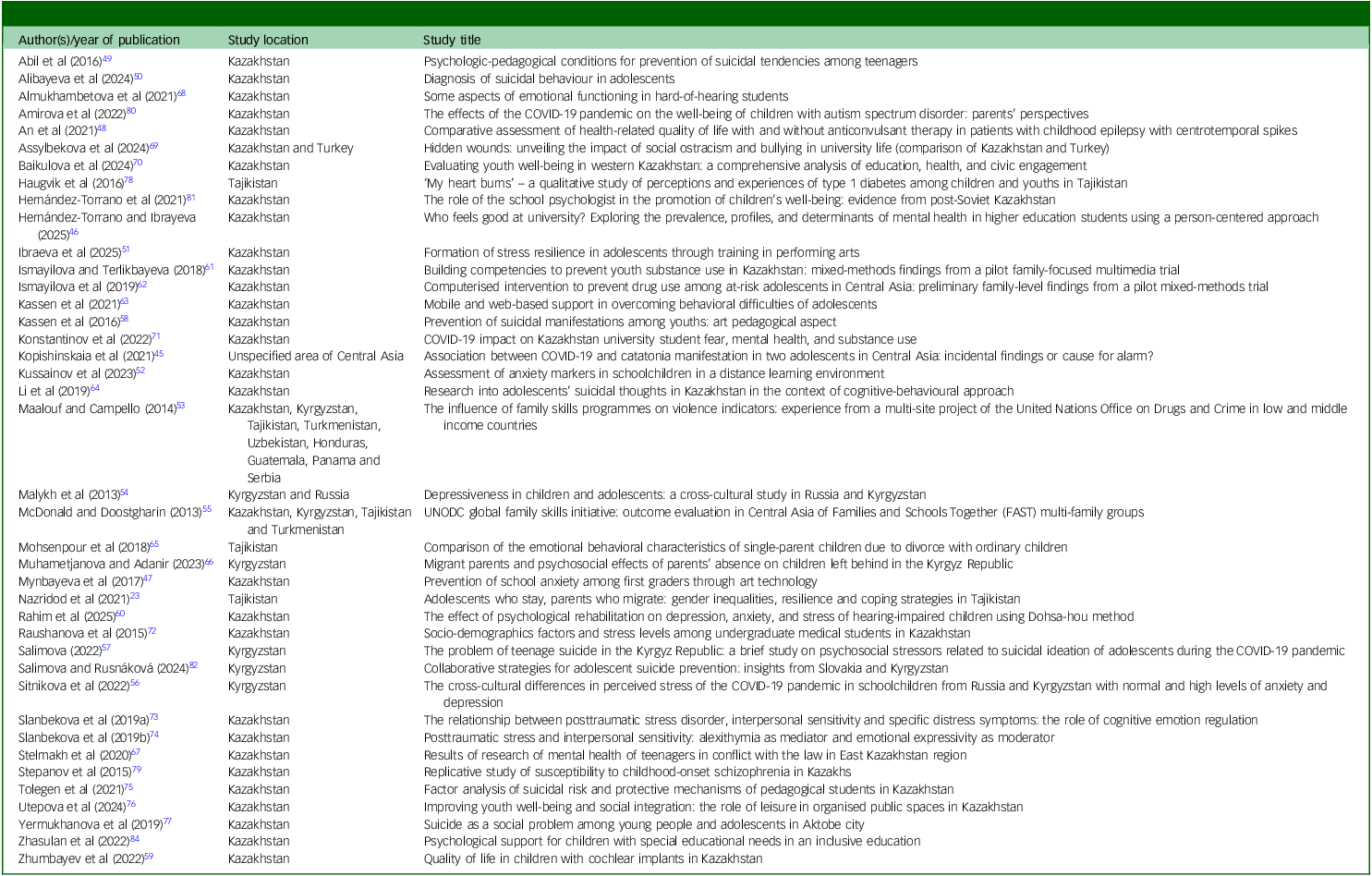
The database search yielded 3030 results. Following removal of duplicates (n = 679), 2351 articles underwent title and abstract screening. This resulted in 151 articles screened on full text, of which 37 met eligibility criteria (see Fig. 1 for the article selection process). Reference Moher, Liberati, Tetzlaff and Altman44 Three publications were retrieved from Google Scholar searches using select key terms on 11 April 2025, two of which had been published since the database search was conducted. We found no additional publications from citation searching. Therefore, 40 articles were included in the final analysis (see Table 1 for a list of the included articles).
The 40 studies included in the review

Table 1 Long description
The table contains 40 rows and 4 columns. The columns are labeled ‘Authors/year of publication’, ‘Study location’, ‘Study site’, and ‘Study title’. Each row lists details of a study, including the authors and year of publication, the study location, the study site, and the study title. Study locations include all countries in Central Asia (Kazakhstan, Kyrgyzstan, Tajikistan, Turkmenistan and Uzbekistan). The study titles focus on topics like suicide, well-being, the impact of COVID-19 on mental health and mental health interventions among children and young people.
UNODC, United Nations Office on Drugs and Crime.
Preferred Reporting Items for Systematic reviews and Meta-Analyses (PRISMA) flow diagram of article selection process for the scoping review.

Study characteristics
Timespan and geographic representation
An overview of the characteristics of the included articles can be found in Supplementary Table 4. The 40 articles were published between 2013 and 2025, with 24 of 39 (62%) published since 2020. Most studies were carried out only in Kazakhstan (n = 28), followed by Tajikistan (n = 3) and Kyrgyzstan (n = 3). Five studies involved multiple countries, including Kazakhstan and Turkey (n = 1), Kyrgyzstan and Slovakia (n = 1) or Russia (n = 1), Kazakhstan, Kyrgyzstan, Tajikistan and Turkmenistan (n = 1), and all Central Asia countries as well as Honduras, Guatemala, Panama and Serbia (n = 1). One article states only that it was carried out ‘with adolescents from the same area of Central Asia’. Reference Kopishinskaia, Cumming, Karpukhina, Velichko, Raskulova and Zheksembaeva45 Figure 2 displays the geographical distribution of studies, with the count including studies carried out in multiple countries.
Geographical distribution of the included studies.

Most of the institutions or organisations of the first authors were in Kazakhstan (n = 24), followed by Russia (n = 4), Kyrgyzstan (n = 3), the USA (n = 2) and one each in Austria, Iran, Norway, Poland, Portugal and the UK. For those studies carried out in one Central Asia country, most of those in Kazakhstan had first authors based there (23/28) whereas none did for those in Tajikistan or Kyrgyzstan; here, first authors were not based in these countries. Of the five multi-country studies, two had first authors based in Central Asia countries included in the studies whereas three had first authors based outside the region.
Journal quality
Of the included articles, 29 were published in journals indexed in Scopus. The remainder were published in journals discontinued by Scopus due to either quality issues (n = 7), published as conference proceedings (n = 3) or published in Academia Letters, Academia.edu’s short-lived (2020–2022) publishing platform (n = 1). Twenty-four of the articles were published in journals with an impact factor (median, 2; range, 0–5.5).
Sample characteristics
The number of participants ranged from 2 Reference Kopishinskaia, Cumming, Karpukhina, Velichko, Raskulova and Zheksembaeva45 to 2262; Reference Hernández-Torrano and Ibrayeva46 23 articles involved children and adolescents aged 3–19 years. Two of these studies do not report participant ages, referring to participants as either ‘first-grade children’ Reference Mynbayeva, Smailova and Akshalova47 or ‘children with an onset of childhood epilepsy with centrotemporal spikes (CECTS) at 3–14 years of age’. Reference An, Nagae, Aringazina and Winesett48 Eleven of these studies included children from the general population (i.e. without apparently recruiting based on any specific conditions or sociodemographic characteristics). Reference Mynbayeva, Smailova and Akshalova47,Reference Abil, Kim, BSh, Mamiyev, Li and Shumeyko49–Reference Kassen, Ageeva, Bulatbayeva, Mukasheva, Onalbekov and Esenova58 Eight studies included children or adolescents with, or at risk of, specific physical and mental health difficulties. Reference Kopishinskaia, Cumming, Karpukhina, Velichko, Raskulova and Zheksembaeva45,Reference An, Nagae, Aringazina and Winesett48,Reference Zhumabayev, Zhumabayeva, Kapanova, Tulepbekova, Akhmetzhan and Grjibovski59–Reference Li, Aimaganbetova, Kozlov and Mynbaeva64 Four included children or adolescents with certain lived experiences, including living in single-parent households, Reference Mohsenpour, Rahmati and Meidani65 those whose parents had migrated for work Reference Nazridod, da Pereira and das Guerreiro23,Reference Muhametjanova and Adanır66 and those ‘in conflict with the law’Footnote a . Reference Stelmakh, Matskevich and Barabanova67
Eleven studies involved university students. Reference Hernández-Torrano and Ibrayeva46,Reference Almukhambetova, Bazhenova, Shuzhebaeva, Dyusembinova and Isabaev68–Reference Yermukhanova, Kushimov, Zhexenova, Turebaev, Salakhova and Mukhanbediyarova77 Participant ages ranged from 16 Reference Almukhambetova, Bazhenova, Shuzhebaeva, Dyusembinova and Isabaev68 to 55 years, Reference Hernández-Torrano and Ibrayeva46 with two studies not reporting ages. Reference Baikulova, Knissarina, Syzdykbayeva, Taubayeva and Meterbayeva70,Reference Yermukhanova, Kushimov, Zhexenova, Turebaev, Salakhova and Mukhanbediyarova77 Nine of these studies involved a general population sample of university students (i.e. without recruiting based on any specific conditions or sociodemographic characteristics). Reference Hernández-Torrano and Ibrayeva46,Reference Baikulova, Knissarina, Syzdykbayeva, Taubayeva and Meterbayeva70–Reference Yermukhanova, Kushimov, Zhexenova, Turebaev, Salakhova and Mukhanbediyarova77 Two studies included students with specific conditions or lived experiences – i.e. being hard of hearing Reference Almukhambetova, Bazhenova, Shuzhebaeva, Dyusembinova and Isabaev68 or witnessing or experiencing social ostracism or bullying. Reference Assylbekova, Saikhymuratova, Atmaca, Somzhurek and Slambekova69
Two studies included participants across life stages and wide age groups of 3–23 years Reference Haugvik, Beran, Klassen, Hussain and Haaland78 and 4–30 years. Reference Stepanov, Bocharova, Saduakassova, Marusin, Koneva and Vagaitseva79 Eight studies included adults involved in CYP’s care, including five with parents and other family members Reference Maalouf and Campello53,Reference McDonald and Doostgharin55,Reference Zhumabayev, Zhumabayeva, Kapanova, Tulepbekova, Akhmetzhan and Grjibovski59,Reference Haugvik, Beran, Klassen, Hussain and Haaland78,Reference Amirova, Cohen Miller and Sandygulova80 and three with service providers. Reference Haugvik, Beran, Klassen, Hussain and Haaland78,Reference Hernández-Torrano, Faucher and Tynybayeva81,Reference Salimova and Rusnáková82
Topics and research areas
Given the broad scope of the included studies, the following section describes the general distribution of research aims and study designs, rather than the results of studies per se. The topics of the included articles related to the following categories: (a) anxiety and affective disorders; (b) suicide; (c) well-being and quality of life; (d) promoting mental health and resilience; (e) substance use; and (f) other mental health difficulties. Within these categories, studies related to evaluating or developing interventions, participants’ perceptions and experiences, measuring prevalence or identifying risk and protective factors.
Anxiety and affective disorders
Eleven studies concerned anxiety and affective disorders, such as depression and post-traumatic stress disorder (PTSD). Seven of these used quantitative cross-sectional designs to measure the prevalence of symptoms within general population samples. Two of these studies examined mental health difficulties following the COVID-19 pandemic using self-report questionnaires: one with adolescents aged 13–18 years in Kyrgyzstan, measuring self-reported depression and anxiety symptoms, Reference Sitnikova, Ekaterina, Alena, Sergey, Oksana and Marina56 and one with university students in Kazakhstan, assessing the relationship between fear, mental health and substance use and gender and religious status. Reference Konstantinov, Berdenova, Satkangulova, Reznik and Isralowitz71
Four other studies with university students in Kazakhstan measured the following: PTSD and other comorbidities using self-report questionnaires; Reference Slanbekova, Chung, Karipbaev, Sabirova and Alimbayeva73,Reference Slanbekova, Chung, Ayupova, Kabakova, Kalymbetova and Korotkova-Ryckewaert74 symptoms of anxiety, depression, psychological distress, well-being and life satisfaction; Reference Hernández-Torrano and Ibrayeva46 and the relationship between stress levels and (a) sociodemographic factors (‘age, year of education, gender, location of graduated high school’) and (b) stress-associated factors (‘financial constraints, marital status, having children, accommodation’). Reference Raushanova, Meirmanov, Turdalieva, Gulshara, Myssayeva and Myssayev72
One study was a cross-cultural comparison of ‘depressiveness’ among Russian and Kyrgyz 7- to 17-year-olds, Reference Malykh, Belova, Sabirova, Voronin, Gindina and Gaysina54 measured using the Children’s Depression Inventory. Besides general population samples, one quantitative cross-sectional study was with a specific population of 7- to 11-year-old children of divorced parents in Tajikistan, comparing their ‘emotional behavioural characteristics’ with those of children of non-divorced parents. Reference Mohsenpour, Rahmati and Meidani65 This study administered the Conners’ Teacher Rating Scale to teachers to assess children’s behavioural difficulties.
Three studies concerned interventions in Kazakhstan, two of which evaluated interventions. Reference Mynbayeva, Smailova and Akshalova47,Reference Kassen, Kudaibergenova, Mukasheva, Yertargynkyzy and Moldassan63 Mynbayeva et al carried out an evaluation of an arts-based intervention for reducing anxiety in ‘first-grade children’, but did not report participant ages besides the programme being for children aged 7–17 years. Reference Mynbayeva, Smailova and Akshalova47 In that study, participants were assigned to either the experimental or control group based on their results in a ‘scale of anxiety levels’ based on the Children’s Form of Manifest Anxiety Scale and Temmel et al’s Reference Temmel, Dorky, Amen and Dermanova83 Anxiety Test. Pre- and post-intervention assessments were done with both groups using this assessment.
Kassen et al Reference Kassen, Kudaibergenova, Mukasheva, Yertargynkyzy and Moldassan63 tested the impact of mobile and online counselling support on behavioural difficulties (anxiety and aggression) in adolescents aged 13–15 years with ‘fixed behavior difficulties’, although this is not defined. In that study, ‘the experimental group received […] constant contact help of web applications, cloud services and mobile control. The second group received counseling from specialists’ and the third ‘were provided consultations only in the case of a direct appeal from adolescents themselves, teachers or parents’. However, it is unclear how allocation to these groups was determined. Pre- and post-intervention assessments were done for all three groups.
Finally, one study concerned intervention development and measured anxiety in 13- to 15-year-old distance learning students with the aim of developing an intervention to address anxiety. Reference Kussainov, Khavaydarova, Beissenova and Kongyrova52 Aspects of the study design were unclear, including how allocation to experimental and control groups was determined, with the authors stating only that ‘the classes and participants were selected randomly’. Details about the control group conditions are also not reported.
Suicide
Nine studies related to suicide. Of these, seven focused on identifying risk and protective factors for suicide in young people; these were explored at the psychological level, such as ‘irrational beliefs’ like catastrophising, Reference Li, Aimaganbetova, Kozlov and Mynbaeva64 perfectionism, Reference Tolegen, Utegenova, Baymuhambetova, Smagliy, Berdenova and Alshanova75 anxiety and depression Reference Salimova57,Reference Tolegen, Utegenova, Baymuhambetova, Smagliy, Berdenova and Alshanova75 and the environmental level, including family conflict Reference Tolegen, Utegenova, Baymuhambetova, Smagliy, Berdenova and Alshanova75,Reference Yermukhanova, Kushimov, Zhexenova, Turebaev, Salakhova and Mukhanbediyarova77 and poor family relationships. Reference Salimova57
Seven studies were based in Kazakhstan Reference Abil, Kim, BSh, Mamiyev, Li and Shumeyko49,Reference Alibayeva, Ormanova, Turniyazova, Zhakanova and Uakpayeva50,Reference Kassen, Ageeva, Bulatbayeva, Mukasheva, Onalbekov and Esenova58,Reference Li, Aimaganbetova, Kozlov and Mynbaeva64,Reference Stelmakh, Matskevich and Barabanova67,Reference Tolegen, Utegenova, Baymuhambetova, Smagliy, Berdenova and Alshanova75,Reference Yermukhanova, Kushimov, Zhexenova, Turebaev, Salakhova and Mukhanbediyarova77 and two in Kyrgyzstan. Reference Salimova57,Reference Salimova and Rusnáková82 Six of these were quantitative cross-sectional studies that involved general populations of CYP, including the following: adolescents aged 10–16 years, Reference Abil, Kim, BSh, Mamiyev, Li and Shumeyko49 13–17 years Reference Alibayeva, Ormanova, Turniyazova, Zhakanova and Uakpayeva50 and 12–17 years Reference Salimova57 and university students. Reference Tolegen, Utegenova, Baymuhambetova, Smagliy, Berdenova and Alshanova75,Reference Yermukhanova, Kushimov, Zhexenova, Turebaev, Salakhova and Mukhanbediyarova77 One of these quantitative cross-sectional studies examined the risk of suicidal behaviour in a specific population of 7- to 18-year-olds ‘in conflict with the law’. Reference Stelmakh, Matskevich and Barabanova67
Another study involved evaluating an art therapy intervention for suicide prevention among 14- to 19-year-olds in Kazakhstan. Reference Kassen, Ageeva, Bulatbayeva, Mukasheva, Onalbekov and Esenova58 However, it included only a post-test survey incorporating questions about how participants found the art therapy sessions and any emotional changes they experienced, such as stress relief and confidence. Reference Kassen, Ageeva, Bulatbayeva, Mukasheva, Onalbekov and Esenova58 One study used a case–control design to compare ‘cognitive distortions in the form of irrational attitudes’ and ‘negative thoughts about their future and their close people’ in 15- to 17-year-olds with and without previous suicide attempt or suicidal ideation, the control group being randomly selected. Reference Li, Aimaganbetova, Kozlov and Mynbaeva64 Finally, one qualitative study explored the perceptions and experiences of professionals on adolescent suicide prevention in Kyrgyzstan. Reference Salimova and Rusnáková82
Well-being and quality of life
Nine studies related to well-being and quality of life. These were in relation to two categories of adverse experiences, either specific contextual experiences or long-term health conditions.
Four studies related to emotional well-being in the context of specific lived experiences or challenges, two of which were quantitative cross-sectional studies: one assessed the well-being of university students in Kazakhstan in relation to civic engagement, economic opportunities, education, health, information and communication technologies, safety and security Reference Baikulova, Knissarina, Syzdykbayeva, Taubayeva and Meterbayeva70 and the other assessed the health and well-being of children in Kyrgyzstan whose parents had migrated for work. Reference Muhametjanova and Adanır66 Two qualitative studies examined participants’ perceptions and experiences; one concerned the experiences and coping strategies of adolescents aged 12–18 years in Tajikistan whose parents had migrated for work, Reference Nazridod, da Pereira and das Guerreiro23 and the other was an exploration of students’ perceptions of the causes and consequences of social ostracism and bullying at university in Kazakhstan. Reference Assylbekova, Saikhymuratova, Atmaca, Somzhurek and Slambekova69
Five studies related to well-being and quality of life in CYP with specific health conditions. Three were quantitative cross-sectional studies based in Kazakhstan: two measured health-related quality of life – one in children aged 2.8–15 years with a cochlear implant Reference Zhumabayev, Zhumabayeva, Kapanova, Tulepbekova, Akhmetzhan and Grjibovski59 and the other in children with CECTS; Reference An, Nagae, Aringazina and Winesett48 the third compared emotional functioning in ‘hard-of-hearing’ compared with ‘normal-hearing’ university students. Reference Almukhambetova, Bazhenova, Shuzhebaeva, Dyusembinova and Isabaev68 One mixed-methods study examined the impact of the COVID-19 pandemic on the well-being of autistic children in Kazakhstan. Reference Amirova, Cohen Miller and Sandygulova80 One qualitative study focused on the perceptions and experiences of CYP aged 3–23 years (median age 14 years) with type 1 diabetes in Tajikistan. Reference Haugvik, Beran, Klassen, Hussain and Haaland78
Promoting mental health and resilience
Seven studies focused on the promotion of mental health and resilience in CYP. Two were qualitative studies based in Kazakhstan, which explored professionals’ perspectives on psychological support in schools; one examined school psychologists’ role in promoting children’s well-being Reference Hernández-Torrano, Faucher and Tynybayeva81 and the other gathered views from ‘counselor teachers’ on support for children with disabilities. Reference Zhasulan, Akbota, Aziya, Kazhimukhanovich, Salikbayevna and Aigul84
Five studies evaluated interventions aimed at promoting mental health. Two used pre- and post-test designs to evaluate a United Nations Office on Drugs and Crime family skills intervention aimed at resilience promotion Reference McDonald and Doostgharin55 and violence prevention Reference Maalouf and Campello53 based in multiple Central Asia countries. Both studies collected pre- and post-data from parents and teachers. McDonald and Doostgharin Reference McDonald and Doostgharin55 included children with an average age of 7.17 years, with Maalouf and Campello Reference Maalouf and Campello53 reporting that the age range of children in Central Asia was 2–11 years, averaging between 7.0 in Tajikistan and 7.6 in Uzbekistan.
Two studies described that participants ‘were randomly divided into’, Reference Ibraeva, Abdigapbarova, Shalabayeva and Zhiyenbayeva51,Reference Utepova, Aubakirova and Kadyraliyeva76 and one described how participants were ‘randomly assigned to’ experimental and control groups Reference Rahim, Dzhusupov, Toguzbaeva, Sultangaziyeva and Kalmatov60 to investigate the effectiveness of interventions in Kazakhstan. Ibraeva et al Reference Ibraeva, Abdigapbarova, Shalabayeva and Zhiyenbayeva51 employed a ‘longitudinal experimental plan’ to examine the effectiveness of a performing arts programme for ‘the development of stress resilience and emotional regulation’ among adolescents aged 13–17 years. Utepova et al Reference Utepova, Aubakirova and Kadyraliyeva76 assessed whether attending activities in public spaces (e.g. local parks, libraries) contributed to well-being and social integration among university students. Rahim et al Reference Rahim, Dzhusupov, Toguzbaeva, Sultangaziyeva and Kalmatov60 conducted ‘experimental research with a pre-test-post-test control group design’ to evaluate the effectiveness of the ‘Dohsa-hou method’, a Japanese body psychotherapy method, in reducing depression, anxiety and stress among hard-of-hearing children with an average age of 9.76 years in the experimental group. The control conditions in two of these studies were not participating in any additional activities, but participants either had the ‘regular curriculum’ Reference Ibraeva, Abdigapbarova, Shalabayeva and Zhiyenbayeva51 or ‘could take part in any activities and visit public spaces’. Reference Utepova, Aubakirova and Kadyraliyeva76 Rahim et al Reference Rahim, Dzhusupov, Toguzbaeva, Sultangaziyeva and Kalmatov60 do not report the control group conditions.
Substance use
Two studies concerned substance use. Reference Ismayilova and Terlikbayeva61,Reference Ismayilova, Terlikbayevab and Rozentalb62 Both related to evaluating an intervention in Kazakhstan, specifically assessing the feasibility and effectiveness of the youth drug prevention intervention ‘Kazakhstani Family Together’. This intervention was aimed at 14- to 17-year-old adolescents at risk of substance use, and one parent of their choice. These studies represent two of the five included in the review with a randomised control design, but were the only two to explicitly state this.
Other mental health difficulties
Two studies related to other mental health difficulties, specifically a severe mental illness or neuropsychiatric syndrome. One was a genome-wide association study identifying genetic markers of childhood-onset schizophrenia with an experimental group of 4- to 30-year-olds in Kazakhstan. Reference Stepanov, Bocharova, Saduakassova, Marusin, Koneva and Vagaitseva79 The other was a case series of catatonia alongside asymptomatic COVID-19 in two adolescents aged 12 and 17 years from an unspecified area of Central Asia. Reference Kopishinskaia, Cumming, Karpukhina, Velichko, Raskulova and Zheksembaeva45
Discussion
Summary of results
To our knowledge, this is the first review to systematically map the research landscape on CYP mental health in Central Asia. Given the diversity of research aims, topics, populations and methodologies, we focused on exploring the scope of research efforts rather than examining study results to answer a specific research question. All studies were published in the past 12 years, suggesting growing research interest in CYP mental health in the region. However, this research is not homogenously distributed, with most studies conducted in Kazakhstan, the most economically developed country in Central Asia (see Supplementary Table 1 for regional demographic and socioeconomic indicators). Studies included various populations of CYP, including those with specific physical and mental health conditions or lived experiences, such as being hard-of-hearing or having type 1 diabetes, autism or parents in labour migration. However, many studies included general population samples of school children and university students living in urban areas. Thus, they may not be representative of the majority of Central Asia’s youth. By contrast, many sub-populations of CYP at risk of mental health difficulties were underrepresented, including those from minoritised and low socioeconomic backgrounds, those living in rural areas and those with neurodevelopmental conditions. This lack of diversity in general population studies may explain why so few interrogated mental health trends based on demographic factors such as gender, age, ethnicity, socioeconomic status, religion and region.
Studies covered a range of mental health topics. The largest number focused on common mental health difficulties, such as anxiety and depression. Underexplored topics include severe mental illnesses such as psychosis and bipolar and eating disorders, despite many young people being at risk of these globally. Reference Xu, Yin, Jia, Li, Zhao and Lv85–Reference Jongsma, Turner, Kirkbride and Jones87 Within the topics explored, most studies used quantitative cross-sectional designs and involved measuring prevalence and identifying risk and protective factors. Few studies used longitudinal designs, limiting the ability to infer causality or track developmental trajectories. Similarly, the structural and social determinants of mental health were underexplored, including those particularly relevant to CYP in the region such as gender inequality, social and gender norms, harmful traditional practices, poverty and discrimination. 17,Reference Bekmurzaev19 For example, the link between practices like child marriage and child labour and mental health outcomes remains poorly evidenced, Reference Burgess, Jeffery, Odero, Rose-Clarke and Devakumar25,Reference Sturrock and Hodes27 rendering targeted interventions to address these practices challenging.
A few studies explored well-being and quality of life in specific sub-populations, including those with long-term health conditions. Encouragingly, there was emerging literature on interventions to promote resilience and well-being. Whereas two studies assessed practitioner views on support mechanisms for young people, five aimed to evaluate the impact of interventions, including trying to improve emotion regulation and the use of social resources and activities to promote well-being. However, few intervention studies focused on addressing the social drivers of mental ill health or involved input on intervention design from CYP themselves; there is a need for studies that examine the long-term effectiveness and local adaptability of interventions to address the underlying drivers of mental health difficulties in CYP in Central Asia.
Although we did not systematically evaluate the quality of the included studies, we noted that many were published in journals with low impact factors. Several studies did not report key methodological details or had limitations such as small or convenience-based samples, unclear recruitment strategies and reliance on self-report without validation of measures within the local context. There was also limited diagnostic assessment or multi-informant approaches. Additionally, there was a scarcity of studies using qualitative or mixed-methods approaches to explore lived experiences and youth perspectives on mental health difficulties; quantitative approaches alone may not capture the multifactorial nature of the aetiology and consequences of mental illness for individuals and communities. Reference Peters88 Reporting of statistical methods was also lacking in several studies, and details about intervention content, delivery and adaptation were sometimes sparse. Among intervention evaluation studies, few used randomised controlled designs and many provided insufficient detail on allocation and blinding procedures, control conditions or intervention fidelity. This echoes Aliev et al’s conclusion that research on mental health policy and service development in Central Asia lacked methodological rigour, and demonstrates the limited capacity and resources for mental health research. Reference Aliev, Roberts, Magzumova, Panteleeva, Yeshimbetova and Krupchanka12
Strengths and limitations
A strength of this review is that it is the first known attempt to systematically map mental health research about CYP in Central Asia, an underexplored yet important area of research. We carried out this scoping review using the JBI’s (2015) systematic approach; we searched and screened the literature for published primary research and retrieved studies based on our inclusion criteria. We also had high interrater reliability for screening, limiting the impact of researcher bias on the selection of studies.
A limitation of this review is that secondary and grey literature that may be pertinent were not included due to the inclusion of only primary research. Second, the exclusion of non-English literature may have missed relevant publications, particularly those published in Russian, which is commonly used in academic institutions in the region. Finally, we excluded studies in which Central Asia countries did not make up the majority of countries included, which may have led to omission of some relevant data.
Recommendations for research, policy and practice
Comparable to Aliev et al, our review did not find studies focused on CYP mental health policy or service development. Reference Aliev, Roberts, Magzumova, Panteleeva, Yeshimbetova and Krupchanka12 Aliev et al’s broader findings suggest that mental health policies in Central Asia remain largely unimplemented, attributing this to limited investment and low government prioritisation, and they report a lack of mechanisms through which evidence informs policy decisions. Together with our findings, this suggests the need for more rigorous research on CYP mental health in Central Asia that could inform policies, services and interventions, particularly given that youth mental health in Central Asia is linked to broader social issues such as school engagement, child labour, gender-based violence and parental labour migration. Reference Lau, Murray, Palauskaite, Aidralieva, Beknazarova and Ismailova89 Building the evidence base on youth mental health to inform prevention efforts has long-term health and economic benefits and would support wider regional development priorities such as poverty reduction, inclusion and gender equality. Reference De Dominicis and Kluge32,90,91 The opportunities related to this are multifaceted. First, there is scope to foster international and multisectoral collaborations to build local research capacity across the region, particularly in countries underrepresented in the literature such as Turkmenistan and Tajikistan. Increased funding for organisations working nationally and locally on CYP mental health would support more rigorous research into the multiple influences (i.e. biological, cognitive, social, structural) that interact to shape mental health outcomes. Research on early childhood experiences and environments could also help inform preventative interventions, given that much of the current literature is skewed towards adolescents and university-aged young people. This work should be carried out with stakeholders across systems, from the community up to non-governmental, governmental and inter-governmental levels. Drawing from research in other regions, key entry points such as parents/carers, schools and youth and community organisations should be leveraged. Reference Barry, Clarke, Jenkins and Patel92,Reference Kohrt, Asher, Bhardwaj, Fazel, Jordans and Mutamba93
These findings also have important implications for policy and practice. Governments across Central Asia could prioritise the integration of mental health promotion into existing health and education systems, particularly through schools and community-based services. Critically, implementation should extend beyond urban centres to ensure equitable access for CYP living in rural and underserved areas. Given the limited attention to structural determinants in the current evidence base, multisectoral collaboration among health, education, social welfare and other sectors may help address wider risk factors such as poverty, violence, discrimination and the challenges associated with parental labour migration. Mental health workforce development should also be prioritised, including task-shifting to train non-specialists, such as teachers, school psychologists and social workers, to deliver evidence-based mental health support to CYP. Reference Connolly, Vanchu-Orosco, Warner, Seidi, Edwards and Boath94
Echoing Hook et al in their review of mental healthcare provision in Eastern Europe and Central Asia, this scoping review does not aim to criticise current research efforts. Reference Hook and Bogdanov30 Instead, we hope to frame existing challenges as a collective call to action to prioritise capacity-building and multisectoral collaboration. In turn, this would contribute contextually relevant evidence for the development of co-designed, acceptable and sustainable interventions to support CYP mental health needs in Central Asia – i.e. interventions designed in partnership with CYP and other stakeholders who will use, deliver and/or engage with the intervention. Reference O’Cathain, Croot, Sworn, Duncan, Rousseau and Turner95
To conclude, although research on youth mental health in Central Asia has increased over the past decade, it remains concentrated in Kazakhstan and is often not representative of key at-risk populations. The dominance of cross-sectional designs and limited focus on structural and social determinants of mental health reduce the applicability of findings to intervention and service development. Although this review found emerging literature on interventions to promote resilience and well-being, youth perspectives in designing such interventions were lacking. More contextually relevant and co-designed research across the region is needed. Strengthening local research capacity and fostering multisectoral collaboration is critical to generating research that informs culturally appropriate and co-designed interventions to support the mental health of CYP in Central Asia.
Supplementary material
The supplementary material is available online at https://doi.org/10.1192/bjo.2026.12140
Data availability
Data availability does not apply to this article because no new data were created or analysed.
Acknowledgement
No artificial intelligence tools have been used in the research or writing process for this manuscript.
Author contributions
All authors were involved in the conceptualisation and design of the study. A.M. and L.P. conducted the literature searches and screened the articles, with input from F.S. and J.Y.F.L. A.M. analysed the data, with input from L.P., F.S. and J.Y.F.L. A.M. wrote the manuscript, with critical feedback and revisions from L.P., F.S. and J.Y.F.L. All authors approved the final manuscript.
Funding
A.M. and J.Y.F.L. are funded by Barts Charity, UK (charity no. 212563, project code MRC&U0042). L.P. is funded by UK Research and Innovation (UKRI), UK (project code ES/X012131/1). J.Y.F.L. and F.S. have also received funding from UKRI (J.Y.F.L.) and the National Institute for Health and Care Research (F.S.). These funders had no role in the study design, analysis and interpretation of data, in writing of the manuscript or in the decision to submit for publication.
Declaration of interest
None.
Transparency declaration
We confirm that this manuscript is an honest, accurate and transparent account of the study being reported; that no important aspects of the study have been omitted; and that any discrepancies from the study as planned (and, if relevant, registered) have been explained.
Ethical standards
Ethical approval and informed consent were not required for this article because no new data were created or analysed.


 Open access


eLetters
No eLetters have been published for this article.