The nature of chain shifts is a perennial topic in the study of phonetic and phonological change. A chain shift may be defined as a state of affairs in which two or more phonemes are undergoing phonetic change in such a way that, as the first phoneme moves in phonetic space, a second phoneme moves into or toward the phonetic position being abandoned by the first; then a third phoneme may move toward the space vacated by the second, and so on. Gordon (Reference Gordon2011) reviewed many of the theoretical and methodological issues attendant on the study of chain shifts, including the difficulty of determining the causal relationship between the movements of phonemes implicated in a chain shift: when we describe a set of phonemes as being involved in a chain shift, we imply that the movements of the various phonemes somehow cause and are caused by each other. Chain shifts may be classified as “push chains” or “drag chains,” depending on whether, respectively, it is the phoneme approaching another's space that causes the latter to move away, or vice versa. An alternative hypothesis, advanced by Stockwell and Minkova (Reference Stockwell, Minkova, Kastovsky and Bauer1988), is that it is a coincidence that one phoneme happens to be moving toward the phonetic position that another is leaving, and the “chain shift” structure is merely the result of linguists seeing causal patterns where there are none.
Labov (Reference Labov1994:586–588, Reference Labov2010:142–144) outlined a cognitive model for the causal structure of chain shifts based on the interpretation of phonetic outliers. Under ordinary circumstances, if vowel phonemes are close together in phonetic space, an intended token of one phoneme that misses its phonetic target by a wide enough margin is apt to be misinterpreted by the hearer as a token of a different phoneme. For example, if the phoneme /o/Footnote 1 as in cot is typically pronounced as a low back-of-center vowel [ɑ], but the speaker overshoots and accidentally pronounces it as low front [æ], the listener is likely to identify it as the phoneme /æ/ and hear the word cat. This outlying production of /o/, therefore, will not contribute to the hearer's judgment of the overall possible phonetic range of the phoneme /o/. However, if the phoneme /æ/ is raised out of the low front position, then an outlying production of /o/ as [æ] is outside the phonetic range of /æ/, and thus more likely to still be perceived as /o/. In this case, the perception of [æ] as /o/ can cause the hearer to adjust forward their estimate of the possible phonetic range of the phoneme /o/, and thus adjust their estimate of the mean phonetic target of /o/ toward [æ]. Labov, Baranowski, and Dinkin (Reference Labov, Baranowski and Dinkin2010) have demonstrated that outliers can have this effect on a listener's perception of a phonetic target. Thus, according to Labov's (Reference Labov1994, Reference Labov2010) argument, a phoneme vacating its former phonetic position can cause the phonetic target of a neighboring phoneme to drift toward the vacated position, and a drag chain is generated.Footnote 2 Gordon (Reference Gordon2011) noted that this account bears affinities with an Exemplar Theory model of phonology (cf. Pierrehumbert, Reference Pierrehumbert2002), in which the abstract phonological unit is fundamentally an epiphenomenon of language users' episodic memories of individual tokens that they have heard and used.
Labov (Reference Labov2010:291–300) observed that this cognitive model of chain shifting may predict the existence of what he terms “allophonic chain shifting,” but which for the sake of clarity we will call “conditioned chain shifting”—a chain shift whose effect is restricted to a specific phonetic environment. For example, if /æ/ has a raised allophone specifically before nasal consonants (while remaining low front [æ] in other environments), as is the case in a great many North American English dialects (Labov et al., Reference Labov, Ash and Boberg2006), the same model predicts that /o/ should become fronted toward [æ] before nasals (while remaining [ɑ] in other environments). Although an outlying front token of a word like cot would still be subject to misinterpretation as cat in this situation, an outlying front token of bond with [æ] would not be likely to be misinterpreted as band, because band itself does not contain [æ]. Thus the available phonetic range of /o/ before nasals should drift forward, and with it its mean phonetic target, while the target of /o/ in other phonetic environments remains stationary.
Labov (Reference Labov2010) searched for conditioned chain shifting in two case studies. In the Northern Cities Shift, raising of /æ/ seems to trigger fronting of /o/, and therefore in other dialects, raising of prenasal /æ/ might trigger fronting of prenasal /o/. Meanwhile, in the Southern Shift, monophthongization of /ay/ seems to trigger lowering of /ey/, so the fact that /ay/-monophthongization is disfavored by following voiceless consonants suggests that /ey/-lowering might be disfavored in the same environment. In neither case does conditioned chain shifting occur. Labov (Reference Labov2010:287–301) attributed this failure of chain-shift pressures to break up the integrity of the phoneme to what he calls “the binding force in segmental phonology.” One of the goals of this paper is to clarify the nature of this mysterious “binding force” in terms of phonological structure.
In the following section, we lay out the phonological theory on which our analysis is based. The third section describes the monophthongization of /ay/ in the Southern United States and motivates our hypothesis that monophthongization originated as a gradient process affecting the whole phoneme /ay/ simultaneously. The following sections present evidence supporting that hypothesis in the Inland South region and compare the Inland South to Raleigh, North Carolina, where monophthongization has a different phonological structure.
MODULAR FEEDFORWARD PHONOLOGY
Rather than Exemplar Theory, we approach this analysis from the generative standpoint according to which phonology has what is (following Pierrehumbert, Reference Pierrehumbert2002) frequently called a “modular feedforward” architecture: the basic units of phonological structure are discretely specified abstract categorical entities, and their surface phonetic manifestations are the result of the operation of a series of grammatical processes (such as derivational rules or constraint evaluations). The key component of the modular feedforward architecture upon which our analysis is based is the contrast between phonological and phonetic processes (see Bermúdez-Otero, Reference Bermúdez-Otero and de Lacy2007, Reference Bermúdez-Otero, Honeybone and Salmons2015; Fruehwald, Reference Fruehwald2013). Phonological processes are those that manipulate the discrete, abstract phonological features that form the underlying representations of lexical items; the outputs of phonological processes are still specified in terms of discrete abstract features of the same type. Phonetic implementation rules then map those abstract representations into more concrete phonetic realizations—for example, for vowels, positions or regions in the n-dimensional vowel space of height, backness, lip rounding, etc. Like phonological rules, phonetic implementations can be contextually conditioned; for example, an adjacent consonant could cause a vowel to be implemented somewhat higher or lower than it would be in a different environment. Crucially, phonetic implementation rules act only on the output of phonological rules and do not have direct access to the underlying lexical representations themselves. This paper will demonstrate that, in Labov (Reference Labov2010)’s two cases of apparently unrealized potential conditioned chain shifting, the phonemes in question are in fact behaving exactly as predicted by a theory of modular feedforward phonology: it is the very modularity of the phonological architecture—the fact that phonetic rules operate only on the output of the discrete phonological rules—that provides the “binding force” preventing conditioned chain shifting.
The empirical differences between the effects of conditioned phonetic and phonological rules depend on the different nature of their outputs; we follow Bermúdez-Otero (Reference Bermúdez-Otero and de Lacy2007) in hypothesizing that these differences are closely tied to the issue of gradience versus discreteness. Phonological rules are discrete operations, mapping categorical abstract phonological representations to each other, but since the outputs of phonetic implementation rules are situated in a continuous phonetic space, they operate gradiently and may be “exquisitely sensitive” (Bermúdez-Otero, Reference Bermúdez-Otero and de Lacy2007:499) to various properties of a segment's phonetic environment. For example, as noted, in most dialects, /æ/ tends to be substantially higher before nasals than in other environments. This prenasal raising of /æ/, however, can be the result of either a phonetic or a phonological process. If the rule is phonological, it changes the abstract phonological featuresFootnote 3 of /æ/ in the prenasal environment; the two allophones are then independently subject to phonetic implementations, giving them distinct phonetic targets. These distinct targets of two allophones may be “widely separated” and “occupy discrete, largely nonoverlapping regions in phonetic space” (Bermúdez-Otero, Reference Bermúdez-Otero and de Lacy2007:500). On the other hand, if prenasal /æ/ raising is implemented phonetically, that means that prenasal and non-prenasal /æ/ have the same surface phonological representation, which is mapped by phonetic implementation to a targeted region in phonetic space; the effect of prenasal raising is to cause prenasal tokens of /æ/ to end up on the higher end of that range. Bermúdez-Otero (Reference Bermúdez-Otero and de Lacy2007:499) described an “unbroken phonetic continuum from the highest and most peripheral … to the lowest and less peripheral” as prototypical for phonetic implementation rules of this type, since the raising is a gradient process interacting with other gradient phonetic implementation rules, coarticulatory pressure, etc.Footnote 4
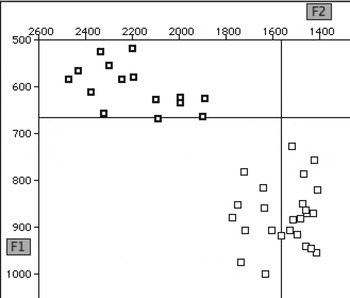
The phonologically and phonetically controlled systems of prenasal /æ/-raising can be exemplified by two speakers interviewed by Dinkin (Reference Dinkin2009) in New York state. Sarah L. from Cooperstown, New York, displays /æ/-raising as a phonological rule, as shown in Figure 1. Sarah's prenasal /æ/ tokens form a cluster in phonetic space that is discretely separated from her non-prenasal /æ/; prenasal and non-prenasal /æ/ look as if they could be the phonetic distributions of two entirely separate phonemes, rather than allophones of a single phoneme. This is the result of a phonological ruleFootnote 5 operating on the discrete features of /æ/ to create two distinct allophones, and then each of those allophones being phonetically implemented in its own region of phonetic space. Labov et al. (Reference Labov, Ash and Boberg2006) referred to this pattern as the “nasal” /æ/ system, but since our focus here is on the discrete phonological rule underlying this pattern, we will refer to it as the discrete system.
The /æ/ of Sarah L. from Cooperstown, New York (born 1983): prenasal tokens with bold outline.

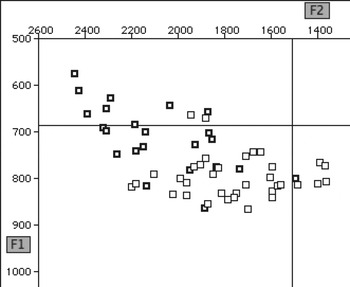
On the other hand, Pete G. from Sidney, New York, as shown in Figure 2, displays a prenasal /æ/ that is raised by a phonetic implementation rule rather than a phonological rule. Like Sarah's, Pete's highest and frontest tokens of /æ/ are all prenasal, and non-prenasal /æ/ tends to be lower and backer, but unlike Sarah's, these do not constitute two identifiably distinct clusters in phonetic space. Rather, Pete's /æ/ appears to occupy a single continuous smear across the phonetic space, from mostly non-prenasal tokens at the bottom to mostly prenasal tokens at the top, but with overlap in the middle and no substantial gap. Rather than having two distinct allophones of /æ/ as Sarah does, Pete has, from a phonological perspective, a single allophoneFootnote 6 of /æ/, including both prenasal and non-prenasal environments, that is extended over a wide range of phonetic space; the fact that the prenasal tokens are concentrated toward the highest end of that range is the product of a gradiently operating phonetic implementation rule acting on that single phonological entity. Labov et al. (Reference Labov, Ash and Boberg2006) referred to this pattern as the continuous /æ/ system.
The /æ/ of Pete G. from Sidney, New York (born 1974): prenasal tokens with bold outline.

Vowel chain shifting itself, as modeled by Labov, can be classified as a change in phonetic implementation rules. It depends upon a hearer's judgment of the mean phonetic target of a particular phonological entity, as influenced by the perception of phonetic outliers. That mean phonetic target must itself be the product of a phonetic implementation rule: phonological rules only map abstract features to each other, not to targets in phonetic space. So if the content of a chain shift is a change in the speaker/hearer's judgment of the phonetic target of a phoneme, what is changing is the phonetic implementation rule for that phoneme.
In a modular feedforward architecture of phonology, however, the phonetic implementation rules do not have access to or act upon the underlying phonological forms, the phonemes, themselves—they act only on the outputs of whatever phonological rules apply. If chain shifts are a change in phonetic implementation rules, that means that the object that undergoes chain shifting is not the phoneme, but rather the phonologically specified allophone. As noted in Dinkin (Reference Dinkin2011), this interpretation explains the lack of conditioned chain shifting that Labov (Reference Labov2010) observed in prenasal /æ/ and /o/.
In a full-scale chain shift, where the entire /æ/ phoneme at large is raised out of the low front position, leaving no allophone behind, Labov's (Reference Labov2010) cognitive model is compatible with a modular feedforward theory of phonology. However, consider the case where a prenasal allophone of /æ/ is raised but non-prenasal /æ/ remains behind in low front position. In this situation, a front-outlier pronunciation of (for example) bond as [bænd] would not be easily mistaken for the word band, but it has still landed in a region of phonetic space occupied by a phonological object other than /o/. Following Labov's cognitive account, the hearer can still perceive the speaker as having mistakenly produced a different phonological segment, [æ], rather than just an outlying realization of (the default allophone of) /o/. The erroneous use of [æ] therefore does not contribute to the listener's judgment of the phonetic target of /o/, since no token of /o/ was perceived. Therefore the raising of prenasal /æ/ does not put chain-shift pressure on /o/ because the non-prenasal allophone of /æ/ is still in its initial position, and it is at the level of the allophone that chain-shift pressure takes place.Footnote 7 Thus the “binding force” Labov posited to prevent prenasal /o/ from responding differently to chain-shift pressure than non-prenasal /o/ is merely the fact that chain shifts are changes in the phonetic targets of the outputs of phonological rules.
This account of the binding force accounts for the first of Labov's two case studies on the absence of conditioned chain shifting. For the second case study—the monophthongization of /ay/ triggering the lowering of /ey/ in the South—a modular feedforward phonological theory makes substantive predictions: we will argue in the next section that the interpretation of Labov's binding force given in the preceding paragraph only satisfactorily accounts for the Southern Shift in the event that /ay/ was a single phonological unit at the initiation of monophthongization. This suggests an empirical test of the theoretical architecture: if the phonological theory is correct, /ay/ should be a single phonological unit. And thus testing this prediction, as a means of testing the phonological theory, will be the focus of the rest of this paper.
MONOPHTHONGIZATION OF /AY/
The monophthongization of /ay/, so that, for example, guide becomes [ga:d], is the defining feature of the South as a dialect region (Labov et al., Reference Labov, Ash and Boberg2006). The “allophonic” relationship at play is that monophthongization is disfavored before voiceless consonants (cf. Fridland, Reference Fridland2003; Thomas, Reference Thomas2001). Yet that fact does not cause the Southern Shift's lowering of /ey/ to be disfavored in prevoiceless environments in turn. However, the lack of conditioned chain shifting in this case study has a structure opposite to that of the previous case study. In the raising of prenasal /æ/, neither prenasal nor non-prenasal /o/ becomes fronted. In the monophthongization of prevoiced /ay/, both prevoiced and prevoiceless /ey/ become lowered. Under a modular feedforward account of chain shifting, this difference implies a hypothesis about what the phonological status of /ay/-monophthongization was at the origin of the Southern Shift: it predicts that /ay/-monophthongization must have originated as a gradient change affecting the whole of the /ay/ phoneme.
Let us refer to the prevoiceless environment of /ay/ as price, and the complementary environment, word-final or before voiced segments, as prize. There are three possible ways for /ay/-monophthongization to have originated in such a way as to “favor” prize and “disfavor” price.
-
1. Monophthongization is a phonologically discrete but variable process of glide deletion, and the process affects prize with a higher probability than price.
-
2. Monophthongization is a phonetically gradual process—a change in phonetic implementation—but prize and price are discretely different allophones, and only prize undergoes this change.
-
3. Monophthongization is a gradual change in phonetic implementation affecting the /ay/ phoneme as a whole, but price is on the trailing end of that change as part of the internal phonetic conditioning of the /ay/ phoneme.
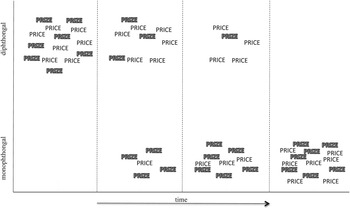
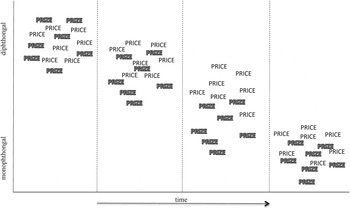
In scenario 1, there are from the beginning of the change two discrete phonological categories, diphthongal [aɪ] and monophthongal [a:], both allophones of /ay/, and a variably acting phonological process that can manifest the underlying phoneme /ay/ as either of these two allophones. The nature of the change toward monophthongization is that, over time, the frequency of selection of the [a:] allophone increases; and the mechanism by which prize is favored over price is that at any given time the probability of monophthongization of prize is greater than that of price. Figure 3 is a schematic diagram of how the degree of (phonetic) monophthongization of prize and price changes over time in scenario 1, from initiation of the change to its possible completion, with the vertical axis roughly representing the height of the glide target of /ay/. Note that, as monophthongization is a phonological process, it is discrete: there is no intermediate value between fully diphthongal and fully monophthongal. This is the model implicitly assumed by Labov et al. (Reference Labov, Ash and Boberg2006)’s discussion of /ay/-monophthongization, inasmuch as they classified speakers and dialect regions by reporting what percentage of tokens of prize and price are monophthongal—thus presupposing that any given token of /ay/ can be classified as either diphthongal or monophthongal.
A model of scenario 1: /ay/-monophthongization as a variable but discrete process favoring prize, from initiation of the change to completion.

In scenario 2, the change from diphthongal to monophthongal is a gradual change in phonetic implementation, with the mean phonetic target of the offglide of prize drifting from [ɪ] to [a]; the mechanism by which prize is favored is simply that price is not involved in the shift at all. In other words, prize and price are two phonologically distinct entities from the initiation of the change, but the relationship between diphthongal prize and monophthongal prize is gradient; this may be contrasted with scenario 1, in which the diphthongal allophone and the monophthongal allophone are phonologically distinct from the beginning, but the prize and price environments can both be found within the same allophone. Scenario 2 is structurally parallel to Fruehwald's (Reference Fruehwald2013) model of the raising of price in Philadelphia, wherein prize remains unchanged while the nucleus of price, as a phonologically distinct allophone, is gradually raised through the vowel space. Scenario 2 is schematized in Figure 4.
A model of scenario 2: /ay/-monophthongization as a gradient process affecting prize but not price.

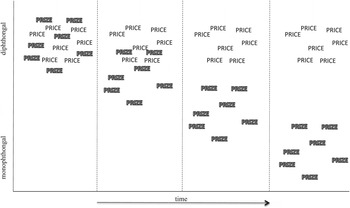
In scenario 3, schematized in Figure 5, the relationships between diphthong and monophthong and between prize and price are both gradient—there is only one phonological allophone of /ay/, from initiation to completion of the monophthongization process. Therefore the entire phoneme /ay/ undergoes the gradual change in phonetic implementation of its offglide. The mechanism by which prize is favored over price for monophthongization is simply that prize is on the leading edge of the gradient change—within the single allophone of /ay/, there is some environmentally conditioned phonetic differentiation. In this situation, the relationship between prize and price is the same as the relationship between prenasal and non-prenasal /æ/ in the continuous system depicted in Figure 2: they differ gradiently in phonetic implementation while still being part of the same phonological entity.
A model of scenario 3: /ay/-monophthongization as a gradient process affecting the entire /ay/ phoneme as a single phonological unit, but with phonetic differences in degree of monophthongization between price and prize.

Labov (Reference Labov2010; also Labov et al., Reference Labov, Ash and Boberg2006; but see Thomas, Reference Thomas1989) characterizes the monophthongization of /ay/ as the triggering event for the lowering of /ey/ toward [æɪ] and the rest of the Southern Shift. If this is true, only the third of these three scenarios of /ay/-monophthongization is compatible with the interpretation of chain shifts sketched in the previous section, according to which chain shifts are changes in the phonetic implementation rules affecting discretely specified phonological segments without regard to whether those segments are entire phonemes or merely allophones of some other phoneme. If /ay/-monophthongization is a chain-shift trigger, it must create a vacant space in /ay/’s original position for /ey/ to move toward. In scenarios 1 and 2, no such vacant space exists: a diphthongal allophone of the /ay/ phoneme persists unchanged alongside the monophthongal or monophthongizing one for the entire duration of the change. In scenario 1 the space is vacated once monophthongization is complete, so in principle the lowering of /ey/ could have initiated very late in the history of /ay/-monophthongization. However Map 18.5 of Labov et al. (Reference Labov, Ash and Boberg2006) suggests that /ey/-lowering is at least old enough to have successfully spread throughout almost the entire South—nearly as broadly distributed as /ay/-monophthongization is itself—which suggests that it is more likely to have been triggered by an early stage of monophthongization than by a late stage. Only scenario 3, under which the original diphthongal position of /ay/ begins to be vacated from the earliest phase of the change, with no allophone staying put in that position, is compatible with a chain shift in which the beginning of the lowering of /ey/ is triggered by the beginning of the monophthongization of /ay/.Footnote 8 This, therefore, makes a concrete, testable prediction: if Labov et al.’s (Reference Labov, Ash and Boberg2006) account of the causality of the Southern Shift is correct, and if chain shifts work as predicted by a modular feedforward architecture of phonology, then when the Southern Shift originated, /ay/-monophthongization must have proceeded as described in scenario 3: a gradual process of glide lowering affecting the /ay/ phoneme as a unit, gradiently disfavoring the price environment but still affecting it.
We will test this hypothesis by examining the phonological structure of /ay/ in the region in which the Southern Shift is thought to have originated. Labov (Reference Labov2007) argued that diffusion of a chain shift—that is, its expansion beyond the region in which it originated, via dialect contact between adults—breaks down the causal structure relating the phonemes involved to each other, as a change in one phoneme may diffuse without the changes that triggered it. Thus, since our hypothesis depends specifically on the role of /ay/-monophthongization as a triggering event for a chain shift, the hypothesis only applies to the region in which the Southern Shift originated organically, rather than regions to which it spread via diffusion.
According to Labov et al. (Reference Labov, Ash and Boberg2006:262), this region is likely to be the “Upland South” or “Inland South,” the Appalachian region extending roughly from northern Alabama to southern West Virginia: “this originally poor and rural population is the originating center of the widespread Southern Shift, which has expanded to influence all but the marginal coastal areas of the South.” Early dialectological research such as that of Kurath (Reference Kurath1949) and Kurath and McDavid (Reference Kurath and McDavid1961) found the Inland South and Coastal South to be part of distinct top-level dialect regions with separate origins; the fact that Labov et al.’s (Reference Labov, Ash and Boberg2006) 1990s data characterized the South as a single dialect region (though with some internal differentiation) suggests that diffusion must have taken place to unify them. Thus, it is in their Inland South data that we will test our hypothesis that /ay/-monophthongization was a gradual process with a gradient relationship between prize and price.
Therefore the empirical hypothesis being tested in this paper is the following:
In the Inland South, the monophthongization of /ay/ exhibits a fully gradient phonetic profile, resembling the sketch in Figure 5.
This concrete hypothesis rests upon a complex scaffolding of more general theoretical hypotheses and assumptions: that chain shifts behave in the manner predicted by a modular feedforward theory of phonology; that the Southern Shift is in fact a chain shift; that it originated in the Inland South; that a gradient change in phonetic implementation will produce a phonetic profile like Figure 5; and so on. Thus a positive result will demonstrate that this entire complex of hypotheses fits together to produce a coherent and empirically consistent picture of /ay/-monophthongization, and therefore provide evidence for the less well established of the hypotheses.
Labov et al. (Reference Labov, Ash and Boberg2006) reported a high rate of monophthongization of price in the Inland South; the majority of speakers in the Inland South are described as monophthongizing more than half of their tokens of price (ibid., Maps 11.5 and 18.3). This suggests that scenario 2, in which prize monophthongizes gradually while price remains unchanged, is not an accurate description of the history of monophthongization in the Inland South. To distinguish between scenarios 1 and 3, it will be necessary to look at the phonetics of /ay/ in the Inland South in some detail.
GRADIENT MONOPHTHONGIZATION IN THE INLAND SOUTH
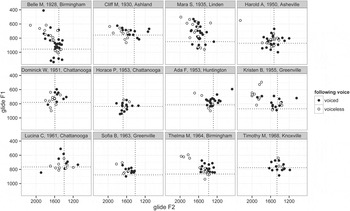
The data set collected for Labov et al.’s (Reference Labov, Ash and Boberg2006) Atlas, known as the Telsur corpus, contains phonetic data for 13 Inland South speakers, 12 of whom are listed by pseudonym in Figure 6. We will examine these speakers' pronunciations of /ay/ for evidence that monophthongization originated as a gradient process affecting /ay/ as a single phonological unit.
Normalized /ay/ glide targets for 12 Inland South speakers in the Telsur corpus, interviewed between 1995 and 1996. White = price; black = prize. Dotted lines mark each speaker's mean F1 and F2 of the nucleus of /ay/, for comparison.

Bermúdez-Otero (Reference Bermúdez-Otero and de Lacy2007, Reference Bermúdez-Otero, Honeybone and Salmons2015) did not propose an accountable quantitative criterion for determining, on the basis of acoustic measurements of a speaker's tokens of a phoneme, whether they represent a single gradient distribution or two discrete phonological allophones. Instead he characterized these states of affairs in terms of qualitative criteria such as (respectively) “an unbroken phonetic continuum” and “discrete, largely nonoverlapping regions in phonetic space.” But it is easy to imagine distributions that are qualitatively ambiguous between these two descriptions—two discrete allophones whose targets are close enough in phonetic space that their distributions overlap and could easily be mistaken for a single extended distribution with strong internal conditioning. As Bermúdez-Otero and Trousdale (Reference Bermúdez-Otero, Trousdale, Nevalainen and Traugott2012:696) put it, “absence of bimodality does not entail absence of categoricity.” Turton (Reference Turton2014:84) proposed diagnosing categoricity by means of a combination of bimodality, discontinuity between categories, and regression models that provide a good fit for the data when two categories are assumed. We begin our analysis by following Bermúdez-Otero (Reference Bermúdez-Otero and de Lacy2007) and interpreting the phonetic data qualitatively; after that, we will propose a quantitative approach to the question based upon regression models of the effect of vowel duration on formant measurements. We will demonstrate the viability of this approach by comparing the Inland South with the city of Raleigh, North Carolina, which is part of the broader Southern dialect region but not the Inland South, and showing that they differ in the quantitative properties of their /ay/ structure.
The hypothesis being tested is that monophthongization is a gradient change in phonetic implementation. We model the degree of gradient monophthongization of a token of /ay/ as the lowering of the phonetic target of the offglide of the phoneme toward identification with the nucleus.Footnote 9 The phonetic measurements extracted by Labov et al. (Reference Labov, Ash and Boberg2006) do not systematically include offglide targets, so it is necessary for us to return to the recordings—made accessible to us in the form of individual sound files for each word—and measure them afresh. For each token of /ay/ included in the Telsur audio data for each of these 13 speakers, we identify the beginning and end of the vowel duration by hand by inspecting the spectrogram in Praat 5 (Boersma & Weenink, Reference Boersma and Weenink2014), and automatically extract F1 and F2 of the point at five-sixths of the total duration, normalizing each speaker's results by scaling them to the normalization parameter calculated for that speaker's nuclear vowel measurements by the Atlas. We use that F1/F2 measurement to represent the glide target of any token of /ay/.
The 13 speakers produced a total of 321 tokens of /ay/, including 202 of prize and 119 of price. Figure 6 displays the /ay/ glide targets for 12 of the 13 speakers.Footnote 10 The first thing to note about Figure 6 is that none of the speakers appear to simply have prize and price as purely separate allophones of /ay/—that is, nobody has all tokens of price in one region of phonetic space, and all tokens of prize in another distinct region, the way Sarah from Figure 1 has separate prenasal and non-prenasal allophones of /æ/. Each of them has, if nothing else, at least one token of price in a region of phonetic space dominated by prize. There are approximately three distinct patterns attested in the phonetic distributions of /ay/ of these speakers:
-
1. A single extended gradient distribution, reaching from more diphthongal (higher and fronter) to more monophthongal (lower and backer) targets, including both price and prize.
-
2. A single relatively compact and uniformly monophthongal allophone, including both price and prize.
-
3. Two discretely separated allophones, one more diphthongal and one more monophthongal, with price (and occasionally prize) realized variably as both of them.
Belle M. from Birmingham, Alabama (born 1928), is the best example of the first of these three situations. Her /ay/ offglides extend from 409 Hz to 1137 Hz in F1, and from 2123 Hz to 1432 Hz in F2—spanning from the range of her nuclei of kit and fleece all the way down to identical to the nucleus of /ay/—with no interruption or gap that would suggest the presence of two phonologically distinct allophones. price tends to be slightly more diphthongal than prize within the continuous distribution, but both price and prize are found across the spectrum from fully diphthongal to fully monophthongal.
The second pattern, with /ay/ uniformly monophthongal, is exemplified by Horace P. from Chattanooga, Tennessee (born 1953). All of Horace's /ay/ offglides have F1 greater than 740 Hz, in the same region as his /ay/ nuclei; and they are distributed across a much narrower region of phonetic space than Belle's /ay/. Prize and price are both found within this fully monophthongal cluster.
The best example of the third pattern, with discretely separate allophones with greater and lesser degrees of monophthongization, is Kristen B. from Greenville, South Carolina (born 1955). She appears to have at least two distinct clusters of /ay/ tokens: one more diphthongal cluster, with offglide F2 between 1786 Hz and 2001 Hz, overlapping with the range of her nuclei of trap, dress, and face; and one monophthongal cluster, with F2 between 1356 Hz and 1583 Hz, matching the nucleus of /ay/. Between these two allophones is a gap of 200 Hz in F2 in which no tokens of /ay/ appear; although it is conceivable that her /ay/ is actually a single gradient distribution and it is only by chance that none of her recorded tokens fall within this 200-Hz range, it seems unlikely. (There is also one outlying back token with F2 of only 720 Hz; this is Kristen's only token of /ay/ before /l/.) The majority of diphthongal tokens are price, and the majority of monophthongal tokens are prize, but both price and prize are found in both allophones. Kristen's /ay/ thus seems compatible with hypothesis 1, in which monophthongization is a discrete process affecting prize more frequently than price—although even the diphthongal allophone appears partially monophthongized, with its offglide more in the mid than high region of the vowel space.
Kristen B. is, however, the only one of the 13 speakers whose /ay/ appears to have two (or more) robust and discretely separated allophones, each including a relatively large number of tokens. Thelma M. (born 1964) from Birmingham, Alabama, has a large monophthongal cluster and four diphthongal tokens of price; Harold A. (born 1950), from Asheville, North Carolina, goes even further and has only a single outlying diphthong drastically separated from his otherwise uniformly monophthongal /ay/ cluster. These two speakers' /ay/ distributions seem to suggest an advanced stage of scenario 1—the stage after discrete variable monophthongization has achieved a very high frequency but before it is quite categorical.
However, if discrete glide deletion were the original mechanism of /ay/-monophthongization in the Southern Shift, we would expect older speakers to exhibit an earlier stage of that pattern—that is, a system with two discrete allophones, with a higher probability of using the diphthong and a lower probability of using the monophthong than younger speakers have. But that pattern is not attested in the data; and the oldest speakers in the sample—Belle, Cliff, and Mara—all appear to have a single continuous distribution from more diphthongal to more monophthongal. In other words, the oldest stage of Southern /ay/-monophthongization visible in apparent time in the Telsur data represents a gradient relationship between diphthongal and monophthongal /ay/. This implies that the origin of monophthongization was as suggested in scenario 3: a gradual change in phonetic implementation affecting the whole of the /ay/ phoneme, as predicted by the modular feedforward account of the mechanism of chain shifting.
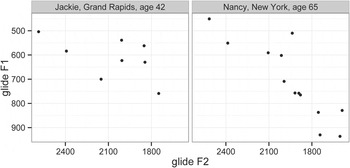
Moreover, Belle, Cliff, and Mara show some evidence of monophthongization even in their most diphthongal tokens. The diphthongal extremes of their distributions do not extend much fronter than 2000 Hz in F2 nor much higher than 500 or 600 Hz in F1; the frontest /ay/ offglide out of any of them is Belle's night at 2123 Hz. This may be compared with the offglide targets of typical non-Southern speakers. To make this comparison, we chose at random two speakers in the Telsur data from non-monophthongizing regions: Jackie R. (42 years old when interviewed) from Grand Rapids, Michigan, and Nancy B. (65 years old) from New York City. Jackie and Nancy's prize offglides, displayed in Figure 7, are substantially fronter on the whole than Belle, Cliff, and Mara's are. Their frontest offglide tokens are 2587 Hz and 2516 Hz respectively, substantially fronter than even Belle's frontest outlier of price. Their F2 means for prize are respectively 2074 Hz and 1949 Hz, significantly fronter than any of Belle, Cliff, and Mara's mean price or prize (at the p < .01 level). So although the three oldest Inland South speakers have their /ay/ phoneme gradiently distributed across a range from diphthongal to monophthongal, even the diphthongal end of that range is less diphthongal than a non-Southern speaker's diphthongal /ay/. This is what would be expected if these three speakers represent a relatively early stage of scenario 3, as depicted in the second column of Figure 5: the entire phoneme undergoes the change toward monophthongization at once, and even the diphthongal edge of the extended gradient distribution is starting to vacate the original fully diphthongal position, not leaving any stably diphthongal allophone behind.
Normalized prize glides for two non-Southern speakers.

The fact that the oldest speakers in the Inland South data exhibit this gradient pattern suggests that the origin of /ay/-monophthongization in the Inland South was as described in scenario 3, a gradient change in phonetic implementation affecting the entire /ay/ phoneme as a single phonological unit. The uniformly monophthongal /ay/ systems of Horace and others represent a later stage of the history of this same gradient change. For the two speakers who have just a few outlying diphthongal tokens, we hypothesize that those tokens represent a more recent innovation on top of a fully monophthongized system, reintroducing a diphthongal /ay/ in careful speech as a correction toward the standard. Whether this is the case for Kristen B., the one speaker who may have produced two robust discrete allophones, is unclear; the other possibility is that her speech is simply uncharacteristic of the Inland South region.
With the exception of Kristen, however, the data as a whole supports the hypothesis being tested; the oldest speakers in the Inland South appear to exhibit a gradient relationship between diphthongal and monophthongal and between price and prize. Now, the seeming phonetic overlap and gradience that we see in these speakers' /ay/ distributions is not itself sufficient to demonstrate that price and prize are a single phonological unit. Fruehwald (Reference Fruehwald2013) argued that price and prize in Philadelphia were distinct allophones from the very beginning of the change that separated them, which means that there must have been a period at which they overlapped phonetically, displaying a seemingly gradient pattern, but were nonetheless phonologically distinct. However, Fruehwald demonstrated this on the basis of the fact that, in Philadelphia, price ultimately underwent a change in phonetic implementation that prize never participated in, in the manner schematized as scenario 2. In the Inland South, we see the opposite happening: price and prize both ended up becoming fully monophthongal. If price and prize are phonologically distinct on the relevant dimension, there is no reason for both of them to be affected by the same phonetic change. Thus these two facts—the gradience of the distribution for the older speakers and the fact that monophthongization goes to completion for the younger speakers—combine to indicate that /ay/-monophthongization in the Inland South originated as a phonetic change gradiently affecting a single phonological category.
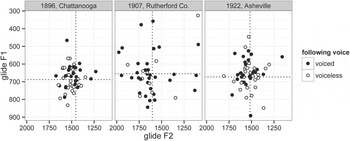
Although this conclusion depends upon only three speakers from the Telsur data displaying the gradient pattern, we can support it a bit more, and push it back a bit further, with the three oldest Inland South speakers in the corpus of the Sociolinguistic Archive and Analysis Project (see Kendall, Reference Kendall2007). These three speakers, born between 1896 and 1922 in western North Carolina and eastern Tennessee, were interviewed by Ron Butters in 1974. These speakers' /ay/ glide targets, as measured at three quarters of vowel duration, are shown in Figure 8. They reinforce the pattern seen in the Telsur data: for each of them, the glide targets of /ay/ are spread relatively continuously across a wide region of phonetic space, with no clear separation into discrete monophthongal and diphthongal clusters; they do not even seem to have very much internal differentiation between price and prize. Thus the earliest data at hand on /ay/-monophthongization in the Inland South suggests that it was a phonetically gradient process, involving the entire /ay/ phoneme as a phonological unit.
/ay/ glide targets for three Inland South speakers in 1974; dotted lines mark mean F1/F2 nucleus of /ay/. Since only /ay/ was measured for these speakers, the normalized formant values here are not directly comparable to log-mean normalizations computed on the basis of full vowel spaces.

Nevertheless, the apparent lack of discrete allophony in the Inland South, as determined by simple visual inspection, does not necessarily mean that the relationship between price and prize is gradient. Coarticulation with the following sound, undershoot at short durations, and even lexical effects all have the potential to make discrete phonological differences look gradient. Furthermore, the glide cannot be expected to consistently reach its most peripheral position in acoustic space at exactly five-sixths (or any other fraction) of the vowel's duration; that is, representing the glide with a single acoustic measurement introduces noise. Conversely, we would expect the vowels in price versus prize to have different phonetic characteristics even in the absence of phonological allophony. This is because voiceless codas tend to promote peripheralization of preceding offglides, and offglides have longer duration, relative to their nuclei, before voiceless codas (Moreton & Thomas, Reference Moreton and Thomas2007; Thomas, Reference Thomas2000). For these reasons, we now turn to a comparison of the Inland South speakers with speakers from the Southern city of Raleigh, North Carolina, and we move beyond visual assessment. We endeavor to show that /ay/-monophthongization is at least more gradient in the Inland South than in Raleigh; this comparison will provide evidence favoring a gradient model of the variable in the Inland South.
DISCRETE (OR LESS GRADIENT) MONOPHTHONGIZATION IN RALEIGH
Raleigh, North Carolina, is a Southern city, but east of the modern Inland South area (Labov et al., Reference Labov, Ash and Boberg2006) and the early 20th century's South Midland region (Kurath, Reference Kurath1949, Kurath & McDavid, Reference Kurath and McDavid1961). So if Southern Shift features originated in the Inland South and diffused eastward, Raleigh's /ay/-monophthongization need not show the same phonetic and phonological profile as /ay/ in the Inland South does. Thomas (Reference Thomas1989) argued, in fact, that /ay/ glide reduction diffused to North Carolina from Virginia rather than from the Inland South, in which case the internal constraints and phonological status of the /ay/ allophones could easily differ from those in the Inland South.
Dodsworth (Reference Dodsworth2013) found that Southern features have been in retreat in Raleigh since the 1950s, as a result of increasing migration from and contact with non-Southern regions, so we will restrict our attention to 11 of the oldest speakers from Dodsworth's Raleigh corpus. These 11 speakers predate the abandonment of Southern features, providing us with a more or less unadulterated look at the Raleigh-local structure of /ay/-monophthongization, and are rough contemporaries with the oldest Inland South Telsur speakers discussed in the previous section. Their /ay/ offglides (measured at three-quarters of vowel duration and normalized using the same method as was used for the Inland South speakers) are shown in Figure 9.Footnote 11
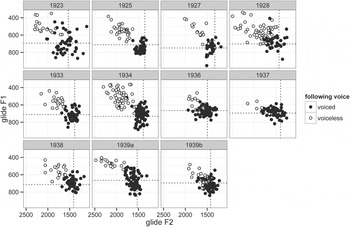
/ay/ glide targets for 11 of the oldest speakers in the Raleigh corpus; dotted lines mark mean F1/F2 of nucleus of /ay/.

For all of these speakers, /ay/ offglides extend over a relatively wide range from more monophthongal to more diphthongal. However, from a visual inspection, there appears to be some variation among them with regard to the structure of their /ay/ phoneme. For some, such as the speaker born in 1925, the ranges of price and prize do not overlap and thus constitute discrete clusters in phonetic space, like the prenasal and non-prenasal /æ/ in Figure 1. Four speakers, those born in 1928, 1936, 1937, and 1939(b), appear on visual inspection to have a more continuous distribution, like the older speakers in the Inland South. Other speakers are harder to classify at first glance; their prize and price are largely distinct, but the ranges do overlap closely enough that they could be opposite ends of a single phonological cluster.
Qualitative comparison of the raw values of the /ay/ offglides of the Inland South and Raleigh samples thus suggests the difference between price and prize is more gradient in the Inland South. In the next section, we turn to a more quantitatively accountable means of diagnosing phonological discreteness and gradience: the effect of vowel duration on the difference between price and prize.
EVALUATING GRADIENCE AND DISCRETENESS VIA DURATION
Solé (Reference Solé, Solé, Beddor and Ohala2007) demonstrated the utility of duration interactions in distinguishing phonological from phonetic conditioning, providing a survey of several studies in which this approach has been used. She argued that, if a distinction (phonemic or allophonic) is encoded phonologically, then the phonetic realization of that distinction will vary with speech rate and segment duration as speakers take advantage of longer duration to increase the distinctiveness of the targeted feature. For example, in both English and Spanish, vowels become partly nasalized prior to nasal consonants. At longer total vowel durations, the duration of the period of nasalization increases concomitantly in English but remains constant in Spanish (Solé, Reference Solé1992); from this Solé inferred that vowel nasalization is a phonological effect in English, but in Spanish it is merely a coarticulatory consequence of physical constraints on articulation. Her analysis does not distinguish between universal physical articulatory constraints and language-specific phonetic-implementation effects, which is what we believe the effect of voicing, if any, on /ay/ in the Inland South to be; however, this approach provides a model for using duration to distinguish between phonetic and phonological patterns.
We hypothesize that tokens of /ay/ with longer duration are more likely to hit closer to their phonetic target. Since phonologically distinct allophones can have distinct phonetic targets, increasing duration may have different effects on their formant values. This is especially true for a diphthong's offglide, since the longer the duration of the vowel is, the more time the tongue has to reach an offglide target that may be quite distant from the nucleus. So, for example, if price becomes more diphthongal the longer its duration is, and prize becomes more monophthongal with longer duration, that is evidence that they are phonologically distinct allophones with separate phonetic implementations. If duration has the same effect on price as on prize, that will be evidence that they are part of a single phonological unit, with differences between them due to internal phonetic conditioning modifying them with respect to a shared target.
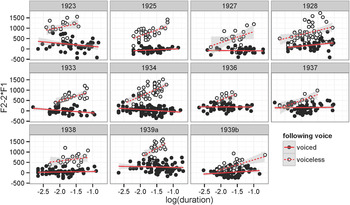
Figure 10 displays the effect of duration on the glide target of /ay/ for each of the 11 Raleigh speakers. For compactness, height and frontness of the glide target are combined into the diagonal height index calculated by F2 – 2 × F1 (cf. Dinkin, Reference Dinkin2013); the individual values of the slopes of F1 and F2 with respect to duration are given separately in the Appendix. For the majority of speakers, prize’s offglide retains a consistent low (monophthongal) target with increasing duration, but price’s offglide becomes higher and fronter with greater duration. The longer the vowel duration, the less phonetic overlap there is between the offglide ranges of prize and price. The exact figures given in the Appendix show that for every Raleigh speaker, the slopes are steeper in the expected direction (i.e., negative for F1 and positive for F2) for price than for prize. This suggests that prize and price are phonologically distinct allophones, with widely separated offglide targets, and longer durations allow those targets to be more successfully achieved.
The relationship between vowel duration and diagonal height of /ay/ glide target in Raleigh.

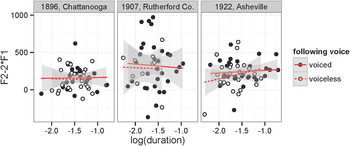
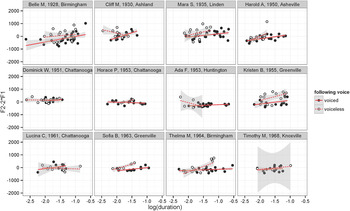
We can contrast the duration effect in Raleigh with that in the Inland South (Figures 11 and 12). In the Inland South, unlike Raleigh, for most speakers the distance between prize and price does not increase noticeably (in either formant) at longer durations. The oldest Telsur Inland South speakers all have upward slopes for prize in one or both formants; this pattern is almost completely absent from the Raleigh data and indicates that prize has a diphthongal target. In contrast with the Raleigh data, where all price slopes were sharper than prize slopes in the expected direction, 10 of the 15 Inland South speakers have prize steeper than price in one or both formants (listed in detail in the Appendix), inconsistent with price having a more peripheral glide target. This suggests that these speakers have a relatively diphthongal phonetic target for prize that they are best able to reach at longer duration, not a distinct monophthongal target separate from that of price. In other words, the duration slopes support our inference that prize and price are part of the same phonological unit in the Inland South, during the same time period in which they were two discrete allophones in Raleigh.
The relationship between /ay/ glide target and duration for 1974 Inland South speakers.

The relationship between /ay/ glide target and duration for the Telsur Inland South speakers.

The relationship between duration and F1 or F2 is potentially conditioned by phonetic factors, especially the tendency for the vowel in prize to have longer overall duration than the vowel in price. We can achieve a clearer and more accountable picture of the differential effect of duration on prize and price by controlling for other potential effects. Accordingly, we calculate mixed-effects linear regression models for each speaker, with (scaledFootnote 12 ) F1 and F2 of the /ay/ glide as the dependent variable. Fixed effects in the regression models were the following:
-
• price versus prize (hereafter “voicing”)
-
• Place of articulation of the following consonant, if any
-
• Duration of the entire diphthong, log-transformed
-
• Interaction between (log-transformed) duration and voicing
Random intercepts for lexical item were also included in each model.
The relevant quantity for our analysis is the regression estimate for each speaker's interaction between duration and voicingFootnote 13 : the greater the magnitude of the interaction term (negative in F1, positive in F2), the more the model predicts that the speaker's prize and price have different glide targets at longer durations. The goal in generating a separate model for each speaker is to produce and then compare two distributions of interaction coefficients—a Raleigh distribution and an Inland South distribution. While we must be cautious about the interpretation of comparing coefficients derived from distinct regression models, we avoid some of the hazards of that approach by comparing the distributions between two sets of multiple speakers.
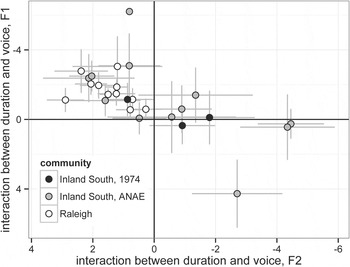
The model estimates for the interaction term are shown in Figure 13. All of the Raleigh speakers have negative F1 estimates and positive F2 estimates, statistically significant in one or both formants, indicating more peripheral price glide targets at longer durations, relative to prize. The Inland South speakers show a wider range of variation in their interaction terms; this is unsurprising, inasmuch as smaller token counts are expected to produce more erratic regression estimates.Footnote 14 For example, the one outlying Inland South speaker with an F1 estimate near –6 has only three voiceless tokens in his sample. Of the remaining 14 Inland South speakers, six pattern with the Raleigh speakers in having negative F1 estimates and positive F2 estimates, some of them statistically significant. The other eight Inland South speakers have negative F2 estimates, and in four cases positive F1 estimates as well. The Inland South speakers who pattern with Raleigh in Figure 13 are not the youngest or most geographically Northern; this group includes the oldest Inland South speaker in the Telsur sample, Belle M. from Birmingham (born in 1928), as well as the Asheville speaker born in 1922 and interviewed in 1974. The fact that the majority of Inland South speakers do not show the interaction that Raleigh speakers do indicates that it is the continuous distribution of /ay/ that is the regional feature of the Inland South at large, even if a few speakers diverge from it to some extent.
Estimates and standard errors for the interaction term between following voice and log(duration) in per-speaker mixed-effects models. If the model for a given speaker predicts no significant difference between the prize and price glides in the effect of duration, then that speaker's standard error will overlap with the black lines at x = 0 and y = 0.

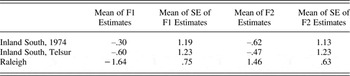
Means and standard errors for the Raleigh and Inland South distributions are shown in Table 1. In general, the distribution of the estimates for the interaction between duration and voicing is more consistent with a gradient relationship between price and prize in the Inland South than in Raleigh. The estimates are more widely dispersed in the Inland South, and unlike in Raleigh, there are some Inland South speakers whose prize even appears more diphthongal than price at long durations. In addition, the standard error of the estimate for the interaction between duration and voicing is larger, on average, for the Inland South than for Raleigh.
Mean estimate and mean standard error of the estimate for the interaction between duration and voicing

CONCLUSION
A modular feedforward architecture for phonological structure, combined with the assumption that /ay/-monophthongization is the phonetic trigger for the Southern Shift, predicts that monophthongization must have originated as a gradient phonetic process affecting prize and price as a single phonological unit, at least in the region in which the Southern Shift originated. Data from the oldest speakers available to us in the Inland South exhibits the phonetic pattern expected for such a gradient shift of a single phonological unit, even while their contemporaries elsewhere in the South show a different phonological pattern. Thus the /ay/ patterns we find in the Inland South constitute evidence for a modular feedforward architecture of phonology, in which the entity that is subject to phonetic implementation is a categorically specified abstract phonological segment that is itself the output of discretely acting phonological rules.
The “binding force” that Labov (Reference Labov2010) attributed to the phoneme is therefore actually the result of the phonological coherence of the allophone. In a modular feedforward phonology, the entities subject to chain shifts are not phonemes per se, as is often implicitly assumed, but phonologically discrete allophones: a region of phonetic space that is filled merely by a conditioned allophone of some phoneme is still, for the purposes of chain shifting, occupied. This analysis explains both of the case studies in which Labov analyzed the interaction of allophony with chain shifts: prenasal /o/ does not front in dialects in which prenasal /æ/ is phonologically raised because non-prenasal /æ/ is still occupying its original phonetic position; and the Southern Shift requires price to have been involved in monophthongization from the start.
The older speakers from Raleigh exhibit a system in which diphthongal price and monophthongal prize are discretely distinguished allophones—the scenario schematized on the right side of Figure 4. We have argued that this situation is incompatible with the internal development of the Southern Shift as a chain shift. This implies that Raleigh, and presumably other Southern cities outside the Inland South, acquired the Southern Shift as a result of diffusion from the Inland South. Labov (Reference Labov2007) argued that individual elements of a chain shift can enter a dialect through diffusion even in the absence of the phonetic triggers that are the prerequisites for the shift in the source dialect.
The fact that /ay/-monophthongization exists in both Raleigh and the Inland South, with different phonological manifestations, is itself somewhat noteworthy. Since the “South Midland” and the South proper were readily distinguishable as dialect regions in the 1940s (Kurath, Reference Kurath1949), and were settled from different sources, we would not a priori expect them to share similar dialect features in the initial condition. The fact that /ay/-monophthongization is present in both suggests that, like the Southern Shift in general, it is likely to have originated in one and spread to the other. It is not impossible for it to have originated independently in both regions; but the fact that the regions are adjacent to each other, and that it is already probable that the Southern Shift diffused between them, makes diffusion a more likely explanation for /ay/-monophthongization. Future research will be necessary to determine which region was the source of this diffusion and which the recipient; the answer will have interesting implications for the theory of how diffusion can change the phonological character of a dialect feature.
The discussion herein is based upon the hypothesis that /ay/-monophthongization is the trigger for the lowering of the nucleus of /ey/, the next stage of the Southern Shift, in the Inland South. Therefore our results can also be interpreted as supporting that hypothesis. To test this hypothesis more directly in future work, it will be necessary to investigate the phonetics of /ey/ itself; the model predicts that, in the Inland South, the lowering of /ey/ should be correlated with the degree of monophthongization of the trailing edge of /ay/.
It will also be necessary for the fine-grained phonetic implications of a modular feedforward phonological theory to be worked out in greater detail. Are adjacent but phonologically discrete allophones expected to display synchronic distributions in phonetic space that are quantitatively distinguishable from that of a single phonetically extended allophone with gradient but robust internal phonetic conditioning, other than by the effects of duration? Variationist analysis is necessary for empirically testing theoretical questions of the structure of phonetic and phonological change, but for the empirical analysis to continue to be robust it is necessary for the theory to make more specifically testable predictions about measurable quantities than it does now.
The existence of chain shifts as a causal system at all, in which a change in one phoneme is actually triggered by a change in another phoneme rather than just moving coincidentally at the same time, has been a subject of some controversy (cf. Stockwell & Minkova, Reference Stockwell, Minkova, Kastovsky and Bauer1988). Since the results in this paper support the hypothesis that /ay/-monophthongization is the trigger for /ey/-lowering, they also support the hypothesis that chain shifts actually exist at all. Thus, classic constructs of the theory of phonology and phonological change—chain shifts, abstract underlying representations, discrete allophonic rules—continue to succeed at predicting the phonetic phenomena we see in major cases of change in progress. The core empirical finding in this paper is narrow, but it is through the testing of such individual specific hypotheses that the broader theoretical architecture underlying them must stand or fall.
APPENDIX
Slopes of F1 and F2 of prize and price with respect to log of vowel duration (cf. Figures 10–12). Bold text highlights those with a sharper increase in glide distance for prize than price at long durations.