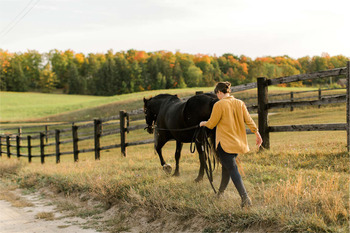
Humans don’t always have to lead; Katrina takes Kimber on a tour of the fields. Ontario, 26 September 2020. (Photo by Michelle Peek)

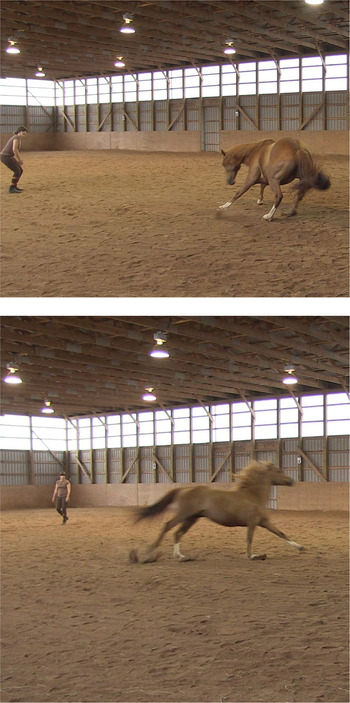
Taco (horse) and I (human) enter the arena. The energy in the air is electric, ready for movement.Footnote 1 I release Taco from his halter and cast it aside. His ears prick and eyes slightly widen as he takes off trotting around the arena, embracing the kinesthetic experience as he explores the space. I follow after him, admiring his energy and dance, as we weave in and out, adjusting our proximity to one another. At times our bodies almost touch, and at other times we are apart, joined only by the physical structure of the arena, present in a shared space and time. I playfully run to one side and jump. Taco kicks up his heels in a buck. Nothing is said. On one level it could appear that very little is going on in this encounter, just a human and a horse messing about, randomly moving through space. It can all seem to have very little meaning. However, the appearance of insignificance only reflects the surface act, a level that many humans never progress past in the company of animals.Footnote 2 Beyond this humanist façade, there is another level, a realm of exchange that can be shared by individuals (both human and animal), and on that level it is a complex interaction, a detailed conversation that communicates information about self, shares perspectives, and cocreates knowledge through performance. But this concept of intentional meaning-making through performance is often held within the realm of the human, and not afforded to our nonhuman kin. The stories animals tell are often not heard as they are articulated through performance.
Taco and I at play offers a glimpse of the potential to learn about one’s self and a radically different other by recognizing interspecies interactions as performance. When Taco bucks as he races around the arena, I analyze his actions and energy to gauge his intentions and how he is experiencing life in that moment. What was occurring in our shared environment previous to the buck? Does the action seem targeted at me, as an aggressive kicking up of his heels in my direction? Did anything change in our space, such as a cat dropping down from the rafters, or something else unexpected and startling? Did I change (in emotion or action)? What was he doing right before he decided to buck and kick up his heels? All of these situational, intuitive, and emotional observations constitute information that allows an action to be understood.
Years of studying and working with numerous horses, combined with an appreciation for the complex ways that horses communicate, allows me to understand the exchange beyond the mere aggression of the kick. With these layers of knowledge, I am able to critically engage with Taco’s actions and deduce the significance (or at the very least create a reasonable hypothesis) of a given sequence of events or gesture statement — how movements and resonance work together to create a clear nonverbal articulation. In order for Taco’s action to speak, I need to be able to recognize the myriad ways that horses can perform their perspectives, and be able to break down the aspects of the performance to illuminate the specifics. Having witnessed that Taco did not seem particularly interested or focused on me before or during the buck suggests that I was not the cause. This was then reinforced when he trotted closer to me after his outburst. Before the buck he had been standing at the door, peeking out at the barnyard. As he approached me afterwards, he had a leaf in his mouth, suggesting that he had likely pulled it off a plant outside the door, perhaps causing the door to move, surprising him and causing him to buck. This interpretation was also reinforced by the messages I received while I watched him move. He did not seem aggressive, but also not entirely playful, suggesting that something unexpected had occurred.
A horse may kick up their heels for a variety of reasons, so the question becomes: Why did this specific horse kick out in this way, at this moment, in this context? In interspecies interactions, if both of the parties are consciously aware of the ways that movement, space, gesture, and feelFootnote 3 may communicate, then a series of acts (that may otherwise seem random) — the adjustments in proximity, the bucks, kicks, and movements — become a conversation. Horses are constantly reading the performances of those around them (human and animal) as this is the primary mode of discourse in their own communities, and why horse training predominantly focuses on body language. However, the majority of humans overlook the nuances of conversations that do not occur through words, that is, conversations amongst and with animals.
Taco’s actions and energy communicate his intentions as he and Kimber play. Ontario, 5 August 2014. (Photos courtesy of Kimber Sider)

In the equestrian arts (my primary human/animal realm of expertise and research), and other areas of human/animal sports and engagements, performance is understood primarily in terms of the functional vocabulary of athletic ability and execution. Horses perform dressage tests and are evaluated on their performance jumping over fences, amongst other exercises; they are judged on their abilities to complete a task, to perform. Although rarely acknowledged beyond these skill-based references, performance is a foundational concept in the equestrian arts as it is the medium of equine/ human communication. This notion is glossed over in practice by focusing on body language, gesture, or the physical aides manipulated in riding (the rider’s legs, seat, and hands). But all of these are about speaking without words, and how the expressive behavior of performance communicates to another species through touch, feel, sound, and visual cues from a distance. Performance holds the potential to be an equalizing methodology that balances the mode of inquiry by honoring each species’ input, perspectives, and ways of knowing. This potential is not always (or even often) realized. Performance is frequently used in the equestrian world for human-centric purposes by humans who refuse to recognize equine perspectives in their own right. In these performances, the humans wield their own expressive actions to manipulate horses for their own purposes. It is about molding a horse to do a human’s bidding, not about discovering the vast potential of this interspecies partnership. Humans are taught to “speak horse,” but rarely to “hear horse.” Many know how to “persuade” a horse to move around an arena (“horse whisperer” Monty Roberts is famous for this “horse speak” [Reference Roberts1997]), but learning how to listen requires a deeper understanding.
A horse onstage is infrequently a unique individual with a complex and nuanced life, and more often a representation of freedom and/or control, of human superiority over “nature,” and/or of beauty and magic. In Théâtre Zingaro’s 2015/16 production, On achève bien les anges (élégies) (They shoot angels, don’t they? [elegies]), horses are literally the partners of angels; they allow humans to fly as they move through various thematically connected acts without a linear narrative, exploring notions of the afterlife.Footnote 4 The horses dance dressage and carry humans through vaulting, while also roaming the stage in “liberty” acts (which suggest freedom of movement for the horses, but are highly contained and controlled). In one scene, Bartabas, the theatre’s artistic director and a lead actor, ground drivesFootnote 5 an equine actor around a graveyard while pretending to be blind.
In one of the two nights of this production that I witnessed, the horse’s performance was not communicating the elegance of a “blind” man being so connected to his equine partner that he could steer him seamlessly around an intricate pattern of gravestones to the music of Tom Waits, but rather suggested discomfort with the situation, particularly Bartabas’s request for him to step into a highly contained piaffe (a collected and springy trot almost on the spot). This horse displayed his displeasure with the request by kicking out at Bartabas twice, before being reprimanded quickly with a stroke of a dressage whip. The horse responded to this scolding by raising his energy and tossing his head, protesting and delaying the change in gait, before stepping into the required maneuver. From the human perspective, what the horse was saying — that he did not want to piaffe for whatever reason — had no place in the show; his resistance had to be tempered or risk damaging the illusion of the artful partnership that the act was aiming to portray.
However, this response had the opposite effect, in that it destroyed any appearance of unity or partnership and left only human dominance. Partnership requires that both partners’ perspectives be valued and considered; it requires compromise. It demands that the message behind the act be understood and accommodated, rather than merely shut down for insubordination. The narrative may have been selling connection, but this display of authority suggested a skewed understanding of the union, as no adjustments were made to consider the horse’s perspective. All that most people saw in this kicking out was a horse disobeying (a common understanding of any “negative” animal actions) when in actuality this action was about the horse communicating something of vital importance to him. The horse was upset enough with what was being asked of him to make a strong statement about it. Horses rarely get to that level of aggressive articulation without having first made many attempts at subtler communication to express their interests and needs. It is when these other performances fall on deaf ears that the expressions intensify. Even here the horse was not trying to hit Bartabas, as the kicks were very short and contained, but rather to make a point. Yet, all that was acknowledged within the moment was the insolence of the kicking, and the importance of completing the human’s objectives.
When an individual horse, such as this Zingaro horse, is included in a production, the ways the horse is understood rarely has much to do with that horse’s perspective and interests, and more to do with the ways the horse is framed for the purposes of the narrative. As in this case, the framing generally has little to do with recognizing the horse as a unique individual, and rather overrides this meaning and these equine layers of communication in favor of ascribing human-centric metaphors to the body of the horse. This creates the subtextual understanding that the voice of an individual horse is inconsequential, and that whatever they are saying, whatever they are communicating about their personal experience in the moment, is irrelevant and should be overlooked in favor of the “real” meaning, the human intentions behind the act (in this case, a dance of connected partnership). This approach not only diminishes the voice of that specific horse but goes so far as to suggest that this horse, and horses more generally, have no voice to begin with, a trope that humans often accept without question. In the case of the Zingaro production, much of the audience likely missed this moment because it was brief and contained due to the scale of the round stage and dim lighting. Or spectators may have considered it inconsequential: just a human putting a horse in his place with a whip — so common.
In the human construction of the Zingaro performance, a piaffe was “needed” to express connection/control. The contrary aspect, however, was that improvising in response to the horse’s narrative would have also served human goals: adjusting to the needs of the horse in that moment would have suggested a connected interspecies partnership. The performance may not have had such an artful dance, but the message behind the dance would have been saved. The notion of a human and a horse working together in union was destroyed not by the horse’s actions (only the illusion of absolute control was dashed by the kick), but rather by the human response to the horse’s comments.
The next night, the horse still showed signs of discomfort but objected far less, and complied much more quickly, allowing those viewing only that second performance to, likely, stay more content with the human narrative, thereby maintaining the belief that the dominant narrative of interspecies harmony was accurate for all involved. It was a more straightforward experience in that the human narrative was never challenged. However, the first night’s performance missed an opportunity to express the difficult beauty of a genuine partnership in which one’s partner does not always say what one would like them to, and where compromise and compassion are more important than control.
Now, of course, this is my meaning, my desire for the act, what I would have found impressive, and what I hope for when I witness an interspecies relationship — genuine partnership — but in reality, the dominance-based understanding of “partnership” is so common that few question the validity of the use of the word “partner” in this context. Equestrian theatre consistently offers opportunities for these other dynamics of human and equine relationships to be addressed, as most productions I have seen hold at least one moment of a horse expressing an alternative equine narrative. In these instants, the horses are “‘kicking out’ against meanings and their making” (Peterson Reference Peterson2007:35), turning the meaning that has been ascribed to them on its head. But it is a rare performance that embraces these moments of equine agency. It is a rare performance that seeks to challenge the dominant narratives of human control over animals, and to offer a more complex understanding of these dynamics. It is a rare performance that is genuinely interspecies to the degree that it fully celebrates both the human and equine narratives, and all of the messy brilliance of this relationship.
My primary equine partner, Katrina, engages in an initial conversation with every new human she meets. This allows her to establish how much consideration a given human deserves, an assessment based on her evaluation of the human’s awareness of this silent conversation. Katrina goes about this evaluation by ever so subtly stepping into the new human’s space. She is so understated about it that the human often assumes it is their fault, that they are crowding her, and responds by moving out of Katrina’s way. The test usually begins while leading Katrina to the barn, or while standing around talking in advance of working with her. Whatever the context, Katrina will find a way to lightly crowd the human to see a) if they notice, b) how they understand the message, and c) how they respond. Most humans, especially those new to horses, will apologize to Katrina (assuming it is their fault for getting in her way, even though she can walk or stand wherever she likes, and they have not moved) and then yield their position to her. This tells Katrina that they either do not understand the meaning behind her movements, or that they are not worthy of being leaders, and therefore do not deserve her respect as an empowered lead horse. If I inform the human about Katrina’s assessment, and instruct them to hold their ground when Katrina crowds them, and even to ask her to step back and be respectful of their personal space, then Katrina’s evaluation of the person changes. They still may not know enough to deserve her full respect, but they are at least no longer pushed around, or schooled, in the same way. With this information the human learns a fundamental life lesson about human/equine interactions: space matters. To the human in this situation, until they are filled in on the proceedings (an important use of verbal language to support and increase nonverbal literacy), it seems that nothing of importance is going on, other than (perhaps) the conversation that we (humans) are having. However, if they are planning on working with Katrina, this other conversation is of vital importance, as it is setting up the parameters of their pending relationship with her. The foundation of their “partnership” is being established, and they are often completely oblivious to it.
As Keri Brandt suggests, humans who work with horses develop the ability to think in this way, to recognize the nuances of how their bodies speak to another (human or animal), and to begin to decipher the messages being performed in response (Reference Brandt2004:306). Their human bodies become tuned to their equine partners, and this (predominantly) nonverbal engagement becomes not only the way of speaking, but also the way of thinking, listening, and engaging in the moment. Diane Dutton argues that “shared somatic awareness is a feature of close human-animal relationships,” and that this is achieved through attuning your consciousness to the embodied expressions of your animal partner (Reference Dutton, Birke and Hockenhull2012:102). The challenge then becomes being able to recognize how you have come to a certain understanding, being able to consciously recognize and break down the elements that have created a certain meaning, in order to avoid negative anthropomorphism.
The more noticeably different the other animal’s way of being in the world is, the more likely the anthropocentrism will be perceived and adjusted, as the moments of miscommunication/misunderstanding are more pronounced. We may only be able to see the world through our own human eyes, but that does not mean that we cannot recognize other ways of being and perceiving the world. The more that we can learn about another animal, the more likely we are to be able to understand their point of view. In thinking about the implications of communication, John Durham Peters writes, “the task is to recognize the creature’s otherness, not to make it over in one’s own likeness and image” (Reference Durham Peters1999:31). The ability to recognize this otherness, while also finding moments of connection, is needed if one is to recognize the perspectives of other animals. With horses, and other animals we work closely with, as Stephen Budiansky points out, “there are enough similarities between […] societies to allow for co-domestication to occur” (Reference Budiansky1997:61).
Concentrating on the communicative potential of performance creates a shared foundation of experience that draws on the animal’s ways of knowing and being in the world, producing the opportunity for a relationship. Brandt writes, “through a co-created embodied (iconic) system of cues, shared meaning is possible in the absence of spoken verbal language” (Reference Brandt, Waskul and Vannini2006:145). Embodied systems of speaking open doors to interspecies conversations. Privileging improvisational performance furthers the shared experience by inhabiting a mutual space and starting from a place of embodied engagement, while still acknowledging the differences between individuals.
Creating spaces steeped in performative knowledge has vast potential for interspecies connections. However, all forms of performance — even all forms of nonverbal performance — do not have the same potential for creating expansive interspecies relationships. Théâtre Zingaro employs nonverbal performance as their primary mode of engagement, and yet, On achève bien les anges (élégies) failed to appreciate the equine commentary due to the prescribed nature of the acts. For a performance to have genuine interspecies potential it must allow for animal contributions. The production must promote collaboration, not control; deal in the present moment; and employ improvisation. Genuine interspecies performance is not possible in nonimprovised, staged theatrical productions. In these productions the foundational decisions have already been made, leaving no room for animal agency. The animal actors cannot recognize or fully comprehend the parameters of the performance they are part of. Clearly, the horses in Zingaro’s productions are at a distinct disadvantage because their only options are to follow or disrupt, not to lead or add creatively. The highly structured format of a nonimprovised theatrical production is inherently anti-interspecies.
Improvisation happens in the now. Improvisation in animal/human performances focuses on the moment, on an equal exchange between animal and human. Usually, humans are notoriously bad at being present in the moment. Verbal language allows us to share the past and consider the future, too often skipping the current moment. However, improvisation offers the gift of now, and it is in the now that animals most noticeably dwell (at least from what we humans can perceive). Improvisational performance holds the possibility of cocreating interconnected and interspecies performances.
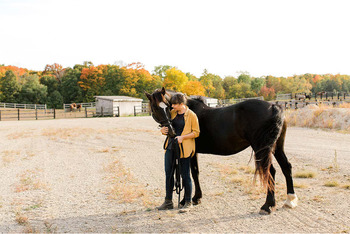
Katrina and Kimber chat before work begins. Ontario, 26 September 2020. (Photo by Michelle Peek)

When I am working with horses, the embodied fluency is complete in that I do not conceive of my intentions in words, nor do I translate my horse’s messages (unless translating for another human or analyzing for myself), but rather I think in action and communicate through feel. There are moments of humor, moments of connection, moments of frustration, moments of elation, moments of departure, and they are all communicated and created through a sensorial dialogue of body, space, movement, gesture, tension, fluidity, feel, emotion, intuition, resonance, and affect. Often many of these layers are working together all at once. To work in this way is not to think in the linear manner of an English sentence, but rather to make meaning through a word cloud of feel and motion. All those embodied “words” come together to inform and share an understanding, or understandings, with another. Equine trainer Carolyn Resnick says communication with a horse is always a dance (Reference Resnick2005:141). To work with horses on a cocreative level is to recognize the conversation as constant; if you are sharing space with a horse then you can assume you are talking, whether or not you are overtly aware of your messages. There is no escaping the performance, but there are many possibilities to learn to recognize expressive action (your own and theirs), and to begin to consciously cocreate understandings and negotiate meanings in this way.
When I am with my horse Katrina, I am generally not focusing on performance in a theatrical sense, but rather on relationship building and the ongoing exploration of partnership. While there are times that I have been more goal-oriented (we crossed Canada together in 2008), 13 years into our relationship our current focus is on being physically active (in some mutually defined manner), learning together, and enjoying each other’s company. We wander and explore. But this does not mean that the performance is any less; it means that we are focused on each other and that there is significant fluidity and collaboration in how an encounter may unfold.
This dance begins the moment we sense each other’s presence, which is often the moment that I arrive at the farm, and continues until we part. Does she immediately perk her ears and come towards me, or glance in my direction and then go back to grazing? The nuances of these first choices begin to articulate where she is coming from that day, and how she is feeling about our relationship. I assess these performance cues, just as she assesses my approach and demeanor. If Katrina is less eager to spend time with me (she is not readily approaching the gate) then I consider if she has not enjoyed our last meeting. Have I not engaged enough with her perspective lately? Have I not been listening? Or perhaps there is something going on with her herd, and she does not want to leave? Does she want to come to the barn to be groomed, or is she reluctant to leave her paddock? How is she moving? Is there flow or stiffness? Is there tension or peaks in how she is holding her muzzle and eyebrows, or a slack relaxation? Is she bright and engaged, or standoffish and dull? These are the first moments of assessing our relationship and how our experience will unfold that day. It starts with where we are meeting, rather than what happened yesterday or what plans I may have. Everything is dictated by how we feel and how our stories intertwine in this moment.
An ongoing negotiation in our relationship is my desire for us to do work — to explore the trails and move — and her desire to hang out and graze or visit the horses in the other fields. We both need movement for our health, but she also needs to be able to explore her surroundings and graze on fresh grass. Both of these things are restricted to some degree for her when I am not around, in that she is confined to the possibilities of her field and herd. If either one of these options overly consumes our interaction, then neither of us is fully getting what we need or want. Given that I have more control over Katrina’s existence than she does over mine, I try to start with her needs. If she is happy and fulfilled, then she is more likely to want to work and explore. Like every relationship it is a negotiation and a dance.
Humans generally assume that if you listen to animals and give them what they ask for then you are doomed to never again be able to do what you want. It is the “danger” inherent in all agency. I have found the opposite of this humanist assumption to be true; the more I listen to Katrina, the more she is willing to listen to me and consider my requests. Because I consider her perspective as much as possible and try to accommodate it, she generally receives the demand more readily when I need her to do something with urgency, as she recognizes that this is not my normal practice. If I say (through my actions), “no you have to do this and do this now,” then she tends to agree quite quickly. But if I make these types of demands a constant aspect of our relationship, then she will shut down, become obstinate and less interested in engaging with me. She may still do what I demand, but she is no longer an eager partner. While domination is often deemed easier, and allows the one dominating to only consider their own perspective, partnership will never be achieved this way. At best you will receive begrudging compliance, and at worst, full-on rebellion.
I won’t pretend that it is always easy to listen to Katrina’s wants and needs and attempt to work with them. But I will say that I have a much more engaged and happier partner because of this consideration. It is also more interesting. I learn more and discover aspects of our shared existence that I would have overlooked without her input and guidance.
How Katrina expresses her interests in practice is often based on movement and willingness. For example, a few years ago she was having some health difficulties that I was having a hard time defining. I would read the scale of her willingness to do things as a way to deduce the problem. What was she eager to do, what was she reluctant to do, and what did she flat out refuse to do? In this instance, it would take a lot of coaxing to get her down to the hayfield where we would ride. I would often have to encourage her down the hill, and then she would continue on with relative ease, but with more drama and skittishness than is common for her. I tried working through this in a variety of ways. Each approach told me more about the nature of the problem. Then one day she’d had enough of my efforts. I brought her in with ease and tacked her up. However, when I went to mount, she reached around and delicately nipped me in the side.
This nip spoke volumes. She wasn’t trying to be mean; she was telling me that I hadn’t adequately responded to all of her subtler messages. How do I know this? For one, it was a far more precise and focused “bite” than most people would realize a horse could achieve (though it still hurt). She pinched me through multiple layers of clothing, lightly grabbing less than a centimeter of skin. It was clear and directed, and not meant to cause harm. I sat down and cried in frustration, not with her, but with the fact that I didn’t know how to fix whatever was happening with her. All I could do now was to listen better. I untacked her and focused on what she wanted to do (which clearly wasn’t riding). We wandered and grazed, both on foot.
Over the next month I worked on attuning myself more effectively to the nuances of Katrina’s performed communication, focusing on trying to understand the boundaries she set as a way of distinguishing what was wrong. She was always happy to see me and would readily let me put her halter on and lead her right up to the point where we would leave her field. Then she would stop and refuse to go further. This suggested to me that it wasn’t me, but rather that she didn’t want to do work (the things we do outside of her field) for whatever reason. So, I started spending time with her in her field. Then I tried getting on her bareback in the field, and this she allowed (suggesting that it wasn’t a back issue). She would follow me over to the fence and stand still while I climbed up and hopped on. These are not “stupid animals”; horses read actions and gesture sequences to an extremely advanced degree. She knew what I was asking before I even stepped on the fence. All Katrina has to do to keep me from mounting is swing a few steps away from the fence. Each moment is a choice that suggests consent or not, and how she is feeling about the proposed activity. She performs her thoughts and opinions through every moment and every movement of our exchange, if I only listen to the subtle shifts in her body.
Likewise, Katrina has created a series of head gestures to communicate to me what she wants and where she wants to go. She will nudge me with her muzzle and flick her head in the direction she would like to draw my attention. I have never seen her use these movements with another horse. In that case she merely moves, and her herd follows. These gestures are for me, and are a language created out of our human/equine culture. This is an interspecies performance born out of our shared ways of being and communicating. Through this I have learned that she likes to take a short trip around the property and check in with all of the other horses (the horses have to acknowledge her presence at each field before she will move on). Once this check-in has been completed, she will willingly follow me into the barn. The more I consider her needs in our plans for our time, the more she considers mine, and goes along easily with my requests.
Our communication is never perfect, and I am constantly trying to find better ways to explain things. Sometimes I resort to words and hope that understanding between species is possible to some degree in this way, in some undefined transfer. At the very least it can help me more fully embody my intentions. In Listening, Thinking, Being, Lisbeth Lipari reminds us that meaning is never precise; even when it comes through words, misunderstanding is always part of communication (Reference Lipari2014:7). Which raises the question: how much must one know about another in order to communicate to some degree, somewhat accurately? Must a human already have knowledge of how horses perform their communication in order to “speak and hear horse”? Or can two significantly different individuals (one human and one animal) share space and recognize aspects of the other merely through being open to the experience?
In the winter of 2017 (and again in 2021), I had the opportunity to design a first-year seminar course around this work and (re)balancing human/animal dynamics through recognizing and listening to animal stories. The foundation of the course included observation assignments in which the students would go out and observe an unfamiliar animal in a shared space. This could mean watching a squirrel in the park, or observing a sheep in a field, as long as the student had no previous relationship with that animal, or extensive understanding of the species. The animals had to be in their natural environment/community (so a sheep may be in a field, but not in a stall), and the human needed to be sharing space with them in order to have a mutual foundation. The students were not allowed to interact with the animals in any way, and were to observe from a respectful distance, while still sharing space. The focus of the assignment was not a behavioral analysis of the chosen species, but on getting to know a specific individual through engaging with the individual’s own unique performance. The students were tasked with exploring how to critically understand these performances as communication through breaking down the elements and recognizing how the animal’s expressive actions were making meaning for them.
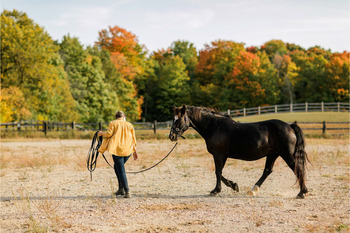
Kimber and Katrina negotiate work through subtle movements and embodied requests. Ontario, 26 September 2020. (Photo by Michelle Peek)

Through tasking my students with three rounds of observation and sharing their encounters, I found that many students noticeably nuanced their understanding of animals and increased their ability to recognize animals as individuals and break down how they arrived at these understandings. They were increasing their critical knowledge of how performance works as communication in human/animal interactions.
One student spent two hours traversing the forest with a deer, from a respectful distance, through engaging in the Equine-Facilitated Learning (EFL)Footnote 6 practice of letting the animal set the boundaries, and not advancing if any sign of nervousness is recognized. I taught them through a performance workshop how to attune themselves to the animal they were observing. Using each other as a demo, they learned to approach another and respect their boundaries by watching for any sign of nervousness and backing off the second any was detected. The instant that they perceived a twitch or tension, they learned to stop moving, rock back on their heels away from the one they were approaching, breathe/sigh/settle, and wait until the individual had noticeably relaxed again in their presence. Then they could begin to advance again. This student’s ability to attune herself to the experience of the deer that she met, and to not be a domineering human, meant that the deer allowed her to share a bit of their experience and stay with them as they wandered the park. The student reported to the class that this was an experience that she did not think possible previously. She was so excited to be invited in by this deer that she stayed with the deer in the middle of winter for four times longer than the assignment required. The deer of course could have left her at any time, and yet chose to stay within a few meters of this student as they wandered the conservation area together.
Through respecting the deer’s personal space and being alert to the subtle communication of her own and the deer’s actions, she felt invited to watch the deer, as the deer watched her. She was allowed a glimpse of a life and experience that had previously been completely foreign to her, and, as she expressed, this experience of feeling invited to wander with a deer had expanded her understanding of what was possible in a human-animal relationship, wild or otherwise. She had begun to learn how to listen to a radically different other.
Listening to animals is not only about hearing the howls, chirps, snorts, mews, nickers, and other vocal articulations; it is about hearing the conversations about preferences, perspectives, and relationships that are communicated through movement, gesture, feeling, and resonance. It is about hearing, through the (often) silent language of improvised performance, how an individual perceives their world and engages with those with whom they share space. It is about hearing animals’ stories and allowing their perspectives to enrich our understandings of the world.
If we do not learn to speak and hear fluently in/through performance we are limited to only communicating with those who share our language, and those who have an invested interest in verbal abstractions, which does not even cover all of humanity. It limits us to discussing only that which can be fully translated into words, when there are rich worlds of intrigue and exchange that exist beyond the verbal. It is through recognizing and listening to the complex ways that animals make meaning through performance that animals can begin to claim their rights to voice and agency in the presence of humans.
To view supplemental materials related to this article, please visit https://doi.org/10.1017/S1054204321000332.