Children require a range of early experiences and environmental inputs in order to develop along a healthy life trajectory. Some of these inputs are required during critical or sensitive periods, the absence of which may engender delays in development that persist across the lifespan (Meredith, Reference Meredith2015). Institutions for abandoned or orphaned children provide an exemplar of severe early neglect as a violation of experience-expectant input, as many of these settings are typified by high child-to-caregiver ratios, infrequent one-to-one interaction, and extreme regimentation. Countless studies have demonstrated that children living in institutions have more cognitive, behavioral, and socioemotional difficulties than those raised in family-based settings (Sonuga-Barke et al., Reference Sonuga-Barke, Kennedy, Kumsta, Knights, Golm, Rutter, Maughan, Schlotz and Kreppner2017, Zeanah et al., Reference Zeanah, Humphreys, Fox and Nelson2017). Children experiencing severe early deprivation in the context of institutional rearing also have higher rates of internalizing and externalizing disorders, which are observed from childhood through adolescence (Zeanah et al., Reference Zeanah, Egger, Smyke, Nelson, Fox, Marshall and Guthrie2009; Rutter et al., Reference Rutter, Sonuga-Barke, Beckett, Castle, Kreppner, Kumsta, Schlotz, Stevens, Bell and Gunnar2010; Wiik et al., Reference Wiik, Loman, Van Ryzin, Armstrong, Essex, Pollak and Gunnar2011; Humphreys et al., Reference Humphreys, Gleason, Drury, Miron, Nelson, Fox and Zeanah2015).
Given that institutional rearing is associated with heightened risk for several psychiatric conditions, it has been suggested that severe psychosocial neglect is a transdiagnostic vulnerability factor for broad-spectrum psychopathology (Wade et al., Reference Wade, Fox, Zeanah and Nelson2018). This is consistent with recent work on the latent structure of psychopathology that has identified the presence of general (‘P factor’) and specific internalizing (INT) and externalizing (EXT) factors in children, adolescents, and adults (Lahey et al., Reference Lahey, Applegate, Hakes, Zald, Hariri and Rathouz2012, Reference Lahey, Rathouz, Keenan, Stepp, Loeber and Hipwell2015; Tackett et al., Reference Tackett, Lahey, Van Hulle, Waldman, Krueger and Rathouz2013; Caspi et al., Reference Caspi, Houts, Belsky, Goldman-Mellor, Harrington, Israel, Meier, Ramrakha, Shalev and Poulton2014; Laceulle et al., Reference Laceulle, Vollebergh and Ormel2015). Since the establishment of the P factor, researchers have been interested in better understanding what precisely it is capturing that is common across disorders. Converging evidence suggests that P is associated with deficits in emotion regulation, which itself is underpinned by problems with executive functioning (EF), including response inhibition, working memory, cognitive flexibility, psychomotor speed, and sustained attention (Castellanos-Ryan et al., Reference Castellanos-Ryan, Brière, O'Leary-Barrett, Banaschewski, Bokde, Bromberg, Büchel, Flor, Frouin and Gallinat2016, Huang-Pollock et al., Reference Huang-Pollock, Shapiro, Galloway-Long and Weigard2017, White et al., Reference White, Moore, Calkins, Wolf, Satterthwaite, Leibenluft, Pine, Gur and Gur2017). Several studies also suggest that global deficits in EF – captured by modeling the shared variance across EF measures – predict higher general psychopathology in childhood and adolescence (Martel et al., Reference Martel, Pan, Hoffmann, Gadelha, do Rosário, Mari, Manfro, Miguel, Paus and Bressan2017; White et al., Reference White, Moore, Calkins, Wolf, Satterthwaite, Leibenluft, Pine, Gur and Gur2017; Bloemen et al., Reference Bloemen, Oldehinkel, Laceulle, Ormel, Rommelse and Hartman2018). Thus, global deficits in EF coincide with global vulnerabilities to psychopathology.
It is now well established that children with histories of institutional rearing demonstrate significant difficulties in many domains of EF that track with those proposed to increase liability to psychopathology, including inhibition, working memory, sustained attention, visual-spatial memory, and cognitive flexibility (Pollak et al., Reference Pollak, Nelson, Schlaak, Roeber, Wewerka, Wiik, Frenn, Loman and Gunnar2010; Hostinar et al., Reference Hostinar, Stellern, Schaefer, Carlson and Gunnar2012; Bick et al., Reference Bick, Zeanah, Fox and Nelson2018). This raises the possibility that aberrations in cognitive functioning provide one mechanism linking childhood neglect to later psychopathology. Indeed, spatial working memory has been shown to mediate the effect of early neglect on aggression in toddlers (Demeusy et al., Reference Demeusy, Handley, Rogosch, Cicchetti and Toth2018), with similar effects reported for ADHD in middle childhood (Tibu et al., Reference Tibu, Sheridan, McLaughlin, Nelson, Fox and Zeanah2016a). Moreover, Miller et al. (Reference Miller, Sheridan, Hanson, McLaughlin, Bates, Lansford, Pettit and Dodge2018) recently showed that poor language ability at age 14 mediates the association between childhood deprivation and externalizing problems at age 17. However, no study has examined whether global deficits in EF mediate the association between childhood neglect and psychopathology, and whether this effect is specific to a particular syndrome or common across domains of psychopathology. Thus, using a quasi-cross-lagged longitudinal design that spans 16 years, the current study examines whether EF in middle and late childhood provides a mechanism linking severe early neglect to general (P) and specific (INT, EXT) psychopathology in adolescence. We focus on adolescence for two reasons: First, adolescence is a period of significant physiological reorganization that is typified by increased rates of psychiatric disorders (Blakemore and Mills, Reference Blakemore and Mills2014); and second, very little is known about the mechanisms linking early neglect to long-term psychopathology outcomes among institutionally-reared children.
Methods
Participants
Participants were children from the Bucharest Early Intervention Project (BEIP), a longitudinal study examining the effects of institutional rearing and foster care on children's brain and behavioral development. A total of 136 children living in institutions in Bucharest, Romania were recruited at 6 to 31 months of age (M = 22 months). Following baseline testing, half the children were randomly assigned to a care as usual group (CAUG; remain in institutions), and half were assigned to a foster care intervention group (FCG). Together, these two groups comprise the ever-institutionalized group (EIG). Seventy-two never-institutionalized children (NIG) reared in their biological families were recruited from pediatric clinics in Bucharest to serve a comparison group. Study procedures were approved by local Commissions on Child Protection in Bucharest and by the institutional review boards of the three principal investigators (CAN, CHZ, NAF). We and others have discussed the ethical dimensions of this study in detail elsewhere (Zeanah et al., Reference Zeanah, Fox and Nelson2012).
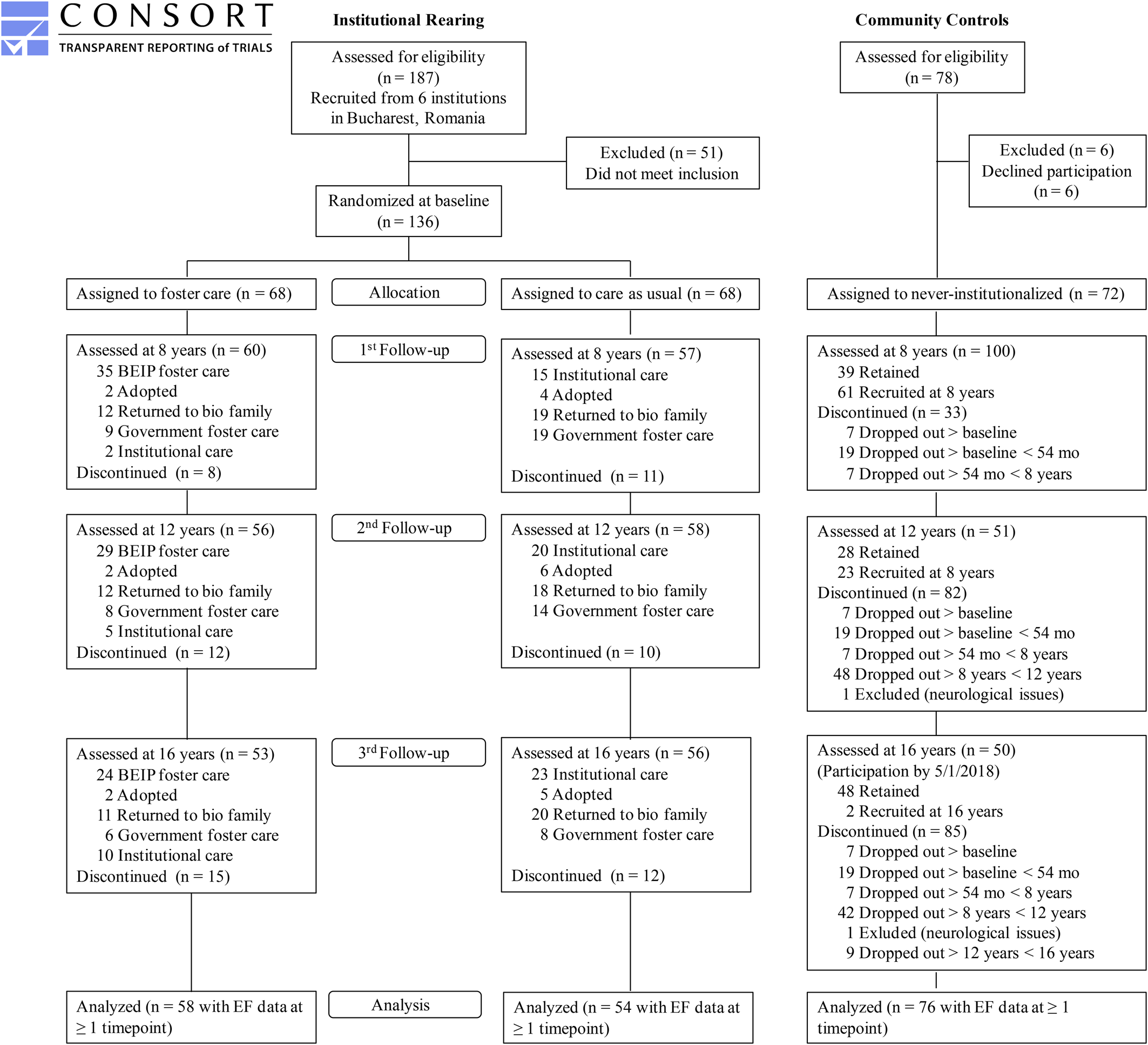
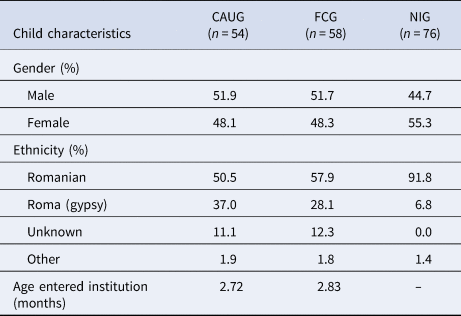
The current study examined children who provided EF and/or psychopathology data at the 8, 12, and 16 year follow-ups. A total of 188 children (112 EIG and 76 NIG) contributed EF data at one or more timepoints. At age 12 (N = 162) and age 16 (N = 149), psychopathology was assessed from caregiver and teacher reports. As described below, full-information maximum-likelihood estimation (FIML) was used to handle missing data over time. Thus, all 188 children who contributed EF data were included in the analysis. Table 1 presents demographic information for the three study groups, and Fig. 1 shows placements of the children over time.
CONSORT Flow Diagram Showing Participants and Placements over Time.

Demographic characteristics

CAUG, care as usual group; FCG, foster care group; NIG, never-institutionalized group (control).
Measures
Executive functioning
At age 8, 12, and 16, the Cambridge Automated Neuropsychological Test Battery (CANTAB; http://www.cantab.com) was used to assess different dimensions of memory and EF (Luciana and Nelson, Reference Luciana and Nelson1998). The CANTAB has been extensively validated in samples of school-age children, and has been found to discriminate well between typical and clinical populations (Luciana and Nelson, Reference Luciana and Nelson2002). Four CANTAB subtests (each taking 5 to 10 min to complete) were administered to assess memory and EF. These are described in detail on the CANTAB website and in previous BEIP publications (Tibu et al., Reference Tibu, Sheridan, McLaughlin, Nelson, Fox and Zeanah2016a; Bick et al., Reference Bick, Zeanah, Fox and Nelson2018). Briefly, the four tasks were: (i) Delayed Matching to Sample (DMS), which assesses attention and short-term visual memory; (ii) Paired Associates Learning (PAL), which assesses visual-spatial memory and new learning; (iii) Stockings of Cambridge (SOC), which is a test of spatial planning and problem-solving; and (iv) Spatial Working Memory (SWM), which assesses the ability to continually update spatial information in memory. We selected a single outcome for each of these tasks to index performance. These included DMS percent correct over all delays, PAL mean errors to success, SOC problems solved in the minimum number of moves, and SWM total errors. Treatment of these variables in estimating a global EF metric is described below.
Psychopathology
At age 12 and 16, various domains of psychopathology were measured using the MacArthur Health and Behavior Questionnaire (HBQ) (Essex et al., Reference Essex, Boyce, Goldstein, Armstrong, Kraemer and Kupfer2002). Reporters were the children's teachers and/or caregivers. Ratings were standardized and averaged into a composite score to reduce rater bias. Teachers and caregivers responded to several items on 3-point Likert scales: 0 (‘never or not true’), 1 (‘sometimes true’), and 2 (‘often or very true’). Subscales included: depression, overanxious, social anxiety, oppositional defiant, conduct problems, overt aggression, relational aggression, and ADHD (see MacArthur Foundation Research Network for Psychopathology and Development website for more details).
Data analysis
We used previously-derived latent bifactor scores for P, INT, and EXT at age 12 and 16 years (Wade et al., Reference Wade, Fox, Zeanah and Nelson2018), which served as our primary outcome variables. In the Supplementary Materials, we describe the estimation of these psychopathology factors in more detail. A global EF factor, which served as the putative mediator, was estimated using latent variable modeling. In this model, each of the four CANTAB outcomes (DMS, PAL, SOC, SWM) served as an indicator of the latent EF factor, estimated at age 8, 12, and 16 simultaneously. The latent factors were allowed to correlate freely (Cole and Maxwell, Reference Cole and Maxwell2003). Several residual correlations were suggested by the modification indices, and these were added to the model (see online Supplementary Fig. S1).
For both the psychopathology and EF factors, these were extracted from the latent models and used as manifest variables in a longitudinal path model linking institutionalization (never-institutionalized = 0, ever-institutionalized = 1) to psychopathology at age 16 through EF at age 8 and 12. To improve inferences around the directionality of effects, we employed a quasi-cross-lagged model in which we controlled for psychopathology and EF at previous timepoints (e.g. psychopathology at age 16 controlled for psychopathology at age 12; EF at age 12 controlled for EF at age 8). In this model, all effects were tested simultaneously and conditional on all other effects in the model, and are thus unique estimates.
The analyses were conducted using Mplus 7.3, and FIML was used to deal with missing data over time. FIML has been shown to outperform other methods for handling missing data, including listwise deletion, pairwise deletion, and mean substitution in terms of convergence, parameter bias, and model fit (Enders and Bandalos, Reference Enders and Bandalos2001). The analyses were performed using a maximum likelihood (ML) estimator, and the significance of the indirect effects was evaluated using 5000 bootstrap samples (Preacher and Hayes, Reference Preacher and Hayes2008). Indicators of model fit included: Root Mean Square Error of Approximation (RMSEA), Comparative Fit Index (CFI), and Standardized Root Mean Square Residual (SRMR).
Results
Measurement model for EF
The measurement model for EF at age 8, 12, and 16 is presented in online Supplementary Fig. S1. Model fit was adequate: RMSEA = 0.061 (90% CI 0.037–0.084), CFI = 0.94, SRMR = 0.057. Each of the indicators significantly loaded onto their respective EF factors at each timepoint, and the EF factors were significantly correlated. Measurement invariance was established over time (see online Supplementary Materials). Given that the EF factors at age 12 and 16 were very highly correlated, and given that we were interested in EF in childhood as a mediator between institutional deprivation and psychopathology in adolescence, the age 16 EF factor was not included in the path model.
Descriptive statistics and group comparisons
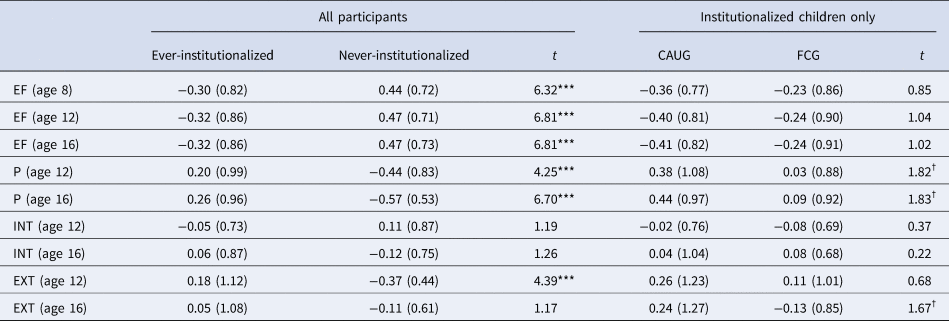
Table 2 presents differences between groups on key outcomes of interest at age 8, 12, and 16. As seen in this Table, ever-institutionalized children had significantly lower EF than never-institutionalized children at all ages. Ever-institutionalized children also had significantly higher P at age 12 and 16, and significantly higher EXT at age 12, compared to never-institutionalized children. Among the institutionalized children, FCG and CAUG did not differ from one another on mean levels of EF at any age. There was a trend such that FCG had lower P at age 12 and 16, and lower EXT at age 16, compared to CAUG.
Descriptive statistics and mean differences among institutionalized and never-institutionalized children

***p < 0.001; **p < 0.01; *p < 0.05; †p < 0.10.
Note: The ever-institutionalized group comprises the CAUG and FCG together.
CAUG, care as usual group; FCG, foster care group.
Note: All statistics are means and standard deviations (in brackets), except for gender (%). P, INT, EXT, and EF are factor scores with a total sample mean of zero.
Path model linking institutionalization to P, INT, and EXT through EF
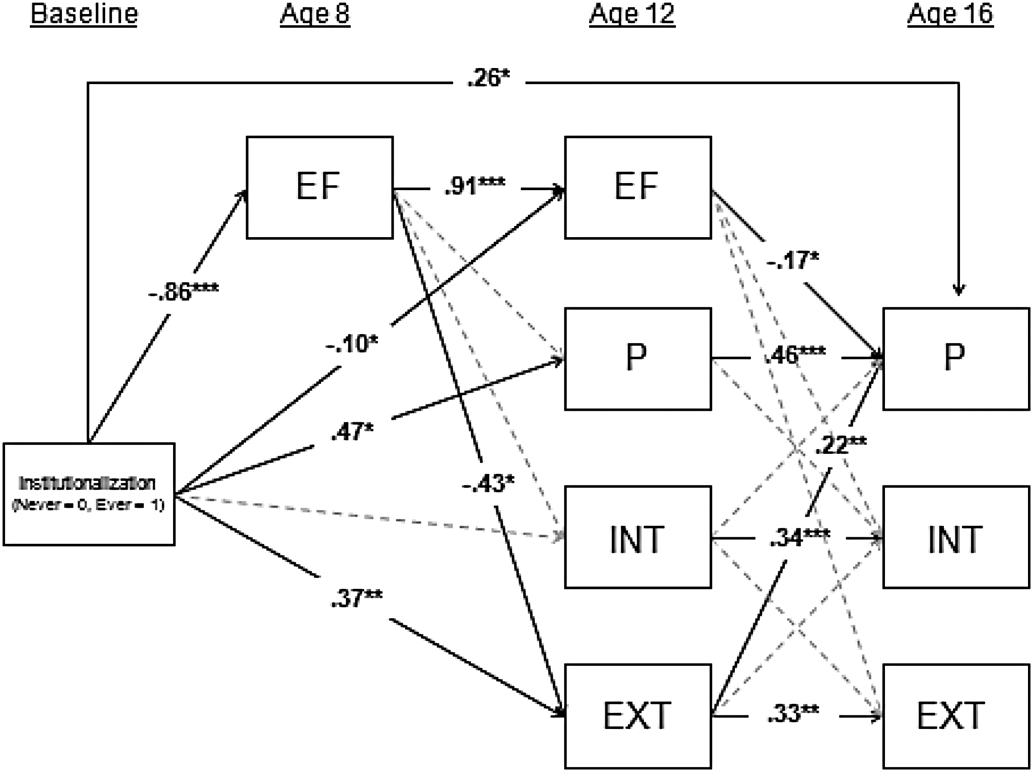
We then tested a path model connecting institutional deprivation (never-institutionalized = 0, ever-institutionalized = 1) to P, INT, and EXT at age 16 through EF at age 8 and 12. This quasi-crossed-lagged model can be seen in Fig. 2. Model fit was good: RMSEA = 0.023 (90% CI 0.000–0.127), CFI = 1.00, SRMR = 0.009. There was considerable within-construct stability over time for P, INT, EXT, but few cross-construct associations, with the exception that EXT at age 12 predicted P at age 16. There was also stability in EF from age 8 to 12. EF at age 12 predicted P, but not INT or EXT, at age 16. EF at age 8 predicted EXT at age 12. A history of institutional rearing significantly predicted lower EF at age 8, as well as higher P at age 12 and 16, and higher EXT at age 12. There was no prediction to INT at any age from either institutionalization or EF.
Longitudinal path model connecting institutionalization (0 = never-institutionalized; 1 = ever-institutionalized) to P, INT, and EXT at age 16 through these same factors as well as EF at ages 8 and 12. Parameters are standardized estimates. Solid lines and bolded coefficients are significant paths, while gray/hashed lines are non-significant. Within-time covariances are not shown to reduce clutter. ***p < 0.001. **p < 0.01. *p < 0.05.

Next, the mediation effects were examined from the bootstrapped ML model. Consistent with study hypotheses, there was a significant indirect effect of institutional rearing on P at age 16 through EF from age 8 to 12, unstandardized estimate (s.e.) = 0.12 (0.06), 95% CI (0.02–0.25) (i.e. EF-mediated path). Three other marginal indirect paths to P at age 16 were also observed: (i) institutional rearing was associated with P at age 16 through P at age 12, unstandardized estimate (s.e.) = 0.20 (0.11), 95% CI (0.02–0.44) (i.e. stability in P over time); (ii) institutional rearing was associated with P at age 16 through EXT at age 12, unstandardized estimate (s.e.) = 0.08 (0.04), 95% CI (0.02–0.17) (i.e. EXT-mediated path); and (iii) institutional rearing was associated with P at age 16 through EF at age 8 and EXT at age 12, unstandardized estimate (s.e.) = 0.04 (0.02), 95% CI (0.01–0.10) (i.e. EF-EXT-mediated path). There was a residual direct effect of institutional rearing on P at age 16 after accounting for the observed mediators, B (s.e.) = 0.24 (0.11), 95% CI (0.01–0.46), suggesting partial mediation by the factors outlined above.
In contrast to P, there were no indirect or direct effects of institutional rearing on INT at age 16 (all p's > 0.10). For EXT at age 16, there was a single marginal indirect effect of institutional rearing through EXT at age 12, unstandardized estimate (s.e.) = 0.12 (0.06), 95% CI (0.01–0.26) (i.e. stability in EXT over time). The residual direct effect of institutional rearing on EXT at age 16 was not significant, B (s.e.) = −0.18 (0.18), 95% CI (−0.50 to 0.17). Finally, for EXT at age 12, there was a significant indirect effect through EF at age 8, unstandardized estimate (s.e.) = 0.20 (0.09), 95% CI (0.04–0.40). The residual direct effect of institutional rearing on EXT at age 12 was significant, B (s.e.) = 0.36 (0.14), 95% CI (0.10–0.63), suggesting partial mediation by EF at age 8. There were no significant indirect effects on P or INT at age 12 through EF at age 8.
Intervention effects
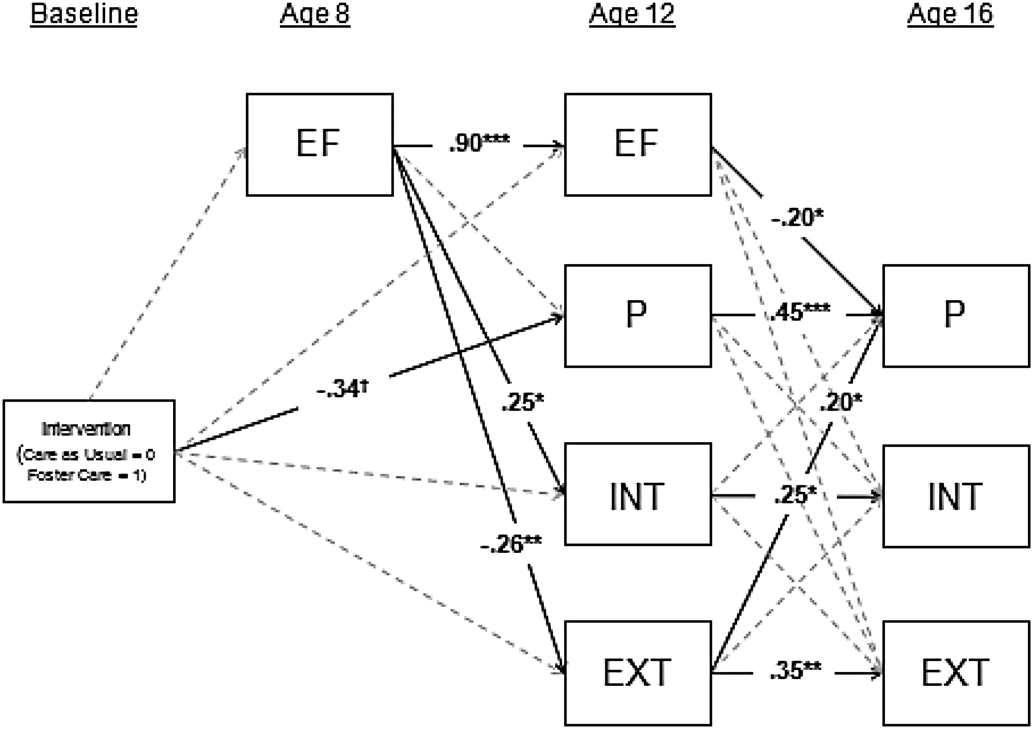
Consistent with the original intent of BEIP – to examine the effects of foster care intervention on children's development – we re-fit the path model among institutionalized children only (CAUG and FCG) to examine whether EF mediated any potential intervention effects on P, INT, or EXT. This model is presented in Fig. 3. In general, paths were similar to our primary model, with the exception that foster care was not related to EF at age 8. This is consistent with results in Table 2, where no EF differences between CAUG and FCG were observed at age 8. Due to this non-significant path, the whole pathway connecting the intervention to psychopathology via EF was non-significant, despite other paths resembling those in the primary model. Thus, while EF mediates the effects of institutional rearing on P, it does not mediate any intervention effects of foster care on psychopathology.
Longitudinal path model connecting foster care intervention (0 = care as usual group; 1 = foster care group) to P, INT, and EXT at age 16 through these same factors as well as EF at ages 8 and 12. Parameters are standardized estimates. Solid lines and bolded coefficients are significant paths, while gray/hashed lines are non-significant. Within-time covariances are not shown to reduce clutter. EF did not mediate the intervention effect on any psychopathology factor at age 16, primarily due to the non-significant relation between the intervention and EF at age 8. ***p < 0.001. **p < 0.01. *p < 0.05. †p < 0.10.

Discussion
The current study showed that stability in global EF from age 8 to 12 years partially mediated the relation between severe childhood neglect as a function of institutional deprivation and general psychopathology (P) at age 16. In contrast, EF was not a mediator of the INT or EXT factors at age 16. Prior studies from our group have shown associations between specific facets of EF such as inhibitory control and its neural components and externalizing problems through late childhood (McDermott et al., Reference McDermott, Troller-Renfree, Vanderwert, Nelson, Zeanah and Fox2013; Lamm et al., Reference Lamm, Troller-Renfree, Zeanah, Nelson and Fox2018). Building on these findings, the current longitudinal study is the first to demonstrate that global deficits in EF in middle and late childhood provide a link between institutional care and general psychopathology in adolescence, thereby improving our understanding of the mechanisms underpinning long-term risk for psychopathology among children with a history of profound early neglect. Notwithstanding the possible contribution of specific EFs for particular domains of psychosocial functioning, we suggest that broad impairments in EF reflect a transdiagnostic vulnerability to several psychiatric conditions via the P factor. It is also notable that EF difficulties partially mediated the relation between institutional deprivation and EXT at age 12 which, in turn, predicted P at age 16. This is consistent with recent work showing that specific psychopathology factors predict the general factor over time (McElroy et al., Reference McElroy, Belsky, Carragher, Fearon and Patalay2018). This pattern of ‘dynamic mutualism’ suggests that specific manifestations of psychopathology may give rise to increased cross-domain comorbidity as symptoms interact with and reinforce one another over time. Our results extend these findings by suggesting that impairments in EF may contribute to this mechanism by setting into motion a developmental cascade of increased transdiagnostic morbidity over the course of childhood.
The importance of P in understanding psychiatric morbidity is not trivial. This latent dimension of psychopathology helps to explain considerable overlap between disorders (i.e. comorbidity), accounts for stability and cross-over between disorders over time (homotypic and heterotypic continuity), and can approximate the severity of psychiatric symptoms in several domains (Caspi and Moffitt, Reference Caspi and Moffitt2018). Moreover, the P factor provides a unifying framework for understanding why mental health problems have shared etiological risk factors. Several environmental factors have been identified in relation to P, including low socioeconomic status, stress exposure, and various forms of childhood adversity (Caspi et al., Reference Caspi, Houts, Belsky, Goldman-Mellor, Harrington, Israel, Meier, Ramrakha, Shalev and Poulton2014; Snyder et al., Reference Snyder, Young and Hankin2019; Schaefer et al., Reference Schaefer, Moffitt, Arseneault, Danese, Fisher, Houts, Sheridan, Wertz and Caspi2018). A recent longitudinal study spanning 20 years showed that early life stress activates general, transdiagnostic liabilities to mental health problems rather than disorder-specific liabilities (Conway et al., Reference Conway, Raposa, Hammen and Brennan2018). We expand on these investigations by demonstrating one mechanism by which early life stress contributes to this transdiagnostic vulnerability – namely, by compromising the EF skills that promote regulation of emotion and behavior. Indeed, some theoretical models describe P as a core impairment in impulse control over emotion (Carver et al., Reference Carver, Johnson and Timpano2017). This ability to control emotions subsumes a confluence of EFs, including attention and response inhibition. Supporting this notion, emerging evidence from cognitive neuroscience suggests that the same brain regions implicated in EF are transdiagnostically associated with psychopathology, including the dorsal anterior cingulate cortex and anterior insula (Goodkind et al., Reference Goodkind, Eickhoff, Oathes, Jiang, Chang, Jones-Hagata, Ortega, Zaiko, Roach and Korgaonkar2015; McTeague et al., Reference McTeague, Huemer, Carreon, Jiang, Eickhoff and Etkin2017). These regions belong to a neural network supporting attention and cognitive control, together suggesting that dysfunction in networks that support EF may reflect an intermediate phenotype for broad-spectrum psychopathology.
In contrast to P, EF at age 12 did not predict INT or EXT at age 16. Unlike P, relatively little research has characterized the developmental bases of the INT and EXT factors, which differ from traditional internalizing and externalizing factors that encapsulate P factor variance within them (Schaefer et al., Reference Schaefer, Moffitt, Arseneault, Danese, Fisher, Houts, Sheridan, Wertz and Caspi2018). There is emerging evidence that certain faculties like attentional vigilance may be more strongly associated with INT compared to EXT symptoms (White et al., Reference White, Moore, Calkins, Wolf, Satterthwaite, Leibenluft, Pine, Gur and Gur2017), while abilities like psychomotor speed and working memory maintenance may more strongly link to EXT compared to INT (Bloemen et al., Reference Bloemen, Oldehinkel, Laceulle, Ormel, Rommelse and Hartman2018). However, these abilities are also frequently related to P, and thus the unique underpinnings of INT and EXT remain rather elusive in the extant literature. Widening the search for cognitive and socioemotional processes known to be impaired in psychopathology (e.g. language ability, theory of mind, reward responsiveness, etc.) will likely improve our ability to identify the shared and distinct mechanism of these factors over the course of childhood.
It is now well known that parenting plays an integral role in scaffolding EF over the early years of life (Valcan et al., Reference Valcan, Davis and Pino-Pasternak2018). Our results provide strong evidence that the lack of contingent responsiveness, cognitive stimulation, and autonomy promotion among children raised in socially-depriving environments during this critical window of development prevents them from achieving typical gains in EF skills, which has negative downstream effects on mental health in adolescence. During adolescence and emerging adulthood, the capacity to effectively regulate emotions and cognition in the face of social, academic, and familial stress is essential for psychological adjustment and wellbeing (Eisenberg et al., Reference Eisenberg, Spinrad and Eggum2010; Fosco et al., Reference Fosco, Caruthers and Dishion2012). Although requiring explicit testing in future research, these results raise the possibility that the absence of early social inputs that build children's EF and self-regulatory abilities may have long-term consequences for their mental health, perhaps by rendering them less cognitively equipped to manage emergent stress that precipitates the onset of psychopathology.
In contrast to the findings reported above, EF from age 8 to 12 did not mediate the effect of foster care placement on psychopathology. This is consistent with a recent study demonstrating relatively stable disparities in multiple aspects of EF between deprived and non-deprived children from mid-childhood to adolescence (Wade et al., Reference Wade, Fox, Zeanah and Nelson2019), as well as previous studies that failed to show improvements in working memory as a mediator of intervention benefits on ADHD symptoms at age 8 and 12 years (Tibu et al., Reference Tibu, Sheridan, McLaughlin, Nelson, Fox and Zeanah2016a, Reference Tibu, Sheridan, McLaughlin, Nelson, Fox and Zeanah2016b). However, it is notable that some studies have demonstrated beneficial effects of parenting programs designed to enhance self-regulatory abilities among foster care children in the preschool period (Lind et al., Reference Lind, Raby, Caron, Roben and Dozier2017). The size of these interventions effects may be moderated by child age, with fewer benefits among older compared to younger children (Merz et al., Reference Merz, Landry, Johnson, Williams and Jung2016). It is possible that the frank severity of early deprivation, or the fact that children in our foster care group were not placed until nearly 2-years-old, may have curtailed the potential benefits of the intervention on EF in later childhood. As a result, the current study cannot conclude that improvements in EF mediate treatment benefits of foster care on psychopathology, only that deficits in EF mediate the impact of institutional deprivation on psychopathology. Indeed, it may be that other domains of functioning not evaluated in the current study account for improvements in psychopathology over time, and future research is needed to determine which domains of functioning may be most amenable to foster care, and the consequences of this for preventing later psychopathology.
There are at least four clinical implications of this research. First, given the robust relation between EF and psychopathology, these results speak to the potential value of early EF screening to identify children who may be at an increased risk of later psychiatric difficulties. Second, there is evidence that children's response to both psychosocial and pharmacological interventions may depend on their level of EF (see Snyder et al., Reference Snyder, Miyake and Hankin2015). Thus, pre-treatment assessments of EF may help tailor interventions to the unique needs and abilities of children and adolescents. Third, given the directional link between EF and psychopathology across the entire sample, these results suggest that direct training of EF may have cross-cutting clinical benefits in reducing psychopathology. It is still unclear whether, and to what extent, explicit EF training contributes to reductions in internalizing and externalizing psychopathology (Siegle et al., Reference Siegle, Ghinassi and Thase2007, Rabipour and Raz, Reference Rabipour and Raz2012, Rapport et al., Reference Rapport, Orban, Kofler and Friedman2013). However, direct training of EF may prevent against the risk of later psychopathology in late adolescence (Bettis et al., Reference Bettis, Coiro, England, Murphy, Zelkowitz, Dejardins, Eskridge, Adery, Yarboi and Pardo2017), and single-session, transdiagnostic interventions to build emotion regulation skills are currently being tested as a preventative intervention for youth at risk of emotional disorders (Bentley et al., Reference Bentley, Boettcher, Bullis, Carl, Conklin, Sauer-Zavala, Pierre-Louis, Farchione and Barlow2018). Finally, improvement in EFs such as cognitive flexibility may mediate the effect of some treatments (e.g. mindfulness) on psychopathology (Shapero et al., Reference Shapero, Greenberg, Pedrelli, de Jong and Desbordes2018). If such cognitive markers of therapeutic change can be reliably identified, then such abilities can be regularly assessed over the course of treatment to assist with short- and long-term outcome monitoring.
Several limitations of this study are noteworthy. First, the model we tested was complex with many parameters, and it is possible that our relatively small sample limited power to detect certain effects. Thus, replication in studies with larger samples is warranted. Second, psychopathology was assessed using teacher and caregiver ratings. While use of multiple raters reduces the potential for single-rater bias, replication using diagnostic interviews is encouraged to ensure the results presented herein are not artifactual. We do not believe this to be the case, however, as this multi-method study used a combination of rating scales (psychopathology), objective assessment (neglect/institutionalization), and standardized testing (EF) to examine the proposed model, which reduces the risk of shared method variance and parameter inflation. Third, missing data over time may have introduced some systematic bias. Although we used best-practice methods for handling missing, additional studies with large samples and minimal attrition will help to confirm the robustness of these effects. Fourth, there was a residual direct effect of institutional rearing on P at age 16 after accounting for EF. While not a limitation per se, this suggests that there are additional mediators beyond EF that are involved in the mechanism linking early neglect to later psychopathology, and future studies that test competing pathways through other dimensions of cognitive, socioemotional, and biological function will improve our understanding of the complex mechanisms contributing to general and specific psychopathology in children with histories of severe early adversity. Finally, it is possible that early experience is not the only meaningful predictor of later functioning, and recent and/or stable caregiving experiences over time may also be important moderators. Highlighting this possibility is the finding that foster care stability appeared to promote greater adaptation in terms of both psychopathology and EF, and the fact that more time spent in the institutions and more placement disruptions were associated with higher P at age 16. These results, presented in online Supplementary Fig. S2 and Table S2, expand on prior work from our group by showing benefits of the foster care intervention on psychopathology, especially in the context of stable family care. Unfortunately, sample size limitations constrained our ability to explore the effect of these variables in linking EF and psychopathology within the path model. Thus, follow-up studies with larger samples will be useful in elucidating the relative importance of past, current, and stable family placements on psychopathology and EF among institutionally-reared and maltreated children.
Supplementary material
The supplementary material for this article can be found at https://doi.org/10.1017/S0033291719001764.
Acknowledgements
We thank the families and the children who participated in this study, as well as the research team and staff in Romania for their support and investment in this project.
Financial support
Support for this study was provided by the John D. and Catherine T. MacArthur Foundation, the Binder Family Foundation, and NIMH (R01MH091363) to Dr Nelson. A Banting Postdoctoral Fellowship to Dr Wade supported this particular report.
Conflict of interest
None.
Ethical standards
The authors assert that all procedures contributing to this work comply with the ethical standards of the relevant national and institutional committees on human experimentation and with the Helsinki Declaration of 1975, as revised in 2008.