INTRODUCTION
The United States (U.S.) presidential election of November 2008 presented voters with one of the most distinctive choices in decades. The Democrats offered Barack Obama who advocated greater regulation of major financial institutions, an increase of taxes for those making more than $250,000 per year, and government action to carry out health care reform. In terms of foreign policy, Obama had strongly opposed the Iraq War and believed that it would undermine the real war on terror by diverting resources from the war against Al Qaeda, internationally isolate the U.S. because the majority of people in most other nations opposed the war, and inflame Arab and Islamic hatred of the U.S. motivating more people to support violent anti-U.S. groups. Obama's consistent opposition to the Iraq War also distinguished him from the 2004 Democratic presidential candidate, Senator John Kerry, who had voted for President Bush's 2002 war authorization legislation.
The Republican candidate John McCain, in comparison, was more supportive of market forces to solve economic and social problems, and opposed the idea of increasing taxes on the affluent. The contrast between Obama and McCain was perhaps greatest with regard to the Iraq War. McCain supported the justifications for the invasion of Iraq. He generally ignored the criticisms of the grounds for launching the war as well as the possible counter-productive aspects of the conflict. McCain also advocated continuing the occupation of Iraq for many years.
In this article, we empirically evaluate the rational political theory hypothesis that when candidates have opposing views on a war, the magnitude of a warring nation's military fatalities should have an impact on elections. And we also attempt to determine whether local religious culture conditions the hypothesized relationship between military fatalities and election results.
RATIONAL POLITICAL THEORY
Rational political theory predicts that higher rates of military fatalities are associated with higher vote levels for an anti-war candidate. Gartner (Reference Gartner2008a) states that people's support for a war is conditional on the information people receive. New information can change people's views concerning the purpose, costs, justifications, and results of a war. Gartner described fatalities as the “most salient costs of conflict.”
Several studies have been carried out at the congressional district and state levels to determine whether local military fatality rates have influenced the outcomes of elections for the House of Representatives and the U.S. Senate. Carson et al. (Reference Carson, Jenkins, Rhode and Souva2001) found that Congressional district Civil War casualties had an independent effect in decreasing the vote for incumbent members of the House of Representatives in the 1862–1863 congressional elections reducing the number of seats held by the pro-war Republican Party. Gartner, Segura, and Barratt (Reference Gartner, Segura and Barratt2003), analyzing data for U.S. Senate elections during the Vietnam War for the 1966–1972 period, found that, controlling for other variables, the higher the state rate of military fatalities, the lower the percentage of the vote going to the incumbent. They also found that the impact was lessened if the incumbent opposed the war and his or her opponent did not.
Analyzing dozens of national surveys for about a three and a half year period, Voeten and Brewer (Reference Voeten and Brewer2006) found that Iraq War military fatalities seemed to negatively affect President George W. Bush's approval rating by influencing people's views about the success of the war. In research using data from a national survey of approximately 900 respondents conducted in March of 2006, Gartner (Reference Gartner2008b) found that knowing a person who had become an Iraq War military fatality tended to cause a respondent, independent of several other variables, to disapprove of President Bush. Studies by Hayes and Myers (Reference Hayes and Myers2009) and Althaus, Bramlett, and Gimpel (Reference Althaus, Bramlett and Gimpel2012) also yielded findings indicating that the frequency of local military fatalities has a negative effect on local support for war. In another study, Karol and Miguel (Reference Karol and Miguel2007) found that, controlling for several factors, Iraq War military casualties had a negative effect on the state level percent of votes going to President Bush in the 2004 presidential election. And Gartner and Segura (Reference Gartner and Segura2008) found in a case study, rather than a multivariate, analysis that in the 2006 midterm election, voters in states with relatively high rates of Iraq War military fatalities tended to vote Republican senators out of office.
Rational political theory leads us to hypothesize that, controlling for other factors, the state rate of Iraq War military fatalities should have had a positive independent effect on the percent of the state vote for the 2008 anti-war candidate, Barack Obama. But it is important to note that existing studies of this type have ignored a powerful cultural factor that varies significantly among states and that can have a major political impact, local religious culture.
RELIGION, ELECTIONS, AND THE IRAQ WAR
Smidt and Kellstedt (Reference Smidt and Kellstedt1992) reported that during the 1980s evangelical Protestant voters shifted significantly from the Democratic Party toward identifying themselves as Republicans and toward preferring Republican presidential candidates. They suggest this trend might have been linked to the Reagan presidential campaigns and presidency. They also noted that the shift to the Republican Party occurred primarily among younger evangelicals, who were also becoming more politically active than evangelicals in the past, suggesting that the change could very well represent a lasting transformation with enormous future political ramifications. In general, evangelicals were becoming significantly more pro-Republican than non-evangelicals.
Manza and Brooks (Reference Manza and Brooks1997) and Brooks and Manza (Reference Brooks and Manza2004) conducted analyses of the effects of religion on U.S. national elections from the 1960s through 2000 and found that evangelical Protestants tended to support the Republican Party. Guth et al. (Reference Guth, Kellstedt, Smidt and Green2004), analyzing data for a random sample of some 2,730 adults from the Fourth National Survey of Religion and Politics carried out by the Survey Research Center of the University of Akron found that large majorities of evangelical Protestants were likely both to believe the Iraq War was justified and to vote for the Republican presidential candidate, George W. Bush, in the 2004 presidential election. Evangelical Protestants, in fact, appeared to be more supportive of the Iraq War than any other Christian denomination in the U.S. (Pew Research Center 2003). Charles Marsh (Reference Marsh2006), a professor of religion at the University of Virginia, reviewed sermons delivered by major influential evangelical ministers leading up to the Iraq War from the fall of 2002 through the spring of 2003 and found explicit calls for Americans to support the war. Marsh quoted Charles Stanley, the pastor of the First Baptist Church of Atlanta whose televised sermons were seen by millions, as declaring “We should offer to serve the war effort in any way possible.” His article also quotes a Southern Baptist Convention missionary as stating in the Baptist Press's news service that “American foreign policy and military might have opened an opportunity for the Gospel in the land of Abraham, Isaac and Jacob.” This orientation reflects one of the central characteristics of evangelical Protestantism which is to evangelize, that is, share one's Christian beliefs through missionary work. Marsh notes that top evangelical leaders asserted that the U.S. “invasion of Iraq would create exciting new prospects for proselytizing Muslims.” Within a year of the beginning of the U.S. led occupation of Iraq, dozens of American evangelical Protestant missionaries, many aided by evangelical churches in the U.S., entered Iraq with the intent of converting Iraqis to Christianity, bringing with them some 900,000 Bibles in the Arab language (Duhigg Reference Duhigg2004). Their intent was to evangelize the Iraqis, provide them with a pathway to heaven, and, once successful in Iraq, greatly expand missionary efforts in other Islamic nations of the Middle East. One missionary was quoted as saying “God and the president have given us an opportunity to bring Jesus Christ to the Middle East” (Duhigg Reference Duhigg2004). Kyle Fisk, executive administrator of the National Association of Evangelicals (representing about 4.5 million U.S. Christians) stated that “Iraq will become the center for spreading the gospel of Jesus Christ to Iran, Libya, throughout the Middle East” (Duhigg Reference Duhigg2004).
Somewhat surprisingly research on the hypothesized effect of military fatalities on elections derived from rational political theory has tended to neglect incorporating religious culture as either a control variable or as a variable which potentially conditions the effect of military fatalities on elections during war time.
RESEARCH QUESTIONS
This study addresses two central research questions. First, did relatively high state rates of Iraq War military fatalities have an independent effect increasing the state percent vote for Barack Obama after controlling for local religious culture? Second, did differences among the states in local religious culture condition the effect of the state rate of military fatalities on election results?
METHODS AND VARIABLES
The dependent variable is the difference in the percent of the vote received in each of the states and the District of Columbia by the Democratic presidential candidate Barack Obama in the 2008 election and the Democratic presidential candidate Al Gore in the 2000 election (% Obama–% Gore), the last presidential election before the start of the Iraq War (CNN Election Center 2008; uselectionatlas.org. 2010). Given this construction, a positive effect signals that Obama did better than Gore did, while a negative effect suggests the opposite. In particular, we expect that the fatality rate will have a significant and positive effect on this dependent variable.
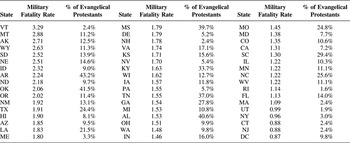
The key independent variable is the Iraq War military fatality rate for each state and the District of Columbia. The Iraq War military fatality rate variable was operationalized as the number of Iraq War military fatalities during the period from the start of the war on March 20, 2003 through the day before the 2008 presidential election, November 3, 2008 for each state and the District of Columbia (icasualties.org 2008) per 100,000 residents. The rate of Iraq War military fatalities varied greatly. Vermont, Montana, Alaska, Wyoming, South Dakota, and Nebraska, for example, all had Iraq War military fatality rates above 2.5 per hundred thousand state residents for the period from the start of the war to the 2008 presidential election. But New Jersey, Connecticut, New York, Utah, Massachusetts, and Florida all had military fatality rates below 1.15.
A second key independent variable capturing the salient element of religious culture is the percent of a state's population who were evangelical Protestants. Percent evangelical Protestants was operationalized as the percent of a state's population that were identified as adherents of evangelical Protestant churches (Glenmary Research Center 2002). Table 1 displays Iraq War military fatality rates for each state and the District of Colombia through November 3, 2008 and each state's and the District of Colombia's population that is evangelical Protestant. The correlation between these two variables is 0.12.
State Rates of Iraq War Military Fatalities from March 20, 2003 through November 3, 2008 and Percent of State Population Evangelical Protestants

A number of other explanatory variables were used in the analyses. Given Obama's popularity with highly educated voters, the percent of each state's population with a four year college degree or a higher level of education (U.S. Bureau of the Census 2000) was included as an independent variable in the analyses. We also included the state unemployment rate for the month of October, 2008 (CNNMoney.com 2008). Other independent variables included in the regression analyses are percent of population that is African-American, percent Hispanic, and dummy variables for census regions.
RESULTS
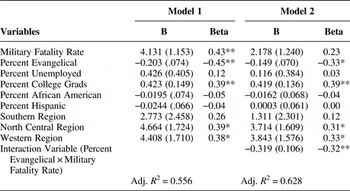
The results indicate that, controlling for the other independent variables, the state level of Iraq War military fatalities rate had a significant and positive effect on the difference in the percent of the vote received by the 2008 and 2000 Democratic presidential candidates as shown in Table 2, Model 1. As expected, a greater fatality rate boosted the vote share of Obama relative to Gore's share. The adjusted R 2 is 0.556.
Multivariate Ordinary Least Squares Regression of the Difference in the State Percent Vote for Obama in the 2008 Election and the State Percent Vote for Gore in the 2000 Election on the State Rate of Iraq War Military Fatalities and Other Variables

N = 51 *p < 0.05, **p < 0.01. (Standard errors in parentheses).
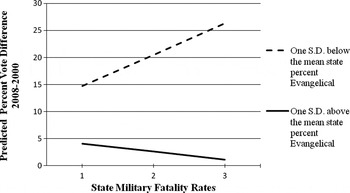
To address the second research question, we created a multiplicative interaction variable, Military Fatality Rate × Percent Evangelicals, which was included in a second regression along with all the other independent variables. The results are reported in Table 2, Model 2. The adjusted R 2 is 0.628. The findings show that the interaction variable had a statically significant negative relationship with the dependent variable. The positive effect of the state Iraq War military fatality rate on the 2008–2000 difference in the vote for the Democratic presidential candidate was stronger in states with lower percentages of the state population who were evangelical Protestants. That is, the fatality rate only boosted Obama's relative vote share in low-evangelical states and the effect reverses in high evangelical states.
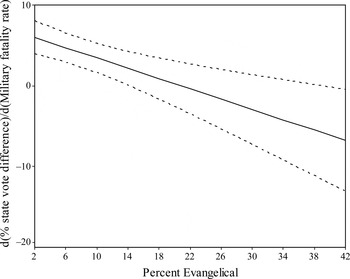
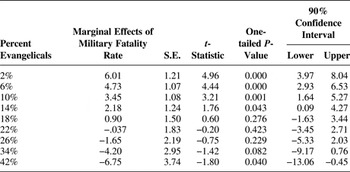
Table 3 presents the marginal effects of the Iraq War military fatality rate on the 2008–2000 difference in the percent vote for the Democratic presidential candidate at different levels of state percent of evangelical Protestants. As shown in Table 3, for the states that are below about 19 percent of their populations composed of evangelical Protestants, which are the majority of states, the marginal effect of the Iraq War military fatality rate is positive. But at about 20 percent evangelical Protestant, the effect of the military fatality rate becomes negative and then the negative effect grows in magnitude as the percent evangelical increases. Figure 1 provides a graphical display of the change in the marginal effect of the military fatality rate at differing levels of percent evangelical. The chart also shows the 90 percent confidence interval for the estimates of the marginal effect of the military fatality rate at different levels of percent of state population evangelical (Kam and Franzese Reference Kam and Franzese2007).
Marginal Effects Of Military Fatlity Rate, With 90 Percent Confidence Interval.

Marginal Effects of the Military Fatality Rate on the Percent Vote Difference for the Democratic Presidential Candidate between the 2008 and 2000 Elections at Different Levels of State Percent Evangelicals

Figure 2 shows how the predicted difference in the percent vote for the Democratic presidential candidate between the 2000 and 2008 elections changes as the Iraq War military fatality rate varies at two different levels of percent of state population composed of evangelical Protestants. The mean and standard deviation for state percent evangelicals are 14.4 percent and 11.4 percent, respectively. The dashed line sloping upward represents the effect of the military fatality rate in states with about 3 percent of their populations composed of evangelicals (one standard deviation below the mean percent evangelical for all states). The solid line sloping downward represents the effect for states with about 26 percent of their populations composed of evangelical Protestants (one standard deviation above the mean percent evangelical). The figure confirms that Obama's relative vote share only climbs in low evangelical states.
Predicted percent state vote difference for the democratic presidential candidate between the 2008 and 2000 elections.

DISCUSSION
Previous multivariate analyses of the relationship of military fatality rates to elections during time of war have yielded results showing that, everything else being equal, the higher the military fatality rates within congressional districts or states, the higher the percent of votes within those voting districts for candidates opposing the war. These findings are consistent with the hypothesis derived from rational political theory that the higher the human costs of war, the less the support for war and for political figures who support war. While these voting district studies have produced results supportive of the rational political theory hypothesis in the contexts of several wars, none have controlled for differences in voting districts' religious culture or examined how variations in religious culture might condition the effect of military fatalities on elections.
Our initial regression result showed that, even after controlling for the percent of population composed of evangelical Protestants, the state level Iraq War military fatality rate had a positive statistically significant effect on the difference between the state percent of the vote for the Democratic anti-war presidential candidate Obama in 2008 and the pre-war Democratic presidential candidate Gore in 2000. This result in itself appears to reinforce the rational political theory hypothesis. In the current study, however, we tested for whether the percent of a state's population composed of evangelical Protestants conditioned the effect of the Iraq War military fatality rate. The results indicate that significant interaction occurred between the percent of a state's population composed of evangelical Protestants and the military fatality rate variable. The interaction effect indicated that the state rate of Iraq War military fatalities had a stronger positive effect on the 2008–2000 difference in the percent vote for the Democratic presidential candidate in states with relatively low percentages of their populations composed of evangelical Protestants. Furthermore, the findings indicated that in states with very high percentages of their populations composed of evangelical Protestants, the Iraq War military fatality rate actually had a negative effect on the dependent variable. How can we interpret this result? Why should states with a strong evangelical religious culture react politically to high military fatality rates so differently than other states?
The answer most likely can be found in two of the central tenets of evangelical Christianity. The first is the belief that Christians have a sacred responsibility to spread their faith and, in so doing, bring salvation to other people. The second is the evangelical focus on the crucial role of the martyrdom of Jesus Christ as the only way that humanity could experience the forgiveness of sins and achieve eternal salvation. Through this cultural outlook, the Iraq War could be interpreted as a means to open Iraq and the entire Middle East to evangelical missionary work and mass conversion to Christianity. And in this context, American soldiers killed in the war can be viewed as martyrs, reflecting the sacrifice of Christ, to the mission of bringing salvation to the Iraqi people. As seen from such a vantage point, the greater the loss of U.S. soldiers, the more intense the commitment to fulfilling the purpose of their sacrifice by supporting the pro-war Republican candidate McCain rather than the anti-war Democrat Obama.
Under Saddam Hussein's government, Christian evangelical churches were illegal, although non-evangelical Iraqi Christians were allowed to practice their faith (Duhigg Reference Duhigg2004). Christian evangelism was also illegal in a number of other Middle Eastern nations. The invasion of Iraq and its occupation by U.S. troops opened the door for American evangelists' missionary efforts. As John Green, a political science professor at the University of Akron who is an expert on religion and politics, noted, “Many evangelicals feel war in Iraq is part of a broader religious mission” (Duhigg Reference Duhigg2004). Success in evangelizing Iraq could create tens of thousands of Iraqi evangelical Christians, many of whom could then enter other Arab nations and discreetly or otherwise engage in new missionary activity. Evangelical Christian leaders appeared relatively unique among American religious leaders in linking success in the Iraq War to expanding opportunities for missionary work.
The findings of the current study have research, theoretical, and political implications. First, although several studies at the voting district level have yielded results indicating that wartime military fatality rates have a positive relationship to the vote for anti-war candidates, virtually none controlled for politically relevant variations in culture among voting districts. Given the results shown here, future studies of this type should explore the effects that local culture can have.
The results of the study showing that the Iraq War military fatality rate did not have a positive effect on the 2008–2000 difference in the vote for the Democratic presidential candidate in states with very high proportions of evangelical Protestants suggests that this type of local religious culture qualified the assumptions made by rational political theory. Whereas rational political theory holds that military fatalities are uniformly viewed as costs of war which, as they mount, lead to a higher percent state vote for an anti-war candidate, the findings here indicate that the local religious cultural context can nullify this hypothesis. Rational theory must take into account morally potent aspects of local culture that have the capacity to undermine its basic assumptions.
The findings also have political implications. The results show that the military fatality rate had large effects only in certain groups of states. There was a strong positive effect on the difference in the percent vote for the successful 2008 Democratic presidential candidate Obama and the unsuccessful 2000 Democratic presidential candidate Gore in states with very low percentages of their populations composed of evangelical Protestants, almost all of which tend to go Democratic in presidential elections whether or not the U.S. is involved in a war. And as noted in the results section above, the military fatality rate had a negative effect in states with very high percentages of their populations composed of evangelical Protestants which virtually always go Republican in presidential elections. What appeared to happen in 2008 was that the effect of Iraq War military fatalities was primarily to change the percent vote for the Democratic presidential candidate in already securely Democratic or Republican leaning states. However, in a number of “swing states” with below average percentages of their populations composed of evangelical Protestants, such as Colorado, Indiana, Iowa, Ohio, New Hampshire, Pennsylvania, and Wisconsin, the Iraq War military fatality rate effect may have contributed to Obama's victory. Future research of this type should incorporate an indicator of the religious culture of voting districts into analyses.
Voting district level studies, however, cannot by themselves provide a complete description of how local religious culture conditions the impact of war fatalities on election results. To further explore this topic, future studies might employ a hierarchical design which would allow for the assessment of religious and war fatalities contextual effects on individual voting behavior.