Most people have to face adverse situations during their lifetime experiencing negative emotions of great intensity such as anxiety, depression, suffering or guilt (e.g., Cardenal, Ortiz-Tallo, Martín Frías, & Martínez Lozano, 2008; Limonero, Tomás-Sábado, Fernández-Castro, Gómez-Romero, & Aradilla-Herrero, Reference Limonero, Tomás-Sábado, Fernández-Castro, Gómez-Romero and Aradilla-Herrero2012; Sojo & Guarino, Reference Sojo and Guarino2011). In many cases, the intensity of these emotions gradually decrease with time by adapting to the new reality such as may happen with the loss of a loved one (Limonero & Gómez-Romero, Reference Limonero, Gómez-Romero and Nomen2012), whereas in other cases the traumatic experience can be so intense that its sequelae can be with them for the rest of their lives (Echeburúa & Corral, Reference Echeburúa and Corral2007; Echeburúa, Corral, & Amor, Reference Echeburúa, Corral and Amor2002). At the other extreme, there are people whose traumatic experience leads to personal growth that allows their lives to acquire a new direction, and they are able to confront the new reality with a greater guarantee of success (Vázquez, Castilla, & Hervás, Reference Vázquez, Castilla, Hervás and Fernández-Abascal2009).
It is in this context of overcoming adversities where the construct of resilience emerges. Resilience is that capacity to get over the adversity, to recover and come out stronger, despite being exposed to a highly stressing psychosocial event (Forés & Granés, Reference Forés and Granés2008; Rutter, Reference Rutter1999). Manciaux, Vanistendael, Lecomte, and Cyrulnik (Reference Manciaux, Vanistendael, Lecomte, Cyrulnik and Manciaux2003) highlight the ability of a person or a group to continue planning for the future despite destabilizing events and traumatic situations, whereas Bonanno et al. (Reference Bonanno, Wortman, Lehman, Tweed, Haring, Sonnega and Nesse2002) state that resilience should include two aspects: coping with the event and getting over it.
According to Luthar and Cicchetti (Reference Luthar and Cicchetti2000), resilience can be conceptualized as a dynamic process where individuals adapt positively despite the adversity or trauma that they experience. Resilient coping involves a form of confronting adversity that encourages the use of cognitive and behavioral strategies (Sinclair & Wallston, Reference Sinclair and Wallston2004). According to these authors, people with a resilient confrontation pattern will tend to use a cognitive re-assessment of the situation and the active solution of problems more often. There has been an increased growth in the scientific study of resilience in the last ten years or so, that has been in parallel with construction of various measurement scales (Ahern, Kiehl, Lou Sole, & Byers, 2006; Kramer, Seedat, Lazarus, & Suffla, Reference Kramer, Seedat, Lazarus and Suffla2011) aimed at adolescents, as well as adults, mainly through self-report measurements. The number of items that these scales contain varies widely, between four items (the Brief Resilient Coping Scale; Sinclair & Wallston, Reference Sinclair and Wallston2004) and 37 items (the Resilience Scale for Adults; Friborg, Hjemdal, Rosenvinge, & Martinussen, Reference Friborg, Hjemdal, Rosenvinge and Martinussen2003).
Among the short versions of resilience self-report scales that have been developed, we are highlighting the Brief Resilient Coping Scale (BRCS) developed by Sinclair and Wallston (Reference Sinclair and Wallston2004) which reflects the influence of the model by Polk (Reference Polk1997) on conceptualizing resilient coping behavior as a tendency to effectively use cognitive appraisal skills in a flexible, committed approach to active problem solving, despite stressful circumstances. In its first form, the authors constructed a scale that contained nine items associated with tenacity, optimism, creativity, an aggressive approach to problem solving, and a commitment to extract positive growth from difficult situations. The scale was tested on a sample of rheumatoid arthritis patients in the US. After performing a refined psychometric analysis of this nine item version, the authors selected the four items that finally made up this scale. Tomás, Meléndez, Sancho, & Mayordomo (Reference Tomás, Meléndez, Sancho and Mayordomo2012) have adapted this scale in an elderly Spanish sample and have shown strong correlations with measures of personal coping resources (e.g., optimism, helplessness, self-efficacy), pain-coping behaviors, and psychological well-being. According to the original authors of the scale, individuals who endorse these four items would be expected to be more goal directed, believe in their ability to address adverse situations, and usually succeed in their selected challenges (Sinclair & Wallston, Reference Sinclair and Wallston2004). In fact, Limonero et al. (Reference Limonero, Tomás-Sábado, Fernández-Castro, Gómez-Romero and Aradilla-Herrero2012) have observed in young people that those with high scores on BRCS had higher levels of emotional regulation and better life satisfaction levels.
The aim of the present study was to provide evidence of validity of the Brief Resilient Coping Scale for use in a young Spanish population.
Method
Participants
A convenience sample of 365 psychology undergraduates was recruited. Of these, 362 students returned properly completed questionnaires. The three students who failed to return the questionnaires, or did so without completing them, were excluded from the study. Ages ranged from 18 to 22 years, and the mean age of male subjects (n = 75) was 19.7 (SD = 3.4) years, while that of the females (n = 287) was 19.8 (SD = 2.5).
Instruments
The subjects responded to an anonymous and self-administered questionnaire that, in addition to data regarding their gender and age, comprised the following tools.
The Brief Resilient Coping Scale
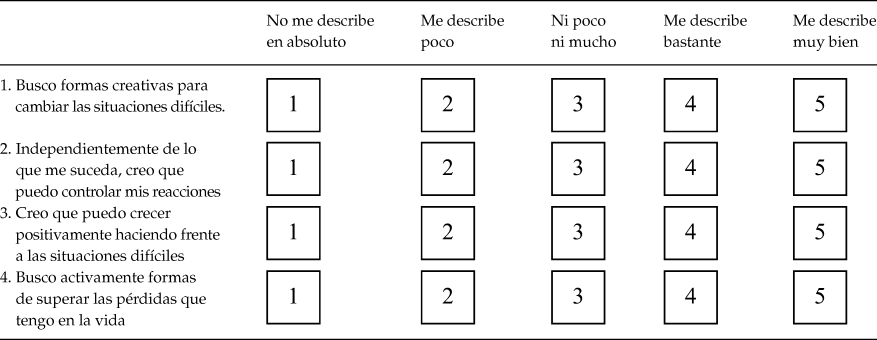
(BRCS, Sinclair & Wallston, 2004). The original English version of the BRCS has four items designed to capture tendencies to cope with stress in a highly adaptive manner. The items (see Table 1 for English wording) have a response format with five options, where ‘1’ means the statement “does not describe you at all” and ‘5’ means “it describes you very well.” The total score could range from 4 to 20, with higher scores denoting greater resilient coping. The BRCS had internal consistency reliability, estimated by Cronbach’s alpha coefficient, of .68, and test-retest reliability of .71, and was significantly correlated with measures of personal coping resources, pain coping behaviors and psychological well-being demonstrating its validity. Furthermore the authors demonstrated the predictive validity of BRCS using Lazarus and Folkman’s (Reference Lazarus and Folkman1984) stress and coping model to demonstrate that resilient coping behavior would affect psychological and physical outcomes (Sinclair & Wallston, Reference Sinclair and Wallston2004). For the current study, the Spanish form of the BRCS (see Appendix) was obtained by using a translation/back-translation procedure, as recommended by the Scientific Advisory Committee of the Medical Outcomes Trust (2002). Starting from the original English version of the BRCS, two Spanish translators with Ph.D. in psychology produced independent translations of the scale, which were then condensed by consensus into a single version. This Spanish version was then back-translated by a bilingual native English translator without knowledge of the original English version. The authors compared the back-translation with the original, classifying the conceptual and semantic equivalence and making any necessary adjustments in order to improve the match.
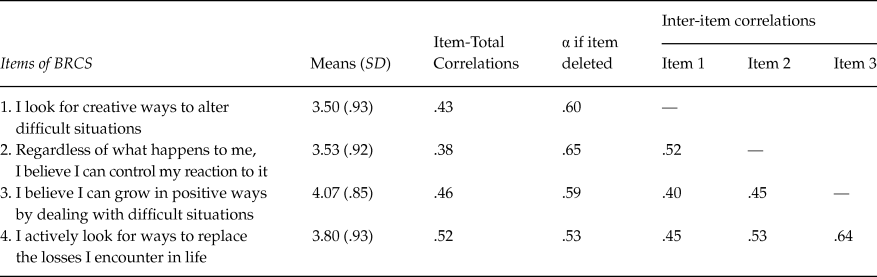
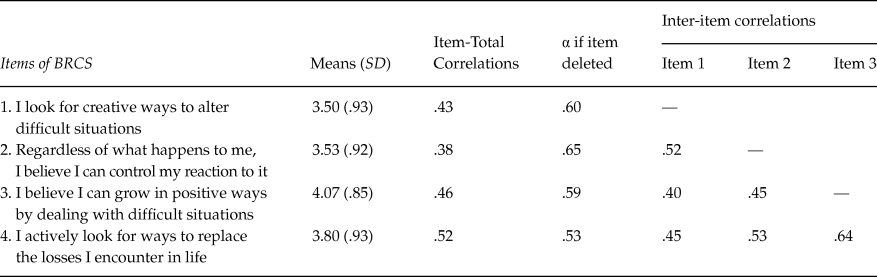
BRCS Items, descriptive statistics, item-total correlation, Cronbach’s alpha if item is deleted and inter-item correlations
Note:
SD = Standard deviation; all correlations p < .01.
The Personal Perceived Competence Scale
(PPC, Wallston, 1992). The PPC comprises eight items which are responded to using a six-point Likert scale, ranging from ‘1’ = “strongly disagree” to ‘6’ = “strongly agree.” Four items are written in a positive manner and four in a negative manner. The negative items scores were reverse-coded. Possible total scores, therefore, range between 8 and 48, and a higher score means high personal perceived competence. The internal consistency reliability of the PPC in the present study estimated by Cronbach’s alpha coefficient was .83. In this study we used the Spanish adaptation of the PPC (Fernández-Castro, Álvarez, Blasco, Doval, & Sanz, Reference Fernández-Castro, Alvarez, Blasco, Doval and Sanz1998) that has shown good properties.
Satisfaction with Life Scale
(SWLS, Diener, Emmons, Larsen, & Griffin, 1985). The SWLS consists of statements relating to overall life to which participants responded on a seven point scale: ‘1’ = “strongly disagree” to ‘7’ = “strongly agree.” A total score is calculated, with higher scores indicating greater satisfaction with life. We used the Spanish version adapted by Atienza, Pons, Balaguer, & García-Merita (2003). The Cronbach’s alpha of the present sample was .84.
The Revised Life Orientation Test
(LOT-R, Scheier, Carver, & Bridges, 1994). The LOT-R is a self-administered tool that was developed to assess individual differences in generalized optimism. It contains six scored items plus four filler items. Three of the scored items are framed in positive terms and the other three are written in negative manner. The negative items scores were reverse-coded. Items are scored on a five-point Likert scale, ranging from ‘1’ = “strongly disagree” to ‘5’ = “strongly agree.” The filler items are not scored. In this sample, the questionnaire yielded a Cronbach’s alpha coefficient of .78. We used the Spanish version of LOT-R adapted by Ferrando, Chico, and Tous (Reference Ferrando, Chico and Tous2002).
The Zung Self-Rating Depression Scale
(ZSDS, Zung, 1965).The ZSDS is a self-administered tool containing twenty statements related to depression. Half the items are framed in positive terms and the other half in negative terms. Items are scored on a four-point response scale, ranging from ‘1’ = “rarely or never” to ‘4’ = “almost all of the time or always.” The negative items scores were reverse-coded. In this study we used the Spanish form of the ZSDS (Conde & Franch, Reference Conde and Franch1984). The internal consistency reliability obtained by Cronbach’s alpha in the present study was .76
The Positive and Negative Affect Schedule
(PANAS, Watson, Clark, & Tellegen, 1988). This is a 20-item self-administered tool assessing positive affect (PA) and negative affect (NA), with ten items assessing PA and ten items assessing NA. Respondents are asked to rate how they generally feel for each item on a 5-point response scale ranging from ‘1’ = “very slightly” to ‘5’ = “extremely.” Scores on the ten positive emotion items are summed to indicate the general level of PA of the participant, while scores on the ten negative emotion items are summed to indicate the participant’s general level of NA. The PANAS has good psychometric properties in terms of reliability and validity (Watson et al., Reference Watson, Clark and Tellegen1988). In our study, we used the validated Spanish version of the PANAS (Sandín et al., Reference Sandín, Chorot, Lostao, Joiner, Santed and Valiente1999). The alpha coefficients for the negative and positive affect scales were .84 and .87, respectively, in our sample.
The Kuwait University Anxiety Scale
(KUAS, Abdel-Khalek, 2000). The KUAS is comprised of twenty items scored on a four-point Likert scale from ‘1’ = “rarely” to ‘4’ = “always” Possible total scores therefore range between 20 and 80, and the higher the score the greater the level of anxiety. ) The Spanish form of this measure (Abdel-Khalek, Tomás-Sábado, & Gómez-Benito, Reference Abdel-Khalek, Tomás-Sábado and Gómez-Benito2004) was used in this study, and had a Cronbach’s alpha of .91.
The Coping Strategies Inventory
(CSI, Tobin, Holroyd, Reynolds, & Kigal, 1989). This scale is made up of a 40-item self-administered list of coping strategies structured in eight dimensions: self-criticism, problem solving, cognitive restructuring, emotional expression, social support, wishful thinking, social isolation, and avoiding problems. Items are scored on a five point response scale, ranging from ‘0’ (“not at all”) to ‘5’ (“completely”). Each dimension is comprised of five items. The sum of the items within each dimension gives a total score for that dimension. We used the Spanish version of CSI adapted by Cano, Rodríguez, and García (2007). The Cronbach’s alpha in our study for each dimension ranged from .65 to .90.
Procedure and Data Analysis
All the students who responded to the questionnaire did so freely and voluntarily and were informed by the researchers that all the data gathered would remain anonymous and confidential. Permission was sought from the authors of the original scales regarding their use in the study.
The data were tabulated and analyzed using SPSS v. 18.0. The internal consistency reliability was evaluated by Cronbach’s alpha coefficient and also by the composite reliability index in the case of BRCS. In order to assess the temporal stability of the Spanish version of the BRCS, it was subsequently administered to a random sub-sample of 68 students, with a test-retest interval of six weeks. Additionally, EQS 6.1 (Structural Equation modeling Software; Bentler & Wu, Reference Bentler and Wu2002) was used for the analysis of the structure of the BRCS through a confirmatory factor analysis (CFA).
To assist in the decision on what estimation methods are more appropriated, we used Mardia coefficient to measure multivariate normality (Tomás & Oliver, Reference Tomás and Oliver1998). Since the value of Mardia coefficient obtained indicates that the data had a multivariate normal distribution, the CFA parameters were estimated using the Maximum Likelihood (ML) method. The following six goodness of fit indicators were used: (1) χ2 statistic; (2) Bentler comparative fit index (CFI); (3) the goodness-of-fit index (GFI); (4) the standardized root mean square residual (SRMR); (5) the root mean squared error of approximation (RMSEA); and (6) the non-normed fit index (NNFI). For there to be a good fit, χ2 had to be not significant, the CFI and GFI values should be around .90 (the higher the value, the better the fit), and the SRMR and RMSEA should be ≤ .05 (the lower the value, the better the fit), and the NNFI greater than .95 (Batista-Foguet, Coenders, & Jordi Alonso, 2004).
Results
Reliability testing
We assessed internal consistency reliability of the BRCS using Cronbach’s alpha and the composite reliability index, Cronbach’s alpha coefficient was .67 and the composite reliability index had a value of .70. A Pearson correlation calculated to assess the temporal stability (test-retest reliability) of the Spanish BRCS over 6 weeks yielded a value of .69 (p < .01). In our scale analysis to obtain Cronbach’s alpha, the item-total correlations ranged from .38 to .52. If we deleted any of the four items, it would cause a decrease in the alpha value, which highlights the importance of all four items for the scale’s reliability. Descriptive statistics of the scale are presented in Table 1.
Confirmatory Factor Analysis
A CFA of the BRCS items was conducted to ratify the supposition that a single latent factor (resilient coping) was responsible for the variance and covariance among the four items. The value of Mardia coefficient was 4.45 indicating that the data had a multivariate normal distribution. The values of the indices of fit obtained were: the χ2 was 3.04 with 2 degrees of freedom (p =. 21); the CFI was .99; GFI was .99; the NNFI was .98; SRMR was .01 and RMSEA was .04. [90% CI = (.00 – .11)]. All rates are in the recommended range, indicating a very good fit of the measurement model to the data (Brown, Reference Brown2006; Hoyle, Reference Hoyle1995).
The standardized factor loadings for the resilient coping factor were within a minimum of .44 (item 2, “Regardless of what happens to me, I believe I can control my reaction to it”) and a maximum of .71 (item 4, “I actively look for ways to replace the losses I encounter in life”). Standardized factor loadings were all statistically significant (p < .05), giving support to the adequacy of the one-factor model and are indicative of an adequate consistency.
Criterion-related validity
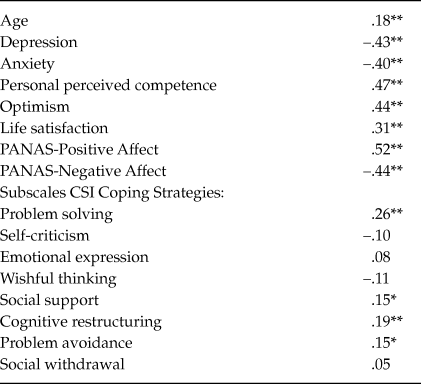
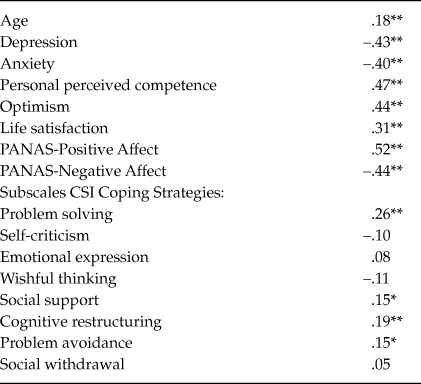
Criterion-related validity of the BRCS was established by correlating resilient coping with other psychological constructs related to resilience as measures of personal coping resources and psychological wellbeing: PPC, SWLS, LOT-R, PANAS, and some dimensions of Coping Strategies Inventory (CSI). It was hypothesized that BRCS would be positively associated with PPC, SWLS, optimism (Lot-R), the positive affect (PA) subscale of the PANAS, and adaptive coping strategies (from the CSI). Table 2 shows Pearson correlations between the BRCS and these measures. We observed positive correlations between the BRCS and the PPC, the SWLS, the PA subscale of the PANAS, the LOT-R, and two dimension of CSI: problem solving and positive restructuring. Conversely, the BRCS should theoretically be negatively related with negative emotions/affect and maladaptive coping as operationalized by KUAS, ZSDS, the NA subscale of the PANAS, and some of the dimensions of the CSI. We observed significant correlations between the BRCS and all three of the measures of negative emotions/affect, but the BRCS was not significantly correlated with wishful thinking, self-criticism or social withdrawal (Table 2).
Pearson correlations between BRSC and the variables of the study
* p < .05; **p < .01.
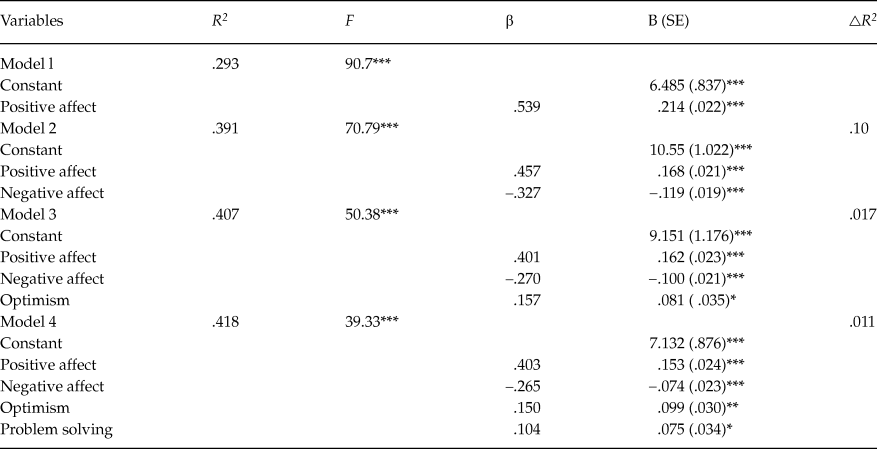
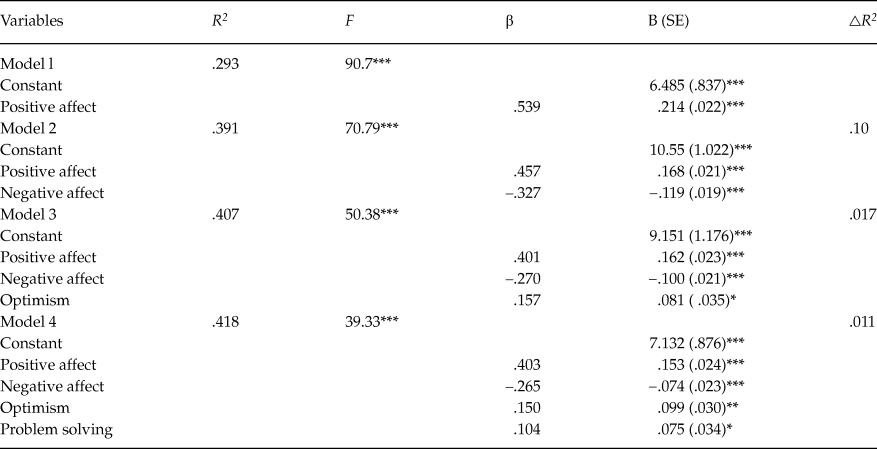
In order to know the contribution of these variables to the variance of the variable resilience measured by BRCS, a multiple regression analysis with stepwise method was conducted. The results of this analysis showed that positive affect was the most influential variable in predicting resilience offering to the model a coefficient of determination of .29. The addition of negative affect increased the explanatory value of the model by 10%. The addition of the two remaining variables, optimism and problem solving (from the CSI), increased the variance explained by the model by 1.7% and 1.1%, respectively. Together these four variables explained 41.8 of the variance of the BRCS (Table 3).
Multiple linear regression analysis by the method stepwise, with variable BRCS as dependent variable, and positive and negative affect, optimism and problem solving as independent variables
* p < .05; **p <.01; ***p <. 001.
Discussion
Resilience is a complex psychological phenomenon related to the capacity to face stressful or traumatic events and the ability that allows a person to reduce or overcome these events (Dyer & McGuinness, Reference Dyer and McGuinness1996). Resilience is an important process that operates across the lifecycle of the people that are faced with situations of high emotional impact (Bonanno, Reference Bonanno2005). Most studies are focused in children or in older people and few have been conducted with young people. The aim of the present study was to provide evidence of validity of the Brief Resilient Coping Scale for use in a young Spanish population.
As the original authors of the scale have pointed out, the BRCS is a short, four-item scale that describes an effective, active problem-solving coping pattern that reflects the resilient coping patterns discussed in the literature, specifically the attributes described by Polk (Reference Polk1997) as situational patterns associated with resilience (Sinclair & Wallston, Reference Sinclair and Wallston2004).
The analysis of internal consistency reliability estimated by means of Cronbach’s alpha coefficient yielded a value of .67 that is very similar to the alpha value obtained by Sinclair and Wallston in the original English version (.70). The test-retest coefficient over six weeks obtained here was also similar to that reported by the original authors of scale, thereby providing evidence that the Spanish form of the BRCS shows adequate temporal stability.
The fact that BRCS is a very short tool with only four items is a great advantage to those who wish to administer it multiple times longitudinally, although this same aspect (brevity) can lower the internal consistency reliability of scale. Nonetheless, the BRCS has sufficient internal consistency reliability and stability for a four-item scale (Shelley, Reference Shelley1984). In fact, Tomás et al. (Reference Tomás, Meléndez, Sancho and Mayordomo2012) obtained in an elderly Spanish sample adequate properties of this scale that were even better than the original scale.
As did Tomás et al. (Reference Tomás, Meléndez, Sancho and Mayordomo2012), we analyzed the BRCS items using a confirmatory factor analysis to determine whether it comprises the single dimension as presented in the original work. All indices were in the recommended range, indicating an adequate fit of the unidimensional measurement model (Schumacker & Lomax, Reference Schumacker and Lomax2004). Tomás et al. also demonstrated similar findings.
As hypothesized, the results also confirm that the BRCS was positively and significantly correlated with measures of personal perceived competence, life satisfaction, optimism, positive affect, and all four adaptive coping strategies: problem solving, cognitive restructuring, seeking social support, and problem avoidance, while showing a negative and significant correlation with depression, anxiety, and negative affect. These correlations provide evidence of the criterion-related validity of the BRCS.
Resilient people would aim to believe in their own abilities in order to restore the adverse situations, something that would result in a greater sense of well-being, as has been observed in patients with chronic arthritis (Sinclair & Wallston, Reference Sinclair and Wallston2004) or in young people (Limonero et al., Reference Limonero, Tomás-Sábado, Fernández-Castro, Gómez-Romero and Aradilla-Herrero2012).
On the other hand, personal competence is related with less levels of anxiety and with better life satisfaction (Limonero, Tomás-Sábado, Fernández-Castro, Cladellas, & Gómez-Benito, Reference Limonero, Tomás-Sábado, Fernández-Castro, Cladellas and Gómez-Benito2010). In this sense, perceived competence in one’s own abilities could facilitate positive reappraisal of the stressful situation and therefore reduce its potential threat or aversiveness (Rueda & Pérez-García, Reference Rueda and Pérez-García2004).
In relation to positive affect, Fredrickson, Tugade, Waugh, and Larkin (Reference Fredrickson, Tugade, Waugh and Larkin2003) showed that positive emotions may also protect against stress, reducing the intensity of aversive events. In fact, individuals with higher levels of resilience have more positive affect and less negative affect (Liu, Wang, & Lü, Reference Liu, Wang and Lü2013). In the same way, optimism could operate by providing an enhanced sense of control over situations in one’s life (Chico, Reference Chico2002). In other words, people with high levels of optimism are more motivated to cope with stressful events, improving their coping strategies including reappraisal.
The positive correlations observed between resilient coping and life satisfaction, optimism, personal perceived competence and adaptive coping strategies and the results of the multiple regression analysis could support an argument that resilience is a positive dispositional trait, where individuals display a unique ability to react to stress in a proactive, adaptive way, across different situations (Nath & Pradhan, Reference Nath and Pradhan2012). In this sense, in our sample of young Spanish students, the emotional factor was the most important internal resiliency factor in the resilience-related processes to predict successful life adaptation (Kumpfer, Reference Kumpfer, Glantz and Johnston1999).
In general, the findings obtained in this study were consistent with findings published in other studies evaluating correlates of resilience (Jacelon, Reference Jacelon1997; Kaplan, Reference Kaplan, Glantz and Johnston1999) and resilient coping (Sinclair & Wallston, Reference Sinclair and Wallston2004; Tomás et al., Reference Tomás, Meléndez, Sancho and Mayordomo2012). Somewhat surprisingly, although the correlations with the wishful thinking and self-criticism dimensions of the CSI were in the expected negative direction, their values did not reach statistical significance, so further work needs to be done to see if the Spanish BRCS is predictive of maladaptive coping.
The main advantage of the BRCS compared to other tools is that it is simple, reliable, understandable, and does not constitute an extra burden to the subject. In particular, the brevity of the BRCS may be very useful with specific subjects, such as grieving people, cancer patients, or caregivers.
A limitation of the present study concerns the nature of the sample used. The fact that it was made up exclusively of university students, where female participants are dominant, limits the possibility of extrapolating the findings to other types of young adults. Another possible limitation is related to the fact that we have not evaluated our participants’ reactions to actual negative life events, but only the tendency of young adults having to face multiple stressors in their lives. Further research is therefore required to study the properties of the BRCS in both the general population and clinical samples, either cancer patients or those with chronic or degenerative disease. The authors are currently working on this aspect. Also, although this is indeed a Spanish version of the instrument, it is unknown whether further modifications would need to be made if it were to be used with other Spanish speaking samples.
Our findings, along with those of Tomás et al. (Reference Tomás, Meléndez, Sancho and Mayordomo2012), demonstrate that the Spanish form of the BRCS may be of considerable interest in the context of research into psychological factors related to those aspects that enable people to cope with stressful events. The BRCS may also be relevant in more applied settings, where it could be used to identify strengths and weaknesses in life areas - for example, in caregivers of dying patients-where the capability to adapt to this situation is a cornerstone of caring for the patient and could be helpful in the subsequent grieving process. As Limonero et al. (Reference Limonero, Tomás-Sábado, Fernández-Castro, Gómez-Romero and Aradilla-Herrero2012) pointed out, the resilient factor could mediate the regulatory process and coping strategies.
In summary, the results obtained demonstrate that the Spanish version of BRCS may be a useful tool for evaluating the resilient coping strategies in young. Given its brevity, it is possible to use it with many types of individuals, especially people with burdensome chronic illnesses when the BRCS could be used as a screening tool to detect vulnerable people and facilitate timely intervention.
Spanish form of Brief Resilient Coping Scale (BRCS)
A continuación encontrará una serie de afirmaciones que describen su comportamiento y acciones. Valore cada una de ellas en una escala de 1 a 5, marcando una X en el número que mejor refleje su comportamiento.