


INTRODUCTION
In January 1891, Portugal and its “ancient ally” Great Britain had reached an impasse regarding their mutually exclusive plans to occupy and colonize southern Africa. Great Britain forced the issue with the Portuguese, presenting an ultimatum to agree to British terms. The resulting loss of face and national prestige in Portugal led to riots against the government and even the monarchy itself, both popularly perceived as weak at a time of national crises.Footnote 1 While many Portuguese who favoured the establishment of a republic used this crisis to further their cause, the writings of a journalist (and later politician) provide a unique insight into the day-to-day workings of Portugal’s largest overseas prison. His experience (below) highlights the themes of penal reform, “development” and occupation of Portugal’s African colonies, and forced labour, which are the focus of this article. Convicts sent to Angola, such as Chagas, in the period up to 1900 formed two thirds of all whites in the colony, and, for the later period of 1902 to 1914, many more convicts entered Angola than free European colonizers.Footnote 2
JOÃO PINHEIRO CHAGAS – A UNIQUE SOURCE
João Pinheiro Chagas, a pro-republican journalist, wrote for several newspapers, including the (aptly named) A República Portuguesa. He was arrested for inciting an uprising in Porto in January 1891 against the British ultimatum and tepid response from the Lisbon authorities. Along with other conspirators, he was sentenced to six years in Portugal’s penal colony in Angola. João Chagas, a highly educated journalist, was no ordinary prisoner and his writings about his time in Angola are unique.Footnote 3
Convicted and sentenced, João was taken aboard the ship São Tomé, and after twenty-five days at sea he arrived at the port of Luanda. On this, his first time in Angola (see below), João was remanded to a secondary facility, a dependency in Mossamedes, further south on the Angolan coast. His one night in Luanda (they removed him overnight from the ship to prevent his escape) drew a scathing comment from him in his notes. “In this facility [speaking of the Depósito] one finds inept and impertinent staff which should not be allowed even in penal colonies because they are the worst of men and everything that is inferior in agents of authority.”Footnote 4 By the first of November that same year (1891), he had escaped from Mossamedes and made his way to Paris and eventually back to Portugal the next year. Apprehended a second time, he was again sent to Angola to complete his sentence. This second time, he would remain under closer watch in Luanda.
Once the ship arrived in Luanda, João Chagas, like so many prisoners before him, was taken to the prison overlooking the city, his name inscribed in the master register of prisoners, he was assigned a number and company, and issued the regulation indigo-coloured prison uniform, including boots, items made by the convicts within the confines of the Depósito. João had some disparaging comments about the uniform:
The cloth for the jacket does not appear to be measured correctly, and it closes across the chest with slender porous buttons made of bone, the type that are normally used for cloth made from raw cotton. At first glance, it appears to be a dish towel like those that appear on kitchen tables. Once you put it on, it has little shape, tight in the waist, loose in the shoulders with shoulder pads like those in soldiers’ uniforms. These are its best features. The pants are grotesque and make you laugh as if they were some child’s creation. They appear to be made in a girl’s school for teaching sewing.Footnote 5
This prison, the Depósito de Degredados, was established as an urban penal colony at the edge of Luanda (1866–1932), but it did not function with any regularity until its second or third administrative reorganization by 1885.Footnote 6 The fort had a long history of being used as a prison; in the eighteenth century, it had been the home for those sentenced to the galleys (public works). It had a parallel institution on the island of Mozambique, established at the same time. Both were administered by special units of the army and both operated under identical guidelines. The prison in Mozambique received inmates from Portugal as well as those sentenced by courts in Portuguese Asia (Portuguese India, Macau, and Timor). By the turn of the twentieth century, the two prisons also exchanged their local inmates; those from Mozambique were sent to Angola and vice versa, preventing any prisoner from having local connections. However, the prison in Mozambique was a much smaller operation than the Luanda Depósito, and it received approximately twelve to fifteen per cent or around 2,500 of the 16,000 to 20,000 prisoners sentenced to time in Portuguese Africa from the 1880s to 1932.Footnote 7
Orlando Ribeiro, Portugal’s outstanding historical-geographer of the twentieth century, described the Angola João Chagas must have experienced at the turn of the century:
The atmosphere of the colony was not attractive: a bad climate, dangerous diseases, a complex population, where on the one hand there was an elite mestiço element with which not all of the whites wanted to live, and on the other hand former convicts who after completing their sentences, some shortened by amnesties, had risen to social positions which those who were more scrupulous did not appreciate. Angola was the main locale for degredo: at the end of the nineteenth century, convicts represented twelve per cent of the white population, living in Luanda with a shocking liberty. Many owned restaurants.Footnote 8
Other travellers in the nineteenth century, including George Tams (writing in the middle of that century) and Mary Kingsley (observing Luanda in 1890s), were more generous in their descriptions of the city.Footnote 9 Kingsley felt Luanda was the only “real” city on the west and southern African coast, probably because Luanda had been founded and planned by Europeans. Thus, she would have felt it had a more familiar urban pattern than other African ports. What made Luanda (and Mozambique Island) unique was that they were both not just colonial capital cities, but also urban penal colonies.
The interlocking rationales in Lisbon for the creation of these two penal colonies are complex. The mid- to late nineteenth century saw the convergence of three (seemingly) unrelated issues in Portugal. The first of these was legal reform and new theories of the goals and methods of incarceration. The second issue was the European contest for colonies in Africa, a process commonly referred to as “New Imperialism”. Third was the gradual end of slavery in Angola and Mozambique and the consequent need for cheap labour.
During the nineteenth century, Portugal revisited and updated its archaic legal codes dating from the early 1600s, revising them several times in the 1860s and 1870s, reflecting changing ideas of punishment. Significantly for Angola and Mozambique, these codes linked the traditional Portuguese punishment of degredo (exile or banishment) with then current ideas of reforming the prisoner (i.e. penitence in the new Lisbon penitentiary) followed by forced labour performed in the colonies. Degredo, that is having one’s legal status “degraded” in the Portuguese legal tradition, meant being exiled for a specific period of time to some distant location. The distance from the sentencing court was determined by the nature of the crime: the more serious the offence, the more distant the location. This punishment dates from the Portuguese legal codes of the Middle Ages.
This linkage of an old punishment with a new objective was a sure-fire method to ensure the “effective occupation” demanded by the Treaty of Berlin in the division of most of Africa among various European powers. This second issue meant that these prisoners would first build the infrastructure needed in the colonies and ideally also become the colonizers, farmers, or settlers themselves. Their presence (so the government believed) would assist in the ongoing transition away from slavery in Portuguese Africa. While these three are the most important and relevant, there are additional aspects as well, such as a growing urban population in Portugal, the government wishing to encourage emigration to the colonies rather than to (now-independent) Brazil, ending vagrancy through forced colonial labour, the promise of extracting mineral wealth from Angola (and to a lesser extent Mozambique), and national pride in maintaining a global empire.
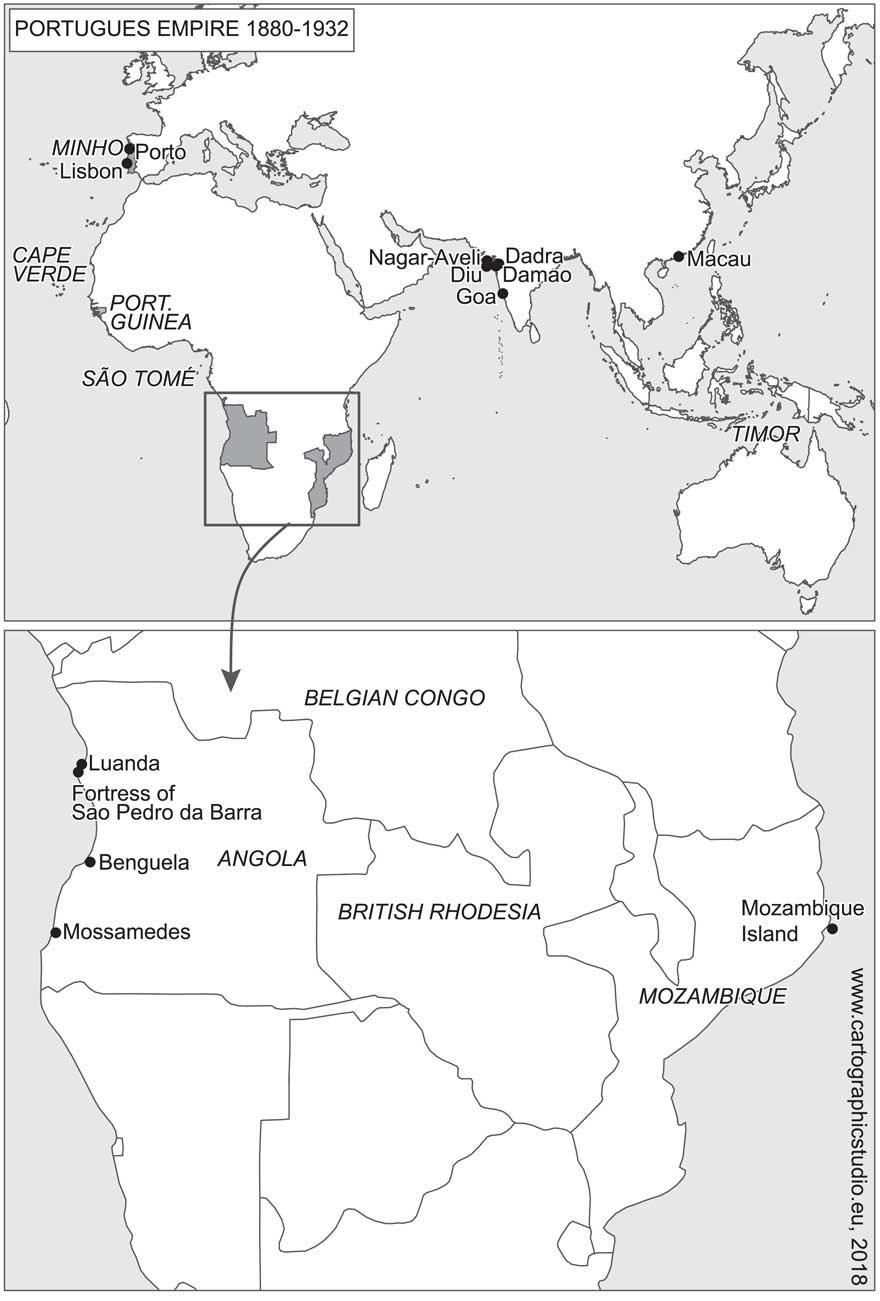
The Portuguese Empire 1880–1932, and the Depósito de Degredados in Luanda and its dependent facilities.
AN URBAN PENAL COLONY AND ITS INMATES
The typical penal colony in the nineteenth and twentieth centuries was located in a remote setting, often on an island far away from urban populations. Juan Fernández Island, used by the Chilean authorities, and Fernando de Noronha Island for Brazil are two such examples.Footnote 10 This is one of the many aspects that make these two Portuguese penal colonies distinctive: their urban locations in the capital cities of Portugal’s two largest and most promising African colonies. As noted above, the larger prison in Luanda accounted for the vast majority of prisoners sent to Africa, and the remainder of this essay will focus exclusively on it.Footnote 11
“Prison” is probably the wrong word to describe the Depósito de Degredados in Luanda, since a prison is a place from which prisoners cannot leave. However, in Luanda many convicts would daily come and go through the Depósito’s gates, working in the city of Luanda and returning at night. Others worked under military supervision in the interior of the country, far away from Luanda. Perhaps “Hub of Convict Activities” would be (an awkward but) a more accurate term.
Reflecting its military administration, prisoners in the Depósito were organized in five companies. The first two were for male prisoners from Portugal. The third was for male prisoners from the Atlantic colonies of Cape Verde, Portuguese Guinea, and São Tomé (as well as any foreigners).Footnote 12 Women composed the fourth company and male vagrants formed the fifth. As noted above with the case of João Chagas, the Depósito maintained dependent facilities in Mossamedes and Benguela, two coastal cities south of Luanda, for its first twenty years, closing Mossamedes in 1884 and Benguela in 1907.Footnote 13 The Depósito also administered a place of secondary punishment, the fortress of São Pedro da Barra in the Luanda harbour. In any given year, the Depósito might oversee more than 1,000 prisoners or as few as 400. The commander also had no way of knowing in advance how many convicts to expect with the arrival of each steamship or the lengths of their sentences. As a result, he had to be flexible and creative in assigning housing and work.
Typically, male prisoners were guilty of murder, theft, or assault, or a combination of these. Their sentences ranged from four to six years of degredo to Angola. Male prisoners formed between ninety and ninety-five per cent of the prison population and, again typically, were under forty and not married. Female inmates were a radically different group. Largely guilty of infanticide, theft, or murder, female prisoners had much longer sentences and their ages ranged more widely. The company of male vagrants came and went, depending on vagrancy laws at the time. The bulk of prisoners came from Portugal; more specifically, the city of Lisbon and the Minho, the densely populated far north of the country.
In addition to common criminals or degredados, there were several other categories of prisoner, each with a special label and all counted separately. Deportados were persons convicted of political crimes, such as João Chagas. This distinction was of sufficient importance that a police sergeant met João Chagas at the boat to accompany him to the Depósito, telling him he offered this courtesy “so that you do not have to walk with the levy of degredados”.Footnote 14 Vagrants or vadios were normally counted apart from the others. Their only crime was not working, and the state alternated between ignoring them or attempting to make them useful. In the period 1905 to 1914, the Depósito received 50 to 240 new vagrants annually, or a total of 1,155, all but fifteen of them men.Footnote 15 Vagrants were younger than convicts, with 49 per cent under the age of twenty-five, and 63 per cent under thirty. The vast majority were single (87 per cent) and illiterate (67 per cent), although 24 per cent were able to read and write. Most vagrants remained in the Depósito for sentences of four years or less, and their death rates were higher than any other group; 20 per cent died before completion of their sentences.Footnote 16 They were also a troublesome lot; 30–40 per cent of the entire group of vagrants faced disciplinary actions each year, mostly for attempting to avoid work.
Given their backgrounds of being homeless, none of these statements appears out of the ordinary. It would be logical to expect vagrants to be illiterate, in poor health, and idle. Attempts to control vagrancy in Portugal (a process begun as early as 1375) appeared in numerous pieces of nineteenth-century legislation. First were attempts to outlaw it (1835, 1836), control it, move vagrants to special asylums (1780, 1836, 1867), create special vagrant agricultural colonies (1894), impress vagrants into military service (in Cape Verde, 1877), banish them overseas, and, as a last resort, forbid them from returning to Portugal (1897). The Depósito was a sometimes-used tool in this much larger picture of attempted social control of vagrancy in Portugal, and its commander tells us clearly that, by 1915, Company 5 (vagrants) was almost extinct because “they are no longer sent here”.Footnote 17 We also know, because of the numerous complaints from those supervising them, that vagrants were the most problematic group within the Depósito. António Leite de Magalhães (a career military man who served in several colonies) provides a good example of this when he made a sharp distinction between convicts and vagrants: “Many times I had convicts under my command and to give them justice, I never had better or humbler workers. The incorrigibles were the vagrants.”Footnote 18 George Tams mentions one vagrant/criminal sent from Portugal to Angola who, “educated in the streets of his native city”, was able to acquire wealth and status in Luanda. How this occurred is a mystery, but profits from the (then ongoing) slave trade are the most probable source of his new-found wealth.Footnote 19
Addidos were recidivists, normally counted separately, but sometimes blended with degredados. They had more liberty than ordinary convicts and were sent to Angola only after committing a series of crimes, none of which alone would have triggered transportation. This provision in Portuguese law was undoubtedly modelled on a similar French provision, which banished recidivists to French Guiana.Footnote 20 The Portuguese were close students of both the French and British experiments with transportation and had nothing but admiration for what the British had achieved in Australia. The greatest differences, however, between British Australia and Portuguese Angola was that convict labour had real value (i.e. there was a demand) in the former and such a demand was absent in the latter. Angola had a very large native population, especially when contrasted to the number of native Australians. The Portuguese had the added advantage of hindsight in that the Australian experience was earlier (1788–1868) and had concluded by the time they established their two prisons in Africa.
Military deportees were present in large numbers in Angola, but they were sentenced and supervised by the military itself and do not make their way into documentation from the civil judicial system. It is quite possible that some of the personnel supervising the convicts were themselves military deportees, but there is no proof of that. We occasionally get glimpses into a convict/military connection that was surprisingly widespread, such as this comment from a Minister of the Colonies:
The colonies which up to that point [1843] had been a nest of slaves then became an exclusive nest of convicts. The detestable system of populating the African colonies with criminals produced, as its first result, the inability of the governors of each of the provinces to depend on the loyalty of the troops because they were largely composed of convicts.Footnote 21
Although referring to Portuguese Guinea, this statement applied equally to all of Portuguese Africa. Nor was this connection unique to Portugal; the French used their convicts in the military as well.Footnote 22
This link between degredados and the military in Angola was strong. Gerald Bender, in his fundamental work on the Portuguese in Angola, claims that they formed the majority of the military in the colony. However, it is not clear from his statement whether these were civilians impressed into military service or military personnel punished with degredo to Angola.Footnote 23 These troops “rarely amended their notorious behaviour [...] official missions into the interior to foment or protect the slave trade, collect taxes, or procure forced labourers often gave the degredado troops an open license to murder and plunder the African populations [...] this pattern continued throughout the century [...]”.Footnote 24 The police were equally riddled with degredados among their ranks and were noted for their corruption and incompetence.Footnote 25
CONVICT LABOUR
These prisoners were sent to Angola to redeem themselves through labour, and the state attempted a number of distinct schemes to extract and direct convict labour in the colony. First, perhaps the most privileged convicts were leased to individuals under a bond and worked anywhere in the colony. This option was available only to those who had completed at least one fifth of their sentences and were not recidivists. These individuals had to present themselves periodically before the local police authorities as a precaution against escape. In the 1901 listing (see below), only twenty-seven convicts were so licenced, but, of those, fourteen faced disciplinary charges. The bulk of the prison population worked either in Luanda for a municipal and state agency or in one of the workshops within the prison.
Escape into the interior of the colony was apparently a well-worn path for many convicts from Luanda, and as long as the Depósito functioned it would appear it produced escapees who made their way into the interior. This was especially true for the first half of the nineteenth century. Bender makes the point that “[t]he end of the slave trade forced most of the degredados out of the interior”.Footnote 26 Degredados had to survive by participating in the colonial workforce, and when the slave trade was one (if not the primary) economic activity in Angola it is not surprising to find degredados (and former degredados) supplying and supervising slaves.
The 1901 statistical summary for the colony includes a listing of the assignments for the 993 convicts assigned to the Depósito that year:Footnote 27 Fifty-seven were delegated to work with the troops in Benguela (building infrastructure?); twenty-four were being punished in the fortress of São Pedro da Barra, thirty-three were working for the telegraph company of Luanda; another thirty-four laboured for the town council of Luanda (cleaning streets?); twenty-seven worked at the army’s storage depot; twenty-two were in the hospital; and 127 were absent. While concentrated in Luanda, it is fair to say they worked throughout the colony as clerks, maids, and in many other positions. João Chagas makes the comment that, at the turn of the century, many convicts performed public works in pairs, chained together. The townspeople of Luanda complained that the sight of chained convicts coming and going through town was a disgrace. The Depósito stopped this practice as a result.
By 1915, the Depósito had added a third possibility for work when it created a series of workshops within its walls. The Depósito had already been making the uniforms and boots for its own convict population as well as for the military. New workshops were added to these tailors and cobblers to bind books, and make locks and items from tin; a carpentry shop was created and the inmates made bookcases, beds, and other pieces of furniture. The Depósito also created a barber’s workshop and a section for street sweepers. Female inmates worked in the tailor’s shop or in the laundry, the laundry reception area, washing, starching, and ironing clothes from the prison and from town. In short, the convicts performed a great variety of tasks under supervision, ranging from very light (when leased under bond) to constant (within the walls of the Depósito). The type of work they performed also varied greatly, from the hard labour of building docks to semi-skilled work in a prison shop or clerical desk work.
Some of these prisoners were paid, but the methods used to calculate their salaries were extremely complex and not totally clear. All prisoners paid at least twenty-five per cent of their salaries into an obligatory repatriation fund, and probably paid more into other obligatory funds supervised by the commander. Men working in one of the first eight workshops listed above received a wage based on the workshop’s monthly profit divided by the number of workers. Women were paid in a similar manner except that they were also subject to a behaviour classification system, which rewarded those who had not broken any of the rules.Footnote 28
THE PRISON AS A LOCAL INSTITUTION
The rationale for the creation of this prison is relatively clear when viewed from Lisbon and an imperial perspective. However, what impact did the Depósito have on Angola? What was the perspective when viewed from Luanda? Just about every author who visited Luanda during this period mentioned the presence of convicts in their distinctive uniforms throughout the city. Commentary came from a wide range of visitors to the colony, such as Protestant missionaries working in the interior of the country to Portuguese government officials conducting official business in Luanda. The fact that virtually every visitor to the colony mentioned them makes it all the more unusual that no one went beyond these comments to inquire as to their numbers, the organization of their labour, the goals of the Depósito, or the success or failure of this redemptive effort (to list but four possible questions). The colonial government itself vacillated between providing a great deal of data about the Depósito and its prisoners (such as the 1901 data or the 1915 published annual report) or offering little or nothing, such as details about its budget or expenses. We do know that during the early years of its organization in 1885, in a letter to the Lisbon authorities, the Financial Council of Angola stated that the expenses for the Depósito were ruinous, costing the colonial government over fifty thousand milréis (50,000$000) annually.Footnote 29 The Depósito and its inmates were, in fact, the proverbial elephant in the room. Everyone saw them, was aware of them, and yet avoided saying anything of consequence about them. Unfortunately, as a result of this avoidance, the impact of the convict presence in Angola is murky and becomes a matter of guesswork and assumption. Other than Bender’s work, there is no discussion of the prison in the secondary literature.Footnote 30 The documentation produced by the state itself does little to clarify the role or importance of the Depósito since its budget and expenses are blended with the total colonial military budget.Footnote 31
We know that supervision was relatively lax, which allowed for many convicts to escape from this system. We also know that convict mortality was relatively high, reflecting their difficult living and working conditions. A third method of escaping the prison system was by way of a pardon, and convicts were well aware of this possibility. The medieval and early modern Portuguese monarchs periodically issued pardons on special occasions, such as marriages or births of royal children. This practice continued after 1910 with the Republic; the President publishes a list of those fortunate convicts pardoned each 5 October, the anniversary of the Republic. While convicts did request pardons before 1910, the number and frequency accelerated after 1910, no doubt fuelled by the republican rhetoric of “equality, fraternity, liberty”. However, requesting a pardon was a tricky matter and required a scribe (since most prisoners were illiterate) and official paper with fiscal stamps. Thus, a prisoner would have had to pay to make such a request. By 1915, the prison commander had developed a standardized form for this purpose and these completed forms made their way through his office, to the military commander of Angola, to the governor, then to Lisbon for the attention of the Overseas Minister, the Minister of Justice, and finally to the President. This was obviously a slow and cumbersome process. In the turbulent and unstable years of Portugal’s First Republic (1910–1926), with numerous changes of government, it is not surprising that bundles of petitions sat unanswered at each stage of the process.Footnote 32
One such collection is a batch of sixty-eight petitions from 1915, frozen in the archives of the Ministry of Justice.Footnote 33 Since we know little about the individual convicts, these petitions offer welcome details. Of these, sixteen are from women and fifty-two are from men; women represented only five per cent of the prison population, so how do we explain the fact that their letters account for almost a quarter of the total? João Chagas tells us that female convicts in the 1890s believed a republic would be more merciful and grant more pardons.Footnote 34 Here, we see that female prisoners obviously had higher expectations of this process than their male counterparts.
These sixteen women were guilty of first degree murder (six cases), infanticide (five), poisoning (three), theft and murder (one), and simple theft (one). An equal number were married and unmarried (six each) and four were widows. This group is a good example of the characteristics of female convicts in general: their average age was thirty, the oldest was sixty, and the youngest eighteen, and all were from the north of Portugal. Some of them had very long sentences of more than twenty years in Angola, which had been shortened with previous commutations. With one exception, all appear to have been model prisoners with no disciplinary actions taken against them. The exception, Mathilde de Jesus, had violated prison rules three times with an insolent attitude, insulting guards.
The fifty-two men were more diverse in age and crimes committed. The oldest was sixty-three and the youngest was eighteen, with an average age of thirty-two. Almost all were from the north of Lisbon, about half were married (twenty-three), and they were overwhelmingly guilty of theft, murder, or attempted murder. Their sentences were typically time in prison (four to eight years), followed by transportation to Angola for years of work, typically eight to twenty. Several also had obligatory fines and many were not model prisoners; in some cases, the commander needed a second sheet of paper to list all their infractions. In both cases of male and female inmates, it would appear they were out of luck. Few, if any, received a pardon from the President of the Republic.Footnote 35
The Depósito was a major purchaser of foodstuffs for its population, so it is safe to say that merchants who supplied it with food had a large and steady customer. Two lists of purchases for food for the Depósito were uncovered in archives in Lisbon detailing purchases for August and September 1931. They show monthly purchases from ten individual providers of foodstuffs, plus purchases from the state’s bakery and butcher’s shop.Footnote 36 This would have been a very lucrative contract indeed, assuming prompt payment from the state. As early as 1915, the commander noted the rising costs of food and the difficulties of staying within his budget while also providing sufficient sustenance for his charges. The only other evidence that we have regarding the prisoners’ diet are the photographs from the published 1915 commander’s report, which shows rail-thin prisoners blankly staring at the camera, contrasted with a smiling and well-fed military administration. We also know from the commander’s published report that European and African prisoners were given two distinct sets of rations, yet the photographs of both groups show very thin men, in many cases with oversized uniforms hanging on them. Meanwhile, the officers appear to be a contented lot and are clearly better fed.
The prisoners – or at least some of them – were paid for their labour. On payday, another safe assumption is that those who were able to temporarily leave the Depósito for a visit to Luanda (and many were allowed this privilege) did so. The fact that so many inmates were listed as “absent” in 1901 (127 of 993, or almost thirteen per cent) underlines their relatively lax supervision in Luanda. The fact that none appear to have been pardoned partially explains their reasoning for running away. Of course, the simple fact that they had fled could have resulted in several outcomes. They could return, meet their deaths, continue living in the interior, or escape to another colony.
This payday and its impact would have meant that certain days of the month were probably not as safe as others for the citizens of Luanda to wander out in the streets, especially at night, and this would have been common knowledge among the townspeople. Not just the inmates, but the guards themselves (as well as all other military personnel) were paid, and payday for them would have been equally problematic in Luanda, given the large number of military stationed in the city. The town itself had a long-standing reputation as a rough place filled with convicts who were friends of drink. Alcohol in Angola has a long history among the European population as being indispensable for the tropics. It was the only item produced by a series of planned agricultural/settlement colonies during the nineteenth century that made a profit and it had long been a staple trade item in the slave trade itself, Brazilian rum being traded for African slaves. As a result, alcohol has a powerful and dark history in Angola associated with slavery and convict labour.Footnote 37 Bars, taverns, and restaurants, by association, were convict-friendly environments in Luanda and this would have been common knowledge among the locals as well. We know from the lists of infractions that many returned drunk or late. Other visitors commented that the bars and restaurants in Luanda were largely run by former convicts. As a result, there was obviously a large network of former and current inmates within Angola centred on these bars and taverns. It would have been there that current inmates would have been able to obtain the name of someone willing to provide a bond (for work outside the prison), send or receive correspondence from home (outside the scrutiny of the prison authorities), borrow money, learn the identity of sympathetic guards, or arrange an escape to the interior or neighbouring Belgian Congo or British Rhodesia.
Many of the inmates spent time recovering from illnesses in the Luanda hospital, and such medical expenses were substantial. George Tams visited the military hospital, where convicts were also treated, describing it as “showing signs of excessive economizing”. Soldiers treated there, he claimed, were “mostly criminals” who had received severe punishments of whippings.Footnote 38 In 1898, the hospital had 800 admissions from inmates during the year, in all likelihood not 800 separate individuals but times admitted. The governor of the colony complained in a letter to his superiors that each convict in the hospital cost the state 300 réis daily. Prisoners largely suffered from fevers and other symptoms of malaria, but gastrointestinal illness, anaemia, and bronchitis were also widespread.
In spite of the best efforts of the military authorities, supervision of the convict population was spotty at best and non-existent for many. Both of the sub-depositories in Mossamedes and Benguela were closed because adequate supervision was impossible, given the lack of funds and personnel. The result was that convicts roamed the streets of both towns and escaped into the interior. Convicts in the period up to 1900 formed two thirds of all whites in the Angolan colony, and for the later period of 1902 to 1914 many more convicts entered Angola than free European colonizers.Footnote 39 The reality on the ground in Luanda (and elsewhere throughout Angola) was that being a European meant that you could be assumed to be a convict or former convict; the terms were synonymous. This would continue until the post-World War II period, when Portugal had some success encouraging free immigration to both Angola and Mozambique. When one examines the overall demographic picture of Angola up to World War II, white “colonizers” were (largely) convicts or former convicts, and this would have been common knowledge to all Angolans as well as to people remaining in Portugal. This underlines the fact that Brazil was more attractive as an emigration destination for the Portuguese. It was not strictly for economic reasons; “Angola” meant “penal colony” for the white population.
RATIONALES FOR THE PRISON AND ITS END
Perhaps another way of examining this question is that we know that the anticipated outcomes from establishing the Depósito never materialized. The authorities in Lisbon wanted the convicts to marry, cultivate land, and produce children, to thus create a stable European presence in the colony. We know they did none of these things. Although the majority were not married, there is no evidence of convicts marrying each other or Africans in any significant numbers. Marriages between convicts were unlikely given the nature of their crimes: men were common criminals guilty of murder, theft, etc., while women were normally guilty of a one-time crime (today it might be called “a crime of passion”) – killing an unfaithful husband or boyfriend or ending the life of an unwanted baby. The state was eager to give or lease land to convicts to encourage commercial agriculture in the colony, yet there were fatal problems with this plan as well. Most of the convicts came from an urban setting and had no background or interest in farming. Quite the opposite. In nineteenth-century Portugal many single men left the countryside for the cities to escape a life of rural poverty working with their hands as a farmer. Why would they want to return to a farmer’s life in Africa?
How many convicts remained in the colony after the completion of their sentences? This is one of a series of questions that are difficult to determine with any certainty, but it appears that the vast majority of these convicts did not remain in the colony. An obligatory percentage of their earnings went into a transportation fund to help repay the state for their journey home, and every indication is that most convicts used it to return. One of the major complaints of the Depósito’s commander in his 1915 report was that the year-long grace period enjoyed by a former convict to request transport home should be eliminated. In fact, he felt that only a handful of carefully screened ex-convicts should be allowed to remain in the colony. One has to admire the tenacity of a prison commander suggesting in print to his superiors that one of the initial goals of creating the prison and of state policy was a total folly. However, this also demonstrates that state officials were of two minds about this population. On the one hand, sending them to Africa meant “cleansing” the European homeland of criminal undesirables and any expenses associated with them. However, allowing them to remain in Angola then linked “Angola” with “penal colony”, making free immigration less attractive and burdening the colonial budget. Was it better for former convicts to remain in the colony or return to Europe? We see evidence of both goals (in spite of their contradictions) in the documentation.
Thus, the major goals of the state – marriage, cultivation of land (by former convicts), and children (in a stable environment) – were illusions. The other goals of penal reform, i.e. penitence and redemption, were equally distant from reality. In fact, convicts were sent thousands of miles from their sentencing courts (at state expense) to conduct work that could easily and much more cheaply have been accomplished by local wage labour. They lived under difficult conditions, with questionable diets and in poor health. Many died and those who survived returned to their homeland “broken down by their sufferings”.Footnote 40
In spite of all this, convict labour was responsible for the Portuguese meeting two critical objectives in the late nineteenth and early twentieth centuries in Africa. First, the consolidation of Portuguese colonial presence by means of military supervision and control, effectively defining the geographical extent of modern Angola (and Mozambique). Second, the creation of infrastructure to facilitate the influx of free European immigrants who would follow in the post-1945 period. However, even though it is true that Portuguese emigrants to Angola and Mozambique increased sharply after World War II, such emigration in the twentieth century was largely to Brazil, France, and the United States (in that order).Footnote 41 This was in spite of the best efforts by the Lisbon authorities to direct it to Portuguese Africa.
The entire issue of vagrancy and its punishments, especially reforming efforts and attempted uses of vagrants for public works, military conscripts, overseas colonizers, etc., remains unexplored and a fertile subject for future study. The same can be said for the military-convict connection, especially as it applies to Angola and Mozambique. Our understanding of both the prison in Mozambique as well as in Angola would be greatly enhanced by a focused institutional study of each, using local archival materials (assuming these are available).
Several late nineteenth-century institutions, such as the Sociedade de Geografia de Lisboa (Lisbon Geographical Society, a private organization) and the state-sponsored Instituto de Investigação Científica Tropical (Tropical Research Institute), were central to planning and implementing colonial policies in Africa. Institutional studies on them as well as other related bodies, such as the Lisbon Penitentiary, and even the Overseas Council itself, would clarify many issues surrounding convict labour in Portuguese Africa.



